Leaf Spot Disease on Heartleaf Philodendron: Causes, Checks
Quick answer
Leaf spot disease on heartleaf philodendron is usually fungal or bacterial infection on wet glossy heart-shaped leaves—not normal aging. First step: isolate the plant, remove spotted leaves with sterilized scissors, and switch to soil-level watering only.
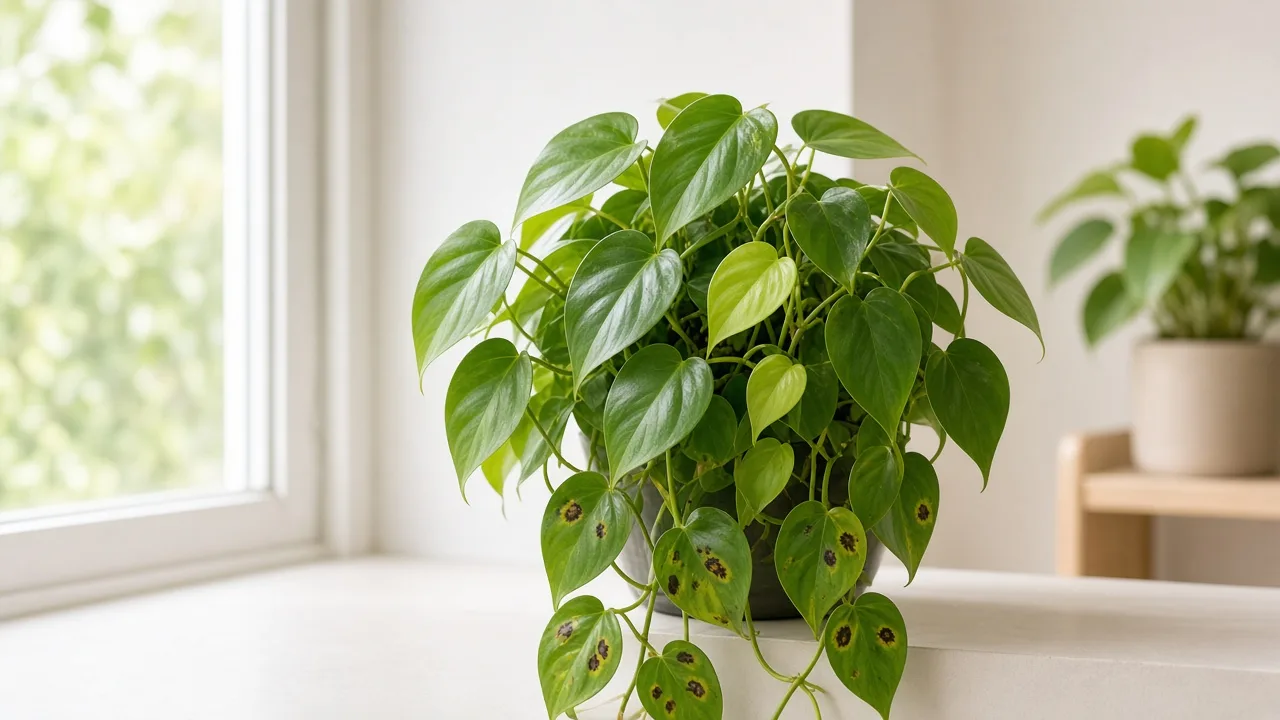
Leaf Spot Disease on Heartleaf Philodendron: Causes, Checks & Fixes
This guide covers leaf spot disease on Heartleaf Philodendron. See also the general Leaf Spot Disease guide, watering, and light pages for this plant.
Leaf Spot Disease on Heartleaf Philodendron: Causes, Checks & Fixes
Quick answer
Leaf spot disease on heartleaf philodendron (Philodendron hederaceum) is infectious damage from fungal or bacterial pathogens on leaf tissue—not the same thing as one old yellow leaf dropping off a healthy trailing vine. On this fast-growing aroid, lesions usually appear as round brown or tan spots with yellow halos, or water-soaked grey patches that enlarge over days after foliage stays wet. For how leaf spot pathogens spread in general, see our leaf spot disease guide. On heartleaf philodendron, long cascading runners put the lowest glossy heart leaves in the soil splash zone, and NC State notes leaf spots may appear on this species alongside root rot in overly wet soil.
A single dry mark on one blade is often mechanical damage. Multiple enlarging lesions along one vine after wet nights need action the same week—not extra fertilizer.
First step: isolate the plant and remove spotted leaves with sterilized scissors, then keep all foliage dry. Water at soil level only, empty saucers, and give hanging baskets room to breathe. Then decide whether you are dealing with surface leaf-spot pathogens, overwatering, or a bacterial emergency like blight.
When to use this page vs other Heartleaf Philodendron guides
| Your question | Best page |
|---|---|
| Infectious spots with halos spreading on blades | This page |
| Dark spots—wet vs dry routing | Black spots |
| Fast mushy petioles, sour odor, vine collapse | Blight |
| Whole plant yellowing on heavy wet pot | Overwatering |
| Mushy roots, sour smell, wilt on wet mix | Root rot |
| Crisp brown patches after south-window sun | Brown leaves |
| Stippling with fine webbing | Spider mites |
What leaf spot disease looks like on Heartleaf Philodendron
Healthy heartleaf philodendron leaves are firm, glossy, and heart-shaped. Leaf spot disease breaks that pattern with lesions that enlarge or multiply over several days:
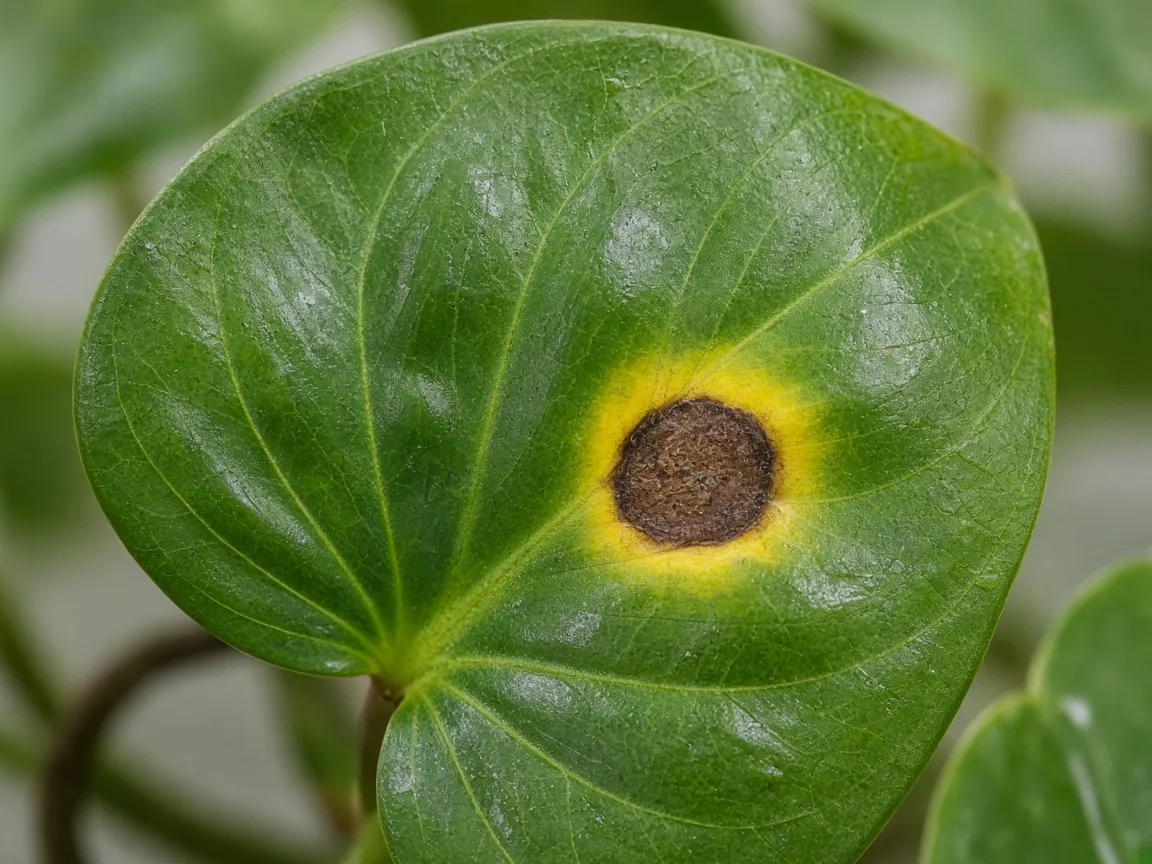
Leaf spot lesions on glossy heart-shaped philodendron leaves—compare circular halos with healthy green tissue on the same trailing vine.
Fungal leaf spots
Fungal leaf spots often appear as small brown spots with yellowish margins, sometimes with a target-like ring pattern. Small black dots—the fruiting bodies of fungi—may appear in dead tissue on older heart-shaped blades. On philodendron’s glossy surface, lesions can stay dry and papery while neighboring tissue stays clean.
Epic Gardening describes fungal leaf rot on philodendron as dark, water-soaked lesions that sink in and darken with time, often spreading by splash from an infected neighbor pot on a shared shelf.
Bacterial leaf spots
Bacterial infections produce water-soaked spots, sometimes with yellow halos that enlarge and run together in humid conditions. On aroids, Epic Gardening notes translucent margin spots that turn reddish brown with yellow halos from Xanthomonas campestris pv. dieffenbachiae—a pathogen documented on philodendron relatives. Spots may eventually fall out as holes, but the halo-and-spread timeline distinguishes them from normal fenestration-like tears.
If tissue turns mushy with a sour odor in petioles, escalate to blight—that is beyond firm surface leaf spot.
Why trailing philodendron gets leaf spot on lower nodes first
Heartleaf philodendron is usually grown as a cascading vine with aerial roots at nodes, not an upright rosette. That growth habit changes where infection starts:
Soil splash on hanging strands. Lower heart leaves rest near the pot rim, cachepot overflow, or mold on soil debris. Water running off dense peat splashes onto glossy blades and carries fungal spores from decaying matter on the soil surface.
Glossy leaves hold surface moisture. Philodendron’s waxy heart-shaped foliage dries more slowly than thin-leaved plants after misting or shower-rinsing. Pathogens need hours of continuous leaf wetness before infection takes hold—exactly what happens when trailing vines stay damp overnight in a dim corner.
‘Brasil’ variegation dries last. Cream and chartreuse streaks on variegated cultivars lack the same cuticle density as all-green tissue, so yellow-halo spots often appear first on variegated sectors after wet nights—not because the plant is “weak from variegation,” but because those zones stay wet longest.
Crowded hanging baskets trap humid air. Multiple philodendron pots on one hook press heart-shaped blades together. The inner leaves dry last—the same conditions extension guides cite for indoor leaf spot outbreaks.
Chronic wet mix weakens resistance. When owners water on a calendar instead of the top-2-inch dry-down check, roots stay saturated while the heavy trailing canopy shades the pot. Stressed tissue spots more easily even when the primary trigger is wet foliage, not submerged roots.
How to confirm the cause
Work through these checks before repotting or spraying:
- Timeline — Do spots appear or spread over days? Static marks that never change fit mechanical damage, sun scorch, or old pet scrapes—not active leaf spot.
- Spot texture — Wet, greasy, or water-soaked margins suggest active disease. Dry, papery lesions may be healed fungal spots or environmental damage.
- Halo pattern — Yellow ring around a brown center fits pathogen spotting per RHS guidance on fungal leaf spot.
- Moisture history — Recent misting, overhead watering, shower-rinsing without drying, or saucer splash on draped vines strongly supports leaf spot.
- Leaf underside — Spider mites cause stippling and webbing, not discrete water-soaked lesions. Mealybugs leave white cottony clusters in leaf axils.
- Stem check — Soft, dark stems at the base suggest root rot or blight overlapping with leaf symptoms. Firm green stems with surface spots alone are less alarming.
- Neighbor plants — Matching halos on nearby pothos or philodendron confirm contagious disease rather than a one-off injury.
Symptom lookalike comparison
| Symptom pattern | Spreads over days? | Key differentiator on Heartleaf Philodendron |
|---|---|---|
| Fungal leaf spot | Yes | Circular tan/brown lesions with yellow halo on glossy heart blades |
| Bacterial leaf spot | Yes, faster in humidity | Water-soaked grey patches; may show translucent margins before reddening |
| Black spots (symptom routing) | Varies | See black spots for wet vs dry dark marks |
| Overwatering margin burn | Gradual | Blackening from edges on lower leaves while mix stays wet—see overwatering |
| Sunburn | No after event | Crispy bleached tissue on window-facing half—UConn warns full sunlight causes sunburn spots on philodendron |
| Mechanical scrape | No | Single dry mark, no halo, no vine-to-vine spread |
First fix for Heartleaf Philodendron
Isolate the plant and remove infected leaves—then keep foliage dry.
Move the philodendron away from other plants until active spread stops. With clean, sharp scissors, cut each heavily spotted or mushy leaf at the base of its petiole. Bag and discard tissue in household trash—not indoor compost. Wipe blades with rubbing alcohol between cuts and before touching another plant.
Stop misting entirely. Water at the soil line until a small amount drains, then empty the saucer. Lift trailing strands off pot rims so heart leaves do not rest in splash zones. A low fan on indirect setting helps, as long as the plant is not in a cold draft below 13°C (55°F).
Hold fertilizer until new growth looks clean. Stressed philodendron tissue does not need extra salts while recovering.
Step-by-step recovery
- Quarantine the affected plant at least arm’s length from other collections.
- Remove all leaves with active spots, yellow halos, or mushy tissue.
- Pull fallen debris off the soil surface; discard—it harbors spores on decaying matter.
- Switch permanently to soil-level watering; never wet leaves at night.
- Increase airflow by spacing hanging baskets and avoiding enclosed humid corners.
- Monitor daily for one week. Mark a reference leaf and watch whether the spot enlarges.
- If fungal spots persist on new leaves after two to three weeks of dry culture, consider a houseplant-labeled copper soap or biofungicide per label directions—test on one leaf first.
Clemson HGIC recommends removing infected plant parts before spraying copper soap, chlorothalonil, myclobutanil, tebuconazole, or Bacillus amyloliquefaciens biofungicide. For leaf spots, begin treatment when disease first appears and repeat at 7 to 10 day intervals as long as needed, spraying all plant surfaces thoroughly.
Node-cutting salvage when lower vines are heavily spotted
Philodendron roots readily from nodes. If lower hanging sections are more than half spotted but firm green tissue remains higher on the vine, take single-node cuttings from clean tissue above the damage, root in water or moist mix, and quarantine new starts before returning them to the main collection. Epic Gardening recommends isolating affected philodendron and removing damaged foliage when leaf spot appears—node salvage is the practical next step when lower runners are too far gone cosmetically but the upper vine is still firm.
Discard the soggy root mass if stems are soft at the soil line—see root rot for trim-and-repot steps.
Recovery timeline
Mild fungal leaf spot on a healthy heartleaf philodendron often stabilizes within two to three weeks after you remove infected leaves and dry the foliage. New heart-shaped leaves should unfurl without fresh lesions. Because philodendron grows quickly in warm months, you may see clean new growth within 10–14 days in summer; winter recovery takes longer when the pot dries slowly.
Spotted old leaves never green up again—judge success by clean new growth at vine tips and halted spread, not by repairing damaged tissue.
Severe bacterial collapse with soft stems and foul odor rarely saves the whole plant. Take firm green cuttings with nodes above the affected zone as backup before discarding the base.
Mistakes to avoid
Do not mist infected leaves hoping humidity will help—it keeps pathogens wet. Do not compost spotted foliage indoors. Do not apply fungicide to every brown mark before confirming disease and drying the plant first. Do not return philodendron to a crowded hanging hook while spots are still spreading. Avoid overhead showering unless you can dry leaves within an hour in bright airflow.
Wear gloves when handling cut tissue—heartleaf philodendron contains calcium oxalate crystals and is toxic to cats and dogs if chewed. Keep trailing vines out of pet reach on low shelves.
Heartleaf Philodendron care cross-check
Leaf spot prevention aligns with normal care: medium to bright indirect light per our light guide, watering when the top 2 inches of mix dry per our watering guide, and perlite-amended well-draining mix per our soil guide. A philodendron in dim light with weekly overhead watering will stay vulnerable even after you remove spotted leaves.
Slow winter growth means the pot dries more slowly; adjust watering when light drops rather than keeping the same calendar schedule. UConn notes overwatering causes yellow leaves to drop on philodendron—yellowing plus wet foliage often overlap when both root stress and leaf-spot culture are present.
How to prevent leaf spot next time
Water early in the day at soil level so any accidental splashes dry quickly. Space hanging baskets for airflow around trailing canopies. Sterilize pruning tools between specimens. Quarantine new philodendron vines for two weeks before mixing collections. Remove fallen leaves from the soil surface promptly. Skip routine misting unless you run a dedicated humidifier without wetting foliage—philodendron tolerates typical indoor humidity when roots and light are appropriate.
When to worry
Escalate if spots enlarge daily despite dry leaves, stems soften at the base, leaves drop in clusters, or tissue smells rotten. Mild scattered halos on a few lower hanging leaves usually respond to removal and cultural fixes. Systemic bacterial collapse with mushy petioles may mean discarding the plant and propagating from unaffected nodes—heartleaf philodendron’s stem-cutting habit makes that a practical salvage path when nodes above the damage remain firm.
If spots persist on new growth after three weeks of dry culture, sterile pruning, and corrected watering, compare your pattern with our problems hub and sibling guides before stacking multiple treatments on the same day.
Related Heartleaf Philodendron guides
- Heartleaf Philodendron overview — species hub
- Watering — top-2-inch dry-down rhythm
- Light — placement for strong new growth
- Black spots — wet vs dry dark mark routing
- Blight — mushy petioles and fast bacterial spread
- Root rot — when yellowing and spots follow wet roots
- Propagation — node salvage after heavy spotting
Use this page when you have confirmed or strongly suspect infectious leaf spot pathogens with enlarging halos on glossy blades. Use black spots when you need symptom-first routing between wet disease, margin blackening, and mechanical marks. Use blight when vines collapse with mushy tissue and sour odor.
Related tool
Use the Plant Problem Diagnosis Tool to narrow causes for leaf spot disease on this plant before changing multiple variables at once.