Chemical Damage on Heartleaf Philodendron: Causes, Checks &
Quick answer
Chemical damage on heartleaf philodendron usually follows a recent fertilizer feed, pest spray, alcohol wipe, or household cleaner — not random neglect. First step: stop the agent, rinse foliage with plain water, and list everything that touched the plant in the last seven days before leaching salts or repotting.

Chemical Damage on Heartleaf Philodendron: Causes, Checks & Fixes
This guide covers chemical damage on Heartleaf Philodendron. See also the general Chemical Damage guide, watering, and light pages for this plant.
Chemical Damage on Heartleaf Philodendron: Causes, Checks & Fixes
Quick answer
Chemical damage on heartleaf philodendron (Philodendron hederaceum) shows up after something besides plain water touched the plant — liquid fertilizer, granular feed on dry soil, neem oil, insecticidal soap, isopropyl alcohol for mealybugs, bleach mist, leaf shine, or herbicide drift near outdoor pots. The trap is that bleached patches, brown crisp edges, and sudden leaf drop look like sunburn, overwatering, or pest stress until you map a timeline.
First step: stop the agent and rinse foliage with lukewarm plain water. Wipe pooled residue from leaf tips and vine nodes. Before leaching soil or repotting, list everything that contacted the plant in the last seven days — feed date, spray product, concentration, and whether the hanging basket sat in direct sun while leaves were wet.
For how phytotoxicity develops in general, see our chemical damage hub. On heartleaf philodendron, the pattern usually ties to a single recent event — fertilizer on dry mix, neem sprayed before hot glass, or cleaner drift on thin trailing leaves — not slow month-long decline.
When to use this page vs other Heartleaf Philodendron guides
This page is the symptom-first entry when you suspect sprays, cleaners, or fertilizer salts — not water rhythm alone.
- Fertilizer burn — go here when tip burn and white soil crust appeared within days of feeding without a separate spray event
- Salt build-up — go here when crust returns after repeated light feeding without a single overdose
- Brown tips — go here when margins crisp in dry winter air with no spray or feed date
- Deformed new growth — go here when unfurling leaves stay twisted without a chemical timeline
- Mealybugs — go here when cottony pests triggered the alcohol or neem that may have burned leaves
- Watering guide — go here after chemical injury stabilizes and you need long-term dry-down rhythm
What chemical damage looks like on Heartleaf Philodendron
On heartleaf philodendron, chemical injury usually arrives as a sudden pattern tied to one event — not slow month-long decline. Phytotoxicity from misapplied chemicals often appears all at once with regular distribution on treated tissue: blotches, bleaching, marginal browning, or tip dieback where product collected.
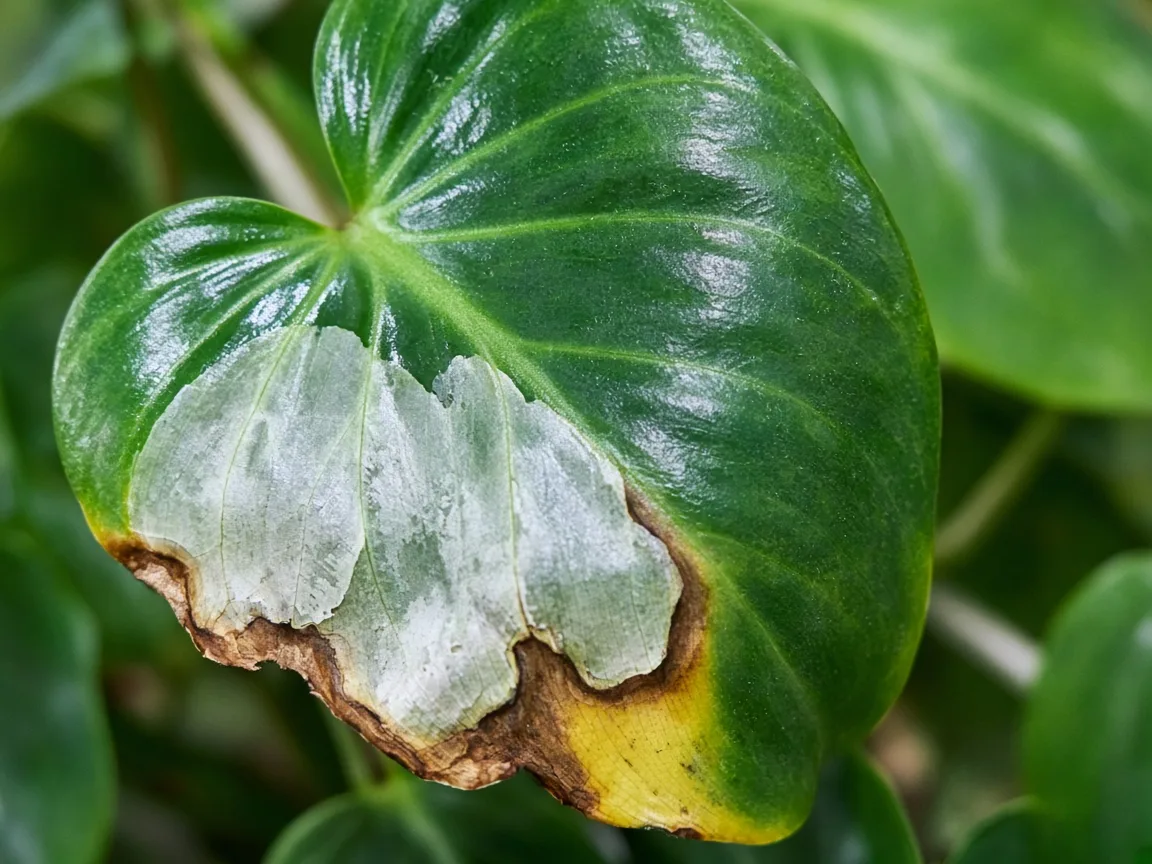
Chemical damage on heartleaf philodendron — compare bleached spray zones with healthy green tissue on the same vine.
Foliar burn patterns
Neem, horticultural oil, or insecticidal soap in heat: Bleached or translucent patches on spray-wetted leaves, brown crisp margins within two to seven days, sometimes heavy leaf drop if the hanging basket faced direct afternoon sun while foliage stayed wet. UMD Extension notes that even non-toxic soaps and oils can burn stressed plants when temperatures are high and drying is slow.
Isopropyl alcohol mealybug treatment: Localized pale spots or crisp tissue where alcohol pooled on the thin glossy cuticle — common when swabs drip down trailing vines or whole-canopy alcohol mist is used. Stems often stay firm while affected leaves scar; see the mealybugs guide for targeted dab technique.
Household cleaners and leaf shine: Sudden widespread chlorosis, greasy-looking film, or burnt patches after cleaning nearby surfaces, misting “leaf polish,” or moving the pot through bleach fumes.
Salt crust and root-zone injury
Fertilizer overdose or winter feeding: Brown or burnt leaf tips and margins, lower-leaf yellowing and drop, and a white or yellow crust on the soil surface or inner pot rim. University of Maryland Extension lists these as classic fertilizer-toxicity signs from excessive or frequent feeding. Root tips may die back; wilting can appear even when soil feels moist because salts pull water away from roots.
Full feeding protocol and half-strength schedules live on the philodendron fertilizer guide — salt burn prevention starts there.
Reading damage along trailing vines
Heartleaf philodendron’s hanging growth habit makes chemical injury easy to misread. Spray drift and fertilizer splash rarely hit every leaf evenly — they follow gravity.
- Lower strands and leaf tips often show the worst burn because neem, soap, and liquid feed pool at drip points on heart-shaped leaves
- Upper vines near the hanger may look clean while the bottom third bleaches — that gradient points to foliar chemical injury, not uniform heat stress
- Leaves touching a cachepot rim or shelf edge can show one-sided scorch from cleaner residue on the surface below
- Moss-pole vines may show tip burn only on leaves that received fertilizer poured onto wet moss instead of the potting mix at the base
Walk the full length of each trailing strand before deciding the whole plant is lost. Firm nodes along a burned lower section can still produce clean cuttings per the propagation guide.
Unfurling leaves and chemical timing
New heartleaf philodendron leaves emerge rolled and unfurl over several days. Chemical exposure during that window produces a distinctive pattern:
- Stuck or torn unfurling tips with brown scorch along the folded edge — often neem or alcohol applied while the leaf was still rolled
- Pale translucent panels on the newest leaf only — spray burn on the most tender tissue
- Twisted or crinkled new growth without a treatment date — weigh deformed new growth or pest damage instead
If older leaves look fine but the newest heart-shaped leaf alone is bleached, tie the injury to something that happened in the last week — not chronic overwatering.
Common chemical agents that harm heartleaf philodendron
Fertilizer salt burn and overdose
Philodendron is a moderate feeder in bright months but still burns from full-strength fertilizer on dry soil, granular product on the surface without watering through, or feeding through winter dormancy. Iowa State Extension recommends light philodendron feeding during active growth — pairing heavy feed with slow winter uptake is a common burn route.
Timing clue: symptoms worsen within days to two weeks after feeding, especially if a white crust appeared on the mix.
Pesticide, neem, and alcohol foliar treatments
Heartleaf philodendron attracts mealybugs, scale, spider mites, and thrips — so many owners reach for alcohol, neem, soaps, or oils. Pesticide burn risk rises when sprays dry slowly on stressed tissue in high humidity or above roughly 85°F (29°C). Epic Gardening recommends applying neem in evening or early morning and avoiding hot direct sun on treated foliage.
Timing clue: blotching or drop two to seven days after treatment, often worse on the side that faced sun while wet.
Household cleaners and leaf products
Bleach cleaners, ammonia-based sprays, furniture polish drift, and “leaf shine” products strip or burn the thin cuticle. Outdoor philodendron near herbicide drift shows distorted new growth or bleached panels on the exposed side only.
Timing clue: damage the day of cleaning or within 48 hours of relocating the pot — no tie to watering rhythm.
How to confirm the cause — seven-step inspection
Work through these in order. Stop when one branch clearly fits.
- Agent timeline — List fertilizer, sprays, alcohol wipes, cleaners, or repot fertilizer in the last seven days. Chemical damage almost always ties to a date.
- Symptom pattern along vines — Even bleaching on sun-facing sprayed leaves? Tip burn and soil crust after feeding? Patchy mottling with webbing points to pests, not chemicals alone.
- Soil surface — White or yellow crystalline crust on mix or inner pot rim points to salt injury; sour wet smell without recent feed points to overwatering.
- Leaf firmness — Firm stems with bleached patches only on treated zones → foliar chemical burn. Soft mushy stems at soil level with wet heavy pot → rot branch, not primary chemical foliar injury.
- Sun context — Recent move to hot south or west glass without acclimation? See light guide for sun scorch. Spray applied same day as sun exposure? Weight chemical + sun combo.
- Pest check — Cottony masses or stippling mean live pests may have triggered the spray that caused burn; treat pests and chemical injury as linked but separate problems.
- Newest unfurling leaf — Clean new growth emerging while old leaves stay scarred supports recovery. Collapsing tips with spreading stem softness after leaching → escalate to root inspection.
Lookalike symptoms — chemical burn vs. other philodendron problems
| Symptom cluster | Likely cause | Key differentiator |
|---|---|---|
| Bleached/crisp patches after spray or feed | Chemical damage | Ties to treatment or fertilizer date; pattern on wetted tissue or lower vine tips |
| Sun-facing panels only, after window move | Sun scorch | No spray or feed event; see light guide |
| Brown tips in dry winter room, no crust | Low humidity / underwatering | Dry pot weight; no salt crust or spray history |
| Soft stems, heavy wet pot, sour smell | Overwatering / rot | Wet mix for weeks; not tied to single chemical event |
| White crust on soil + tip burn after feeding | Fertilizer salt burn | Confirms chemical root-zone injury; see fertilizer burn |
| Twisted new leaves, no treatment date | Deformed growth / pests | No spray or feed timeline; inspect undersides |
If multiple signs conflict — crust on soil and mushy stems — address salt leach first, then reassess roots after the pot drains normally for one dry-down cycle per the watering guide.
First fix for Heartleaf Philodendron
Make one primary correction, then wait five to seven days before stacking repot, prune, or re-spray.
Step 1 — Stop the agent immediately
Pause fertilizer, pesticides, oils, soaps, alcohol mist, and leaf products. Do not “feed it back to health.”
Step 2 — Rinse foliage
Shower or wipe leaves with lukewarm plain water. Pay attention to leaf tips and nodes where neem or alcohol pooled along trailing vines. Let the plant dry in bright indirect light, not hot direct sun.
Step 3 — Branch by severity
Mild foliar burn only (few bleached leaves, firm stems, no soil crust):
- Rinse complete; hold all sprays seven to fourteen days.
- Spot-test any future pest product on one leaf for 48 hours.
Moderate fertilizer salt injury (tip burn, crust on soil surface, firm stems):
- Scrape no more than ¼ inch of crusty surface salt if present.
- Leach: Pour plain room-temperature water through the pot until it runs freely; use at least one full pot volume. Repeat three to four times over 48 hours. UMD Extension recommends repeated irrigations at least equal to pot size to flush excess salts.
- Empty saucers; never leave standing water.
Severe injury (heavy drop, widespread bleaching, soft lower stems after leach):
- After leach and full drain, unpot only if stems soften or smell sours — trim dead roots, air-dry cuts 24 hours, repot into fresh well-draining mix sized to remaining roots per the soil guide.
- Node-cutting salvage: If lower vines are chemically scarred but nodes stay firm, trim above healthy nodes and root cuttings in water or moss — details on the propagation guide.
Do not confuse leaching with overwatering rescue: leach is several controlled flushes with full drainage, not keeping mix soggy for weeks.
Recovery timeline
Foliar spray burn, mild: New leaves often unfurl clean within two to four weeks if no further chemicals are applied. Old bleached leaves stay scarred.
Fertilizer salt burn, caught early: Tip burn stops spreading after leach within one to two weeks; full aesthetic recovery waits on new heart-shaped leaves — often three to six weeks on fast spring growth.
Severe drop after concentrated neem or alcohol: Four to eight weeks before you can judge survival. Success = firm nodes and at least one clean unfurling leaf; failure = spreading softness despite appropriate dry-down.
Do not fertilize until firm new growth resumes for two weeks — usually next active season for winter-injured plants.
What not to do
Do not re-spray neem, soap, or alcohol on a chemically burned philodendron to “finish” pest treatment the same week — rinse and spot-test later.
Do not fertilize stressed vines to “push recovery” — salts worsen root injury.
Do not leach repeatedly into a saucer that holds water for days; that converts salt flush into overwatering.
Do not stack repotting, heavy pruning, fertilizer, and pesticide on the same day after chemical injury.
Do not assume every brown tip is fertilizer — confirm timeline before leaching a dry pot.
Pet safety: Heartleaf philodendron is toxic to cats and dogs. Wear gloves when wiping sap; keep rinsed plants and runoff away from pets.
How to prevent chemical damage next time
- Feed only spring through early fall at half strength on moist soil — details on the fertilizer guide.
- Apply pest sprays in early morning or evening; let leaves dry before sun hits glass.
- Dab mealybugs with alcohol swabs; avoid drenching entire trailing canopies.
- Keep cleaners, bleach, and leaf shine away from foliage; move hanging baskets before spraying household chemicals.
- Acclimate to brighter windows over two to three weeks per the light guide — sun plus wet oil doubles burn risk.
- Change one variable at a time during recovery.
Practical checks
Urgency check
Treat as urgent when stems soften at soil level after leaching, soil smells sour despite corrected watering, or more than half the canopy drops within a week. Lower urgency when a few sprayed leaves bleached but nodes stay firm and a new leaf is unfurling clean.
Best inspection order
Agent timeline → pattern along trailing vines → soil crust and pot weight → leaf firmness → sun and spray context → pest evidence on undersides → newest unfurling leaf.
Heartleaf Philodendron care cross-check
Chemical damage is often the second problem — the first was over-feeding, aggressive pest spray, or cleaning exposure. Stable philodendron resists repeat injury when feeding stays seasonal, sprays stay cautious, and the overview hub routine keeps light and dry-down aligned.
Related Heartleaf Philodendron guides
- Fertilizer — half-strength feeding, salt burn signs, and leach timing
- Fertilizer burn and salt build-up — when crust and tips trace to feeding alone
- Mealybugs — safer alcohol and spray use
- Light — sun scorch vs. spray burn in hot windows
- Propagation — node-cutting salvage after severe vine damage
- Problems hub — full symptom index for this plant
- Overview — placement, watering, and seasonal rhythm
Use the Plant Problem Diagnosis Tool to narrow causes for chemical damage on this plant before changing multiple variables at once.