Fertilizer Burn on Heartleaf Philodendron: Causes, Checks &
Quick answer
Fertilizer burn on heartleaf philodendron usually shows as brown crispy margins on glossy heart leaves within one to two weeks of feeding — especially full-strength liquid, winter doses, or fertilizer poured on dry soil in a small hanging basket. Stop feeding immediately, run the flush protocol below, and wait at least four to six weeks before any half-strength spring feed.
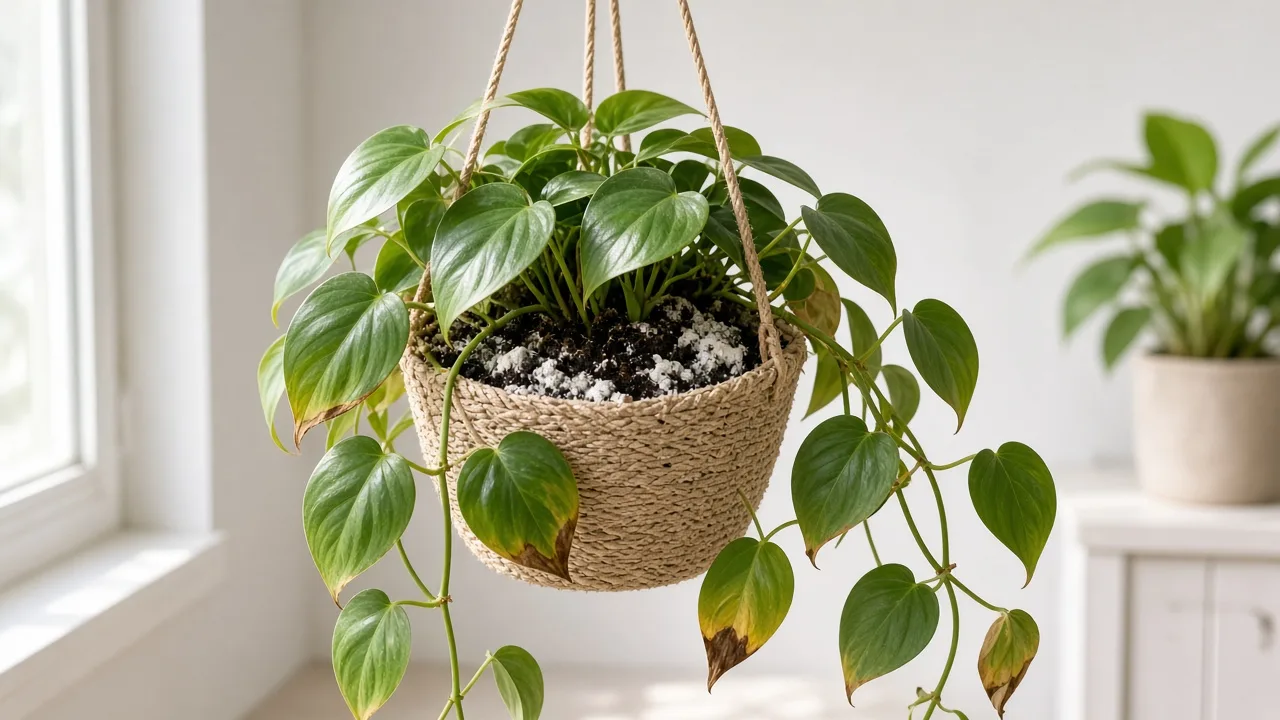
Fertilizer Burn on Heartleaf Philodendron: Causes, Checks & Fixes
This guide covers fertilizer burn on Heartleaf Philodendron. See also the general Fertilizer Burn guide, watering, and light pages for this plant.
Fertilizer Burn on Heartleaf Philodendron: Causes, Checks & Fixes
Quick answer
If several heartleaf philodendron leaves developed brown crispy tips or curled margins within one to two weeks of your last fertilizer application — especially after full-strength liquid, a winter feed, granular spikes in a small pot, or pouring feed onto bone-dry mix — suspect fertilizer burn before you change watering, light, or repot. On heartleaf philodendron (Philodendron hederaceum), excess soluble salts injure fine root hairs first; when soil salt levels exceed what roots hold, water moves away from roots through osmotic stress, and stress shows as crispy margins on thin glossy heart leaves while vines may still feel firm.
First step: stop all fertilizer and run the flush protocol in the section below. Do not repot, move rooms, or spray pesticides on the same day — you need to see whether burn stops spreading after salts leach out.
For how soluble salt injury works in general, see our fertilizer burn guide. On heartleaf philodendron, the pattern usually ties to a recent feed date — white crust on the soil rim, tip burn on newest unfurling leaves, or sudden lower-leaf drop after a winter dose — not slow month-long decline alone.
Use this page for acute tip scorch tied to a recent feed. For months of light feeding with returning white crust but no single overdose, start with salt build-up on Heartleaf Philodendron. For sprays, neem, or alcohol injury, see chemical damage. Ongoing feeding schedules after recovery live on the philodendron fertilizer guide.
When to use this page vs other Heartleaf Philodendron guides
| Your situation | Start here | Read next |
|---|---|---|
| Tips browned 3–14 days after liquid feed or granules | This guide | Fertilizer guide for safe resume schedule |
| White crust + pale bands after months of regular feeding, no recent spike | Salt build-up | Return here only if a heavy winter feed preceded the flare |
| Brown tips in dry winter air, no feed or crust | Brown tips | This page if feeding history points to salts |
| Bleaching after neem, soap, or alcohol spray | Chemical damage | This page when only fertilizer touched the plant |
| Mushy stems, sour soil, wilt on wet mix | Root rot | This page first only if tips are firm and feed was recent |
What fertilizer burn looks like on Heartleaf Philodendron
On heartleaf philodendron, salt burn from overfeeding is usually margin-focused on glossy heart-shaped foliage:
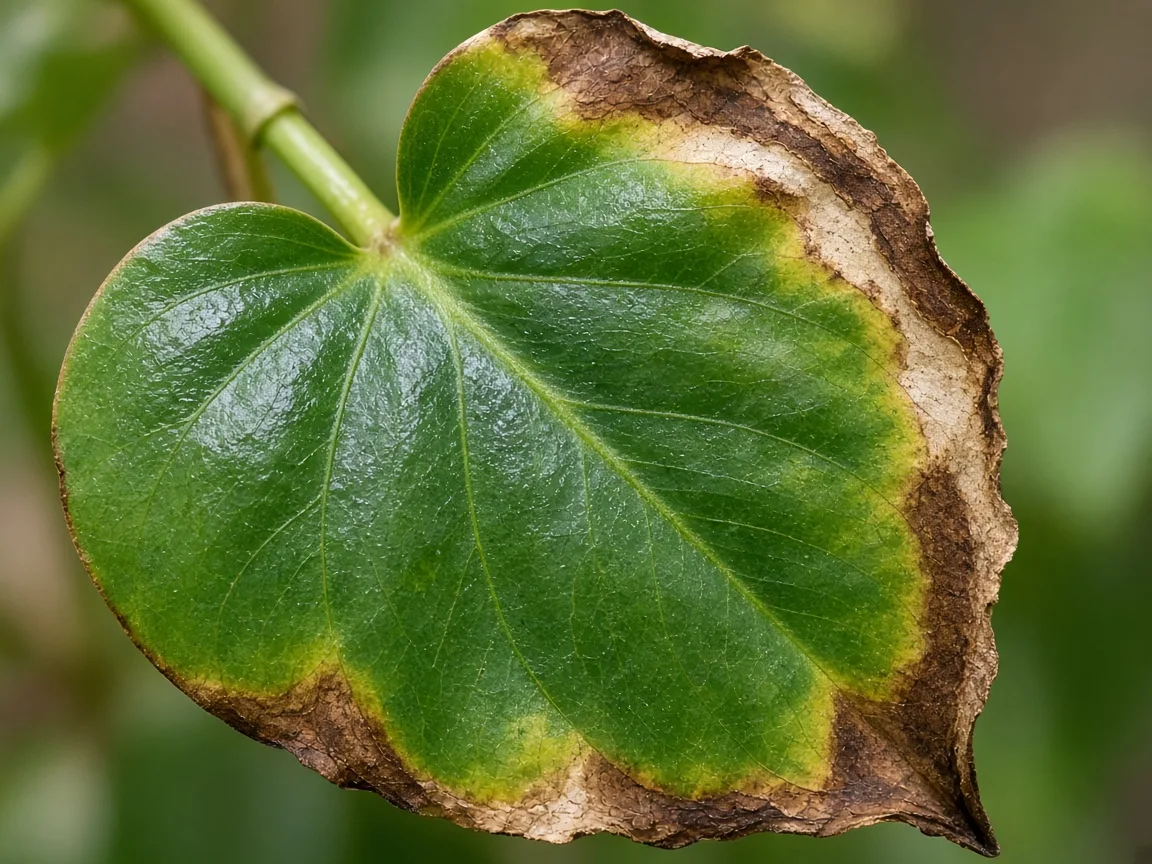
Fertilizer burn on heartleaf philodendron — compare scorched leaf margins with healthy green tissue on the same vine.
- Dry brown, tan, or papery tips and thin margins on heart-shaped leaves while the mid-blade stays green and the vine feels firm
- Damage on several leaves within one to two weeks of feeding, often lower strands on a hanging basket or leaves that received pooled liquid at drip points
- White or crusty residue on soil surface, inner pot wall, or saucer — Clemson HGIC links white film on media and pot rims to overfertilizing and salt buildup
- Curling or crinkled leaf margins on newest growth shortly after a concentrated dose — UF/IFAS notes too much fertilizer can brown and curl leaf tips on heartleaf philodendron
- Sudden yellowing and drop of lower leaves on an otherwise watered vine when salts damage roots
- New unfurling hearts stall small, brown at edges, or never fully expand after a feed on dry soil
This differs from root rot, where stems soften at nodes, soil smells sour, and vines wilt on heavy wet mix. Sun scorch bleaches or browns patches on the window-facing side of leaves rather than isolated tip necrosis across multiple strands after a feed event.
Post-feed timing decision tree
Work through timing before treating drought or pests:
- Did you fertilize in the last 14 days? Yes → strong fertilizer-burn signal; stop feed and flush.
- Was the dose full label strength, winter timing, post-repot, or a second dose this month? Yes → higher confidence; proceed with flush protocol.
- Is white crust visible and damage appeared within days of that feed? Yes → fertilizer burn is the working diagnosis.
- No recent feed, but months of regular feeding and returning crust? No → redirect to salt build-up for chronic accumulation.
- Recent feed AND neem or alcohol spray in hot sun? Both → compound injury likely; flush salts first, then read chemical damage for foliar burn zones.
Reading burn along trailing vines
Heartleaf philodendron grows as a fast trailing vine with nodes every few centimetres in hanging baskets and on moss poles. That habit changes where fertilizer burn shows up.
Gravity pooling on hangers: Liquid feed poured quickly into a hanging basket often runs to the lowest drip point on the lowest heart leaves. Brown crispy tips clustered on the bottom third of the cascade — while upper vines look clean — strongly suggest fertilizer splash or salt concentration at the pot base, not uniform low humidity across the whole plant.
Small-pot salt trap: A 6-inch basket dries fast, which tempts owners to feed often. Clemson HGIC notes that water-soluble fertilizers are preferred because dilute solutions reduce burn risk — but even half-strength feeds stack quickly when the root zone is tiny. Fast dry-down does not flush salts if the saucer is never emptied or the nursery pot sits in a cachepot holding runoff.
Moss-pole mistake: Pouring fertilizer onto wet moss instead of the potting mix at the base starves roots while salts concentrate in the pole surface. Tip burn on upper leaves with a white rim on the inner pot points to root-zone overdose, not pole nutrition.
Walk every trailing strand before deciding the plant is lost. Firm nodes above burned lower leaves can still produce clean cuttings per the propagation guide once salts are flushed.
Unfurling hearts vs fertilizer burn
Heartleaf philodendron wraps new leaves in a cataphyll as each glossy heart unfurls. A single papery brown sheath at one node that peels away to reveal a firm green leaf is normal — not fertilizer injury.
Escalate when:
- Multiple unfurling hearts stall brown at the margins and never reach full size within a week
- Newest leaves at the vine tip show crisp margins within days of feeding while older leaves still look green
- Brown spreads up the vine toward the growing tip after a winter or post-repot feed
Tender unfurling tissue burns before mature glossy blades because it has thinner cuticle and higher transpiration at the margin. That is why tip burn on fresh hearts after a feed is a sharper diagnostic signal on philodendron than on thick succulents.
Fertilizer salts vs drought vs chronic salt build-up
| Symptom pattern | Fertilizer burn (acute) | Chronic salt build-up | Underwatering | Root rot |
|---|---|---|---|---|
| Trigger | Recent feed (days–2 weeks) | Months of regular feeding | Long dry spell | Wet, heavy soil |
| Soil surface | White crust after feed | White crust, reappears on tap | Dry, dusty — no crystals | May be wet; crust optional |
| Tip texture | Dry, papery; firm vine | Dry margins; gradual | Crispy; pot very light | Mushy base, limp vine |
| Leaf pattern | Several hearts after feed | Slow tip creep | Outer strands first | Lower yellow, soft stems |
| First move | Stop feed + flush | Flush + reduce feed schedule | Soak per watering guide | Dry back, inspect roots |
| Read next | This guide | Salt build-up | Underwatering | Root rot |
Why Heartleaf Philodendron gets fertilizer burn
Heartleaf philodendron is a moderate feeder in bright months — Iowa State Extension recommends fertilizing philodendrons lightly once or twice a month during active spring and summer growth with balanced all-purpose fertilizer at reduced strength. The mistake is treating forgiving growth as permission for full label strength, winter feeding, or monthly doses in dim corners where the plant barely uses nutrients.
Clemson HGIC classifies heart-leaf philodendron among medium-light foliage plants and notes that at least 200 foot-candles for 12 hours daily is necessary before fertilization benefits foliage at all. Feeding a philodendron in a dim north room through winter stacks salts while growth stalls — a common burn setup.
Excess fertilizer salts build up in potting mix and damage roots, causing reduced growth, brown leaf tips, lower leaf drop, and wilting despite moist soil. On thin heart leaves, that root stress shows first as margin necrosis and curl rather than uniform yellowing across the whole blade.
Feeding dry soil in a basket that dried over a weekend concentrates salts at root contact — especially when owners pour undiluted liquid directly onto dusty mix. Post-repot stacking is another trigger: fresh potting mix often includes starter nutrients, and an immediate feed on top causes tip burn within days. Hold feed four to eight weeks after repotting.
Slow-release spikes or granules sprinkled on the surface of a small pot release unpredictably in warm summer windows and are harder to flush than one liquid mistake. Prefer dilute water-soluble feed per the fertilizer guide.
How to confirm the cause
- Fertilizer history — Did you feed in winter, use full strength, apply to dry soil, or feed within weeks of repotting?
- Soil crust — Is white or yellow mineral residue on the surface, inner rim, or drainage hole?
- Timing — Did tips brown or curl within days to two weeks of the last feed?
- Pot size and placement — Is the plant in a small hanging basket or cachepot that traps salty runoff?
- New growth — Are youngest unfurling hearts at vine tips still clean after you stop feeding?
- Water rhythm — Is soil bone dry (drought overlap) or heavy and slow to dry (rot risk layered on salts)?
If only one tip browned after physical damage, watch two weeks before flushing. Pattern across multiple heart leaves plus recent feeding strongly favors fertilizer burn.
First fix — stop feed and flush (canonical protocol)
This is the only flush procedure for this page. Later sections refer back here rather than repeating steps.
- Stop all fertilizer — including slow-release granules on the soil surface and any “feed every watering” product.
- Scrape surface crust — If a white fertilizer crust sits on top, remove it carefully with a spoon without taking more than the top quarter-inch of mix.
- Flush once — Place the pot in a sink. Run room-temperature plain water slowly through for three to five minutes until roughly three times the pot volume has drained. Lift hanging baskets so salty water does not re-enter through the bottom. Empty the saucer or cachepot completely.
- Wait one week — Hold off on repotting, moving to new light, and heavy pruning beyond dead tips.
- Flush again — Repeat step 3 with plain water only.
- Pause feeding — Skip fertilizer for at least four to six weeks, longer if damage was severe.
Do not compensate with extra fertilizer to “help the plant recover.” Clemson HGIC recommends preventing salt injury by watering thoroughly and emptying drainage trays — this double flush is an emergency leach after overfeeding.
Step-by-step recovery
After the canonical flush above:
- Trim — Cut only necrotic tip tissue with clean scissors, following the natural heart shape. Sterilize blades between leaves if any stem base feels soft.
- Water before future feeds — Lightly moisten soil before applying diluted fertilizer so salts do not concentrate on dry roots — see the watering guide.
- Match light to feeding — If the plant sits in low light, reduce feed frequency before increasing dose; pale small hearts in shade rarely need more fertilizer — see light guide.
- Repot only if crust persists — If white buildup returns within two to three weeks after two flushes, repot into fresh well-draining mix without added fertilizer for two months per soil guide.
- Resume feeding — Half strength once or twice monthly in spring and summer only when new growth looks clean. Full schedule on the fertilizer guide.
Make one correction at a time. Do not stack systemic pesticide, heavy pruning, and repotting into a larger pot on the same weekend.
Example recovery timeline (winter over-feed mistake)
A typical home scenario — full-strength liquid feed in January on a heartleaf philodendron in a 6-inch hanging basket:
- Week 0: Owner notices tan tips on four lower heart leaves ten days after the last feed; white specks on soil rim.
- Week 1: Stop feed; scrape crust; first flush; saucer emptied after each drain.
- Week 2: Second flush; no new tip spread on the vine tip.
- Weeks 3–4: Outer tips trimmed cosmetically; soil dries on normal watering rhythm.
- Weeks 5–8: New heart at the growing tip opens fully green — recovery confirmed.
- Week 10+: Optional half-strength feed once if spring growth is active; winter feeding discontinued.
This timeline is editorial synthesis from extension leaching guidance, not a published case study. Recovery may be faster in bright summer light or slower in a cool north window.
Recovery timeline
Existing brown tips and margins will not revert to green. Mild burn on a few lower heart leaves often stabilizes within two to four weeks after flushing and stopping feed. Judge full recovery by clean new hearts unfurling at vine tips over four to eight weeks in spring and summer light.
If tip burn continues on fresh growth despite no feeding and two flushes, inspect roots for rot or mealybugs at nodes. Severe salt damage may require repotting into entirely fresh mix.
What not to do
Do not feed a stressed heartleaf philodendron to “green it up” — salts worsen burn. Do not increase watering because tips look dry; soggy soil causes root rot faster than cosmetic tip damage threatens the plant. Do not use full-strength fertilizer, foliar feed on heart leaves, or slow-release granules piled on the soil surface.
Avoid fertilizing in autumn and winter when growth slows. Do not feed immediately after repotting. Do not reuse flush water or let the pot sit in a saucer full of salty runoff. Do not assume monthly full-strength feeding is safe because the plant is a “fast grower” — pot size and light set the real limit.
How to prevent fertilizer burn next time
Treat heartleaf philodendron as a moderate feeder only in active growth. Feed at half strength once or twice monthly during spring and summer when the vine pushes new nodes. Skip winter entirely. Apply only to moist soil, leach small pots every few months if you feed regularly, and empty cachepots after every watering.
Pair feeding with adequate light — Clemson HGIC notes foliage plants need sufficient light before fertilizer produces any benefit. When in doubt, skip a feeding — under-fertilizing rarely harms heartleaf philodendron; over-fertilizing scorches tips and can damage roots. Full product choice and dilution math live on the fertilizer guide.
When to worry — cosmetic vs repot decision
| Severity | What you see | Action |
|---|---|---|
| Cosmetic only | Dry tips on lower hearts; firm vines; clean tip growth after flush | Trim dead tips; wait for new leaves — no repot needed |
| Persistent crust | White buildup returns within 2–3 weeks after two flushes | Repot into fresh mix without fertilizer for two months |
| Escalate to root rot | Entire vines wilt within a week of heavy feed; mushy nodes; sour soil | Stop feed; inspect roots; follow root rot guide |
Fertilizer burn alone is low to medium severity on heartleaf philodendron when vines stay firm and new growth stays clean after flushing.
Related Heartleaf Philodendron guides
- Overview — species profile, growth habit, and care hub
- Problems hub — full symptom index for this plant
- Fertilizer guide — half-strength schedule, products, and when to resume after burn
- Salt build-up — chronic crust without a single overdose event
- Brown tips and brown leaves — when margins brown without a clear feed date
- Yellow leaves — lower-leaf yellowing from wet roots vs salt injury
- Chemical damage — neem, soap, alcohol, and cleaner injury overlapping with salt burn
About this guide
This guide was written by sai-ananth and reviewed by the LeafyPixels Review Board against Clemson HGIC indoor plant fertilizing guidance, Iowa State Extension philodendron culture, NC State Philodendron hederaceum, and LeafyPixels heartleaf philodendron care pages. The post-feed timing tree, trailing-vine burn patterns, and week-by-week recovery example are editorial diagnostics synthesized from extension leaching protocols — not a single published grower trial. Reviewed 2026-09-11.
Related tool
Use the Plant Problem Diagnosis Tool to narrow causes for fertilizer burn on this plant before changing multiple variables at once.