Caterpillars on Pilea: Identify and Remove Them
Quick answer
First, isolate the Pilea peperomioides from other plants. Caterpillars are likely when new irregular holes or scalloped edges appear with a visible larva, frass, or silk; remove a confirmed larva by hand before considering any spray. Existing holes will not close, so judge recovery by clean new leaves and no new feeding marks.
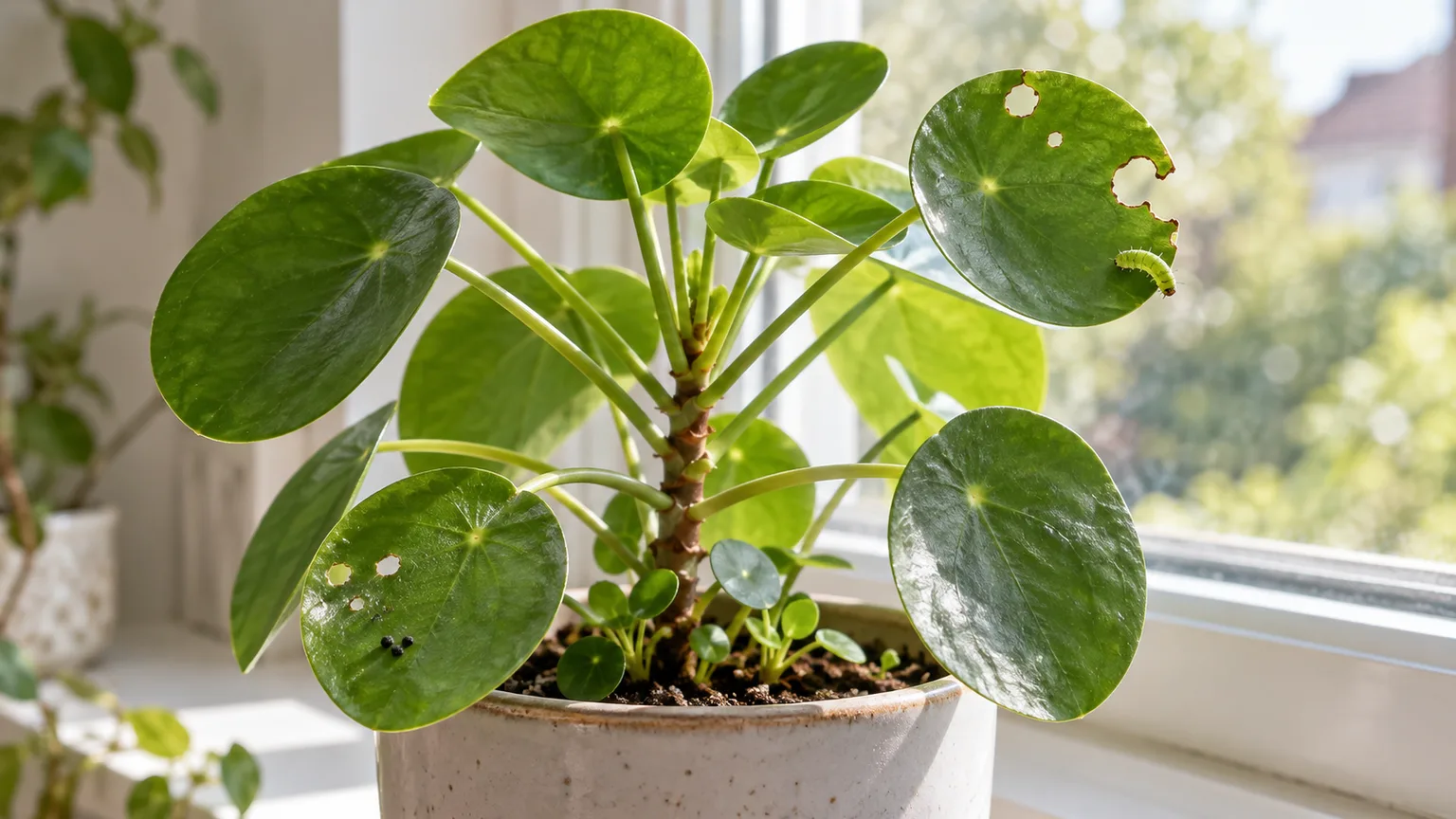
Caterpillars on Pilea Peperomioides: Identify and Remove Them
This guide covers caterpillars on Pilea Peperomioides. See also the general Caterpillars guide, watering, and light pages for this plant.
Caterpillars on Pilea Peperomioides: Identify and Remove Them
Quick answer
First, move a Pilea peperomioides with suspected caterpillars away from your other plants. Fresh, uneven bite marks on a coin-shaped leaf are more convincing when you also find a segmented larva, dark droppings (frass), eggs, or a little silk. Caterpillars are larvae of moths and butterflies; they feed by chewing plant tissue, sometimes making holes, scraped windows, or rolled leaves depending on the species (UConn Extension’s caterpillar guide).
Do not respond to missing leaf tissue by changing watering or fertilizing. Those adjustments may matter to a plant’s general health, but they will not remove a chewing insect. Confirm and remove the feeder first, then use the new leaves and absence of fresh damage to judge whether the Pilea has settled.
What caterpillar damage looks like on Pilea peperomioides
Caterpillar injury is tissue that has been eaten away. On the round, dark-green leaves of a Chinese money plant, that usually means an irregular notch in the edge, a hole through the blade, or a patch where only a thin layer remains. The pattern varies with the larva: small caterpillars can make pinholes or a pale, translucent “window,” while larger feeders may leave a wider ragged gap. The University of Minnesota Extension describes young caterpillars that chew many small holes and sometimes leave a clear layer behind; that is a useful clue, not a species diagnosis for Pilea (UMN Extension’s scouting example).
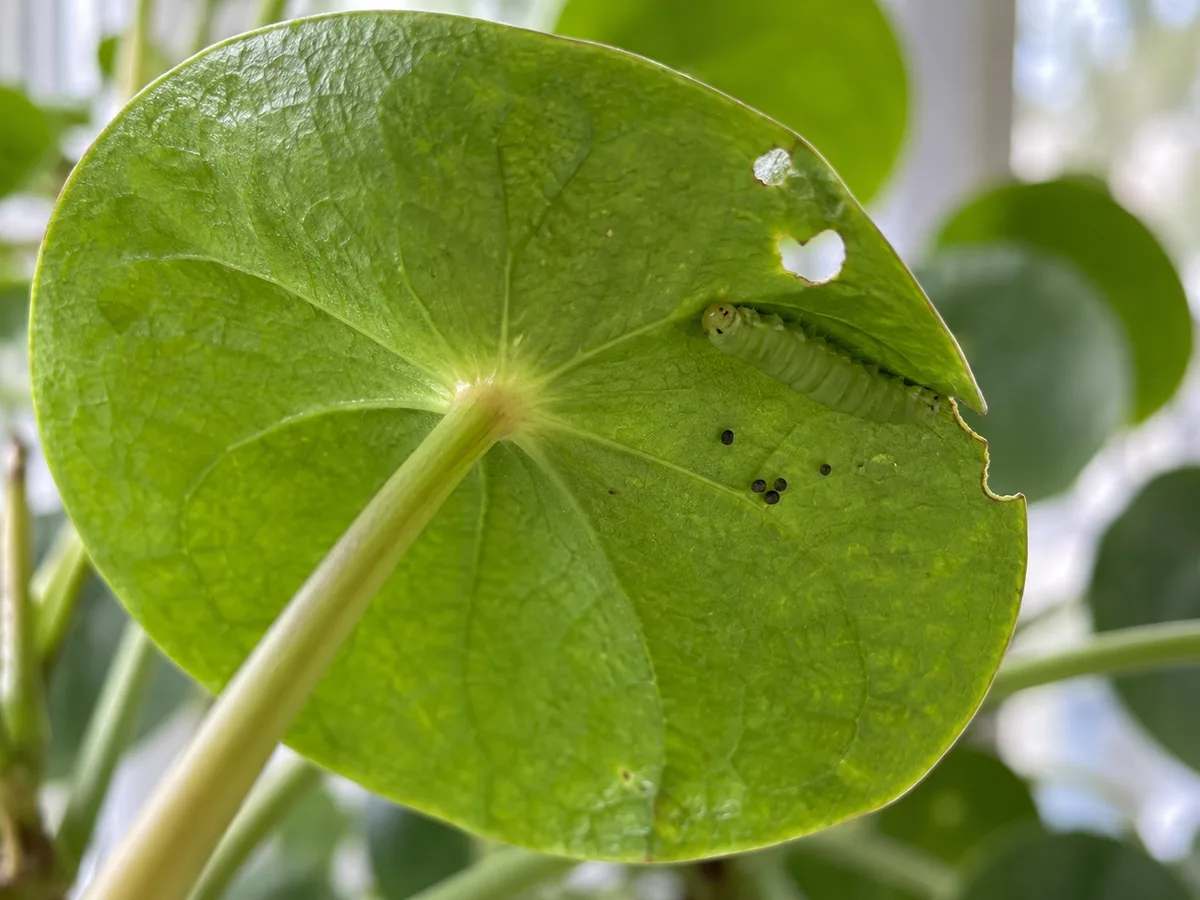
Fresh chewing, a small larva, and dark frass are stronger evidence together than leaf holes alone.
A pellet-like deposit on a leaf, stem junction, pot rim, or windowsill is frass. It can look like tiny dark grains rather than the sticky residue left by sap-feeding insects. Some caterpillars also pull leaves together with silk, shelter in a curled leaf, or feed mostly from the underside. Caterpillar guides describe frass and webbing among the signs to check alongside fresh leaf loss (The Spruce’s caterpillar guide; UConn Extension).
One missing piece of leaf tissue is not enough to name the pest. A split from handling, a scrape against a nearby object, a slug outdoors, or another chewing insect can create a hole-like mark; leaf holes have several possible causes, so compare the edge and surface before treating (The Spruce’s leaf-hole guide). The strongest home confirmation is a live caterpillar at the damage, or a repeated pattern of new bites plus frass or silk in the same area.
Why Pilea’s coin leaves change the inspection
Pilea’s structure makes it possible to inspect this problem methodically. NC State Extension describes its fleshy circular leaves as peltate, with long petioles attaching at the center of each blade, and an upright, clumping habit (NC State’s Pilea profile). A flat leaf can hide a small feeder below it, while the long petiole creates a narrow junction against the central stem. Check both sides of each blade and follow the petiole back to the stem instead of scanning only the top surface.
Work from the newest leaves down toward the older outer leaves. The growing tip is where newly opening coin leaves are most tender and where a small larva can be hard to see before the damage widens. Then look at the lower stem and offsets: a dense cluster of pups may hide a curled leaf or a few pellets at the soil line; NC State notes that this plant can be propagated by offsets (NC State’s Pilea profile). These are inspection priorities based on Pilea’s shape, not a claim that caterpillars prefer Pilea over other plants.
The plant’s rotation habit can help you notice a change. If you turn the pot regularly, compare the same leaves from one inspection to the next; if not, take a close photo and mark which leaf is damaged. A new ragged notch is active evidence. An old round hole that stays the same size is not a reason to keep spraying or to remove an otherwise functioning leaf.
How to confirm a caterpillar rather than a care problem
Inspect the whole coin leaf, not only the hole
Lift the plant into bright room light and gently turn over each affected leaf. Use a phone flashlight to check the underside, the leaf center, the petiole, and the point where that petiole joins the upright stem. Look for a soft, visibly segmented larva, small eggs, shed skin, silk, or fresh dark pellets. Do not squeeze or rub an unknown larva; some caterpillars have spines that can irritate skin, so use gloves or a soft brush to move it into a clear container for inspection (Epic Gardening’s removal guidance).
Check the newest leaf first, then the lower leaves and the bases of offsets. If you find a larva, photograph it beside the damaged leaf before removing it. Green color alone does not identify a species, and caterpillar shape and host preferences vary. If the species matters—for example, if you are deciding whether to release it outdoors—send a clear image to a local extension service rather than guessing from color.
Look for fresh activity
Caterpillar damage changes as feeding continues: an edge notch grows, a small window becomes a hole, or new frass appears below the same leaf. Photograph the leaf and note the date. Recheck in the morning and again near dusk; some caterpillar pests, including cutworms, feed at night, although not every larva follows that schedule (UConn Extension). If a new mark appears overnight but you cannot find a larva, inspect the plant and the surface beneath it again with a flashlight.
Also inspect the nearby windowsill, plant saucer, shelf, and any other plants that touched the Pilea. A larva may have moved, and frass can fall away from the leaf where it fed. Check plants that recently shared an outdoor space or were placed beside the same open window. Finding a caterpillar does not prove how it entered the home; it tells you to keep the affected plant separate while you check for additional activity.
Separate feeding damage from water, light, and nutrient symptoms
Water and light stress usually change leaf firmness, color, or position; they do not remove a bite-shaped section of tissue. A Pilea that is drooping or yellowing at the same time may have a second issue, so use the Pilea watering guide to check the pot before changing its routine. A stretched stem or smaller leaves point you toward the Pilea light guide, not toward caterpillar treatment.
This distinction prevents a common detour: repotting or feeding a plant because a leaf has holes. If the leaf tissue is missing and the soil and stem remain firm, start with a pest inspection. If there are no bite marks and the leaves instead yellow, soften, or curl, compare those symptoms with the Pilea peperomioides problem hub and the Pilea overview before changing several care variables at once.
The first fix: isolate the Pilea
First, isolate the Pilea from nearby plants. That gives you time to check every leaf without a suspected feeder moving onto another pot. Place it in a bright, stable spot where you can inspect it easily; keep its normal light and watering conditions rather than putting it in a dark corner or leaving the pot wet as a treatment.
If you see a caterpillar, lift it away with gloved fingers, blunt tweezers, or a soft artist’s brush. Avoid crushing it against the leaf, which can smear it across the surface and make the damage harder to inspect. If you are not confident that it is a caterpillar, capture it in a clear cup for a photograph rather than applying a pesticide. Manual removal is a practical first response for a small, visible infestation; The Spruce also describes hand removal as a direct nonchemical control, while Epic Gardening advises gloves because some species are spiny (The Spruce; Epic Gardening).
After removal, check the rest of the Pilea and nearby plants once more. Wiping every leaf with oil or soap is not a substitute for finding the pest; spraying before you know where the larva feeds may miss it and makes it harder to tell whether removal stopped the damage. If you later consider a product, read its label and use only a formulation that specifically allows indoor ornamental plants and the identified pest. Ohio State Extension recommends using a pesticide according to its label as part of an integrated pest-management approach (Ohio State Extension’s pesticide guidance). Do not mix a home remedy or increase a labeled concentration.
Pilea-specific recovery: protect the growing tip and offsets
Caterpillar feeding does not make a round leaf round again. A leaf with a hole can remain green and continue contributing energy, so leave it in place unless it is mostly eaten, torn at its petiole, or beginning to die. Removing every marked leaf at once can leave a single-stem Pilea with little foliage while it is trying to produce new growth.
Inspect the central stem and growing tip for chewing or soft, broken tissue. If the main stem is firm and the newest leaf is intact, keep the plant in bright indirect light and give it its usual measured care. A damaged outer leaf is mostly cosmetic; damage to the growing tip or several petioles can slow the plant’s appearance, but it does not by itself show that the roots have failed. The Pilea soil guide can help if the mix is staying wet or compacted, but changing soil is not a caterpillar treatment.
Check each offset at the base separately. A small pup may be partly hidden by the mother plant’s leaves, but there is no reason to separate healthy offsets during pest cleanup. If a pup has feeding marks, remove a larva from it as you would from the main plant and keep the pot isolated. Avoid taking cuttings or sharing pups until repeated inspections show no fresh feeding; moving plant material can carry a small egg or larva to another home.
Lookalikes: holes, scrapes, and marks that are not caterpillars
| What you see | What it suggests | Next check |
|---|---|---|
| Fresh, irregular holes or scalloped leaf edges, especially with a larva or frass | A chewing pest, possibly a caterpillar | Inspect the underside and stem junction; if the feeder is not present, do not treat the hole alone as a confirmed diagnosis. |
| Tiny pale dots with fine webbing, but no missing tissue | Spider mites are more plausible; their feeding commonly starts as pale stippling, and colonies often sit on leaf undersides | Inspect with a hand lens and compare with the general spider-mites guide; UC IPM describes stippling and webbing as useful signs. |
| White flecks or silvery scars, dark specks, or distortion on unfolding leaves | Thrips become a stronger possibility than caterpillars because the surface is marked rather than eaten away | Inspect the newest leaves and compare with the general thrips guide; Utah State Extension’s thrips note describes these feeding marks. |
| A flat discolored spot with intact tissue and no new frass | This alone does not show active chewing | Photograph it and check whether its edge changes; do not treat it as confirmed caterpillar feeding. |
Use the table to select the next inspection, not to diagnose by color alone. If the edge continues to disappear and fresh pellets collect nearby, revisit the caterpillar check. If the mark stays flat and does not change, there may be nothing active to treat. The global caterpillars symptom guide explains general caterpillar signs across plants; this page narrows those checks to Pilea’s round leaves and central stem.
What not to do while the Pilea is recovering
Do not water more often because the leaves have holes. Water only when the potting mix has dried to the depth you normally use for this Pilea; caterpillar feeding is above the soil line. If the plant also wilts or lower leaves yellow, inspect that as a separate symptom rather than treating it as proof that the caterpillars are still present.
Do not prune the central stem or detach offsets to “reset” the plant. Caterpillars feed on foliage, so drastic pruning removes healthy leaf area without removing eggs hidden on a neighboring leaf. Remove only a leaf that is nearly consumed, broken, or dying, and clean the scissors afterward.
Do not apply neem oil, insecticidal soap, or a broad-spectrum insecticide simply because a hole appeared. Those products have different targets and application rules. If a confirmed infestation is too large for hand removal, photograph the larva and ask a local extension service for identification and an indoor-plant control option; any pesticide must be used exactly as its label directs. This is especially important for a plant kept around children or pets.
Recovery timeline and signs to watch
After you remove a visible larva, the first useful milestone is no new feeding marks. Check the plant every few days for the next couple of weeks, including the undersides of new leaves and the offset cluster. The exact time a larva spends feeding depends on its species and stage, so a single clean inspection is not enough to rule out a hidden egg or a second larva.
Existing holes remain. Do not score recovery by whether old leaves look smooth; look for an intact growing tip, firm petioles, and new leaves that open without fresh damage. If new marks continue, or if you find more than one larva, keep the plant isolated and request identification before escalating treatment. If no new damage appears through repeated checks and the central stem remains firm, return the Pilea to its usual place gradually.
A plant with extensive leaf loss may take longer to regain a balanced shape because the remaining leaves must support new growth. Do not rush it with extra fertilizer. Resume any normal feeding only when the plant is actively producing healthy leaves and the pest is no longer evident. If the stem base turns soft, the crown collapses, or the mix smells sour, investigate those as separate root or stem problems; caterpillars alone do not explain every sign of decline.
Prevent another caterpillar visit
Before bringing a new Pilea into the collection, inspect both sides of every coin-shaped leaf, each petiole junction, the main stem, and the soil surface. Keep it separate while you watch for new damage. A few careful checks are more useful than an automatic pesticide treatment on every new plant.
If the plant spends warm weather outdoors, examine it before carrying it back inside. Check the leaf undersides and the tight center of the plant, where eggs or a small larva could be overlooked. Keep open windows screened if moths are gathering around indoor lights, and do not leave a Pilea pressed against outdoor foliage. If a leaf is damaged, isolate it and inspect again instead of moving it between rooms.
Keep ordinary Pilea care steady. Bright indirect light, a pot with drainage, and a mix that does not stay waterlogged support firm growth, but they do not repel caterpillars. Use the plant’s overview and relevant care pages to maintain that baseline; do not change light, soil, and watering together in response to a bite mark. Regularly turning the pot also gives you a chance to check every side of the upright stem.
When to use this page vs other Pilea peperomioides guides
Use this guide when tissue is visibly missing or freshly chewed and you suspect a caterpillar. If you see holes without a larva, frass, silk, or new feeding, compare the possible causes in the table before treating. For stippling and silvered scars, use the pest-specific guides linked there; for wilting, yellowing, or poor growth, start with the Pilea care guide that matches that symptom rather than applying a caterpillar treatment.
Related tool
If you cannot match the damage to a caterpillar, use the Plant Problem Diagnosis tool to organize the visible symptoms and choose the next check. A tool can narrow possibilities, but a photograph of the larva and fresh damage is more useful when you need a species-level identification.
Related Pilea peperomioides guides
- Pilea peperomioides overview: use it for the plant’s normal shape and care baseline; use this page for confirmed or suspected chewing insects.
- Pilea problems hub: use it to compare other symptoms when no caterpillar evidence is present.
- Pilea watering guide: use it for a separate moisture problem; watering will not close a bite mark.