Pilea Magnesium Deficiency: Check the Older Leaves First
Quick answer
On Pilea peperomioides, magnesium deficiency is a possibility when several older, lower coin-shaped leaves turn yellow between greener veins while the growing tip stays healthier. First, confirm that leaf-age and vein pattern before adding Epsom salt or more fertilizer.
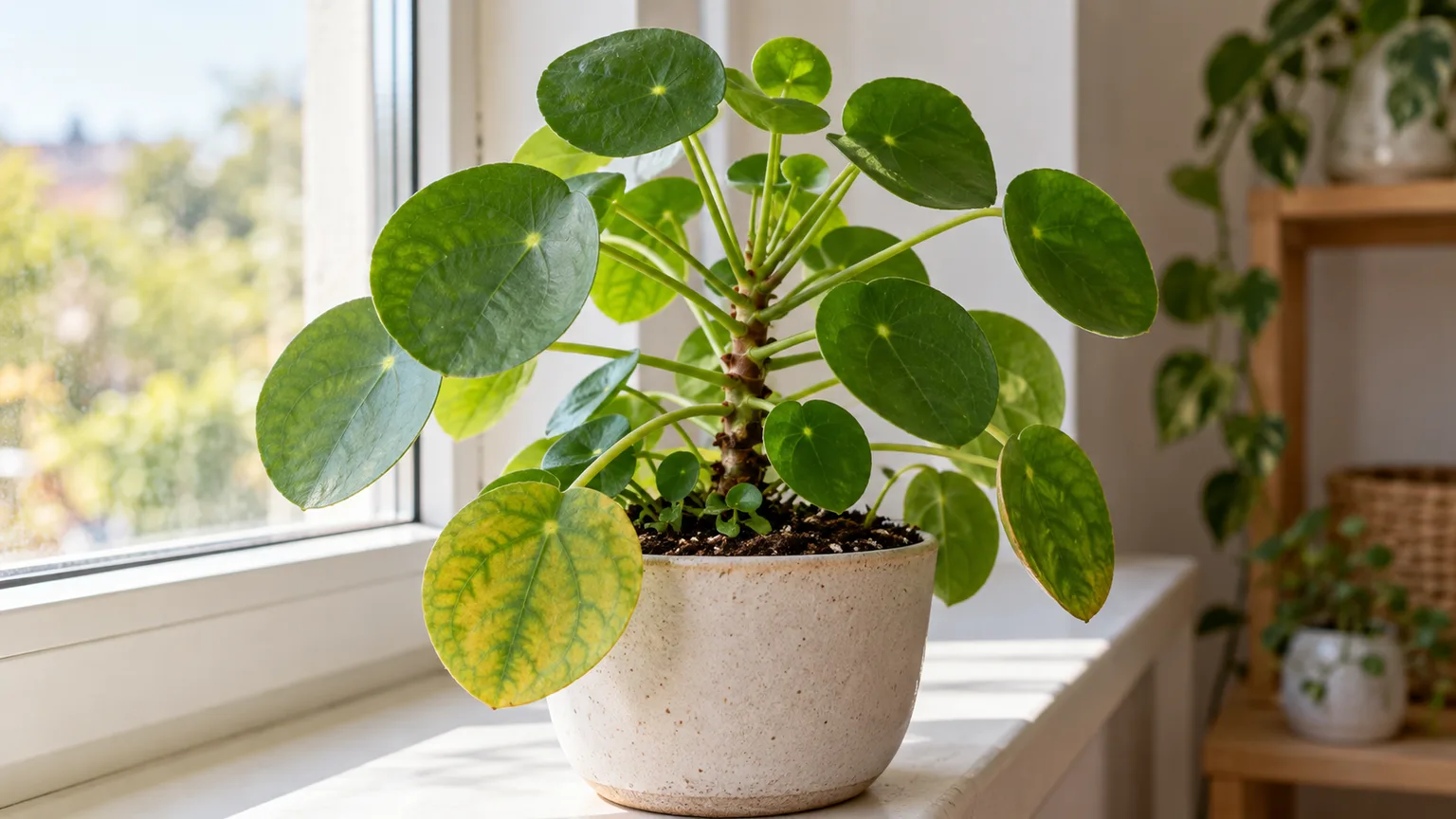
Magnesium Deficiency on Pilea Peperomioides: How to Confirm It
This guide covers magnesium deficiency on Pilea Peperomioides. See also the general Magnesium Deficiency guide, watering, and light pages for this plant.
Magnesium Deficiency on Pilea Peperomioides: How to Confirm It
Quick answer
Magnesium deficiency is a possibility when several older, lower leaves on a Pilea peperomioides turn yellow between greener veins while the newest leaves at the top of the stem stay healthier. First, confirm that the yellowing follows this older-leaf, between-the-veins pattern; do not add Epsom salt just because one Pilea leaf has turned yellow. Magnesium is mobile within plants and is part of chlorophyll, so a shortage can show first in mature leaves, but visual symptoms alone do not establish what is happening in a houseplant pot Penn State’s magnesium reference.
A single old leaf fading evenly may simply be aging, while yellowing that starts on new leaves, appears with a wet mix, or forms sun-bleached patches points toward a different check. This guide follows the structure of Pilea peperomioides itself: compare lower coin-shaped leaves with the central growing tip, then examine the root zone and feeding history before correcting nutrients.
What magnesium deficiency looks like on Pilea peperomioides
On a Pilea, look first at the oldest leaves attached lower on the upright stem. A pattern consistent with magnesium deficiency is not just “a yellow leaf”: the tissue between the leaf veins loses green color while the veins remain more visible, and more than one mature leaf may develop the same pattern. The leaf usually remains recognizable as a round coin; the difference is the color map across the blade.
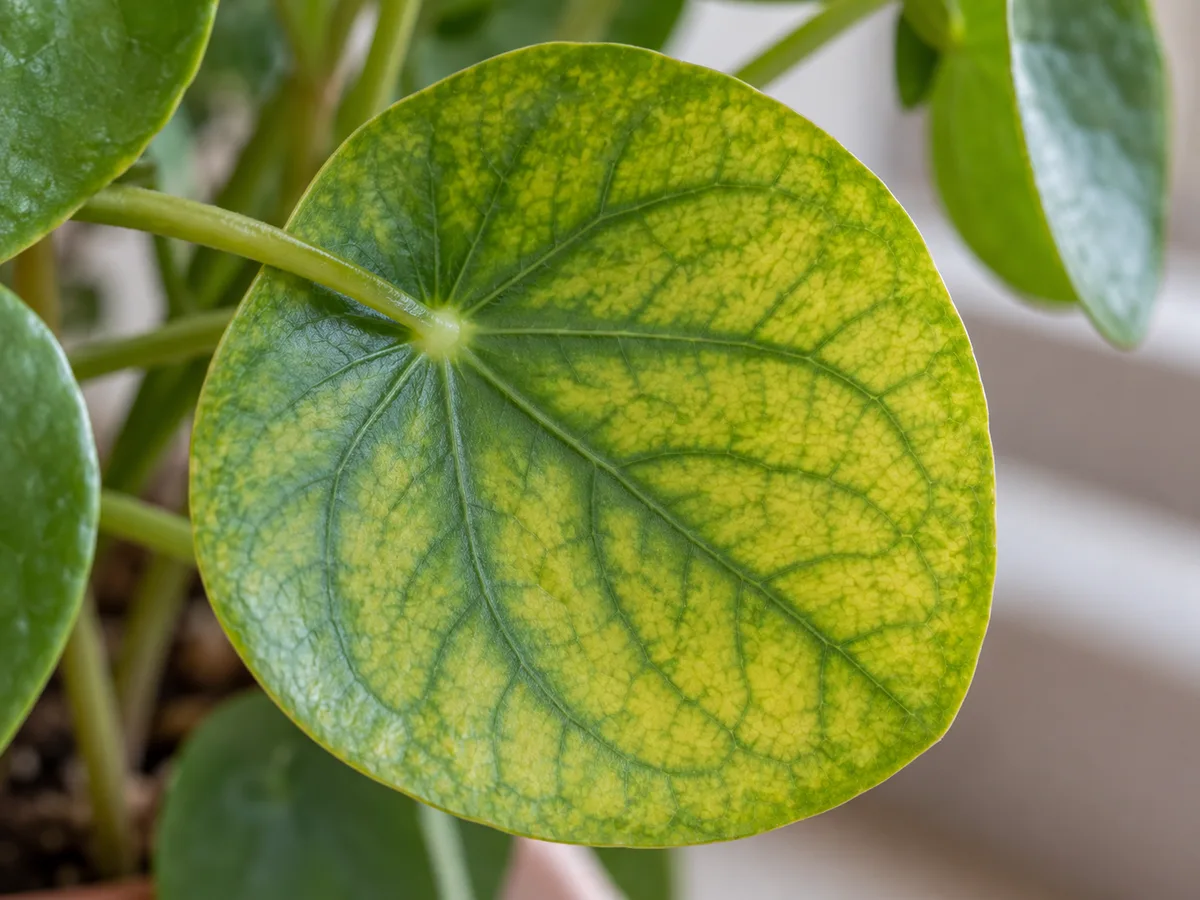
An older Pilea coin leaf with interveinal yellowing; compare several leaves and the newest growth before treating.
Read the lower coins against the growing tip
Pilea leaves have a distinctive round blade with the petiole joining near the middle rather than at the outer edge, so inspect the whole coin around that central attachment point. The characteristic peltate shape is described in Bob Vila’s Pilea guide. On a plant with magnesium shortage, the lower, mature leaves are the more useful comparison; the central stem’s youngest leaves can stay greener early in the process because the plant reallocates mobile magnesium toward newer growth.
Do not diagnose from color alone. Use your phone camera in the same natural light each time and photograph one affected lower leaf beside one healthy upper leaf. If the whole lower leaf is turning the same pale yellow, with no greener vein network, that is a weaker match for magnesium deficiency than clear interveinal chlorosis. If only a single leaf is fading while the rest of the Pilea is firm and producing normally colored coins, wait and observe rather than reaching for a supplement.
One old Pilea leaf can age without a deficiency
Chinese money plants sometimes shed one or two older leaves while putting energy into new growth; that normal pattern is noted in The Spruce’s reviewed care guide. A single evenly yellowing bottom leaf, paired with a firm stem and healthy central growth, may be ordinary leaf turnover. A deficiency becomes more plausible when multiple leaves of similar age share the same between-vein yellowing and the pattern is spreading upward.
Why the Pilea stem and leaf age matter
Leaf age is a useful first filter, not a rule. Penn State’s diagnostic reference says older leaves usually show interveinal magnesium chlorosis first, although younger leaves can sometimes show symptoms too Penn State’s magnesium guide. In a Pilea, if the newest coins are already paling, check root function and broader care problems before assuming the symptom is limited to magnesium.
Pilea peperomioides does not make a dense rosette with all leaves the same age. Its coin-shaped leaves are spaced along a central stem, and basal pups may grow beside the parent stem. That layout gives you a practical diagnostic ladder: compare a lower mature coin, a middle leaf, and the newest coin unfolding at the top. The main plant’s tip and its pups are separate growth points; a healthy pup does not prove that the parent’s older leaves are nutritionally sound, but it can show that at least one growing point remains active.
A crop-focused NC State Extension description of early magnesium symptoms also places interveinal chlorosis on lower foliage and recommends combining visual diagnosis with plant testing. Its crop and growing conditions are different from an indoor Pilea, so use it for the general leaf-age pattern, not as a Pilea-specific threshold or feeding recipe.
Check this Pilea before calling it a magnesium deficiency
Map the symptom across three leaves
Start with the lowest mature leaf that looks abnormal, then compare one leaf halfway up the stem and one newly opened coin. Write down whether the yellowing is between veins, across the entire blade, or limited to the window-facing surface. Record whether the center growth is unfolding normally and whether more than one leaf has changed since your last photograph. This short comparison prevents a single aging leaf from becoming a reason to add a nutrient the plant may already have.
On a Pilea, also note whether discoloration follows the round leaf evenly or is concentrated along a damaged edge. Magnesium-pattern chlorosis should be considered alongside—not instead of—the leaf’s age, the growing tip, and what changed in its pot. If the plant has several basal pups, check whether the parent and offsets show the same symptoms; a repeated pattern across the pot is more informative than one isolated coin. Pilea produces these small offshoots beside the parent stem, as noted in Bob Vila’s propagation notes.
Check moisture and roots before nutrients
Feel the mix below the surface and lift the pot to judge whether it is still heavy from a recent watering. Pilea peperomioides does best in bright indirect light, with a draining mix that can dry between thorough waterings; The Spruce’s Pilea guidance describes those conditions. Persistent wet mix, dark brown or mushy roots, and a decay smell are root-rot warning signs rather than proof of magnesium shortage; The Spruce’s houseplant root-rot guide lists those root changes alongside yellowing and wilting.
If the soil is only slightly damp and the stem remains firm, do not unpot the plant just to inspect the roots. Instead, check that the container has a drainage hole, that the pot is not sitting in collected water, and that the mix is not compacted. Link the correction to the actual issue: use the Pilea watering guide if your watering rhythm is the problem, and the Pilea soil guide if the mix remains dense or slow to dry. When the plant has widespread yellowing with soft roots, follow the plant-specific root rot guide, not a magnesium recipe.
Review feeding and visible residue
Read the fertilizer label rather than relying on the product’s “balanced” name. Check whether magnesium is included, when the plant was last fed, whether you have used several products, and whether the dose matched the label. A white crust on the mix may indicate fertilizer or mineral-salt accumulation; Bob Vila’s Pilea care advice warns that a crust can follow overfertilizing. In that situation, adding another fertilizer—magnesium-containing or not—makes the history harder to interpret.
High amounts of another nutrient can also interfere with magnesium uptake in some crops. Utah State University Extension’s nutrient comparison lists excess potassium or calcium among conditions associated with magnesium deficiency in hemp. That does not prove the same imbalance in a Pilea, but it is a reason to check the entire fertilizer label and avoid a single-nutrient guess.
Lookalikes on a Chinese money plant
| What you see | More likely explanation | What to check next |
|---|---|---|
| One oldest lower leaf fades evenly, while the stem tip keeps producing healthy leaves | Normal aging may fit better than a deficiency | Watch whether the pattern spreads to another leaf |
| Older leaves are uniformly pale, with no green-vein network | Nitrogen shortage or general stress is a better match | Utah State’s nutrient guide describes older-leaf yellowing in its nitrogen example; see nitrogen deficiency on Pilea |
| The newest central leaves turn yellow between greener veins while older coins stay greener | Iron-related chlorosis or root uptake trouble deserves attention | Check mix and roots; compare the Pilea iron deficiency guide |
| Several leaves yellow after the pot stays wet, or the lower stem softens | Root stress or rot is more urgent than a magnesium-only correction | Check drainage and root firmness; use the Pilea root rot guide |
| Pale, dry or brown patches cluster on the side facing a sunny window | Light injury is more plausible than a vein-by-vein nutrient pattern | Review the Pilea light guide before moving it |
| Fine stippling, visible webbing, or tiny moving specks appear under leaves | Spider mites can cause discoloration and should be inspected directly | Turn over several coins; The Spruce describes webbing and tiny insects under Pilea leaves in its Pilea pest notes |
The location distinction is useful because magnesium and iron symptoms can both look interveinal. Utah State’s Mg-versus-iron comparison places magnesium symptoms on older leaves and iron symptoms on new growth; the Pilea’s central tip versus lower stem gives you the same age comparison at home. The source describes hemp, not Pilea, so treat that as a diagnostic clue rather than a guaranteed rule for every indoor plant.
Pilea leaves can also change color after environmental stress. Strong direct sun may burn the delicate foliage, while inconsistent watering or persistently wet mix can produce broader yellowing and leaf loss; Bob Vila’s Pilea care guide notes that direct sunlight can burn its leaves. The Pilea yellow-leaves guide helps sort those whole-plant patterns from a repeated, vein-centered symptom.
The first fix: verify the pattern before adding magnesium
Your first action is to photograph the lowest affected coin beside the newest coin at the stem tip before you change the fertilizer, soil, or light. If the yellowing is limited to one uniformly fading bottom leaf, or the roots are dark and mushy, do not add magnesium. Correct the more likely cause first and keep the care routine stable so the response is readable.
If several older Pilea leaves show interveinal chlorosis, the stem and roots are firm, and the feeding history points to a shortage, use a complete houseplant fertilizer during active growth only if its label includes magnesium, and follow that label’s rate. The Spruce recommends a balanced fertilizer for Pilea and following product directions The Spruce’s fertilizer guidance. Do not invent an Epsom-salt dose or combine a new feed with repotting, pruning, and a watering change; visual patterns should remain clues rather than proof of magnesium levels.
If the plant has a white crust, has recently received repeated feedings, or has roots in trouble, stop nutrient additions while you address that condition. For an otherwise healthy Pilea with a confirmed magnesium shortage, use a product specifically labeled for houseplants and follow its instructions. The Pilea fertilizer guide covers routine feeding; it is not a reason to increase the dose on a stressed plant. If label dilution is confusing, the fertilizer dilution calculator can help work out a labeled mix, but it cannot test the potting mix or confirm magnesium levels.
How to read recovery in the central stem and pups
The older yellow leaf is not the best recovery gauge. Once tissue has lost much of its chlorophyll or developed brown damage, it may not regain a uniform green color even after the underlying condition is corrected. In severe crop examples, magnesium symptoms can progress to dead tissue and leaf drop, as shown in NC State’s crop description; that source illustrates the possible limit but does not predict exactly how a Pilea will respond.
Watch the next coin as it opens at the top of the central stem. Better signs are that new foliage emerges without the same interveinal yellowing, the stem stays firm, and the symptom stops appearing on additional lower leaves. If a pup is growing beside the parent, assess its new leaves separately rather than removing it as a treatment. A healthy offset can remain part of the recovery plan if the parent stem declines, but separation is not necessary just because an old leaf is yellow.
Recovery timing depends on whether the Pilea is actively growing and whether the root environment is usable. Give the plant time to produce new growth rather than changing fertilizer every few days. In slower light or cooler conditions, new leaves may take longer to appear; The Spruce’s Pilea guide notes that lower light can limit growth and offshoot production. If the newest leaves continue to pale, the plant loses several leaves quickly, or the stem base softens, revisit the root and light checks instead of repeating a magnesium dose.
Avoid these Pilea-specific correction mistakes
- Do not treat every dropping lower coin as a deficiency. A Pilea may shed an occasional old leaf while growing at the center. A repeated interveinal pattern is stronger evidence than one evenly yellow leaf.
- Do not use Epsom salt as a test. It adds magnesium whether or not magnesium is limiting; a temporary lack of further yellowing does not prove the diagnosis.
- Do not stack fertilizer and repotting unless the root environment requires it. Pilea roots need a mix that drains, but an unnecessary move plus a new feeding routine makes it difficult to learn which change mattered.
- Do not feed dry or saturated mix to compensate for weak color. First return the root zone to a reasonable moisture pattern and use a product label if feeding is warranted.
- Do not remove healthy pups to “save” the mother plant. Basal offsets are another growing point, not evidence that the mother needs a nutrient dose.
If the mix is chronically wet or the plant has soft roots, prioritize root care and pause feeding. If the leaf pattern is mostly on young growth, compare the iron pattern before reaching for magnesium. If the cause remains unclear after these checks, the Pilea problems hub gives you a route to the other Pilea-specific symptom guides.
Prevent a repeat with a steady Pilea routine
Keep the Pilea in bright indirect light and rotate it occasionally so the central stem does not lean toward one direction. Let the mix approach dryness between waterings, then water thoroughly through a pot with drainage. These are part of the steady routine in The Spruce’s Pilea care guide. A well-draining mix with perlite helps the round-leaved plant avoid staying wet too long; the Pilea overview summarizes its growing conditions, and its light guide covers placement if the window exposure has changed.
Feed during active growth according to the label of a complete houseplant fertilizer rather than relying on a calendar dose of one nutrient; Bob Vila’s Pilea fertilizer guide recommends diluted houseplant fertilizer during the growing season. This keeps the plant’s full nutrient supply in view and avoids layering supplements onto a mix that may already contain fertilizer. Check the label before each change, particularly when you switch products or repot into fresh mix. A regular, restrained routine is safer than reacting to a single lower leaf with magnesium, nitrogen, and potassium products in succession.
Every few weeks, make a short Pilea-specific check: compare one lower coin with the newest leaf at the stem tip, feel whether the pot is still heavy, look for white crust on the mix, and turn a leaf over if you see stippling. That simple record can distinguish a nutrient pattern from normal old-leaf turnover, water-related yellowing, or pests before the damage spreads.
When to use this page vs other Pilea peperomioides guides
Use this guide when multiple older Pilea leaves show yellowing between greener veins and the center growth is less affected. Use the Pilea yellow-leaves guide for uniform yellowing or leaf drop, the iron deficiency guide when new coins show interveinal yellowing first, and the nitrogen deficiency guide when older leaves turn uniformly pale. The Pilea watering guide and soil guide are the better starting points if the mix stays too wet or drains poorly.
For the general nutrient pattern across houseplants, see the magnesium deficiency symptom hub. That hub explains the shared symptom; this page focuses on how to read the Pilea’s lower coin leaves, central stem, and new growth.
Related tool
Use the plant-problem diagnosis tool to organize the visible symptoms and recent care changes before you choose a correction. It helps narrow the next check; it does not confirm magnesium levels in the pot.
Related Pilea Peperomioides guides
- Use the Pilea care overview for the whole plant’s placement and routine.
- Use the Pilea fertilizer guide for regular feeding; come back here when the older leaves show an interveinal pattern.
- Use the Pilea problems hub to compare this issue with other plant-specific problems.