Nitrogen Deficiency on Pilea Peperomioides: Causes, Checks
Quick answer
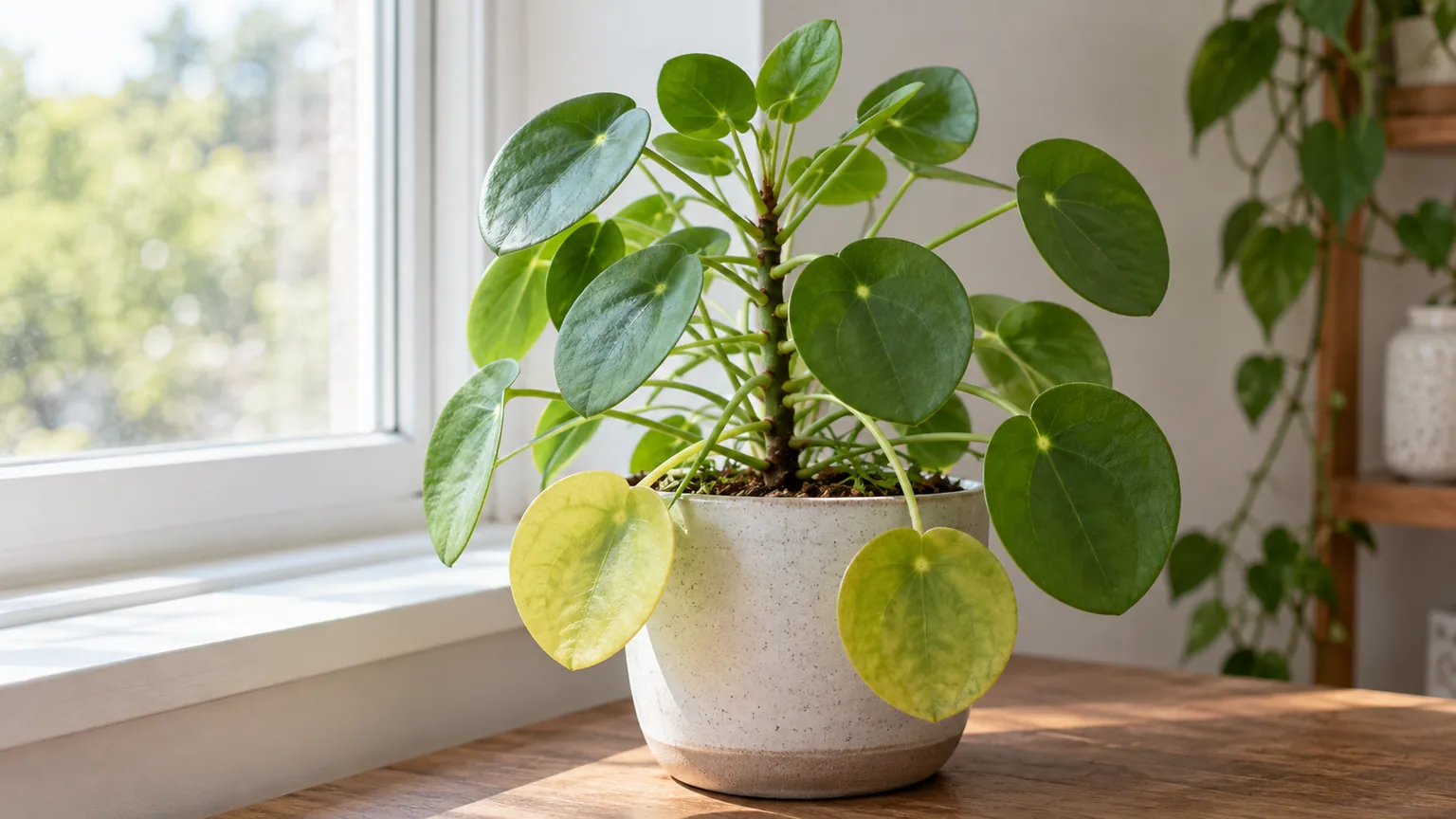
On Pilea peperomioides, a nitrogen shortage is more plausible when several older lower leaves turn evenly pale while the central new leaves stay greener and growth slows. First check the leaf-age pattern and root zone; if the mix drains and roots are sound, give one balanced houseplant feed at the product's indoor label rate to moist soil.
Nitrogen Deficiency on Pilea Peperomioides: Causes, Checks & Fixes
This guide covers nitrogen deficiency on Pilea Peperomioides. See also the general Nitrogen Deficiency guide, watering, and light pages for this plant.
Nitrogen Deficiency on Pilea Peperomioides: Causes, Checks & Fixes
Quick answer
A Pilea peperomioides can develop nitrogen deficiency, but yellow leaves alone do not prove it. Nitrogen moves within a plant, so a shortage tends to show first on older, lower leaves; on this coin-leaf plant, repeated even paling on those leaves is more suggestive than one aging disk. The center should still be producing greener leaves, even if growth has slowed. Cornell’s nutrient guide also cautions that leaf patterns overlap and visual clues are not a definitive test.
First compare the oldest leaves with the newest growth, then check whether the pot is drying normally and the central stem remains firm. If the pattern fits, roots appear healthy, and the plant has gone through active growth without feeding, give one balanced liquid houseplant fertilizer at the indoor rate on its label to already moist mix. If the root zone is soggy or the stem base is soft, correct that problem before adding nutrients. For the broader symptom pattern, see the nitrogen deficiency guide; this page focuses on whether it fits a Pilea.
What nitrogen deficiency looks like on Pilea peperomioides
The most useful clue is where the color change begins. On a Pilea with a possible nitrogen shortage, several older leaves lower on the upright stem may lose their medium green color and become evenly pale green or yellow-green. The new leaves emerging at the crown can remain greener at first because nitrogen is mobile: a plant can redirect some nitrogen from older tissue toward active growth. That age pattern is a clue, not a diagnosis by itself.
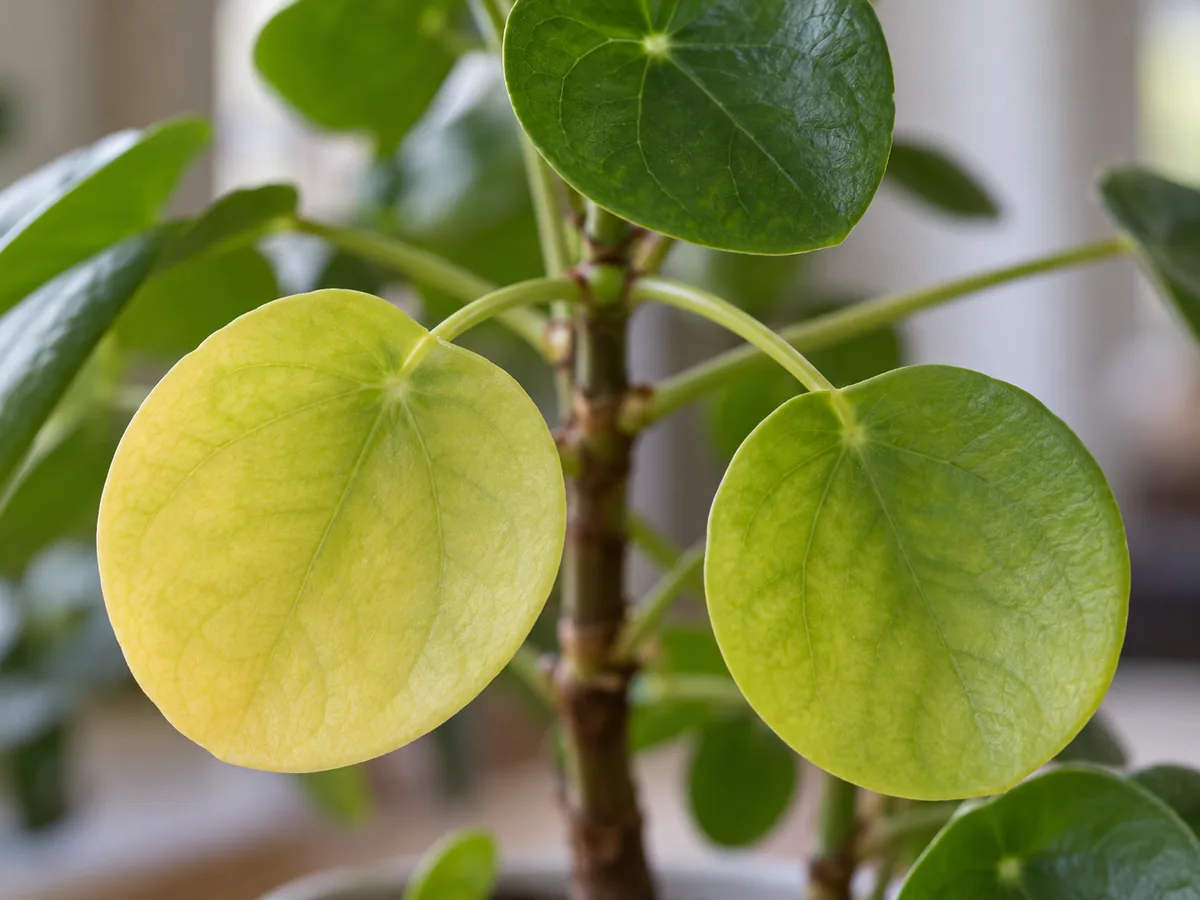
Even paling on an older coin-shaped leaf is more consistent with a mobile-nutrient clue than with a spot or edge-burn pattern, but compare several leaves and inspect the root zone before feeding.
Look at the whole stem rather than one leaf in isolation. A Pilea makes round leaves on long petioles along a central stem, and healthy plants often retain a mix of leaf ages while producing new growth from the top. If only the lowest leaf is yellow and the crown continues to add firm, normally colored leaves, ordinary aging is at least as plausible as a nutrient shortage. The Spruce notes that Chinese money plants may shed an older leaf normally and that low light can produce smaller leaves and fewer offsets, both useful clues when you compare the Pilea with its own growth history (Pilea care guide). The Pilea care overview helps set a baseline for what this plant’s normal leaves and upright growth should look like.
A stronger deficiency suspicion comes from a repeated sequence: lower leaves fade one after another, the plant adds leaves more slowly during a period when it should be growing, and the new disks are smaller or paler than its own earlier growth. Nitrogen deficiency is commonly associated with generalized chlorosis on older growth, while several other nutrient problems produce more localized patterns. Do not expect every Pilea to show the same shade or timing; light, leaf age, and growing conditions change how symptoms appear.
Why a coin-leaf Pilea may run short of nitrogen
The simplest possibility is a long feeding gap while the plant is actively growing. A Pilea kept in bright indirect light can keep making leaves in spring and summer, but potting mix contains a finite supply of nutrients. Repeated watering and normal growth can reduce the nutrients available to the roots, especially when a plant has remained in the same container for a long time and has received no balanced feed. The plant’s fertilizer guide is useful for establishing a light routine before a deficiency becomes likely.
The plant’s growth pattern helps explain why a diagnosis should follow the leaves from bottom to top. Older disks sit lower along the central stem, while the crown is where fresh leaves unfold. A basal pup may also begin as a small cluster near the soil line, so do not mistake one pale mother-plant leaf beside a healthy offset for a whole-pot nutrient problem. Compare the mother stem’s older and newer leaves, and check whether the pup itself is firm and green. The species’ crown and saucer-shaped leaves are described in Gardening Know How’s Pilea profile.
A Pilea can also have nutrients in the pot but fail to use them well. Roots need an aerated, appropriately moist growing medium; persistent saturation, a compact mix, or a root system damaged by repeated overwatering can slow uptake. Cornell notes that nutrient uptake depends on nutrients being available in a suitable chemical form and on growing conditions such as soil moisture, temperature, and pH. That is why adding fertilizer to a pot with failing roots can make the diagnosis worse rather than solve it.
Light changes can mimic a feeding problem. Pilea peperomioides grows best in bright indirect light; a dim corner may leave the plant stretched toward the window, with smaller leaves and fewer offsets, while direct hot sun can scorch exposed leaves. Those are different patterns from older leaves paling evenly while the crown remains green. The Pilea light guide helps you assess whether the plant’s placement has changed.
Confirm the pattern before feeding
Use the same sequence each time so you do not treat a yellow leaf as a fertilizer request.
- Map leaf age. Identify the oldest lower leaves, then compare their color with the newest disks at the center. Nitrogen becomes more plausible when several older leaves are paling in a similar, fairly even way and the upper growth is still greener. If the yellowing is confined to one leaf, appears as spots, or begins on new leaves, pause before diagnosing nitrogen.
- Check the Pilea’s central stem and crown. The stem should feel firm where it enters the mix, and the crown should not be collapsing. Look for new leaves that are firm enough to hold their shape. A soft base, sudden leaf drop across several ages, or a sour smell from a persistently wet pot points away from a simple feeding gap.
- Read the pot, not the calendar. Feel the upper mix and lift the pot to estimate how quickly it dries after watering. Pileas should be watered after the surface mix begins to dry. If the mix remains wet for many days, inspect drainage and roots before feeding. Use the Pilea watering guide to compare the plant’s dry-down with its usual routine.
- Review recent changes. Note when you last fed, repotted, moved the plant, or changed its watering pattern. A newly purchased Pilea may still be adjusting to a different window or potting mix. If you fed recently at a stronger-than-label dose, crispy margins or a pale crust on the mix are reasons to suspect excess salts rather than a nitrogen shortage.
- Compare the pattern with other Pilea symptoms. Interveinal yellowing, where tissue between veins pales while the veins stay greener, deserves a separate nutrient check. Younger leaves that are pale while older ones stay green also do not fit the usual mobile-nitrogen pattern. The Pilea problems hub collects the plant-specific routes if another symptom fits better.
Visual diagnosis has limits. Different nutrient deficiencies can overlap, and non-nutrient stress can change leaf color too. Use the pattern as a clue, not a soil-test substitute. For an indoor Pilea, start with the growing medium’s history and root condition; pursue testing if the same pattern persists after care is corrected.
First fix: give one balanced feed only if the checks fit
When several older leaves show the same even paling, the crown still looks healthy, the mix drains, and there has been no recent feed during active growth, the first corrective step is one measured application of balanced liquid houseplant fertilizer. Choose a product that provides nitrogen along with other major nutrients rather than a concentrated nitrogen-only supplement. Follow its indoor-use dilution rate; if its label gives a range, start at the lower end. Apply it to moist, not bone-dry, mix so the roots are not asked to take up a concentrated feed from a dry pot.
Pilea-specific guidance supports light, seasonal feeding rather than a heavy rescue dose. The RHS advises watering after the top few centimetres begin to dry and feeding pileas with balanced liquid fertilizer every month or two from April to September at the product dilution rate (RHS Pilea guidance); Bob Vila’s Pilea care guide also recommends feeding during active growth and applying fertilizer to a recently watered plant. Use the instructions for your own product, because fertilizer concentrations differ.
Do not repeat the dose a few days later because the old leaf still looks yellow. Existing chlorosis can remain visible even after the plant has enough nutrients, and another application can create salt stress. Wait for the next growth to tell you whether the correction is helping. If the roots are damaged, the soil is staying saturated, or the plant has recently been fed, do not apply the first feed yet; stabilize the root zone or allow the previous dose to work through.
Recovery: judge the Pilea’s next leaves
The two leaves already paling may remain pale, yellow further, or drop. They are not a reliable progress meter by themselves. Watch the central stem and compare the next leaves with the plant’s previous healthy growth: are they opening with a normal green color, holding firm petioles, and approaching their usual size? A stable crown is more useful evidence than trying to make an old yellow disk look perfect again.
For the next few weeks, keep care steady. Water when the top layer begins to dry rather than adding water because the leaves look yellow. Give the plant bright indirect light, and avoid moving it repeatedly between windows. Pilea leaves tend to orient toward light, so rotate the pot gradually if the stem has been leaning, but do not treat a lopsided silhouette as evidence of nitrogen deficiency.
If a healthy offset is already growing at the base, leave it attached while the mother plant stabilizes unless the parent is declining from the stem base. Basal pups are part of this Pilea’s growth habit, and a firm pup with its own roots can sometimes be kept if the older stem cannot recover. Do not separate every offset as a routine “nutrient fix”; that adds root disturbance without showing whether the actual problem was fertilizer, light, or water.
Lookalikes on Pilea peperomioides
| What you see | More likely direction | What to check next |
|---|---|---|
| Several older lower leaves fade evenly while the crown stays greener | Nitrogen deficiency is possible, especially after a long feeding gap during active growth | Check roots, recent feeding, and whether the plant is otherwise growing |
| Yellow tissue between green veins, often on older leaves | Magnesium deficiency may fit better than nitrogen | Compare the pattern with the Pilea magnesium-deficiency guide |
| Youngest leaves are pale between the veins while older leaves stay green | Iron availability or another young-leaf nutrient issue deserves a closer look | See the Pilea iron-deficiency guide |
| The whole plant is pale, stretched toward the window, and making fewer or smaller offsets | Low light is more likely than a simple nitrogen shortage | Check placement with the Pilea light guide |
| Yellowing comes with a heavy wet pot, soft stem base, or fast leaf drop | Root stress or overwatering needs attention before any feed | Compare the overwatering guide and Pilea root-rot guide |
| One oldest leaf yellows while the crown keeps producing healthy leaves | Normal aging may explain it | Track whether the same pattern repeats; use the Pilea yellow-leaves guide if more leaves are affected |
A nitrogen deficiency is less convincing when a Pilea has crisp brown edges soon after feeding, a white crust on the potting mix, or a sudden decline after fertilizer was added. Those clues can point toward excess salts or root injury. Likewise, if several plants share the same window and only this Pilea is pale, compare its potting mix, drainage, and feeding history before changing the whole shelf’s routine.
When light and roots matter more than fertilizer
Pilea peperomioides keeps a central stem with broad, circular leaves on petioles that turn toward the brightest side of the room. That shape can make the plant look uneven even when it is healthy: one side may be fuller because the window is off-center. A gradual lean by itself is not a nutrient signal. If the newest leaves are smaller and the stem is stretching, assess light first; if the newest leaves look healthy and only the oldest disks pale, nutrition becomes more plausible.
Water use changes with light and season. A Pilea near a bright window may dry faster in warm months than one placed farther back in a dim room or kept through winter growth slowdown. Do not keep a fixed weekly schedule just because you expect nitrogen deficiency. Check the mix and pot weight before watering. If the soil remains soggy, improve drainage and check roots before applying fertilizer. The Pilea soil guide explains the plant’s well-draining mix needs.
If you uncover dark, soft roots or a loose stem base, shift to root triage rather than feeding. Remove only clearly dead material, keep any firm crown or rooted pup, and use the Pilea root-rot guide for the recovery steps. A balanced feed cannot rebuild roots that are no longer functioning. Repot only when the mix is failing, the roots are damaged, or the container drains poorly; yellowing alone is not a reason to disturb a stable root ball.
Mistakes that can make a Pilea worse
- Adding nitrogen without checking the pattern. Nitrogen is not the only cause of yellow leaves. A Pilea that is overwatered, shaded, or adjusting after a move can lose leaves even if nutrients are present.
- Using a strong or nitrogen-only product. A high dose is not a faster correction. Follow the product label for indoor plants and choose a balanced fertilizer when the cause is not confirmed by a test.
- Feeding dry or stressed roots. Wait until the mix is lightly moist and the plant is actively growing. If the stem base is soft or the pot smells sour, resolve that root problem first.
- Adding several products at once. Do not combine balanced fertilizer, Epsom salt, compost tea, and a “leaf booster” to see what sticks. If the Pilea improves, you would not know which change helped, and extra salts can worsen root stress.
- Removing every yellow leaf immediately. A single older leaf can be a normal loss. Keep it until it is mostly yellow or easy to remove, and use the sequence of new growth—not cosmetic cleanup—to judge the response.
- Repotting solely because a leaf turned yellow. Repotting can damage fine roots and adds another change to diagnose. Use fresh mix when the current mix stays waterlogged, is compacted, or has an obvious salt crust, not as a substitute for identifying the cause.
Prevent another nitrogen shortage
Keep the plant where it receives bright indirect light and can maintain steady growth. Water when the upper mix begins to dry, then let excess water drain away. A Pilea’s needs change with the season and room, so assess moisture rather than following a calendar. The Pilea watering guide gives the plant-specific check; the soil guide helps if the pot stays wet for too long.
During active growth, use a balanced liquid houseplant feed at the product’s indoor rate. These schedules are not a reason to feed a plant that is dormant, newly repotted, or losing roots; match the feed to visible growth and follow the specific label.
Record the date and product whenever you feed. If yellowing returns, that record helps distinguish a genuine gap from an overfeeding episode. A Pilea that has been in the same mix for years may benefit from fresh, free-draining potting medium, but a fixed repotting interval is less useful than checking whether the roots are crowded, the mix has collapsed, or the pot no longer dries normally. Keep the root environment stable and make one change at a time.
When to use this page vs other Pilea guides
Use this nitrogen guide when multiple older leaves are paling evenly, newer leaves remain greener, and the plant has a plausible feeding gap while its root zone is sound. If the yellowing begins between veins or on new growth, follow the linked magnesium or iron guide instead. If the whole plant is pale and stretching, start with light; if the mix stays wet or the stem is soft, start with overwatering and root rot.
The Pilea problems hub routes other symptom patterns, while the Pilea overview gives the baseline for this species. For a guided check of competing causes, open the Plant Problem Diagnosis tool; the broader nitrogen deficiency symptom hub is linked near the start of this guide.
Related Pilea peperomioides guides
- Use the fertilizer guide for light feeding during healthy growth.
- Use the magnesium-deficiency guide for older leaves with greener veins and yellow tissue between them.
- Use the iron-deficiency guide when the youngest leaves show the clearer pattern.
- Use the yellow-leaves guide when age and color alone do not identify a cause.
- Use the root-rot guide when the pot stays wet, roots soften, or the stem base weakens.