Whiteflies on Pilea Peperomioides: What to Check First
Quick answer
First, isolate the Pilea Peperomioides from nearby plants. Tap a leaf over white paper: whiteflies lift as a small cloud, while pale, flattened nymphs and eggs stay on leaf undersides. Confirm both signs before treating, because yellow leaves alone do not diagnose whiteflies.
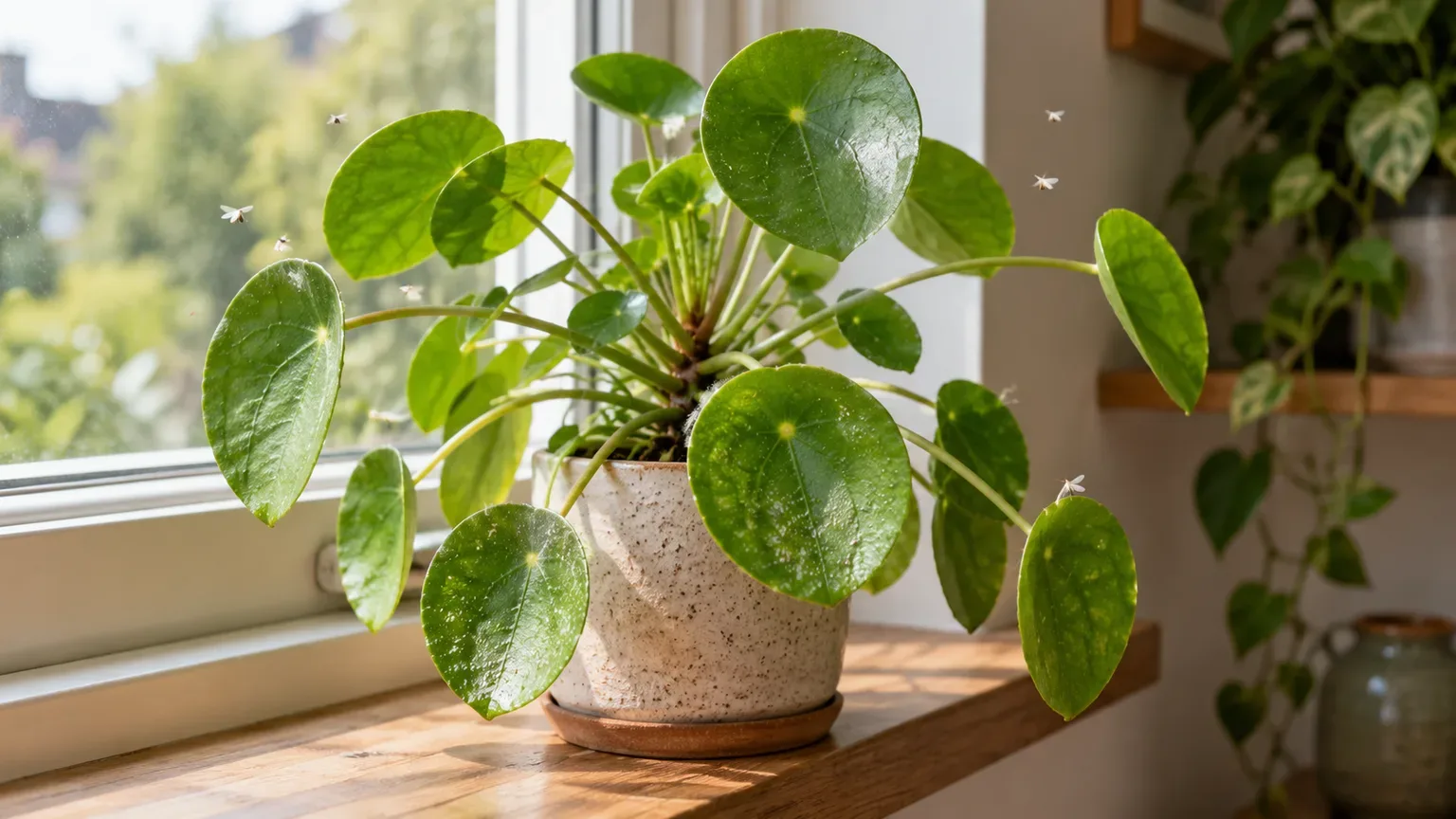
Whiteflies on Pilea Peperomioides: How to Confirm and Control Them
This guide covers whiteflies on Pilea Peperomioides. See also the general Whiteflies guide, watering, and light pages for this plant.
Whiteflies on Pilea Peperomioides: How to Confirm and Control Them
Quick answer
First, isolate the Pilea Peperomioides from nearby plants. Tap a leaf over white paper: whiteflies lift as a small cloud, while pale, flattened nymphs and eggs stay on leaf undersides. Confirm both signs before treating, because yellow leaves alone do not diagnose whiteflies. Extension guidance describes whitefly adults as tiny insects that fly when disturbed and immature stages as fixed on leaves; indoors, they can feed on houseplants year-round (University of Minnesota Extension, UC IPM).
A Pilea’s coin-shaped leaves make the underside check straightforward, but broad green leaves can still yellow as they age or from care stress; The Spruce notes that one or two older leaves may drop as a Chinese money plant grows, so a lone yellow lower leaf without insects is not confirmation of whiteflies (The Spruce). If you see no adults, eggs, or nymphs, compare the pattern with the Pilea yellow-leaves guide before treating. For general whitefly biology and tactics, see the whiteflies pest guide; use this page to decide whether the evidence fits a Chinese money plant.
What whiteflies look like on Pilea Peperomioides
A disturbed Pilea with adult whiteflies may release a few tiny, pale insects that flutter around the leaf canopy. Turn the round leaves over and look for stationary, pale oval nymphs or small eggs along the veins; later nymph stages stay attached while developing. Large colonies commonly collect on leaf undersides, and feeding can leave yellowing or weakened foliage (UC IPM Pest Notes). The Spruce describes the species’ distinctive coin-shaped leaves, a useful cue when deciding which foliage to inspect on a mixed shelf of houseplants (The Spruce).
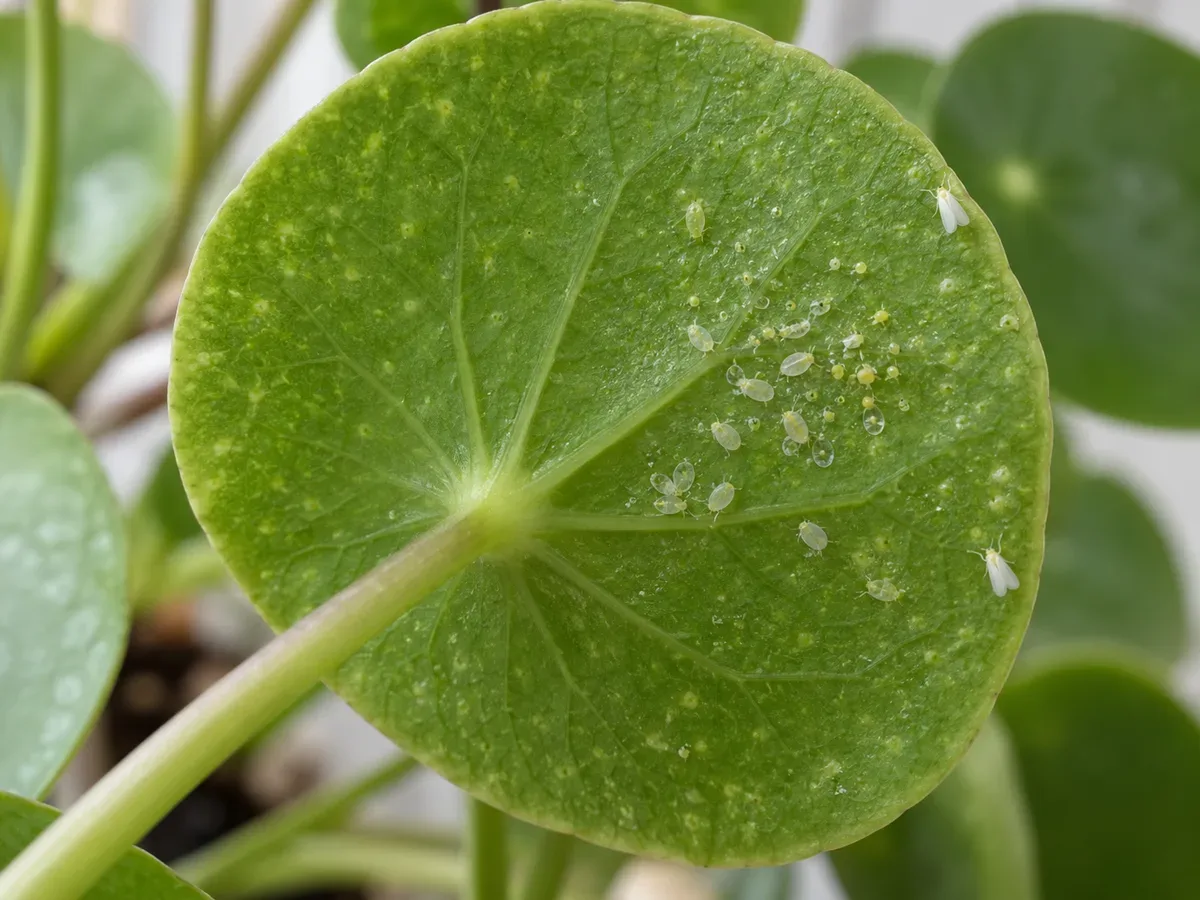
Look beneath the coin-shaped leaves for attached pale stages; adult whiteflies may flutter up when the plant is disturbed.
Adults and immature whiteflies feed on plant sap. Their excess sugary excretion, called honeydew, can leave a tacky film on leaves or the surface below; dark sooty mold may develop on honeydew if it remains. Sticky residue is a supporting clue, not proof by itself, because other sap-feeding insects can produce it too (UC IPM Pest Notes, Garden Design).
Read the coin-shaped leaves as a repeatable inspection route
Use a repeatable route instead of glancing across the canopy. Start with one outer coin-shaped leaf, support it near the stalk, and inspect the underside from edge to attachment. Continue around the plant, then work toward newer growth. Pilea’s broad leaves make this one-by-one check practical; move each gently rather than pulling the plant toward you.
Look for pale, fixed stages on more than one underside and adults that lift when disturbed. If you find no attached stages, pause treatment and repeat the check later. Immature whiteflies remain on foliage while adults move, so one clean leaf does not confirm the whole plant is clear (UC IPM Pest Notes).
Where to inspect a Chinese money plant first
Start with the undersides of lower and middle leaves, then check newer leaves and the tight center where leaf stalks meet the upright stem. The coin-shaped foliage makes a gentle turn-and-check routine easier than twisting the stem or tugging on a pup (The Spruce). Whiteflies commonly place eggs and feeding nymphs on leaf undersides; look for several stages together instead of relying on a single moving insect (UC IPM Pest Notes, Gardening Know How).
For a simple confirmation check, hold a white sheet beneath one branch and tap the petiole once. A small white cloud rising from the foliage supports whiteflies; if no adults lift and no attached stages are visible, do not treat yet. Do not shake the entire plant over neighboring pots; isolate it first and keep the test contained (Garden Design).
Include Pilea offshoots without separating them
Inspect leaves on any offshoots as well as the larger leaves. Chinese money plants produce offshoots from the main plant, adding foliage that can be missed when attention stays on the tallest leaves (The Spruce). Check each offshoot in place; do not separate a healthy pup simply to make the inspection easier.
Record where you found evidence: older outer leaves, the center, or an offshoot. On the next check, revisit those leaves before scanning the rest. This helps distinguish fresh attached stages from old damage that remains after the pest count falls.
The first fix: isolate the Pilea
Move the plant away from other houseplants before wiping, pruning, or spraying. Whitefly adults can fly to nearby foliage when disturbed, so isolation limits spread while you inspect the leaves. Keep the Pilea separate during follow-up checks; a new plant should also be inspected before joining the collection, as indoor whiteflies can remain active through the year (University of Minnesota Extension, Garden Design).
Once it is separated, remove a heavily infested leaf only if it is already declining or carries many attached nymphs. Hand-removing heavily infested leaves can reduce whitefly numbers; seal discarded leaves in household waste rather than leaving them beside the plant (UC IPM Pest Notes). Avoid stripping every yellowing leaf: Pilea can shed an older leaf for reasons unrelated to whiteflies, and unnecessary pruning reduces healthy foliage.
Keep the isolated pot far enough from other foliage that its leaves do not brush neighboring plants. If you carry it to another room, keep it apart during the trip and wipe the surface afterward. Move it before shaking, wiping, or rinsing so you can keep the work area contained.
Before returning the Pilea, inspect plants that shared its shelf, especially leaves that touched its canopy. Check their undersides and tap a few leaves over white paper. Keep any plant with positive signs isolated too; proximity alone does not prove it needs treatment. Return the Pilea only after its follow-up checks stay clear, and leave enough space that its coin-shaped leaves are not rubbing neighboring foliage. This keeps each plant’s evidence easy to track.
Reduce the infestation without stressing Pilea
For a light infestation, wipe the undersides of affected leaves with a damp, soft cloth or rinse them with a gentle stream of lukewarm water; water sprays can dislodge whitefly eggs and nymphs (Garden Design). Support each leaf from beneath so its petiole does not bend, and keep the potting mix from becoming waterlogged during a wash (The Spruce). Recheck the same leaf surfaces after they dry; whitefly nymphs attach to foliage, so one rinse may miss some stages (UC IPM Pest Notes).
If adults continue to emerge and nymphs remain, use only a ready-to-use insecticidal soap or horticultural product whose label permits indoor ornamental plants. Test it on one leaf first, then apply exactly as directed with complete coverage of the undersides; contact products affect only the insects they reach, and repeat treatment may be needed under the label schedule (UC IPM Pest Notes). UC IPM advises against using soaps or oils on drought-stressed plants, so wait until the Pilea is stable and follow the label for temperature, placement, and reapplication (UC IPM Pest Notes).
A yellow sticky card near the canopy can help you notice adult activity, but it will not remove eggs and attached nymphs. UC IPM treats traps mainly as a monitoring tool rather than a complete control method, so continue leaf-by-leaf checks even if the card catches adults (UC IPM Pest Notes).
Choose the next step from what you see after this physical cleanup. If only a few leaves carried attached stages and the next inspection finds fewer, continue monitoring and remove isolated badly infested leaves as needed. If adults keep rising and new attached stages appear, a labeled contact product may be warranted; repeating a wash alone can leave stages behind, while applying a stronger or more frequent spray than the label allows adds risk without improving diagnosis. Any contact treatment still needs complete underside coverage and label-directed timing.
Before any treatment, consider the Pilea’s current condition. If it is limp from dry mix or otherwise stressed, stabilize its ordinary care first rather than adding a spray to a plant that is already struggling. For this species, do not turn pest treatment into repeated watering: let the mix approach its usual dry-down between waterings and keep drainage working, as the Chinese money plant is normally watered after the soil has dried (The Spruce).
Lookalikes on Pilea Peperomioides
| What you notice | More likely explanation | Next check |
|---|---|---|
| Tiny white adults lift from leaves, with pale attached stages underneath | Whiteflies | Continue the underside inspection and isolate the plant |
| No white adults or attached stages, but leaf damage continues | Another pest or a care issue is possible | Compare with the Pilea thrips guide and review recent changes |
| Fixed bumps or sticky residue without a white cloud | Scale insects or another sap-feeding pest may be involved | Inspect the scale insects guide |
| One older bottom leaf yellowing, with no insects or residue | Aging or a care issue rather than confirmed whiteflies | Review the yellow-leaves guide and recent watering |
Sticky honeydew and yellowing are shared signs among sap-feeding pests, so confirm white adults or attached whitefly stages before using a pest-specific treatment. If the Pilea has no underside activity, reassess its root moisture and light: the plant’s watering guide and light guide cover those care checks.
Pilea care stress can also make leaves look tired. Too much direct sun can burn foliage, low light can produce leggier growth with smaller leaves, and watering problems may cause drooping or leaf loss; none confirms whiteflies without insects or attached stages (The Spruce). Compare the whole plant: sun injury may be concentrated on exposed surfaces, while whitefly evidence is usually found underneath leaves. If both problems appear present, correct care gradually while treating confirmed insects rather than escalating sprays because old leaves remain damaged.
Compare normal older-leaf turnover with feeding damage
If only one older lower leaf is yellow and its underside is clean, inspect nearby foliage and the growing center before treating. Natural aging does not produce adults that lift when tapped or pale attached stages underneath. Keep a leaf that is still mostly green and functional while you check the rest of the plant.
Whiteflies are best confirmed by finding adults or attached immature stages, not by the shape of one damaged leaf. A yellow sticky card can show that flying adults are nearby, but cannot tell which Pilea leaf carries nymphs. Use it alongside an underside inspection, not instead of one (UC IPM Pest Notes).
Recovery: watch new Pilea leaves
A leaf that has yellowed, dried, or developed dark mold will not become pristine again after treatment. Remove only foliage that is mostly damaged or still heavily infested; keep green leaves that are supporting the plant. Whitefly feeding can reduce vigor and cause leaves to yellow and drop, although indoor infestations do not usually kill the plant when they are found and managed (University of Minnesota Extension).
Check leaf undersides every few days at first, then continue weekly checks for several weeks. Look for fewer adults on disturbance, no fresh eggs or nymphs, and new leaves that unfold without stippling or sticky residue. If populations persist after careful label-directed treatment, inspect nearby plants again and review the Pilea problems hub for overlapping symptoms rather than increasing spray strength or frequency.
Judge recovery by new evidence, not by whether the old leaves become attractive again. Keep the same short record you began during diagnosis: which leaves had attached stages, whether adults rose during the tap check, and whether the sticky card is still catching adults. A declining count across those checks is more useful than a single pest-free glance. If you treated the undersides carefully and still find new nymphs, revisit the plant’s crowded center and any offshoot leaves before concluding that the product failed; missed surfaces can leave a small population in place.
As the Pilea resumes growth, avoid rough handling of new leaves: support each blade near its base during checks and leave healthy center growth intact. If repeated checks find no active stages, return the plant to its normal position and keep inspecting nearby foliage. Separating a clean offshoot is a recovery choice if the main stem fails, not a routine whitefly treatment.
Prevent whiteflies on future Pilea growth
Inspect new plants before placing them beside the Chinese money plant, especially under the leaves and around fresh growth. A short quarantine period gives you time to spot an infestation before pests can move between pots; Garden Design recommends keeping new houseplants separate for two to three weeks (Garden Design). Check the Pilea’s broad leaf undersides during regular watering and when rotating it toward the light.
Rotation can help make that routine consistent: The Spruce recommends turning a Chinese money plant occasionally so it does not become lopsided, and you can use each turn to inspect another part of the canopy (The Spruce). Turn the pot slowly rather than swinging the foliage. Check the round leaves that were facing the wall or another plant, and include any offshoots tucked below the main canopy. This is especially useful when leaves overlap, since a fast glance from above may miss the underside where whitefly stages are usually found.
Keep routine care steady while you monitor. Pilea peperomioides grows best with bright indirect light and a well-draining mix, so correct placement and drainage support healthy growth but do not substitute for pest checks (The Spruce). Use the soil guide if the mix stays wet for too long, and the overview for the plant’s broader care pattern.
When to use this page vs other Pilea Peperomioides guides
Use this page when you can confirm white adults lifting from the leaves or pale, fixed stages attached underneath them. Use the thrips guide when another small leaf-feeding pest seems more likely, the scale guide for fixed bumps, and the Pilea yellow-leaves guide when discoloration appears without pests. The Pilea problems hub helps compare other symptoms when the evidence is mixed.
Related Pilea Peperomioides guides
If the leaf undersides show whitefly stages, isolate and treat this page’s pest pattern. If they do not, start with the Pilea watering guide for a dry or saturated root ball, or the light guide for stretched growth and small new leaves. For the overall plant context, use the Pilea Peperomioides overview.
Related tool
Use the Pest Identifier to compare visible insects before choosing a treatment.