Faded Flowers on Prayer Plant: What Is Normal and What
Quick answer
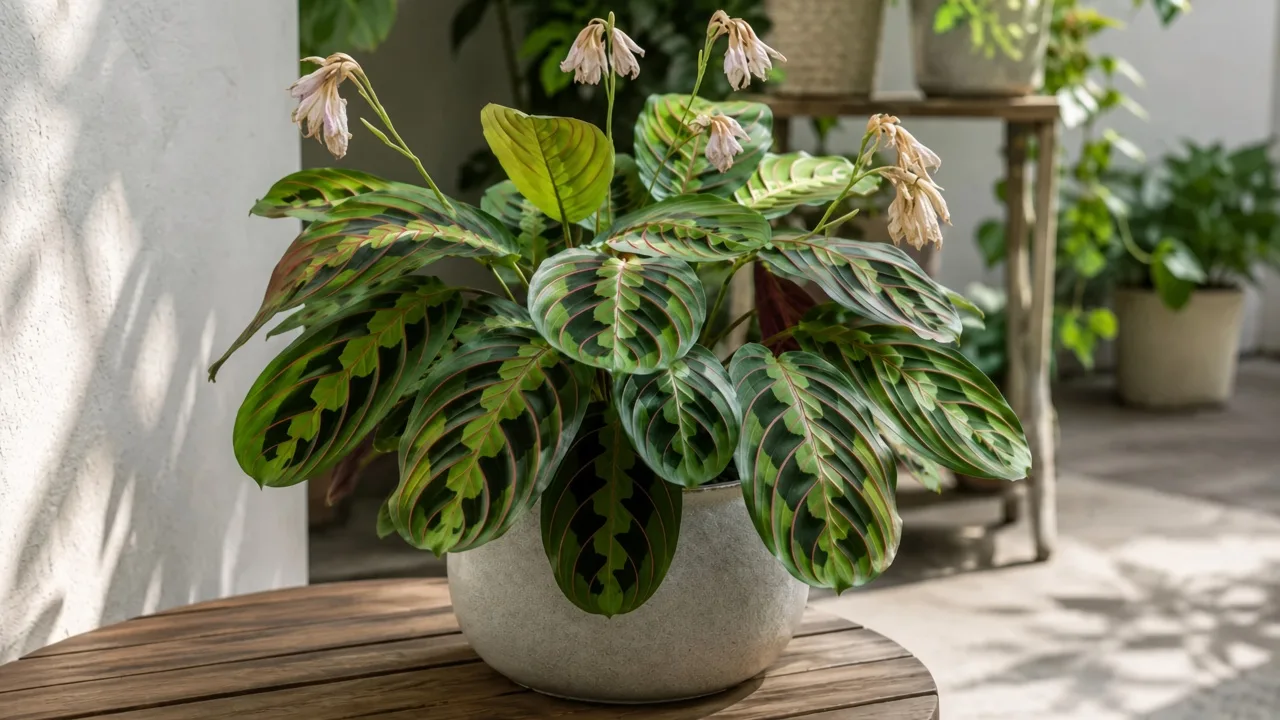
Prayer plant flowers are naturally small and rarely appear indoors. If one bloom fades after opening while its stalk and patterned leaves remain firm, treat it as a spent flower and keep care steady. First check whether the change is limited to that bloom; only investigate light, water, roots, or pests if other symptoms appear too.
Faded Flowers on Prayer Plant: Causes, Checks & Fixes
This guide covers faded flowers on Prayer Plant. See also the general Faded Flowers guide, watering, and light pages for this plant.
Faded Flowers on Prayer Plant: Causes, Checks & Fixes
Quick answer
On a prayer plant (Maranta leuconeura), one flower losing color after opening is usually a reason to observe, not to reach for fertilizer or water. Maranta is grown mainly for its patterned leaves, and its flowers are small; indoor flowering is unusual. NC State Extension describes the blooms as small and insignificant, while the RHS notes that they are unusual on houseplants.
First, check whether the change is limited to one bloom. If the petals are fading but the stalk stays firm and the foliage looks as it did last week, keep the care routine steady and let that flower finish. If buds are dropping alongside yellowing leaves, a soft crown, or a pot that remains wet, investigate the matching plant symptom before changing conditions. For general bloom problems across houseplants, compare the faded flowers symptom hub; the checks below focus on Maranta.
What a prayer plant flower looks like
The flowers can be easy to overlook beside a Maranta’s red-veined or rabbit-track foliage. They are small, tubular or two-lipped, usually white to purple, sometimes with purple markings, and carried above the leaves on slender stalks. The RHS describes small tubular flowers that may appear in summer. The Missouri Botanical Garden profile describes white, purple-spotted flowers on slender spikes in late spring to early summer; Gardening Know How gives a similar seasonal description and says they rarely appear on houseplants.
This matters because a small flower that turns dull can look dramatic only because it is the plant’s first bloom. A normal bloom cycle is not a promise of repeated flowers, and a pale or shriveled individual flower does not tell you whether the roots are healthy. Use the Prayer Plant overview to compare the plant’s normal foliage and growth habit before interpreting the bloom in isolation.
Normal fading versus a care problem
Likely a spent flower
Treat the bloom as spent when it opened, then gradually lost color or became papery; the stalk remains firm, and the rest of the clump continues to hold its leaves normally. Maranta flowers are not the showy feature of this species: NC State says the plant blooms under ideal conditions but that the flowers are small and insignificant. That description is consistent with prioritizing healthy foliage rather than trying to preserve every bloom.
You do not need to remove a fading flower immediately. The RHS lists no pruning as required for Maranta. If a stalk becomes completely dry and you prefer a tidier plant, cut that stalk close to its base with clean scissors. Do not cut into the crown, and do not remove a green, firm stalk just because the flower has lost its color. The pruning guide covers routine trimming; spent-flower removal is optional grooming.
Look closer when several parts change together
A faded bloom is more informative when it follows a visible change in the plant’s environment or appears with other symptoms. Note whether the pot was moved, repotted, placed near a heating or cooling vent, or left unusually dry or wet. Missouri Botanical Garden’s general indoor-plant guidance notes that changes in watering, temperature, light, or location can be followed by flower drop; that makes a recent disturbance worth checking when buds fall, but it does not prove that a single fading Maranta flower was caused by stress.
Look at leaves and stems next. A firm, patterned leaf that still opens and folds as usual, alongside one fading bloom, points to a different situation from multiple yellowing leaves or a soft crown. Maranta foliage can lose color in poor light and can bleach in excessive direct sun, according to NC State Extension. Those leaf changes are useful care clues; they are not a diagnosis of faded petals. If the leaves are also pale or stretching, use the Prayer Plant light guide to assess the window and recent light changes.
Check the mix without automatically watering. Feel the top layer and lift the pot to compare its weight with a recently watered pot. Prayer plants prefer an even-moisture routine during active growth, with less water as growth slows; Illinois Extension recommends bright diffused light and keeping the soil moist. A bone-dry mix or persistently soggy pot may matter if leaves are drooping or yellowing too. Follow the watering guide and correct the measured root-zone problem rather than watering to rescue the flower.
If the crown is soft, the mix smells sour, or leaves collapse while the pot stays heavy, treat that as a separate root or stem problem. A fading bloom by itself is not a reason to unpot the plant, prune healthy foliage, or apply a pesticide. Inspect leaf undersides only if there is stippling, sticky residue, visible insects, or distorted new growth that points to pests.
The safest first fix
When only one open flower is fading, leave the plant’s care unchanged and watch the stalk and foliage for a week. Take a quick photo and note whether the stalk stays firm, the bloom dries, and new leaves remain healthy. A single bloom is too little evidence to justify extra fertilizer, more frequent watering, a brighter direct-sun position, or an emergency repot.
If other symptoms are present, make one correction that matches the evidence. Move the plant away from direct sun only if leaves show bleaching or scorch; improve the root-zone routine only if the mix is staying wet or drying completely; address a draft only if the plant is exposed to one. Maranta prefers filtered or indirect light, and it is sensitive to harsh direct sun, so do not place it in a hot window in an attempt to “feed” the flower with stronger light. Change one factor, then use new growth and the soil’s drying pattern to judge the result.
Extra fertilizer is not a reliable bloom treatment. A flowering prayer plant is not necessarily deficient when its flower fades, and its normal indoor display is foliage first. Continue a restrained feeding plan only while the plant is actively growing; the Prayer Plant fertilizer guide explains how to avoid feeding as a substitute for diagnosing light or root stress.
Recovery and prevention
A faded flower will not regain its original color. Judge the plant’s recovery by the condition of the crown, leaves, and new growth, not by whether that same stalk produces another bloom. If the leaves remain firm and patterned and no additional buds or foliage decline, no treatment may be needed. If decline continues, diagnose the leaf, root, or pest symptom separately and give the plant time to respond after one targeted correction. Indoor flowers are uncommon, so an interval without another bloom is not proof that the plant is failing.
For prevention, keep the environment consistent: bright filtered light, a freely draining mix that stays lightly moist during active growth, and less frequent watering in winter. Avoid repeated moves while buds are visible, but do not mistake an old bloom for a reason to freeze all normal care. Check the plant weekly and record when new leaves appear, when a flower opens, and whether a change in location or watering came first. The record helps separate ordinary bloom turnover from a broader pattern.
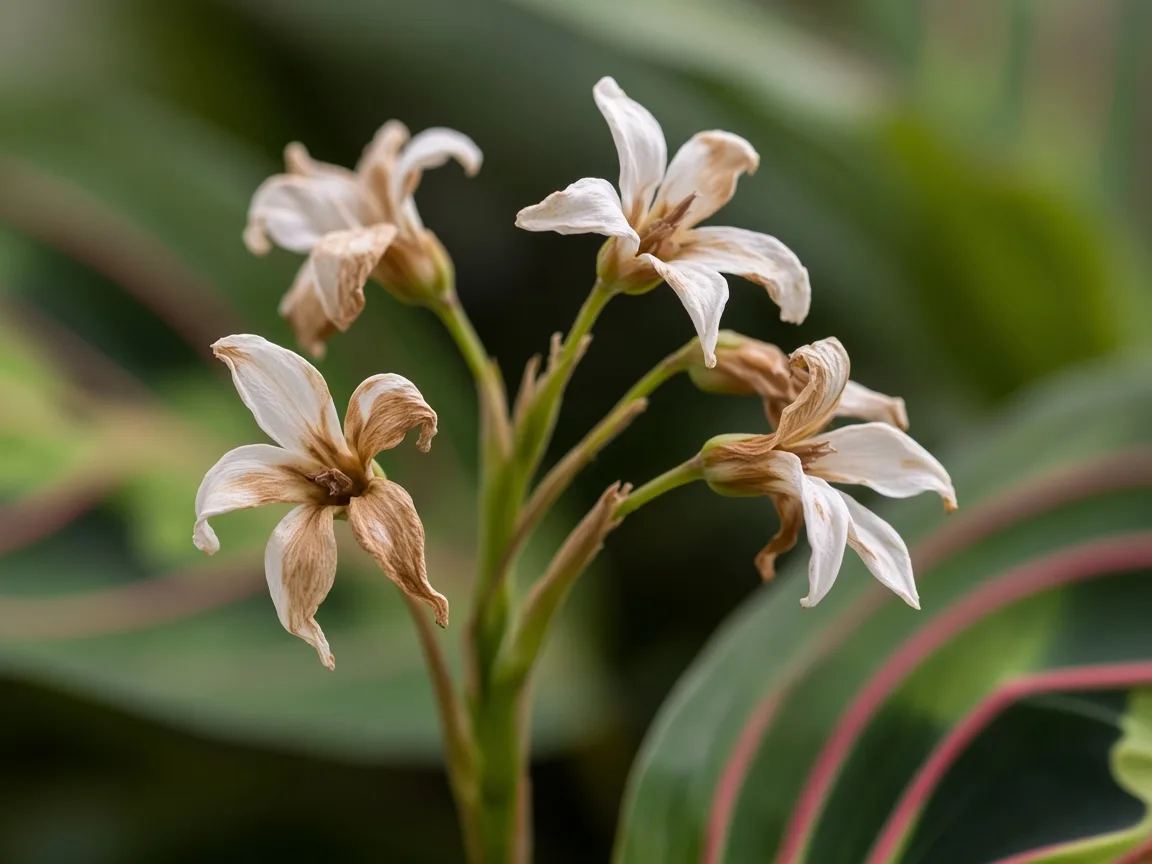
An individual prayer plant flower fading above otherwise healthy foliage can be a spent bloom; check the stalk and surrounding leaves before changing care.
Related tool
Use the Plant Problem Diagnosis Tool if faded flowers appear with another symptom and you need help deciding which pattern to inspect next.