Ants on Prayer Plant: What They Mean and How to Remove Them
Quick answer
Ants on a prayer plant usually mean they are following a trail to food or tending a honeydew-producing pest such as aphids, mealybugs, or soft scale. Check the leaf folds, petiole bases, pot rim, and drainage holes before treating. Isolate the plant and remove the trail; treat a confirmed pest or nest rather than spraying the leaves.
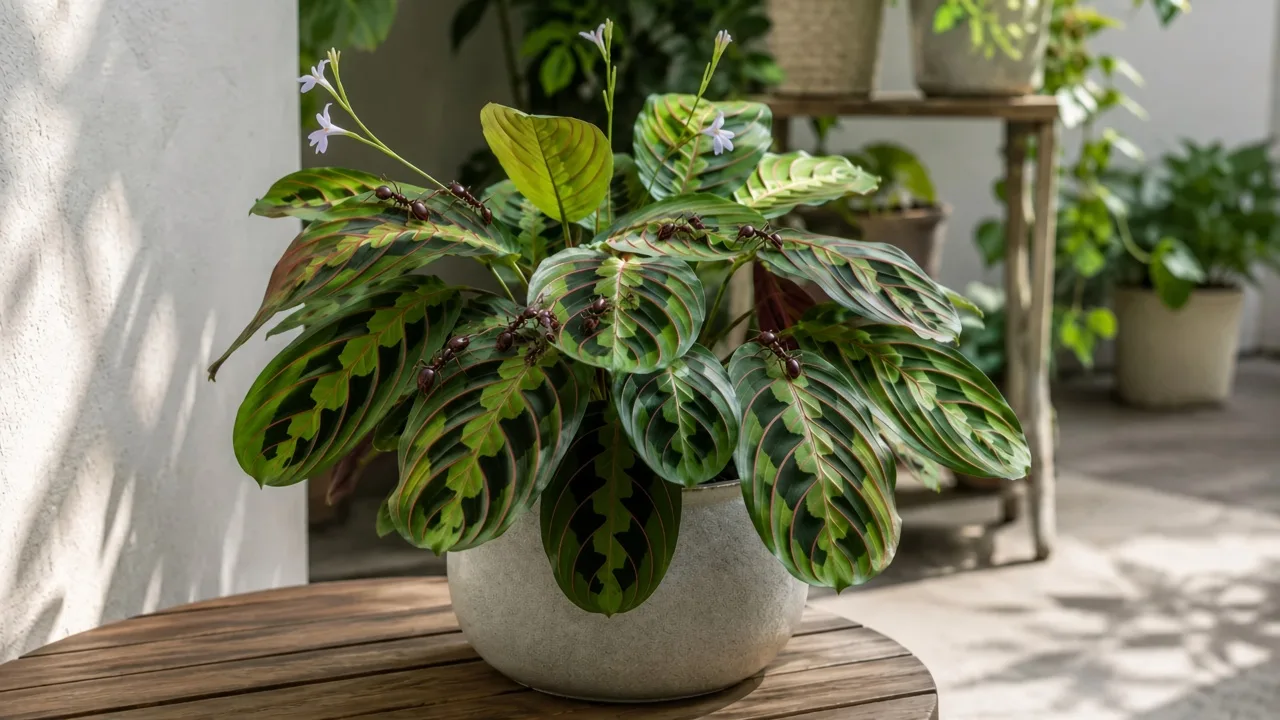
Ants on Prayer Plant: Causes, Checks & Fixes
This guide covers ants on plant on Prayer Plant. See also the general Ants on Plant guide, watering, and light pages for this plant.
Ants on Prayer Plant: Causes, Checks & Fixes
Quick answer
Ants on a prayer plant (Maranta leuconeura) are a clue to investigate, not a diagnosis. The ants may be following a trail to food, tending aphids, mealybugs, soft scales, or other honeydew-producing insects, or nesting in the potting mix. First isolate the plant, follow the trail, and inspect leaf folds, petiole bases, the pot rim, and drainage holes. Remove ants from the foliage with a damp cloth and clean nearby trails with soapy water. Do not spray a household ant killer on the leaves.
Why ants show up on prayer plants
The most useful first distinction is whether ants are visiting the plant for food or living in the container. UC IPM notes that ants can protect honeydew-producing insects, including aphids, soft scales, mealybugs, and whiteflies, and that some ants nest in potted plants. A trail along a stem or petiole may lead to these insects; steady traffic emerging from drainage holes points more strongly toward a nest in the mix. Neither pattern proves the cause until you inspect it.
A honeydew trail from sap-feeding pests
Aphids, mealybugs, and some scale insects feed on plant sap and leave sticky honeydew. Ants may collect that sugary residue and protect the insects from predators. On a prayer plant, inspect the undersides of leaves, folded new growth, the places where petioles meet the crown, and any sheltered stem joints. Look for live insects, waxy or cottony patches, sticky spots, or dark sooty growth on top of the residue. UC IPM describes this ant and honeydew relationship in its guidance for ants and houseplant problems.
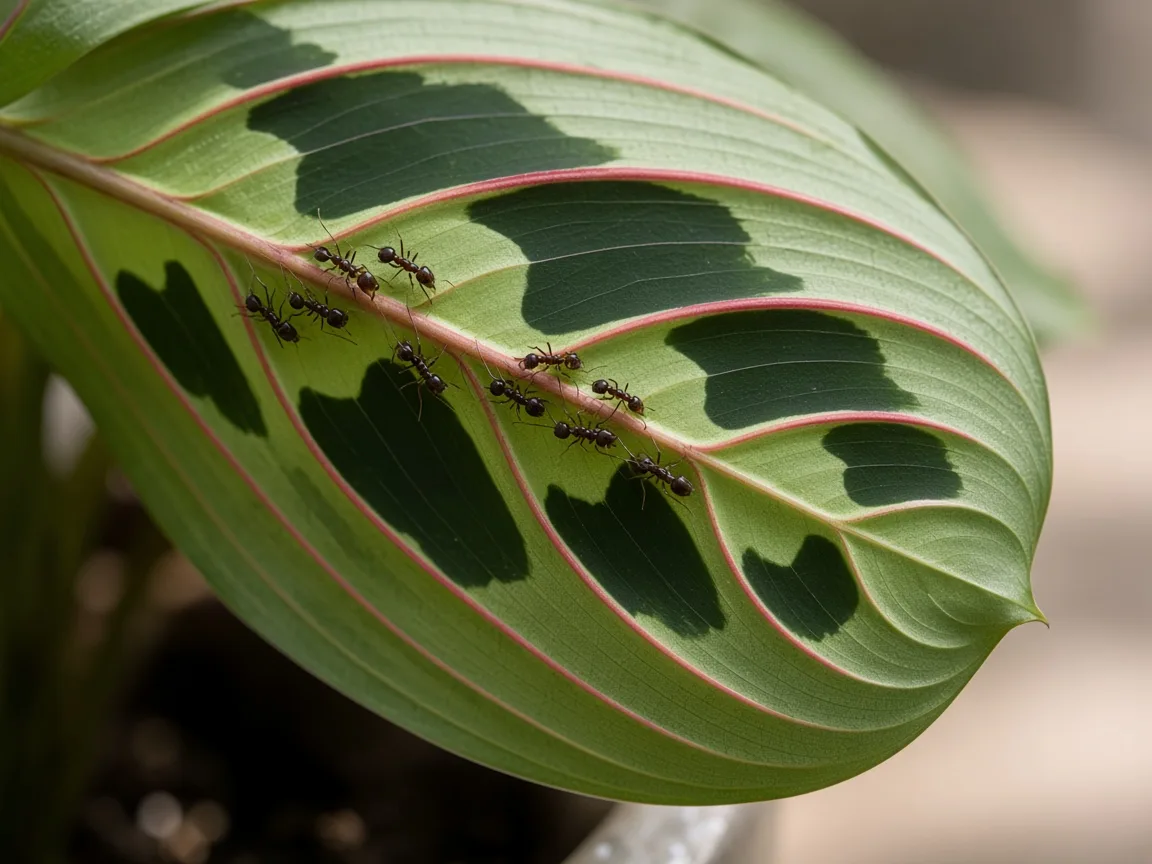
Ants do not confirm that aphids are present. UC IPM explains that aphids can excrete honeydew and that ants may tend and defend them, so inspect for the insects themselves before choosing a treatment. Compare the leaves with our aphids on prayer plant guide if you find soft-bodied insects, or the mealybugs guide if you find white waxy clusters.
A nest inside the pot
Ants can use potting mix as a protected nesting site. This is more likely to matter when an outdoor pot has been sitting on soil or pavement, or when ants repeatedly emerge from its drainage holes. Mississippi State Extension notes that fire ants may nest in the soil of outdoor potted plants. Do not infer that every small ant is a fire ant: if the ants are aggressive, sting, or form a visible mound, avoid handling the pot and get local extension or pest-control advice.
A trail that only crosses the plant
Sometimes a plant is simply part of a route between an ant nest and a food or water source. Check the shelf, nearby window, saucer, cachepot, and the room for crumbs, sticky spills, pet food, or leaks. UC IPM recommends cleaning indoor ant trails with soapy water because it removes the scent trail; finding ants on one leaf does not by itself show that the plant is infested.
How to check the cause
Take a close look before applying a product. Move the plant away from other plants, then use a flashlight to inspect:
- Leaf undersides and folds. Look for aphids on soft growth, cottony mealybugs, or small immobile scale bumps. Check new leaves and their rolled edges as well as older foliage.
- Sticky residue. Honeydew feels tacky and may collect below feeding insects. Wipe a small patch with a damp cloth and recheck later; residue returning can mean a pest remains.
- The ant trail. Follow workers in both directions. If they climb from the potting mix or repeatedly appear at drain holes, inspect the root zone. If they arrive from a wall, shelf, or window, clean that route and check the room for food or moisture.
- The pot and mix. Look for loose mix around the pot rim or drainage holes, and lift the inner pot from its saucer. Do not unpot the plant unless you have a reason, such as a confirmed colony or other root-health concern.
- Prayer-plant condition. Ants are not a watering signal. Prayer plants fold their leaves in darkness, and normal nighttime movement is not pest damage. Keep routine care steady while you identify the ants.
Illinois Extension recommends moist soil and diffused, bright indirect light for prayer plants, while warning that water standing in the crown can rot the stems. Use the watering guide to check moisture; do not compensate for ants by adding water or leaving the pot in a tray.
What to do first
If ants are foraging and no nest is present
Move the plant a short distance from neighboring foliage and wipe visible ants away with a damp cloth. Clean the pot exterior, shelf, and nearby ant trail with soapy water, then dry the surfaces. Remove food or standing water nearby and watch where the next ants appear. UC IPM advises that wiping or sponging indoor trails with soapy water can temporarily remove ants and their scent trail.
If ants are linked to aphids, mealybugs, or scale, isolate the plant and manage that insect. UC IPM recommends nonchemical measures first for aphids and says insecticidal soaps or oils should be used only as directed; some plants can be sensitive. Prayer-plant leaves are soft, so do not coat the whole plant with a product just because ants are present. Confirm a pest, choose a product whose label includes the plant and target pest, and test a small area as the label directs. Follow the aphids guide, mealybugs guide, or scale-insects guide for the confirmed pest.
If you confirm ants nesting in the mix
Take the plant outside before disturbing the colony. For an ordinary small colony, Utah State Extension describes repotting container plants into fresh mix and rinsing ants from the root system as a practical approach. Use a gentle stream, keep the rhizome and roots from drying, and pot back into a clean container with drainage. Do not use a pesticide drench unless its current label specifically allows use in that plant and situation.
Fire ants require extra caution. Mississippi State Extension advises that a fire-ant product used as a soil drench must be labeled for that use, mixed and applied exactly as directed, and kept outdoors for the label’s stated period before moving the plant inside. Do not improvise with household sprays, dish soap, vinegar, or a product meant for lawns. If you cannot identify the ants or the label does not cover the container, contact your county extension office or a licensed pest professional.
What not to do
- Do not spray an indoor ant aerosol or perimeter insecticide onto prayer-plant leaves, stems, or potting mix.
- Do not treat aphids, mealybugs, or scale as confirmed just because ants are visible; inspect for the pest first.
- Do not use a pesticide drench unless the label expressly permits that use, and do not bring a treated plant indoors before the label allows it.
- Do not flood the crown or leave the pot standing in water. Prayer-plant stems can rot when water remains in the crown.
- Do not overwater or repot a stable plant solely because a few ants crossed it. Change one thing at a time and check whether the trail stops.
What recovery looks like
After cleaning trails, ant numbers should fall as the source is removed. If honeydew pests were present, judge recovery by whether new leaves emerge clean and no sticky residue returns. If you repotted because a nest was confirmed, check that the plant is stable, the mix drains, and new growth remains firm. Old leaves may retain feeding marks; they do not need to become perfect for treatment to have worked.
How to prevent ants returning
Inspect plants that spent time outdoors before bringing them inside. Check the soil surface, pot rim, saucer, leaf folds, and stems; quarantine new plants while you scout for pests. Clean the stand and remove spilled sugary drinks or pet food. Keep saucers empty after watering, but keep the mix on the prayer plant’s normal moisture routine. If ants continue to enter the home, UC IPM recommends using bait stations near trails only as the product label directs and away from children and pets. Baits work on ants that carry them back to a colony; a spray on the plant does not resolve a nest elsewhere.
Related tool
Use the Plant Problem Diagnosis Tool to keep track of the ant trail, any honeydew pests, and the checks you have completed before changing several parts of the plant’s care at once.
Related Prayer Plant guides
- Prayer Plant overview for general care and identification.
- Prayer Plant problems hub to compare other symptoms.
- Aphids, mealybugs, and scale insects if you find honeydew-producing pests.
- Watering guide if the mix or crown condition also needs attention.
Conclusion
Ants on a prayer plant usually point to a trail, a honeydew-producing pest, or a nest in the pot. Follow the trail and inspect the foliage and drainage holes before treating. Clean nearby trails, manage any confirmed sap-feeding pest, and reserve repotting or a labeled soil treatment for a confirmed colony. Keep the prayer plant’s normal moisture routine and its crown free of standing water while it recovers.