Blight on Prayer Plant: How to Check Leaf Spots and Limit
Quick answer
Blight describes spreading dead or discolored plant tissue; it does not identify one disease or pathogen. North Carolina State Extension lists prayer plant as having no serious disease problems, so do not assume every brown mark is contagious. First isolate the plant, photograph the lesions, and keep water off the leaves while you check whether spots are enlarging or merging.
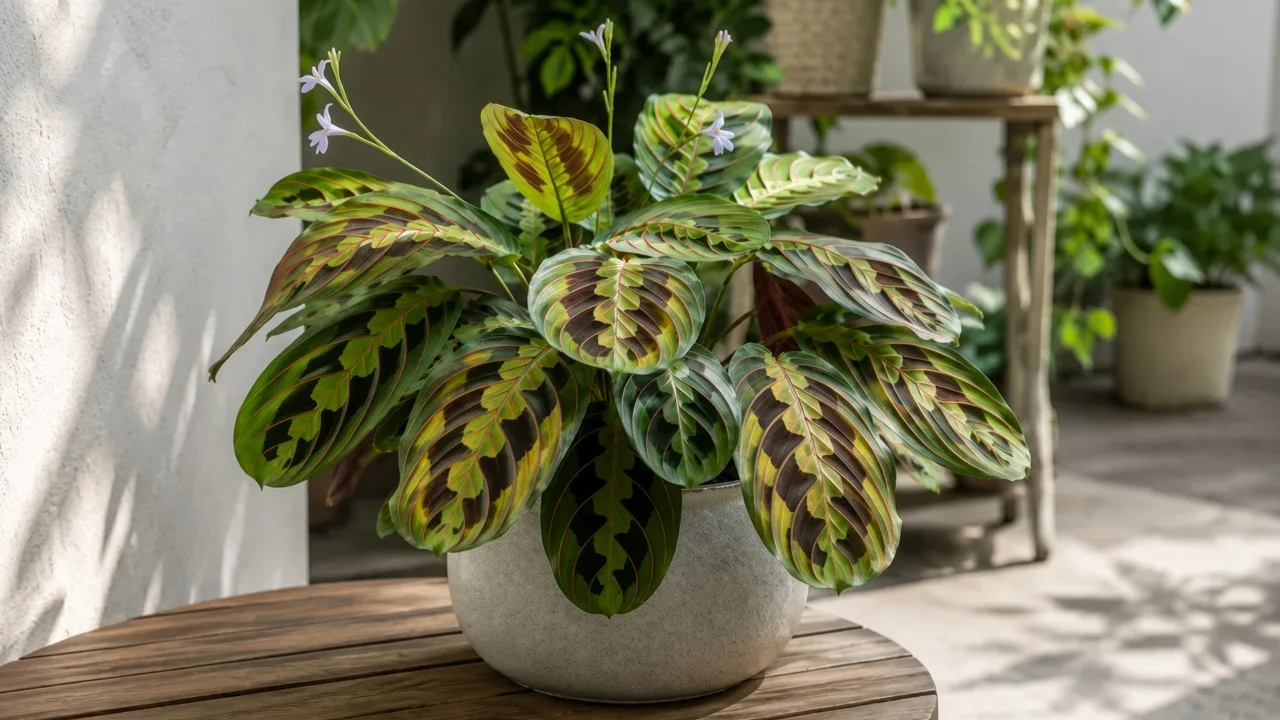
Blight on Prayer Plant: Causes, Checks & Fixes
This guide covers blight on Prayer Plant. See also the general Blight guide, watering, and light pages for this plant.
Blight on Prayer Plant: Causes, Checks & Fixes
Quick answer
On a prayer plant (Maranta leuconeura), “blight” is a description of tissue that is dying across a leaf or several leaves. It does not name a single disease. The brown, yellow-edged marks in a photograph may resemble a leaf infection, but they cannot establish which organism—if any—is responsible. North Carolina State Extension says this plant has no serious disease problems, which is a reason to diagnose carefully instead of treating every mark as contagious.
First, isolate the plant and photograph the affected leaves. Keep water off the foliage while you note whether each spot is stable, growing, or merging with another. This protects nearby plants while giving you useful evidence. A single static mark after a move is a different pattern from new lesions appearing on several leaves over a few days.
Prayer plants normally prefer bright, indirect light and evenly moist potting mix during active growth; they do not need a wet canopy. Their leaves also move between a flatter daytime position and a more upright nighttime position. Compare any change with the plant’s normal care using the Prayer Plant overview and light guide before changing several conditions at once.
What “blight” means on a prayer plant
Blight is a symptom word for expanding damage that kills a substantial part of a leaf or plant tissue. It is not a diagnosis such as bacterial leaf spot or a named fungal disease. In bacterial diseases, separate lesions can enlarge and merge into broader blighted areas; other pathogens and noninfectious injuries can also make leaves brown and collapse. The UC IPM guide to bacterial leaf spots and blights explains this relationship between spots and larger areas of dead tissue.
That distinction matters for Maranta. A bright window, a cold draft, splashed or chemically treated water, or stressed roots can produce discoloration that looks alarming but does not spread from leaf to leaf. NC State’s prayer plant profile notes that the species has no serious disease problems and that too much direct sun can bleach its patterned foliage. So start with the pattern and recent conditions, not the label “blight.”
Disease is possible, especially when plants stay crowded and leaves remain wet, but indoor foliar infections are less common than care or environmental problems. UC IPM’s houseplant diagnosis guide notes that fungal and bacterial leaf spots are more likely when a plant has recently come from a greenhouse or outdoors, where splashing and humidity can favor disease. It also lists excess light, chilling, spray injury, and overwatering among the possible lookalikes.
How to inspect the spots
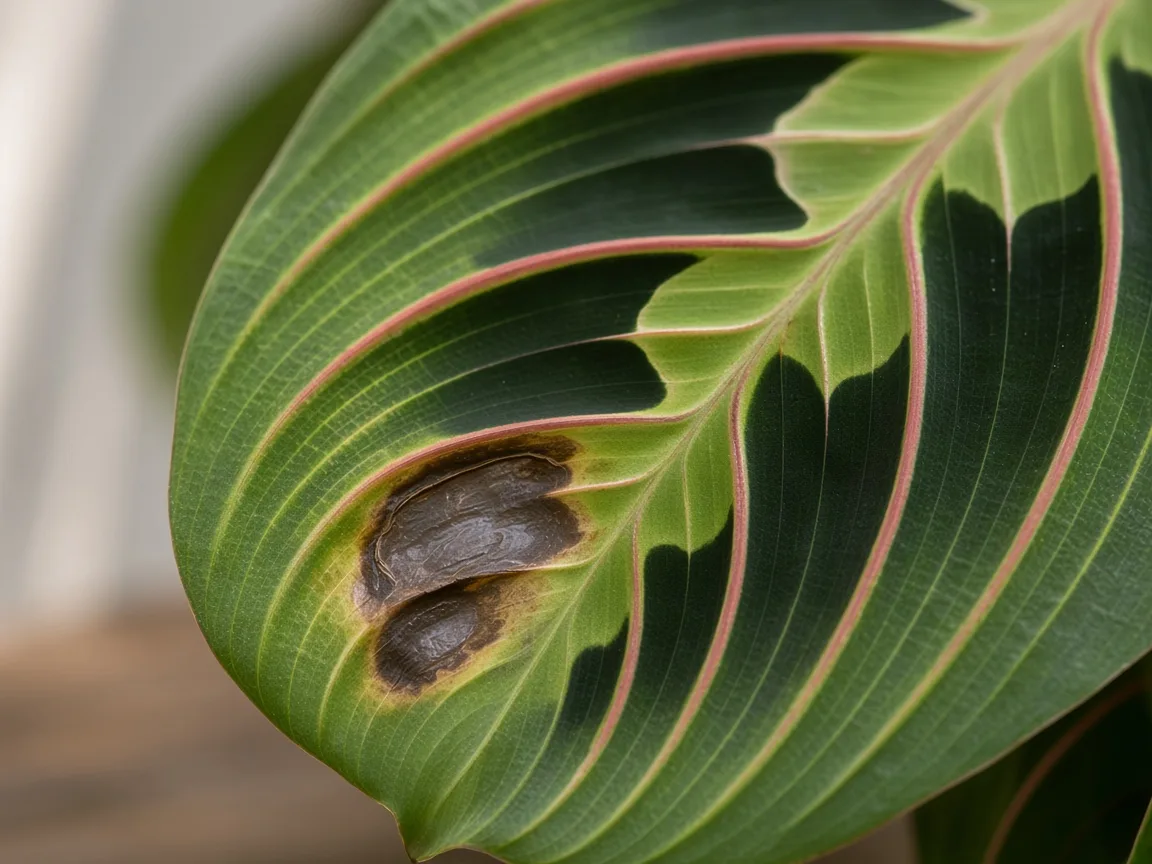
Use a bright lamp and look at both sides of the leaf. Prayer plant leaves are patterned, so compare the mark with the leaf’s natural dark patches and red veins. A true lesion usually interrupts the leaf surface or changes its texture; normal variegation follows the plant’s color pattern and is not wet, sunken, or expanding.
Check these details and write them down:
- Shape and edge. Are there discrete round or angular spots, a larger irregular dead patch, or a uniform dry edge? Fungal houseplant leaf spots can have brown centers and yellow margins, sometimes with rings or tiny dark structures. Clemson Extension describes that pattern in its houseplant disease guidance.
- Texture and underside. Water-soaked or greasy areas, particularly visible from below, can fit bacterial leaf spot. Infected areas may later turn brown or black; a yellow halo is possible but not proof of bacteria. Do not scrape or squeeze lesions as a home test.
- Change over time. Take a dated photo from the same angle. A lesion that expands or joins adjacent lesions is more concerning than an unchanged mark. Look for new spots on leaves that were clean when you first noticed the problem.
- Where the damage begins. Marks only on the window-facing side can fit light or heat injury. Damage concentrated where water droplets dried, or following a recent spray, points toward exposure rather than an infectious diagnosis.
- Stems and roots. If leaf stalks become soft, the crown smells sour, or the plant wilts while the mix stays wet, inspect drainage and roots. Those signs suggest a root or stem problem that needs separate attention; use the Prayer Plant root rot guide rather than treating leaf spots alone.
Because prayer plant grows as a low, rhizomatous clump, note whether the damage is limited to one leaf or appearing across the plant; the Missouri Botanical Garden profile describes this growth habit.
An app or a visual search may suggest possible diseases, but it cannot reliably identify a pathogen from a single image. A diagnostic lab may be needed when the result would change treatment.
What to do first
Isolate the prayer plant and keep its foliage dry while you observe the lesions. Place it where it still receives bright, indirect light and has gentle air movement, with space between leaves and nearby plants. Avoid moving it into direct sun or a cold, drafty spot just to “dry it out.” The goal is to prevent leaf-to-leaf contact and prolonged wetness without stressing a tropical foliage plant.
Do not mist the leaves, shower them, or water overhead while you are assessing possible infection. Direct water onto the potting mix instead. The Prayer Plant watering guide can help you maintain moisture at the roots without leaving the crown or foliage wet. Do not let the mix remain soggy: Maranta wants moisture, but poor drainage can damage roots and create a second problem.
Recovery steps after the first check
If damage is limited to one leaf
If one leaf is mostly dead or the lesion continues to enlarge, remove that leaf with clean scissors. Avoid cutting healthy leaves just because they have a small, stable mark. Clemson Extension recommends removing diseased houseplant material and avoiding splashing; Wisconsin Extension’s houseplant guidance also recommends early removal when a problem is confined to one area.
Clean the scissors before and after the cut, and disinfect between cuts if you remove more than one leaf. Bag the discarded tissue rather than leaving it on the potting mix or beside other plants. Wash your hands before handling another plant. Do not compost the material if you suspect a contagious disease.
If the spots appeared after a care or location change
Review the previous one to two weeks. Did the plant move into stronger direct sun? Was it near a cold window, heating vent, or air conditioner? Did you apply leaf shine, fertilizer, or a spray? Did water collect in the crown or on the leaves overnight? A clear event that matches the damaged side or leaves may make an environmental cause more likely than infection.
Make one correction at a time. Move the plant back to stable, bright indirect light if it was scorched, or stop the suspected product if marks began after spraying. Check the Prayer Plant soil guide if the mix stays wet for a long time, and use the repotting guide only if the mix has broken down, drainage is poor, or roots show decay. An unnecessary repot can add stress and does not treat a pathogen on the leaves.
If fresh lesions continue to appear
Continue isolation, keep leaves dry, and take another set of photos after several days. Record which leaves develop new marks and whether nearby plants are affected. If spread continues despite these steps, contact a university extension office or plant diagnostic clinic with photos and a short history of watering, light, location, and recent sprays. A clinic can advise whether a sample is needed to distinguish fungal disease, bacterial disease, or a noninfectious injury.
Avoid choosing a fungicide based only on the word “blight.” Fungicides do not treat every cause of brown tissue, and a product may not be labeled for indoor use or for this plant. Wisconsin Extension emphasizes confirming the problem before pesticide use; follow the label exactly if a qualified diagnosis leads to a product recommendation.
Lookalikes to rule out
| Pattern | More likely explanation | What to check next |
|---|---|---|
| Large pale or tan patch on the window side, stable after the plant is moved | Sun or heat injury | Review recent placement and the Prayer Plant light guide. |
| Dry, crispy edges across several leaves without separate spots | Watering, humidity, or salt stress | Check the mix and water routine; compare with brown tips on Prayer Plant. |
| Yellowing and limp leaves while the mix is wet, possibly with soft roots | Root stress or rot | Check drainage and roots; see root rot. |
| Fine pale stippling, webbing, sticky residue, or visible insects | Pests rather than blight | Inspect leaf undersides and use the relevant pest guide. |
| Lesions that expand, merge, or appear on new leaves after prolonged wet foliage | Possible infectious leaf spot or blight | Keep isolated and seek a reliable diagnosis before spraying. |
Prayer plant’s nightly leaf movement is normal. Leaves lifting after dusk is not itself a sign that infection is spreading. What matters is whether tissue is developing new lesions, becoming water-soaked or necrotic, or collapsing at the stem.
Recovery and when to discard the plant
Damaged leaf tissue will not become green again. Recovery means the existing marks stop advancing, healthy petioles remain firm, and new leaves open without similar lesions. Keep a weekly photo log for a few weeks rather than judging the plant by the old damaged tissue.
If the crown and most stems turn soft, the plant collapses, or suspected disease keeps spreading across several nearby plants, ask a local diagnostic service whether it is worth keeping. UC IPM notes that some established houseplant problems are difficult to manage and that discarding a severely affected plant can be the practical choice. If you do discard it, clean the pot and tools before reusing them.
Preventing another outbreak
- Inspect the top and underside of leaves when watering, especially new leaves as they unfurl.
- Keep enough space around the plant for leaves to dry and air to move. Maranta can enjoy a humid room while its leaves still stay dry; high ambient humidity is not the same as leaving water on the leaf surface.
- Water the soil rather than the canopy, and keep the pot draining freely. The Prayer Plant overview and watering guide cover the plant’s normal moisture needs.
- Quarantine new or returning plants for a short observation period and inspect them before placing them beside the prayer plant.
- Use clean scissors and remove fallen, dead tissue from the pot surface.
- Do not apply routine fungicide or fertilizer as prevention. Correct light, watering, airflow, and sanitation first.
Related tool
Use the Plant Problem Diagnosis Tool to compare spots, care changes, and root symptoms before deciding whether a disease diagnosis is needed.
Related Prayer Plant guides
Use this page when leaf lesions are expanding or merging. For other patterns, start with the closest match: brown tips for dry margins, sunburned leaves for damage after stronger light, or root rot for soft roots and wilt in wet mix. See the Prayer Plant problems hub to compare symptoms, and use the plant’s soil guide or repotting guide if drainage is part of the problem.