Stromanthe Magic Star Light Requirements & Placement
Stromanthe Magic Star Light Requirements & Placement
Stromanthe Magic Star Light Requirements & Placement
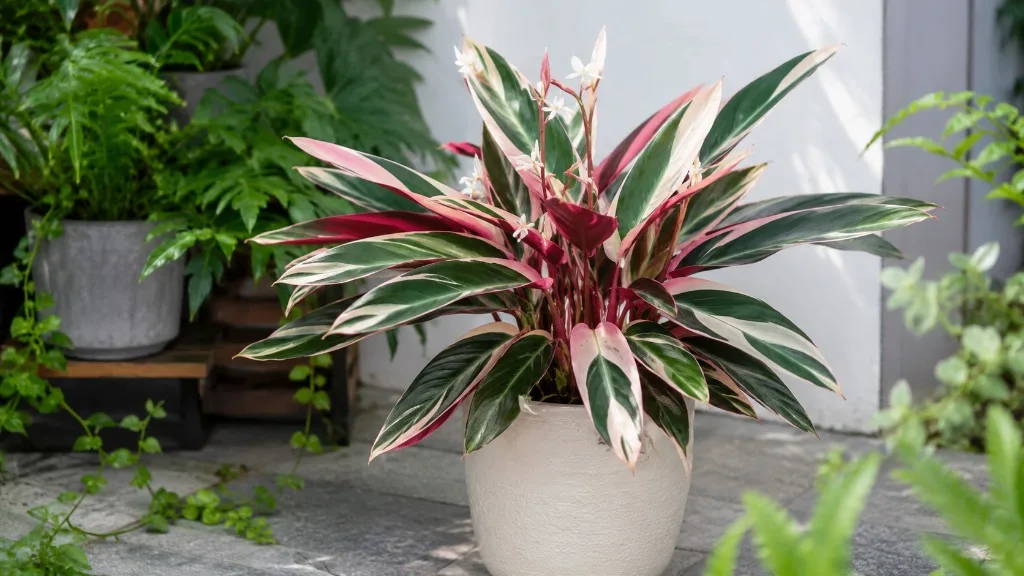
Stromanthe Magic Star is one of those houseplants you notice from across the room — long lance-shaped leaves splashed with cream, green, and pink in a star-scatter pattern, with burgundy undersides that flash when the foliage folds at night. That color is living tissue with uneven pigment distribution across a thin leaf blade, and uneven pigment changes how the plant handles light at the cellular level. Give Magic Star the wrong exposure and you do not get a slow, dignified decline. You get pink and cream that wash toward green in dim corners, or bleached, crispy patches on the palest splatter zones when harsh afternoon sun hits unfiltered glass.
Magic Star at a glance: Stromanthe sanguinea ‘Magic Star’ — a pink-and-green variegated prayer plant related to Triostar. Foliage: long leaves splashed with pink, cream, and green with magenta undersides; pale variegation needs bright indirect light and clean water. Humidity: high humidity (at least 60%); pink panels crisp faster than green tissue in dry air. Water: filtered, distilled, or rainwater — variegated stromanthe shows mineral burn on cream and pink zones within weeks. Difficulty: moderate to high — same care band as Triostar with slightly softer pink tones.
The practical target for Stromanthe sanguinea ‘Magic Star’ — the star-splatter sibling to the more striped Triostar cultivar — is bright indirect light for most of the day. That means strong ambient brightness where rays reach the canopy without sitting in the direct sun path during the hottest hours. Wisconsin Horticulture Extension recommends bright light for the best variegation on the species band Magic Star belongs to, and Missouri Botanical Garden notes that foliage burns in direct sun. Magic Star is not an exception because the splatter pattern looks softer than Triostar stripes. If anything, the scattered cream and pink panels make light placement more consequential, not less.
How Much Light Stromanthe Magic Star Actually Needs
Stromanthe species evolved in the shaded understory of Brazilian rainforests, where light arrives filtered through canopy gaps rather than as sustained direct beams. Magic Star inherits that ecology through thin leaves, high humidity demands, and visible responses to both photon deficit and photon overload.
For home growers, Magic Star should live where the plant faces open-sky brightness for roughly 6 to 8 hours daily, with direct rays limited to gentle morning exposure or heavily filtered afternoon light. Medium indirect light keeps many prayer plants alive, but Magic Star’s star-splatter variegation intensity usually softens there within a few new leaves. Too little light produces green drift, slow spear unfurling, and faded pink; too much produces bleached and burned pale zones on cream and pink tissue while greener sections may still look fine for a few days.
Light also sets the pace for watering and overall metabolism. A Magic Star in proper bright indirect light uses water at a predictable rate, unfurls new spears steadily, and holds color on emerging foliage. The same plant in a dim corner with wet soil stalls growth, leans toward the window, and loses pink splatter node by node — a common silent spiral in the Marantaceae family where growers blame humidity when light was the limiting factor all along.
The Short Answer for Busy Growers
If you only remember four rules, use these. Default placement: bright indirect light within 2 to 4 feet (60 to 120 cm) of an east-facing window, or a filtered west or south window where the plant sees sky but not a hard sun disk at midday. Variegation goal: prioritize brightness enough that new spears and unfurling leaves keep vivid pink, cream, and green contrast; fading on old leaves alone is not the test. Direct sun rule: brief morning sun can work when acclimated; unfiltered midday and afternoon sun on pale panels is high risk for scorch and bleach. Diagnostic habit: judge light by the newest spear or unfurling leaf after 10 to 14 days in a spot — old damage does not heal, only new growth tells the truth.
Do not change light, watering, humidity tools, and pot size in the same week. Move the plant, wait for a new spear to open, then adjust water if dry-down speed changed.
Foot-Candles, Clemson Medium-Light Floor, and Magic Star Targets
Human eyes are poor light meters. A dim corner and a bright window can both feel “fine” after a few minutes of adaptation, which is why foot-candle ranges help anchor placement decisions. Clemson Extension classifies medium light as a minimum of 100 to 150 foot-candles, with 200 to 500 preferred for good growth — and notes that the interior of a well-lighted home is often less than 100 foot-candles, which explains why a room that looks bright to you can still starve a variegated prayer plant.
For Magic Star, treat 100 to 150 foot-candles as the survival floor for maintaining structure, and aim for roughly 200 to 400 foot-candles at leaf height when you want strong pink splatter and crisp cream panels on new growth. UF/IFAS Gardening Solutions places medium indoor light in the 100 to 500 foot-candle band — usually near windows without direct sun, or in shaded east and west exposures. Optional phone lux apps help compare spots; the new-spear color test still matters more than chasing one perfect reading.
Why Magic Star Foliage Is Light-Sensitive in the Prayer Plant Family
Not all houseplant leaves respond to light the same way. A solid green Pothos has chlorophyll distributed across most of the lamina, which gives cells more capacity to absorb useful light and dissipate excess energy safely. Stromanthe Magic Star is different. Its beauty is star-splatter variegation — cream, green, and pink breaking across each blade with burgundy undersides — rather than the herringbone stripes of Calathea or the more banded look of Triostar. That patchwork creates tissue types on a single leaf, and the palest splatter zones are structurally disadvantaged in both low light and high light.
In low light, the plant cannot afford to maintain high-contrast variegation across slow-growing rhizomes. It compensates by pushing more chlorophyll into newer growth, which reads as greener, duller, less pink foliage. In high direct light, the same pale zones lack the pigment machinery to process sudden photon load, so they bleach, collapse, or necrose into crisp brown patches while greener sections may still look fine for a few days. Magic Star is therefore more demanding than many solid green houseplants even though it shares a care tag with easier tropicals — and its cream and pink splatter panels are especially sensitive during spear formation, when new leaves expand under whatever light level the plant currently receives.
Rainforest Understory Context and Nyctinasty
In the wild, Stromanthe grows on the rainforest floor and lower understory of Brazil, where light is dappled, humidity is high, and direct sun is rare. That ecology explains two behaviors indoor growers often misread. First, Magic Star wants filtered brightness, not shade and not blazing glass. Second, it performs nyctinasty — the prayer-plant habit of raising leaves at night and lowering them by day — which Wisconsin Horticulture Extension describes as leaves that fold up at night and reorient toward morning light.
Nyctinasty does not replace light diagnostics. A Magic Star can fold beautifully at night while still living in too dim a room, or it can scorch during the day while still moving at dusk. Use leaf color on new growth and scorch patterns as your primary light evidence, not nightly folding alone.
How Pale Cream and Pink Splatter Panels Respond to Light
Chlorophyll does more than make leaves green. It is the core photosynthetic machinery, and it participates in managing light energy flow through the leaf. In cream, pink, and lightly variegated zones, chlorophyll density is lower by design. Those cells reflect more light — which is why they look pale — but they also have less capacity to convert or safely dissipate excess energy when direct sun hits.
Pink coloration in Magic Star is tied to anthocyanin pigments, which require adequate light to develop and maintain. When light is too low, the plant produces less anthocyanin and increases chlorophyll production instead, causing new leaves to emerge more green and less pink. Wisconsin Horticulture Extension notes that plants grow in lower light but bright light produces the best color development. When strong direct rays land on pale tissue, energy can outpace the leaf’s protective chemistry. The result is photobleaching, followed by necrosis on the most exposed zones. Green tissue on the same leaf may tolerate the exposure longer, which confuses growers who see partial burn and assume fungal disease or watering error. On Magic Star, scorch often starts on the creamiest and pinkest splatter panels facing the window. Bright indirect light delivers energy without that spike; direct sun destroys the feature you bought the plant for.
Bright Indirect Light and Star-Splatter Variegation
Bright indirect light is the phrase every prayer plant care sheet repeats, and it is also the phrase most growers misunderstand. It does not mean “any room that feels airy.” It means the plant receives strong, diffuse illumination — enough to cast a soft shadow at midday — without sustained direct sun on the leaf surface.
For Magic Star, bright indirect light supports three outcomes simultaneously. It supplies enough energy for steady spear production rather than a stalled clump that sits unchanged for months. It maintains vivid pink, cream, and green contrast on new foliage. And it keeps metabolism high enough that your Stromanthe Magic Star watering guide stays predictable — a dim plant in wet soil is a common root-rot setup for Marantaceae species that look dramatic long before they are truly lost.
Rotate the pot a quarter turn weekly so variegated leaves develop evenly instead of leaning hard toward one bright side, and so you catch early scorch on the window-facing face before it spreads across the whole blade.
What Bright Indirect Means in a Real Room
Use these room-level checks instead of guessing from ceiling brightness.
Shadow test: At midday, hold your hand between the plant and the window. A fuzzy, soft shadow with visible edges means useful indirect brightness. A sharp, dark shadow means direct sun is hitting the plane — fine for a few morning minutes if acclimated, risky for pale variegation at midday. No meaningful shadow means the spot is below the productive 100 to 150 foot-candle floor Clemson Extension cites for medium-light foliage plants.
Leaf-level test: Place the pot so light lands on the canopy, not just the floor beside it. Magic Star is often displayed on plant stands, shelves, or floor corners where the room looks bright but the leaves sit below window height. “Near a window” should mean the top of the foliage sees window sky, not that the pot sits in a corner while the glass is three meters away.
Season test: Winter sun angle can pull rays onto a previously safe sill — bleach appears on cream panels even though “nothing changed” in your routine. Summer heat through west glass can do the same even when winter placement was perfect.
Reading New Spears and Unfurling Leaves
Old leaves are history. On Magic Star, judge light by the newest rolled spear and the youngest fully opened leaf at the crown.
Healthy bright-indirect growth looks like this: the spear unfurls firm and smooth without crisping at the pale zones; pink, cream, and green splatter is obvious within days of opening, with clear contrast across the blade; new spears appear at a steady rhythm during the growing season rather than stalling for months; and the plant holds an upright, balanced posture rather than collapsing sideways toward the brightest vector.
Low-light new growth looks different: spears emerge smaller than recent predecessors; pink fades toward cream or white, then green dominates the blade; unfurling slows dramatically or stalls with brown tips on the rolled spear; and the whole clump may angle sharply toward the brightest window. These are not cosmetic flaws — they are the plant reporting photon deficit.
High-light new growth failures show up as tan or brown dry patches on pale tissue during or right after unfurling, translucent bleached zones where pink used to be, curling on the window-facing margin even when soil moisture and humidity are correct, or sudden leaf collapse after a move from shade to blazing glass. If scorch appears only on the creamiest and pinkest sections while green areas remain intact, you are almost certainly looking at direct sun or reflected heat, not root rot on Stromanthe Magic Star.
Best Window Placement for Stromanthe Magic Star
Window direction is a map, not a guarantee. A “west window” shaded by a porch roof may behave like east light, while an east window with no outdoor obstructions can deliver surprisingly strong morning rays. Still, compass orientation gives a reliable starting point for distance from glass and curtain strategy.
Magic Star performs best when it can live close enough to benefit from window brightness but protected from sustained direct beams on its palest tissue. For many homes, that means east exposure or offset placement from south and west glass — not pressed against unfiltered panes through hot afternoon hours. Missouri Botanical Garden recommends eastern windows with high humidity for houseplant culture, with part shade or dappled light outdoors.
East, South, West, and North Windows Compared
An east-facing window is the most reliable default. Morning sun is bright but relatively cool, which helps intensify pink tones without instantly bleaching pale panels. Start 2 to 3 feet (60 to 90 cm) from east glass for medium-to-bright filtered exposure without sunburn.
A north-facing window delivers gentle, consistent indirect light year-round in the Northern Hemisphere. Magic Star often thrives here because the light is bright enough to maintain color without the scorch risk of south and west glass. North is underrated for Stromanthe Magic Star overview — many growers assume colorful plants always need south windows, then burn Magic Star trying to force intensity.
A south-facing window delivers the strongest year-round sun. In winter, south light can work pulled back from the pane or behind sheer fabric. In summer, south glass can magnify heat and scorch pale tissue within days — use diffusion at peak hours and treat south placement as a seasonal dial, not a fixed rule.
A west-facing window is higher risk. Afternoon sun carries more heat load, and harsh midday and afternoon direct sun on pale panels causes the most predictable damage. West can work with 3 to 5 feet (90 to 150 cm) of setback or a sheer curtain — treat it as a trial placement and watch the window-facing leaf face daily for the first two weeks.
Distance From Glass and Seasonal Shifts
Distance controls intensity more precisely than compass labels. Use distance as your fine dial after choosing the best available window.
East glass: start 2 to 3 feet (60 to 90 cm) from the window. Move closer if new spears show low-light fade; move back if pale zones crisp on morning-facing leaves.
North glass: keep as close as practical to the brightest zone. North usually forgives closeness better than south or west because direct beam risk is lower, but watch winter readings that slip below 100 to 150 foot-candles.
South glass: start 3 to 5 feet (90 to 150 cm) back or on the sill behind sheer curtain. Watch the window-facing leaf face daily for the first week after any move.
West glass: start 3 to 5 feet (90 to 150 cm) back unless curtained. Heat plus light kills pale tissue faster than light alone.
Seasonal shifts matter on Magic Star because damage shows within days on thin leaves. In winter, lower sun angle can suddenly put a previously safe sill into direct beam path — bleach appears on cream panels even though your watering schedule stayed the same. In summer, longer days and higher heat may require pulling the pot back or adding diffusion even if winter placement was perfect. In short winter days, consider a grow light before accepting green drift as normal.
For bathrooms and bright hallways, remember that humidity does not replace light. A steamy east bathroom can be excellent for Magic Star if the leaves still receive real window brightness. A humid dim corner will still green out the variegation.
Direct Sun Risk and Scorched Pale Tissue
Direct sun is the fastest way to ruin Magic Star’s display value. Unlike some succulents that need hard light to color up, this plant evolved under canopy shade where dappled brightness was the ceiling, not full solar exposure. When growers press Magic Star against an unfiltered south or west sill “because colorful plants need sun,” the pale panels bleach first — often within 48 to 72 hours of a sudden move.
Direct sun damage is not always total-leaf death. It frequently presents as localized necrosis on cream and pink zones while green tissue looks acceptable briefly, which leads to delayed action. By the time the whole blade crisps, the placement mistake is days old. Trim severely damaged leaves if they are mostly necrotic, but understand that scorched tissue does not recover — your proof of fix is the next healthy spear, not the old blade greening back.
Morning Sun Tolerance vs Afternoon Heat Load
Not all direct sun is equal. Early morning sun from an east window is lower in heat load and shorter in duration, which is why some acclimated Magic Stars tolerate a bit of morning beam on the leaf surface without immediate collapse. Late morning through afternoon sun — especially from west and south glass — combines higher energy with longer exposure and window-heated air, which dries pale tissue faster than roots can compensate even in humid rooms.
If you want to test slightly brighter placement, do it in spring or fall when heat stress is lower, move the plant in 6-inch (15 cm) increments over 7 to 14 days, and stop the moment pale panels show translucence or crisping. Never jump from a dim interior shelf to a blazing sill in one afternoon. Leaves formed in low light lack the structural and pigment readiness for sudden hard sun — acclimation must be gradual or you will lose the showiest foliage first.
Reflected sun counts too. Mirrors, white walls, glass tables, and bright patios can bounce beams onto Magic Star even when the pot is not in the direct window path. If scorch appears despite “indirect” placement, scan the room for hot reflections during midday.
Low-Light Limits and Green Drift
Magic Star can survive in medium indirect light longer than many growers expect, which is part of the problem — survival masks slow variegation loss until the plant looks like a plain green Stromanthe with a memory of pink. Low light does not usually kill Magic Star quickly. It dims the star-splatter, slows spear production, and stretches the plant toward the brightest vector in the room.
The mechanism is straightforward. With insufficient photons below the 100 to 150 foot-candle medium-light minimum, the plant prioritizes photosynthetic efficiency over ornamental pigment. Anthocyanin production drops, chlorophyll rises, and new leaves emerge greener and less patterned. Old leaves may still show faded pink and cream for weeks, which tricks growers into thinking the plant is fine while every new spear confirms the decline.
Low light also changes watering risk. A dim Magic Star uses water slowly. If you keep the same watering schedule that worked near an east window, soil stays wet longer, roots lose oxygen, and you get yellowing, speckling, or edge crisping that looks like humidity failure but started with light deficit plus overwatering on Stromanthe Magic Star.
Short-term quarantine or recovery: After shipping stress or Stromanthe Magic Star repotting guide, a stable medium-light spot can reduce additional stress while roots settle — but move to brighter indirect once new growth resumes. North window in a bright room may hold acceptable color if the plant is close to glass, though pink intensity will usually be softer than an east placement. Supplemental grow light plus medium natural light often outperforms a dim south sill with no lamp.
Grow Lights for Dim Homes and Winter Short Days
Natural light is not always negotiable. Basement apartments, north-only bedrooms, office cubicles, and short winter photoperiods can all drop leaf-level brightness below what Magic Star needs to hold star-splatter variegation. A full-spectrum grow light is a legitimate primary light source, not a desperation move.
The goal is to mimic understory brightness — strong but diffuse — not to blast the canopy like a desert succulent. Full-spectrum LED grow lights are the most practical choice for home growers because they run cooler than older HID fixtures and can be timed precisely. Position the fixture 12 to 18 inches (30 to 45 cm) above the top of the foliage, and run it 12 to 14 hours daily on a timer to approximate useful day length. Wisconsin Horticulture Extension notes that plants grow in lower light but need bright light for vivid variegation — a grow lamp supplements when natural windows fall short.
Start conservatively. A lamp too close causes the same pale-tissue bleaching as window scorch, just from a different direction. Begin at the far end of the recommended distance range, watch the next spear for color and firmness, then lower the fixture 2 inches (5 cm) at a time only if new growth shows low-light fade. If pale panels bleach or curl despite correct watering, raise the light or reduce hours before assuming humidity is the culprit.
Fixture Height, Hours, and Spectrum Basics
Use these starting parameters and adjust by new-growth response.
Distance: 12 to 18 inches (30 to 45 cm) from leaf top for most household LED panels; taller for high-output commercial boards.
Duration: 12 to 14 hours daily on a timer. Magic Star does not want 24-hour light — nyctinasty and rest cycles still matter. Clemson Extension notes that sixteen hours of light and eight hours of darkness are satisfactory for most indoor plants when supplementing weak natural light.
Spectrum: Full-spectrum white LED in the 4000K to 6500K range; avoid heavy red-only bloom bulbs for foliage maintenance.
Placement: Center the beam over the crown where new spears emerge, not just the pot rim. Rotate the plant weekly for even color.
Adjustment signals: Move the lamp closer if new leaves green out and spears shrink; move it farther if pale zones bleach or leaves curl upward during lamp hours.
Grow lights pair well with east or north windows — use the window for ambient fill and the lamp for consistent intensity through winter. Do not leave Magic Star in a dim room with a weak accent lamp across the room and call it lit. Leaf-level flux at the canopy is the standard.
Warning Signs Your Magic Star Has the Wrong Light
Magic Star communicates light mistakes on new foliage faster than many slow-growing tropicals, but only if you know which signs map to which direction. Use this checklist as a placement decision tool, not as a substitute for checking roots or humidity when multiple stressors overlap.
Too much light — move back, diffuse, or acclimate more slowly:
- Bleached white or tan patches on cream and pink splatter panels, especially on the window-facing side
- Crispy brown necrosis that appears on pale tissue first, green tissue second
- Upward curling or folding during the brightest hours despite adequate soil moisture
- Sudden damage within days after moving closer to glass or removing a curtain
- New spears that open already scorched at the pale zones
Too little light — brighten gradually or add a grow lamp:
- New leaves emerging mostly green with reduced pink and cream patterning
- Pink fading to near-white or cream on successive spears, then disappearing
- Slow or stalled spear unfurling over many weeks in the growing season
- Smaller new blades compared to older leaves formed in brighter conditions
- Strong lean or asymmetrical growth toward the brightest window or lamp
Light is likely acceptable — keep the placement steady:
- New spears open with clear star-splatter contrast within days
- Steady spear rhythm in spring and summer without long stalls
- Nyctinasty continues with firm leaves that are not crisping at edges
- Dry-down rate matches your watering habit without chronic wet soil in the root zone
When symptoms conflict — yellowing plus scorch, or crisp edges plus green drift — check watering and humidity after fixing the obvious light mismatch. Marantaceae plants often fail from two variables changing at once, which is why the single-change rule matters. Move light first, wait for a new spear, then adjust water.
Conclusion
Stromanthe Magic Star light requirements boil down to a single principle stated three ways: give the plant bright indirect light for vivid star-splatter foliage, protect cream and pink panels from harsh direct sun, and judge success by new spears rather than old leaves that will never regain lost pigment. East and north windows are the easiest wins in most homes; south and west work when distance and sheer curtains block the hot beam path. Aim for at least 100 to 150 foot-candles at the leaves per Clemson Extension’s medium-light floor, with 200 to 400 foot-candles when you want the pinkest, crispest new growth.
Magic Star is not failing because it is dramatic. It is a rainforest understory prayer plant with thin, tricolor leaves that respond honestly to photon surplus and deficit. Place it where the canopy sees real sky brightness, rotate the pot weekly, acclimate gradually if you need more intensity, and add a full-spectrum grow light when winter or room layout cannot deliver leaf-level light. Get the placement right and watering becomes simpler, pink returns on new growth, and the plant earns its reputation as a living watercolor instead of a slow green disappointment.
When to use this page vs other Stromanthe Magic Star guides
- Stromanthe Magic Star overview - Start here for whole-plant context before deep-diving this topic.
- Stromanthe Magic Star problems hub - Jump to symptom-specific fix guides when this care topic does not resolve the issue.
- Not Enough Light on Stromanthe Magic Star - Escalate here when light adjustments are not enough.
- Leggy Growth on Stromanthe Magic Star - Escalate here when light adjustments are not enough.
Related Stromanthe Magic Star guides
- Stromanthe Magic Star overview
- Stromanthe Magic Star watering
- Stromanthe Magic Star soil
- Stromanthe Magic Star propagation
- Stromanthe Magic Star fertilizer
- Stromanthe Magic Star repotting
- Not Enough Light on Stromanthe Magic Star
- Leggy Growth on Stromanthe Magic Star
- Stromanthe Magic Star problems
Magic Star-specific humidity and water quality
Stromanthe Magic Star is a Marantaceae prayer plant, so high humidity (at least 60%) matters — pink panels crisp faster than green tissue in dry air — and filtered, distilled, or rainwater limits mineral burn on cream and pink zones. Misting alone rarely holds humidity long enough — use a humidifier, pebble tray, or grouped tropical placement. If new leaves open with brown edges while soil moisture looks correct, switch water sources before changing your watering schedule.