Stromanthe Magic Star Care Guide
Stromanthe sanguinea 'Magic Star'
Stromanthe Magic Star care: bright indirect light, high humidity (at least 60%), filtered water, evenly moist soil, and rhizome division. Pet safe.
Stromanthe Magic Star Care Guide
Start with wateringThe most common care mistake for Stromanthe Magic StarWatering guide →Stromanthe Magic Star care essentials
Light
Water
Water when top inch dries; use filtered, distilled, or rainwater. Keep evenly moist spring–summer; slightly drier in winter.
Soil
Well-draining peat- or coco-based mix with perlite; moist but never waterlogged.
Humidity
high humidity — at least 60%
Temperature
65–75°F (18–24°C); avoid cold drafts
Fertilizer
Feed lightly during active growth. Use monthly during spring and summer.
About Stromanthe Magic Star
Stromanthe Magic Star has a upright growth habit. It is also known as Magic Star Stromanthe and Stromanthe tricolor Magic Star.
| Detail | Information |
|---|---|
| Also known as | Magic Star Stromanthe, Stromanthe tricolor Magic Star |
| Growth habit | Upright |
| Scientific name | Stromanthe sanguinea 'Magic Star' |
Stromanthe Magic Star Care Guide
What Is Stromanthe Magic Star?
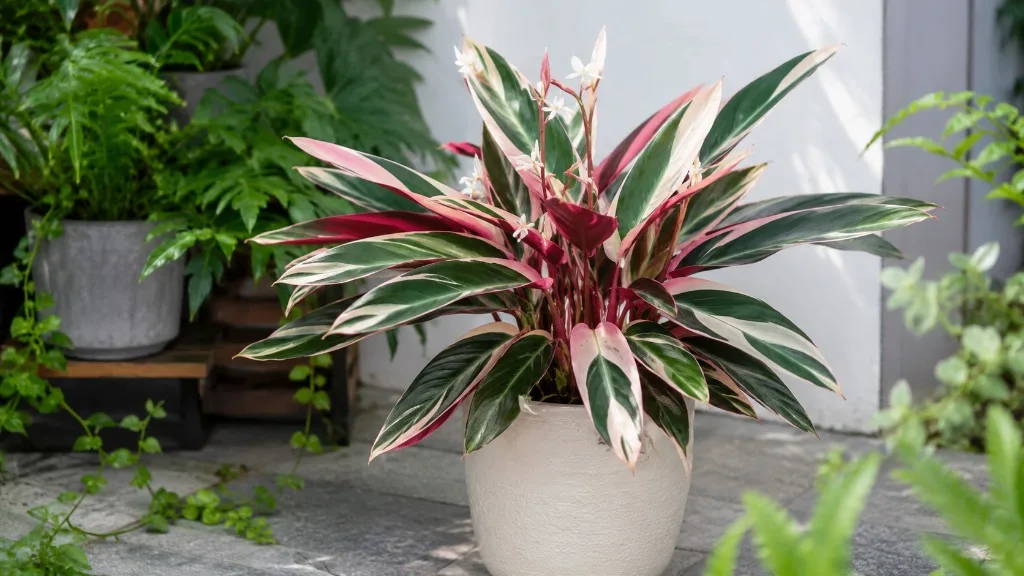
Magic Star at a glance: Stromanthe sanguinea ‘Magic Star’ — a pink-and-green variegated prayer plant related to Triostar. Foliage: long leaves splashed with pink, cream, and green with magenta undersides; pale variegation needs bright indirect light and clean water. Humidity: high humidity (at least 60%); pink panels crisp faster than green tissue in dry air. Water: filtered, distilled, or rainwater — variegated stromanthe shows mineral burn on cream and pink zones within weeks. Temperature: 65–75°F (18–24°C); avoid cold drafts. Difficulty: moderate to high — same care band as Triostar with slightly softer pink tones.
Stromanthe Magic Star — also sold as Magic Star Stromanthe or Stromanthe tricolor Magic Star — is a tropical foliage houseplant prized for elongated leaves painted in green, cream, and pink with a softer star-splatter pattern than the bold stripes of Stromanthe sanguinea ‘Triostar’. Deep magenta undersides glow when light passes through the canopy at dusk. It belongs to the Marantaceae family alongside Calathea, Maranta, and Ctenanthe. Indoors, Magic Star typically reaches 24 to 36 inches (60 to 90 cm) in height and spread as an upright, clumping perennial with moderate growth in stable conditions.
If you are deciding whether Stromanthe Magic Star fits your home, the honest summary is this: Magic Star rewards consistent humidity, filtered water, and bright indirect light — and it punishes dry air, hard tap water, and irregular watering faster than most foliage plants. It is not impossible to grow, but it is more demanding than a pothos or snake plant. The payoff is one of the most colorful non-flowering displays you can keep indoors, plus a plant widely recognized as non-toxic to cats and dogs when sourced from reputable growers.
Botanical Background and the Prayer Plant Family
Stromanthe Magic Star belongs to Marantaceae, commonly called the prayer plant family. Members share baseline indoor rules: they prefer warm, humid air, dislike sudden temperature swings, and show stress on leaf margins long before the entire plant fails. If you have grown a calathea or maranta, you already understand the general rhythm; Magic Star sits in a similar care band with slightly more emphasis on bright light to hold variegation on pale panels.
Botanically, Magic Star is Stromanthe sanguinea ‘Magic Star’ — a cultivar of the species also known as Stromanthe thalia in current taxonomy. Wisconsin Horticulture Extension notes that the species name was changed to S. thalia but nursery tags still list S. sanguinea, and variegated clones including Triostar and Magic Star share the same species band. The plant is native to tropical rainforests of Brazil, where it grows in the shaded understory beneath a closed canopy. That origin explains nearly every indoor requirement: warm temperatures, high humidity, filtered light, and evenly moist but never waterlogged soil.
Like other Marantaceae members, Magic Star displays nyctinasty — leaves lift and fold slightly at night, then reopen in the morning. This daily movement is driven by a pulvinus at the leaf base and is a sign of healthy turgor when it happens on schedule. If leaves stay rolled or limp during daylight hours, that usually points to dry air, underwatering, or cold stress instead.
Magic Star vs Triostar: Same Species, Different Pattern
Retail tags confuse growers because Magic Star and Triostar are sibling cultivars of the same species, not different plants with different care sheets. Both are variegated selections of Stromanthe sanguinea with cream, pink, and green on long lance-shaped leaves and burgundy undersides. Missouri Botanical Garden describes the species cultivar group as featuring olive green leaves variegated with white, cream, and pink — names like ‘Triostar’, ‘Tristar’, and ‘Tricolor’ circulate for the striped form.
Magic Star reads softer and more scattered — a star-splatter wash across each blade rather than Triostar’s bolder longitudinal bands. Pink tones are often slightly muted. Care requirements overlap completely: both need high humidity (at least 60%), 65–75°F (18–24°C), filtered water, and bright indirect light. Do not buy Triostar care advice and assume Magic Star is easier; do not buy Magic Star expecting Triostar’s graphic striping. Judge success on newest unfurling leaves holding pink and cream splashes, not on matching a reference photo of a different cultivar.
Why the Foliage Demands Extra Attention
The variegation on Magic Star is unusually sensitive to environment. Cream and pink panels contain less chlorophyll than green zones, which makes those sections more vulnerable to direct sun scorch and more dependent on adequate light to stay vivid. When the plant is too dim, new leaves emerge mostly green and the pink wash fades. When the plant is too bright without acclimation, pale panels bleach to paper-white before brown scorch appears at the margins.
The magenta leaf undersides are not just decorative. They add depth when the plant folds in the evening and create a striking display when backlit by a nearby window with sheer filtration. Dust on the broad leaf surface dulls both the top pattern and the underside glow, so a gentle wipe with a damp soft cloth every few weeks improves appearance and photosynthetic efficiency. Among prayer plants, Magic Star is often chosen as a statement specimen for living rooms and bright bedrooms where humidity can be managed — it is less suited to dry offices, drafty hallways, or rooms with only north-facing exposure unless you supplement light and humidity deliberately.
Best Growing Conditions for Stromanthe Magic Star
Magic Star does best when your room approximates the stable understory conditions of its native range. The four variables that decide almost every outcome are light, water, soil, and humidity (with temperature acting as the frame around all four). Get those aligned and feeding, repotting, and propagation become routine. Get one badly wrong — especially humidity or water quality — and the plant will show crispy leaf edges and faded variegation long before the roots fail completely.
Light Requirements
Stromanthe Magic Star needs bright, indirect light to maintain its splatter variegation. In practical home terms, that means a spot where the plant receives strong ambient daylight but no more than a sliver of direct sun on the leaves. East-facing windows are often ideal: gentle morning light, then bright indirect exposure the rest of the day. North windows work in bright rooms. West- and south-facing windows can work too, but place the pot at least 2 feet (60 cm) back from the glass or filter the light with a sheer curtain.
Direct sun is the fastest way to damage pale panels. Leaves exposed to harsh midday or afternoon sun develop bleached patches, brown scorch marks, or curled edges on the sun-facing side — and the pink and cream zones burn before the green tissue does. UF/IFAS Gardening Solutions notes that too much sun causes unsightly brown splotches on variegated stromanthe foliage. A little early-morning direct sun is tolerable for established plants if they were grown in similar conditions, but do not move a shade-grown nursery plant straight onto a south sill without acclimating over one to two weeks.
Low light is survivable but costly to the display. In dim corners, expect slower growth, smaller new leaves, loss of pink coloration, and longer internodes as the plant reaches toward the brightest source. Low light also slows drying, which increases overwatering risk if you keep the same summer watering schedule all year. A full-spectrum grow light on a 10–12 hour timer, positioned 12–18 inches above the canopy, can supplement weak natural light without the heat stress of an unfiltered sunny window.
Temperature and Humidity
Stromanthe Magic Star prefers stable indoor temperatures between 65 and 75°F (18 and 24°C). Wisconsin Horticulture Extension notes that most Marantaceae suffer when temperatures fall below 60°F, and this species prefers warmth above 65°F. Magic Star reacts badly to cold drafts, sudden drops below 60°F (15°C), and hot dry air from heating vents or radiators. Do not place the pot on a windowsill where winter glass chills the leaves overnight, and keep it away from air-conditioning vents that blow directly on the foliage.
Humidity is the defining care variable for Magic Star. Missouri Botanical Garden recommends houseplants in eastern windows with high humidity, and Wisc Extension warns that without adequate humidity leaves dry out starting along the edges. Target high humidity — at least 60% for the cleanest margins on pale tissue. Many households sit at 30–40% in winter, which is why brown tips and edge crisping are the most common complaints even when watering looks correct.
Raising humidity effectively means changing the air around the plant, not misting leaves once a day. A small humidifier placed near the plant is the most reliable method and the only approach that consistently holds levels above 60% through heating season. Secondary options include grouping humidity-loving plants together, using a pebble tray (pot elevated above water, not sitting in it), or placing the plant in a naturally humid room such as a bright bathroom or kitchen. Misting provides only minutes of elevated humidity and can leave water spots on pale variegation or encourage fungal issues if droplets sit on folded leaves overnight — treat it as cosmetic, not structural, humidity support. A hygrometer near the plant tells you whether your setup is actually working rather than guessing from leaf symptoms after damage appears.
Soil and Drainage
Use a moisture-retentive but well-draining potting mix with high organic matter and added perlite or similar coarse amendment. Magic Star roots need access to moisture and oxygen at the same time — a heavy, compacted peat mix that stays waterlogged for days is one of the fastest paths to root rot. Missouri Botanical Garden recommends fertile, moist but well-drained soils that must never be allowed to dry out completely. A workable home recipe is roughly two parts quality peat-free or peat-based houseplant mix, one part perlite, and one part orchid bark or coco chips — adjust toward more perlite if your home runs warm and bright, or slightly more organic matter if you struggle to keep moisture even between waterings.
Target a slightly acidic to neutral pH around 6.0–7.0. Exact pH metering is rarely necessary for hobbyists; the bigger issue is salt and mineral buildup from hard tap water and over-fertilizing, which show up as crust on the soil surface and brown leaf tips. Always use a pot with a drainage hole. Decorative cachepots are fine only if you empty runoff after every watering. See the dedicated Stromanthe Magic Star soil guide for mix ratios and warning signs when structure fails.
How to Water Stromanthe Magic Star
The general rule for Magic Star is keep the soil evenly moist during active growth, never bone dry and never soggy. This is not a drought-tolerant plant, and it is not a bog plant either. Water when the top 1 inch (2–3 cm) of mix is beginning to dry and the pot still feels slightly heavy; in many homes that works out to roughly every 5–7 days in spring and summer and every 7–10 days in winter, but your calendar should be a reminder to check, not a rule to follow blindly.
Water thoroughly until a small amount runs from the drainage hole, then empty the saucer so the roots are not standing in stale water. Check moisture with a finger, a wooden skewer, or by lifting the pot — a light pot means the root zone has dried more than Magic Star prefers. Because the root system is relatively shallow and fine, the top of the mix is a meaningful indicator, but always confirm an inch or two down before assuming the whole pot is dry. Leaves that curl inward during the day accompanied by dry, lightweight soil usually confirm the plant wants water; leaves that curl with wet soil point to root stress or humidity problems instead.
Watering Rhythm During Active Growth
During the warm, bright months when new leaves are unfurling, Magic Star uses water steadily. The goal is a consistent moisture band: the mix should feel like a wrung-out sponge through most of the root zone, not wet mud and not dusty dry. New spears that stick closed, limp petioles, or sudden leaf roll during daylight often mean the plant dried too far between waterings. Soft yellowing lower leaves with wet mix, by contrast, usually mean the opposite problem and warrant a root check before the next drink.
If you are transitioning a newly purchased plant, expect a few weeks of adjustment. Nursery conditions — higher humidity, greenhouse watering, filtered light — rarely match a home office or living room. Do not compensate for transplant stress with extra water; stabilize light and humidity first, then fine-tune the watering interval based on how fast your specific pot dries. Magic Star is particularly sensitive to the wet-dry swing where a plant is allowed to go completely dry until leaves crisp, then flooded repeatedly — that pattern damages fine root hairs and makes the plant more reactive over time.
Seasonal Adjustments and Water Quality
In cooler, dimmer months, growth slows and the pot dries more slowly. Stretch the interval between waterings and reduce or pause fertilizer until new growth resumes in spring. The most common winter failure mode is continuing a summer watering schedule in lower light, which keeps the mix waterlogged and leads to root rot and yellowing leaves. Heating systems compound the problem by dropping humidity while slowing evaporation from the soil surface — a plant that needed water every five days in July may need ten to fourteen days in January even though the leaves look drier.
Water quality matters as much as frequency for this species. Prayer plants in the Marantaceae family are sensitive to fluoride, chlorine, and other minerals in municipal tap water, which can cause brown leaf margins even when humidity and watering are otherwise correct. NC State Extension notes that Marantaceae foliage burns with high fluorides in tap water — Magic Star shows that damage first on cream and pink zones. Distilled water, rainwater, or filtered tap water reduces that risk. If you must use tap water, let it sit uncovered overnight to off-gas some chlorine, or run it through a carbon filter — and flush the pot with plain water every few months to wash accumulated salts through the drainage hole. Room-temperature water is preferable to cold water straight from the tap, which can shock warm roots and slow uptake.
How to Feed Stromanthe Magic Star
Stromanthe Magic Star does not need heavy feeding. A balanced, water-soluble houseplant fertilizer diluted to one-quarter to one-half of the label rate is sufficient during active growth. Apply to already-moist soil so nutrients distribute evenly and do not burn fine roots. A monthly feeding from late spring through early fall is enough for most indoor specimens; in bright, warm setups with year-round growth, you can extend to every four weeks — but watch for salt buildup on the soil surface and brown tips as your signal to flush and pause.
Hold fertilizer entirely during the cool, low-light months, after repotting until new growth appears, and while the plant is recovering from pest damage or root problems. Salt buildup from overfeeding produces the same crisp brown tips as fluoride and low humidity — if tips brown despite good humidity and filtered water, flush the pot with plain water at two to three times pot volume and pause feeding for six to eight weeks. See the Stromanthe Magic Star fertilizer guide for dilution details and dormant-season rules.
Repotting and Root Health
Repot Stromanthe Magic Star roughly every one to two years, or when roots circle the drainage holes, the mix breaks down and stays wet too long, or water runs straight through without soaking in. The best timing is early to mid-spring as active growth resumes, which gives the plant a full season to settle into fresh mix. Choose a pot only one size larger than the current root ball — typically 1–2 inches (2.5–5 cm) wider. Oversized pots hold excess wet mix around roots that cannot use it, which is a common trigger for rot after repotting.
Tease circling roots gently, remove only clearly dead or mushy tissue, and replant at the same depth as before. Water lightly after repotting and keep humidity high while new root growth establishes. Avoid fertilizing for four to six weeks after repotting so the plant can settle without salt stress on healing roots. Physical signs it is time include roots emerging from drainage holes, a top-heavy plant that dries out in a day or two, or mix that smells sour and drains poorly. If you find brown, mushy roots, trim them back to firm white tissue, reduce pot size if the root mass is now small, and keep humidity high during recovery without flooding the mix.
Propagation Methods for Stromanthe Magic Star
The standard home propagation method for Magic Star is division of the rhizome, not leaf cuttings or stem cuttings. Wisconsin Horticulture Extension recommends propagating by division of clumps, preferably in spring before new growth starts. Each division needs its own rhizome section, several healthy leaves, and a portion of roots. The best timing is late spring through early summer, aligned with the start of active growth when the plant can recover quickly from root disturbance.
To divide, unpot the plant and brush away loose mix. Identify natural separation points where the clump forms distinct crowns connected by thick horizontal rhizomes. Sterilize a sharp knife or shears and cut so each section retains roots and at least three to four leaves. Pot divisions into the same moist, well-draining mix you use for the parent plant, water lightly, and place them in bright indirect light with humidity above 60%. Expect some transplant shock — older leaves may curl or brown slightly while new growth confirms success. A clear bag or humidity dome for the first week can help, but vent daily to prevent mold.
Do not propagate from a stressed, pest-infested, or rotting parent plant. Weak divisions fail at a much higher rate, and you risk spreading root disease to new pots. Fix the parent’s environment first, then divide from healthy outer growth.
Common Stromanthe Magic Star Problems
Most Magic Star problems are environmental, not mysterious diseases. The plant communicates through leaf texture, margin color, and variegation intensity long before the entire clump collapses. The useful habit is to check humidity, moisture, light, and water quality in that order before reaching for pesticide or fertilizer.
Yellow Leaves, Brown Tips, and Pests
Yellow leaves can mean overwatering, underwatering, low light, natural aging of older leaves, or a recent move. If yellow leaves are soft and accompanied by wet mix, suspect overwatering and inspect roots for brown mushy tissue. If yellow leaves are crisp and the pot is light, the plant likely dried too far. A single yellow lower leaf on an otherwise healthy plant is often normal senescence — remove it and watch new growth instead of overcorrecting.
Brown leaf tips and edges usually point to low humidity, fluoride or chlorine in tap water, salt buildup, or chronic slight underwatering. Fix humidity first because it is the most common indoor gap; switch to filtered or rainwater; flush the pot if fertilizer salts are suspected. Tips that are already brown will not turn green again — judge success by new leaves emerging without damage. On Magic Star specifically, the cream and pink panels crisp before the green zones, so margin burn is often your first humidity or water-quality warning rather than a nutrient deficiency. See brown tips on Stromanthe Magic Star and curling leaves for symptom-specific fixes.
Leaf curl during daylight hours strongly suggests dry air, cold exposure, or root stress from incorrect watering. Nighttime folding alone is normal nyctinasty. Faded or mostly green new leaves mean insufficient light — move the plant closer to a filtered window or add a grow light before changing other variables. Bleached white patches on variegated sections mean too much direct sun — pull back from the glass or add a sheer curtain.
Watch for spider mites in dry air — they show as fine webbing and stippled leaves, especially on thin variegated tissue. Missouri Botanical Garden lists mealybugs, root rot, and spider mites as common problems on stromanthe. Mealybugs hide in leaf axils as white cottony clusters. Catch pests early with weekly inspection of undersides. A shower to wash off mites, manual removal of mealybugs, and insecticidal soap applied to labeled directions handle most infestations if you act before the population spreads. Fungus gnats indicate overly wet surface mix; let the top layer dry slightly and avoid decorative mulch that stays damp.
Is Stromanthe Magic Star Safe for Pets?
Stromanthe Magic Star is widely recognized as non-toxic to cats and dogs. The ASPCA lists prayer plant as non-toxic to dogs, cats, and horses — and Magic Star shares the same Marantaceae family, similar chemistry, and the same practical pet-safety profile that reputable nurseries cite for stromanthe cultivars.
Non-toxic does not mean intended for eating. Consumption of any plant material can cause mild gastrointestinal upset — vomiting or diarrhea — in pets because of fiber and unfamiliar compounds, even when poisoning is not expected. Discourage chewing when you can, especially on newly treated plants. If your pet eats a large amount of any houseplant and shows persistent symptoms, contact your veterinarian or the ASPCA Animal Poison Control Center at (888) 426-4435.
For households with curious cats, Magic Star is among the safer colorful foliage choices compared with pothos, true lilies, or dieffenbachia. Pair it with stable placement — a heavy pot and a spot that is not a launch pad to higher shelves — to reduce knock-over accidents more than toxicity concerns. The plant’s thin leaves are tempting to bat at, so elevation alone is not always enough.
Conclusion
Stromanthe Magic Star (Stromanthe sanguinea ‘Magic Star’) is a Brazilian rainforest prayer plant that earns its reputation as a humidity-sensitive houseplant — but that reputation is manageable once you treat it as a system rather than a list of rules. Give it bright indirect light to hold the pink and cream splatter, evenly moist well-draining soil, high humidity (at least 60%), stable temperatures between 65 and 75°F, and filtered or rainwater, and the foliage will stay vivid through the seasons. Divide the rhizome in late spring when you want more plants or when the clump outgrows its pot.
When something looks wrong, read the leaves in context: night folding is normal; daytime curl is a warning. Brown tips usually mean air or water quality, not a missing nutrient. Yellow leaves often mean moisture imbalance at the roots. Fading pink on new growth means the plant wants more filtered light, not more fertilizer. Fix the environment first, adjust watering second, and reach for fertilizer or repotting only when the basic four conditions are already stable. Do that, and Magic Star becomes a reliable, pet-safe centerpiece instead of a recurring frustration.
When to use this page vs other Stromanthe Magic Star guides
- Stromanthe Magic Star hub — Canonical species page linking all care topics and problems.
- Stromanthe Magic Star problems — Symptom-first path when you already know something is wrong.
Related Stromanthe Magic Star guides
- Stromanthe Magic Star watering
- Stromanthe Magic Star light
- Stromanthe Magic Star soil
- Stromanthe Magic Star propagation
- Stromanthe Magic Star fertilizer
- Stromanthe Magic Star repotting
- Stromanthe Magic Star pruning
- Brown tips on Stromanthe Magic Star
- Curling leaves on Stromanthe Magic Star
- Yellow leaves on Stromanthe Magic Star
- Root rot on Stromanthe Magic Star
- Overwatering on Stromanthe Magic Star
How to care for Stromanthe Magic Star?
When should you water Stromanthe Magic Star?
Water when top inch dries; use filtered, distilled, or rainwater. Keep evenly moist spring–summer; slightly drier in winter.
- Check top 2 inches - Water when top inch dries; use filtered, distilled, or rainwater.
- Drain excess water - Water when top inch dries; use filtered, distilled, or rainwater.
What soil works best for Stromanthe Magic Star?
Well-draining peat- or coco-based mix with perlite; moist but never waterlogged.
- Well-draining mix - Well-draining peat- or coco-based mix with perlite; moist but never waterlogged.
Grower notes for Stromanthe Magic Star
What makes Magic Star different
Stromanthe Magic Star is the star-splatter sibling to Triostar — same Brazilian prayer-plant species band with cream, pink, and green panels on long leaves and magenta undersides. The pattern reads softer and more scattered than Triostar stripes. It needs bright filtered light to hold color, steady humidity to protect pale tissue, and clean water to avoid mineral edge burn on cream and pink zones.
Magic Star color note
Place Magic Star near a bright east window or back from a filtered south or west exposure. Rotate the pot so new leaves develop evenly. Keep water off folded foliage when possible — trapped moisture can mark pale panels. If new growth opens mostly green, the plant is usually too dim; if cream panels bleach white, light is too strong.
Magic Star buying note
Choose Magic Star with strong pink and cream on the newest unfurling leaf, not only on faded older foliage. Avoid widespread crispy margins, bleached patches, or rolled leaves across the whole clump. Minor shipping marks are common on thin colorful leaves. A healthy new spear matters more than a perfect old leaf.
What matters most with Stromanthe Magic Star
Magic Star is part of the fussy Marantaceae group where leaf movement, crisping, and humidity stress look dramatic before the plant is truly lost. Judge the newest rolled leaves and root moisture before reacting to every old edge mark. The care checkpoint is simple: bright indirect light, high humidity (at least 60%), filtered water, and moist-but-draining mix — change one variable at a time.
Best placement in a real home
Magic Star belongs where bright indirect light and stable humidity are realistic all day — not only where the pot looks good. Water when the top inch dries; use filtered, distilled, or rainwater. If the pot stays wet longer than expected, improve light or reassess the mix before watering again. Humidity target: high humidity — at least 60%. Temperature comfort zone: 65–75°F (18–24°C); avoid cold drafts.
Before you buy this plant
Choose Stromanthe Magic Star with firm new growth, clean leaf undersides, and soil that does not smell sour or feel compacted. Be cautious if you see brown tips, sticky residue, collapsed crowns, or a pot that is wet in poor light. Cosmetic old-leaf damage is less worrying than weak roots or active pests.
First month after bringing it home
Do not repot Stromanthe Magic Star on day one unless the mix is failing or pests are obvious. Quarantine it, learn how fast the pot dries, and keep care boring while it adjusts. Watch especially for brown tips and curling leaves. If problems appear, correct the condition first rather than stacking fertilizer, repotting, and pruning together.
Is it pet safe?
Stromanthe Magic Star is generally considered pet safe.
Non-toxic to cats and dogs per ASPCA Marantaceae prayer plant listings; chewing may cause mild stomach upset.
Watering Stromanthe Magic Star
Water when top inch dries; use filtered, distilled, or rainwater. Keep evenly moist spring–summer; slightly drier in winter.
Soil & potting for Stromanthe Magic Star
Well-draining peat- or coco-based mix with perlite; moist but never waterlogged.
Humidity & temperature for Stromanthe Magic Star
Stromanthe Magic Star prefers high humidity — at least 60%, though normal home humidity is usually fine. Keep temperatures around 65–75°F (18–24°C); avoid cold drafts.
| Detail | Information |
|---|---|
| Humidity | high humidity — at least 60% - normal home humidity is fine. |
| Ideal temperature | 65–75°F (18–24°C); avoid cold drafts |
Fertilizer & pruning for Stromanthe Magic Star
Use feed lightly during active growth. Use monthly during spring and summer. for Stromanthe Magic Star.
| Detail | Information |
|---|---|
| Fertilizer type | Feed lightly during active growth. Use monthly during spring and summer. |
Common problems on Stromanthe Magic Star
Yellow Leaves
MediumLikely cause: Common on this plant type; confirm with recent watering, light, and root checks.
Quick fix: Inspect the plant and correct the most likely care stressor before stacking treatments.
Full fix guide →Brown Tips
MediumLikely cause: Common on this plant type; confirm with recent watering, light, and root checks.
Quick fix: Inspect the plant and correct the most likely care stressor before stacking treatments.
Full fix guide →Root Rot
MediumLikely cause: Common on this plant type; confirm with recent watering, light, and root checks.
Quick fix: Inspect the plant and correct the most likely care stressor before stacking treatments.
Full fix guide →Overwatering
MediumLikely cause: Common on this plant type; confirm with recent watering, light, and root checks.
Quick fix: Inspect the plant and correct the most likely care stressor before stacking treatments.
Full fix guide →Underwatering
MediumLikely cause: Common on this plant type; confirm with recent watering, light, and root checks.
Quick fix: Inspect the plant and correct the most likely care stressor before stacking treatments.
Full fix guide →Spider Mites
MediumLikely cause: Common on this plant type; confirm with recent watering, light, and root checks.
Quick fix: Inspect the plant and correct the most likely care stressor before stacking treatments.
Full fix guide →Mealybugs
MediumLikely cause: Common on this plant type; confirm with recent watering, light, and root checks.
Quick fix: Inspect the plant and correct the most likely care stressor before stacking treatments.
Full fix guide →Aphids
MediumLikely cause: Common on this plant type; confirm with recent watering, light, and root checks.
Quick fix: Inspect the plant and correct the most likely care stressor before stacking treatments.
Full fix guide →Leggy Growth
MediumLikely cause: Common on this plant type; confirm with recent watering, light, and root checks.
Quick fix: Inspect the plant and correct the most likely care stressor before stacking treatments.
Full fix guide →Slow Growth
MediumLikely cause: Common on this plant type; confirm with recent watering, light, and root checks.
Quick fix: Inspect the plant and correct the most likely care stressor before stacking treatments.
Full fix guide →Wilting
MediumLikely cause: Common on this plant type; confirm with recent watering, light, and root checks.
Quick fix: Inspect the plant and correct the most likely care stressor before stacking treatments.
Full fix guide →Drooping Leaves
MediumLikely cause: Common on this plant type; confirm with recent watering, light, and root checks.
Quick fix: Inspect the plant and correct the most likely care stressor before stacking treatments.
Full fix guide →Low Humidity
MediumLikely cause: Common on this plant type; confirm with recent watering, light, and root checks.
Quick fix: Inspect the plant and correct the most likely care stressor before stacking treatments.
Full fix guide →Not Enough Light
MediumLikely cause: Common on this plant type; confirm with recent watering, light, and root checks.
Quick fix: Inspect the plant and correct the most likely care stressor before stacking treatments.
Full fix guide →Fungus Gnats
MediumLikely cause: Common on this plant type; confirm with recent watering, light, and root checks.
Quick fix: Inspect the plant and correct the most likely care stressor before stacking treatments.
Full fix guide →Mold on Soil
MediumLikely cause: Common on this plant type; confirm with recent watering, light, and root checks.
Quick fix: Inspect the plant and correct the most likely care stressor before stacking treatments.
Full fix guide →