Underwatering on Syngonium Albo: Causes, Checks & Fixes
Quick answer
Underwatering on Syngonium Albo shows as limp arrow-shaped leaves and a light dry pot during active growth. Water deeply once, then wait for the top inch to dry again-white variegated edges crisp first.
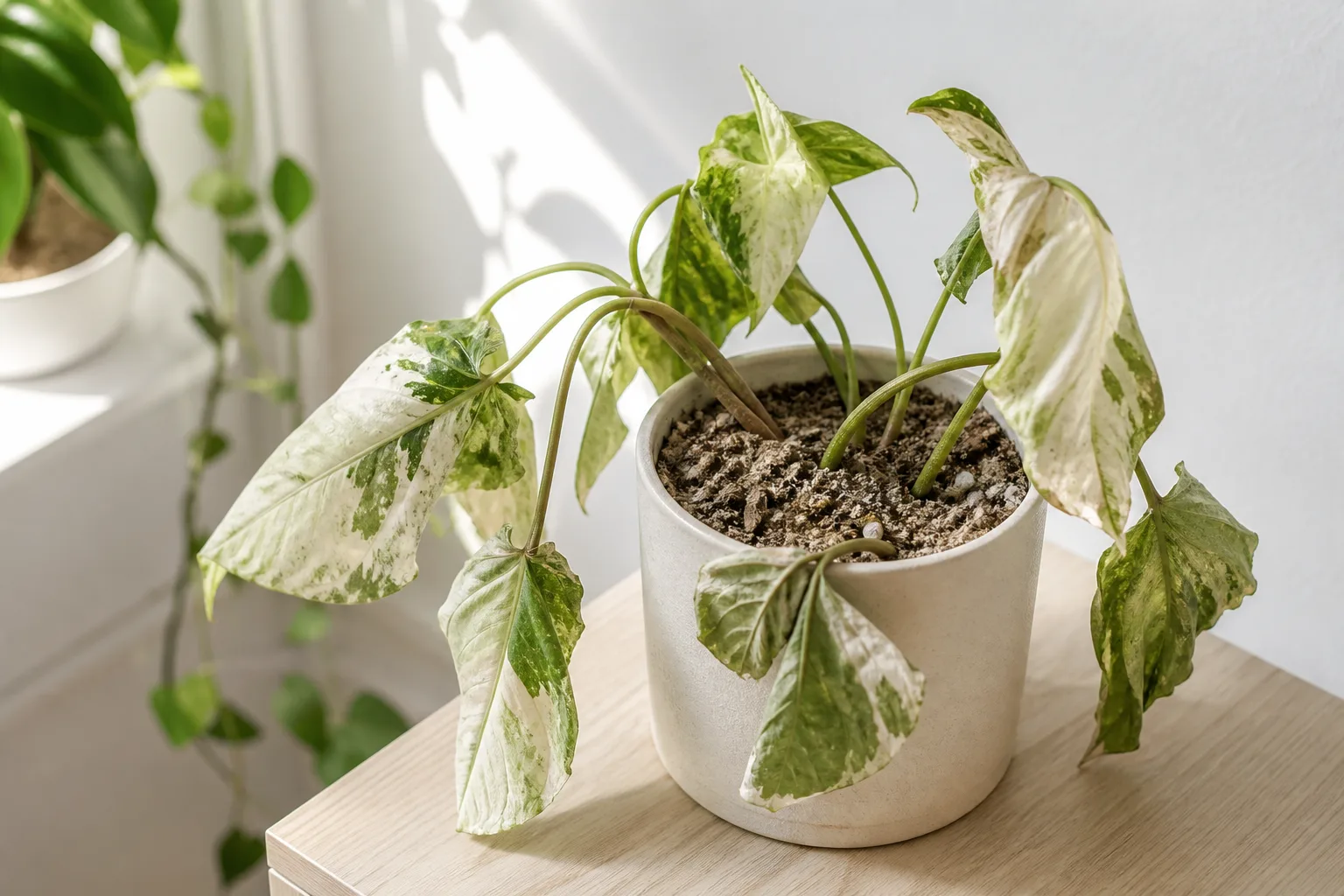
Underwatering on Syngonium Albo: Causes, Checks & Fixes
This guide covers underwatering on Syngonium Albo. See also the general Underwatering guide, watering, and light pages for this plant.
Underwatering on Syngonium Albo: Causes, Checks & Fixes
Quick answer
Syngonium Albo (Syngonium podophyllum ‘Albo Variegatum’) tolerates a missed drink better than soggy roots, but long dry spells during active growth still stress this tropical aroid-especially white variegated sectors with less chlorophyll. The telltale pattern is limp arrowhead leaves on a light, dry pot with firm stems and no sour smell from the drainage hole.
Dry soil + limp leaves → water deeply once. Wet soil + limp leaves → stop watering and inspect roots-that branch is overwatering or root rot, not thirst. If you are unsure which side you are on, use the wilting decision guide before you touch the watering can.
First step: water thoroughly until excess runs from the drainage hole, then empty the saucer completely. Limp leaves that perk within hours after a proper soak confirm underwatering. Crisp brown edges on white sectors will not re-green, but new growth should look normal once watering stabilizes.
When to use this page vs. wilting
Both pages cover limp Syngonium Albo foliage, but they serve different moments:
- Use this underwatering guide when you already suspect drought-dry top inch, light pot, white margins crisping first, and firm stems.
- Use the wilting guide when you do not know whether the roots are too dry or too wet, or when wilt persists after a confirmed deep soak.
Underwatering is the focused drought-and-rehydration path. Wilting is the full dry-wilt vs. wet-wilt decision tree when symptoms overlap.
What underwatering looks like on Syngonium Albo
Symptoms build in a recognizable order on this white-splashed cultivar:
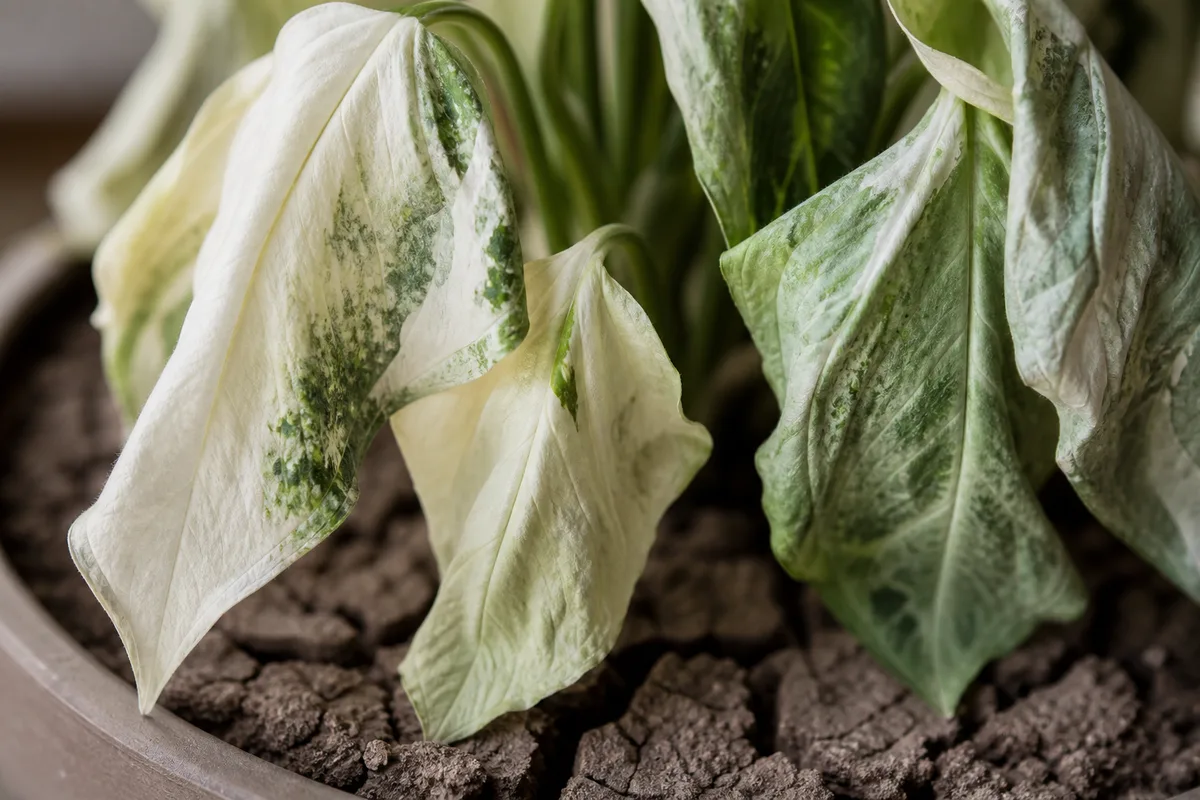
Underwatering symptoms on Syngonium Albo - compare with healthy tissue on the same plant.
Early signs:
- White variegated leaf margins feel papery or turn light brown before green tissue loses turgor
- Arrowhead leaves hang slightly, especially on outer stems
- Top inch of mix feels dusty dry; pot feels noticeably lighter than after a recent watering
Continuing drought:
- Leaves curl inward or fold along the midrib
- Soil pulls away from the pot wall; water runs straight through without soaking the center
- Older lower leaves may yellow and drop after several dry cycles
Advanced dryness (not normal aging):
- Leaf tips and margins go fully crisp and brown, often worse on white portions of variegated blades
- New leaves stay small, wrinkled, or slow to unfurl
- Growth stalls even though light and temperature are otherwise fine
- Repeated extreme dryness during active growth can slow new leaves and push greener, less variegated growth
Unlike overwatering, the stem base stays firm, soil does not smell sour, and you will not see fungus gnats from a chronically dry surface. Wilted leaves with wet soil mean rotting roots cannot take up water-the opposite problem.
Low humidity alone can crisp white edges, but if the top inch is damp and the pot feels heavy, dry air-not thirst-is the more likely cause of tip browning. See brown tips when edges brown with otherwise normal moisture.
Why Syngonium Albo gets underwatered
Albo is a collector-grade variegated arrowhead vine that transpires faster in bright indirect light-where white variegation stays crisp-than in a dim corner. A small nursery pot in a warm east or south window can dry in a handful of days during spring and summer. That is normal water use, not a sign the plant is unusually thirsty.
Underwatering happens when the root zone stays dry too long between drinks. Common triggers on this species include:
- Calendar watering instead of checking the top inch before every major watering
- Travel or a forgotten pot in a bright room where expensive variegated plants dry faster than you expect
- Hydrophobic old mix that repels water while the root ball stays dry inside-runoff from the sides creates a false “watered” signal
- Overcorrecting after overwatering fear-many albo owners let the mix go too dry because the species is often described as “forgiving” and rot scares are real on premium plants
- Undersized pots that dry faster than a weekly memory-based schedule in active growth
Fine aroid roots need both moisture and oxygen. Underwatering is far less dangerous than rot on Syngonium Albo, but repeated extreme dryness during the growing season kills fine root hairs that absorb water efficiently and stresses variegated tissue that is more sensitive to moisture swings.
Match your rhythm to the Syngonium Albo watering guide: roughly every four to seven days in warm bright active growth and every ten to fourteen days when light and temperatures drop-not a fixed calendar.
Lookalike symptoms to rule out
| What you see | More likely cause | Quick check |
|---|---|---|
| Limp leaves, light dry pot | Underwatering | Perks after deep soak |
| Limp leaves, heavy wet pot | Overwatering / root rot | Soft stem base, sour smell |
| Crisp white tips only, damp soil | Low humidity or salt buildup | Top inch moist; edges dry |
| Yellow lower leaves, wet mix | Overwatering | Mix stays damp 10+ days |
| Slow growth, pale stretched stems | Not enough light | Variegation faded; stems long |
| Lower leaf drop, firm stems, normal moisture | Normal aging or slight drought | Not whole-plant collapse |
Syngonium Albo reacts dramatically to both too little and too much water. Pot weight and top-inch moisture always beat leaf color alone for diagnosis.
How to confirm the cause
Work through these checks before you change your routine:
- Top-inch finger test - Press into the mix to about 1 inch (2.5 cm). Dusty, hard dryness confirms the plant is ready for water. Cool dampness means wait, even if a leaf looks slightly soft.
- Pot weight - Lift the pot; if it is light, it needs water. Compare against how it felt right after your last thorough watering.
- Stem firmness at the soil line - Firm green tissue supports underwatering. Soft, mushy base with wet mix points to rot-do not add more water.
- Recovery test - Water once deeply. Check again in 4–24 hours. Perked leaves confirm drought was the issue.
- Drainage hole peek - Dry mix at the bottom edge and no foul odor support underwatering. Wet, dark mix at the hole with limp leaves suggests overwatering instead.
- Hydrophobic probe - If water runs off instantly and the pot still feels light, the mix may have dried into a water-repelling crust. Bottom-soak before you declare the plant unresponsive.
If soil is wet and stems are softening, stop and treat as possible root rot before soaking again.
First fix for Syngonium Albo
Water thoroughly with room-temperature water until excess drains from the bottom, then empty the saucer or cachepot completely.
That single deep drink rehydrates fine roots better than several shallow splashes on a dry surface. Pour slowly so water penetrates the center of the mix, not just the edges. If water runs through instantly and the pot still feels light, the mix may have gone hydrophobic-move to bottom-watering or aerate the surface before a second pass.
Do not fertilize a dry plant. Do not repot on day one unless the mix is so degraded it cannot hold moisture at all. Wear gloves when handling stressed tissue; arrowhead plant contains calcium oxalate crystals toxic to pets.
Step-by-step recovery when soil won’t absorb water
When peat-heavy mix dries hard, top watering alone may fail:
- Bottom-water - Set the pot in a basin of room-temperature water for 30–45 minutes so moisture wicks up through the drainage hole. Remove when the top inch feels evenly moist, then drain fully.
- Aerate the surface - Gently poke a chopstick into the mix to open channels before the next top watering if water previously ran off without soaking the center.
- Slow top soak - Water in two or three small passes five minutes apart if the first pour channels through.
- Wait for the top inch to dry again - Resume regular watering during the growing season, checking the pot rather than the calendar per the watering guide.
- Trim only fully dead tissue - Snip crisp brown tips if they bother you cosmetically; they will not green up. Leave partially green blades until the plant pushes replacements.
- Raise humidity if white edges crisp between waterings - Albo likes high humidity; a pebble tray or grouping with other plants reduces edge burn while you stabilize watering.
Recovery case study
A four-inch albo in a bright east window skipped water for five days during a heat spell. White margins turned crisp on the outer leaves, the top inch was bone-dry, and the plastic pot felt feather-light. One deep top soak produced little absorption-water ran down the sides. A 35-minute bottom-water rewet the core; petioles lifted within eight hours. Brown white sectors stayed permanent; the next unfurled leaf showed normal variegation.
Recovery timeline and what to expect
Mild underwatering often shows improvement within 4–12 hours after a proper soak-leaves regain turgor first on the youngest stems. Moderate drought may take 1–3 days before the plant looks composed again. Crisp brown tips on white sectors and yellow lower leaves that already dropped do not reverse; judge success by new unfolded leaves and stable stem firmness, not by old blemishes fading.
Watch variegation on new growth for three to four weeks after chronic drought. If new leaves emerge mostly green despite corrected watering and adequate light, the plant may be compensating for stress-stabilize moisture and light before assuming the cultivar has reverted permanently.
If leaves stay limp 48 hours after a confirmed deep watering with properly moistened mix, roots may have been damaged by prior overwatering or extreme drought cycles-inspect before watering again.
What not to do
- Assuming every droop means “add water” without checking soil first-wet rot and dry thirst look similar on the foliage.
- Daily shallow splashes that wet the surface while the root ball stays dry.
- Overcompensating with heavy watering after one dry spell, swinging into rot territory on an expensive albo.
- Keeping soil constantly wet as a reaction to crispy white tips-that protects neither variegation nor roots.
- Misting instead of soaking - surface humidity does not replace root-zone moisture.
- Fertilizing to “wake up” a dry plant - rehydrate first; salts on drought-stressed roots cause burn.
How to prevent underwatering next time
Build a rhythm around how your albo dries in your home:
- Check the top inch every 5–10 days in active growth and every 14–21 days in fall and winter, watering only when dry at that depth per the watering guide.
- Learn the full vs. empty pot weight after a few normal cycles-the UF/IFAS houseplant guide recommends lifting containers to gauge moisture when surface appearance is misleading.
- Refresh peat-heavy mix that repeatedly turns hydrophobic or shrinks from the pot wall.
- Match pot size to the plant-a very small container in strong indirect light will outpace a weekly memory-based schedule.
- Maintain moderate to high humidity to protect variegated edges between waterings.
Reduced winter watering is part of healthy Syngonium care, not neglect-as long as the top inch is not rock-hard for weeks and stems stay firm.
When to worry / inspect roots or propagate
Underwatering is rarely fatal on Syngonium Albo if you catch it while stems are still firm. Escalate when:
- The entire plant goes crisp after prolonged neglect and water runs off without soaking even after bottom-watering
- Leaves stay limp after two confirmed deep waterings with properly moistened mix
- Fine roots look shriveled, brown, and brittle when you unpot-extreme drought can damage roots much like excess moisture can
- New growth stops entirely for several weeks despite corrected watering and adequate light
At that point, unpot, trim clearly dead roots, repot into fresh airy mix, and water on the top-inch-dry rule while you wait for new shoots. If the root ball cannot rebound, salvage firm nodes via propagation before the last healthy tissue fails.
Related Syngonium Albo guides
- Watering - moisture rhythm, top-inch checks, and seasonal dry-down
- Wilting - dry-wilt vs. wet-wilt when you are unsure of the cause
- Overwatering - heavy wet pot differentiation
- Root rot - limp-on-wet-soil escalation
- Brown tips - crispy margins with normal moisture
- Low humidity - edge burn without drought
- Yellow leaves - lower-leaf loss after dry cycles
- Propagation - salvage cuttings if root damage is confirmed
FAQs
Why did the white parts of my Syngonium Albo turn brown-is that underwatering?
Crispy brown on white variegated sectors often appears before the whole leaf droops when the mix has stayed dry too long. Green tissue may still look okay while white margins go papery. If the top inch is dry and the pot feels light, drought is the likely cause-not rot.
I watered but my Syngonium Albo is still limp-is the soil hydrophobic?
When peat-heavy mix dries hard, water can run down the pot sides without rewetting the root ball. Bottom-water for 30 to 45 minutes, aerate the surface with a chopstick, then try a slow top soak. If leaves perk within hours, hydrophobic dry-out was the blocker-not root failure.
Can underwatering cause my albo to revert to green?
Repeated extreme dryness during active growth can stress variegated tissue and push greener new leaves as the plant prioritizes survival. One missed watering rarely causes lasting reversion, but chronic drought cycles over several weeks are worth correcting before variegation patterns shift.
How do I tell dry soil from root rot on a Syngonium Albo?
Lift the pot first. A light dry pot with firm stems at the soil line points to thirst. A heavy wet pot with soft lower stems, sour smell, or fungus gnats points to overwatering or root rot-do not add more water. Use the wilting guide when both problems look similar on the foliage.
How often should I water Syngonium Albo to avoid underwatering?
Water when the top inch of mix feels dry, which often means every four to seven days in bright active growth and every ten to fourteen days in cooler low-light months. Check the pot weight rather than a calendar-the same plant can dry in three days in summer and two weeks in winter. See the full watering rhythm for seasonal detail.
Conclusion
Underwatering on Syngonium Albo is a moisture-timing problem, not a mystery disease. White margins crisping on a light dry pot with firm stems tell you the fix: one thorough soak, full drainage, then return to watering when the top inch dries. Crisp old white sectors are cosmetic; healthy new variegated leaves are the scoreboard. Learn your pot’s dry-down speed in each season and you will rarely confuse winter rest with summer thirst-or rot with drought-again.