Thai Basil Light Needs: Sun, Shade & Indoors
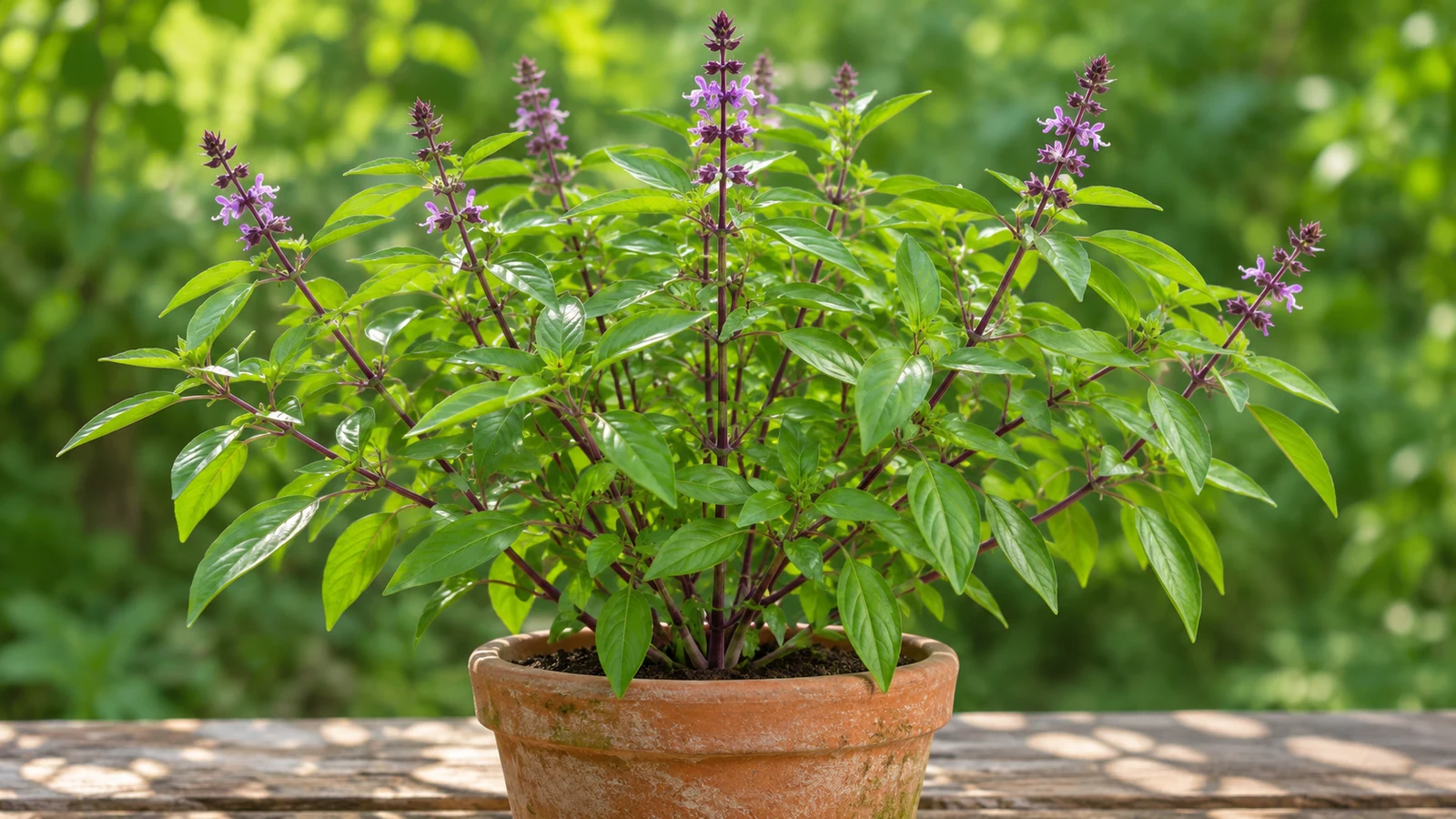
Thai Basil Light Needs: Sun, Shade & Indoors
Thai Basil Light Needs: Sun, Shade & Indoors
Thai basil grows best with strong light, but a hot balcony can make the brightest spot too harsh by afternoon. Start with about six hours of direct sun, then adjust the timing if leaves scorch or the pot heats up; indoors, a genuinely sunny window or a grow light can make the difference between compact growth and a plant reaching for the glass.
How much light does Thai basil need?
Aim for at least six hours of direct sunlight a day as a practical starting point. NC State Extension classifies Thai basil under Ocimum basilicum for full sun, which it defines as six or more hours of direct sun, while also listing partial shade; the Thai-basil entry from Gardening Know How likewise recommends six hours to flourish. NC State Extension Plant Toolbox and Gardening Know How’s Thai basil guide support that baseline.
Full sun is a useful default, not a rule to expose every plant to punishing heat all day. NParks lists Thai basil for both full sun and semi-shade, and its indoor guidance calls for at least six hours of sunlight near a sunny window; a named Thai-basil cultivar, ‘Thai Sita’, is also listed by the RHS for full sun. NParks Flora & Fauna Web and the RHS profile for ‘Thai Sita’ show that bright light is the starting point while some shelter can still fit the plant’s care.
Choose a bright, steady spot
Look at the light reaching the plant, not just whether a location feels bright to you. A balcony may have direct sun for several hours but lose it when a neighboring building casts shade; an indoor corner can look well lit while receiving no direct sunlight at all. Track the sun on the leaves across a typical day before moving the pot.
Outdoor beds and balconies
For a garden bed, choose an open position where Thai basil gets morning or early-day sun and remains bright for much of the day. In a container, keep the plant close enough to the open edge of a balcony to receive that light, while avoiding a spot pressed against a hot wall or glass panel that reflects afternoon sun back onto the leaves.
Basil can manage some partial shade, but the amount and timing matter. Yates describes basil as suited to full sun to part shade. Use partial shade as heat relief, not as a reason to place Thai basil in a dim corner. Yates Australia’s basil guide offers general basil guidance; the Thai-basil-specific hot-weather exception follows below.
Indoor windows and grow lights
Set Thai basil close to a window that gives it several hours of direct sun. A sunny sill can work, but if stems keep leaning toward the glass or new growth stays sparse, move the pot to the brightest available window and turn it periodically so one side does not receive all the light. Indoor Thai basil still needs real light; a bright room several feet from a window is not equivalent to a sunny sill.
If no window provides enough direct sun, add a full-spectrum grow light above the plant and follow the fixture maker’s instructions for distance and daily use. Homes & Gardens notes that Thai basil grown indoors needs at least six hours of direct sunlight and that grow lights can supplement light levels; use the lamp to fill the gap rather than placing the pot in a dark room and expecting a weak fixture to compensate. Homes & Gardens’ Thai basil growing guide describes both the indoor sunlight target and supplemental lighting.
Full sun versus afternoon shade in hot weather
Thai basil is a warm-season herb, so bright sun supports strong growth. In hot conditions, intense afternoon sun can be too much for leaves; a sunny position is usually the best choice in mild weather, while morning sun followed by bright afternoon shade can be kinder on a hot balcony. The Spruce’s Thai basil care guide recommends at least six hours of sun and afternoon shelter in very hot climates, and Epic Gardening’s basil container guide likewise suggests shade from the hottest afternoon exposure.
Do not respond to a few scorched leaves by moving the plant into deep shade. Keep the light generous and reduce only the intensity of the harshest hours if leaves show stress.
Adjusting light in India and similar climates
In much of India, an east-facing balcony or a spot with morning sun may be easier to manage than an exposed west-facing ledge in peak summer. Treat this as a starting point, not a compass rule: buildings, trees, railings, and seasonal sun angles change the hours that actually reach the plant. If Thai basil is growing outdoors in a cooler season, it may tolerate more direct sun; if a container sits on hot concrete in late summer, add afternoon shade or move it to a cooler bright position.
During monsoon weather, prioritize the brightest sheltered spot available. Several cloudy days are a reason to avoid adding more shade, but they are not a cue to overwater; check the mix before changing the watering routine. If the plant is indoors through repeated overcast days, a grow light can supply steadier exposure.
Change exposure with the season
Light changes as the sun’s path shifts, nearby trees leaf out, or the plant moves between a windowsill and a balcony. Recheck the pot’s position when growth slows, when shadows lengthen, or when a formerly comfortable afternoon spot begins to scorch leaves. Avoid moving a plant straight from shade into a full day of strong sun; increase its direct exposure over several days so the newest leaves can adjust.
Thai basil can be grown as a container herb, so use that mobility. A light pot can be shifted out of the hottest afternoon rays during a heat wave, then returned to brighter conditions when temperatures ease. If it lives indoors, rotate the pot a little every few days rather than repeatedly moving it between very different light levels.
Signs Thai basil is getting too little light
Watch the shape of new growth. Stems that stretch toward a window, longer gaps between leaf pairs, and a sparse canopy are useful clues that the plant may need a brighter position. Epic Gardening’s indoor basil guide also uses leggy growth and small leaves as signs to increase light. These clues do not prove that light is the only issue, but they are a good reason to record how many direct-sun hours the plant receives before increasing fertilizer or pruning it hard.
The plant may also grow slowly or produce fewer side shoots when it lacks light. Thai basil can still survive in partial shade, but survival is not the same as producing a sturdy, harvestable plant. If it receives only a short patch of direct sun, try a brighter spot first and assess the next few sets of leaves rather than expecting older stretched stems to become compact again.
Signs the light is too intense
Dry brown patches can indicate leaf scorch, especially when a plant faces intense afternoon sun. Epic Gardening identifies dry brown patches as a basil scorch sign, but leaf damage alone does not prove light is the only cause. Its basil guidance is a practical reference for that symptom.
Separate scorch from watering stress
Check the soil before adding water. If the mix is dry, water thoroughly and let the pot drain; if it is wet, do not keep watering in response to drooping or damaged leaves. Move the plant out of the harshest afternoon sun while retaining bright morning light, and remove only leaves that are mostly damaged. For a closer diagnosis of moisture problems, use the Thai Basil watering guide.
A simple light-adjustment routine
Make one change at a time so you can tell whether it helped. First, note when direct sun reaches the leaves and how long it lasts. Next, check whether the light is blocked by a roof, screen, tree, or neighboring building; if the plant gets less than roughly six direct hours, move it toward a clearer exposure or add supplemental light.
If leaves develop fresh scorch after the move, keep the morning sun and reduce only the hottest afternoon exposure. If the plant is stretched but the leaves are not scorched, increase brightness gradually. Keep watering consistent during this trial so the plant is not coping with a light change and a drying root ball at the same time.
When light is not the main problem
Yellow leaves, drooping, or slow growth are not enough by themselves to diagnose low light. If the mix stays wet, basil can develop brown spots, wilt, and eventually rot; Thai basil growth can also be stunted by temperatures below 50°F. Yates describes those wet-soil symptoms, and The Spruce gives the cold-growth threshold. If the plant wilts while the mix is wet or stays limp after the hottest part of the day, check drainage and roots before moving it again; the Thai Basil soil guide covers drainage, and the overview guide puts light alongside the rest of its basic care.
Do not use extra fertilizer to fix stems that are stretching toward a window. Once light and watering are steady, the Thai Basil fertilizer guide can help you judge whether active growth needs feeding. If the plant is already tall and uneven, the Thai Basil pruning guide explains how to pinch it without stripping the stems.
Recheck the plant’s newest growth
After moving the pot, judge the change by the leaves and stems that grow afterward. Older leaves may keep their marks and stretched sections will not shorten, so a quick look the next morning cannot tell you whether the new location worked. Over the next couple of weeks, look for compact new leaves and stems that hold their position rather than leaning toward a window.
If the container is root-bound or dries unusually quickly, the plant may need a pot adjustment as well as better light; use the Thai Basil repotting guide to check roots and size the next container. When a plant is too far along to shape or you want a fresh start, the propagation guide covers taking a healthy cutting.
When to use this page vs other Thai Basil guides
Use this page to decide where the plant should sit and how to change its exposure. If it is wilting, check the watering guide before assuming it needs less sun; if the pot stays wet or dries unevenly, check the soil guide and drainage. The overview is the broader starting point for warmth, moisture, and growth habit.
Use the pruning guide when better light has not fixed a leggy shape, and the fertilizer guide only after light, moisture, and root space are reasonable. Repotting and propagation are separate decisions: check the repotting guide for crowded roots and the propagation guide for starting a replacement from a healthy stem.
Related Thai Basil guides
- Thai Basil overview — review the full growing baseline, from warmth and soil to harvesting.
- Thai Basil watering — decide when a pot needs water and how to distinguish dry mix from wet-root trouble.
- Thai Basil soil — choose a mix that holds moisture without staying saturated.
- Thai Basil fertilizer — assess feeding after the growing conditions are in place.
- Thai Basil pruning — pinch stretched stems and flower spikes to manage the plant’s shape.
- Thai Basil repotting — check whether crowded roots or a small container limit growth.
- Thai Basil propagation — take a healthy cutting if you want to start another plant.
Conclusion
Give Thai basil about six hours of direct light as a starting point, then adjust the hottest hours rather than moving it into deep shade. A sunny outdoor spot or window supports stronger growth, while morning sun, bright afternoon shade, and a supplemental grow light can help when heat or indoor light limits the plant. Check the actual sun pattern, soil moisture, and newest growth before changing fertilizer or watering; that makes the next adjustment more likely to solve the problem you can see.