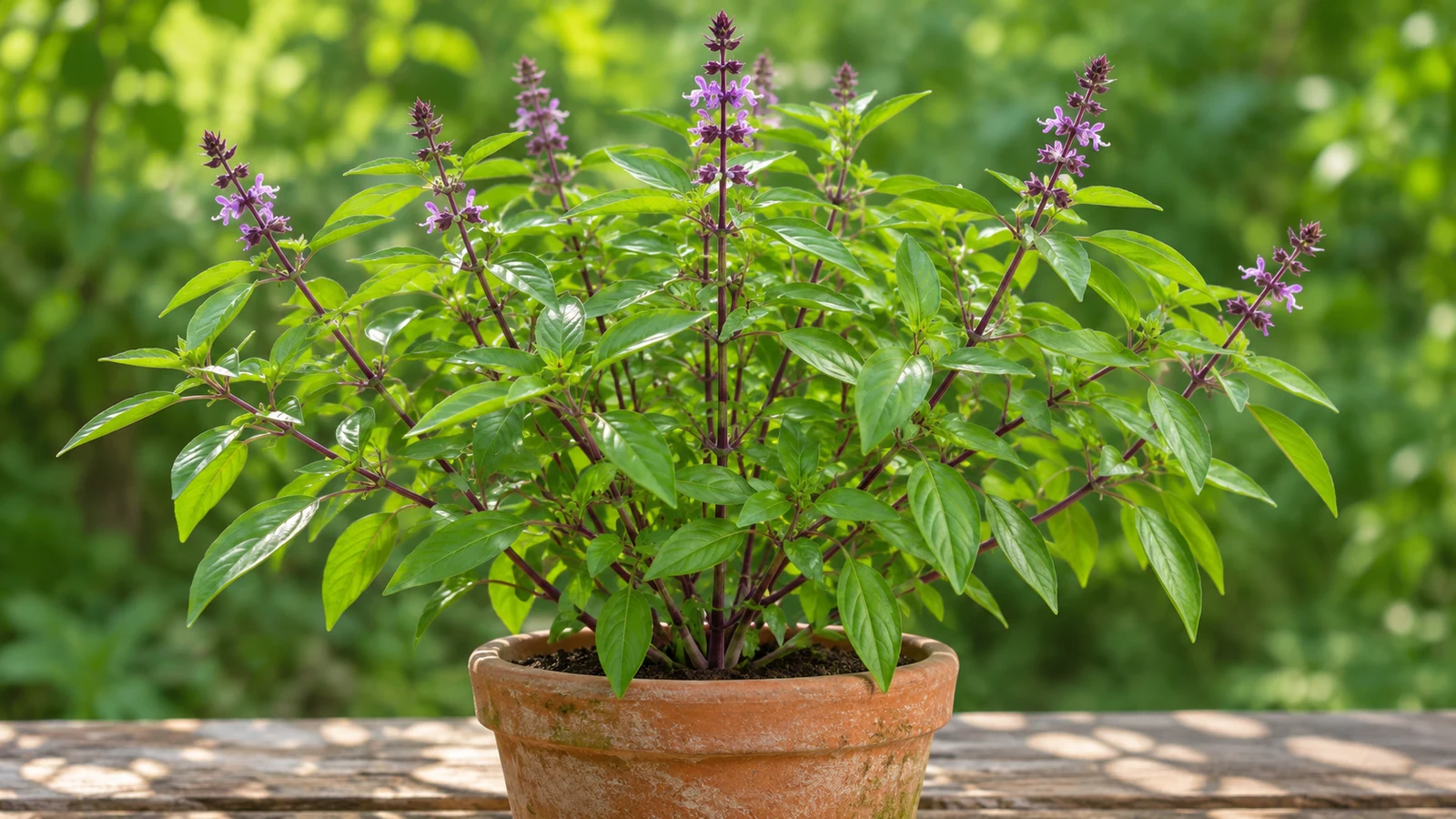
Keep the root zone evenly moist but well-drained. Water when the upper layer of soil or potting mix begins to dry, and let excess water drain; avoid keeping the roots waterlogged. In practice, water check garden plants during dry spells and pots more often in warm weather. Water thoroughly when the surface begins to dry rather than following a fixed calendar. Feel the top 2–3 cm of the mix. If it is beginning to dry, water at the base of the plant and let the pot drain fully. Water more often during hot, bright weather and less as growth slows in cool conditions. Thai basil is tender; protect it from cold nights and treat it as an annual outside frost-free climates.
What light does Thai Basil need?
Thai Basil needs bright, indirect light for steady indoor growth.
Is Thai Basil safe for cats and dogs?
Thai Basil is generally considered non-toxic to cats and dogs. Always monitor pets around new plants and contact your vet if unusual symptoms appear.
How do I propagate Thai Basil?
Propagate Thai Basil from healthy stem or root divisions during active growth.
What soil is best for Thai Basil?
Use fertile, moisture-retentive but well-drained soil; a loose potting mix amended with mature compost suits container plants. A good mix includes Use quality peat-free potting mix with mature compost for a fertile, moisture-retentive blend, Choose a pot at least 30 cm (12 in.) deep with drainage holes, Avoid a mix that stays waterlogged after watering. Keep the root zone moist without leaving it saturated. Use a container with drainage holes and water at soil level to help keep foliage dry. Target soil pH around 6.5–7.5.
When should I repot Thai Basil?
Repot Thai Basil move a crowded plant into a slightly larger pot when roots fill the container; a mature Thai basil plant grows well in a pot about 30 cm (12 in.) deep., ideally in late spring, after frost risk has passed and nights are consistently warm. Signs it needs a bigger pot: roots fill the pot or emerge from drainage holes, the plant dries out unusually quickly in warm weather, the potting mix has compacted and no longer drains freely.
Written by Sai AnanthLead content writer at LeafyPixels. B.Pharmacy graduate from Andhra University with a background in pharmacognosy, turned indoor gardening writer after a long-time plant hobby became a research-led resource for home growers.View Sai Ananth's profile · Reviewed by LeafyPixels Review Board
This Thai Basil problems problem guide was researched and written by Sai AnanthLead content writer at LeafyPixels. B.Pharmacy graduate from Andhra University with a background in pharmacognosy, turned indoor gardening writer after a long-time plant hobby became a research-led resource for home growers.View Sai Ananth's profile. Problems symptoms on Thai Basil, lookalike causes, and step-by-step fixes are cross-checked against extension pest, disease, and care references before publication.
We prioritize sources that hold up under scrutiny:
University cooperative extension bulletins and fact sheets (Penn State, Clemson, UMD, NC State, and similar programs)
Botanical garden and horticultural society publications
Peer-reviewed plant science and veterinary toxicology references where pet safety matters (including ASPCA Animal Poison Control)
Established reference works on indoor plant culture
The LeafyPixels editorial team then reviews the draft for clarity, step-by-step usefulness, and fit with real apartment and home conditions-not ideal greenhouse setups. When guidance changes materially, we update the page and note the revision date.
NC State Extension Plant Toolbox — Thai Basil (n.d.) Thai basil as an Ocimum basilicum cultivar, light, moist well-drained soil, pinching, and basil disease and pest context. [Online]. Available at: https://plants.ces.ncsu.edu/plants/ocimum-basilicum/common-name/thai-basil/ (Accessed: 1 March 2024).
NParks Flora & Fauna Web — Ocimum basilicum (Thai Basil) (n.d.) Thai basil identity, family, growth form, 30–45 cm height, light, moderate water, drainage, and cultivation in Singapore. [Online]. Available at: https://www.nparks.gov.sg/florafaunaweb/flora/6/6/6695 (Accessed: 1 March 2024).
Royal Horticultural Society — Ocimum basilicum 'Thai Sita' (n.d.) Named Thai-basil cultivar habit, size, full-sun position, well-drained soil, container growing, and pinching flowers; cultivar-specific details. [Online]. Available at: https://www.rhs.org.uk/plants/319211/ocimum-basilicum-thai-sita/details (Accessed: 1 March 2024).
The Spruce — How to Grow Thai Basil in Your Herb Garden (n.d.) Accepted Thai basil botanical name, Southeast Asian origin, size, light, soil, water, temperature, container, pruning, harvest, and propagation guidance. [Online]. Available at: https://www.thespruce.com/thai-basil-7375163 (Accessed: 1 March 2024).
Yates — How to Grow Sweet Basil, Thai Basil, & Purple Basil (n.d.) Warm-season basil cultivation, moist well-drained soil, watering at the base, pinching, flowering, and frequent harvest tips. [Online]. Available at: https://www.yates.com.au/how-to-grow/basil/ (Accessed: 1 March 2024).