Water Lettuce Not Enough Light? Tank & Pond Light Audit
Quick answer
Water lettuce often survives on too little light while rosettes stay small, flat, and slow to spread. First step: audit surface photons-confirm 10–12 hours on a timer, float rosettes directly under your strongest calm LED or morning sun zone, and thin dense mats that shade lower plants before changing fertilizer or water chemistry.
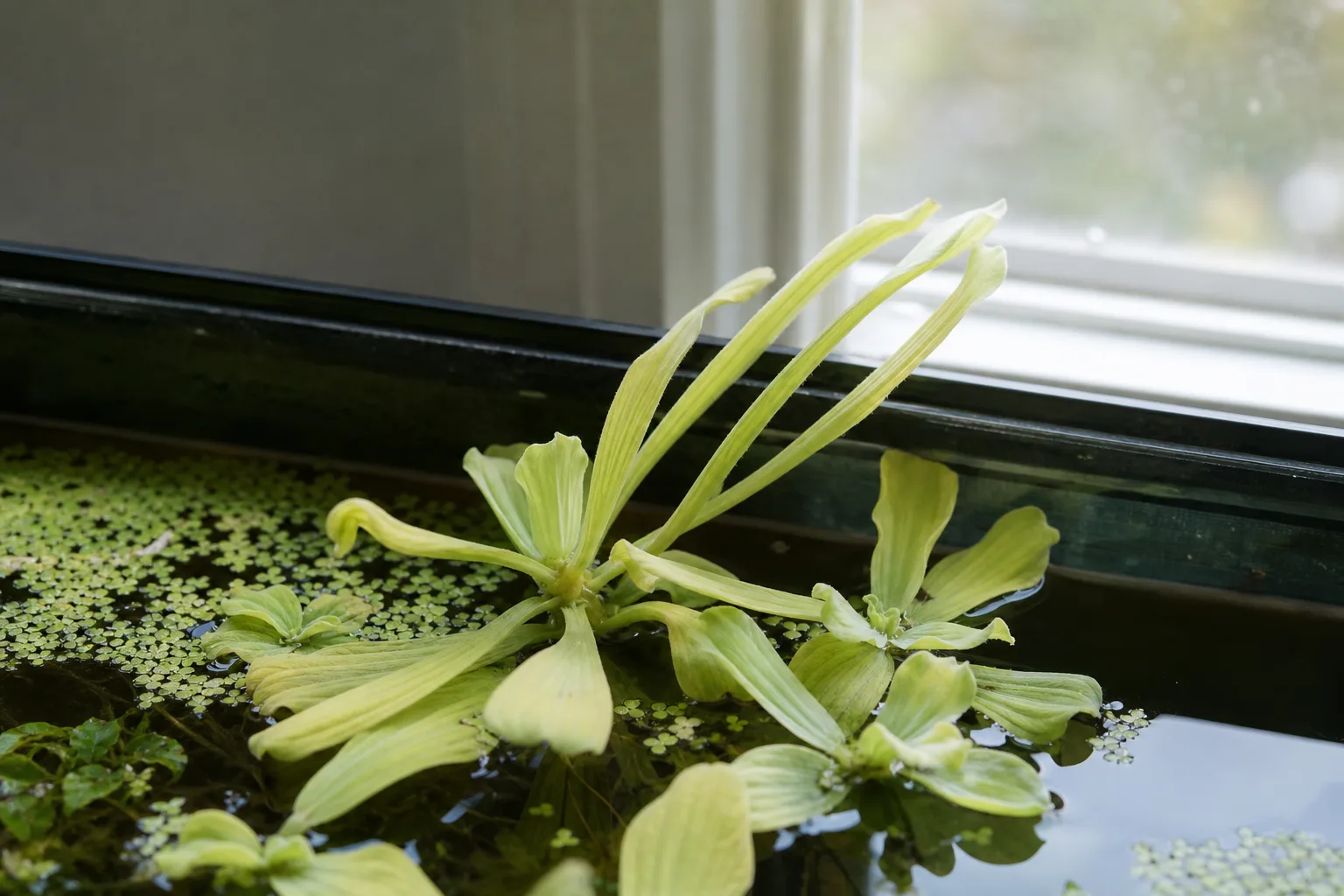
Not Enough Light on Water Lettuce: Causes, Checks & Fixes
This guide covers not enough light on Water Lettuce. See also the general Not Enough Light guide, watering, and light pages for this plant.
Not Enough Light on Water Lettuce: Causes, Checks & Fixes
Quick answer
Not enough light on water lettuce (Pistia stratiotes) is one of the most common reasons indoor mats look healthy yet never thrive. This free-floating tropical rosette lives at the air-water interface and cannot lean toward a brighter corner the way a potted houseplant might. When surface photons or daily photoperiod fall short, rosettes linger in survival mode-green but small, slow to reproduce, and weak at nutrient uptake-rather than building the domed cushions you see in summer ponds.
First step: audit surface light before changing water chemistry or fertilizer. Confirm 10–12 hours on a timer, float rosettes in the brightest calm zone at the water surface, and thin any overcrowded mat shading lower plants. Wait two weeks and judge new center leaves, not old flat outer blades.
| Your question | Start here | Deeper reference |
|---|---|---|
| Is my setup bright enough? Fixture height, timer, mat shading | This page | - |
| Flat, pale, horizontally spread rosettes (leggy form) | Leggy growth | Morphology and etiolation detail |
| PAR bands, outdoor sun vs shade, acclimation | Light guide | Comprehensive culture |
| Yellow older leaves with firm domed centers | Yellow leaves | Nutrients, heat, or burn |
Survival light vs growth light on Water Lettuce
Many growers assume green rosettes mean conditions are fine. On Pistia, that assumption hides the most frequent indoor failure: the plant is alive on survival light but starved for growth light.
Survival light keeps tissue green for weeks with little visible change-rosettes stay small, spread slowly, produce sparse daughter plants, and clarify water weakly. A generic fish-display hood, a distant ceiling fixture, a north-facing tank across the room, or a pond under all-day tree canopy often lands here. The plant is not dying; it is waiting for photons that never arrive at the surface plane.
Growth light produces measurable weekly progress: tighter center leaves, thicker velvety texture, faster daughter-plant spacing, and-outdoors-rapid vegetative spread on still water in full sun to part shade. Indoors that usually means a full-spectrum planted-tank LED sized for tank length, mounted close enough that the water surface-not the substrate-receives medium-to-high photosynthetically active radiation. Hobby targets often land near 40–80 PAR at the surface; your eyes and rosette cupping are the final instruments if you lack a meter.
Understanding this split explains why water lettuce “does nothing” in a dim living-room tank while the same species blankets a half-barrel pond in June. The species did not change; the photon budget did.
What insufficient light looks like on Water Lettuce
Low-light stress on floating Pistia shows a recognizable bundle. You do not need a PAR meter to start-pattern matters.
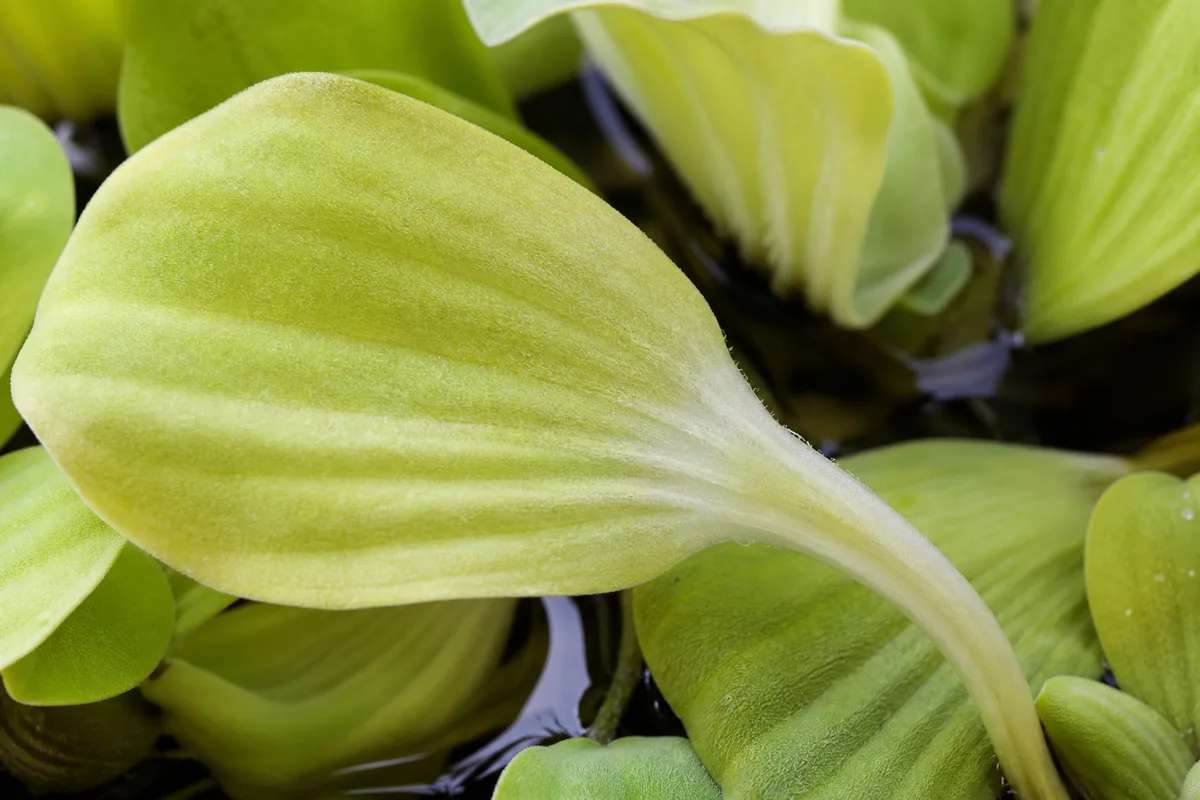
Not Enough Light symptoms on Water Lettuce - compare with healthy tissue on the same plant.
Small, flat rosettes that spread horizontally:
- Diameter grows wider without gaining height; leaves lie nearly flush with the water instead of cupping at the crown
- Pale lime-green wash on thin blades; texture feels papery compared with firm outdoor cushions
- Mat density stays low for weeks even though individual rosettes remain buoyant
Slow daughter-plant production:
- Offsets on short stolons cluster tight under growth light; under dim conditions bare stem sections stretch between small pale plantlets
“Dwarf” shop form that never fills in:
- Aquarium dwarf water lettuce is often the same species kept compact by indoor light limits-not a separate low-light cultivar. Outdoors in full sun to part shade many jump from 2-inch flat pads to 4–6-inch domed heads
For side-profile photos and etiolation vocabulary, see leggy growth on water lettuce. This page focuses on whether your setup delivers enough photons-not re-describing every leaf angle.
Unlike wilting, underlit rosettes usually stay firm and floating. Unlike sudden post-shipping melt, light deficit builds over weeks in a stable dim tank or shaded pond corner.
Why Water Lettuce stalls in weak surface light
Floating plants harvest photons only where leaves touch open air and still water. Several setup patterns produce chronic “not enough light” even when owners believe the tank is bright.
Undersized or distant aquarium fixtures. Floating leaves sit directly under the hood; if the LED is rated for low-light fish display or mounted too high, surface PAR may be survival-level while substrate plants look acceptable. Open-top tanks outperform sealed hot hoods for this species because they reduce heat buildup and allow humidity above the water line.
Short photoperiod or inconsistent timers. Extension culture notes cite roughly 10–12 hours of daily illumination for vigorous growth. A dim bulb running 12 hours still produces flat rosettes; a bright bulb on 6 hours does the same. Both variables matter.
Self-shading mats. Competitive surface cover blocks light to lower rosettes. Upper plants may look acceptable while neighbors underneath flatten-a partial mat can read as “half underlit” even when the fixture is adequate.
Deep outdoor shade. Ponds under all-day tree canopy or north walls keep Pistia alive but slow. Missouri Botanical Garden notes best spread in cool spring and autumn sun; perpetual shade mimics indoor survival mode.
Seasonal winter drop indoors. Short cloudy days plus unchanged timer settings reduce effective photon budget even when nitrate and temperature stay stable-flat rosettes by February are often light failure, not fertilizer exhaustion.
Nursery low-light conditioning. Retail plants from shaded benches arrive pale. Staying in the dim corner preserves small form; jumping to high PAR without acclimation causes burn-see the light guide acclimation ladder.
How to confirm light deficiency vs lookalikes
Work through this audit before stacking treatments. Change one variable at a time.
- Timer and photoperiod log - Record daily hours. Indoor target: 10–12 hours on a reliable timer. Below 8 hours with already-weak intensity strongly supports light deficit.
- Fixture position audit - Note LED type, wattage or PAR rating, and height above the water surface (not tank rim). Compare against 4–10 inches (10–25 cm) mounting guidance in the light guide.
- Bright-zone test - Move three rosettes to your strongest calm surface spot-directly under the LED or morning sun tray. If they cup and green within two weeks while edge plants stay flat, placement and intensity are the limiters, not species failure.
- Mat density check - Can you see open water between rosettes? If not, thin 20–30% and reassess shaded plants before buying hardware.
- Water chemistry screen - Test ammonia, nitrite, and nitrate in stocked tanks. Chronic flat slow growth on stable chemistry fits light; sudden melt with foul smell is decay-see root rot.
- Temperature band - Active growth occurs roughly 72–86°F (22–30°C). Growth stalls near 60°F even under bright light-cool winter rooms mimic light stress.
- Newest center leaves - Pale flat inner growth confirms ongoing deficit. Tight new crown after a light change confirms the fix even if outer leaves stay flat.
Quick lookalike comparison
| Pattern | Likely cause | First direction |
|---|---|---|
| Small flat rosettes; firm; lazy stolon spread | Low surface light / short photoperiod | Bright-zone test + timer audit |
| Flat rosettes only under dense upper mat | Self-shading | Thin to 50–70% cover |
| Yellow + brown dry tips on bright open-top tank | Excess light / low humidity | Raise fixture; see light guide |
| Yellow older leaves on domed centers | Nutrients, temperature, or burn | Yellow leaves |
| Mushy black tissue; foul water | Rot / quality crash | Remove decay; root rot |
| Pale rosettes + limp collapse after heat wave | Level drop / acute stress | Wilting |
| Post-shipping melt days 7–10 | Acclimation shock | Bright indirect hold; discard mush |
First fix: surface light upgrade and mat thinning
Float rosettes in the brightest calm zone at the water surface, verify a 10–12 hour photoperiod on a timer, and thin overcrowded mats so every remaining plant receives direct surface light.
Indoor steps:
- Position plants directly under a full-spectrum planted-tank LED sized for tank length, roughly 4–10 inches (10–25 cm) above the water surface
- Target approximately 40–80 PAR at the surface if you meter; otherwise watch for new center leaves cupping within two weeks
- Run 10–12 hours daily on a timer; do not change photoperiod, intensity, and fertilizer the same week
- Skim excess rosettes until 50–70% of the surface is open water so submerged companions and lower floaters receive photons
Outdoor steps:
- Relocate clusters from all-day deep shade to morning sun plus afternoon partial shade in hot regions-full sun to part shade on still water builds the largest domed rosettes in temperate summers
- Acclimate nursery plants over 5–7 days before open pond placement to avoid scorch false negatives
Do not repot-Pistia has no soil. Do not dose terrestrial houseplant fertilizer as day-one response. Do not rely on window light alone for a tank more than a few feet from a bright south exposure.
Recovery timeline and success markers
Within 7–14 days of corrected surface light, inspect new center leaves first. Success looks like:
- Inner leaves shorter relative to the outer ring, beginning to cup upward
- Slightly deeper green on fresh tissue-not repair of old flat blades
- Daughter plants appearing closer to the parent on shorter stolons
- Measurable weekly spread in warm water once photons match growth mode
Old outer leaves that already spread flat rarely re-dome. Remove chronically flat parents if clean daughters are available so they do not shade recovery.
Three to six weeks may pass before a thin indoor mat regains pond-like density-normal in cool rooms or small tanks.
Worsening signs during adjustment: bleached or crispy margins after jumping from dim corner to 100% LED at close range-step intensity over several days; continued flat growth directly under the fixture after two weeks-fixture still too weak or photoperiod under 8 hours; melt with ammonia spike-water-quality emergency, not light tuning alone.
Mistakes to avoid
- Assuming green means adequate - Survival color masks photon deficit for weeks
- Chasing nutrients before light - Flat slow spread with lazy stolons is still a photon problem until a bright-zone test fails
- Window language for a floater - Moving the tank nearer a north window without upgrading aquarium surface light rarely fixes dim Pistia
- Keeping 100% surface cover - Solid mats guarantee shaded lower rosettes even under a good fixture
- Extending photoperiod alone on a dim bulb - 14 hours of weak light does not equal growth light; raise intensity or lower fixture first
- Dumping excess in natural waterways - Pistia is a high-risk invasive in much of the US; bag and trash responsibly
How to prevent low light next time
- Size aquarium LEDs for surface coverage, not substrate carpet plants alone
- Keep 10–12 hour photoperiod on a timer year-round; add modest intensity or hours in dim winter months
- Thin weekly in fast summer spread so mats stay near 50–70% cover
- Acclimate new nursery rosettes before full sun or high PAR shelves per the light guide
- Quarantine new batches in bright treated water before merging with display tanks-catch flat form early
- Cross-check baseline culture on the overview and watering guides so level and temperature do not compound light stress
When to worry
Chronic low light is slow and reversible. Escalate promptly if:
- Rapid melt of most rosettes within 48–72 hours after a large untreated water change or heater failure
- Ammonia or nitrite above zero in stocked systems-fix water for livestock first
- Black mushy tissue and foul smell-decay, not light deficit (root rot)
- Flat rosettes persist directly under your strongest fixture for three weeks after thinning and photoperiod correction-re-test chemistry, temperature, and consider replacing the culture from a bright quarantine tub
Related Water Lettuce guides
- Overview - species ID, invasive disposal, baseline culture
- Light - PAR, photoperiod, indoor vs. outdoor culture, fixture setup
- Leggy growth - flat-rosette morphology and etiolation detail
- Yellow leaves - color loss with different causes
- Wilting - acute limpness and level drop
- Propagation - daughter-plant backup after thinning
Related tool
Use the Plant Problem Diagnosis Tool to narrow causes for not enough light on this plant before changing multiple variables at once.