How to Prevent and Deal With Lawn Grubs
Before treating lawn grubs, check the roots, count larvae in several places, identify the life stage, and choose a response that fits your region and lawn.
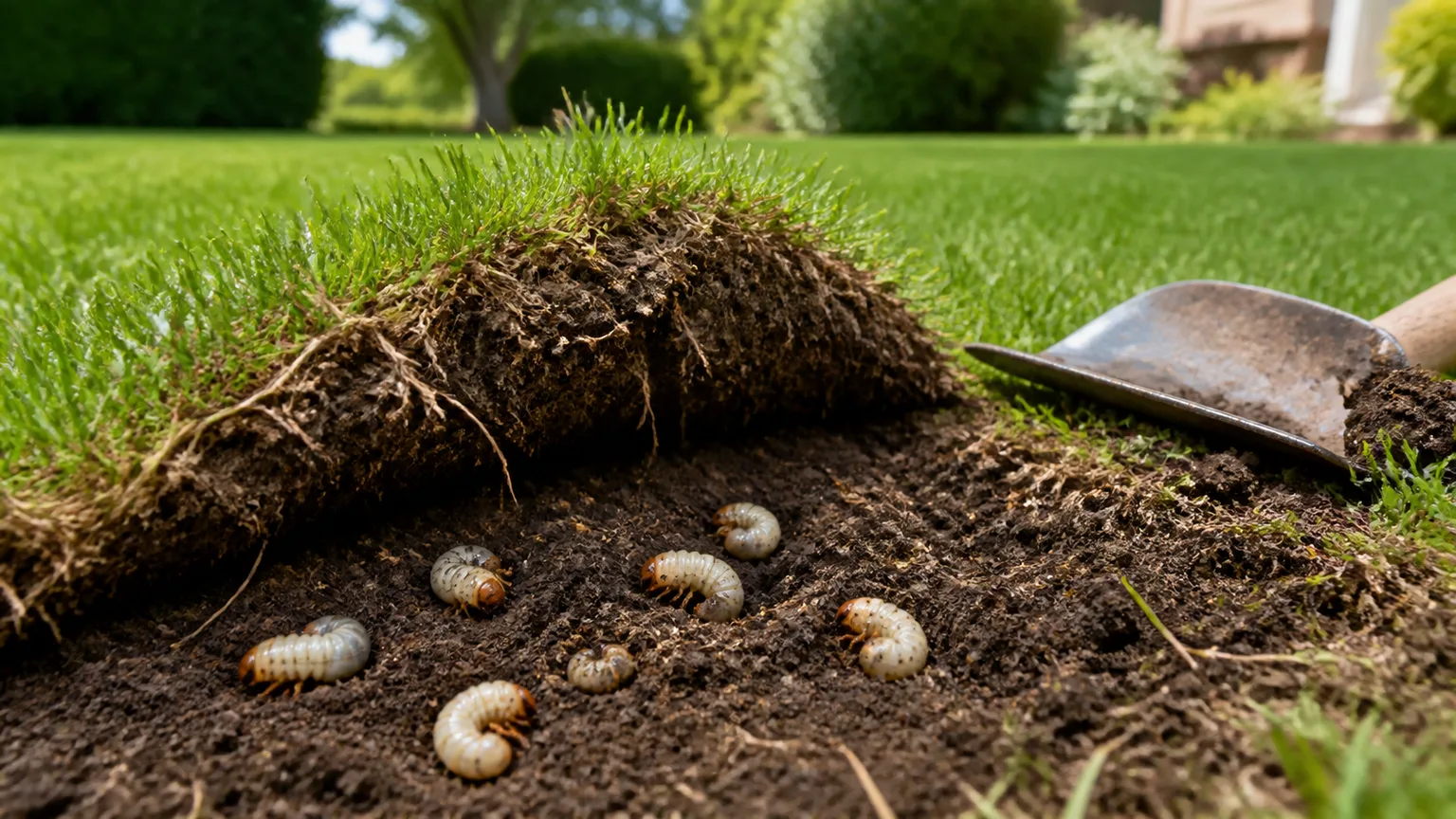
A brown lawn does not automatically mean grubs, and finding a grub does not automatically mean you need to kill it. The useful first move is to check whether roots are being eaten, sample more than one spot, and weigh the count against visible damage and the kind of turf you have.
That order matters because “lawn grub” can describe several beetle larvae with different life cycles, and some grubs in soil are not damaging turf at all. Once you know what is present and whether it is causing injury, you can choose to monitor, improve turf care, use a biological control, or follow a locally appropriate product label.
Start by confirming the problem
Before you spread anything, check the grass and the root zone. White grubs chew roots; that loss can make turf wilt even when the soil is moist, thin out irregularly, and loosen so a damaged patch lifts more easily than healthy sod.
A small number of larvae may be present in a healthy lawn without visible injury. Wisconsin Extension notes that most lawns can contain some white grubs and that healthy turf often tolerates low numbers, so “I found one” is not the same conclusion as “this lawn needs treatment” (UW–Madison Extension’s white-grub guide).
What “lawn grub” means—and which larvae damage turf
The classic white grub is the larval stage of a scarab beetle. Japanese beetles, masked chafers, European chafers, May or June beetles, and other scarabs can produce pale, C-shaped larvae, but species and development stage affect their size, timing, and vulnerability to controls. Purdue Extension’s turfgrass insect reference notes that several species may overlap in one region and that their life cycles do not all follow the same calendar.
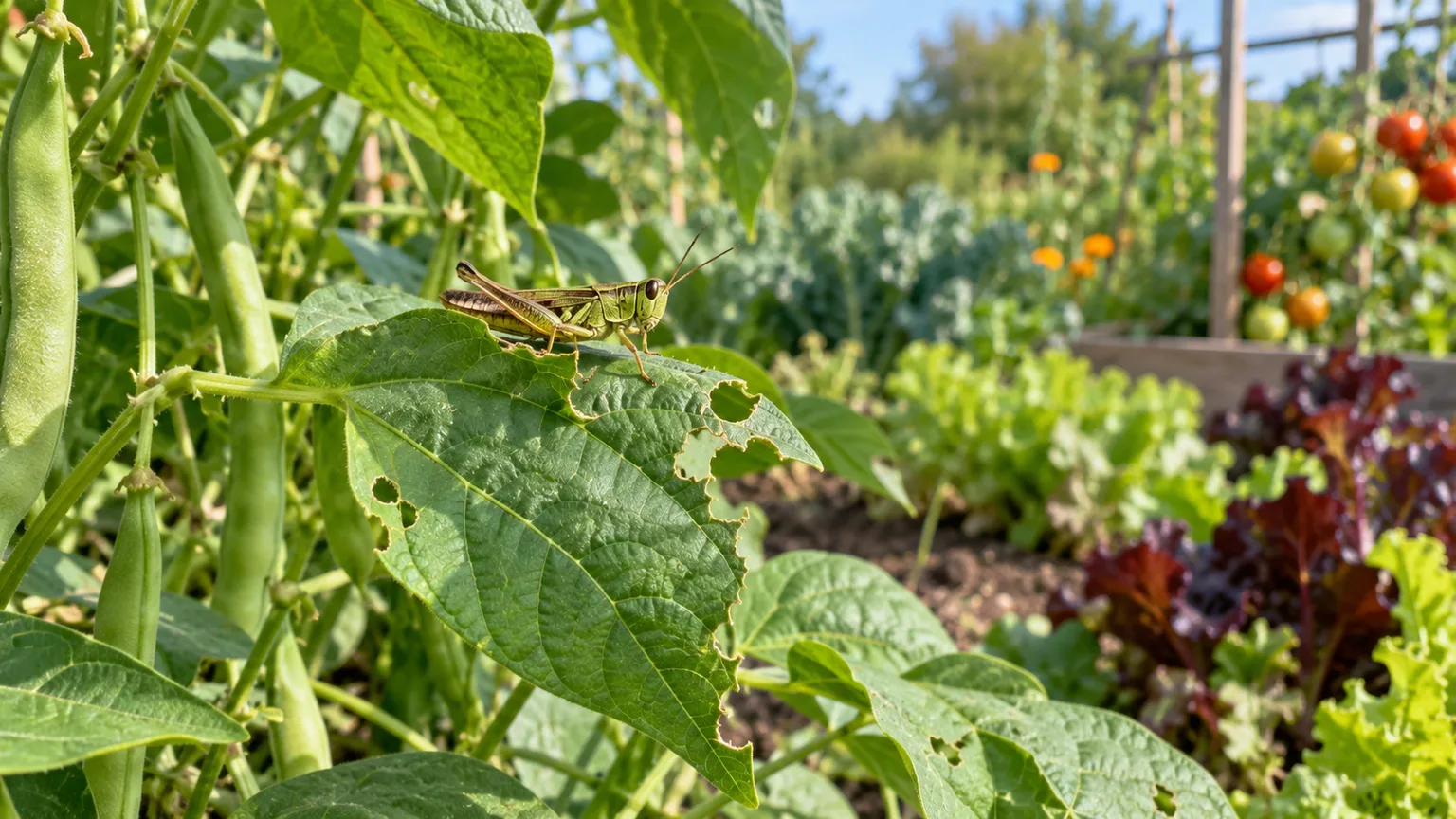
The word “grub” is also used for other larvae that damage turf, including billbugs, which are weevils rather than scarab beetles. Some billbug larvae are legless and feed inside grass stems or crowns before moving toward roots; that pattern can resemble drought stress and is a reason not to treat every brown patch with a generic white-grub product. Family Handyman’s lawn-grub guide describes this difference and recommends checking the actual larva instead of relying on turf color alone.
Not every pale grub you uncover is a lawn pest. Some beetle larvae feed on decaying material or live in garden beds and compost; the important distinction is what the insect is eating and where you found it, not whether it looks unpleasant.
Read the lawn’s symptoms
Clues that support a grub diagnosis
Grub injury often starts as scattered areas of thinning, yellowing, or wilting that do not respond as expected to normal irrigation. As roots are eaten, patches can turn brown, feel spongy, and pull away from the soil as a shallow mat; crows, skunks, raccoons, or other animals may also tear turf while searching for larvae. These are clues, not proof: sampling the root zone is what makes the diagnosis more reliable.
Look-alikes that need a different response
Drought or summer heat can make grass brown while the roots remain attached. If color improves after appropriate watering or cooler weather, or the damage follows sun exposure and dry soil more broadly rather than appearing as loose, patchy sod, investigate water stress before reaching for insect control. A lawn can also be dormant and tan while the crowns remain alive; dead-looking foliage alone is not a grub diagnosis.
Disease, compaction, fertilizer burn, pet damage, chinch bugs, and billbugs can create different patterns of thinning or discoloration. Fungal disease may show lesions or advancing rings; chinch bug injury often favors hot, sunny turf and needs an insect inspection in the thatch; billbug larvae may be found in stems or crowns. If several explanations fit, send clear photos and a sample to a local extension office or lawn diagnostic clinic before applying a product.
Animal digging deserves the same caution. Wildlife may be feeding on white grubs, but it can also be after earthworms or other soil prey, and digging alone does not tell you the species or number below ground. Check the turf where the digging and root damage overlap rather than treating the entire lawn on the strength of animal visits.
Take representative samples, not one guess
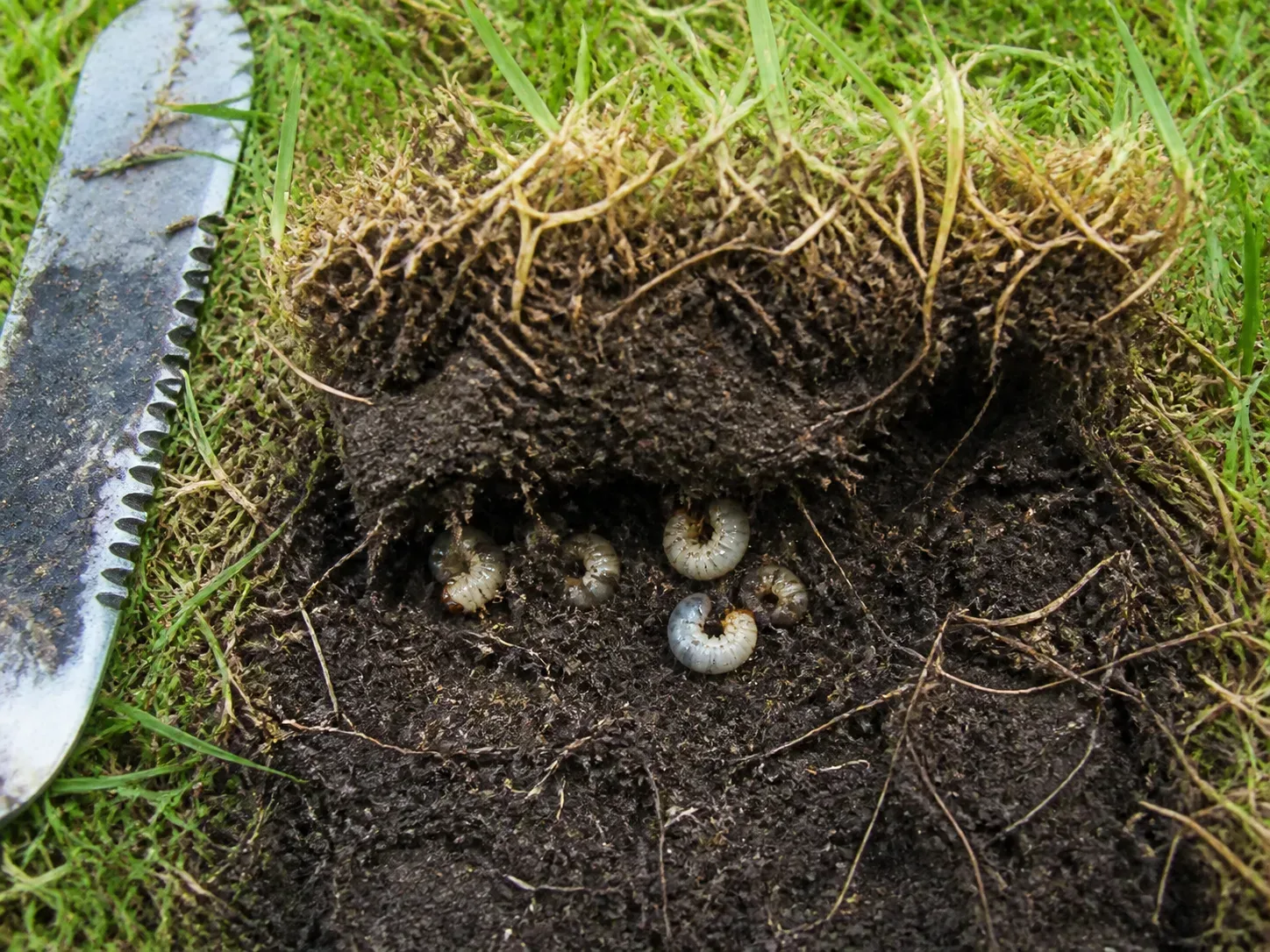
Choose a section at the edge of a suspicious patch, where grass is declining but not completely dead, and another nearby area that still looks healthy. With a sturdy knife or spade, cut a small square or wedge through the sod and lift it back; inspect the soil and thatch a few inches down, breaking apart the sample gently over a tray so larvae are easier to see. A one-square-foot turf check is a familiar homeowner method, also described in Family Handyman’s practical lawn guide.
Repeat the check in several separated locations, including known problem spots and unaffected turf. Grubs are not evenly distributed, so a single clean sample can miss a localized cluster, while one heavily infested square can exaggerate the problem across a large property. Rutgers Extension recommends recording where samples were taken and notes that rarely does an entire turf area require treatment (Rutgers’ integrated white-grub management guide).
Count live larvae in each sample and note approximate size, shape, and whether they are feeding near the root zone. Take a quick photo beside a ruler or coin for scale if you need help identifying them; return the sod and soil, press it into place, and water if it is dry so the inspection itself does not leave a dead patch.
If the larvae do not clearly match scarab grubs, do not guess at the species. The raster pattern—tiny hairs and spines on the underside of the abdomen—can help an entomologist identify a white grub, but a homeowner usually needs a hand lens and experience to interpret it. A clear underside photo or intact sample can be more useful than a confident guess based only on color.
Interpret grub counts in context
There is no single number that makes every lawn a treatment case. Purdue and Rutgers describe published damage thresholds around six to ten grubs per square foot for some species, while Rutgers reports higher ranges for others; it also explains that turf type, maintenance, weather, and root health change how much feeding grass can tolerate (Purdue Extension; Rutgers Extension). Treat those numbers as regional references for comparison, not a universal spray trigger.
For a practical decision, combine three kinds of evidence: the number of larvae across multiple samples, the amount and speed of turf decline, and how well the grass holds together when lifted. A few grubs in rooted, green turf usually call for monitoring and sound lawn care; a concentrated count with expanding rootless patches is more serious. If the damage threshold published for your area differs from a generic online number, follow the local turf or extension guidance.
The grass species and site also matter. A deep-rooted, vigorous lawn may tolerate more feeding than stressed turf with shallow roots, while a highly maintained playing surface has less tolerance for visible damage than a low-input home lawn. A count becomes useful when it helps explain an actual lawn problem and informs a decision—not when it is detached from symptoms and site conditions.
Why species and life stage matter
A larva’s stage changes both its feeding and its susceptibility to control. Young white grubs are small and close to the surface; as they grow, some move deeper or become harder to control, and eventually they stop feeding while pupating. Annual scarab species often have adults that lay eggs in summer, young larvae that feed later in the season, and larger larvae that overwinter, but May or June beetles can take multiple years to complete development (Purdue Extension’s life-cycle overview).
The adult beetles you see on roses or near porch lights are not a reliable lawn forecast on their own. A Japanese beetle on a shrub confirms that adult beetles are active, but it does not establish how many larvae are in your turf; Purdue’s publication cautions that adult activity should not substitute for sampling the lawn.
Likewise, not every grublike larva follows scarab timing. Billbugs and other turf pests have their own life cycles, so a product or treatment window intended for a different pest may miss the stage causing damage. When identification is uncertain, record the date, lawn symptoms, sample location, and larva photo, then get a local identification before choosing a product.
Use a regional calendar, not a national date
“Treat in June” or “treat in August” is not complete advice. Timing shifts with beetle species, climate, soil temperatures, irrigation, and the product’s mode of action. Wisconsin Extension separates preventive products, which work best around egg laying or against small larvae, from curative products used after grubs are present; it also notes that application windows differ among species (UW–Madison Extension).
A preventive treatment is intended to be in place before or as eggs hatch, so it is usually planned from local beetle activity and extension timing—not applied simply because spring arrived. A rescue or curative treatment is considered after sampling confirms damaging larvae; it is most useful while susceptible grubs are actively feeding near the surface, and may be less effective against large or deeper larvae. Spring damage from overwintered larvae can be real, but an automatic spring application may be too late for some products or unnecessary if the turf can recover.
A homeowner’s calendar should therefore begin with local extension guidance and the exact product label. If you missed the recommended window, do not compensate by increasing a rate or applying an off-label product; find out whether the larvae are still at a susceptible stage and whether the label supports treatment at that site.
Choose the least disruptive effective response
Integrated pest management starts with a threshold question: is the grub population causing damage that justifies intervention? If not, leaving larvae in place preserves food for birds and other wildlife, avoids unnecessary pesticide use, and lets healthy grass tolerate minor feeding. If there is confirmed and growing root injury, target the affected area and choose a response supported for the grub group and stage you actually found.
If you find only a few grubs
Leave healthy, firmly rooted turf alone and check it again if the same area begins to thin. Maintain grass in a way that supports root growth: mow at a height suited to the turf species, avoid removing too much leaf at once, and water according to rainfall and soil moisture rather than on a fixed shallow schedule. Fertilize only as needed for the grass and soil; excess fertilizer does not turn a weak diagnosis into a good treatment plan.
Do not intentionally dry out a lawn to stop beetles. Some beetles may prefer moist soil for egg laying, but drought can stress the turf and make existing root injury harder to tolerate. The goal is balanced irrigation: avoid chronic overwatering, but do not sacrifice grass health as a grub-control shortcut.
If biological control fits
Beneficial nematodes are living organisms sold for certain soil pests, but their usefulness depends on the nematode species, grub species, soil moisture, temperature, product freshness, and handling. Penn State Extension identifies Heterorhabditis bacteriophora as one option for white grubs and emphasizes adequate moisture and avoiding peak sun; Rutgers likewise says nematode effectiveness differs among grub species (Penn State Extension; Rutgers Extension). Apply only a product whose label names the pest and lawn site, and follow its storage, watering, and timing directions.
Savvy Gardening’s practical nematode notes also emphasize moist soil and low-light application, but no general blog recipe can guarantee control across species or climates (Savvy Gardening). Do not buy nematodes solely because a package says “grub control”; check the scientific name, target pests, shipping and storage requirements, and local availability first.
Milky spore is a specific bacterium, Paenibacillus popilliae, that is intended for Japanese beetle grubs. It is not a broad-spectrum treatment for every pale, C-shaped grub. University recommendations on its performance are not uniform: Penn State describes the Japanese beetle limitation, while recent Wisconsin Extension guidance says it has not been effective for white-grub control in recent university research. That difference is a good reason to check local results before investing in it, rather than expecting a one-time application to cure an unidentified lawn problem.
If a pesticide may be justified
Consider a pesticide only when sampling, injury, local thresholds, and the target species point to a real problem. Preventive and rescue products are not interchangeable: a preventive product may be useful before egg hatch, while a curative product is meant for actively feeding larvae and often has a narrower window. The active ingredient, allowed turf site, target grub, application timing, irrigation requirement, and restrictions can change by product and location, so follow the full label rather than a generic online schedule.
Use the least area and least disruptive option that the label and local advice support. Keep products away from flowering clover and weeds, ornamental blooms, storm drains, and water; check label instructions for protective equipment, irrigation, pets and children, re-entry, and weather restrictions. Wisconsin and Penn State Extension both flag pollinator or non-target risks from some insecticides, especially when pollinators can contact flowering vegetation in treated areas (UW–Madison Extension; Penn State Extension). If you cannot apply the product exactly as labeled, use a licensed professional or choose another response.
Repair turf after root loss
Control and repair are separate jobs. A product will not instantly attach loose sod or refill bare soil, and damage may continue to look severe for a while even after the grubs are no longer feeding. First check whether grass crowns remain alive: lightly tug at the edge of the damaged patch and look for firm, pale growth at the base rather than brittle, detached stems.
If the sod still has living roots or crowns, press it back into contact with soil and keep it appropriately moist while it re-establishes. If grass is dead and rootless, rake away loose material, loosen the top layer of soil, and reseed or patch with sod suited to your region and sun exposure. Seed should contact soil and stay moist through germination; avoid heavy foot traffic until it is rooted. Family Handyman’s lawn-care overview also stresses reseeding or resodding bare patches after grub damage.
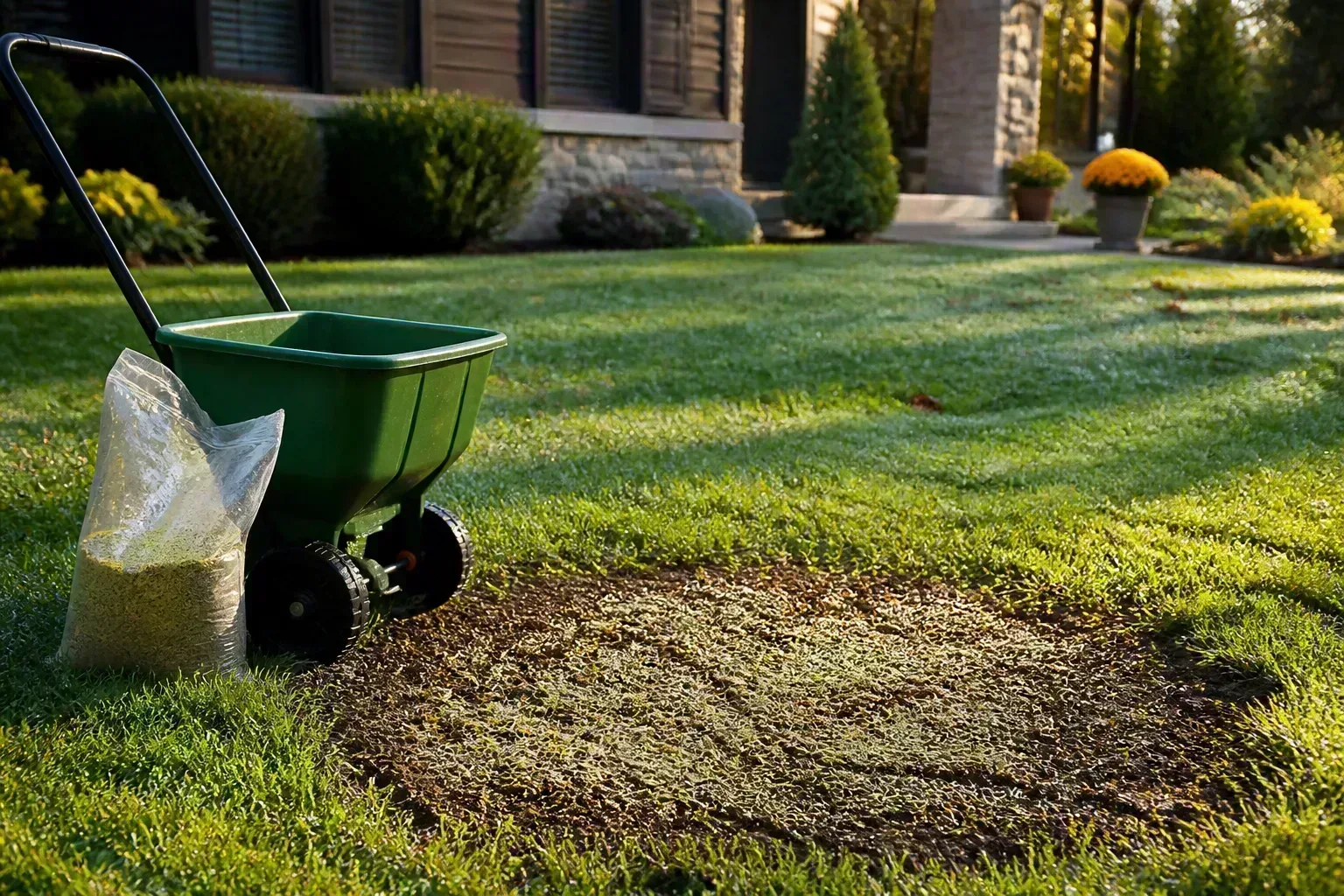
For a large area, soil test first and choose the grass type and seeding season recommended locally. Cool-season grasses and warm-season grasses have different establishment windows; using a seed mix suited to the wrong climate or shade level can leave the same area thin again. If wildlife keeps lifting fresh sod, repair after the feeding problem is resolved or protect only the small repaired area temporarily while new roots anchor.
Make the next season less favorable to damage
Healthy turf can withstand more root feeding than grass already weakened by drought, scalping, poor nutrition, or compacted soil. Mow at the correct height for your turf type, return to a reasonable irrigation schedule after inspection, and use a soil test to avoid under- or over-fertilizing. Extension guidance favors strong root growth and targeted monitoring over automatic insecticide use across every lawn.
Patch bare areas before weeds and erosion take over, and consider whether every part of the yard needs to remain turf. Converting a low-use strip into a planted bed or choosing a locally adapted grass with a stronger root system can reduce the amount of vulnerable lawn and the cost of repeated repair. The right choice depends on shade, foot traffic, water availability, and regional recommendations.
If one portion of the property has repeated confirmed damage, mark it on a simple map and inspect that area during the locally recommended monitoring window the next season. Do not treat the full lawn just because it was damaged once; adult beetles can fly in from elsewhere, and a past problem does not prove that every square foot has larvae now.
Mistakes that prolong the problem
The most expensive mistake is treating a color change before confirming root injury. A pesticide cannot correct drought, disease, fertilizer burn, or mowing stress, and it can reduce beneficial insects even when grubs were not responsible. Diagnose first, then decide whether the evidence justifies treatment.
Other common errors are counting only one patch, applying a product after its useful stage has passed, using milky spore for an unidentified grub, or expecting nematodes to work without the required moisture and storage conditions. Homemade dish-soap drenches are not a dependable way to reach larvae through a lawn’s root zone; avoid using detergents or concentrated home mixtures that can injure grass or soil life. Also avoid withholding all water in hot weather, which can add drought stress without proving that the grub problem is solved.
Finally, do not confuse adult beetle control with grub control. Traps or sprays aimed at adult beetles may not reduce larvae already feeding under the turf, and adult beetles may arrive from neighboring properties. Manage the life stage that is actually damaging the lawn.
When to call your extension office or a turf professional
Ask for local help if you cannot identify the larva, the count seems high but the grass symptoms do not fit, patches are spreading quickly, or the affected lawn is large, expensive, or used heavily by children and pets. An extension office can often identify a sample or point you to a regional threshold; a turf professional can assess species, site conditions, product timing, and repair options.
Bring photos of the whole patch and close-ups of the larva, plus notes on where and how many you found, the grass type if known, recent watering, and the date. Those details help separate a root-feeding grub problem from a look-alike and keep a control recommendation specific to your lawn.
Conclusion
Treat lawn grubs only when you have evidence that larvae are causing unacceptable damage. Check roots, inspect several mapped spots, identify the grub group as well as you can, and compare the result with local guidance instead of relying on one universal count or calendar date.
If the turf is holding and you find only a few larvae, strengthen the lawn and monitor. If active root injury and local thresholds support intervention, choose a species- and stage-appropriate option, follow its label, and repair dead turf after the damage is controlled. A measured response protects the lawn without treating every brown patch—or every grub—as an emergency.