How to Grow Zucchini Plants From Seed Through Harvest
Learn how to grow zucchini from seed to harvest, with clear timing, spacing, watering, pollination, container, and pest advice for a longer harvest, too.
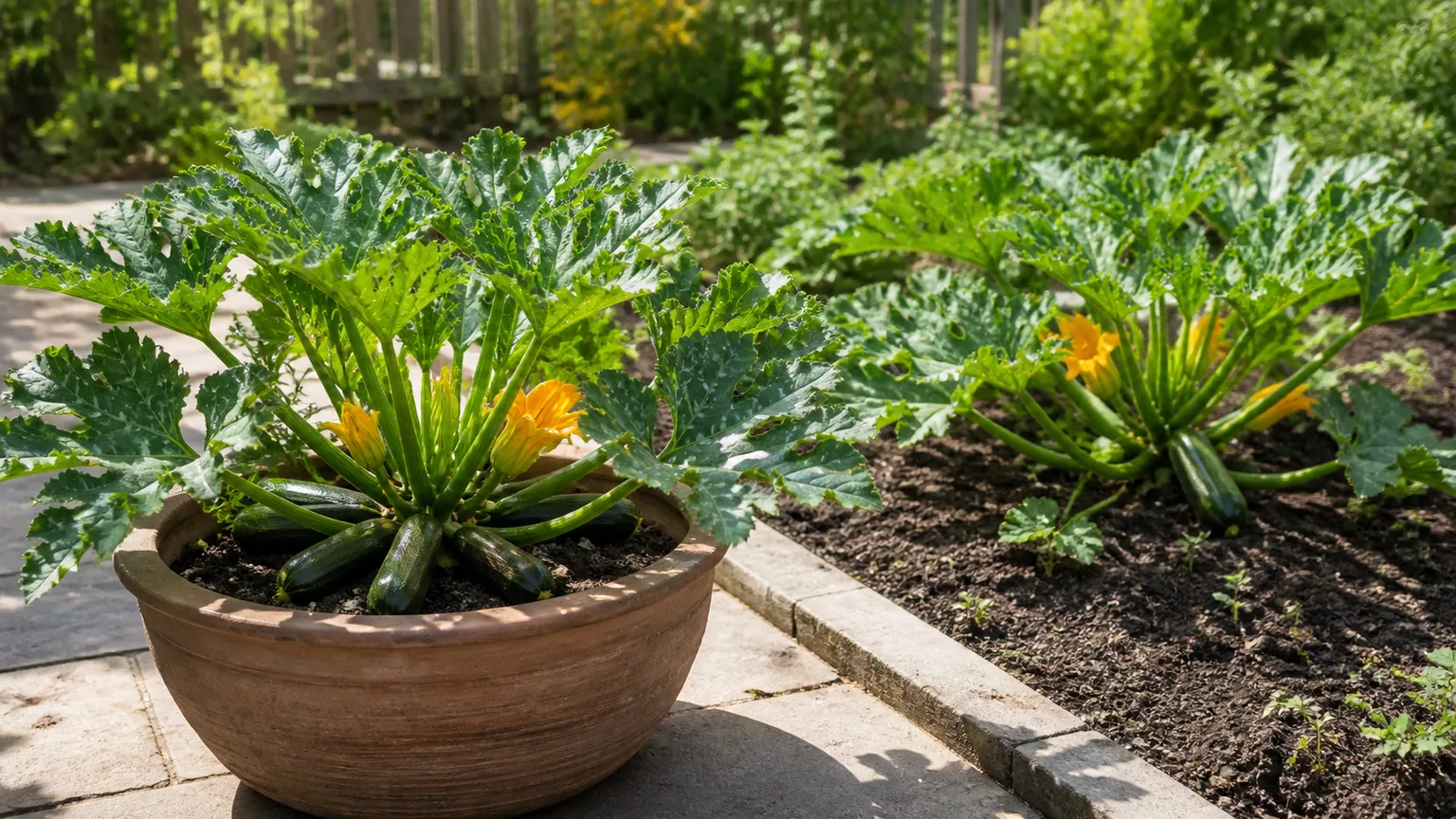
Zucchini is quick to grow, but a productive plant still depends on a few choices made before the first flower opens. Planting into cold soil, crowding a bush variety, or letting a pot dry out can turn an otherwise vigorous squash into a leafy plant with little fruit.
The reliable approach is simple: choose a cultivar for the space you have, wait for warmth, keep the root zone evenly moist, and learn what the flowers are telling you. Then check the plant often once fruit begins; zucchini can go from tender to oversized while hidden under its leaves.
Start with a variety that fits your space
The name zucchini usually refers to summer squash in the species Cucurbita pepo. It is a warm-season annual, not a perennial: frost ends the plant, so gardeners sow it again each growing season. Seed packets differ in days to maturity, fruit color, shape, plant size, and disease resistance; those details matter more than a generic promise of “high yield.”
For a first garden, pick a cultivar that matches your main constraint. If space is tight, look for a compact or bush habit and a container-suitable label. If powdery mildew is common in your region, choose a variety with stated resistance where available; resistance can reduce risk, but it does not make a plant immune in every weather pattern.
Zucchini is normally propagated from seed, but seed saved from a tender fruit is not ready to plant. For seed saving, fruit must mature fully on the vine, and pollen can cross between nearby zucchini and other summer squash in the same species, so saved seed may not produce the cultivar you grew. Epic Gardening notes that Cucurbita pepo varieties cross-pollinate readily; use labeled seed when you want predictable fruit and disease-resistance traits.
Bush and vining types serve different gardens
Most familiar zucchini plants form a large leafy bush rather than a long climbing vine, but their mature spread can still take several feet. A bush type makes sense in a bed or large container where its leaves can fan out. Some vining or semi-vining summer squashes can be trained up a sturdy trellis, but only if the seed packet describes that growth habit and you can support the weight of foliage and fruit.
If you want the simplest setup, choose a bush cultivar and give it the room listed on the packet. A trellis is a space-management tool, not a cure for crowding: tying a non-vining zucchini upright can kink or split its brittle stems. For a container, a compact habit and manageable mature spread are more useful than choosing a variety because its fruit looks unusual. Epic Gardening’s summer-squash guide compares common types and explains why cultivar choice changes the space and harvest plan.
Choose a sunny, fertile site with room for leaves
Give zucchini at least six hours of direct sun; eight hours is a better target where summers are mild or cloudy. A site with morning sun and good air movement dries dew from the broad leaves and gives bees a clear route between flowers. Avoid a low pocket that stays waterlogged after rain, since warm-weather growth does not compensate for oxygen-starved roots.
The soil should drain well and hold moisture without staying soggy. Before planting, work in finished compost if the bed is low in organic matter, and use a soil test if you do not know the pH or nutrient level. A soil pH around 6.5 is a useful target, but use a soil test before applying lime or fertilizer. Savvy Gardening’s zucchini problem guide gives that pH as a practical target and cautions that excess nitrogen can favor leaves over fruit.
Zucchini leaves are big enough to shade neighboring seedlings, and they can sprawl into a path. Plan access from the start: leave space to reach the crown, inspect the underside of leaves, and harvest without stepping on stems. A raised mound is optional, not mandatory; it can help warm cool, heavy ground and improve drainage, while a flat bed is easier to water evenly in hot or dry climates.
Plant after frost and warm soil
Sow outdoors only after the frost risk has passed and the soil has warmed. Zucchini seed may germinate slowly or unevenly in cold earth; seedlings that emerge into chilly weather also stall, and frost can kill them outright. A soil temperature around 60°F is a useful lower threshold, while warmer soil near 65°F or above often gives faster, more even emergence. Local frost dates and a simple soil thermometer are more useful than choosing a calendar date from another climate.
In a long, hot season, you can sow a little later than the first possible planting date and still harvest well. In a short season, start at the first safe warm spell and choose a cultivar whose stated days to maturity fit the weeks before your first fall frost. The seed packet’s timing is an estimate, not a guarantee; cool nights, cloudy weather, and transplant shock can all delay it.
Direct sowing is easiest; transplant only gently
Direct sowing usually gives zucchini the least stressful start because squash seedlings dislike root disturbance. If you want a head start, sow indoors only a few weeks before the expected outdoor planting window, preferably in a biodegradable pot or another container that lets you move the root ball intact. Harden seedlings off gradually over about a week, then plant them once nights and soil are warm; do not move a lush indoor seedling straight into hot sun or wind.
A nursery transplant can shorten the wait, but check for a compact, healthy plant rather than one already root-bound or carrying flowers in a tiny cell. Keep the root ball intact and water it in well. If a transplant droops briefly, protect it from harsh afternoon sun while it settles; if it remains limp in wet soil, investigate root or stem damage instead of watering repeatedly.
Sow shallowly, then thin to the right spacing
Plant seeds about one inch deep, following the packet if it gives a cultivar-specific depth. In a hill or planting pocket, sow two or three seeds and later keep the strongest one or two plants; in a row, place seeds several inches apart and thin them after they establish. Hills warm quickly and drain well, but they are not a pollination requirement: one zucchini plant can produce both male and female flowers.
Space bush plants according to their mature spread, commonly about two to three feet apart, with wider row spacing if the leaves would overlap into a solid mass. Compact varieties can be closer than sprawling cultivars, so the seed packet wins over a blanket number. Plants need enough room for air and access; close spacing makes harvest harder and encourages a humid, tangled canopy where diseases and hidden fruit are easy to miss.
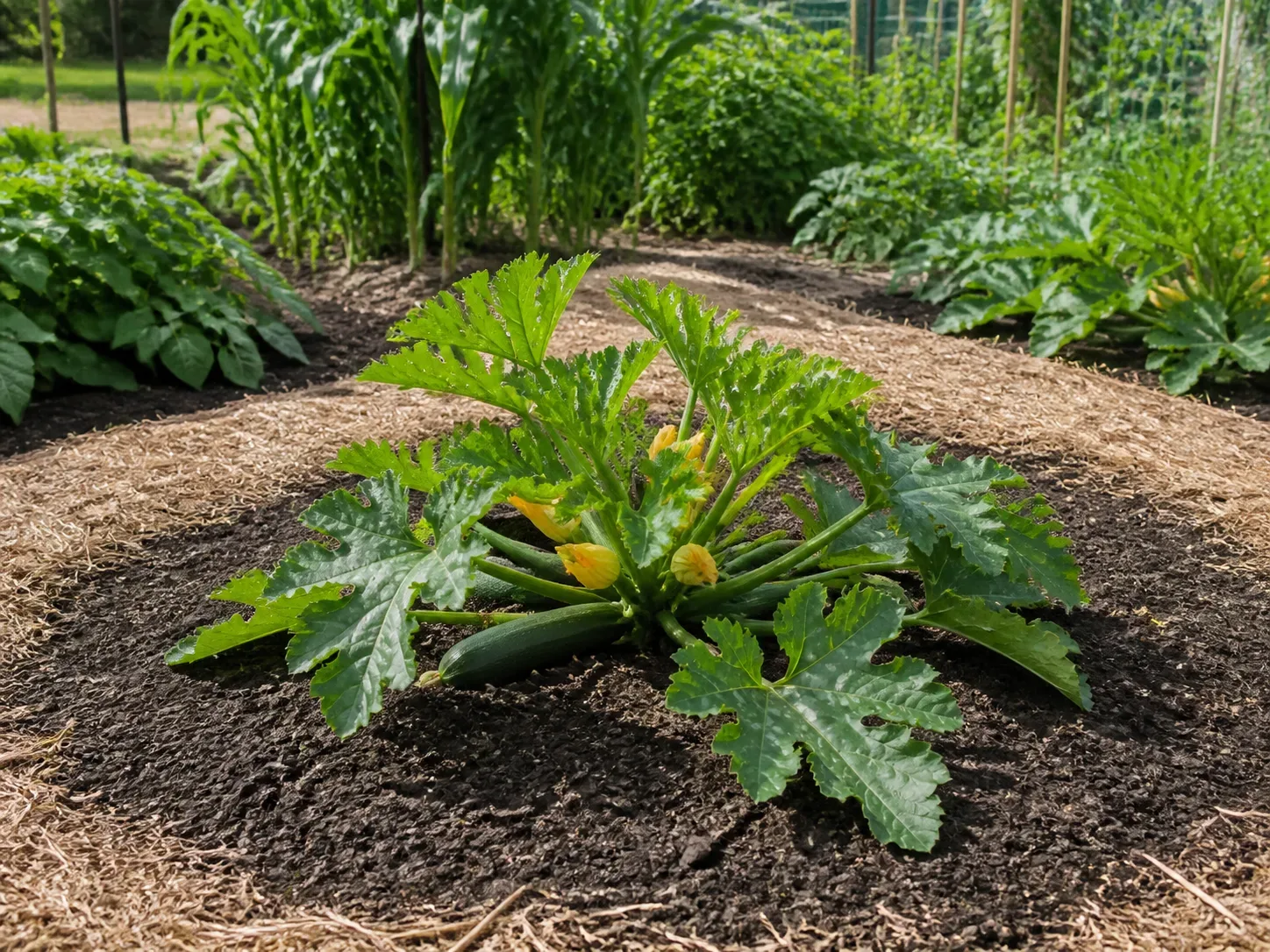
Cover seeds lightly and keep the planting zone consistently damp, not flooded, until seedlings appear. Zucchini commonly germinates within about a week in warm soil, but cool ground can stretch that time. Once seedlings have true leaves, cut weaker extras at soil level rather than pulling them up and disturbing the roots of the plant you are keeping.
Grow zucchini in a large container with daily checks
A container makes zucchini possible on a patio, but it does not make the plant small. Pick a compact bush variety and use the largest stable pot your space can hold; a broad container of roughly 10 to 15 gallons or more gives one plant a more forgiving reservoir than a small patio pot. A smaller pot may produce fruit, but it dries faster, leaves less room for roots, and needs closer attention in heat.
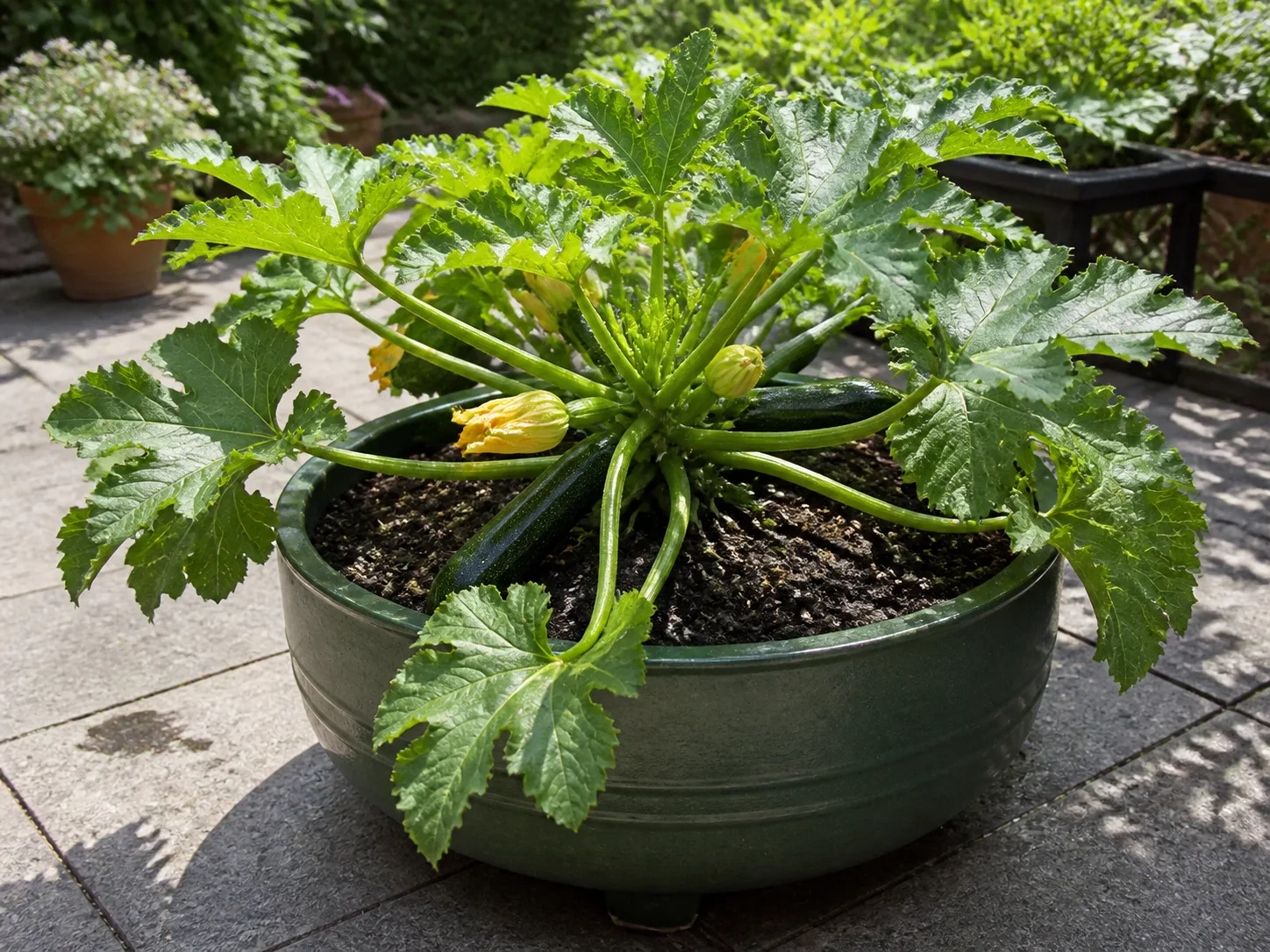
Use a lightweight potting mix blended for containers rather than garden soil, which can compact and drain poorly in a pot. Make sure water can escape through unobstructed drainage holes, then place the container where it will receive six to eight hours of sun. A zucchini in a pot may need water every day during hot, windy weather; check the mix with a finger rather than following a fixed schedule. The practical advice in Savvy Gardening’s container guide also emphasizes variety choice, drainage, sunlight, and pollination.
Keep a pot where bees can find its flowers. On a high balcony or enclosed courtyard with few pollinators, fruit set may be unreliable even when the plant looks healthy, so be ready to hand-pollinate. If the pot is in a windy spot, use a heavy container and a sheltered position; a large canopy can catch wind and tip a lightweight planter.
Water deeply, mulch, and avoid excess nitrogen
A mature zucchini plant uses water quickly, especially when it is carrying fruit. For a baseline, Epic Gardening recommends at least one inch of water per week for summer squash; count rain toward that total and adjust for heat, soil type, and container size. Push a finger into the soil near the root zone: if the top inch is dry, water thoroughly at the base so moisture reaches the roots rather than wetting only the surface.
Consistency matters more than a rigid weekly number. Letting a plant wilt repeatedly and then soaking it can stress root uptake and contribute to small, misshapen, or damaged fruit. In a container, check daily during heat waves; in the ground, mulch and deep watering may make checks less frequent. A rain gauge helps distinguish “it rained” from “the roots received enough water.”
Once the soil has warmed, apply a loose layer of straw, shredded leaves, or another clean organic mulch. Keep it an inch or two away from the crown so the stem base does not stay damp. Mulch slows evaporation, suppresses weeds, and reduces soil splashing onto leaves, but a heavy layer laid over cold spring soil can delay warming.
Zucchini benefits from fertile soil, but more fertilizer is not automatically better. Mix compost into poor soil before planting and use a balanced product only if a soil test or clear plant need supports it. Too much nitrogen can create an enormous canopy with fewer female flowers and less fruit, while adding calcium without evidence will not fix an irrigation problem. If the foliage is lush green and fruiting is weak, review nitrogen and pollination before adding more feed.
Understand zucchini flowers before worrying about fruit
Zucchini plants are monoecious: each plant can produce separate male and female flowers. Male flowers sit on a slim stem; a female flower has a tiny zucchini-shaped ovary between the flower and main stem. Both are needed for ordinary varieties to set fruit, because pollen must move from a male flower to a female one.
It is normal for young plants to open male flowers first. A plant may bloom for a week or two before female flowers appear, so a handful of flowers that drop early does not mean it needs fertilizer or another plant. The real test is whether a female flower opens while a male flower is also open and pollinators are active; cool rain, extreme heat, or a shortage of bees can narrow that window.
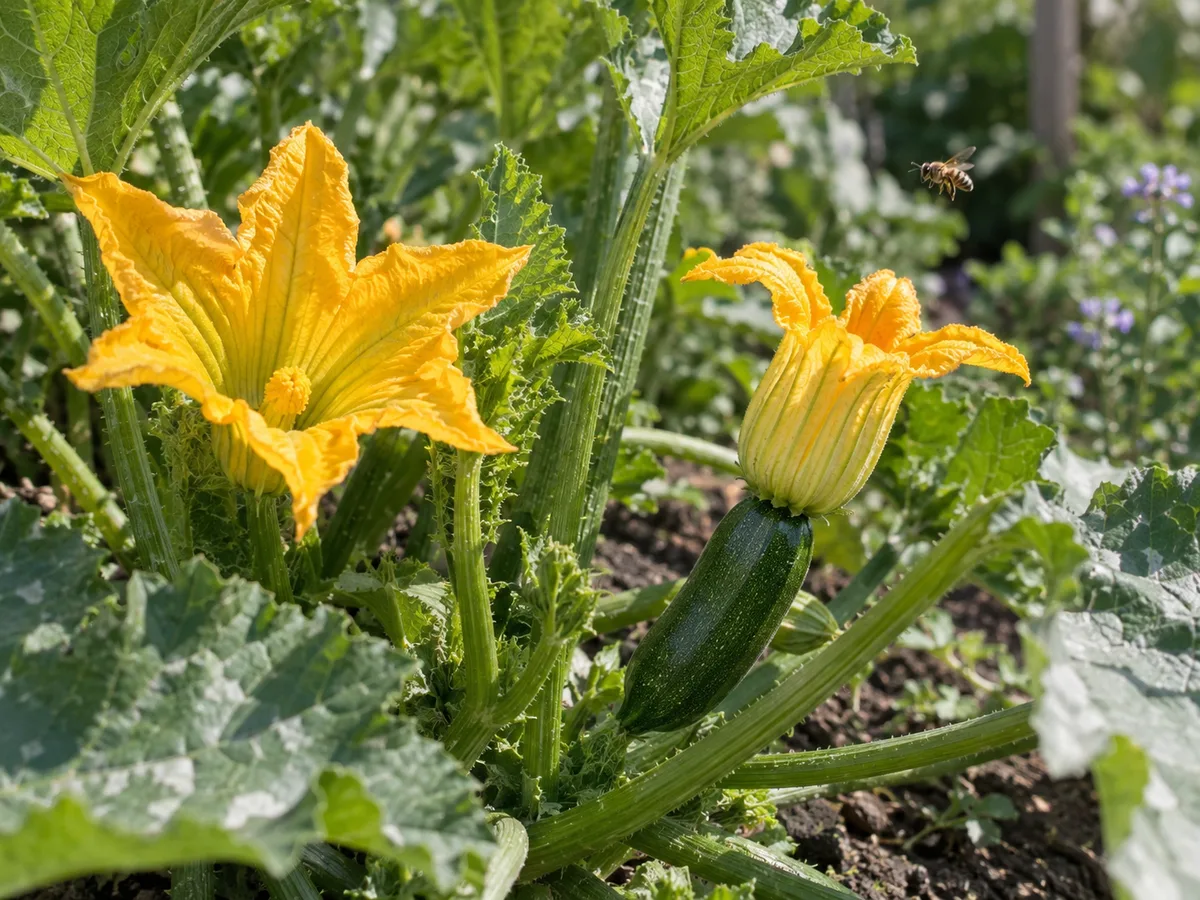
Each flower is short-lived, often opening in the morning and closing later that day. If an immature zucchini starts to enlarge but then yellows, shrivels, or drops, poor pollination is one likely cause; a female flower that never opens will not set fruit. University of New Hampshire Extension explains how squash’s separate flowers rely on pollen transfer and why hand-pollination is best done early in the day.
Hand-pollinate only when the timing and signs fit
Hand-pollination is a backup when female flowers are open but bees are scarce, weather has been rainy, or several young fruits are shriveling. It is not a remedy for a plant that has only male flowers yet, and it will not correct drought, root damage, or a pest boring through a stem. Check flowers in the morning while they are open and use a clean, dry artist’s brush or cotton swab.
- Find a fresh male flower with visible yellow pollen on its central anther.
- Find a fresh female flower with the small fruit behind its petals and a sticky central stigma.
- Lightly brush pollen from the male flower onto the stigma, or remove the male flower and touch its pollen-bearing center to the stigma.
- Leave the female flower attached and avoid wetting or disturbing it for the rest of the day.
You do not need to hand-pollinate every bloom if bees are already moving between the flowers. More plants can increase the chance that male and female flowers overlap, but a single healthy zucchini plant can set fruit because pollinators can move pollen between its own flower types. If a balcony gets almost no pollinator traffic, consider a parthenocarpic cultivar that can set fruit without pollination, if one is available for your growing conditions.
Harvest small fruit often, not by pulling
Most zucchini are best harvested when they are tender and roughly six to eight inches long, but round or specialty cultivars have their own ideal size. Use the fruit’s appearance and the seed packet as a guide; smaller fruit generally has softer skin and less-developed seeds. Once the first zucchini appear, check under the leaves every day or two because a hidden fruit can swell noticeably between visits.
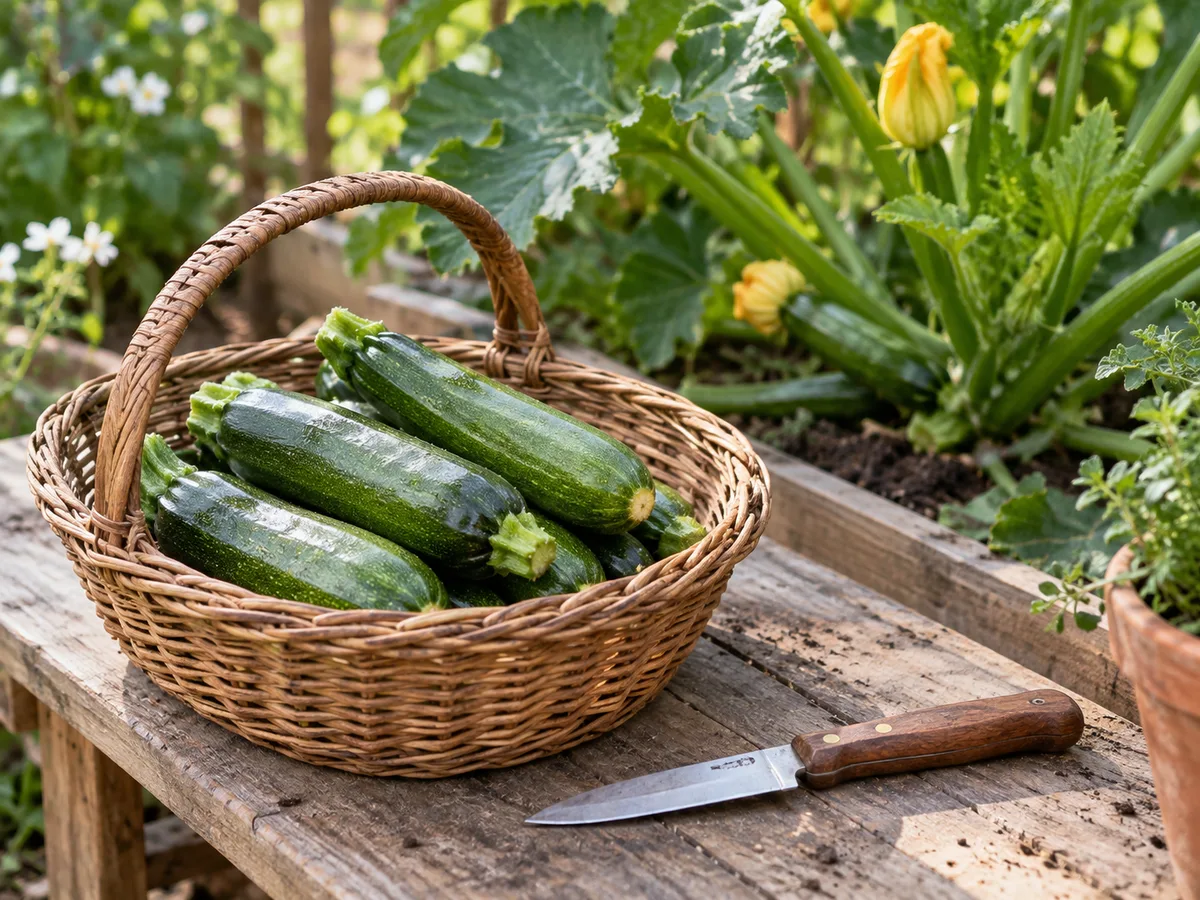
Cut the fruit with a clean knife or pruners, leaving a short stem, rather than twisting or yanking it from the plant. Pulling can tear the stem or damage the plant’s crown, opening a wound and interrupting growth. Harvesting often also prevents a large fruit from monopolizing the plant’s energy and keeps the next flush of fruit easier to spot.
The skin of a good summer zucchini should feel firm and look glossy for its variety. An oversized zucchini is still edible, but its seeds may be more developed and its flesh less delicate; grate it for baking or soup rather than expecting the texture of a young squash. Refrigerate harvested fruit and use it while its skin is firm; summer squash is not a long-term storage crop.
Use succession planting to outlast pest pressure
A zucchini plant can start strong and then slow as disease, heat, or pests accumulate. A second sowing a few weeks after the first can extend the harvest, provided enough warm growing time remains before frost. Count backward from your area’s first fall frost using the seed packet’s days to maturity, and allow extra time for slower late-season growth.
In places where squash vine borers are a recurring problem, a later planting can sometimes avoid the peak egg-laying period, but the trade-off is a shorter window before cold weather. University guidance varies by region and pest timing, so use local extension advice rather than assuming one midsummer date applies everywhere. If you had borers in a bed last year, rotate zucchini to a different part of the garden; row covers placed over last year’s host site may trap emerging moths with the crop.
A second planting is also useful if the first crop becomes diseased or stops setting fruit. Remove spent vines rather than leaving infested debris to shelter pests, and do not put visibly diseased or borer-infested material into a home compost pile unless your system reliably reaches pathogen-killing temperatures. Succession planting is a way to spread risk, not a guarantee that the second crop will escape every pest.
Prune and support only when they solve a problem
You do not need to prune a healthy zucchini plant on a weekly schedule. Every leaf contributes to photosynthesis, and cutting away too much foliage exposes fruit to sunscald and reduces the plant’s ability to feed itself. Remove leaves only when they are dead, badly damaged, or so crowded that they block airflow and access; use clean pruners and avoid cutting into the central crown.
If you remove an infected leaf, take it on a dry day and discard it rather than dropping it beside the plant. Do not strip the plant just because a few older lower leaves are yellow; shade, age, or normal wear can affect those first while the crown and newer growth remain healthy. A plant with many healthy leaves but few fruit usually needs a pollination or nutrient check, not more pruning.
A stake or cage may keep some fruit off wet soil and make a compact planting easier to inspect, but most bush zucchini do not climb naturally. Install support while the plant is young so you do not damage roots later, and tie stems loosely where they can flex. Stop if the main stem resists bending; forcing it upright can split the plant.
Diagnose the problem before changing care
When zucchini looks wrong, first note where the symptom starts and how fast it changes. One yellow old leaf is different from a plant that collapses in the morning; a tiny fruit that shrivels is different from a mature fruit with a sunken, dark blossom end. Check soil moisture, look under leaves, and inspect the stem base before adding fertilizer or spraying.
White powder on leaves: treat it as a disease clue
Powdery mildew appears as white, dusty patches, often on leaf surfaces, and tends to become more noticeable as plants mature and the canopy thickens. It can reduce vigor when widespread, but a few spots late in the season do not automatically require removing the whole plant. Improve airflow by spacing plants well, watering at soil level when practical, and cutting off only badly affected leaves; avoid removing so much foliage that fruit is left exposed.
Do not confuse powdery mildew with natural silver markings found on some zucchini leaves. Natural markings follow the leaf veins and are part of the leaf surface, while mildew looks like a superficial growth that spreads across the tissue. Downy mildew is a different disease group: its white, bluish, or gray sporulation appears on leaf undersides, as NC State Extension’s plant-disease diagnostic guide explains. If the leaves have angular yellow areas, fuzzy growth underneath, or rapid collapse, compare the symptoms with a local extension diagnostic rather than treating every pale mark as powdery mildew.
Blossom-end rot is a different clue: the end opposite the stem turns dark, sunken, or leathery while the fruit is still small. Uneven moisture can disrupt calcium movement into the fruit even when the soil contains calcium, so stabilize watering before buying a calcium supplement. Savvy Gardening’s zucchini problem guide explains how inconsistent moisture, excess nitrogen, and pollination problems can produce different symptoms.
Sudden wilt or damaged leaves: inspect stems and undersides
A zucchini plant that wilts in afternoon heat may perk up overnight if it is simply thirsty, but wilting that persists in the morning deserves a closer look. Examine the stem base for a hole, yellow or tan sawdust-like frass, or a soft damaged area. Squash vine borer larvae feed inside the stem and can interrupt water movement, so a plant may collapse even when the soil is wet. UConn Extension’s squash vine borer guidance describes the moth, the frass-and-entry-hole clue, and why prevention and early monitoring matter.
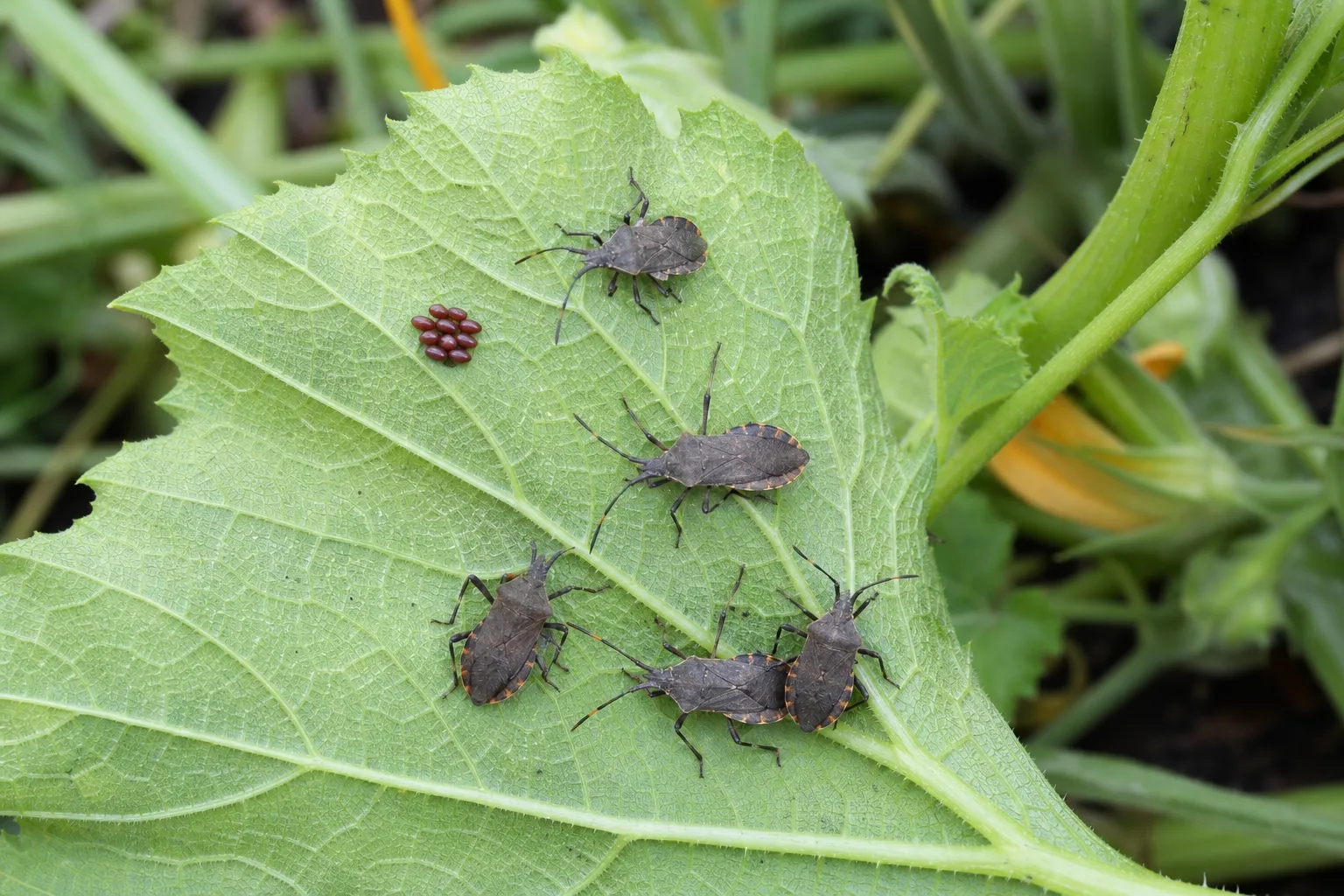
Look under leaves for clusters of bronze-colored squash bug eggs and groups of gray nymphs, especially near leaf veins. Remove egg clusters when you find them and check again in a few days; early, repeated inspection is more useful than waiting until leaves are badly stippled. A row cover can keep some pests from reaching young plants, but ordinary zucchini needs insect pollination, so remove the cover when flowers open unless you are hand-pollinating or growing a parthenocarpic cultivar.
If you find a borer larva in a stem, carefully opening the damaged area and removing it may save part of a plant, but success is uncertain and the cut itself creates a wound. Remove and discard a collapsed plant if the crown is extensively damaged, then rotate the next crop. When considering any pesticide, use a product specifically labeled for the crop and target pest, follow the label exactly, observe the preharvest interval, and protect bees by avoiding exposure during bloom.
Conclusion
For dependable zucchini, choose a cultivar that fits your space, wait until frost has passed and the soil is warm, and give the plant sun, drainage, and room to spread. Direct-sow when possible, water deeply and consistently, and avoid feeding or pruning by habit when the plant gives no reason to do either.
When flowers appear, look for both sexes before worrying about a missing crop; hand-pollinate only if female flowers are open and pollination is failing. Harvest tender fruit often, scout the stem base and leaf undersides, and sow a second crop only when your remaining frost-free season gives it time to mature. Those small decisions do more for a steady harvest than any single fertilizer or pruning trick.



