How to Identify and Remove Amur Maple Trees Safely
Learn where Amur maple is invasive in your area, how to distinguish it from lookalikes, and when to pull seedlings, remove saplings, or call an arborist.
Amur maple at a glance: the four clues to check
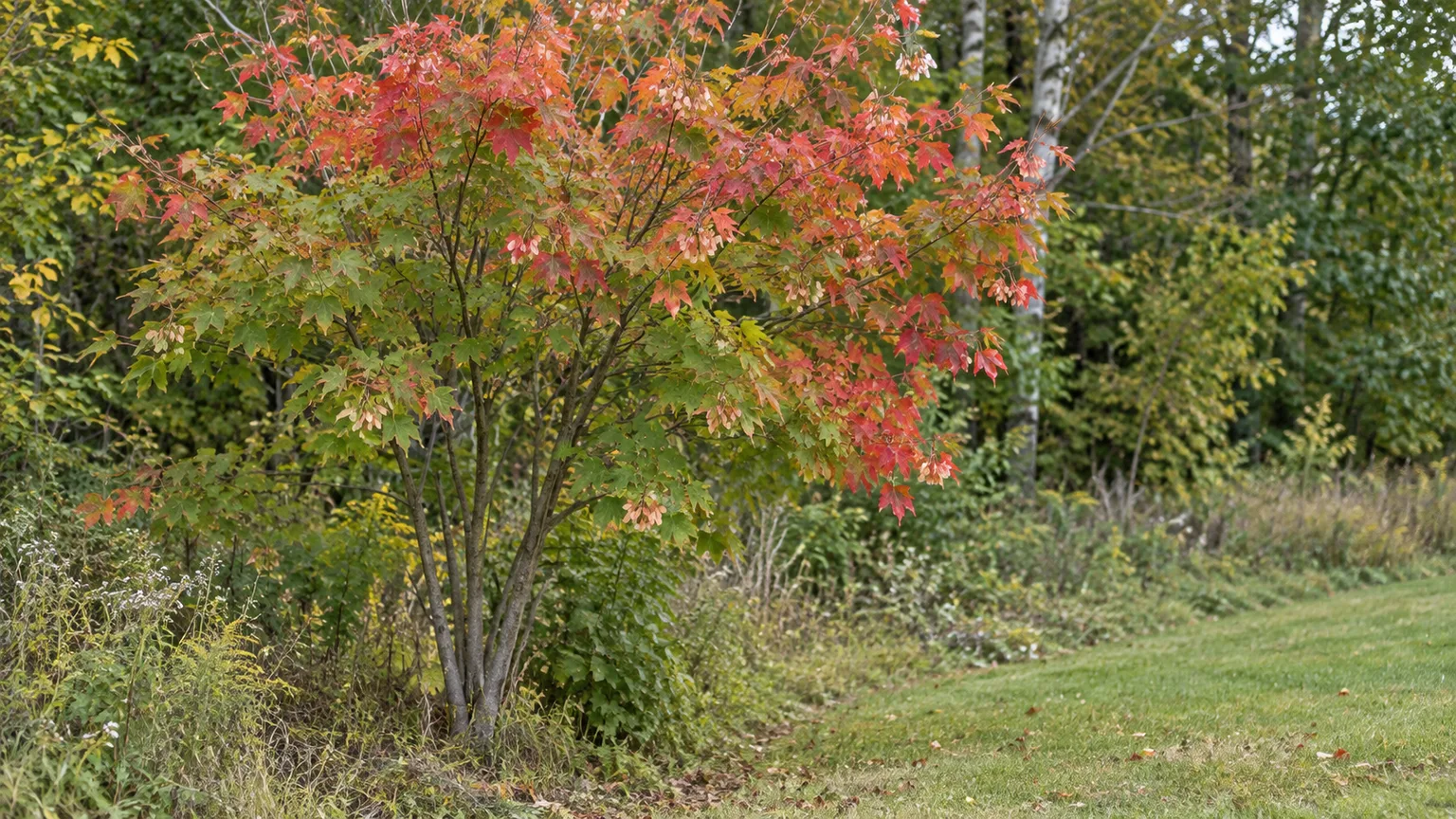
Amur maple (Acer ginnala, also treated botanically as Acer tataricum subsp. ginnala) is a small deciduous tree or large shrub from northeastern Asia. It often grows with several trunks, usually stays far shorter than a full-sized shade maple, and can turn bright red or orange in fall. Those traits make it attractive in a yard, but fall color alone is a poor reason to remove a tree: several maples look similar, and local rules do not treat every nonnative tree the same way.
For a fast first check, look for four clues together: opposite buds or branches, simple leaves commonly divided into three lobes with an elongated middle lobe, small pale spring flowers, and paired winged seeds called samaras. Then confirm the tree’s growth form and compare the leaves on several branches. A single leaf or a red canopy is not enough for a confident identification.
The mature size is often in the range of a large shrub or small tree, around 15 to 20 feet, and the crown may be nearly as broad as it is tall. University of Illinois Extension describes Amur maple as often multistemmed and notes that flower, fruit, and fall color vary among trees and cultivars; a tidy specimen in a landscape can therefore look different from a self-sown thicket at a woodland edge. Its Amur maple profile is useful for confirming the ornamental form, but the local invasive-plant list is what should guide your management decision. North Carolina State Extension also catalogs the plant as Acer tataricum subsp. ginnala in its Amur maple profile.
Why invasive status depends on where you live
“Invasive” is often used casually to mean any plant that spreads. In ecological guidance, it usually refers to a nonnative plant that establishes outside cultivation and causes environmental harm; a regulated or prohibited plant is a separate legal category. A state agency may manage a species on state lands without banning it from every private property, and a regional invasive-species group may document a local problem without creating a legal restriction.
The local difference is real for Amur maple. Pennsylvania’s Department of Conservation and Natural Resources includes it in its invasive plant fact sheets and says the listed species are considered invasive on state lands managed by the department; that description is specific to the lands it manages. Southeastern Wisconsin’s invasive-species consortium describes Amur maple as a threat to open grasslands, prairies, forest edges, and understory communities. University of Illinois Extension likewise says it has become invasive in some parts of the country and advises checking local authorities. These sources support a regional concern, not the claim that every Amur maple in every state is legally prohibited. See Pennsylvania DCNR’s fact-sheet list and University of Illinois Extension’s local-status caution.
Before you remove a mature specimen, check three places: your state agriculture or natural-resources department’s current invasive and noxious-weed lists; your county or regional invasive-plant council; and any municipal, conservation-district, or land-trust rules that apply to the site. Use the agency’s exact category and date. If a page says “invasive,” do not assume that automatically means a homeowner must remove it; if a rule says “restricted,” read what activities are restricted, including sale, transport, or planting.
Location also changes what “good control” looks like. A small seedling beside a garden path may be a simple hand-pulling job, while a mature tree spreading seed into a prairie or woodland may need a coordinated plan with a land manager. If you are unsure about either the species or its status, photograph leaves, buds, bark, flowers, and fruit and send them to a local extension office or invasive-species coordinator before cutting a large tree.
Identify Amur maple through the seasons
An identification is strongest when several features agree. Start with the branch pattern and leaves, which are present for much of the growing season, then use flowers or fruit as a seasonal cross-check. If those features are unavailable, record the tree’s shape and bark and return when it produces leaves rather than relying on a distant view of fall color.
Leaves and opposite branching
Maples have opposite branching: buds, leaves, and side branches emerge in pairs across from one another on a twig. This is a useful first clue because many unrelated small trees have alternate branching, but it does not identify Amur maple by itself; native maples share the same basic pattern.
Amur maple leaves are simple, not divided into separate leaflets. Many have three lobes, with the center lobe longer and narrower than the two side lobes, and toothed edges. Leaf shape can vary across a crown and between cultivated forms, so compare several mature leaves from different branches. A leaf that is damaged, unusually small, or still expanding may look less typical. Purdue Arboretum’s Amur maple description notes the long, dagger-like central lobe and nearly parallel samara wings, two details that help separate it from lookalikes.
Flowers, samaras, and growth habit
In spring, Amur maple can produce clusters of small creamy-white flowers. Later, it develops paired winged fruits—the familiar “helicopters” shared by maples. Immature samaras can show pink or red tones before turning tan or brown as they dry. Check a cluster on the tree rather than assuming every winged seed on the ground came from that tree; nearby maples can drop similar fruits.
The overall plant is often a low-branched, rounded, multistemmed shrub or small tree. Look for seedlings beneath or downwind of a seed-producing plant and along disturbed edges, but treat their presence as a reason to inspect, not as proof of species. The Southeastern Wisconsin Invasive Species Consortium notes that the species produces abundant, wind-dispersed seeds that germinate readily and can outcompete native shrubs and understory trees in affected habitats. Its regional profile describes the ecological concern; it is not a substitute for a legal list in your jurisdiction.
Tell Amur maple from lookalike trees
The hardest identification is often between maples, not between a maple and a completely unrelated plant. Red, orange, or yellow fall foliage is shared by many species, and the amount of red can vary with cultivar, weather, and site. Use a close-up of a leafy twig, the arrangement of opposite buds, and any samaras to narrow the possibilities.
Amur maple is generally much smaller and more often multistemmed than a mature red or sugar maple. Its three-lobed leaf commonly has a longer central lobe, while the broad outline and depth of the lobes differ among other maples. Norway maple typically has broader leaves with five main lobes and may exude milky sap from a broken leaf stalk; this is a comparison clue, not a stand-alone test. Japanese maples include many forms with deeply cut or finely divided leaves and are usually cultivated as ornamentals, so a lace-leaved specimen is not the typical Amur maple leaf.
Cultivars can complicate the picture. Names such as ‘Embers’ and ‘Flame’ are associated with strong fall color and colored fruit, but a nursery label or cultivar name does not override local invasive guidance. If a specimen is a valued planted tree and the identification is uncertain, pause before removal. Take clear photographs of a twig showing opposite buds, a full leaf with a ruler for scale, the plant’s multistem habit, and the fruit; a local botanist or extension office can provide a much better confirmation than one autumn photograph.
Choose a removal method by size and site
The method should match the plant’s size, the number of stems, the surrounding vegetation, and the consequences of a missed cut. A young seedling can usually be removed by hand; a woody sapling may need digging or repeated cutting; a larger tree may require an arborist and a stump plan. A broad-spectrum herbicide is not a default step for every tree, and removing a canopy tree without considering what it shades or supports can create a new site problem.
Use this simple decision rule: pull what comes out cleanly, cut or excavate what you can manage safely, and hire help when the tree or site makes felling risky. If the plant is in a sensitive natural area, near water, or among desirable plants, ask the land manager which method will minimize collateral damage. If local authorities do not recommend removal at your address, monitor seedlings and prevent seed dispersal while you confirm the site-specific guidance.
Do not use a fixed radius as the only trigger for removal. Distance to a forest edge, prairie, stream corridor, or other habitat can help you prioritize inspections, but seed movement depends on wind, water, slope, vegetation, and nearby source trees. A quick walk around your property and the adjoining edge gives more useful information than treating one distance as a universal threshold.
Pull small seedlings before they harden
Small seedlings are the easiest stage to control without herbicide. Work when the soil is moist—often after rain or a thorough soaking—and pull slowly at the base so the young root system comes with the shoot. If resistance is strong, loosen the soil with a hand trowel rather than yanking until the stem snaps; a broken top leaves you with a plant to find again.
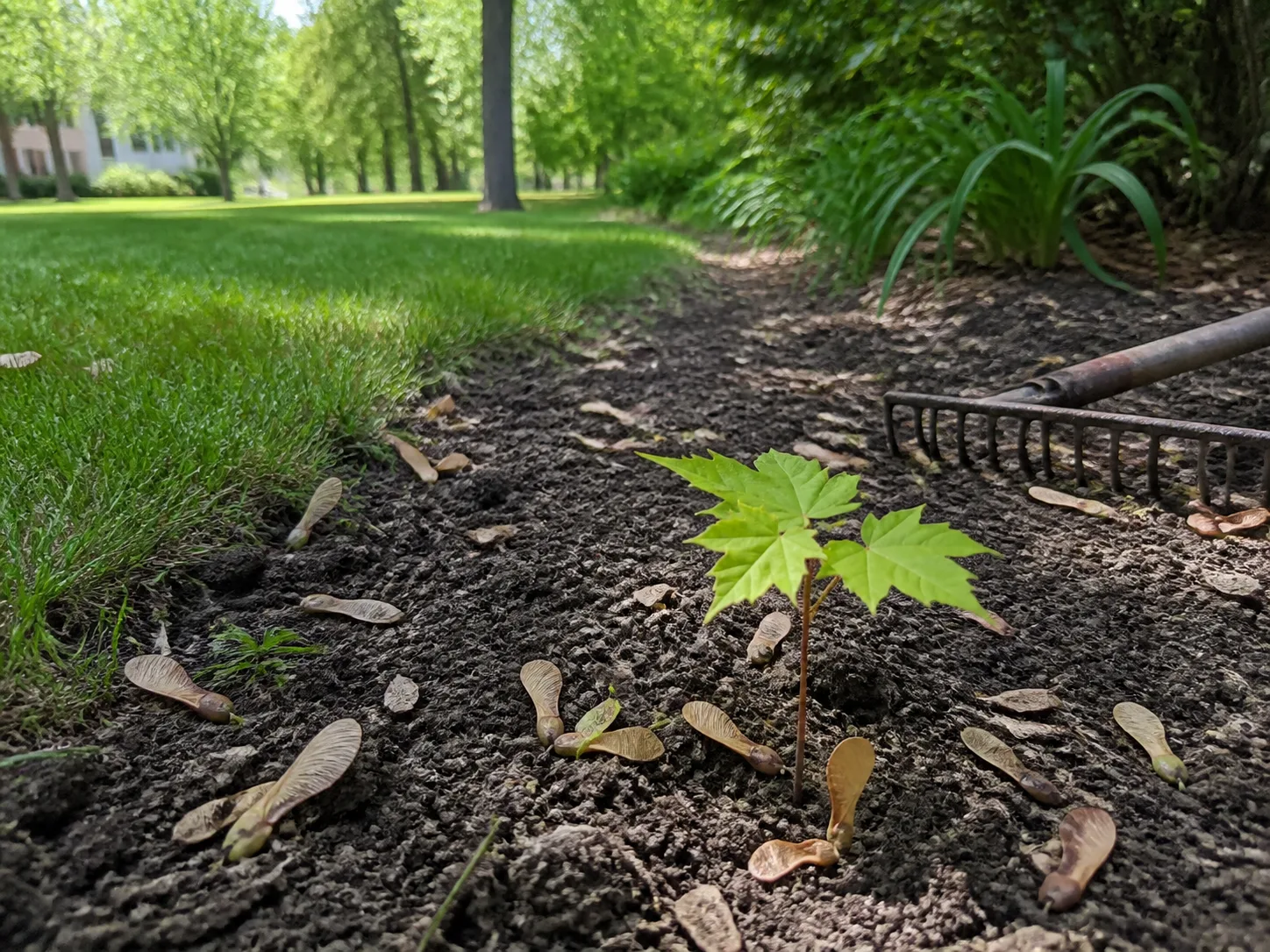
Walk the area from the parent tree outward, checking beds, fence lines, path edges, open ground, and the boundary nearest natural habitat. Look for seedlings in spring and again after the tree releases samaras. If the leaves are too small for reliable identification, flag the cluster and return in a week or two rather than removing a desirable native seedling by mistake.
Place pulled plants on a tarp or in a bucket while you work, especially if they carry developing or mature samaras. Do not drag seed-bearing branches across a lawn or into a wooded corner. A field account from Ney Nature Center describes pulling newly growing Amur maple seedlings after rainy days and revisiting the area after the larger trees had been removed, a practical reminder that easy first-year removal still takes follow-up. The nature center’s stewardship notes describe that sequence.
For seedlings embedded in lawn, repeated mowing can suppress very small growth, but one pass is not a reliable eradication method. Mow before seedlings develop woody stems, then inspect the same strip again; any survivor that branches or becomes too large for the mower needs hand removal or another method. Protect nearby native seedlings and do not scalp the surrounding vegetation simply to reach the maple.
Remove saplings without leaving a stump problem
Once a seedling is woody or too large to pull by hand, first decide whether the entire root crown can be dug out without damaging nearby plants, utilities, retaining walls, or irrigation. For a small sapling in loose soil, expose the root flare and loosen the soil around the crown; pull the plant out only when it releases without heavy force. Backfill the hole and check for fragments or nearby seedlings before moving on.
For a sapling that is too large to dig cleanly, cutting may be more practical. The catch is that many woody plants can resprout from a cut stump, so cutting is a first action rather than proof of success. If you choose repeated cutting, remove new shoots as they appear and keep the stump visible so you can see whether it is still alive. Do not assume that one low cut has killed the root system.
If using herbicide is allowed and appropriate for the site, a selective cut-stump application can target the freshly cut stem rather than broadcasting product over surrounding vegetation. Penn State Extension explains the basic cut-stump approach as a way to reduce regrowth from cut woody plants, while Alabama Cooperative Extension describes it as most useful when stem density is relatively low and stems can be safely cut and handled. Penn State’s cut-stump treatment guidance and Alabama Cooperative Extension’s detailed method both emphasize that timing and site conditions matter.
Plan removal of mature or multi-stem trees
A mature Amur maple can have several trunks, a wide crown, and branches over a roof, path, fence, or neighboring property. Before cutting, identify the fall direction, overhead lines, nearby structures, vehicle access, and where branches can land. If any part of the tree could strike a person, a building, utility line, road, or another tree you intend to keep, stop and hire a qualified arborist; do not use a ladder or chainsaw to improvise a solution.
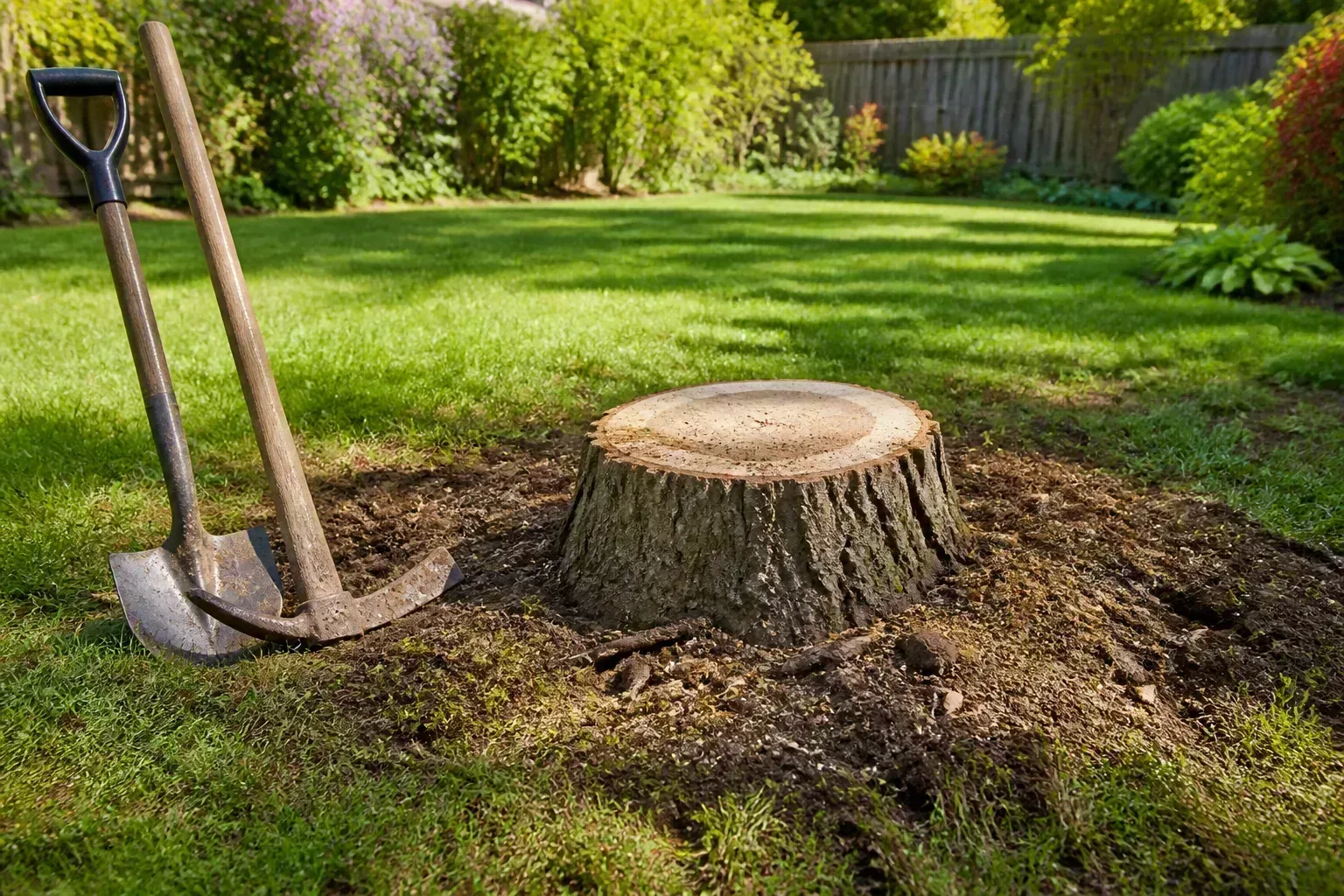
The stump plan matters before the first cut. If the goal is to prevent regrowth, choose in advance between professional stump removal or grinding, a locally appropriate cut-stump treatment, and repeated removal of new shoots. If the tree is on public, conservation, or shared land, coordinate with the responsible owner or manager. An active management project can combine tree removal with immediate seedling sweeps and replanting; cutting the canopy but leaving a bare patch can invite new weeds and make the work less durable.
When a cut-stump treatment makes sense
Cut-stump treatment is a targeted option for a woody plant when the product is legal for that site, the applicator can follow its label, and the stem can be cut safely. Extension guidance describes applying the appropriate labeled product to a fresh stump promptly after cutting; delays and the wrong formulation can reduce effectiveness. For Amur maple, treat each cut stem in a multistem clump only if the selected product label and local guidance permit that use.
Do not copy a concentration or mix rate from an article written for a different product, state, or site. Product registration and label directions determine where and how a pesticide may be used, and restrictions can differ near water, in residential areas, or on public land. Read the complete label, wear the specified protective equipment, keep product off desirable plants, and avoid application when conditions could carry it onto foliage or into water. Alabama Cooperative Extension’s cut-stump treatment guide emphasizes using a product labeled for the site and following its directions.
Herbicide is not automatically preferable to digging or repeated cutting. If only a few young plants are present, manual removal may be simpler and avoids chemical handling; if the tree is in dense vegetation, a trained applicator may be able to treat it more selectively than a homeowner. If treatment is prohibited, the tree is near water, or you cannot confidently follow the label, choose a nonchemical method or consult a licensed local professional.
When to hire an arborist or land manager
Hire an arborist for a tree large enough to require climbing, a chainsaw above shoulder height, rigging, or controlled lowering near structures and wires. Ask whether the person is insured and has credentials appropriate to your state, and explain that the goal includes preventing stump resprouting and managing seed-bearing debris. Utility lines require the utility company or a qualified line-clearance professional; they are not a homeowner pruning target.
Call a land manager or conservation organization when Amur maple has formed a patch in a woodland, prairie, wetland edge, or public natural area. They can advise whether removal should happen in phases, which native plants to protect, and what follow-up schedule fits the site. A one-time tree service visit may remove the canopy, but restoration often depends on returning to pull seedlings and establish competing vegetation.
Handle seeds and woody debris responsibly
If samaras are still attached or have recently fallen, keep them from being moved into an untreated area. Bag or contain seed-bearing material and follow local yard-waste or invasive-plant disposal instructions; some municipalities accept woody debris but have limits on seed-bearing or diseased plants. Do not pile ripe seed clusters at a woodland edge or add them to a compost pile unless the composting program confirms that its process destroys viable seeds.
Branches and trunk wood without seeds may be handled as ordinary woody debris if local rules allow. Chipping, firewood, and municipal brush collection each have different movement and disposal rules, particularly if the wood is taken off-site. Ask the county solid-waste authority or invasive-species program before transporting material from a natural area. Burning is not a shortcut unless local fire rules, permits, and site conditions explicitly allow it.
Clean soil and seed debris from boots, hand tools, tarps, and mower decks before moving from an infested patch to a clean area. This is a modest precaution, but it prevents a cleanup task from carrying samaras or other plant material farther than the original tree did. Keep disposal simple: contain reproductive parts, use an approved route, and avoid creating a new seed source in the process.
Monitor the site for regrowth and new seedlings
After removal, inspect the stump for shoots and search the nearby ground for new seedlings. Check once during spring leaf-out and again after the local samara-fall period; the calendar date varies with climate, elevation, and the particular tree. A simple phone photo from the same spot each visit can help you compare changes and remember where small seedlings first appeared.
Expect seedlings to continue appearing for a while if the parent tree had already released samaras before removal or if other Amur maples remain nearby. This does not prove that a buried seed bank will persist for a specific number of years; it means new plants may still be coming from seed sources you have not removed. Inspect adjoining boundaries, drainage paths, and disturbed soil as well as the original trunk area.
If the stump resprouts, return to the plan rather than repeating the same cut indefinitely. Recut and remove new shoots when manual control is safe, consult local extension about a suitable labeled treatment, or call the contractor back if the original scope included regrowth prevention. Keep a record of treatment dates and products if you used a pesticide, and follow the label for retreatment intervals and site restrictions.
Replace the tree with locally suitable plants
Replacing Amur maple is not just a cosmetic step. Vegetation keeps soil covered, restores shade or screening, and can reduce the open disturbed space that is easy for seedlings and other weeds to occupy. If your reason for removal is habitat protection, choose a tree or shrub native to your ecoregion and suitable for the site’s sun, moisture, soil, and mature size.
There is no single replacement list that fits every state. A plant native to one region may be nonnative in another, and wetland edges, dry slopes, street strips, and small yards need different species. Use your state extension service, native-plant society, or conservation district’s regional planting guide; ask for a small tree or shrub that fits the same functional role, then check its mature width and whether it needs pruning around paths or wires.
Planting immediately can be unwise if the site needs invasive seedlings removed first or if the stump must be ground. You can stabilize the area with suitable groundcover or mulch while planning the replacement, keeping mulch away from trunks and avoiding a deep blanket that hides new seedlings. Once the site is ready, water and weed the replacement through establishment; a native label does not make a young plant maintenance-free.
Common mistakes that let Amur maple return
The most common mistake is using fall color as the diagnosis. Red foliage is conspicuous, but it is not unique to Amur maple; confirm the opposite twig pattern, leaf form, fruit, and growth habit before destroying a mature tree. The second mistake is treating the word “invasive” as a universal legal instruction; read the local agency’s actual category and rules before applying a pesticide or transporting plant material.
Another mistake is cutting a trunk without deciding how to deal with the stump. That can leave a living base that resprouts and hides the fact that the work is incomplete. On the other hand, broadcast herbicide or an unlabelled home remedy can injure plants you meant to keep, create runoff risk, or violate product directions; use the least disruptive method that is effective for the plant and site.
Finally, do not stop after removing the largest tree. Seedlings may already be present, and a single surviving sapling can mature and restart seed production. Schedule repeat visits, contain seed-bearing debris, and replace the disturbed area with appropriate vegetation so the project addresses both the current tree and the conditions that let it spread.
Conclusion
Identify suspected Amur maple by combining opposite branching, its often three-lobed leaves with a longer middle lobe, spring flowers, paired samaras, and its commonly small, multistemmed form. Then check your state and local invasive-plant guidance: Amur maple is a documented concern in parts of the Northeast and upper Midwest, but ecological status and legal restrictions are not identical everywhere.
Match removal to size. Pull small seedlings from moist soil, dig manageable saplings, and plan a safe stump strategy before a larger tree is cut. Use herbicides only when permitted and in strict accordance with the product label, and call an arborist or land manager when the tree or habitat makes do-it-yourself work risky. Finish with a return visit, a seedling sweep, and a locally suitable replacement so the site stays managed after the canopy is gone.