Bamboo vs. Cork Flooring: Pros, Cons, and Costs
Compare bamboo vs. cork flooring for comfort, durability, moisture, sustainability, upkeep, and cost. Learn what to check before choosing a floor for each room.
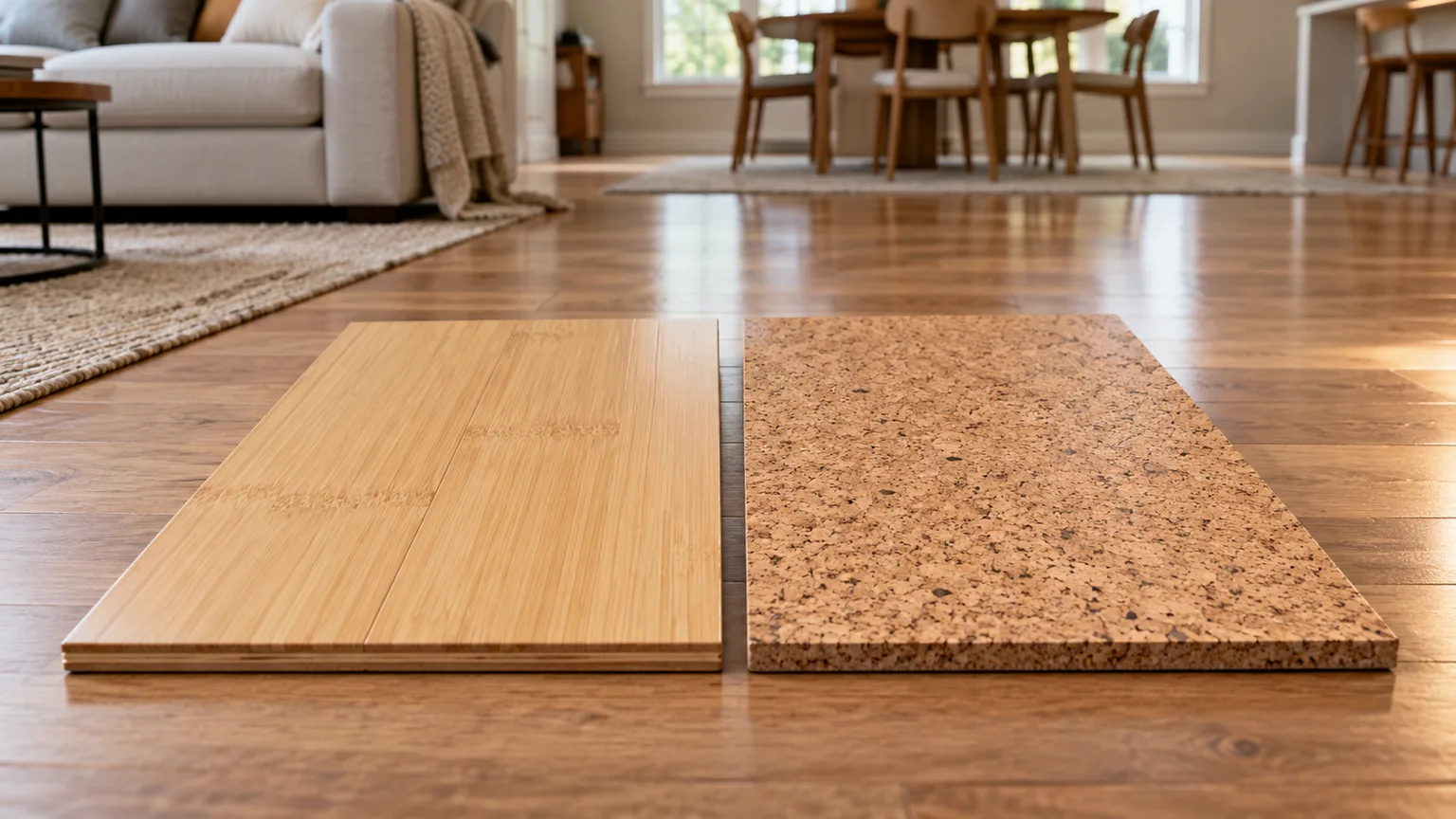
Bamboo and cork can both be made into attractive, renewable flooring, but they solve different problems underfoot. Bamboo usually gives you a firmer, smoother surface with a wood-like look; cork usually feels warmer and more forgiving when you stand or walk on it. Neither description applies equally to every product, because each material is manufactured in several constructions with different cores, finishes, and installation requirements.
The short choice is simple: put comfort, warmth, and a quieter feel first, and cork deserves a close look. Prefer a harder, more familiar plank surface and less cushion, and a well-specified bamboo floor may fit better. Before you commit, compare the complete flooring system: the surface layer, core, finish, room conditions, installation plan, warranty, and total quote.
The short answer: choose by feel, room, and risk
Choose cork when you want a warmer, slightly cushioned floor for a bedroom, den, or area where you stand for long stretches. That comfort can make a kitchen or home office more pleasant, but the softer feel does not make cork immune to dents, scratches, heavy furniture, or moisture.
Choose bamboo when you want a firm plank floor with a wood-like appearance and the construction and finish suit your traffic. Strand-woven bamboo is often denser than strip-built bamboo, but “bamboo” by itself is not a wear rating, a waterproofing promise, or a guarantee that the floor can be refinished.
For either material, rule out a room before comparing colors if it has active leaks, recurring standing water, a persistently damp concrete slab, or unstable humidity. Neither a natural origin nor a sealed surface makes every bamboo or cork product appropriate for a wet room. The installer must follow the instructions and written warranty for the exact product and subfloor.
What these floors are made of
Bamboo flooring is a manufactured plank made from processed bamboo. Cork flooring is made from cork oak bark, but a finished product may be a glued tile, a dense cork composite, or a floating plank built with a cork surface and a separate core. A sample that looks like solid cork or bamboo from above may contain layers that affect water exposure, sound, repairability, and emissions.
Look at the full cross-section in the product specification. The top wear layer, factory coating, core, backing, adhesive, and underlayment can matter as much as the material named on the carton.
Bamboo construction can change its performance
Horizontal and vertical bamboo planks are made by laminating strips in different orientations, which changes the visible pattern. Strand-woven products use compressed bamboo fibers and resin, producing a denser, more uniform surface than many strip-built planks. An engineered bamboo plank may use a thin bamboo layer over plywood, medium-density fiberboard, or another core; the bamboo layer’s thickness affects whether professional sanding is even possible.
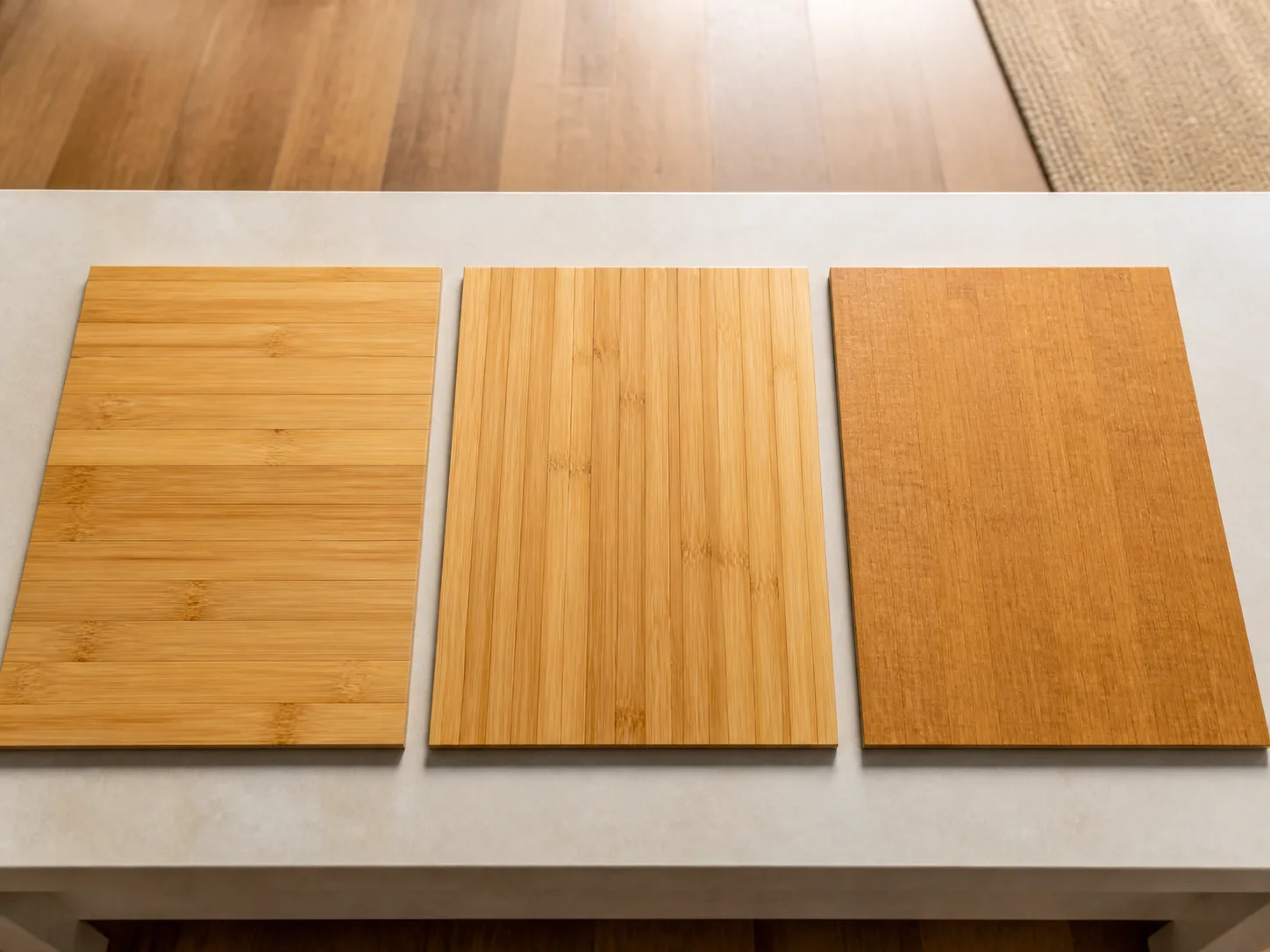
These formats are not interchangeable. A hardness figure can help compare specific products, but it does not measure finish abrasion, scratch visibility, moisture tolerance, or the quality of an installation. Ask which construction you are considering and request the manufacturer’s wear, finish, and refinishing details instead of choosing from the word “bamboo” alone.
Cork tiles and planks are not identical
Cork begins as the bark of cork oak. For flooring, cork is cut or ground and bonded into a surface layer, tile, or plank; some products use cork veneer over a fiberboard or plywood core, while others are more fully cork-based. Family Handyman’s cork-tile installation guide describes natural cork, prefinished cork, vinyl-clad options, and floating products, illustrating why one “cork floor” description cannot cover every construction.
A glue-down tile and a click-lock plank also behave differently at the seams and during repair. A loose or damaged tile may be replaceable in place if the matching product and installer method are available; a floating plank may require lifting a section of the floor to replace a board. Confirm which product you are buying and whether the manufacturer sells replacement pieces before installation.
Bamboo vs. cork: a side-by-side comparison
| Factor | Bamboo flooring | Cork flooring |
|---|---|---|
| Typical feel | Firmer, smoother, closer to a wood plank | Warmer and more cushioned underfoot |
| Construction range | Horizontal, vertical, strand-woven, and engineered planks | Glue-down tiles, composite tiles, and floating planks |
| Wear considerations | Density and finish vary by construction; hard does not mean scratch-proof | Pattern can disguise small marks, but concentrated loads can dent or compress some products |
| Moisture question | Most products are not automatically waterproof; check the exact product and installation | Surface finish, joints, core, and backing change water behavior; do not assume a sealed top makes the assembly waterproof |
| Sound and temperature | Usually a harder, cooler-feeling surface; underlayment and floor assembly affect sound | Often chosen for warmth and sound-softening, but the specific backing and installation affect results |
| Maintenance | Dry dirt removal, prompt spill cleanup, and manufacturer-approved cleaner | Similar spill care; some products have finish-specific restrictions or recoating needs |
| Sustainability question | The feedstock can regrow quickly, but binders, finish, sourcing, and transport belong in the assessment | Bark can be harvested without felling the tree, but the core, binder, finish, and sourcing still matter |
| Best starting point | Dry, conditioned rooms where a firm plank is preferred | Rooms where comfort and reduced footfall sound are priorities |
This table describes common tendencies, not guarantees for an individual product. A thick, well-finished cork plank may feel firmer than a thin cork tile, and an engineered bamboo system may sound different from solid bamboo installed over another underlayment. Compare the same sample size, core, finish, and warranty when you can.
Comfort, warmth, and sound underfoot
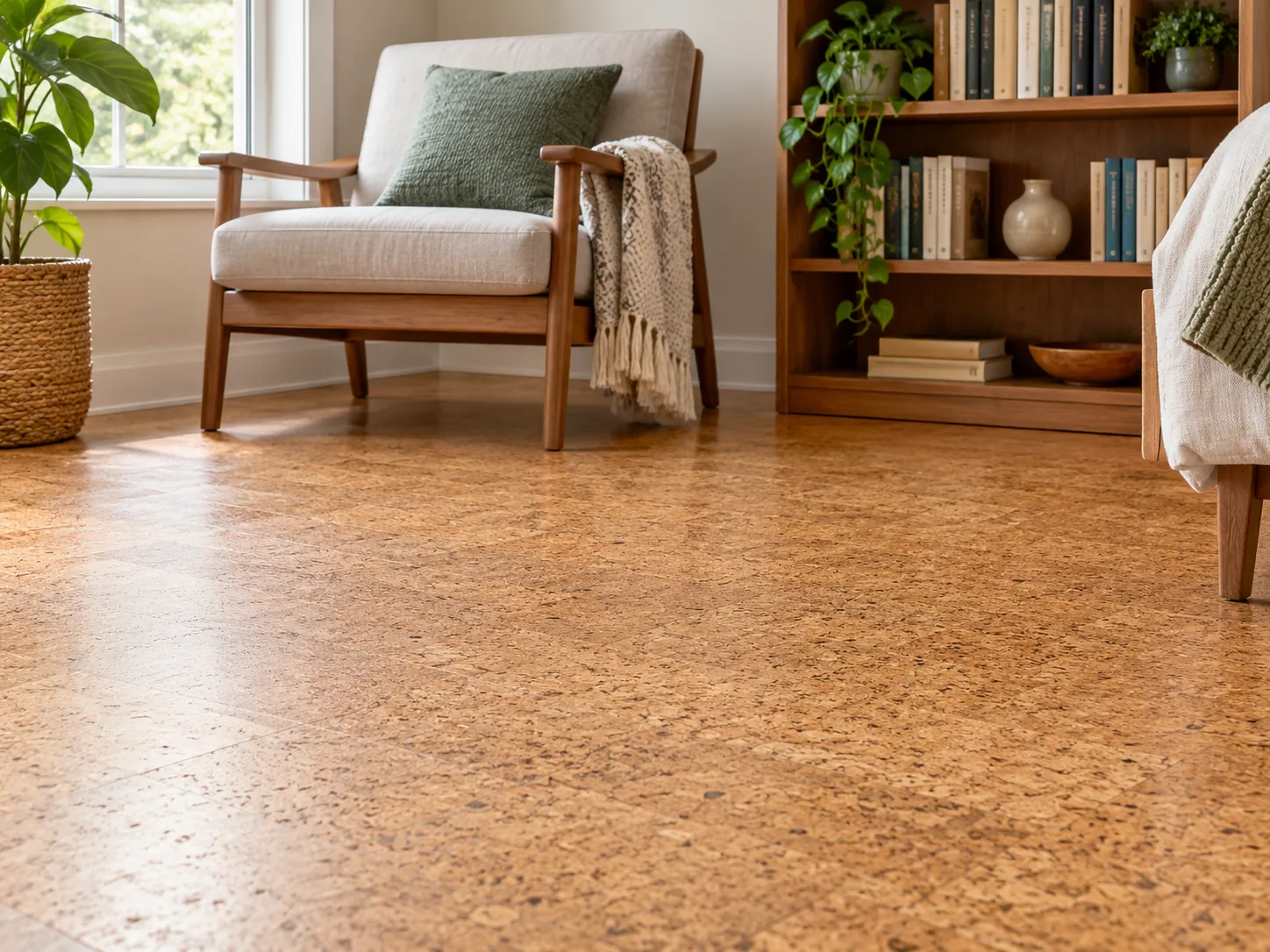
Cork’s most consistent advantage is its feel. Its cellular structure and resilient surface make many cork products feel warmer and softer than a hard plank floor, so it can be appealing in a bedroom, playroom, or work area where you stand at a counter. A Family Handyman account of one cork basement installation also describes cork’s cushioning and insulation; that is useful context, not a promise that every cork product will produce the same result.
Bamboo is usually the better match if you like the stable, firm feel of a wood floor and do not want a noticeably soft surface. Its visible grain ranges from recognizable strip patterns to a more uniform strand-woven look, so it can suit interiors where a natural plank finish matters more than cushion.
“Quiet” depends on the entire floor assembly. A cork layer or underlayment may soften footfall sound, but the room’s ceiling, subfloor, floating gaps, and installation method also affect what people hear below. If you live in an apartment or are renovating an upstairs room, ask for the tested sound rating of the exact flooring-and-underlayment combination rather than assuming any cork floor is quiet.
Durability: dents, scratches, pets, and furniture
Bamboo is often selected for its hardness, especially in strand-woven construction, but hardness and scratch resistance are different things. Grit can abrade a finish, chair casters can scuff a surface, and a dropped heavy object can damage a plank. Dark, glossy, or strongly colored finishes may also make small marks more visible than a natural-looking matte finish.
Cork’s resilience can make walking and standing more comfortable, yet a soft surface can show compression beneath heavy furniture or sharp furniture feet. Some patterns camouflage light marks better than a plain surface, but pattern is not a repair strategy. Use broad furniture glides, keep grit off the floor, and place suitable mats at entry points; check that mat backing will not stain or trap moisture against the finish.
For homes with dogs, children, or rolling office chairs, compare the wear layer and maintenance instructions before comparing the material name. No bamboo or cork floor is scratch-proof, and neither a hard plank nor a cushioned tile should be expected to hide every pet claw, spill, or dragged chair. A sample viewed at home in daylight can help reveal how grain, gloss, and color show everyday dust and marks.
Water, humidity, and room suitability
Treat both materials as moisture-sensitive unless the exact product says otherwise in writing. A quick spill may be manageable if the surface is sealed and the spill is wiped up, but water can enter joints, edges, seams, or an exposed core. A “water-resistant” claim usually has limits for standing water, duration, room type, and installation details.
In bamboo, moisture from a slab or repeated humidity swings can contribute to swelling, gaps, cupping, or movement. Cork can absorb moisture, and many cork planks have a wood-fiber core that may be vulnerable if water reaches it. A finished cork surface is not the same as a waterproof plank assembly.
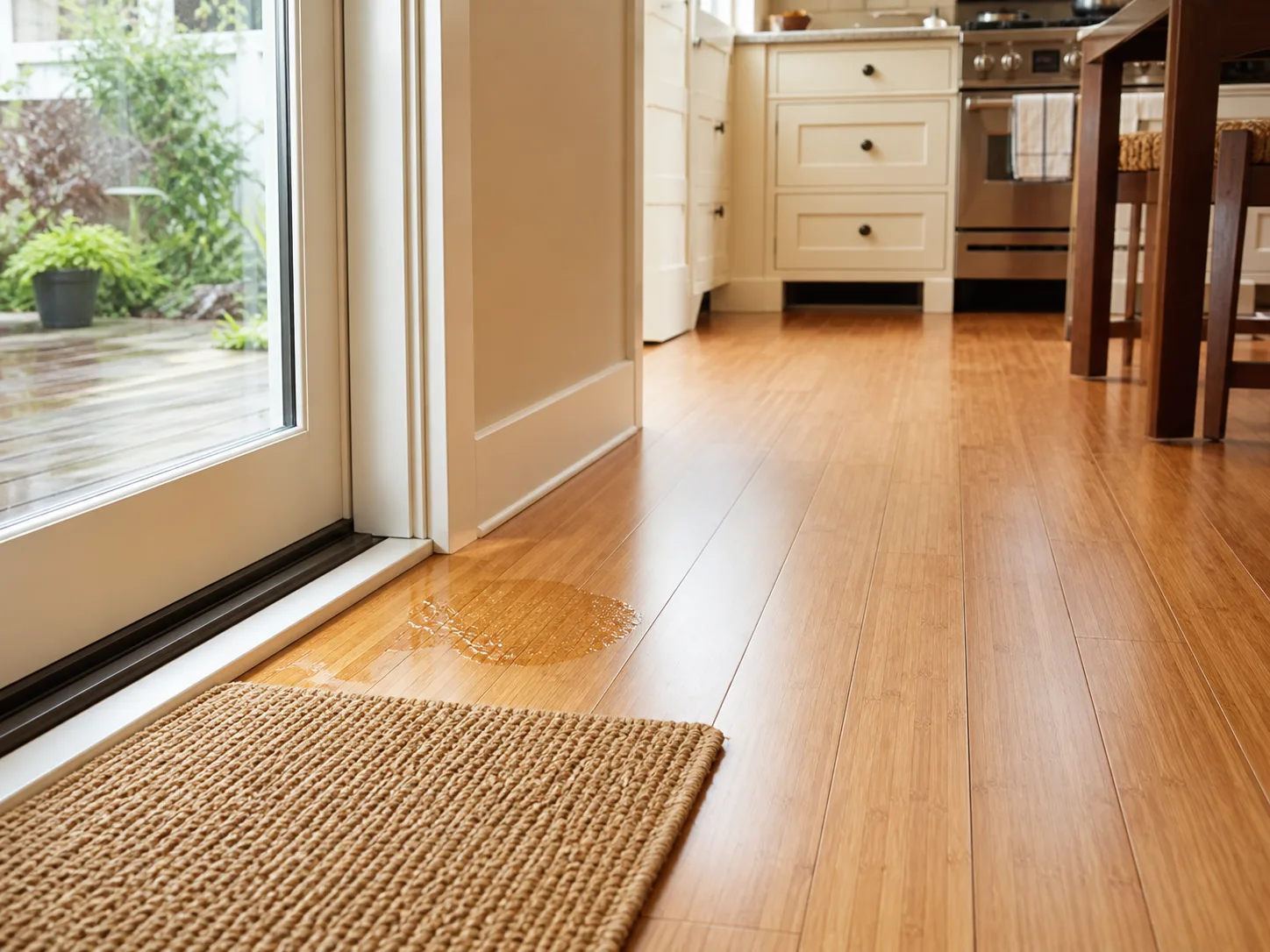
A kitchen may be suitable for some products when the manufacturer approves that room and the household can wipe spills promptly. That does not make a bathroom, laundry room, or basement safe by default. If a room has an appliance leak history, a floor drain, condensation, or regular wet cleaning, compare it with a floor system specifically warranted for that exposure.
Read the room and installation warranty before deciding
A floor can fail because the installation conditions were wrong even when the plank itself was well made. Concrete slabs, crawl spaces, and below-grade rooms can release moisture; the installer may need to test the slab and use a specific moisture barrier, adhesive, or underlayment. The required method depends on the product, the measured subfloor, and the manufacturer’s current instructions.
Ambient Bamboo’s installation guidance warns about acclimation, concrete moisture, and stable indoor humidity, and directs buyers to follow the instructions for the product they purchased. Its time and measurement recommendations are product-specific, so do not copy them as universal rules. Ask the installer to document the moisture tests, mitigation system, expansion space, transitions, and the warranty sections that apply to your room.
A Family Handyman writer reported that a cork floor lasted 17 years in his own basement, but also noted that the home was in a semi-arid area with a low water table and that cork absorbs moisture. That account shows why a successful room-specific example cannot replace a slab test or the product warranty. Do not install either material over a damp slab or unresolved leak just because another homeowner’s floor survived.
Cleaning and ongoing maintenance
For both materials, start with dust, grit, and sand: sweep or vacuum with the hard-floor setting so particles do not grind against the finish. Wipe a spill as soon as you notice it. Use a barely damp mop only if the product allows it, and use the cleaner specified for that finish rather than a steam cleaner, polish, or strong all-purpose chemical.
Cork products may need occasional recoating or other finish care, but the schedule depends on whether the tile came unfinished, factory-sealed, or prefinished. Wicanders’ cork-flooring care guide limiting water and avoiding abrasive or ammonia-based cleaners for its products; treat that as a manufacturer’s guidance for its own floors, then check the brand you actually buy. Do not assume that one cork finish, sealant, or cleaner works for every cork tile.
Bamboo is also simple to keep clean when you use a dry method for everyday grit and follow the maker’s rules for damp cleaning. Never flood a floor to make it “extra clean,” and do not apply wax or a refinish product unless the manual allows it. Felt pads, entry mats with compatible backing, and prompt spill cleanup are inexpensive ways to protect either floor.
Installed cost: treat estimates as a starting range
Published U.S. project estimates place bamboo and cork in overlapping cost bands rather than giving either material a reliable price advantage. HomeGuide’s bamboo flooring estimate is roughly $7–$17 per square foot installed, while its HomeGuide’s cork flooring estimate is about $5–$15 per square foot installed; it lists strand-woven bamboo higher than some other bamboo constructions. The ranges are broad estimates, not a bid for your location, product, or subfloor.
The HomeGuide bamboo page carries an older byline than its cork page, so use those numbers only as rough planning context. A current local quote can differ with the product’s thickness and finish, the room’s shape, labor market, removal and disposal, moisture mitigation, leveling, underlayment or adhesive, transitions, baseboards, stairs, and the installer’s minimum charge.
Ask for two itemized quotes based on the same room plan and scope. A lower carton price can disappear after subfloor preparation or more complex installation, while a higher material price may buy a finish, wear layer, or warranty that matters for your expected use. Compare the installed total and the maintenance or repair plan, not just the sample’s price per square foot.
Installation and future repairs
Bamboo comes in products designed for different installation methods, including nailed or glued boards and floating click-lock planks. Cork can be installed as glue-down tiles or floating planks, depending on its construction. Floating floors may be more approachable for a capable DIYer, but they still need a suitable, flat subfloor, the correct expansion gaps, a compatible underlayment, and careful transitions at doorways.
Glue-down installations add surface preparation and adhesive compatibility to the job. A small mistake in a concrete moisture system or adhesive coverage can affect the floor across a much larger area, so get the product and installer’s plan in writing before work begins. Do not assume that a floor marketed as easy to install is safe to install over any existing tile or slab.
Plan for the first repair as well as the initial installation. Thick, solid bamboo may be professionally sandable if the manufacturer permits it; a thin engineered bamboo wear layer may not be. Cork’s repair and refinishing options vary by finish and construction, and floating systems can require removal of surrounding planks to reach one damaged piece. Ask whether replacement stock will be available later and whether sanding or recoating would void the warranty.
Sustainability: renewable does not mean impact-free
Bamboo is a fast-growing grass, and INBAR’s bamboo facts that it can become harvestable in about three to six years. That is a genuine raw-material advantage, but it does not show that a specific flooring line is responsibly sourced or low-impact. The finished plank can also include binders, a composite core, a coating, packaging, and transport from its manufacturing location.
Cork comes from cork oak bark, which can be harvested without cutting down the tree. Amorim’s cork production process a nine-year interval between cork harvests after the tree’s first stripping, while a peer-reviewed study of Portugal’s cork value chain discusses forest-management certification and gaps in tracing material through the supply chain. Those facts explain cork’s renewable potential; they do not certify every floor made from it.
To make an environmental comparison, ask for product-level information rather than choosing from the label “eco-friendly.” Look for origin and chain-of-custody information, an Environmental Product Declaration (EPD) if available, the core and binder, the finish, and a realistic service-life or repair plan. A floor that lasts in the actual room is a better practical choice than a renewable material installed where it is likely to fail early.
Ask about origin, emissions, and the exact product
Indoor-air claims depend on the product’s layers and installation materials, not just the top surface. Some engineered bamboo uses a plywood or MDF core, and some floating cork products use a wood-fiber core; adhesives and factory finishes add more materials. Ask for the technical data sheet and any product-specific emissions documentation for the plank, adhesive, and finish.
The EPA’s TSCA Title VI overview and current eCFR regulation cover specified composite-wood products and finished goods containing those materials. The rule does not mean that every floor with a bamboo or cork surface has the same regulatory status; confirm whether the exact core and construction fall within the standard’s scope. If the claim is “low VOC,” “no added formaldehyde,” or “waterproof,” ask which exact product and test or certification support it rather than relying on a broad brand statement.
Which material fits your home?
| Situation | Better place to start | What to verify |
|---|---|---|
| Bedroom or den where warmth matters | Cork | Wear layer, finish, sunlight exposure, and whether the floor’s sound rating matches your building |
| Busy hallway where you prefer a firm plank | Bamboo | Construction, finish warranty, grit control, and whether strand-woven density matters for your household |
| Kitchen with ordinary, occasional spills | Either, if approved | The product’s room warranty, spill limits, edge protection, and prompt-cleanup requirements |
| Dogs, kids, or rolling chairs | Compare the exact product | Finish, scratch visibility, dent resistance, chair-caster limits, felt pads, and replacement-board availability |
| Basement or concrete slab | Neither by default | Slab moisture test, active leaks, below-grade rating, mitigation system, and written approval from the product maker |
| Long room with wide floating planks | Product-specific | Expansion limits, transition placement, stable indoor humidity, and the manufacturer’s installation guide |
| Priority is lower environmental impact | Compare documented products | Sourcing, core, adhesive, finish, EPD, service life, and whether the floor is repairable |
A household that wants quieter, warmer footing may prefer cork if the product is approved for the room and its furniture loads. A household that wants a firm wood-like surface may prefer bamboo if the selected construction, finish, and moisture warranty match its use. If the room is damp or the household expects repeated water exposure, solve that constraint before choosing either material.
How to compare samples and quotes
Use this short checklist with the retailer and installer:
- Identify the exact construction. Ask whether the bamboo is horizontal, vertical, strand-woven, or engineered, and whether the cork is a tile, composite, or floating plank. Request the surface-layer thickness, core material, finish, and approved installation method in writing.
- Read the room exclusions. Check the product warranty for kitchens, bathrooms, laundry rooms, basements, direct sunlight, wet mopping, and underfloor heating. A room that is excluded should not be approved verbally by a salesperson.
- Request the moisture plan. Ask how the installer will test a concrete slab, crawl-space conditions, or other subfloor; what mitigation system will be used; and which product instructions set the acceptable limits. Get the test result and chosen adhesive or underlayment on the quote.
- Compare full-size samples at home. View each sample in morning and evening light, then notice how the color, grain, gloss, and texture change beside your furniture. A tiny swatch can hide pattern variation and make two different finishes look more similar than they will across a room.
- Price the same complete scope. Ask each installer to include removal, disposal, subfloor leveling, moisture mitigation, underlayment or adhesive, waste allowance, transitions, baseboards, stair work, and furniture moving. Do not compare an installed price on one floor with a materials-only quote for the other.
- Ask how the floor will be repaired. Find out whether a damaged plank or tile can be replaced, whether the product can be refinished or recoated, and how long matching material will remain available. These answers can matter more than a small difference in the initial material price.
If bamboo remains on your shortlist, our bamboo flooring buyer’s guide explains its product types, moisture limits, adhesives, maintenance, and finish trade-offs in more detail.
Conclusion
Bamboo and cork are not interchangeable, and neither is automatically better for every home. Cork is the stronger starting point when warmth, cushioning, and a softer feel matter most; bamboo is the stronger starting point when you want a firm plank look and a product whose specific construction and finish suit your traffic.
Make the last decision from the exact product documents and installation plan. Confirm construction, moisture limits, room approval, emissions information, repair options, and a fully itemized quote; then compare samples in the room where they will live. That process is more useful than choosing from a sustainability label or a general claim about hardness.