Bamboo Flooring Pros and Cons: What to Know Before You Buy
Bamboo flooring can be hard, renewable, and easy to clean—but humidity, scratches, adhesives, and warranty details matter. Use this buyer’s guide to choose.
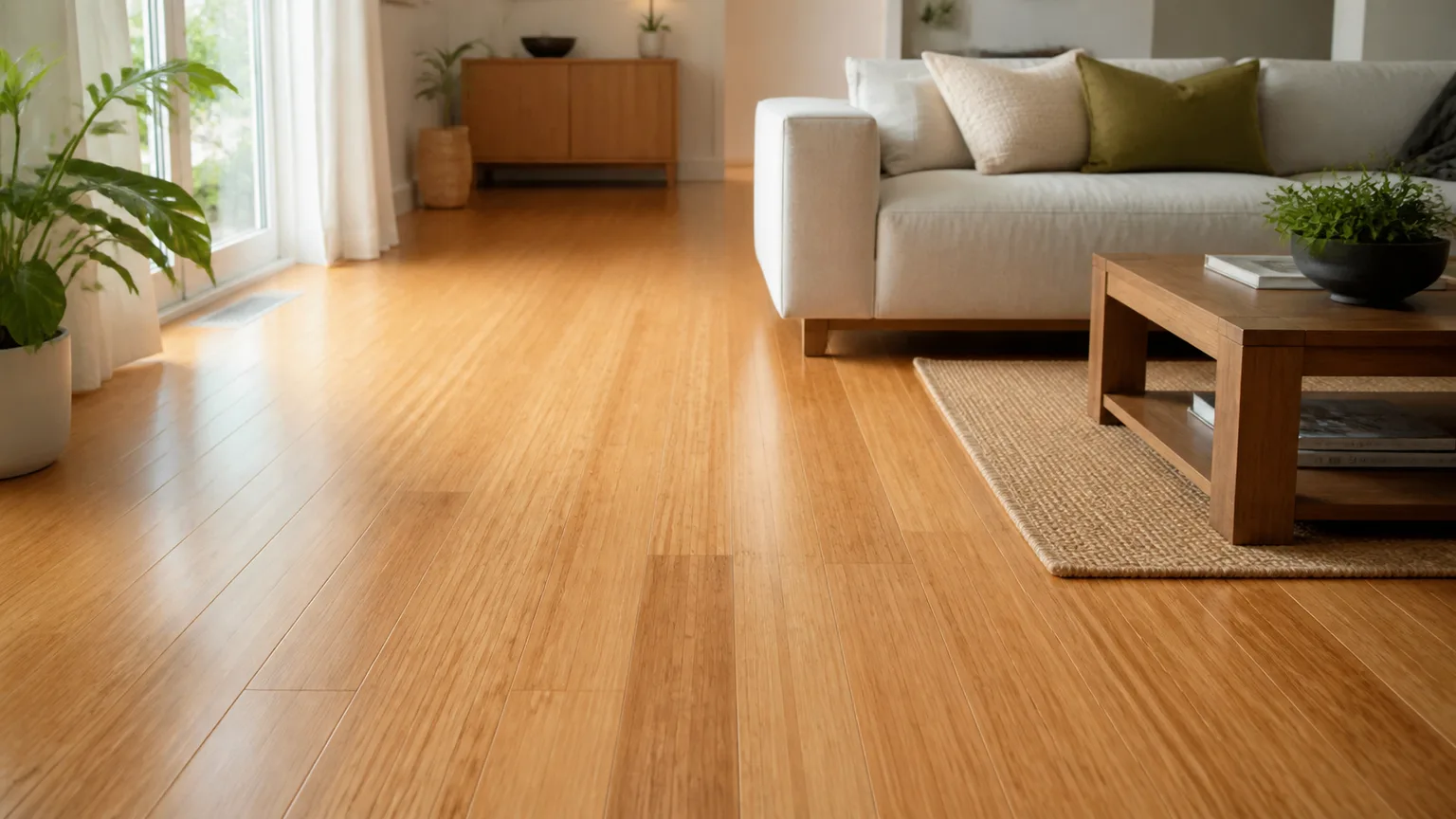
Bamboo flooring can look like a smart middle ground: warmer and more natural than vinyl, often less expensive than premium hardwood, and made from a grass that regrows quickly. The catch is that bamboo is not one uniform flooring product. A dense strand-woven plank, a carbonized horizontal plank, and a thin engineered veneer can behave very differently under the same household traffic.
The practical question is not whether bamboo is “good” or “bad.” It is whether the specific plank, room, subfloor, and maintenance habits line up. Use the guide below to evaluate the material by its real failure risks—moisture, humidity movement, scratches, finish wear, and adhesive chemistry—before you let a low sample price make the decision for you.
Quick verdict: bamboo is a good floor only when the room is dry and the product is well specified
Bamboo is a strong candidate for living rooms, bedrooms, hallways, and home offices that stay temperature-controlled and reasonably dry. It is especially appealing if you want a hard, smooth surface with a more consistent grain than hardwood and you are willing to follow the manufacturer’s cleaning and humidity rules.
The short list of benefits is compelling: bamboo is rapidly renewable, easy to sweep and damp-clean, available in solid and engineered constructions, and often competitive with hardwood on material cost. The short list of drawbacks is just as important: most products are not waterproof, lower-density or carbonized planks can scratch more readily, humidity swings can create gaps or cupping, and the adhesives or composite cores deserve scrutiny.
Skip bamboo—or choose a genuinely waterproof alternative—when the room routinely has standing water, persistent dampness, an uncorrected concrete moisture problem, or a history of large indoor humidity swings. A flooring warranty cannot make a wet room dry.
What bamboo flooring is—and why construction changes the answer
Raw bamboo is a grass culm, not a tree trunk. Flooring manufacturers cut, split, shred, flatten, or laminate that material, dry it, bind it with adhesive, press it into boards, and add a finish. Every step changes the plank’s density, dimensional stability, repairability, appearance, and potential emissions.
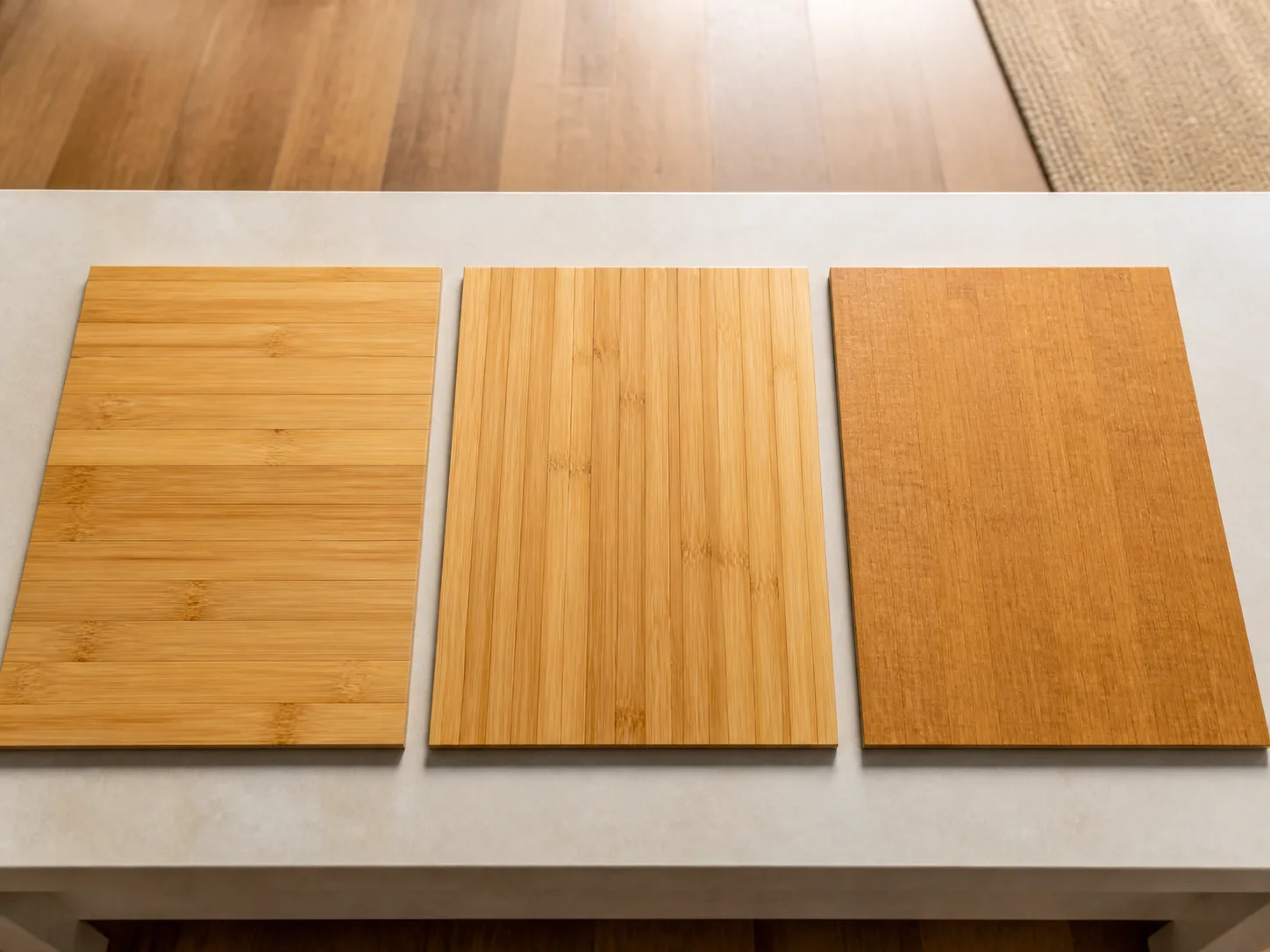
Strand-woven bamboo
Strand-woven bamboo is made by shredding or pulling bamboo into fibers, treating and drying them, then compressing them under heat and pressure with a resin binder. The resulting plank is usually the densest bamboo format and is often the best choice for busy hallways, active households, or rooms where dent resistance matters.
That does not mean strand-woven bamboo is scratch-proof or automatically superior. Published hardness figures vary by product and test method, but current cost and product guides commonly place strand-woven bamboo in the roughly 3,000 to 4,000-plus Janka range, while other constructions can be much lower. Treat the number as a comparison clue, not a guarantee; finish quality, grit, pet claws, chair legs, and installation still decide how the surface looks after a few years. HomeGuide’s current bamboo flooring guide shows how much price and hardness can vary by construction.
Horizontal, vertical, and engineered bamboo
Horizontal bamboo glues wide strips side by side so the natural nodes and “knuckles” remain visible. Vertical bamboo turns narrow strips on edge, creating a straighter, more uniform pattern. Both can look more recognizably like bamboo than strand-woven flooring, but they are generally not as dense as the best strand-woven products and can show dents or scratches sooner in demanding rooms.
Engineered bamboo uses a thinner bamboo wear layer over a plywood, fiberboard, or other core. It can be easier to install as a click-lock floating floor and may be more dimensionally forgiving than a thick solid plank, but the top layer controls whether it can ever be sanded and refinished. Ask how thick the actual bamboo wear layer is; the word “engineered” alone does not tell you whether future refinishing is possible.
The advantages of bamboo flooring
Renewable feedstock is a real benefit, not a complete sustainability verdict
Bamboo’s growth cycle is genuinely faster than that of most flooring hardwoods. INBAR reports that bamboo can become harvestable in roughly three to six years, and that its root system allows harvesting without replanting the entire plant. That is a meaningful renewable-material advantage when the stand is managed well. INBAR’s bamboo facts overview explains the growth and harvest context.
Finished flooring still has a life cycle. Fibers or strips need adhesives, planks need drying and pressing, finishes add chemistry, and much of the market is manufactured far from the home where it is installed. Green Building Advisor makes the useful distinction that fast-growing bamboo does not by itself answer questions about binders, transport, factory practices, or long-term durability. Its sustainable-flooring analysis is a good reminder to compare the finished product, not just the plant’s growth rate.
For a lower-impact purchase, look for transparent sourcing information, a credible chain-of-custody claim when available, a long service life, and a product that can be maintained instead of discarded after a few years. A durable floor that lasts in the room is often a better choice than a supposedly greener product that fails early.
Easy daily care and flexible installation
Bamboo does not need waxing or a complicated routine. Sweep or dust-mop often enough to keep grit from acting like sandpaper, use a vacuum on its hard-floor setting, wipe spills promptly, and use a barely damp microfiber mop with the cleaner approved for that finish. Do not flood the floor to make it look “extra clean.”
Depending on the product, bamboo can be nailed or stapled to a suitable wood subfloor, glued where the manufacturer allows, or installed as a floating click-lock floor over the specified underlayment. Floating engineered planks are approachable for experienced DIYers, while solid nail-down or glue-down work demands more attention to subfloor flatness, moisture, expansion gaps, and transitions.
The smooth surface is also comfortable for households that dislike carpet dust and fiber buildup. That is a cleanliness and feel benefit, not a promise that bamboo will resist every stain, pet accident, or abrasive particle.
The drawbacks that change the decision
Moisture and humidity are the main failure modes
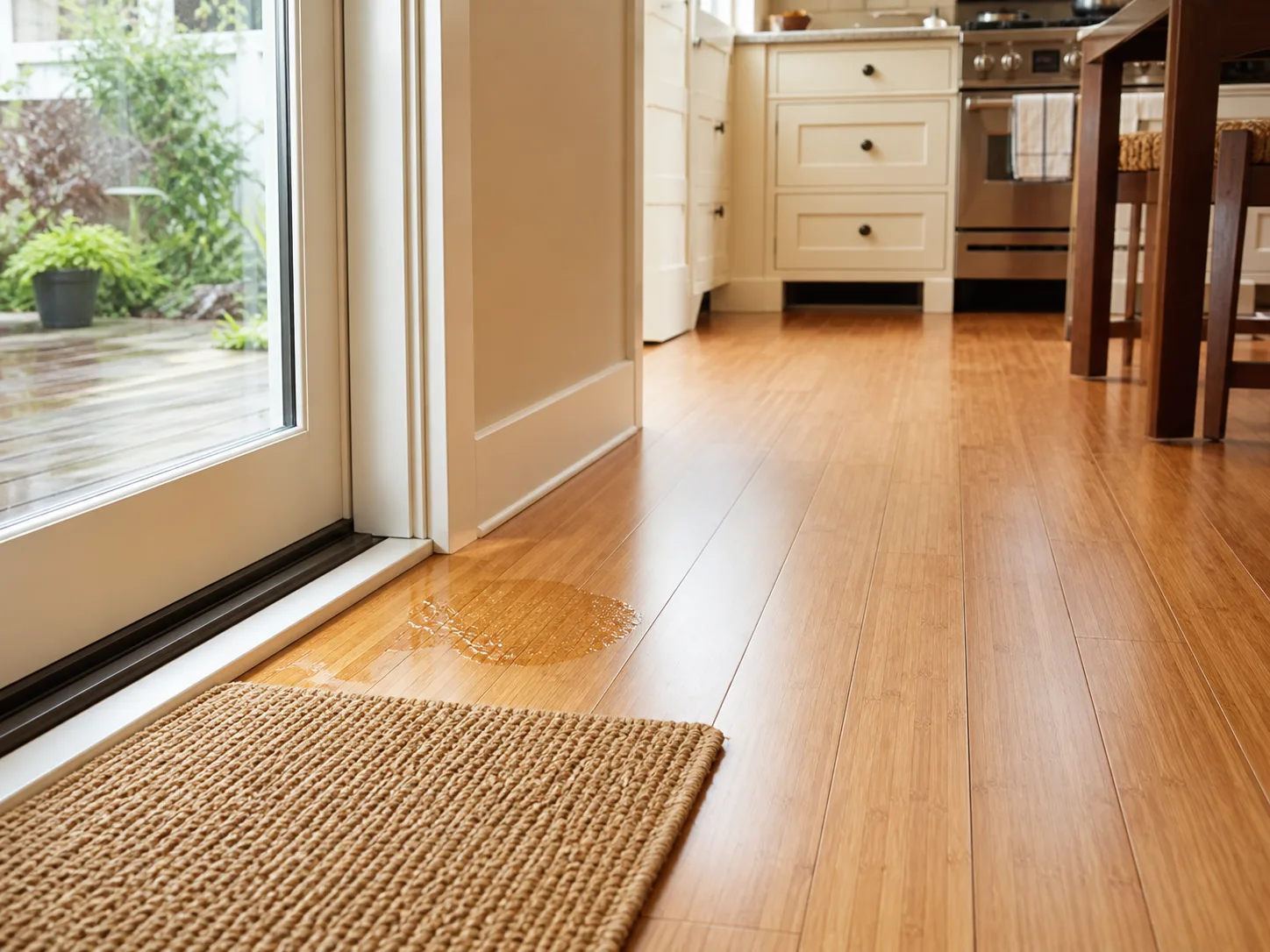
Most bamboo flooring is water-resistant for ordinary spills, not waterproof. Standing water, repeated wet mopping, leaks from appliances, and damp concrete can make planks swell, cup, buckle, separate, or develop mold-related problems. Drying the surface quickly helps with a small spill; it does not solve moisture coming from below or through the room’s air.
Humidity matters even when no water touches the floor. Too much moisture can push boards together and create cupping or buckling; very dry conditions can open gaps or contribute to cracking. That is why acclimation, an expansion gap, a moisture-tested subfloor, and stable indoor conditions belong in the installation plan rather than in the fine print you read after a failure.
Do not assume an engineered core makes every bamboo plank safe for a wet room. Some newer products are marketed as waterproof, but that claim is product-specific and should be backed by a written installation warranty that covers the exact room and exposure. If the manufacturer says “not for bathrooms” or “avoid wet mopping,” believe the limitation.
Scratches, finish wear, and carbonized color
Hardness helps with dents, but it does not prevent scratches. Grit tracked in from outside, rolling desk chairs, pet claws, pointed furniture feet, and dragging a heavy cabinet can cut the finish on any bamboo floor. Dark or glossy finishes can make fine scratches more visible, even if the plank underneath is still sound.
Carbonization is a heat treatment used to darken bamboo from blonde or honey tones toward amber and brown. The process changes the material’s structure and generally makes it softer than the same plank in its natural color. If you love the darker look, reserve carbonized bamboo for lower-wear rooms or choose a product whose finish and warranty are designed for your traffic level. Do not buy a dark floor on the assumption that color and hardness are unrelated.
Refinishing is possible for some solid bamboo floors, but not for every product. A thick, sandable plank may tolerate one or more professional resurfacing jobs; a thin engineered veneer may have little or no sanding margin. A refinisher should confirm the wear layer and finish system before a sander touches the floor. Current homeowner cost guidance also notes that engineered bamboo may have limited or no refinishing potential, so product thickness is part of the ownership calculation. HomeGuide’s refinishing notes are useful for framing that distinction.
Adhesives, binders, and indoor-air questions
Bamboo flooring is manufactured, not simply cut from a log. Horizontal and vertical strips are glued; strand-woven fibers are compressed with a binder; engineered products may add a core and adhesive layer; and factory finishes add another material layer. The result can be a low-emitting product, but “bamboo” by itself does not identify the resin or the emissions performance.
For products sold in the United States, the current eCFR Part 770 formaldehyde standards set testing, certification, and emissions requirements for covered composite-wood products and components. The rules define covered materials by construction—such as hardwood plywood, MDF, particleboard, and certain laminated products—so a buyer should not assume every bamboo plank is covered in exactly the same way. Ask for the product’s specific compliance documentation and emissions certification rather than accepting a generic “eco-friendly” statement.
If indoor air quality is a major concern, compare a current product data sheet, resin information, emissions label, and installation adhesive together. FloorScore or GREENGUARD documentation can be useful screening signals, but verify that the certificate applies to the exact product line and not only to a manufacturer or a different core. “No added formaldehyde” is also a specific resin claim, not a synonym for “contains no chemicals.”
Bamboo flooring cost: budget for the whole project
Material price is only the first line on a flooring quote. A current 2026 HomeGuide estimate places installed bamboo flooring around $7 to $17 per square foot, with strand-woven products often higher. The same guide lists material and labor as separate cost drivers and notes that removal, subfloor repair, underlayment, trim, layout complexity, carbonization, and finish choices can move the total sharply. Review the current bamboo flooring cost ranges before treating any sample-box price as a project budget.
Your quote should identify the product construction, square footage, waste allowance, old-floor removal, subfloor leveling or repair, moisture testing, underlayment or adhesive, transitions, baseboards, stairs, delivery, and disposal. Add a waste allowance for cuts and damaged boards; a recent BuildDirect installation checklist suggests that a typical order may need roughly 7% to 9% extra, though room shape and installer experience change the figure. BuildDirect’s bamboo flooring dos and don’ts also emphasizes acclimation, dry and level subfloors, careful cleaning, and prompt spill removal.
Refinishing can extend the life of a sandable floor, but it is not free and it cannot rescue a plank that has swollen, delaminated, or lost its wear layer. A cheaper engineered product can be a sensible choice when easy floating installation matters; a thicker solid or strand-woven product may be better value when you expect heavier traffic and want a repair path. Compare total cost over the time you expect to stay, not only the material cost on day one.
Bamboo versus hardwood versus luxury vinyl plank
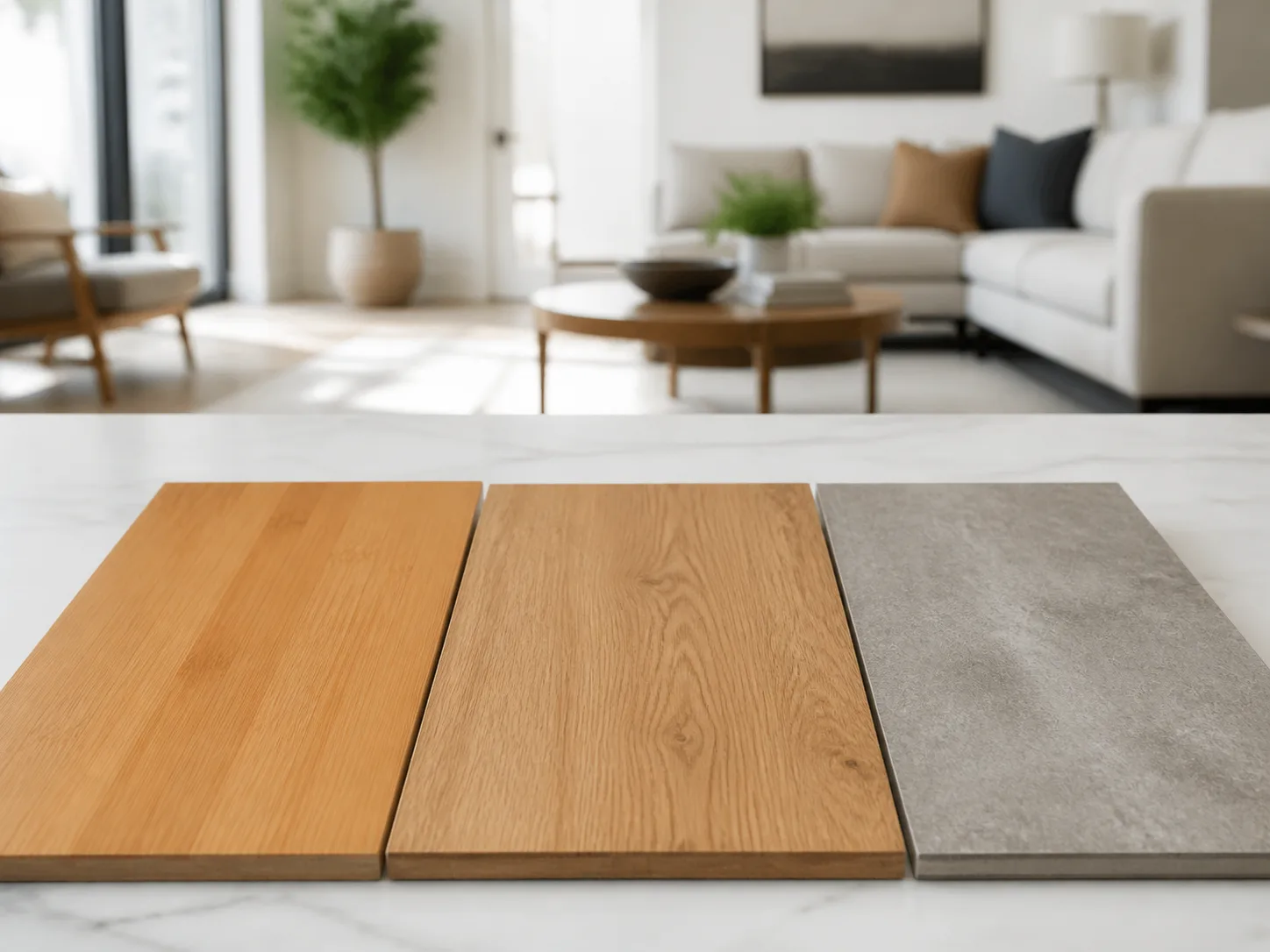
The best comparison is not “which material wins?” It is “which failure can I live with, and which one do I want to prevent?” Bamboo and hardwood can both offer a warm, natural surface and can both be damaged by water, grit, and humidity. Luxury vinyl plank usually gives you stronger water tolerance and easy replacement, but it does not offer the same natural-material feel and may raise different questions about plastics, backing, and end-of-life disposal.
| Decision factor | Bamboo | Hardwood | Luxury vinyl plank |
|---|---|---|---|
| Typical strength | Strand-woven can be very hard; other bamboo types vary widely | Varies by species and construction | Resists many everyday dents, but the wear layer can scratch or gouge |
| Water risk | Most products are not waterproof | Solidly moisture-sensitive; engineered products vary | Often the safest choice for spill-prone rooms, but check seams and subfloor moisture |
| Refinishing | Solid, thick planks may be refinished; thin engineered veneers usually cannot | Solid hardwood has the clearest long-term refinishing path | Usually replaced rather than sanded |
| Appearance | Uniform grain, visible nodes, or strand pattern depending on type | More species and natural grain variation | Printed wood visuals can be convincing but are not real wood or bamboo |
| Sustainability question | Fast-growing feedstock, but binders, transport, and sourcing matter | Forest management, finish, and service life matter | Material chemistry, production, and disposal matter |
| Best fit | Dry, conditioned rooms where a hard natural surface is wanted | Owners prioritizing classic appearance and long refinishing life | Rooms where water tolerance and easy replacement outrank natural material |
Choose bamboo when you want a natural floor and can control moisture. Choose hardwood when species character, resale familiarity, and multiple refinishes justify the price. Choose luxury vinyl plank when a leak-prone room or active household makes water tolerance the first requirement.
How to vet a bamboo product before you buy
Verify construction, finish, emissions, acclimation, and warranty
Start with the technical specification, not the lifestyle photograph. Ask the seller to identify whether the product is solid strand-woven, horizontal, vertical, or engineered; the plank thickness; the bamboo wear-layer thickness; the core material; the finish; the approved installation methods; and the rooms excluded from the warranty.
Then ask five plain questions:
- What is the core and binder? A bamboo veneer over MDF is not the same product as a thick solid strand-woven plank.
- What does the warranty call “moisture damage”? Look for exclusions covering bathrooms, basements, wet mopping, plumbing leaks, and subfloor moisture.
- What emissions documentation applies to this exact SKU? Request current FloorScore, GREENGUARD, CARB, TSCA Title VI, no-added-formaldehyde, or other documentation that actually matches the plank and core.
- What humidity and subfloor conditions are required? The written installation guide should specify acclimation, expansion gaps, moisture testing, and acceptable substrates.
- Can it be refinished? Get the answer in writing and record the minimum remaining wear layer before you assume sanding is a future option.
Order samples and test them against your real life: wipe a spill, inspect the sheen under daylight, place a chair pad or felt pad under a sample, and view natural and carbonized colors next to your cabinets. A sample cannot prove long-term performance, but it can expose a finish you already dislike or a color that shows every mark.
Installation and maintenance checklist
Before installation:
- Confirm the subfloor is clean, flat, structurally sound, and dry; a clean surface is not necessarily a dry surface.
- Check concrete or crawl-space moisture with the method required by the flooring manufacturer.
- Bring the sealed product into the room and acclimate it exactly as the installation guide says; do not guess based on a generic number of days.
- Plan the expansion gap, thresholds, transitions, baseboards, and the direction of the planks before the first board is fixed.
- Keep extra boards from the same lot for future repairs and photograph the product label, warranty, and installation instructions.
After installation:
- Use mats outside entry doors, but choose breathable mats that do not trap moisture against the finish.
- Sweep or dust-mop frequently and vacuum only with a hard-floor setting or soft attachment.
- Use a lightly damp mop only when needed; never use a steam mop, soaking mop, steel wool, or abrasive powder unless the product maker explicitly approves it.
- Wipe spills and pet accidents quickly, and investigate any recurring damp spot instead of repeatedly drying the surface.
- Add felt pads to furniture, lift instead of drag, and use a protective mat under rolling chairs approved for hard floors.
- Keep the room within the manufacturer’s humidity range, using a hygrometer and humidifier or dehumidifier when necessary.
- Refinish only after a professional confirms that the plank has enough sandable material and that the warranty will not be voided.
Room-by-room fit: where bamboo works and where to skip it
Living rooms, bedrooms, dining rooms, and home offices: Usually the most forgiving locations. Choose the construction and finish for traffic, use rugs where grit or chair movement is concentrated, and keep direct sunlight from creating uneven fading across furniture-free areas.
Hallways and entry-adjacent spaces: Possible, but the grit load is higher. Strand-woven bamboo, good entry mats, frequent sweeping, and furniture protection matter more here than a low sticker price.
Kitchens: A kitchen can work if the product warranty permits it, the sink and dishwasher areas are monitored, and spills are wiped quickly. Do not confuse “handles a splash” with “safe beside a leaking appliance.” If the room has a history of leaks or you want to wet-mop freely, choose a more water-tolerant floor.
Bathrooms, laundry rooms, and damp basements: Usually skip standard bamboo. The combination of plumbing, humidity, wet cleaning, and below-grade moisture creates too many ways for the floor to fail. A product marketed as waterproof is an exception only when its written warranty covers the exact installation and the moisture-control plan is sound.
Radiant-heated floors: Never assume compatibility. Some engineered bamboo products are rated for radiant heat; others are not. Confirm the exact system, surface-temperature limit, installation method, and warranty requirements before ordering.
Conclusion
Bamboo flooring earns its reputation for a reason: it can be hard, attractive, renewable at the feedstock stage, easy to maintain, and flexible enough for many dry rooms. Its weaknesses are not mysterious, but they are easy to underestimate when every product is marketed simply as “bamboo.”
Make the decision in this order: identify the construction, rule out moisture, verify emissions and warranty documents, then compare the complete installed cost with hardwood and luxury vinyl plank. If the room is dry and conditioned, the product has a credible finish and documentation, and you are comfortable with careful cleaning, bamboo can be a sensible natural floor. If water tolerance or a deep refinishing path is your top priority, choose the material that solves that problem directly instead of hoping the bamboo label will.



