8 Best Cordless Hedge Trimmers for Different Hedge Types
Compare eight cordless hedge trimmers by blade length, cut capacity, battery system, runtime claims, weight, safety, and hedge type.
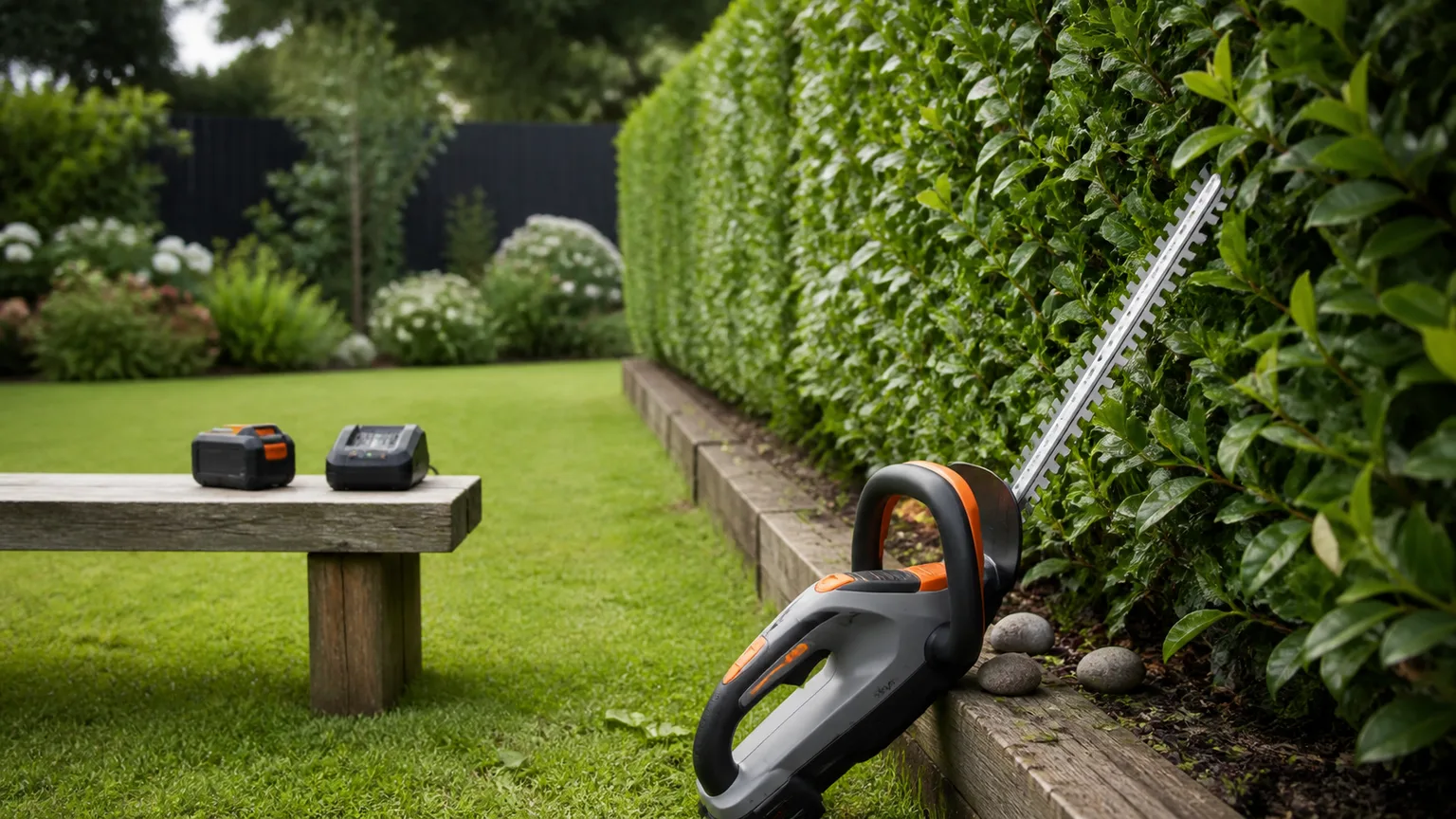
The best cordless hedge trimmer is the one that fits your hedge, your battery platform, and the amount of tool you can comfortably control. A 24-inch blade may be an efficient choice for a long, straight hedge, while a shorter trimmer can be easier to steer around a small boxwood or a crowded border. A large cut-capacity number does not turn a hedge trimmer into a chainsaw, and a long runtime claim does not guarantee an afternoon of continuous cutting.
This is a source-based buying guide, not a hands-on test. The picks below are matched to real yard situations using manufacturer specifications, product manuals and safety information, plus independently published tool-selection criteria. Runtime numbers are manufacturer estimates; use them for planning, not as a promise. Where a product page is tool-only or does not publish a complete carry weight, that limitation is part of the recommendation.
An honest way to read these recommendations
The phrase “best” is conditional here. Each pick earns its place because a particular combination of blade length, rated cut capacity, controls, battery system, or ownership path makes sense for a certain kind of hedge or homeowner. None should be treated as a universal winner.
Manufacturer pages are the authority for model-specific specifications. The Virginia Tech Powered Hand Tools Safety guide supplies the safety baseline, while tool editors such as Expert Reviews and Bob Vila are useful for identifying comparison factors such as balance, blade length, tooth spacing, battery life, and the type of hedge being cut. Those editorial criteria inform the framework; they do not turn this article into a shared test report.
Two cautions will prevent most buying mistakes. First, a battery and charger may be sold separately even when a trimmer looks complete in a product photo. Second, a published runtime is usually measured under a particular load and battery size. Dense, woody growth, a larger battery, temperature, pauses, and battery age can all change the result.
A transparent comparison framework
Start with the work, then choose the tool. Measure the approximate length and height of the hedge, identify whether it is soft new growth or woody mature stems, and note how often you expect to trim it. A small ornamental shrub has different needs from a 100-foot laurel screen.
Next, score each candidate against six questions:
- Does the battery already live in your shed? A bare tool that uses a battery you own can be a better purchase than a nominally cheaper kit that starts a new platform.
- Does the blade suit the hedge face? Short blades favor control; longer blades cover more area per pass but can feel less nimble.
- Does the tooth spacing match the stems? The tool’s rated capacity is a ceiling, not a target for every cut.
- Can you carry the complete tool? Compare the trimmer, battery, and any required charger or harness, not only a tool-only specification.
- Will the controls help you work safely? Hand guards, blade brakes, rotating handles, anti-vibration features, and clear safety switches matter when a session lasts longer than a few minutes.
- Can you maintain it? A blade sheath, accessible cleaning points, serviceable blades, and clear lubrication instructions make ownership easier.
This is also why the table below does not pretend that every brand publishes comparable weight or runtime data. A clean-looking number is less useful than a clearly labeled limitation.
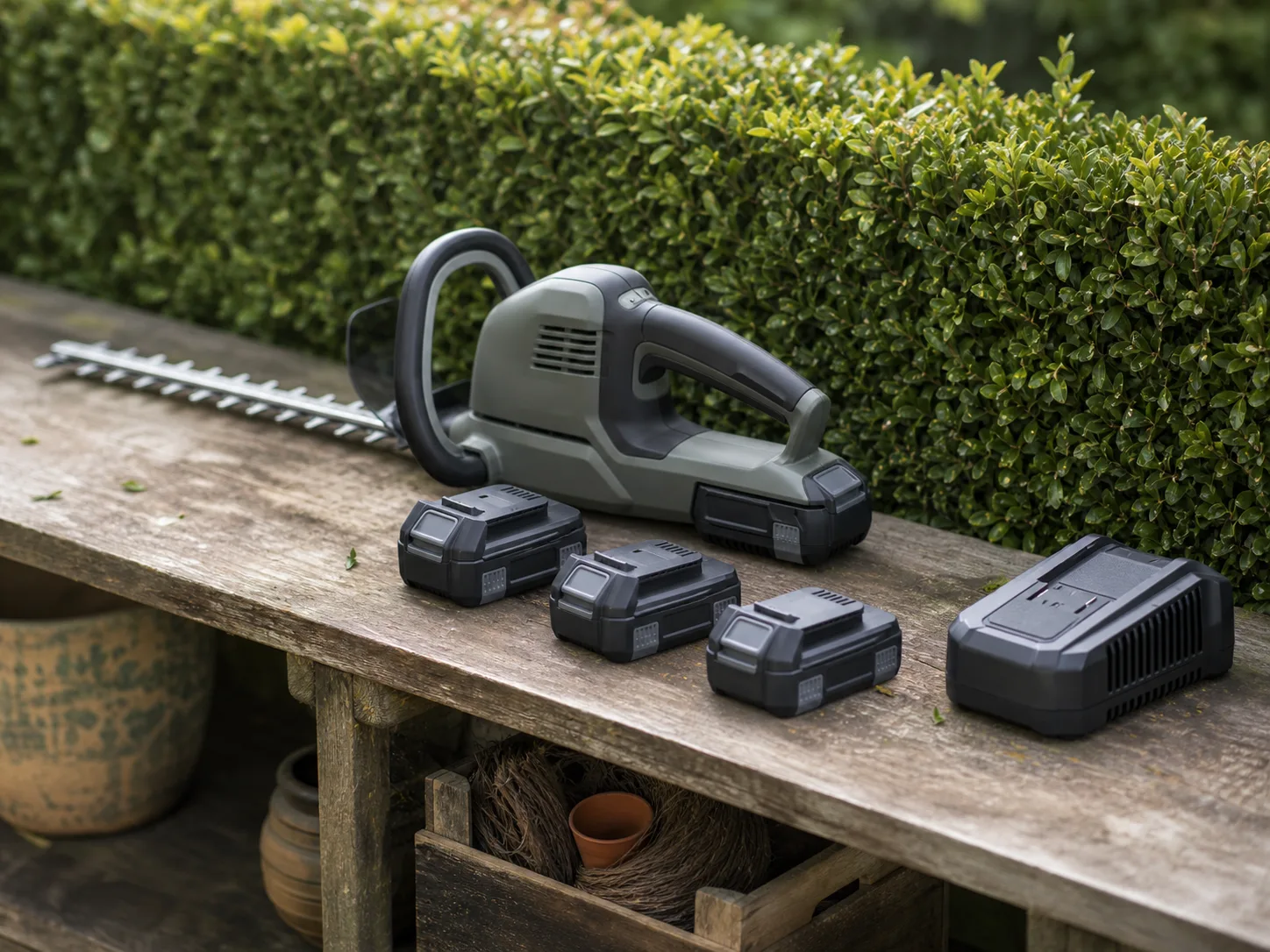
An illustrative battery-platform setup: confirm the battery, charger, and tool-only status of the exact model you plan to buy.
EGO POWER+ HT2410: Best for thick hedge work
The EGO POWER+ HT2410 is a strong fit for homeowners who want a full-size hedge trimmer with a relatively generous rated capacity and already use the EGO battery system. EGO lists a 24-inch blade, 1-inch cut capacity, dual-action hardened-steel blades, and a 3,000-strokes-per-minute cutting rate. It also lists fully serviceable blades and an electric brake that stops blade action quickly.
That specification combination makes the HT2410 a sensible candidate for established hedges with stems that are more substantial than soft seasonal tips. It is still a hedge trimmer, not a substitute for a lopper or pruning saw. Use the capacity rating to screen out unsuitable stems, and use a dedicated pruning tool when a limb is too woody, too large, or structurally important to remove with a sweeping hedge cut.
The battery choice is important. The HT2410 is a bare tool, and EGO says it works with all EGO POWER+ ARC Lithium batteries. EGO also lists a five-year limited residential tool warranty, but warranty terms and kit contents should be checked with the retailer and region before purchase. Pick this model when the EGO ecosystem, serviceable blade design, and electric brake are more valuable to you than a lighter compact trimmer.
DEWALT DCHT820B: Best for 20V MAX households
The DEWALT DCHT820B is the straightforward ecosystem choice for someone who already owns DEWALT 20V MAX batteries and chargers. DEWALT specifies a 22-inch laser-cut, hooked-tooth blade engineered for clean cuts on branches up to three-quarters of an inch, along with a high-output motor and a friction clutch designed to protect the transmission.
The 22-inch length sits in a useful middle ground: broad enough for a typical residential hedge face but less unwieldy than a very long blade around corners and small shrubs. The hooked-tooth description is relevant when the hedge has stems that tend to slide away from a flat cutting edge, but it does not remove the need to keep the blade within its rated capacity.
This listing is for the tool only, so the total ownership decision depends on the batteries already in your collection. If you are starting from zero, price the battery and charger as part of the trimmer rather than comparing a bare-tool listing with a complete kit. For a 20V MAX owner who wants one cordless tool for routine hedge shaping, the DCHT820B is a sensible, clearly specified shortlist option.
Milwaukee M18 FUEL 2726-20: Best for existing M18 owners
The Milwaukee M18 FUEL 2726-20 suits a homeowner or property manager who already owns several M18 tools and wants a longer-blade trimmer on the same system. Milwaukee lists a 24-inch blade, a three-quarter-inch cutting capacity, a blade tip guard, a POWERSTATE brushless motor, and an all-metal gear case. It also says the tool is compatible with more than 200 M18 solutions.
Milwaukee publishes up to two hours of runtime per charge for this model. Read “up to” as a maker estimate under stated conditions, not as two hours of uninterrupted cutting in every hedge. The actual result will depend on which M18 battery is used, the density and diameter of the stems, how often the blade is allowed to run between cuts, and the battery’s condition.
The handle placement and weight distribution are central to the appeal. A 24-inch blade can make a long hedge faster to cover, but it can also become tiring when held at shoulder height. Choose the 2726-20 when your M18 batteries, the blade-tip protection, and the platform’s breadth outweigh the cost of buying a tool-only product and carrying a full-size battery.
RYOBI 40V 24-Inch RY40HG01B: Best for a broad residential hedge
The RYOBI 40V 24-inch RY40HG01B is a practical fit for a broad residential hedge when the 40V system makes sense for the rest of the yard. RYOBI lists 24-inch blades, a 1-inch cut capacity, a wraparound front handle, and a HEDGESWEEP attachment for helping remove clippings. The manufacturer says the trimmer can run for more than 45 minutes with a 40V 2Ah battery and that the 40V battery works across more than 85 products.
That runtime figure is useful for planning a moderate trimming session, but it should not be compared directly with a different brand’s “up to” number. A tool with a longer blade, denser hedge, or larger stems can use energy faster. If you need to cut on both sides of a long hedge, a spare compatible battery may be more useful than assuming one charge will finish every job.
Check whether the exact listing you are considering is a bare tool or a kit. The RY40HG01B is most compelling when you value the 40V platform, want a 24-inch working edge, and can use the front-handle design comfortably for the angles your hedge requires.
RYOBI 40V HP Brushless 26-Inch RY40606BTL: Best for wide, overgrown hedges
The RYOBI 40V HP Brushless Whisper Series 26-inch RY40606BTL is the wide-hedge option in this group. RYOBI lists 26-inch blades, a 1.5-inch cut capacity, a rotating handle, and up to 29 minutes of runtime with a 40V 2Ah battery. The model is part of the 40V system, which RYOBI says spans more than 85 products.
A 26-inch blade can cover a broad, flat hedge face efficiently, and the rotating handle can help keep the grip aligned as the cutting angle changes. The tradeoff is control and carry weight: the extra reach can feel unnecessary around a small shrub, and the larger rated capacity should not encourage cutting old structural wood with a hedge trimmer. Use a lopper or saw when the job is branch removal rather than surface shaping.
The short published runtime relative to some other 40V claims is a useful reminder that numbers are not a ranking. A wide blade and heavier cutting load can change energy use. Choose this model for an existing 40V owner who values reach and wide-hedge coverage, not because 1.5 inches is automatically better for every yard.
RYOBI 18V ONE+ HP Brushless 24-Inch PBLHG01K: Best for ONE+ owners
The RYOBI 18V ONE+ HP Brushless 24-inch PBLHG01K makes the most sense for someone already invested in the 18V ONE+ system. RYOBI lists a 24-inch blade, three-quarter-inch cut capacity, and 25 minutes of runtime with an 18V ONE+ 2Ah battery. The company says the platform includes more than 300 products.
The 18V label does not make this a weaker choice by itself. Voltage is a platform specification, and motor design, battery size, blade load, and the hedge itself determine the work a trimmer can do. For routine shaping of a maintained privet, boxwood, or similar hedge within the rated capacity, the broad ONE+ platform can be more important than moving to a higher nominal voltage.
Pay attention to the kit suffix. This model is listed as a kit, but retailers and regions can package tools differently, so confirm the included battery, charger, and warranty before ordering. Choose it when sharing batteries with other ONE+ tools is the priority and your hedge does not demand a larger tooth gap.
STIHL HSA 60: Best for handle adjustment and anti-blocking
The STIHL HSA 60 is a thoughtful choice for users who care about adjustable control and jam recovery. STIHL lists a 24-inch blade, a 3,000-strokes-per-minute rate, a 34-millimeter tooth spacing, a 90-degree rotatable multifunction handle, anti-vibration features, and an anti-blocking system that reverses blade direction when twigs jam. Its AK battery system uses a 36V rated voltage, with the maximum voltage listed as 40V.
The teardrop-shaped blade geometry is designed to help hold stems, while the handle rotation can keep the wrist in a more comfortable position on the side or top of a hedge. Those features do not eliminate fatigue or the need to stop the tool before clearing a stubborn obstruction. They are ownership advantages for a user who expects to trim regularly and wants more control over how the trimmer is held.
STIHL regional pages can differ in kit contents, battery, charger, and warranty details. Confirm the exact HSA 60 package available in your market, and compare the complete carry weight with the battery attached. Pick it for the controls and anti-blocking design when those details matter more than simply choosing the longest blade.
Husqvarna 522iHD60: Best for an existing Husqvarna battery system
The Husqvarna 522iHD60 is primarily an ecosystem recommendation. Husqvarna describes its battery hedge trimmers as part of a 40V lithium-ion system and highlights features such as the SavE function for optimizing runtime, an easy-access keypad, low noise, and no direct exhaust emissions. The linked listing is a tool-only page.
The important limitation is transparency: the accessible manufacturer listing does not expose the same complete set of model-specific blade, capacity, weight, and runtime figures as the other pages in this comparison. Before buying, verify the exact 522iHD60 package, battery and charger requirements, carry weight, blade length, tooth gap, and local warranty. Do not fill in missing specifications from a different Husqvarna model just because the names look similar.
For an owner already using Husqvarna battery equipment, the shared system and SavE setting may be enough to put this trimmer on the shortlist. For a new buyer who wants an apples-to-apples specification comparison, one of the more fully documented picks above is easier to evaluate.
Compare the eight picks at a glance
| Model | Published blade and capacity | Battery ecosystem | Manufacturer runtime note | Best fit |
|---|---|---|---|---|
| EGO POWER+ HT2410 | 24 in.; 1 in. | EGO POWER+ ARC Lithium; bare tool | Not published on the captured product page | Thick established hedges; serviceable blade and electric brake |
| DEWALT DCHT820B | 22 in.; up to 3/4 in. | DEWALT 20V MAX; tool only | Not published on the captured product page | Routine shaping for 20V MAX owners |
| Milwaukee M18 FUEL 2726-20 | 24 in.; 3/4 in. | Milwaukee M18; tool only | Up to 2 hours per charge | M18 owners planning longer sessions |
| RYOBI 40V RY40HG01B | 24 in.; 1 in. | RYOBI 40V | More than 45 min with 40V 2Ah | Broad residential hedges and 40V yards |
| RYOBI 40V HP RY40606BTL | 26 in.; 1.5 in. | RYOBI 40V | Up to 29 min with 40V 2Ah | Wide or overgrown hedge faces |
| RYOBI 18V ONE+ PBLHG01K | 24 in.; 3/4 in. | RYOBI 18V ONE+ | 25 min with 18V ONE+ 2Ah | ONE+ owners with maintained hedges |
| STIHL HSA 60 | 24 in.; 34 mm tooth spacing | STIHL AK system | Depends on battery and kit | Adjustable handling and jam-prone growth |
| Husqvarna 522iHD60 | Verify exact local listing | Husqvarna battery system | Verify exact local listing | Existing Husqvarna owners |
This table is intentionally not a made-up weight ranking. Tool-only weights and complete kit weights are not presented consistently across the captured product pages, and a battery can change how a trimmer feels more than a small difference in bare-tool weight. Before ordering, look for the complete operating weight, battery position, handle shape, and return policy.
Match blade length and tooth gap to the hedge
Blade length is about coverage and control. A short blade around 18 to 20 inches is easier to steer around a small shrub, a narrow side passage, or a detailed topiary shape. A 22- to 24-inch blade is a versatile middle ground for many residential hedge faces. A 26-inch blade can reduce passes across a wide, straight screen, but it asks more of your shoulders and may be awkward in tight spaces.
Those ranges are practical starting points, not rules. Bob Vila’s buyer guidance describes shorter blades as useful for small hedges and 19 to 30 inches as a common residential range, while Expert Reviews emphasizes testing across different hedge types and considering balance, blade length, and weight together. The best length is the one you can keep controlled while seeing the blade and maintaining a stable stance.
Tooth spacing or cut capacity is a separate question. The gap between teeth determines how easily the blade can accept a stem, but the manufacturer’s maximum capacity is not an instruction to cut that diameter repeatedly. Hedge trimmers are designed for shaping many smaller stems; old limbs, rigid branches, and anything outside the manual’s limit belong to a lopper, pruning saw, or qualified service.
Look for dual-action blades if you want the common residential hedge-trimmer format, but do not treat that label as a complete quality rating. Blade design, tooth geometry, speed, guard, balance, and serviceability work together. A close-up of the tooth gap can tell you what the spec means, but it cannot tell you whether the whole tool will be comfortable after 20 minutes.
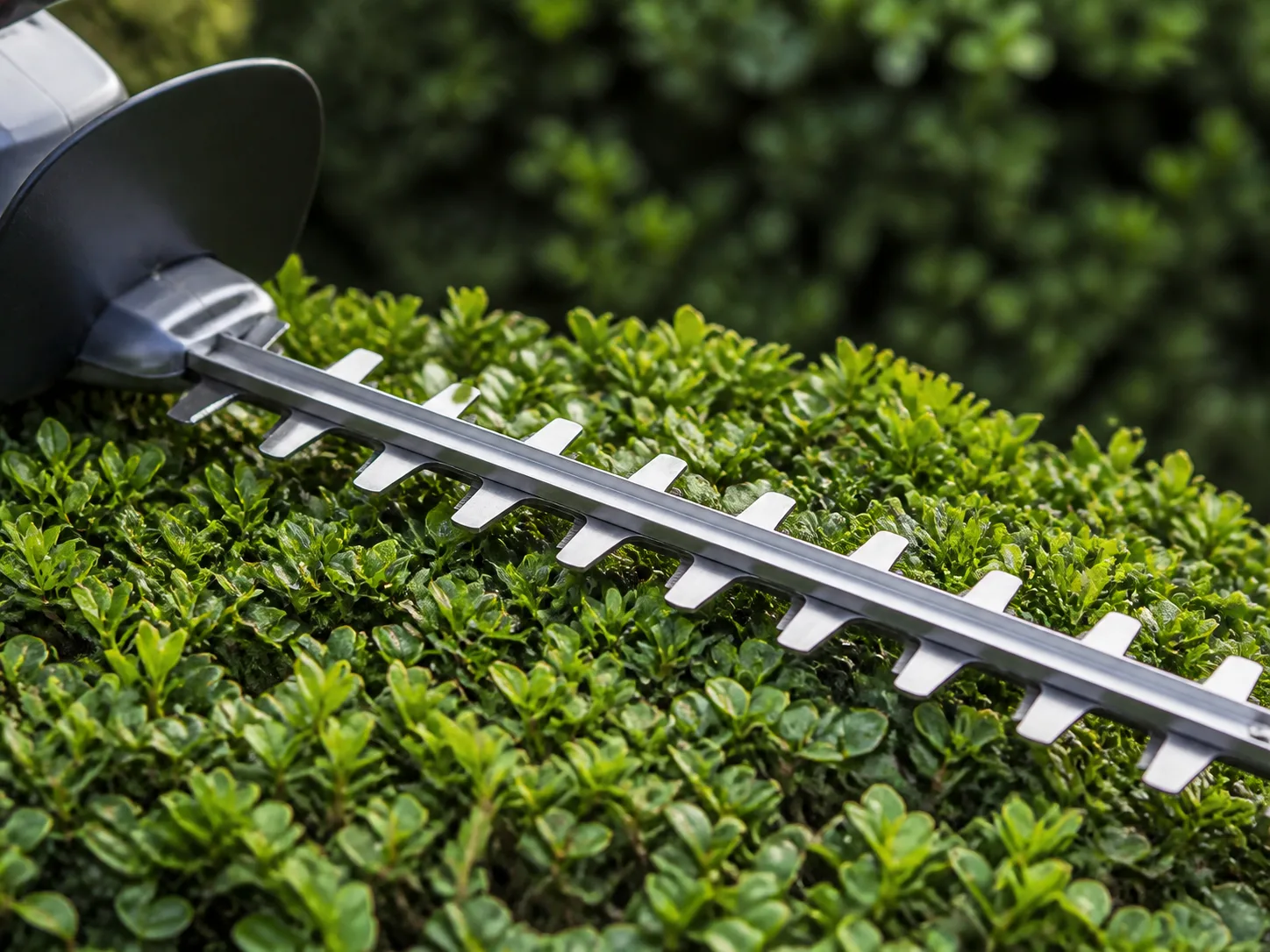
Tooth spacing is one part of the specification; it does not replace the model’s cut-capacity limit or a safe pruning tool for oversized wood.
Plan battery runtime around the work, not the label
Battery runtime depends on more than voltage. Amp-hours describe how much energy a battery stores under its rating, while the trimmer’s motor, blade length, branch load, hedge density, temperature, and battery age affect how quickly that energy is used. A 2Ah runtime claim on one brand is not a fair one-to-one promise against a different brand’s 2Ah claim.
The most useful first choice is usually the battery ecosystem you already own. A bare tool can reduce duplication, and an extra battery may be a better solution for a long hedge than paying for a higher-voltage platform that introduces a new charger and new battery inventory. If you have no platform, compare the total kit: tool, battery, charger, warranty, and the other products you might realistically buy later.
Use maker runtime figures as a session-planning estimate. A claim such as “more than 45 minutes” or “up to two hours” may be measured with a particular battery and light cutting conditions. Heavy woody growth, constant trigger use, a dirty blade, cold weather, and an old battery can reduce the usable time. Leave enough charge to finish safely and transport the tool; do not keep cutting simply because the battery is nearly empty.
Charging time matters, too. If the hedge takes two batteries to finish, check whether the second battery can charge while the first is in use and whether the charger is included. A kit that looks inexpensive or complete in a photo may be a bare tool, and the missing battery can change the real ownership cost more than a modest difference in blade length.
Treat weight, balance, and reach as safety specifications
Compare the complete operating setup, not just the tool-only line. A large battery mounted behind the handle can make a tool feel different from the same trimmer fitted with a smaller pack. A long blade can move the center of gravity away from your body, which matters when trimming the top of a hedge or holding the tool at chest height.
Balance is partly personal, but several questions are universal: Can you keep both hands in the intended positions? Can you release the trigger without twisting? Can you rotate or reposition the tool without stepping into the blade’s path? Does the front handle give you a stable grip without forcing your wrist into an awkward angle?
A rotating handle, anti-vibration feature, hand guard, or well-placed controls can make a longer session more manageable. They do not make a heavy tool weightless. Work in shorter passes, take breaks before your arms become shaky, and choose a shorter blade or smaller battery when control matters more than coverage.
Reach is not the same as height. A longer blade may help with a broad side face, but it does not make it safe to lean, climb, or use a hedge trimmer overhead. If the hedge requires unstable footing or a ladder, change the setup or get help rather than stretching the tool farther.
Use a cordless hedge trimmer safely
Virginia Tech’s powered-hand-tool guidance recommends reading the manual, inspecting the tool and its safety features, and wearing eye and hearing protection, protective clothing, long pants, closed-toe shoes, and gloves. It also warns against loose clothing and jewelry, fatigued operation, unattended running, and placing hands near the blade. For electric hedge trimmers specifically, the guide says to shut down and disconnect the power source before inspection, repair, or maintenance and not to use an electric hedge trimmer overhead.
Before every session, check the blade, guard, fasteners, battery housing, trigger lock, and any visible safety switch. Make sure the blade is not bent or loose and that the battery seats securely. Clear people, pets, toys, stones, and hidden wire from the area, and do not assume a quiet cordless motor is harmless just because there is no extension cord.
If a twig jams, release the trigger, wait for the blade to stop, remove the battery, and follow the manual’s clearing instructions. Never pull at a jammed branch while the battery is connected. Keep both hands on the intended grips, maintain stable footing, and stop when visibility, weather, fatigue, or the work area makes control uncertain.
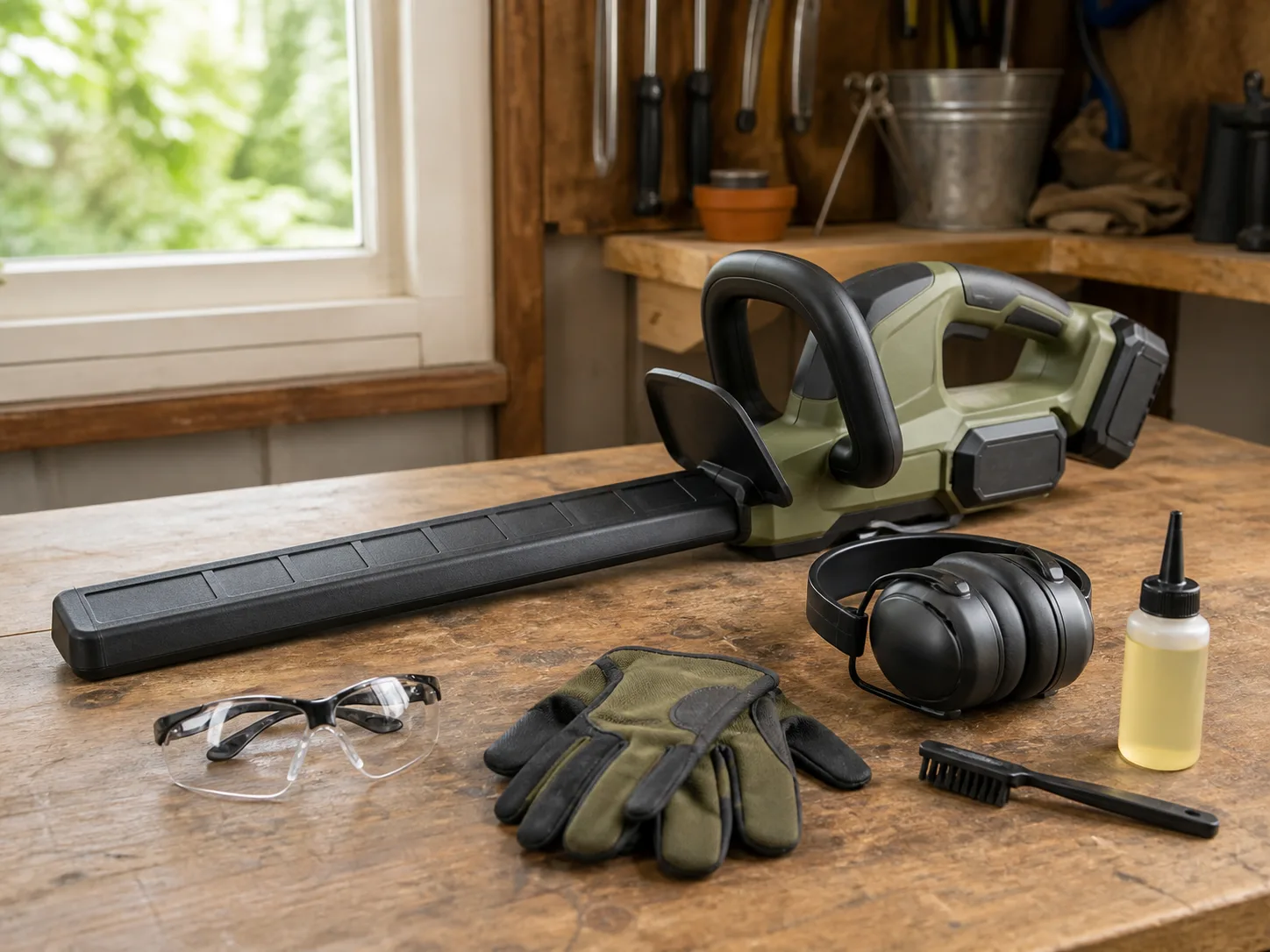
Keep protective equipment and maintenance supplies together, but follow the exact safety and lubrication directions in the trimmer manual.
The broader reason for this care is not theoretical. Virginia Tech cites U.S. Consumer Product Safety Commission injury data for power lawn trimmers and edgers, including a substantial share of eye injuries. Eye protection, a guard, and a deliberate inspection routine are inexpensive compared with an avoidable injury.
Maintain and store it between cuts
Maintenance starts with isolation. Turn the trimmer off, wait for the blade to stop, remove the battery, and put the blade sheath on before brushing away clippings or checking the teeth. Use a soft brush or dry cloth to clear leaves and sap from the blade and air openings; keep moisture and debris out of the battery compartment.
Inspect the teeth, guide bar, guard, fasteners, trigger, hand switch, and battery contacts. If the blade is bent, cracked, unusually loose, or still binds after the correct clearing procedure, stop using the tool and follow the manufacturer’s service route. Do not file a modern blade by guesswork when the manual specifies a service process or replacement part.
Lubricate only as the manual directs. EGO’s HT2410 information, for example, says light machine oil can be used for blade lubrication. That does not authorize soaking every trimmer in oil or spraying products into the motor housing. Wipe away excess lubricant so it does not collect dust and clippings.
Store the trimmer with its blade covered in a dry, protected place. Remove the battery if the manual says to do so for storage, keep battery contacts clean, and avoid leaving lithium-ion packs in a hot car, direct sun, or a damp shed. Charge and store the battery according to its own instructions rather than treating every brand’s storage procedure as interchangeable.
Conclusion
Choose the cordless hedge trimmer by starting with the hedge and the battery shelf. The EGO HT2410 and RYOBI 40V 26-inch model suit different kinds of heavier work; the DEWALT, Milwaukee, RYOBI 18V, and Husqvarna options make the most sense when you already own the matching system; and the RYOBI 40V 24-inch and STIHL HSA 60 offer practical middle-ground choices with different handling priorities.
Before buying, confirm the complete kit contents, compare the battery-attached weight, check the blade length and tooth gap, and treat every runtime claim as conditional. A trimmer that fits your platform and your actual hedge will be easier to carry, safer to control, and less likely to be pushed beyond what it was designed to cut.