The 11 Best Drop-Leaf Tables for Small Spaces
Compare 11 drop-leaf tables by size closed vs open, leaf mechanism, materials, and price—plus clearance math so you buy once, not twice.
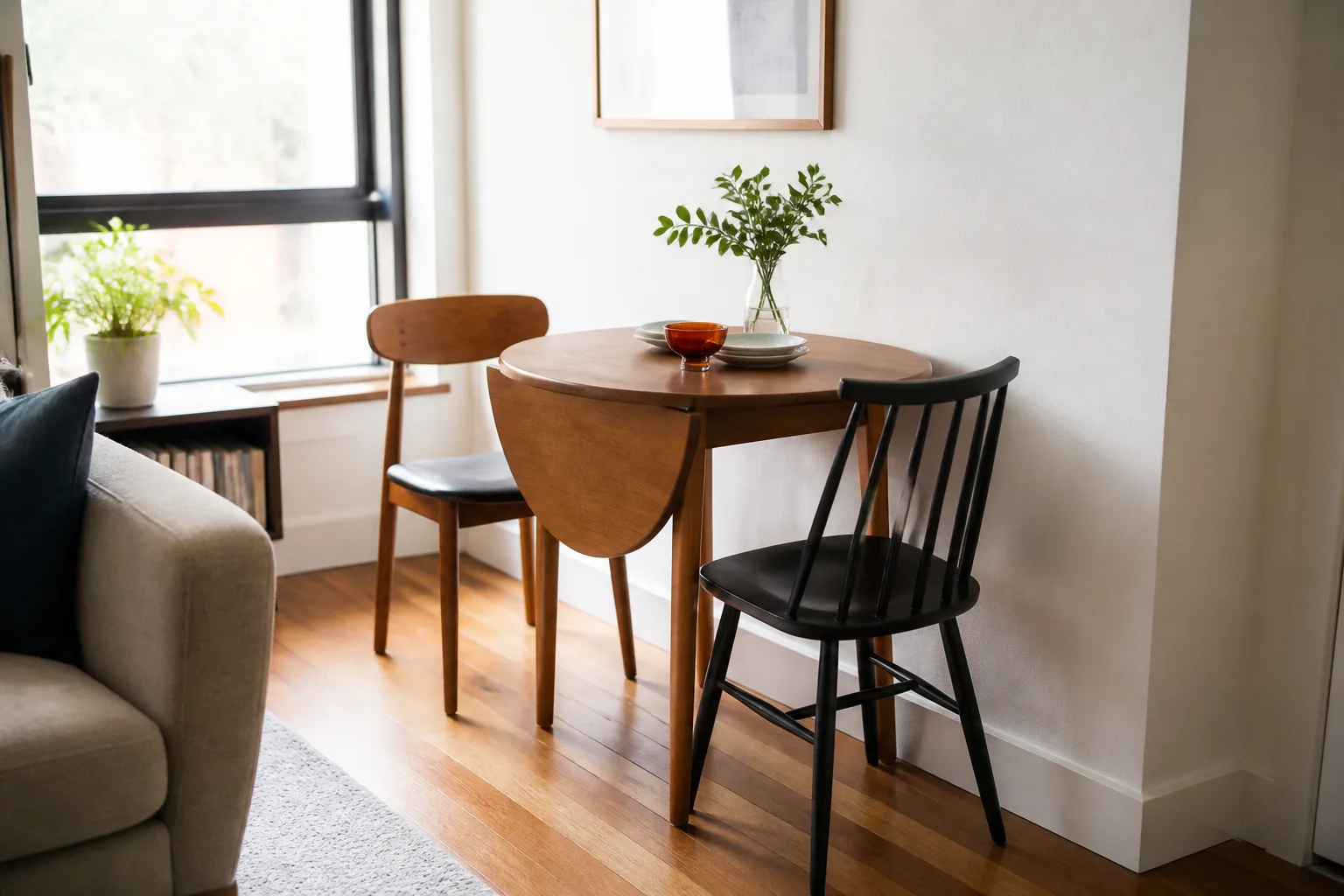
A drop-leaf table gives you a dining surface that shrinks when you need floor space and expands when guests show up—but the wrong mechanism or a footprint that only works “fully open” defeats the whole point. Most buyer regret comes from skipping closed dimensions, not from picking the wrong stain color.
This guide starts with how much room you actually have, then compares hinge leaves, gatelegs, and wall mounts, and finally walks through 11 vetted tables from roughly $98 to $1,800 with honest trade-offs on weight limits, materials, and daily usability.
Quick Answer: Match Closed Size to Your Room First
Buy the smallest closed footprint that still meets your everyday job—console width for a hallway desk, 26-inch depth for a kitchen nook, or a 10-inch gateleg slab against a wall—then confirm you can seat your real guest count when leaves are up. For most apartments, a round 42-inch extended or rectangular 60-inch extended table seats four comfortably; squeezing six requires a narrow trestle and accepting tight side-by-side chair placement.
Mechanism quick pick: Standard hinge leaves with lever locks (Ashley Berringer, International Concepts) suit daily flip-up/down. Gatelegs with extra folding legs (IKEA Norden, Winsome Hannah) trade bulk for stability. Wall-mounted Murphy tables (Houseables) free floor space entirely but demand stud-mounted install and cap seating at one or two.
If you host more than four adults regularly, a drop-leaf is usually the wrong primary table—look at a fixed 48- to 54-inch top or a leaf that stores inside the apron (butterfly leaf) instead. Drop-leafs win when daily footprint matters more than maximum holiday capacity.
Before clicking “buy,” measure three numbers: closed length × closed depth × clearance behind a pulled-back chair. Kitchen and bath designers commonly plan 36 inches minimum behind a seated diner so someone can walk behind without bumping (NKBA). Tighter rooms can work at 30 inches if the table sits against a wall with no through-traffic—but do not guess; tape the footprint on the floor first.
Drop-Leaf, Gateleg, and Wall-Mount Mechanisms Explained
All three categories solve small-space dining, but they fail in different ways. Matching mechanism to how often you flip the table prevents the wobble-and-collapse problems that show up in product reviews after week one.
Hinge leaves and lever locks
Classic drop-leaf tables attach one or two leaves to the center slab with butt hinges hidden under the apron. You swing leaves up level with the center, then engage metal support brackets or sliding levers that lock the leaf horizontal. Ashley’s Berringer and International Concepts’ round dual-leaf tables use this pattern: push levers under the apron, test that leaves sit flush without rocking, and drop one leaf to tuck the table against a wall while keeping the other up for a slim work surface.
Pros: Fast daily operation, clean look when leaves hang vertically, works for round and rectangular tops. Cons: Leaves typically support less weight than the center—often 25–50 pounds per leaf on mid-range tables versus 75–220 pounds at the center on gateleg or heavy trestle designs. Heavy serving dishes belong over the center seam, not cantilevered on a single leaf.
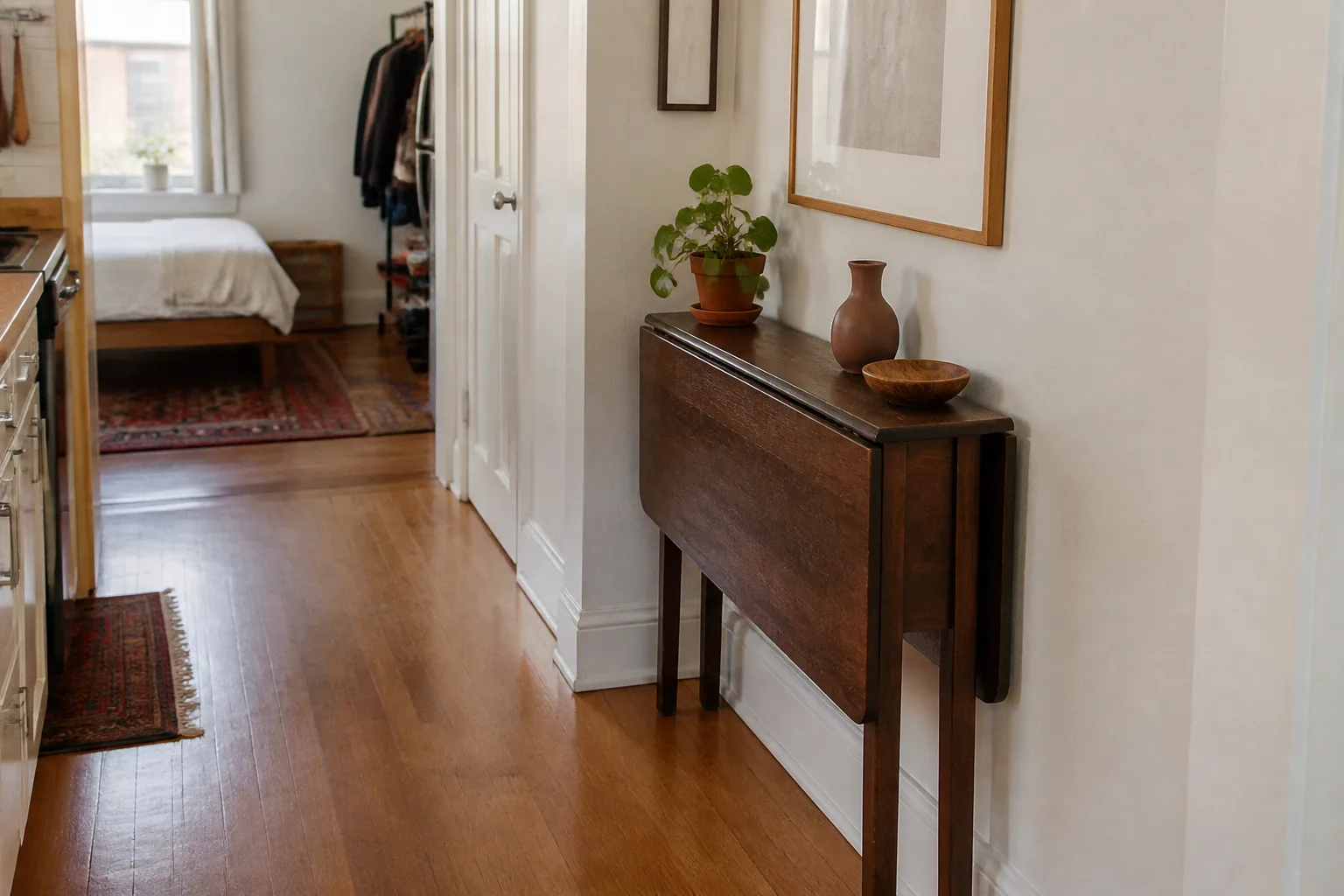
Wall-mounted fold-down tables use a different logic: the leaf is the entire top, hinged at the wall with a bracket or cable support. They eliminate leg footprint entirely but fix you to one wall location and one height. Install into studs or heavy-duty anchors, not drywall alone, or the rated capacity is meaningless.
Gateleg tables with folding support legs
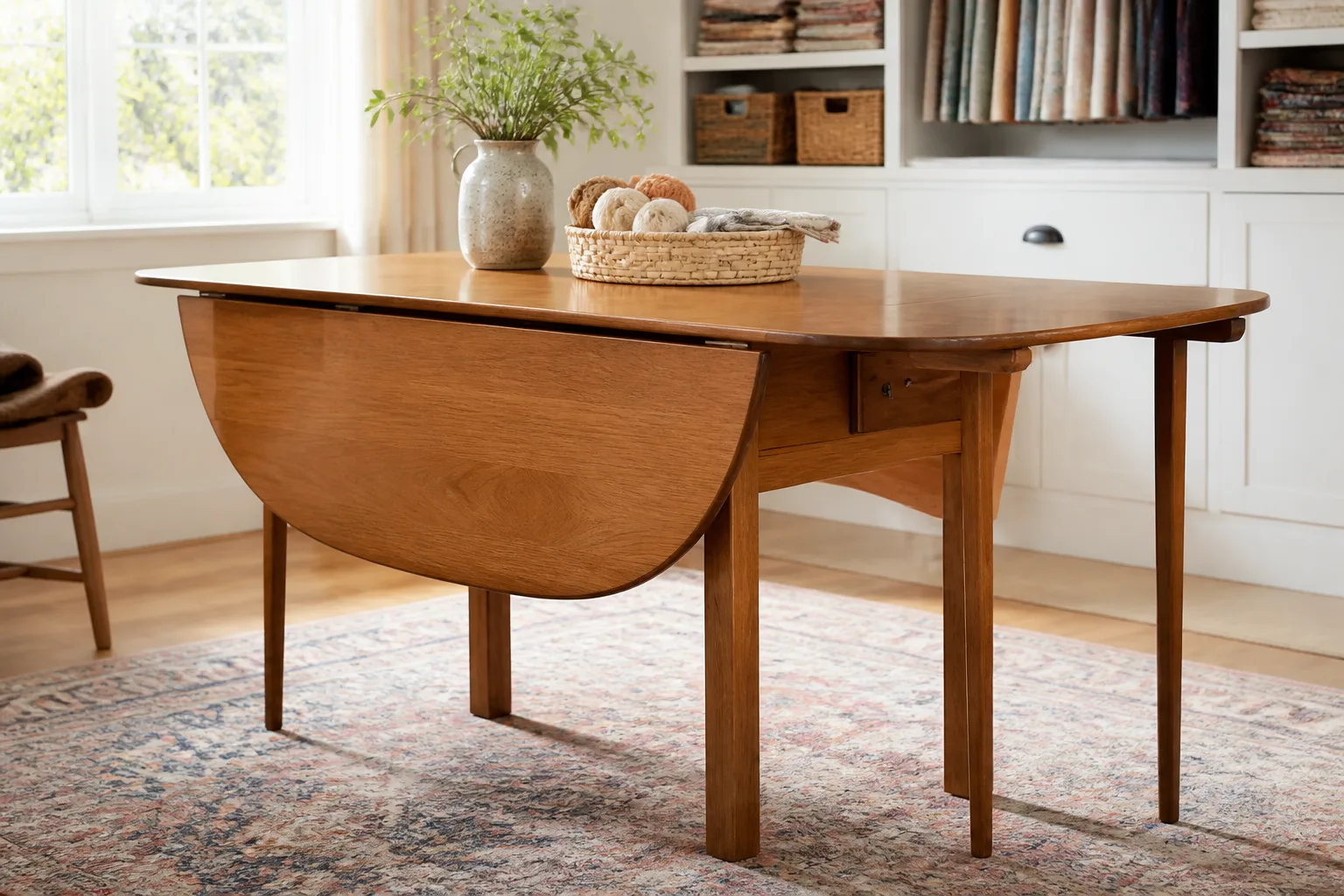
Gateleg tables add hinged legs that swing out under each leaf, sometimes combined with sliding brackets (IKEA Norden’s gateleg design). The extra legs dramatically improve stability for crafts, quilting, and daily family meals at the cost of more moving parts and weight. IKEA lists the Norden gateleg at about 100 pounds—durable, but not something you slide across the room weekly (IKEA).
Gatelegs shine when leaves must stay level under moderate load or when you run a sewing machine, laptop plus monitor, or holiday serving spread. They struggle in very tight footprints because unfolded legs need clearance around the table perimeter—measure leg swing, not just tabletop length.
Size, Clearance, and Seating Capacity
Closed dimensions on the spec sheet tell only half the story. You also need space for chairs, walking paths, and—on storage tables—drawer access on all sides you plan to use.
The 36-inch chair pull-back rule
Plan at least 24 inches of table width per diner for elbow room; 30 inches feels noticeably better for adults. Rectangular narrow trestles (Latitude Run Adams at 12.25 inches deep closed, 31.5 inches open) can seat six on paper, but two standard chairs on the long side feel tight—four is the realistic comfort zone unless you use slim armless chairs.
For clearance behind seated chairs, use this sequence:
- Mark the closed table footprint on the floor with painter’s tape.
- Place real chairs (or cardboard cutouts) at the table edges.
- Pull chairs back as if someone were sitting down—measure to the nearest wall, island, or traffic path.
- If that distance is under 36 inches, expect bumping; under 30 inches, consider a wall-mounted table or a narrower closed depth.
Round 42-inch tops (extended) fit four place settings with adequate elbow room; pushing a fifth requires overlapping corners. Two-person daily dining pairs well with Winsome Space Saver-style cart tables that include stored stools—excellent for galley kitchens, limited for dinner parties.
Traffic path test: Walk the route you use most (fridge to sink, entry to sofa) with tape marking the extended chair zone. If the path narrows below 24 inches when chairs are out, you will feel cramped every dinner—not just on holidays.
Materials Compared: Solid Wood, Veneer, and Metal
Solid rubberwood, beech, and hardwood (International Concepts, Winsome Hannah, Room & Board Adams) resist edge impacts and accept refinishing—Room & Board builds the Adams from 1-inch-thick solid tops with hidden apron hardware (Room & Board). Expect higher price and real weight; rubberwood tables often ship unfinished or stain-ready, adding a weekend of prep before first use.
Veneer over engineered core (Ashley Berringer) delivers consistent finishes and lower cost with beveled edges that look finished when leaves are up. Surfaces hold up to daily meals but hate standing water and sharp dragged pottery—use coasters and wipe spills quickly.
Particleboard and melamine (IKEA Norden internals, many budget cart tables) feel heavy and stable yet swell if wet and are hard to repair. Fine for craft rooms with controlled humidity; risky next to dishwashers or in unconditioned garages.
Metal legs with wood tops (Latitude Run Adams trestle, VASAGLE industrial frame) add rigidity and industrial style. Check top thickness—0.63-inch particleboard (VASAGLE) is adequate for light daily use but not for heavy vise work without a pad.
Outdoor acacia (vidaXL patio pick) resists rot when maintained; plan annual oiling or accept silver patina, plus furniture covers in heavy rain (vidaXL product guidance).
| Material | Best for | Watch out for |
|---|---|---|
| Solid rubberwood/beech | Refinishing, moderate daily dining | Unfinished units need sealing; lower leaf weight limits on budget models |
| Veneer + engineered core | Consistent factory finishes, mid price | Swelling at seams if water sits; hard to sand out chips |
| Particleboard/melamine | Heavy stable craft tables (Norden) | Irreversible water damage; screw loosening in humidity swings |
| Metal frame + wood top | Narrow trestles, industrial look | Thin tops flex; check separate leaf vs center ratings |
| Outdoor acacia | Small patios, seasonal dining | Annual oil or gray patina; cover in storms |
The 11 Best Drop-Leaf Tables by Use Case
Prices shift with sales; ranges below reflect typical U.S. retail at publication time. Always confirm closed and extended dimensions on the seller page before ordering.
Best overall, budget, and narrow picks
Best overall — Signature Design by Ashley Berringer Round Drop-Leaf (~$200–$300): A 42.25-inch round that collapses to 26 inches deep with one or both leaves down—ideal for one-leaf-up against a wall dining. Two-tone and dark brown finishes suit mixed interiors; 15-minute two-person assembly if you align leaf levers carefully (Ashley Furniture). Seats four extended; veneers and engineered core keep cost down versus solid wood. Test leaves immediately—misaligned brackets are the top defect call.
Best narrow — Latitude Run Adams Drop-Leaf Trestle (~$370): At 12.25 × 63 inches closed, this is a console-depth expandable desk that opens to 31.5 inches deep for meals. Natural wood top with black metal trestle suits studio lofts; 50-pound top rating beats many solid-wood leaves. Best as dual-purpose office/dining in combo living rooms—not a traditional round kitchen table.
Best budget — International Concepts Small Drop-Leaf (~$130–$170): 18 × 22 inches closed, 36 × 22 extended—square when folded, rectangular when both 9-inch leaves rise. Unfinished rubberwood means you must sand and seal before use; knees may contact dropped leaves more than on round designs. 100-pound capacity when weight is balanced; excellent starter table for renters willing to DIY finish.
Best storage, gateleg sturdy, and stool-included sets
Best with storage — IKEA Norden Gateleg (~$350): Scandinavian staple with six drawers (three per side) and gatelegs supporting leaves up to 60 × 31.5 inches extended. Closed depth 10.25 inches tucks tight; ~100-pound weight means permanent placement (IKEA). Critical placement note: wall-mounting one long side blocks three drawers—center it in the room or accept lost storage.
Best gateleg sturdy — Winsome Hannah Round (~$175–$205): Beech gateleg with 75-pound center / 25-pound per leaf ratings—honest limits that prevent overload surprises. 42 × 9.5 inches closed slides to a wall; leaves can collapse if legs skid, so add rubber feet on slick floors. Traditional profile without IKEA’s drawer bulk.
Best with stools — Winsome Space Saver Set (~$200): Table plus two stored stools, drawer, and towel rack in a 29-inch square footprint—functionally a mobile kitchen cart with one drop leaf. Seats two comfortably; wheels help galley kitchens but reduce rock-solid dining feel. Composite wood construction; treat spills promptly.
Best solid wood heirloom, wall-mounted, outdoor, and industrial
Best solid wood classic — International Concepts Round Dual Drop-Leaf (~$230): Solid rubberwood pedestal with 0.75-inch top and 9-inch leaves; 40-pound max means light dining only—keep heavy cast iron closer to the pedestal. Many stain/finish options plus matching chairs from the same line.
Best design investment — Room & Board Adams Drop-Leaf (~$1,800): Heirloom-grade solid wood with hidden hinges when leaves drop, 1-inch top, and 3-inch apron concealing hardware (Room & Board). Sharp leaf edges when seated—mind knees. 30 × 34 closed, 46 × 34 extended seats two to four with refined proportions; order wood samples before committing.
Best wall-mounted — Houseables Murphy Drop-Leaf (~$98): 48 × 16-inch fold-down surface; stud mounting required for rated 150-pound capacity when installed correctly. Frees floor space for studio entryways, laundry folding, or counter-height dining—not a replacement for a four-person holiday table.
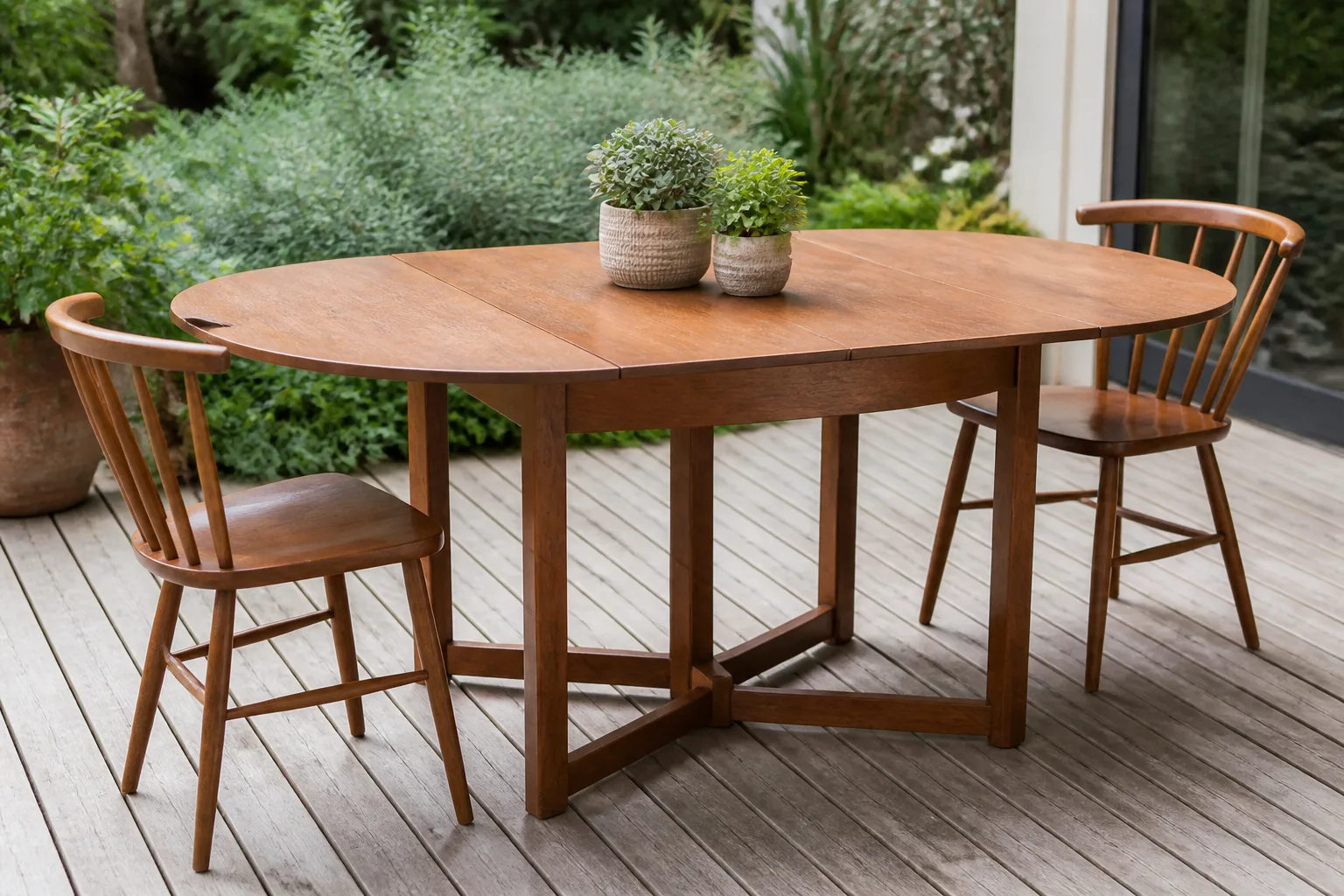
Best outdoor — vidaXL Acacia Drop-Leaf Patio (~$167): Solid acacia oval top 35.4 inches closed, 51.2 extended—rare true drop-leaf in outdoor wood. Seats four to six on a small deck; maintain with mild soap, immediate drying, and periodic hardwood oil.
Best industrial — VASAGLE Folding Drop-Leaf (~$113–$130): Distressed top, black steel frame, button-release leaves; 220-pound center capacity with lighter leaf limits typical of particleboard wings. Fits rustic lofts and rental dining nooks; pair with matching chairs if you want a uniform set.
How we grouped these 11: Most roundups scatter picks by marketing labels; we sorted by job-to-be-done so you can jump to narrow-console desks, drawer storage, or patio wood without reading every blurb. Cross-check seller pages for current price, finish availability, and ship weight—gateleg tables over 80 pounds often need in-home delivery or two strong helpers.
What to Look For Before You Buy
Mechanism tests, weight limits, and assembly traps
On delivery day, run this 10-minute QA before discarding boxes:
- Raise each leaf and apply downward pressure at the outer edge—any bounce means brackets need adjustment.
- Load 10 pounds on a leaf edge, then 25 pounds at center—if the leaf flexes visibly, treat it as a light-duty surface.
- Cycle leaves ten times; sticky levers predict future frustration.
- Check apron screws after first week—particleboard tables loosen as humidity shifts.
Read weight limits separately for center vs leaves; marketing photos always show feasts centered for a reason. Gateleg tables need leg feet stable on your floor type—tile and polished concrete may need grip pads.
Placement mistakes that waste the space you saved
Blocking drawers by pushing storage tables against walls is the Norden owner’s classic error—measure drawer pull clearance on every side you will use. Centering a wall-mount too high turns dining into an ergonomic shoulder workout; aim for standard 29–30-inch table height unless you deliberately want bar height.
Using outdoor acacia unprotected through wet winters cracks boards regardless of “weather-resistant” labeling. Buying extended size only—always tape the closed footprint; many returns happen because the table fits guests but not the daily walkway to the fridge.
Ignoring chair width on narrow rectangles ruins six-seat spec-sheet dreams—bring your actual chairs into the taped layout. Finally, unfinished budget rubberwood is not move-in ready; budget one weekend for sand, stain, and polyurethane before hosting.
Return window strategy: Run the 10-minute QA in the first 48 hours while return shipping is still economical. Leaf misalignment that “sort of” locks is a defect, not a break-in period—exchange it before living with a wobble for years.
Conclusion
The right drop-leaf table is the one whose closed footprint lives comfortably in your room while its open size matches how you actually host—not the one with the prettiest product photo. For most small dining rooms, the Ashley Berringer round balances price, finish options, and flexible one-leaf-up placement; International Concepts’ small unfinished table wins on entry cost if you will finish it yourself; IKEA Norden rewards crafters who need drawers and gateleg stability if you can center it for drawer access.
Measure clearance with real chairs, test leaf locks on day one, respect lower leaf weight limits, and match mechanism type—hinge, gateleg, or wall-mount—to how often you transform the table. Do that upfront work once, and a drop-leaf stops being a compromise and becomes the reason your apartment eats, works, and hosts without a dedicated dining room.