How to Grow and Care for Blue Star Juniper Shrubs
Grow Blue Star juniper in sun and fast-draining soil. Get practical spacing, watering, container, pruning, propagation, and browning troubleshooting advice.
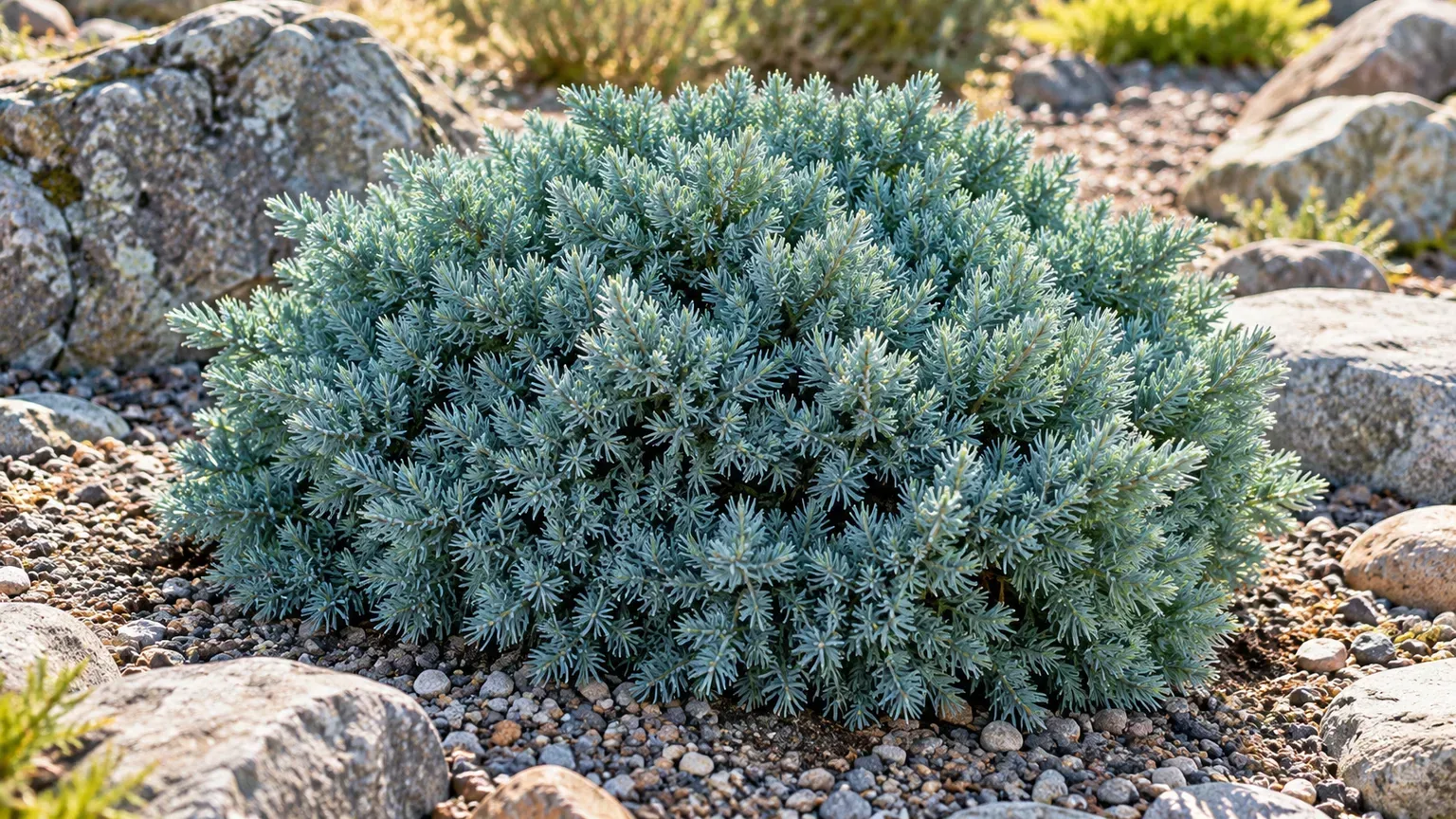
Blue Star juniper (Juniperus squamata ‘Blue Star’) is a compact, slow-growing evergreen with icy blue-gray foliage and a naturally rounded, spreading shape. It is a good fit for a sunny rock garden, front border, or large patio pot when you want year-round color without the footprint of a full-size conifer. The main thing it asks for is a site where water does not linger around its roots.
That last point matters more than a strict watering schedule or a special fertilizer. Junipers can cope with dry spells after they establish, but a newly planted shrub still needs regular moisture while its roots move into surrounding soil. This guide covers that difference, realistic spacing, container limits, safe pruning, and how to tell ordinary interior browning from a problem.
Blue Star Juniper at a Glance
| Trait | What to expect |
|---|---|
| Botanical name | Juniperus squamata ‘Blue Star’ |
| Form | Slow-growing, dense, rounded mound; wider than tall |
| Typical mature size | About 1–3 feet high and 1–4 feet wide, depending on source and site |
| Hardiness | Commonly listed for USDA Zones 4–8 |
| Light | Full sun gives the tightest growth and strongest blue-gray color |
| Soil | Adaptable texture, but the root zone must drain well |
| Main maintenance | Establishment watering; little routine pruning or feeding |
NC State Extension describes this cultivar as a dwarf, dense mound with blue-gray awl-shaped needles and a mature range of 1 to 3 feet tall by 1 to 4 feet wide. The Royal Horticultural Society gives a narrower height range and estimates 10 to 20 years to maturity, a useful reminder that nursery labels and local growing conditions do not produce one exact final size (NC State Extension; RHS).
The fine needles are sharp to the touch, and the plant does not make showy flowers. Its small, berry-like structures are seed cones, not edible berries. A useful identification cue is the dense, starry clustering of blue-gray needles at the tips of short branches; the cultivar originated as a compact mutation of ‘Meyeri,’ so it keeps a much lower habit than that parent selection (NC State Extension; Missouri Botanical Garden).
Where the Compact Mound Works Best
Treat Blue Star as a broad accent or low mound, not as a vertical screen. Its form works along the front of a sunny mixed border, among boulders, on a raised bed edge, or as a repeated group in a rock garden. The blue tone creates a cool visual counterpoint to gold foliage, burgundy leaves, or warm-colored stone, while the evergreen structure holds the composition together through winter.
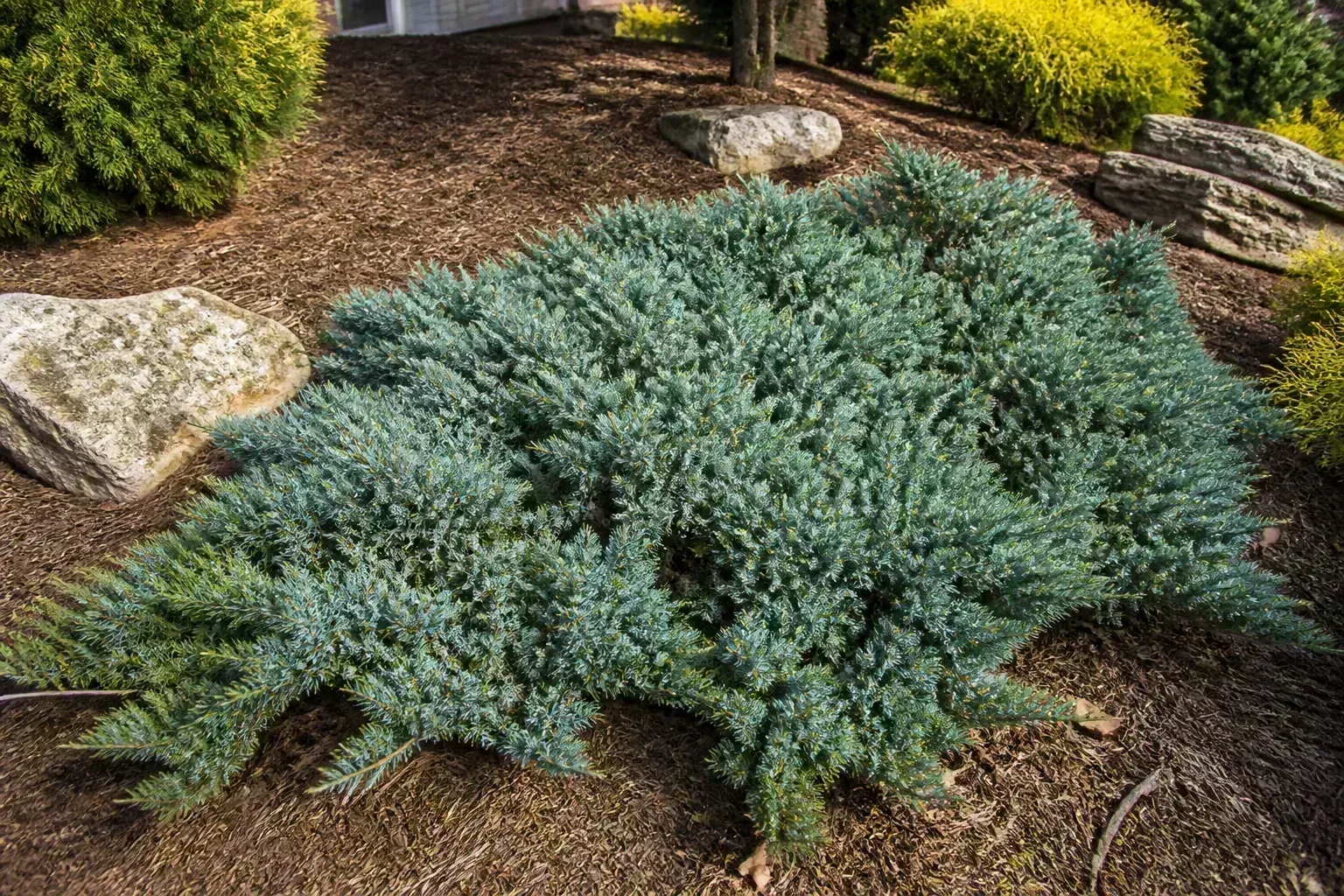
It can function as a low ground-cover-like shrub in a small grouping, but it is not a fast blanket for a large slope. The plant grows slowly, so closing gaps takes patience; if you need immediate, continuous coverage or a true creeping mat, compare it with a spreading juniper cultivar before buying. In the wrong spot—deep shade, wet clay, or a narrow walkway—it will not become a useful low-maintenance choice just because it is labeled dwarf.
Space It for Its Mature Spread
Plan for the upper end of the 1-to-4-foot spread range rather than the nursery-pot diameter. For a single specimen, leave roughly 3 to 4 feet of open width around its center when the bed permits; use a little more clearance beside a walk, driveway, or door where prickly foliage could brush people. If planting a row, measure center to center using the width you want the mature plants to occupy, not the small gap visible between young pots.
Closer spacing can create a continuous drift, but crowding trades the rounded silhouette for overlapping branches and less air movement. Before buying, mark the mature footprint with a garden hose or stakes. If the circle blocks a path or sits beneath a downspout, choose another location instead of expecting regular shearing to keep the shrub miniature.
Choose a Site With Sun and Drainage
The simplest successful site is open to direct sun, with soil that sheds excess water. NC State lists full sun and identifies the cultivar as intolerant of wet soils, while also noting that it can tolerate a range of soil textures, including clay, loam, and sand when other conditions are appropriate (NC State Extension). This is more useful than treating “sandy soil” as a mandatory ingredient: soil structure and drainage matter more than matching a single texture label.
Light, Heat, Humidity, and Cold
Aim for at least six hours of direct sun if you want the mound to stay compact and the foliage to retain its strongest blue-gray cast. It may survive some light shade, but growth can open up and color may read greener; avoid a deeply shaded foundation bed where rain and shade keep foliage and soil damp. Check how nearby buildings, trees, and fences cast shade at midday and in late afternoon before planting.
Hardiness listings commonly place Blue Star in Zones 4 through 8. That range describes typical winter minimums, not a guarantee against every site stress. NC State reports relative tolerance of hot and humid conditions, but warm, rainy weather combined with saturated soil and stagnant air still raises disease pressure; prioritize drainage and spacing rather than assuming the shrub is either immune to heat or automatically unsuitable in a humid region (NC State Extension).
In colder climates, in-ground plants are generally better buffered by surrounding soil than plants in pots. Choose a sheltered but sunny position if winter winds are severe, and avoid a roof edge where heavy snow repeatedly drops onto the mound. In warm climates near the upper end of the range, a sunny site can still work if the plant is not trapped in reflected heat next to paving and its root zone dries between rains.
Soil and Drainage
Blue Star tolerates a fairly broad pH range and can grow in lean, sandy, or rocky ground, but its roots need air as well as water. Long periods of saturation can suffocate fine roots and favor root rot. A plant may therefore fail in heavy soil even when its top looks dry, because water drains slowly below the surface.
Before planting, check the site after a soaking rain. If water stands for hours, the bed stays glossy and sticky, or the proposed spot lies at the bottom of a slope, move the plant to a raised area or choose a different shrub. Do not try to “fix” a small planting hole by filling it with loose potting mix: water can collect in the amended pocket like a basin when the surrounding soil is dense.
If the soil is compacted clay, improve the broad planting area or build a modest raised bed rather than adding a pocket of gravel under the roots. A coarse surface mulch can reduce moisture swings, but it cannot correct a site with a high water table or chronic ponding. RHS also lists well-drained soil as the key growing condition and describes this cultivar as drought resistant once established (RHS).
Planting Blue Star Juniper Step by Step
Spring and early fall are usually practical planting windows in temperate regions because the root system has time to settle before severe heat or frozen soil. A cloudy, mild day is easier on a recently handled shrub than a hot, windy afternoon. If you are planting in summer, plan to monitor soil moisture more closely through the first season.
Set the Root Ball at the Right Height
- Water the nursery pot before planting if the root ball is dry, then slide it out and inspect the roots. Gently loosen circling outer roots; keep the root ball intact rather than tearing it apart.
- Dig a hole about twice as wide as the root ball and no deeper than its height. Roughen slick sides so roots can grow into the surrounding ground.
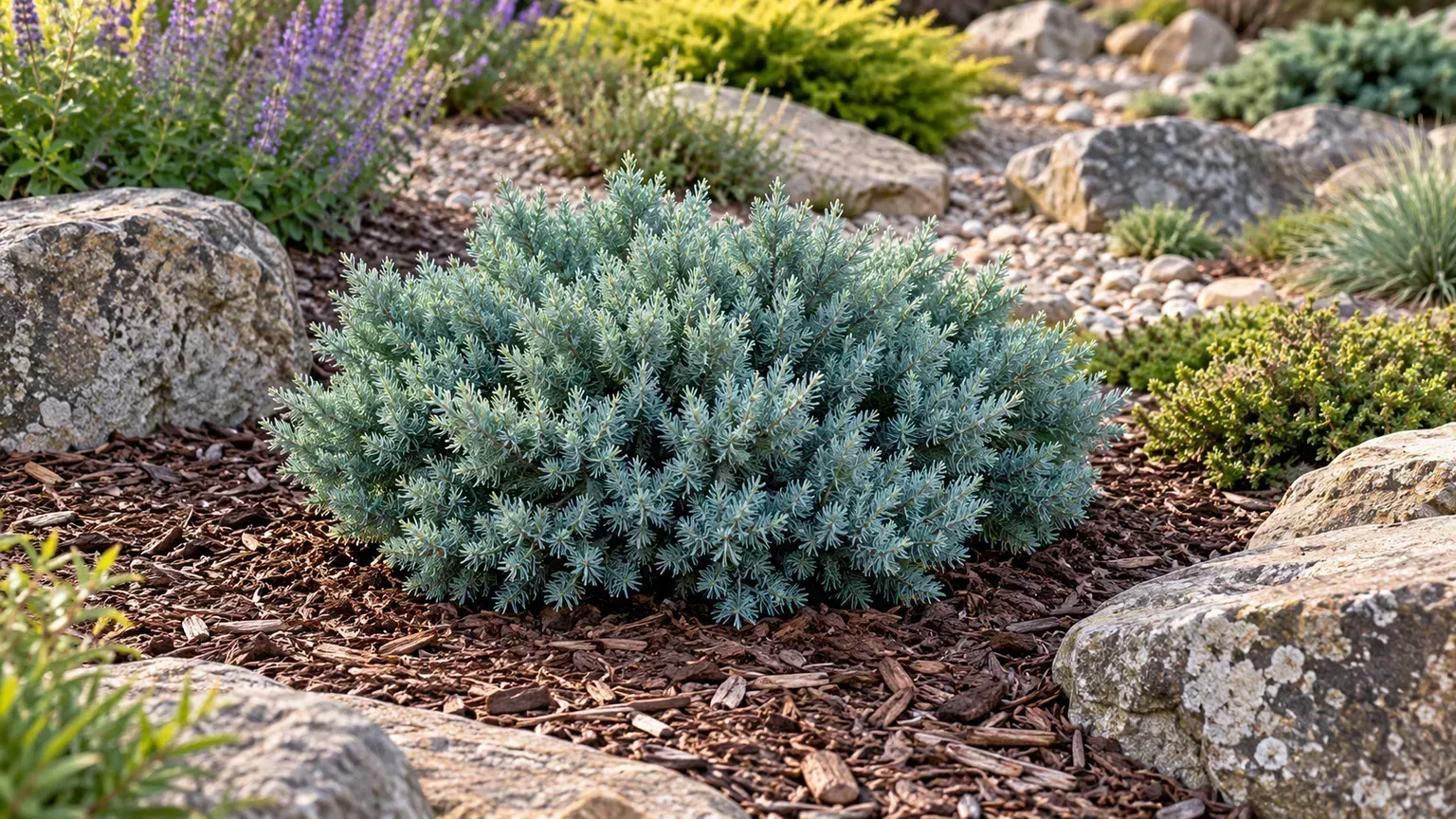
- Set the shrub so the top of its root ball sits level with, or slightly above, the surrounding grade in poorly draining soil. Never bury the stem base under extra soil.
- Backfill with the excavated soil, firming gently to remove large air pockets without compacting the bed. Water slowly to settle the soil around the roots.
- Add a shallow layer of organic mulch over the root zone, leaving a clear gap around the stems and crown.
The wide hole gives roots a route into the bed; extra depth does not. Planting too low is especially risky where rainwater already drains slowly. The University of New Hampshire Extension’s shrub-planting guidance likewise emphasizes setting planting depth correctly, watering to settle the root zone, and keeping mulch away from the trunk or stems (UNH Extension).
Watering: Establishment vs. Long-Term Care
During the first growing season, check the root ball and surrounding soil regularly and water deeply when the upper few inches are drying. The aim is to moisten the root zone, then let excess drain; it is not to keep the soil constantly wet. A light sprinkle on the foliage does not substitute for water reaching the roots.
There is no universal weekly schedule. Sandy soil, wind, a small root ball, and hot weather can shorten the interval; heavy soil and repeated rain lengthen it. Push a finger or a narrow trowel into the soil beside the original root ball to check moisture below the surface, because the surrounding bed may be damp while a dry nursery root ball sheds water.
After the shrub is established, reduce supplemental watering and use the weather and soil condition as your guide. Water during a prolonged dry spell if the root zone has dried out, but do not continue a frequent schedule simply because the plant is evergreen. NC State calls the cultivar drought tolerant and notes its preference for dry, sandy soils with good drainage; that describes an established plant, not a reason to let a recent transplant dry out completely (NC State Extension).
Container plants need closer checks because potting mix warms and dries faster than garden soil. Water thoroughly until excess drains from the bottom, then empty any saucer. If rain is frequent, make sure the pot is not sitting in runoff or a water-filled cachepot; persistent wetness is a more serious risk than missing one scheduled watering.
Growing Blue Star Juniper in a Container
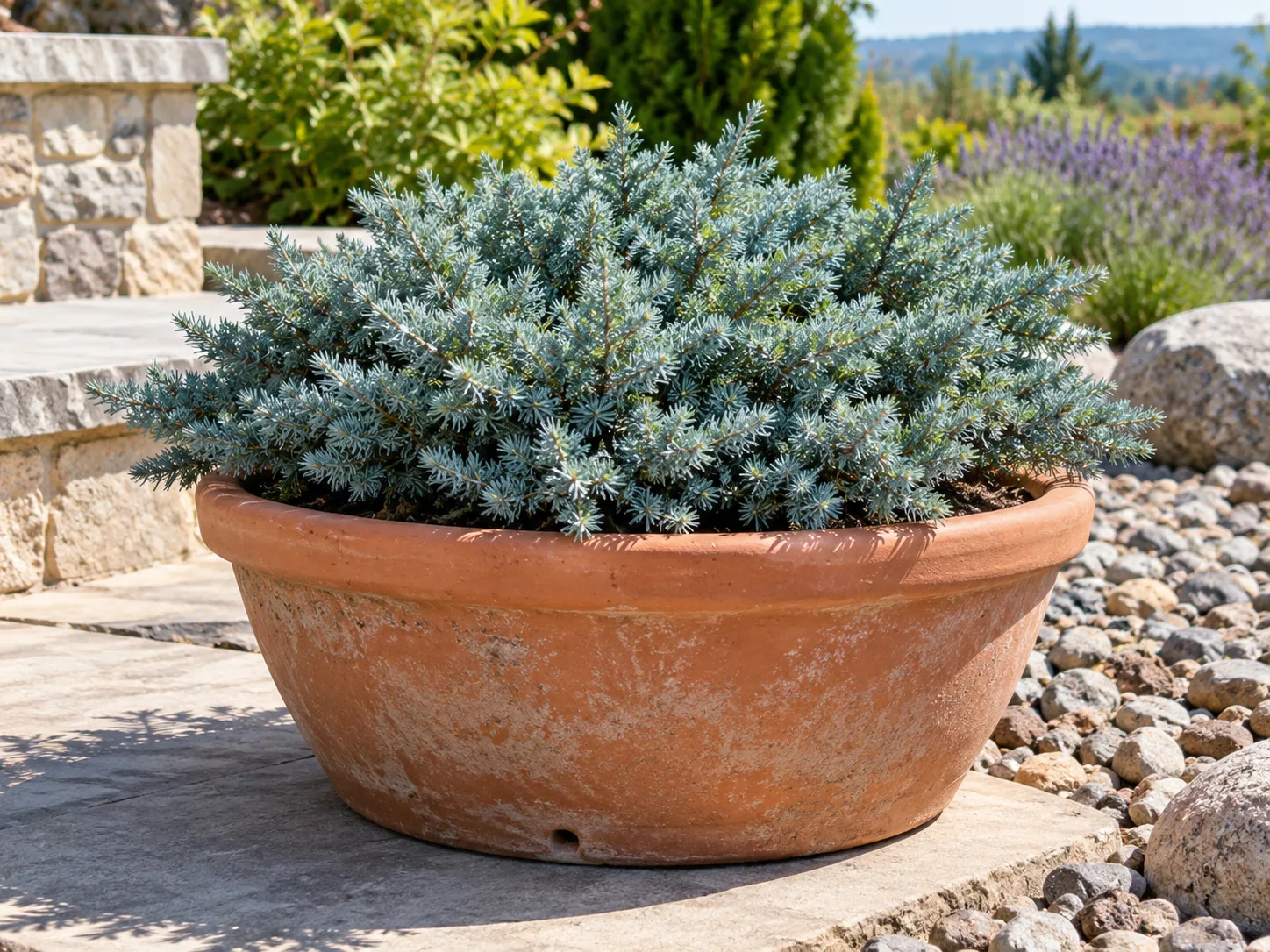
A container is useful on a sunny patio, balcony, or paved courtyard where garden soil drains poorly, provided the pot has open drainage and enough volume to buffer heat and moisture changes. Keep the shrub outdoors year-round; it is a landscape conifer, not an indoor houseplant. A bright window cannot reproduce the air movement, direct sun, and seasonal temperatures it is adapted to.
Containers also impose a ceiling on root room and increase winter exposure. A shallow decorative bowl may look proportional at purchase but dry out quickly, while a thin-walled pot can freeze and thaw more rapidly than soil in the ground. The trade-off is manageable if you select a stable, frost-resistant container and accept that potted plants need more monitoring.
Choose a Stable Pot and a Fast-Draining Mix
Choose a container with several unobstructed drainage holes and a broad enough base that a gust will not topple the top-heavy evergreen. A heavy terracotta, stone, or frost-resistant resin pot can work; the important features are stability, drainage, and enough room for roots. As a practical starting point, pick a pot several inches wider than the nursery container, then move up only when roots have filled the current root zone.
Use a quality outdoor container mix that drains freely but does not dry into dust immediately. Avoid garden soil in a pot because it can compact and restrict drainage. Do not put a layer of gravel in the bottom as a supposed drainage fix; the hole and the potting medium should do the work. Set the container where it receives direct sun and where water can run out without staining or pooling on the patio.
In cold-winter areas, move the pot beside a protected wall or into an unheated sheltered space before severe freezes, while keeping it outdoors and exposed to natural light. Insulate the outside of the container if needed and keep it off frozen paving. Check moisture periodically through winter: dormant evergreens still lose water, but frozen or saturated mix should not be watered blindly.
Fertilizer and Mulch: Keep Inputs Modest
Established Blue Star juniper usually needs no routine fertilizer in ordinary garden soil. The species is adapted to lean, well-drained conditions, and pushing soft growth with excess nitrogen can undermine the compact form that makes this cultivar useful. If growth is weak, first check sunlight, drainage, root depth, and establishment moisture rather than reaching immediately for fertilizer.
A thin mulch layer helps moderate soil temperature and reduces competition from weeds. Keep it away from the crown so stems do not stay damp or become buried. Compost can be used as a light surface amendment where soil is poor, but it is not a substitute for correcting ponding or compaction.
For a potted shrub, follow the container mix or fertilizer label if a feed is needed, and use a conservative rate during active spring growth. Do not apply fertilizer to a drought-stressed or waterlogged plant in hopes of making it recover; correct the stress first. A soil test is more useful than guesswork when nutrient deficiency is suspected.
Pruning Without Leaving a Brown Hole
Most Blue Star junipers need little or no shaping. Let the natural mound develop and remove only dead, broken, or crossing tips. The RHS describes this cultivar as requiring no pruning, which is a useful default for a shrub whose slow growth is part of its appeal (RHS).
If you need to tidy an individual branch, use clean, sharp pruners in mild weather and cut back to a live side shoot that still carries foliage. Do not shear deeply or cut into bare brown wood. Junipers do not reliably push new foliage from old, leafless interior stems, so a hard cut can leave a permanent brown patch rather than a smaller, denser plant.
Wear gloves and long sleeves while handling the prickly foliage, and step back often to preserve the loose, rounded outline. If the shrub has outgrown the space, pruning cannot safely turn it into a miniature forever. Relocating or replacing it is usually better than repeatedly cutting past green growth; next time, use the plant’s mature spread to set the spacing.
Diagnose Browning and Other Common Problems
A few brown needles deep inside an evergreen mound are not automatically a disease. Older shaded foliage can die as the shrub adds new growth at the tips, especially when the exterior remains firm and evenly colored. The pattern, location, and soil moisture tell you more than a single brown twig.
Blue Star juniper has no serious pest or disease problems under suitable conditions, but NC State notes that wet springs can bring twig blight and lists root rot, rust diseases, aphids, bagworms, scale, and spider mites among possible issues (NC State Extension). The RHS also flags Phytophthora and other conifer diseases as possible problems (RHS). These are possibilities, not a diagnosis from browning alone.
Check the Soil First, Then Inspect the Foliage
If the whole shrub is fading, first check whether the root ball is bone dry or the soil is persistently wet. Dryness often shows as brittle, dull tips after heat or missed watering; root damage from wet soil can also cause general decline, even while the bed surface looks dry. Stop adding water until you have checked below the surface.
Next, examine whether damage is scattered or concentrated on branch tips. Tip dieback after a wet spring may be consistent with twig blight; stippled or bronzed foliage and fine webbing can point toward spider mites; small fixed bumps may be scale. Inspect the underside and inner branch joints with a hand lens, and look for live insects before treating.
Prune out clearly dead or diseased branches back to healthy tissue and dispose of them rather than composting questionable material. Improve airflow by removing debris and nearby weeds, and fix drainage or irrigation practices before reaching for a pesticide. If branch dieback is spreading, the whole shrub declines, or the cause remains unclear, take a sample to a local extension office or qualified nursery; fungal and root problems are difficult to identify from a short description.
Propagating Blue Star Juniper
Because Blue Star is a selected cultivar, seed-grown offspring are not a dependable way to reproduce the same compact shape and color. Use a vegetative method if you want a plant true to type. The RHS lists semi-hardwood cuttings as a propagation method, while Epic Gardening also describes cuttings and air layering as options (RHS; Epic Gardening).
A practical home attempt is a semi-hardwood cutting taken from healthy current-season growth as it firms later in the growing season. Use clean pruners, strip needles from the lower portion, and place the cutting in a sterile, free-draining propagation mix. A rooting hormone may help, but it cannot compensate for wet medium, heat stress, or a cutting that dries out.
Keep the medium lightly and evenly moist, not saturated, and set the pot in bright indirect light out of strong sun. Junipers can root slowly, and a cutting that remains green for a few weeks is not proof that roots have formed. Avoid tugging to check; wait for firm new growth or gentle resistance, then pot on only after the root system can hold the plug together.
Propagation is less predictable than buying a nursery-grown plant, and the slow growth means a new cutting may take years to become a landscape-sized mound. If you want a matched row soon, purchase plants from a reputable nursery and check the cultivar name on each label. Take only a modest cutting from a healthy plant, since removing too much foliage from this slow grower can spoil its shape.
Conclusion
Blue Star juniper succeeds when you give its rounded mound room, direct sun, and a root zone that drains instead of staying waterlogged. Water consistently while it establishes, then scale back as the roots spread; feed lightly if at all, and avoid pruning into bare interior wood. If you are deciding where to plant one, choose the sunny, well-drained spot first and measure its mature 3- to 4-foot footprint before you dig.



