Brass Buttons Plant Care: Grow a Lush Groundcover
Brass buttons makes a fine low groundcover in the right spot. See how to plant, water, divide, and contain Leptinella squalida.
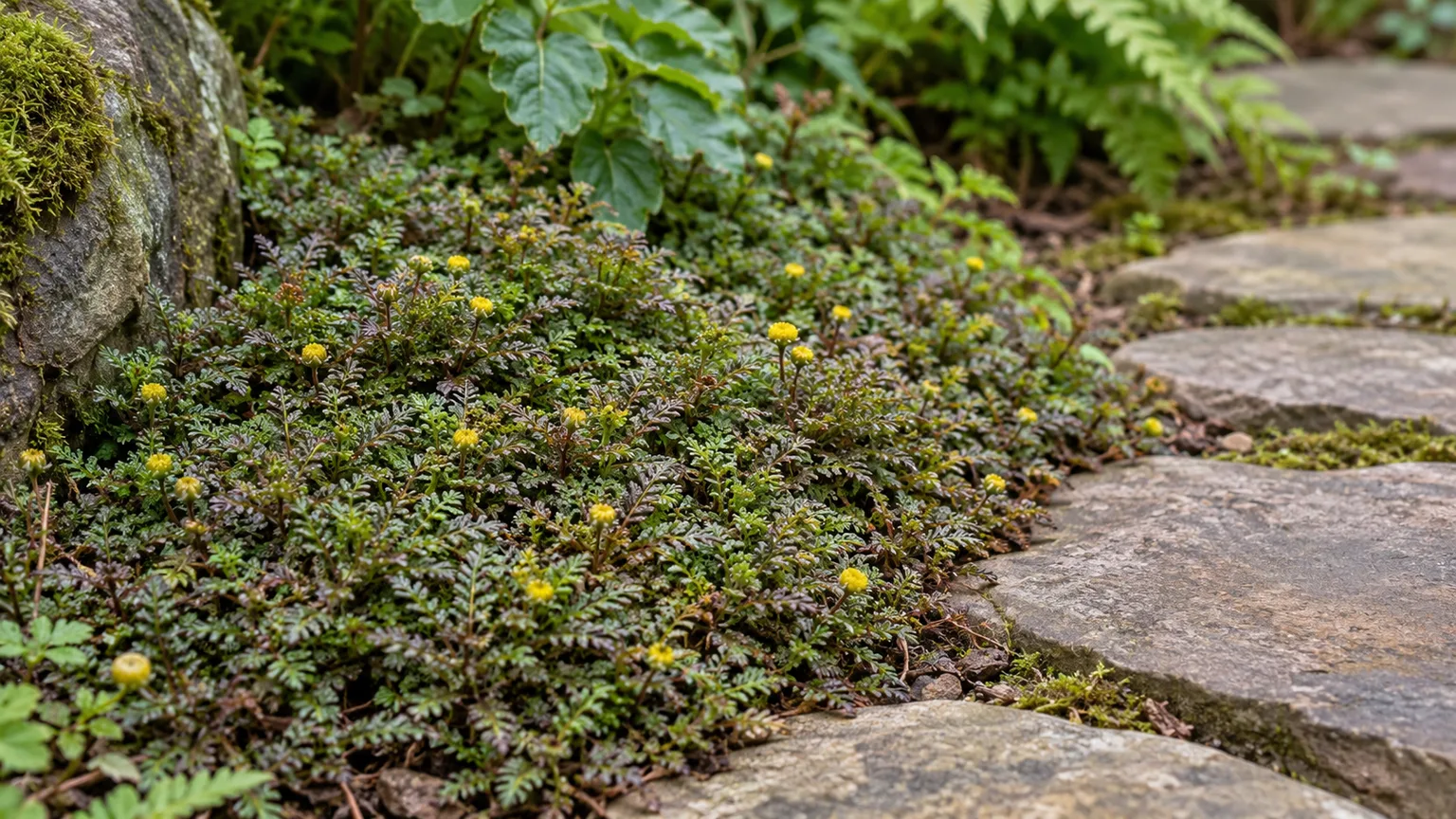
Brass buttons (Leptinella squalida) is a tiny, creeping perennial that earns its place where a conventional lawn is too thirsty, too tall, or awkward to mow—but it is not a miniature grass. Its fernlike foliage forms a low mat that softens the joints between stepping stones, edges a path, and brings close-up texture to a rock garden. The same spreading habit that makes it useful also means you should decide where its boundary will be before you plant.
The key to success is not fertilizer or constant trimming. It is matching the plant to a site with reliable moisture, loose soil, and shade during hot afternoons. Brass buttons can handle only light, occasional foot traffic; a dry, compacted path or a busy route through the yard will expose its limits quickly.
Quick answer: Is brass buttons right for your garden?
Choose brass buttons for a small, cool-to-moderate-climate bed, a damp edge, a rock garden, or the spaces between broad pavers where the soil does not dry out completely. It stays low—roughly ½ to 2 inches tall—and spreads by creeping rhizomes into a dense carpet, so it can cover ground without blocking the view of nearby plants. University of Wisconsin–Madison Extension describes it as a mat-forming perennial for small groundcover areas and notes that it tolerates very light foot traffic. Wisconsin Horticulture Extension
Skip it where the soil bakes dry, the ground stays saturated, or people routinely walk, run, or play across the planting. It is also a poor “plant it and forget it” choice if you are unwilling to trim its edges or lift a tired patch after years of growth. If you need a surface that takes regular traffic or survives summer drought with little supplemental water, select a groundcover adapted to those conditions instead.
Identify brass buttons and sort out the names
The accepted botanical name is Leptinella squalida; older labels may say Cotula squalida. Kew recognizes Leptinella squalida and lists Cotula squalida as a synonym, while New Zealand’s Flora profile records the plant as indigenous and endemic there. Its very small, divided leaves can resemble a miniature fern, but it is a flowering member of the daisy family, not a fern. Kew Plants of the World Online, Flora of New Zealand
The flowers are small yellow to gold heads made up of disk florets, without the showy outer petals many people associate with daisies. They appear buttonlike against the foliage, which is where the common name comes from. The plant’s appearance changes with conditions and season: ordinary forms are green to gray-green, often with bronze, purple, or darker tones, and exposed cold can turn or remove the foliage. Wisconsin Horticulture Extension
Common names can mislead. Cotula coronopifolia, also called common brassbuttons or buttonweed, is a different species; California’s invasive-plant profile concerns that taxon, not Leptinella squalida. Tansy (Tanacetum vulgare) is different again and grows much taller. When you are checking a local plant list, buying a plant, or evaluating an invasive-plant notice, use the full botanical name on the label rather than “brass buttons” alone. California Invasive Plant Council
Choose light for your climate
In a cool summer climate, brass buttons can grow in full sun if its shallow root zone remains moist. Where summers are hot or afternoon sun is intense, give it morning sun or bright light with afternoon shade. Light shade is generally tolerated, though a deeply shaded site is likely to produce fewer flowers and a less compact-looking mat. The Royal Horticultural Society lists the plant for sun or light shade and emphasizes moisture-retentive soil; Wisconsin Extension likewise recommends part shade in hotter climates. RHS: Chamomile lawns and alternatives, Wisconsin Horticulture Extension
Think about heat at ground level, not just the number of sunlight hours. A west-facing strip beside stone or concrete may become much hotter and drier than a bed under open sky. In that spot, the reflective paving can stress foliage even when a nearby garden bed grows well. A north- or east-facing path, a place shaded in the hottest part of the day, or a site with moisture-retentive soil is a safer starting point.
Give shallow roots the right soil
Brass buttons roots close to the surface, so the top layer of soil has an outsized effect on its health. It prefers soil that stays evenly moist yet drains freely; damp habitat does not mean that its roots should sit in stagnant water. Compacted ground is another poor fit because it limits the shallow root mat and slows spread. Wisconsin Extension specifically notes that compacted soil can lead to decline and that loosening and amending the area may be needed when a colony loses vigor. Wisconsin Horticulture Extension
Before planting, loosen a broad area rather than digging one narrow hole into hard ground. Blend compost into low-organic or compacted soil to improve its structure, but do not turn a heavy, poorly drained bed into a rich, waterlogged pocket. If water routinely puddles after rain, correct drainage or choose another plant. The goal is a crumbly root zone that holds some moisture between waterings while excess drains away.
Do not treat a particular pH number as a pass-or-fail rule. Published care descriptions vary in how narrowly they state soil preferences, and the species tolerates a range of garden soils when moisture and drainage are suitable. If a bed has a known soil problem, test it and amend for the whole planting area rather than adding lime or acidifier on guesswork.
Plant brass buttons for even coverage
Plant in spring or early fall, when temperatures are mild and you can keep the soil from drying while new roots establish. Set the crown level with the soil surface; burying the foliage base can hold excess moisture against it, while leaving the root mat exposed makes it dry faster. Water the plant in, then gently firm the surrounding soil so the shallow roots contact it without packing the bed hard.
For a connected carpet, space nursery starts about 9 to 12 inches apart. This is the spacing Wisconsin Extension gives for purchased plants; tighter spacing fills faster but uses more plants, while wider spacing leaves gaps exposed to weeds for longer. Give the rhizomes a clear direction to grow, and avoid setting plugs so close to the paver edge that the mat is crushed whenever someone walks by. Wisconsin Horticulture Extension
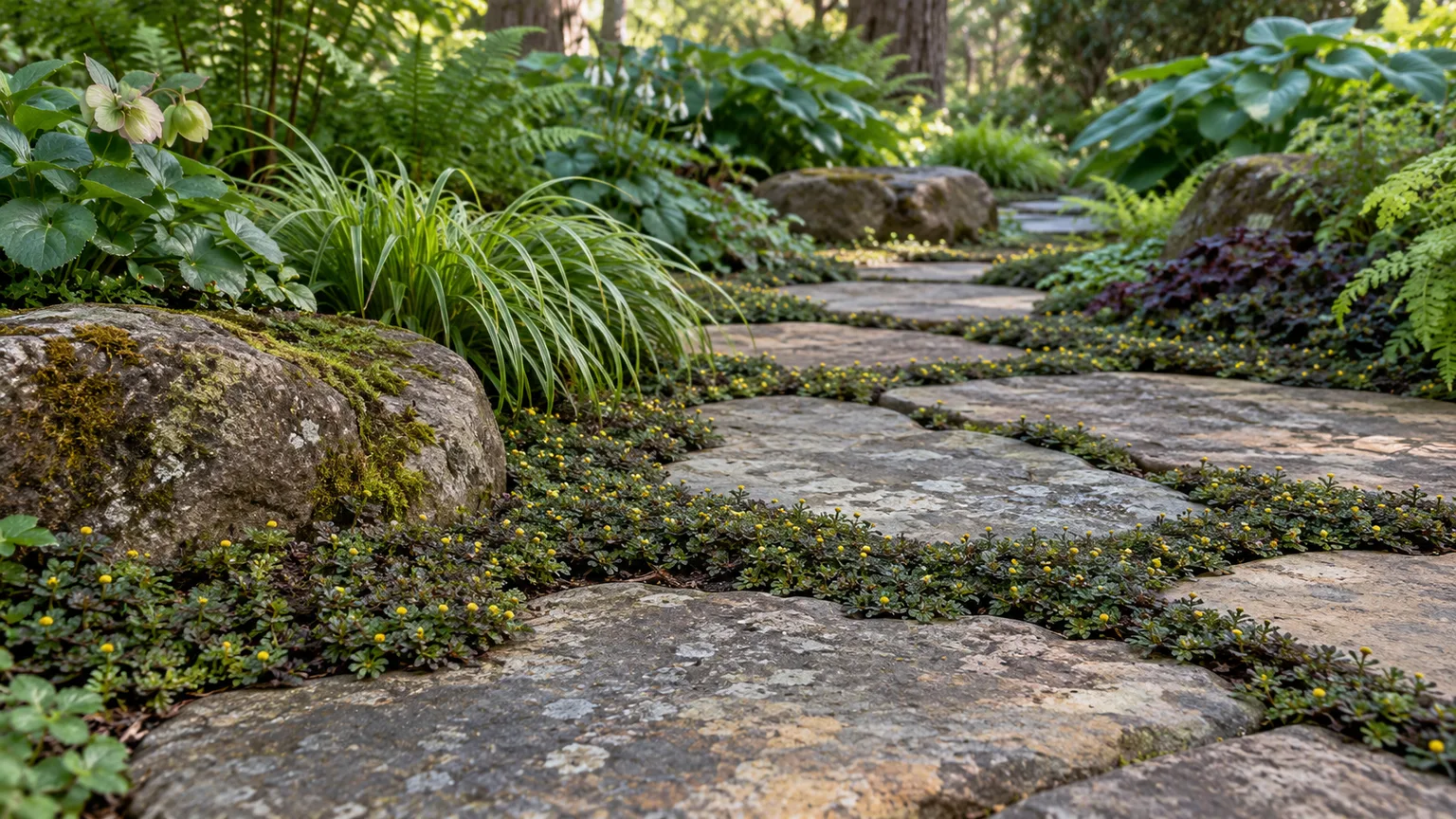
Water new plants thoroughly after installation and keep the root zone evenly moist during establishment. Check the actual soil a finger’s depth down instead of following a fixed daily schedule: small plugs in a windy, sunny edge may dry quickly, while a shaded bed after rain may need no extra water. Keep weeds out while the mat is knitting together; once it forms a close carpet, routine weeding is easier, but perennial weeds can still punch through.
Water for steady growth without waterlogging
Water when the upper soil begins to dry, before the shallow mat wilts or turns crisp. The plant is not drought-tolerant, so a week of hot, windy weather can dry the root zone even if the deeper soil remains damp. Newly divided sections and container plantings need closer attention than an established bed, and sandy or raised sites generally dry faster than loamy ground.
A useful check is to lift a leaf mat gently at its edge and feel the soil beneath it. If the surface feels dry and the leaves are losing firmness, water slowly at soil level so moisture reaches the roots instead of running across the foliage. If the ground is cool and wet, wait. Persistent wetness, especially in compacted soil, can cause decline that looks superficially like drought stress; adding more water without checking the root zone makes that problem worse.
Mulch sparingly. A thick layer can bury this very low plant or block its runners from rooting into nearby soil. If you need to protect the bed from winter drying, use a light, loose cover around rather than over the foliage, and remove it if it mats down or holds moisture against the crown.
Adjust care through the seasons
In spring, remove dead leaves or debris that smothers new growth and check whether the mat has lifted or loosened over winter. This is also the easiest time to divide an overcrowded patch or replace gaps. New growth may take time to cover an area after a hard winter, so do not mistake seasonal dieback for permanent loss before inspecting for living rooted sections.
During summer, prioritize moisture and afternoon shade in hot regions. In mild climates, the mat can remain evergreen; in colder climates, exposed foliage may darken or die back, then refill later in the growing season. Wisconsin Extension notes that autumn foliage can turn bronze, brassy, or purple, while exposed cold may leave plants unattractive early in spring. This winter change is not automatically a disease. Wisconsin Horticulture Extension
The hardiness range is not stated identically by every garden reference. Wisconsin Extension lists zones 5a to 10a, while horticultural features give different ranges; local winter exposure, snow cover, drainage, and cultivar all influence the result. Treat the zone label as a starting point, not a guarantee that the mat will keep its leaves through every winter. Wisconsin Horticulture Extension, Fine Gardening: Plants for Pathways
Manage spread before it becomes a chore
Brass buttons extends by rhizomes close to the soil surface. New sections root as they reach suitable soil, so a healthy planting can keep expanding beyond its original footprint. That is useful for filling a defined bed and inconvenient beside loose gravel, another low groundcover, or a narrow lawn edge. Decide where you want the mat to stop before planting rather than relying on future hand-pulling alone.
Use stone, a hard path edge, or another clear physical boundary where possible, then inspect the perimeter during the growing season. Lift runners that cross the line while they are still easy to remove; small sections with roots attached can be replanted elsewhere. Fine Gardening’s pathway guidance specifically advises planning for where creeping brass buttons should and should not go. Fine Gardening: Plants for Pathways
Spread by itself does not establish that a plant is invasive in every region. The official California invasive listing for “common brassbuttons” describes Cotula coronopifolia, a distinct taxon. Still, a quickly rooting groundcover can become a local nuisance in a small garden, and regional weed rules differ. Confirm the botanical name and check your local invasive-plant or noxious-weed resources before planting near natural areas.
Use it between stones, not as a high-traffic lawn
Brass buttons is most satisfying where its texture can be seen close up: between broad stepping stones, at a path edge, in a rock garden, or as a low living surface in a small ornamental space. It tolerates a light, occasional step, especially when the stones carry most of the weight. That does not make it a substitute for turf on a route used every day, a dog run, or a play area. Fine Gardening distinguishes foot-traffic-tolerant plants from those better suited to only light treading, and places brass buttons in the light-use category. Fine Gardening: Plants for Pathways, Wisconsin Horticulture Extension
As a lawn alternative, compare maintenance honestly. You may mow or shear a larger planting to remove faded flower heads or tidy the top, but the plant still needs dependable water and an edge check. It will not behave like a wear-resistant lawn that recovers from repeated trampling. If you need a mowable carpet across a broad area, evaluate a locally adapted lawn alternative designed for that use instead of choosing brass buttons simply because it stays short.
Feed and prune only when the planting needs it
A fertile, well-prepared bed often needs little or no routine fertilizer. If growth is weak across an otherwise healthy, well-drained patch, a light compost top-dressing in spring can improve the root zone. Avoid repeated high-nitrogen feeding: faster, softer growth is not the answer to compacted soil, drought, poor drainage, or an unsuitable hot site.
Deadheading is unnecessary for a groundcover this low, and the tiny flowers are not usually a major cleanup issue. Remove winter-damaged material in spring. For a larger carpet that looks shaggy after flowering, shear lightly or use a mower set high enough not to scalp the surface; test a small section first and avoid doing this while the soil is soggy. Pruning should tidy the mat, not expose the shallow roots.
Propagate brass buttons by division
Division is the quickest reliable way to make more plants. Take it in spring or early fall when temperatures are mild, and choose a rooted piece rather than a loose handful of leaves. A division with several shoots and a connected section of rhizome establishes faster than a tiny fragment with no roots.
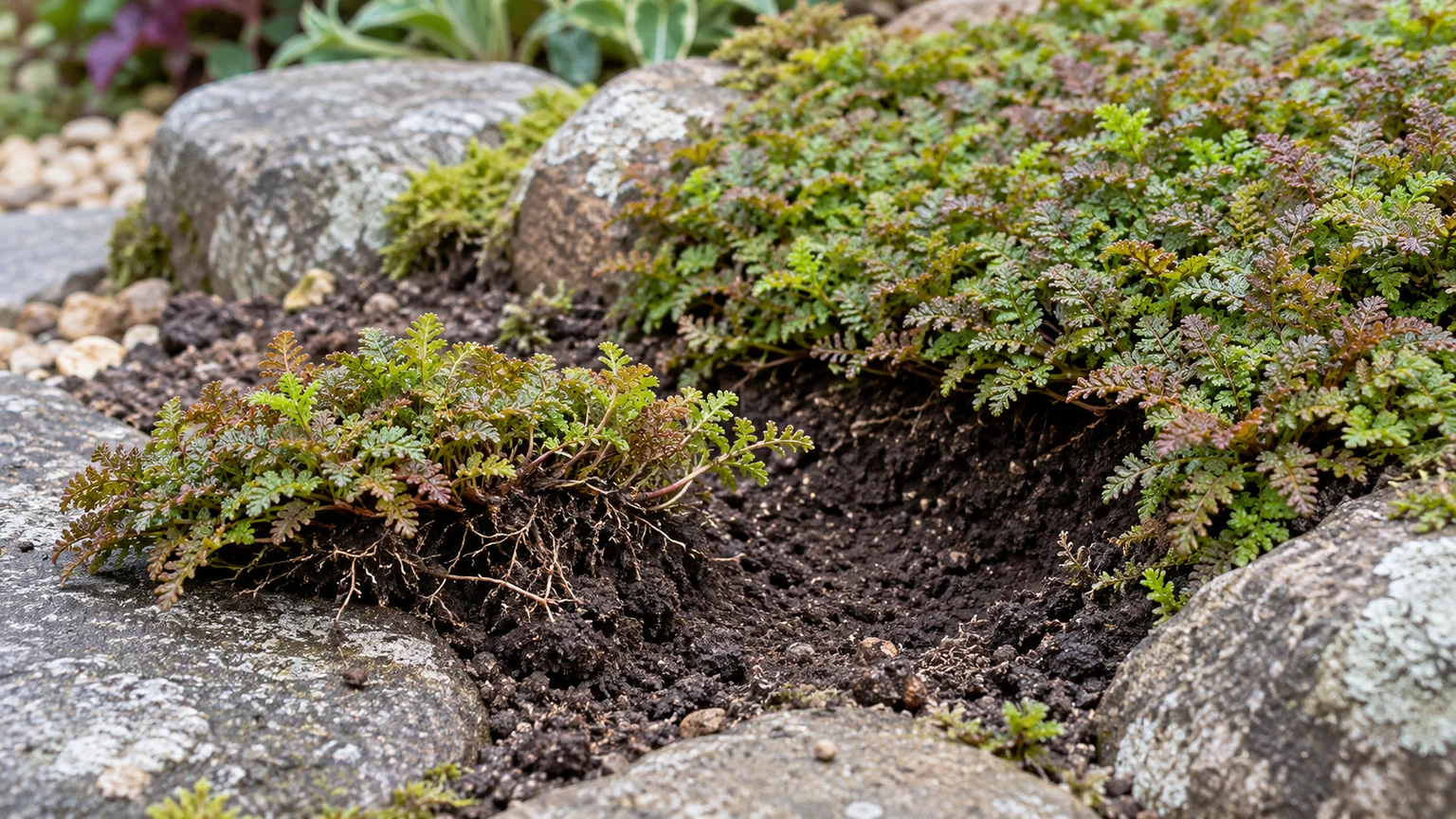
To divide an established planting, loosen the soil at the edge of the mat and lift a shallow section with roots attached. Pull or cut it into small rooted pieces, then set each piece at soil level in a prepared site, spacing sections to suit how quickly you want coverage. Water them in and keep the soil evenly moist until they grip the soil and begin producing new growth. Wisconsin Extension recommends division in spring or early fall and notes how easily rooted pieces can be moved. Wisconsin Horticulture Extension
If you are trying to control spread, use those same steps in reverse: lift sections that have crossed the bed boundary and remove the rhizome fragments you do not want to keep. Check after a few weeks for overlooked rooted pieces. Do not compost invasive or regulated species where local rules prohibit it; first confirm that your plant is the ornamental Leptinella squalida rather than a lookalike identified by a shared common name.
Grow it from seed only if you have a reason
Seed is possible but usually less convenient than division. The heads and seed are tiny, seed may be difficult to find commercially, and seedlings will not preserve a named selection such as ‘Platt’s Black’ reliably. If you already have viable seed, follow the supplier’s species-specific sowing guidance and keep the mix evenly moist without waterlogging it; do not bury minute seed deeply. For a predictable patch or a true-to-name cultivar, buy a correctly labeled plant or divide a known parent instead.
Grow brass buttons in containers and miniature gardens
A wide, shallow container can display brass buttons well because the plant spreads sideways rather than building height. Choose a pot with drainage holes and a moisture-retentive but airy mix. Keep the surface open for the runners to root, and make sure water drains freely; a small planter can dry faster than a garden bed, so check it more often during warm or windy weather.
Treat the container as an outdoor or cool, bright planting rather than assuming the plant will thrive as a warm-room houseplant. It can be used in an open miniature garden where its small leaves fit the scale, but combine it with plants that appreciate similar moisture and light. Separate it from slower-growing companions if its runners begin to crowd them. A closed terrarium traps moisture and limits space, so it is a poor choice unless you can keep the root zone from remaining saturated and are willing to trim the plant often.
Repot only when the mat has filled the container, the soil has compacted, or drainage has deteriorated. Lift the rooted layer, loosen or replace the tired mix, and replant part of the mat. Keeping the entire old root mass in an undersized pot can leave the center crowded and the edges dry.
Choose between green forms and ‘Platt’s Black’
The standard green form gives a softer, fernlike carpet with bronze or purple tones appearing under some conditions. ‘Platt’s Black’ is a named selection valued for its very dark foliage and brighter green tips; its dramatic color works best when you can contrast it with pale stone or brighter foliage. The nearly black leaves are intentional, not necessarily a sign that the plant is dying. Wisconsin Extension describes the cultivar as a commonly available selection and also distinguishes related species such as L. minor, L. potentillina, and L. pusilla. Wisconsin Horticulture Extension
Check labels carefully when shopping. Those related Leptinella species are not simply different color forms of L. squalida, and nursery names can be inconsistent. If you want the classic brass-buttons groundcover, confirm Leptinella squalida on the botanical label; if you want a dark accent, ask specifically for L. squalida ‘Platt’s Black.’
Troubleshoot browning, thinning, and weak growth
When a mat declines, inspect the soil beneath it before changing fertilizer or pruning. Lift a small edge and check whether the root zone is dry, waterlogged, hard, or still cool and moist. Then look at the pattern: uniform crispy edges suggest a different problem from a wet, collapsing center or from foliage that darkens after winter.
Brown foliage or bare patches
Dry, crisp tips after heat or wind: the shallow root zone probably dried too far. Water slowly, add afternoon shade if the site runs hot, and check the soil more often while the mat recovers. A plant stressed by drought may thin rather than rebound immediately, so do not mow it down before you see which rooted sections are alive.
A soft, yellowing or collapsing patch in wet soil: suspect poor drainage or compacted ground rather than thirst. Reduce irrigation, improve the bed’s structure and drainage, and replant healthy rooted edges into loosened soil if the center has died back. Continually adding water is not a cure for a damaged root zone.
Sparse growth in a hot, exposed spot: shift the planting toward morning sun or light afternoon shade and keep moisture more even. Full sun can be suitable in cool climates, but it is a different proposition beside heat-reflecting paving in a hot summer region. If the location cannot be changed and the soil dries quickly, choose a groundcover better suited to heat and drought.
A tired or thinning center after several years: compaction and overcrowding can weaken an established colony. Lift healthy sections, loosen the soil across the whole area, add compost if needed, then replant the vigorous divisions. If the decline is limited to the center, renew that area rather than fertilizing the entire bed.
Foliage darkens or disappears in winter: compare the change with the plant’s usual seasonal cycle in your climate. Cold-exposed foliage can darken or die back, while mild regions may stay evergreen; inspect for living rhizomes and wait for the spring flush before declaring the planting lost. If tender new growth is distorted and insects cluster on it, rinse them off with water and recheck rather than reaching immediately for a pesticide. The species generally has few serious pest or disease problems. Wisconsin Horticulture Extension
Conclusion
Brass buttons works best as a low, spreading groundcover in a small, moist, well-drained site where afternoon heat is moderated and foot traffic is light. Give its shallow roots loose soil, water consistently while it establishes, and set a clear boundary for its runners. Choose it for the fine foliage between stepping stones or along an ornamental path—not for a drought-prone, heavily used lawn—and use rooted divisions to fill gaps or renew an older patch.



