7 Climbing Plants for Fences: Flowers, Fruit & Shade
Brighten a boring fence with seven climbers matched to shade, sun, privacy, flowers, fruit, support strength, and the pruning you can realistically do.
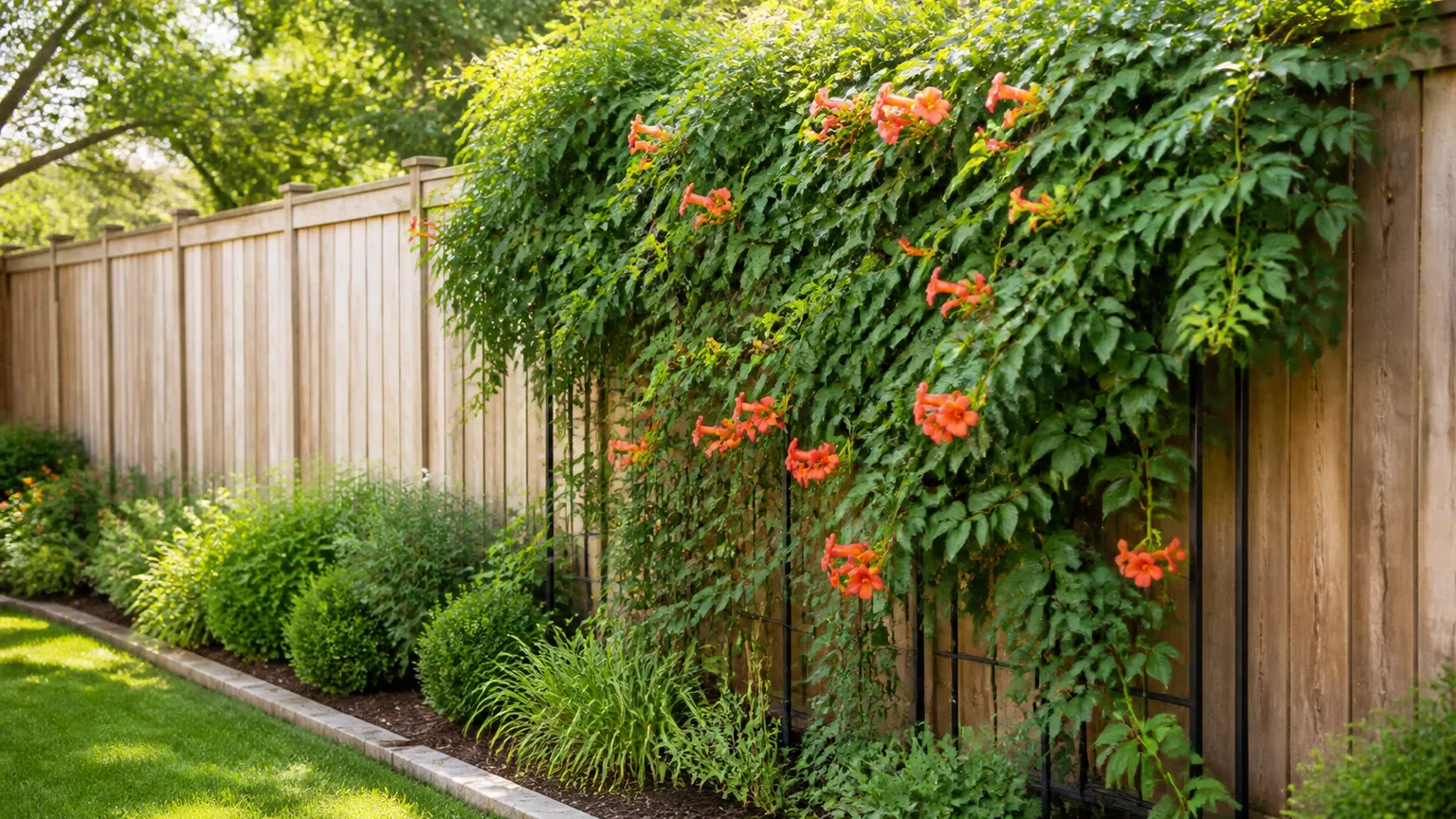
A climbing plant can turn a plain fence into flowers, fruit, shade, or privacy, but the plant is only half of the design. The other half is the fence: its strength, surface, sunlight, airflow, and how easily you will need to reach it for painting or repairs.
The seven vines below cover different jobs. Some twine around wire, some catch a grid with tendrils or leafstalks, and one uses aerial rootlets to cling to a wall-like surface. That distinction matters more than a generic “fast-growing” label, because a vigorous vine on the wrong support becomes a maintenance problem rather than a garden feature.
Start with the fence, not the plant label
Before buying a vine, stand at the fence at three different times of day. Note direct sun, reflected heat from paving or a wall, wind exposure, and whether the soil beneath the fence dries faster than the rest of the bed. A plant can tolerate hot weather in general and still struggle beside a west-facing board fence where the root ball bakes and rain misses the planting strip.
Also decide whether you want a seasonal screen, a flowering accent, an edible crop, or foliage that stays attractive through winter. Those are different jobs. Scarlet runner bean can cover a chain-link panel quickly but is not a permanent winter screen; climbing hydrangea can soften a shady wall beautifully but may take time to establish; grapevines reward a gardener who accepts annual pruning rather than a gardener seeking a carefree tangle.
Match the climbing method to the support
There are four useful climbing habits in this group:
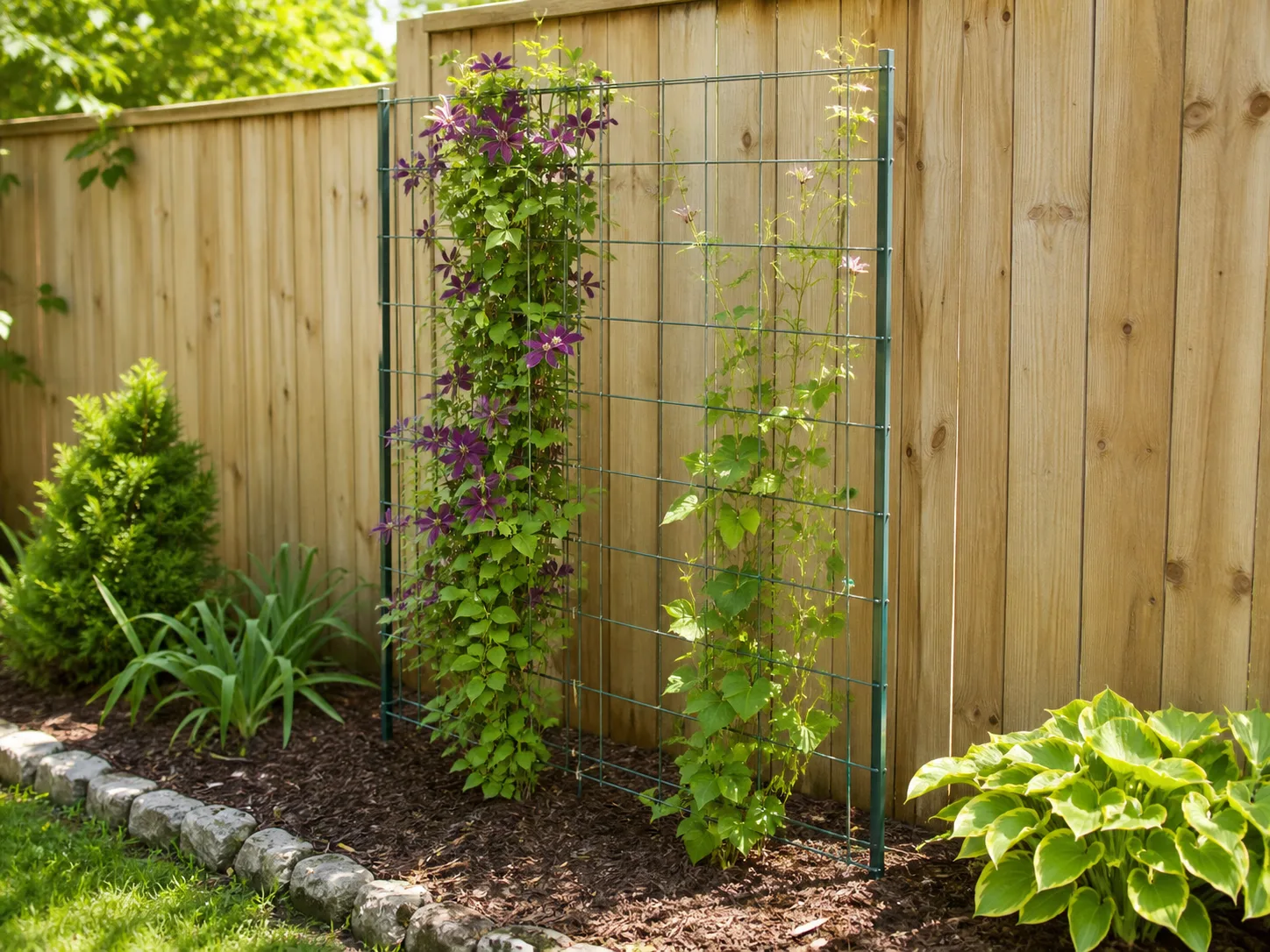
- Twining stems wrap around narrow wires, rods, or lattice members. Coral honeysuckle, scarlet runner bean, and American wisteria need something they can physically wind around.
- Tendrils catch a grid or wire. Crossvine and grapevine do better on a panel, netting, or horizontal wires than on a completely smooth board.
- Leafstalks act like small flexible hooks. Virgin’s bower and other clematis need a relatively fine mesh or lattice, not a broad post with nowhere for the leafstalks to catch.
- Aerial rootlets grip a surface. Climbing hydrangea can climb masonry and other substantial structures, but its mature size still calls for careful support planning.
A separate trellis or wire panel in front of the fence is usually the safest universal solution. It gives the vine the support its habit requires, leaves an air gap behind the foliage, and lets you remove or prune the plant without ripping it out of the fence.
Check the fence’s strength, light, and service access
Inspect posts, rails, and fasteners before planting. A mature woody vine can be much heavier than the small container you bring home, especially after rain or when it is carrying fruit. If a fence already leans, has rot at the posts, or flexes when you push it, repair or reinforce it first.
Anchor a heavy trellis to strong posts or the ground rather than hanging it from thin fence boards. Leave enough space to reach behind the foliage, and keep the base of the vine clear of gates, drains, meters, and the strip where you mow. This small service gap is what separates a living screen you can manage from a green wall that hides every future repair.
Seven climbing plants for fences at a glance
| Plant | Climbing habit | Best fence job | Light | Main caution |
|---|---|---|---|---|
| Virgin’s bower (Clematis virginiana) | Leafstalk climber | Late-summer flowers on lattice or chain link | Sun to shade | Can overwhelm shrubs and self-seed |
| Climbing hydrangea (Hydrangea petiolaris) | Aerial rootlets and twining | Shady wall or very strong support | Sun to shade | Slow to establish; eventually very large |
| Crossvine (Bignonia capreolata) | Tendrils | Broad coverage on a strong trellis | Shade to full sun | Root suckers and seed need monitoring |
| Grapevine (Vitis spp.) | Tendrils and trained canes | Edible crop on wires or a sturdy panel | Full sun | Needs annual pruning and open canopy |
| Coral honeysuckle (Lonicera sempervirens) | Twining stems | Wildlife-friendly color on a trellis | Full sun to part shade | Needs a support and occasional restraint |
| Scarlet runner bean (Phaseolus coccineus) | Twining stems | Fast, temporary summer screen | Full sun | Frost-sensitive; hot weather reduces pods |
| American wisteria (Wisteria frutescens) | Twining stems | Fragrant spring display on a strong frame | Full sun | Vigorous and still needs regular pruning |
Names and performance vary by cultivar and climate, so use the table to make a shortlist, then confirm the plant’s hardiness and invasive-plant status where you live. A “native” vine is not automatically well behaved in every garden, and a plant listed as hardy in your zone can still need establishment water and protection from reflected heat.
Virgin’s bower for late-season flowers and partial shade
Virgin’s bower (Clematis virginiana) is a graceful choice when a fence receives morning sun, dappled light, or even some deep shade. NC State Extension describes this native perennial vine as a rapid grower that can reach roughly 15 to 20 feet, with fragrant white flowers in late summer and fall and feathery seed heads afterward. (NC State Extension Plant Toolbox: Virgin’s bower)
Its leafstalks wrap around fine supports, so use a wire grid, chain-link fence, or narrow lattice. A solid wooden fence may look like a natural backdrop, but it does not give the plant enough to catch; install a separate grid a little in front of the boards. Keep the root zone rich, moist, and well drained, and shade the base with mulch while the upper vine receives light.
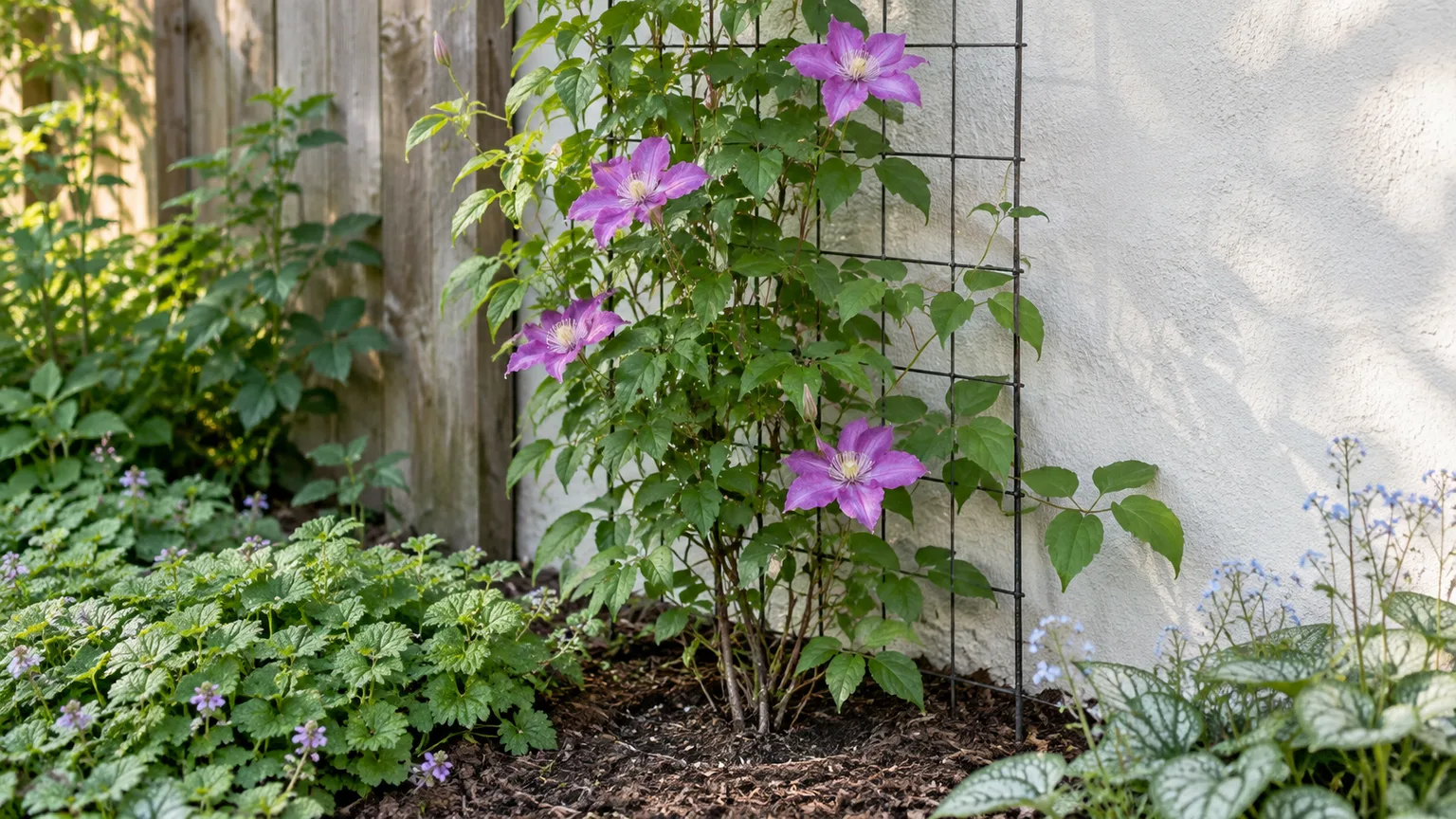
Virgin’s bower is useful when you want late-season flowers rather than an early spring show. The limitation is vigor: it can scramble over nearby shrubs, self-seed, and become weedy if it is allowed to run along the ground. Give it a defined panel, remove unwanted seedlings while they are small, and prune it back during the dormant season if it is outgrowing the section of fence you assigned.
Climbing hydrangea for a shady wall or sturdy structure
Climbing hydrangea (Hydrangea petiolaris) brings white flower clusters, rich foliage, yellow fall color, and peeling bark to a shaded boundary. It is one of the best choices here for a masonry wall or substantial garden structure because it can climb with aerial rootlets as well as by twining, and it tolerates sun or shade once established.
The trade-off is patience and weight. NC State notes that climbing hydrangea is slow to establish and slow to begin flowering after transplanting, yet can eventually reach 60 to 80 feet in suitable conditions. (NC State Extension Plant Toolbox: Climbing hydrangea) That combination makes it a poor match for a flimsy privacy panel and a better match for a strong wall, arbor, or anchored trellis.
Give it rich, moist, well-drained soil and do not keep moving it once planted. Young plants often spend their first seasons building roots and framework rather than hiding the fence. Prune only to remove dead, damaged, or badly placed stems unless you have a clear reason to reduce the plant; hard renovation is difficult once the vine has attached itself to a large surface.
Crossvine for early flowers and broad coverage
Crossvine (Bignonia capreolata) is a vigorous native vine with glossy foliage and trumpet-shaped flowers that can appear in late winter or early spring. Its branched tendrils make it a natural fit for a wire panel, mesh trellis, or open fence rather than a perfectly smooth wall.
NC State Extension says crossvine tolerates conditions from shade to full sun, with better flower production as light increases. It prefers organically rich, well-drained soil and can spread by both seed and root suckers, so its boundary needs to be visible from the start. (NC State Extension Plant Toolbox: Crossvine)
Choose crossvine when you want a broad layer of foliage and early nectar for hummingbirds, not a tiny accent plant. In a small bed, use one support panel and inspect the base regularly for shoots outside the intended zone. If your fence is close to the house, check local fire-safety guidance before planting vigorous vines; several landscape vines are rated highly flammable in extension databases even when they look lush and green.
Grapevine for edible fruit on a wire-trained fence
A grapevine can make a fence productive, but it is best treated as a small fruit-training project rather than a decorative vine you plant and forget. Choose a variety suited to your climate, give it full sun, and plan the wires before planting. Grapes need a structure that spreads the canopy, holds fruit off the ground, and leaves the canes accessible for pruning.
Gardenia’s grape-trellis guidance emphasizes the same practical point: the best support matches the grape variety, pruning system, space, and harvest goal, with simple wire systems often easier to manage than a decorative frame that is awkward to reach. (Gardenia: Best Trellis Systems for Backyard Grapes) A wooden fence can work as a backdrop, but run durable wires on an anchored frame rather than weaving the vine permanently through the boards.
Expect the vine to be bare in winter and to need meaningful annual pruning. Fruit production is usually better when the canopy is open enough for sun and airflow, so dense foliage is not the same thing as a successful screen. If your priority is privacy, combine the grapevine with a separate evergreen hedge or use the fence as a seasonal garden feature instead of expecting grapes alone to hide it year-round.
Coral honeysuckle for hummingbirds and manageable color
Coral honeysuckle (Lonicera sempervirens) is a strong all-around choice for a supported fence in a region where it is adapted. Its tubular coral-red flowers attract hummingbirds, its stems twine naturally around wire or lattice, and it is generally a more restrained choice than invasive Asian honeysuckles.
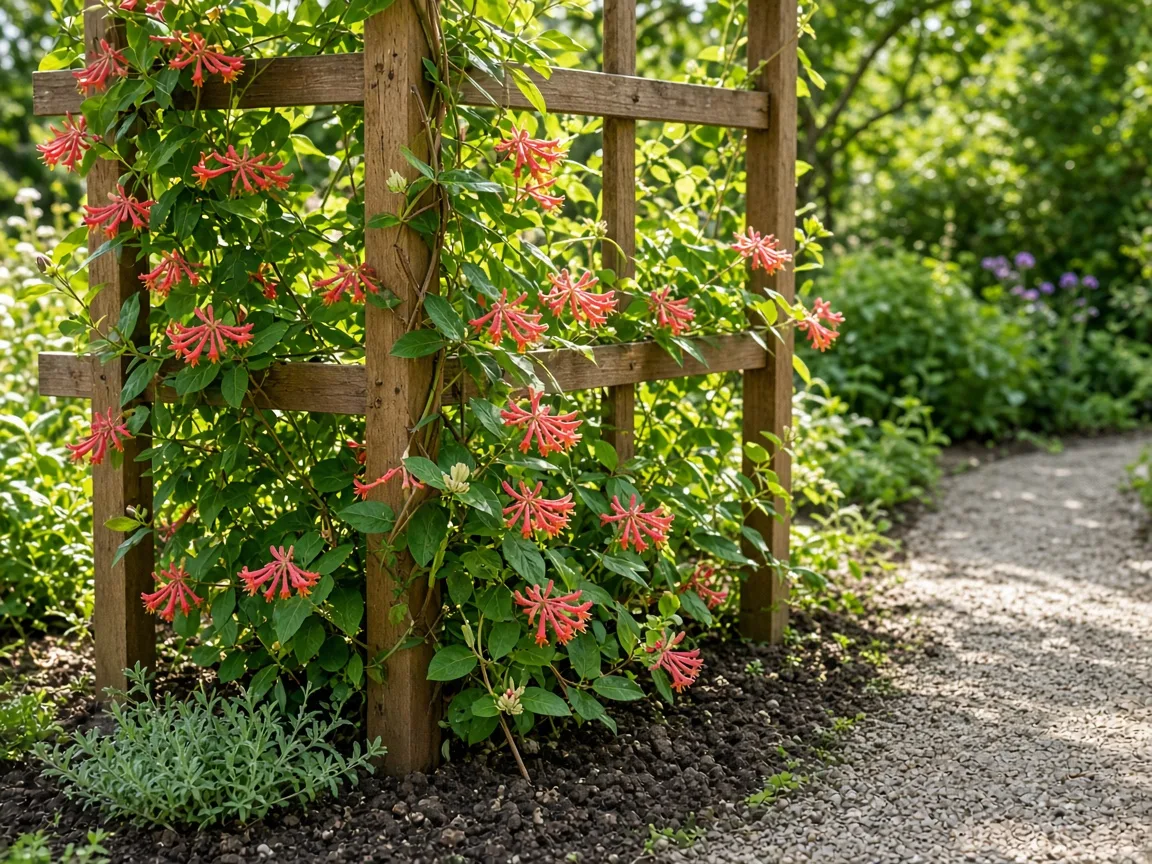
NC State Extension describes trumpet honeysuckle as a 10- to 20-foot vine that prefers full sun and medium-moisture, well-drained soil, although it can tolerate some shade. It flowers on new growth, so pruning after the main bloom is a useful way to redirect the plant without sacrificing the next flush. (NC State Extension Plant Toolbox: Coral honeysuckle)
Use a narrow trellis, wire panel, or arbor that gives the stems something to wrap around. In hot weather, keep the root zone watered while it establishes and avoid heavy nitrogen fertilizer if flowers matter more than leaves. Even a relatively well-behaved native vine benefits from a yearly inspection: guide wayward stems back to the frame, cut dead or tangled growth, and remove shoots that start using neighboring shrubs as an unplanned second support.
Scarlet runner bean for fast seasonal screening
Scarlet runner bean (Phaseolus coccineus) is the practical answer when you want a fence covered this season and you are comfortable with a seasonal display. Wisconsin Horticulture describes it as a vigorous twining vine that can reach 15 feet or more, though it is often shorter in cooler gardens. It produces showy scarlet flowers, attracts hummingbirds and bees, and can provide edible pods when harvested young. (Wisconsin Horticulture: Scarlet Runner Bean)
Plant it in full sun in organically improved soil with average moisture, and install the trellis, netting, or poles before sowing. The support should be close enough for new shoots to find it quickly. The plant’s rapid growth is ideal for a chain-link fence or temporary privacy panel, but the foliage is frost-sensitive and the vine is normally grown as an annual in much of the United States.
Hot weather can reduce pod set, so runner bean is best when the goal is flowers and summer coverage first, with food as a bonus. Harvest pods while they are young and tender; older pods become fibrous. Avoid heavy fertilization, which produces a wall of leaves at the expense of flowers and beans, and remove the spent vine after frost rather than leaving a collapsing tangle against the fence.
American wisteria for fragrant spring clusters
American wisteria (Wisteria frutescens) offers fragrant, pendulous flower clusters and a native alternative to Chinese and Japanese wisterias in places where it is adapted. It is still a vigorous woody vine, so treat “less aggressive” as a management advantage, not as permission to attach it to a weak fence.
Gardenista notes that American wisteria is less vigorous and easier to contain than introduced species, blooms after the foliage emerges, and can be trained over a fence with regular pruning. It performs best in full sun and is hardy from about Zones 5 to 9, though local climate and cultivar still matter. (Gardenista: How to Grow Native Wisteria)
Build the support first: a substantial arbor, anchored wire frame, or heavy trellis is more appropriate than thin fence pickets. Wisteria wraps around its support and can eventually exert significant force. Prune it regularly to keep the main framework visible and the flowering spurs close to the structure, and do not fertilize heavily when the plant is making leaves but refusing to bloom.
Buy by botanical name and check the source carefully. Asian wisterias can be invasive in some regions, and wisteria’s green parts and seeds are toxic even though the flowers have been used in culinary preparations. Keep all plant material away from children and pets who might chew pods or seeds.
How to plant and train a fence vine
Planting beside a fence is a small construction project as much as a gardening task. Set the support where you can still access the fence, make sure its anchors can carry mature growth, and place the plant where its roots will receive rain rather than the dry shadow immediately under a roof edge or cap rail.
Give the root zone a reliable start
Loosen a broad area of soil rather than digging a narrow deep hole. Mix in organic matter only when the soil needs it, keep the root flare at the same level it had in the container, and water thoroughly after planting so air pockets close around the roots. Add a modest layer of mulch to slow evaporation, but keep mulch away from the stem.
For the first growing season, check soil moisture by hand instead of watering on a fixed calendar. A hot fence, reflected sun, wind, and a small root ball can increase demand; heavy clay or poor drainage can cause the opposite problem. Water deeply when the soil is drying below the surface, then adjust after you see how quickly the bed actually loses moisture.
Train the first season before stems tangle
Choose two or three strong stems to lead toward the support and loosely secure them with soft ties. Do not cinch ties around expanding stems, and do not force a tendril vine to wrap around a thick post it cannot grip. For twining vines, guide shoots around narrow wires; for grapevines, establish a trunk and cordon; for clematis, provide a fine grid that the leafstalks can catch.
Spread shoots sideways as well as upward. A vine trained only straight up often creates a leafy top and a bare lower fence, while horizontal or fan-shaped training distributes flowering wood and foliage across the panel. Check every few weeks during active growth and redirect stems while they are flexible; correcting a young shoot takes seconds, while untangling a woody stem later can damage both plant and fence.
Pruning, containment, and fence access
Pruning should follow the plant’s flowering and fruiting habit, not a generic “cut it back in winter” rule. Spring-flowering vines often need shaping after bloom, while vines that flower on new growth can usually be reduced during dormancy. Grapevines need a fruiting framework and annual removal of excess growth; runner beans are simply cleared after frost; climbing hydrangea usually needs restraint rather than a yearly hard cut.
Keep one side of the fence reachable. If you cannot see the posts, rails, or gate hardware, the vine is already too dense for a repair-friendly design. Once a week during the growing season, look at the base for suckers and seedlings, the top for stems escaping into trees, and the ties for constriction. Remove unwanted shoots when they are small, before they become a second root system or a woody knot.
Avoid planting a vigorous vine in a narrow strip beside a house just because it promises fast privacy. Give aggressive or heavy growers a boundary where you can mow, dig, prune, or remove them. If local fire authorities publish defensible-space guidance, use it before planting a dense vine near doors, windows, decks, or other combustible structures.
Troubleshoot bare spots, weak growth, and runaway vines
The vine reaches the top but leaves the bottom bare. Train a few flexible stems sideways instead of allowing every shoot to race upward. If the plant is shade-stressed, flowering and branching may also improve after you increase light or choose a more shade-tolerant species such as climbing hydrangea or virgin’s bower.
The vine will not climb. Recheck the support. Twining stems need narrow elements, tendrils need a grid or wire, and clematis leafstalks need a fine place to catch. A smooth board fence is not a universal trellis, even when the plant is marketed as a climber.
Leaves are plentiful but flowers are scarce. Common causes include too much nitrogen, inadequate light, a plant that is not mature, or pruning at the wrong time. Wisteria can take patience, grapes need a trained fruiting framework, and runner beans often set fewer pods in hot weather. Correct the growing condition before adding more fertilizer.
The fence is leaning. Stop training new growth and inspect the structure before watering or feeding the plant again. A vine cannot repair a failing post; cut back enough foliage to reduce weight and provide temporary support while the fence or trellis is repaired.
Shoots keep appearing outside the bed. Crossvine, virgin’s bower, and other vigorous plants can spread through seed or suckers. Pull or dig small unwanted shoots, cut seed heads before they mature when practical, and keep the support boundary visible so containment stays routine rather than becoming a major removal job.
The top dies after winter. Do not assume the root system is dead immediately. Scarlet runner bean is frost-sensitive and is normally replanted, while some perennial vines can regrow after top dieback. Wait for the plant’s normal spring growth window, then prune clearly dead wood back to live tissue and reassess the site’s winter exposure.
Conclusion: choose the vine your fence can carry
The best climbing plants for fences are not the ones with the biggest mature-size promise. They are the ones whose climbing method fits the support, whose roots fit the planting strip, and whose maintenance you will actually keep up with.
Choose virgin’s bower or climbing hydrangea for a shadier boundary, crossvine or coral honeysuckle for flowering wildlife value, grapevine when you want fruit and accept annual training, scarlet runner bean for quick seasonal coverage, and American wisteria for fragrance on a strong frame. Build the support before the vine needs it, train young stems while they are flexible, and keep a visible path to the fence. That is how a boring boundary becomes a garden feature without becoming the next thing you need to replace.