Crepe Myrtle Landscaping Ideas for Every Size Yard
Plan a crepe myrtle landscape around mature size, sun, and seasonal cleanup. Compare ideas for focal points, screens, borders, patios, and small yards.
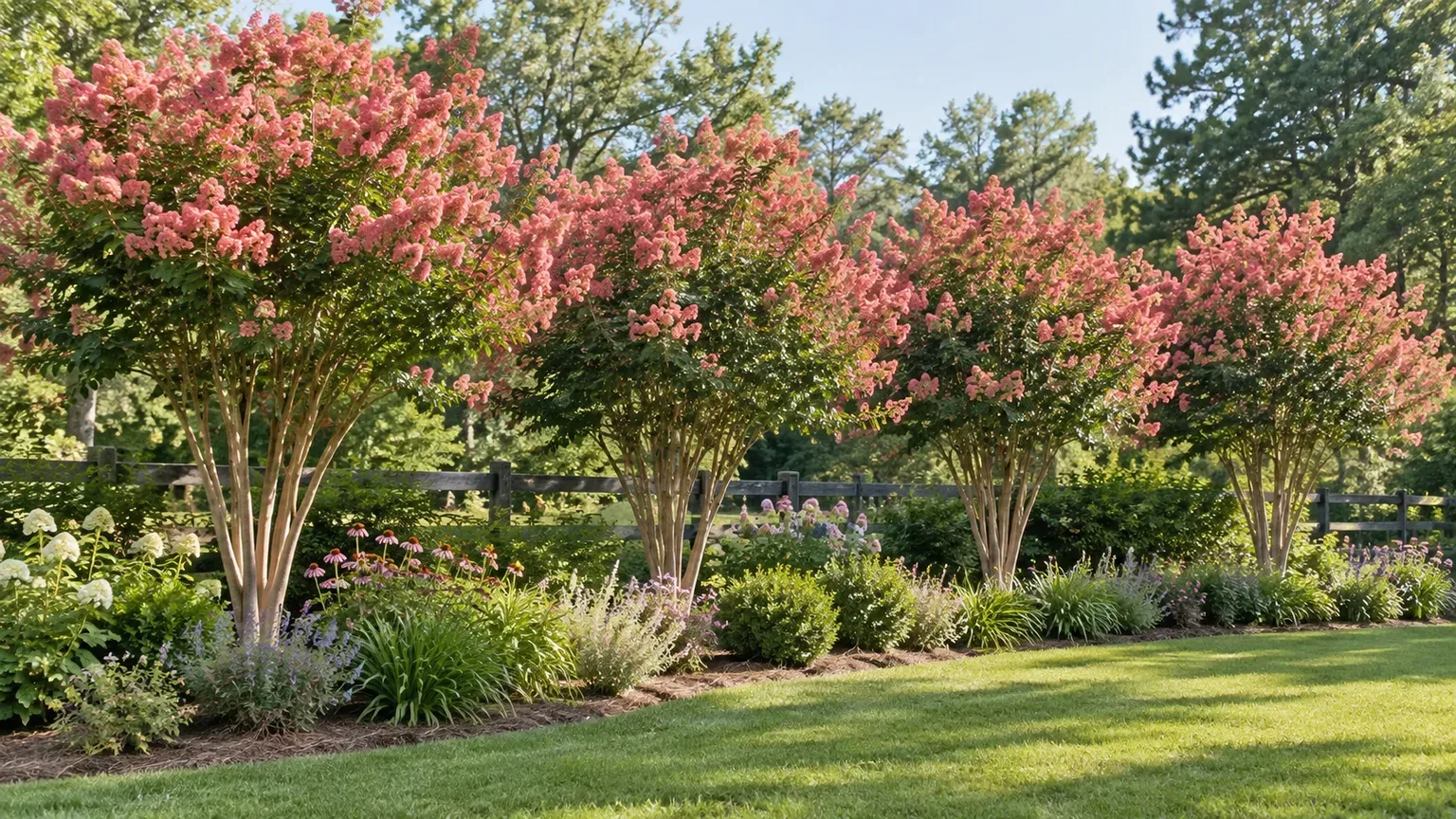
The best place for a crepe myrtle depends less on flower color than on its mature size, available sun, and the job you want it to do. A dwarf cultivar can anchor a sunny foundation bed or a large patio pot; a medium form can mark an entry or shape a courtyard; a large tree needs room to become a canopy rather than a shrub that must be cut back every year.
Before buying, measure the planting area, note what casts shade in summer, and check the cultivar’s expected height and spread—not just the size of the plant in its nursery pot. Crepe myrtles are deciduous, drop flowers and leaves, and vary widely in cold tolerance, so planning around those traits is what turns a pretty bloom into a useful landscape feature.
Start with the job you need the plant to do
Write down the function first: a summer focal point, a loose screen, filtered shade, a border accent, or a container specimen. Then match that use to the plant’s mature dimensions and form. A single-trunk tree creates a clean canopy and shows off its bark; a multi-stem form reads more like a large flowering shrub and can feel relaxed in an informal bed.
This order prevents a common expensive mistake: choosing a plant because it is flowering at the garden center, then trying to force it into a site that is too small. The University of Arkansas Cooperative Extension’s cultivar database spans dwarf plants around 2 feet to tree forms around 30 feet, with different habits and cold-hardiness ranges. That diversity is useful only if you choose for the actual space. (Arkansas Crapemyrtle Database)
Why crepe myrtle earns a place in the landscape
Crepe myrtle contributes at more than one point in the year. Summer flowers draw the eye, many cultivars color in fall, and the branching structure and exfoliating bark can remain noticeable after the leaves drop. Virginia Cooperative Extension describes these features as a source of four-season interest, although the exact display depends on cultivar and climate. (Virginia Cooperative Extension’s crapemyrtle guide)
That sequence makes the plant especially useful where one compact tree can do several jobs: mark a turn in a path, soften a lawn edge, add a flowering canopy above a low planting, or provide a seasonal screen. It is not an evergreen wall, a dense shade tree, or a tidy choice for every hardscape. Treat its changing appearance—and the litter that comes with flowers, leaves, bark, and seed capsules—as part of the design rather than an afterthought.
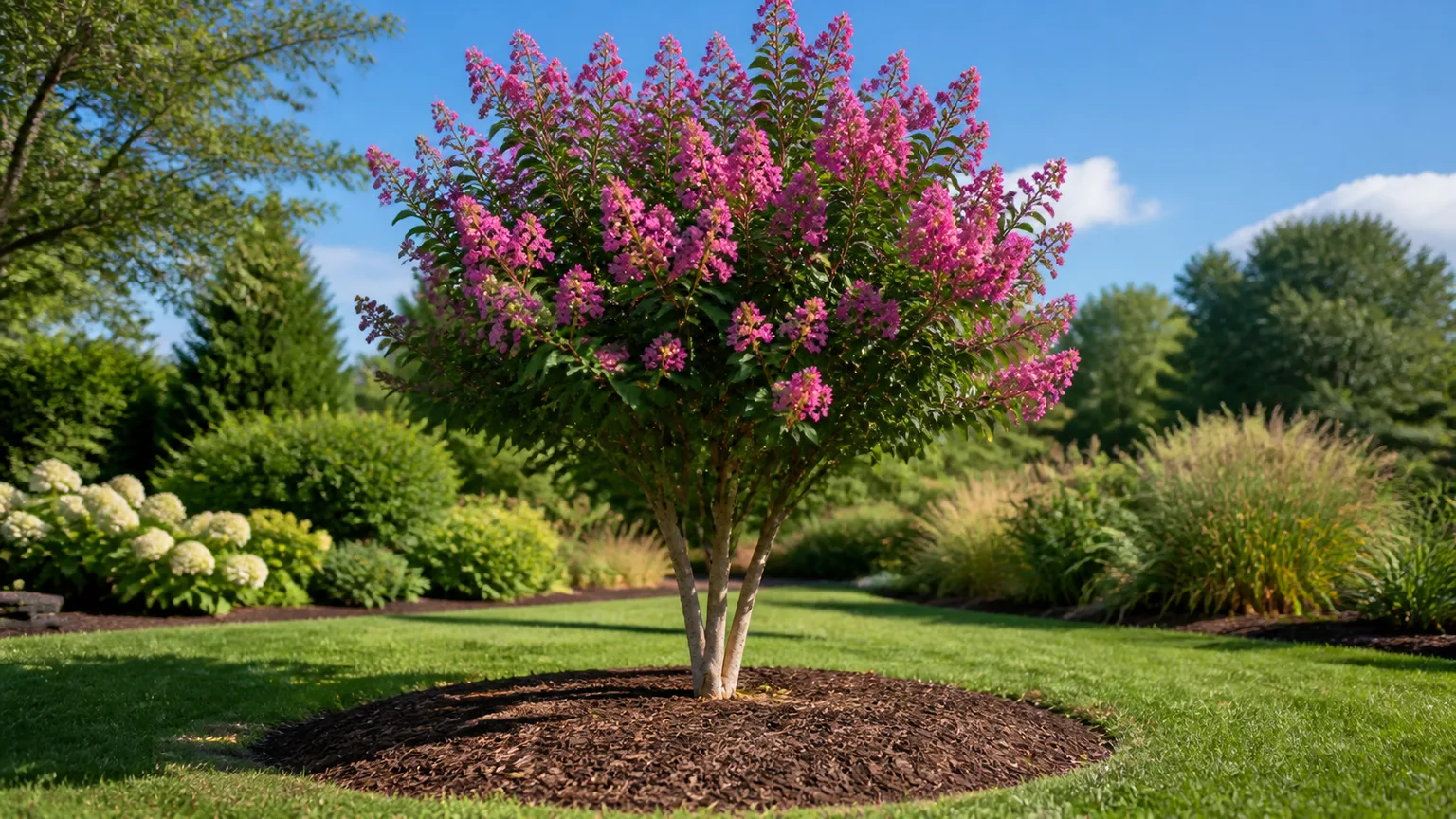
Match cultivar size to available space
Cultivar labels such as dwarf, semi-dwarf, and tree-form are helpful starting points, not exact guarantees. Mature size varies among selections and can shift with climate, growing season, soil, and pruning history. Gardenia’s cultivar overview also cautions that these size groups overlap and that a plant may grow larger in a long, warm season than near the cold edge of its range. (Gardenia’s crape myrtle size guide)
Dwarf and miniature forms
Dwarf cultivars—often under about 5 feet, though nursery categories are not standardized—fit low borders, small courtyard beds, large containers, and spaces below windows where a full-size shrub would overwhelm the view. They can also be repeated in a loose low grouping to carry summer color along a walk. Check both the height and the spread: a short plant can still widen enough to cover edging or lean into a path.
In a container, choose a genuinely compact cultivar rather than assuming any young crepe myrtle will stay small in a pot. Use a substantial pot with drainage, allow room for the root ball, and expect more frequent watering than an in-ground plant during hot weather. A pot makes the plant movable, but it also exposes roots to temperature swings; it is not a reliable way to turn a tender cultivar into a hardy one.
Medium shrubs and small trees
Medium selections—roughly 5 to 15 feet in many landscape references—work well as accents in front or side yards, at the edge of a patio, in a mixed border, or as the middle layer of a small screen. This is often the most flexible size for a residential garden: tall enough to read as a small tree when trained, but less likely than a large cultivar to dominate a compact space.
Decide whether you want a shrub-like clump or visible trunks before planting. If you want to see through the lower canopy, select a cultivar with a suitable habit and train it gradually; do not plan on repeatedly cutting a large plant down to a medium height. Virginia Cooperative Extension recommends choosing a cultivar that fits the landscape without requiring pruning to make it fit. (Virginia Cooperative Extension)
Large tree forms
Large cultivars belong in an open lawn, a broad bed, or a spacious property edge where the mature crown has room on every side. They can make a more convincing small shade tree and a taller seasonal screen than dwarf forms, but they need overhead clearance and room from buildings, roofs, utility wires, parked cars, and regular foot traffic.
Use the upper end of the mature-size range on the plant label when mapping the site. Ask the nursery for the cultivar name and its expected dimensions in your region; “crepe myrtle” alone is not a sufficient size description. If the answer is vague, choose a smaller named selection or a different species instead of hoping pruning will solve the uncertainty.
Make one plant a focal point
A single specimen works where the tree can be seen from a useful angle and its canopy has breathing room: a sunny lawn edge, a broad island bed, a corner of the garden, or the far end of a path. Give it a backdrop that helps its summer flowers and winter bark stand out, such as a simple evergreen hedge, a dark fence, or open lawn. A focal plant needs some quiet around it; placing several competing shrubs directly against its trunk makes the form harder to read.
Avoid the “one tree, one isolated mulch doughnut” look by connecting the planting to the surrounding yard. A low groundcover or a few perennials can soften the base, while a curved bed edge can link the specimen to an existing border. Keep the immediate trunk area clear enough to inspect and maintain, and do not heap mulch against the stems.
Frame an entry with a pair
Two crepe myrtles can frame a front walk, a gate, or a broad entrance without creating a formal clipped hedge. The pair does not need to be mirror-image topiary: matching cultivar and mature size gives the entry coherence, while natural variations in branching keep it from feeling rigid. Use this treatment only if each plant has enough lateral and overhead room as it matures.
Stand at the approach and check the view before planting. The trunks should guide attention toward the door rather than hide windows, obscure a turn, or pinch the path. If the entry is narrow, a single dwarf or medium plant set off to one side usually works better than two trees crowded into a small foundation strip.
Add filtered shade beside a patio
A tree-form cultivar can cast dappled shade over the edge of a seating area, particularly where a broad, dense shade tree would be too much. Decide whether you want shade over the paving, the chair, or the garden bed; those are different placements. Allow the crown to grow without putting branches directly over a roof, gutter, pool, or space that must stay clean.
Remember the trade-off: a deciduous tree gives less shade in winter, and blooms, leaves, and bark will fall where the canopy extends. If a clean dining surface or pool is the priority, move the tree toward the outer edge of the patio or choose a different species. Crepe myrtle is best when the seasonal color is worth a modest amount of sweeping.
Build a loose flowering screen
Several crepe myrtles can soften a fence line, break a long view, or create a partial summer privacy screen. Use cultivars with compatible mature heights and a similar visual habit so the row reads as one composition. An informal stagger can make the planting feel less like a barrier, while a straight line gives a clean boundary; either way, leave enough space for individual crowns to develop and for someone to reach the plants for maintenance.
Do not promise year-round privacy from a deciduous plant. In winter, stems screen less than leafy crowns, and narrow or open cultivars may never block a view completely even in summer. If you need dependable screening in every season, combine crepe myrtle with an evergreen hedge or select an evergreen screen as the primary structure, then use crepe myrtle as the flowering layer in front.
Use compact forms in borders and foundation beds
Dwarf and smaller medium cultivars can bring height and summer color to a perennial border, but place them where they will not shade out plants that require full sun. A crepe myrtle also works in a foundation bed when its mature crown clears windows and eaves and the bed is wide enough to accommodate its spread. Resist the temptation to plant large forms close to a wall and keep cutting them back; the repeated conflict is a sign that the wrong cultivar was chosen.
Think in layers rather than filling every gap on planting day. Set the crepe myrtle where its eventual canopy belongs, then use lower perennials or grasses near the bed edge. Leave an access lane for pruning, inspection, and cleanup, especially between the plant and a wall or fence. Southern Living’s planting guidance similarly stresses choosing by the eventual site and reserving large cultivars for locations where they will not crowd structures or walkways. (How to Plant a Crepe Myrtle)
Grow a dwarf cultivar in a container
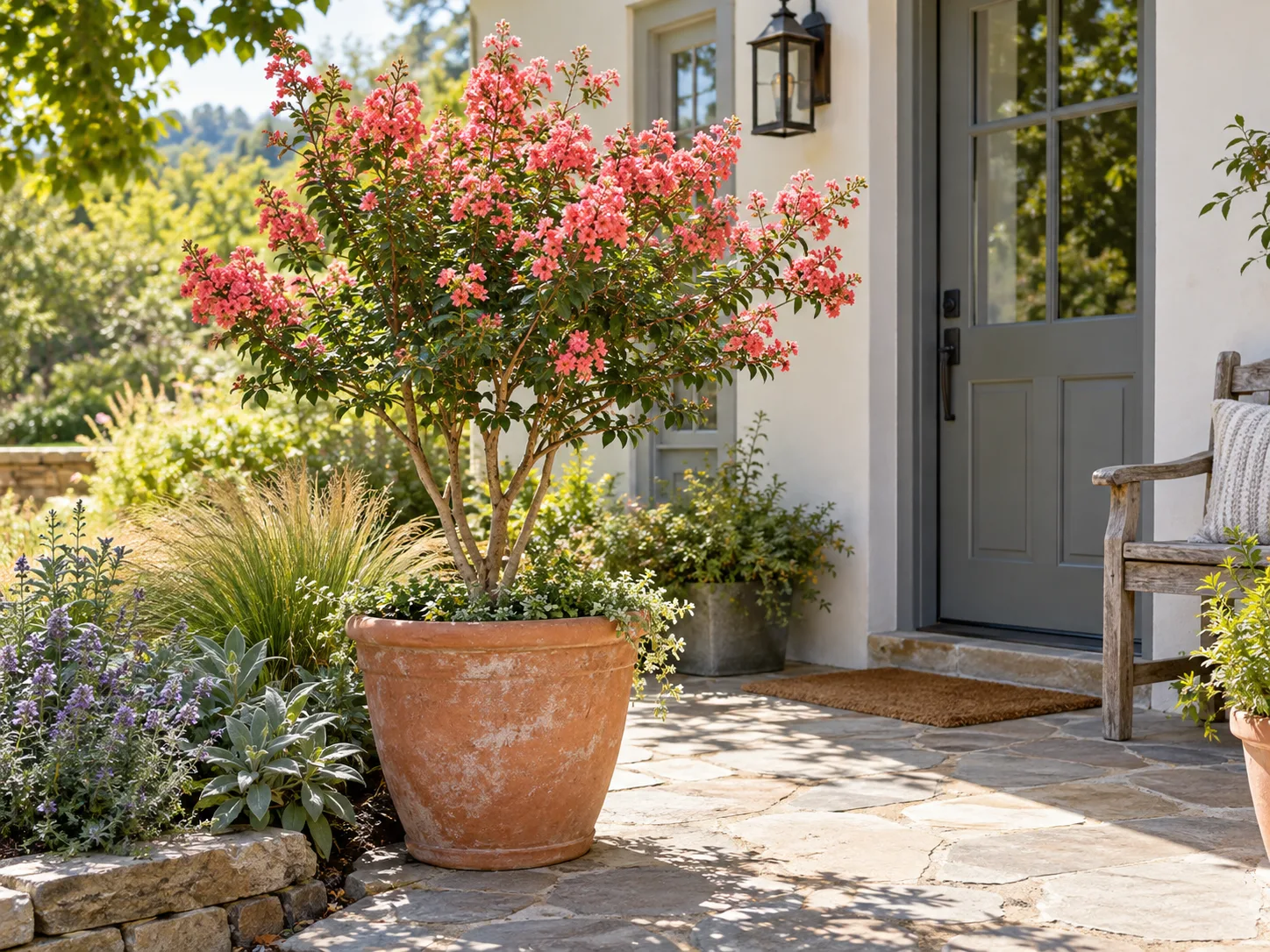
A large container is useful on a sunny patio, balcony, or paved courtyard where there is no planting bed, or where you want the option to move the display away from a high-traffic spot during heavy bloom or leaf drop. Select a dwarf cultivar with a known mature size, a pot with unobstructed drainage, and a stable base large enough that the plant will not become top-heavy as it grows.
Container plants need closer attention to water because their limited root zone dries faster than garden soil. Water thoroughly when the potting mix is drying rather than relying on a fixed calendar, and avoid leaving the pot standing in a saucer of water. In climates colder than the cultivar’s reliable in-ground range, the exposed root ball may need winter protection or a protected dormant location; confirm local guidance before treating a pot as a cold-climate workaround.
Layer companions beneath and around the canopy
Choose companions for the light and moisture they will actually receive once the tree is established. Near the outside of a sunny canopy, drought-tolerant flowering perennials and ornamental grasses can echo the crepe myrtle’s summer display. In dappled shade, use plants suited to that light; do not assume the area beneath every crepe myrtle is a deep-shade garden, because the canopy is often relatively open.
Keep thirsty plants away from the trunk and avoid digging repeatedly through the main root area to install a dense ground layer. A mulch ring can simplify care while the tree establishes, with the mulch kept off the bark. Southern Living’s companion-planting guidance makes the same practical point: match companion plants to the available sun and moisture, and give the tree and its neighbors enough room to avoid needless competition. (Companion Plants for Crepe Myrtles)
For a restrained palette, repeat one or two companion plants in groups rather than adding a different species under every branch. White or purple flowers can contrast with pink cultivars; silver or fine-textured foliage can make a dark-leaved cultivar easier to distinguish. Let the tree remain the high point of the composition, and use the companion layer to extend interest before and after its main bloom period.
Set spacing and clearances from mature spread
The plant label’s mature width is more useful for layout than a generic spacing number. If two similar cultivars are expected to spread about 10 feet, placing their trunks about 10 feet apart gives the crowns a chance to meet near maturity; more distance preserves separate silhouettes, while less creates overlap and can increase crowding and pruning. Treat that as a starting calculation, then adjust for the cultivar’s natural shape and the screen density you want.
For a building, fence, walkway, or driveway, think from the trunk to the nearest edge: leave roughly half the expected mature spread plus an additional clearance for access, sightlines, and overhang. A wide, arching cultivar therefore needs more room from the path than a narrow upright one, even if both reach a similar height. Confirm overhead utilities and local setback rules before planting; do not rely on a plant tag’s height alone to predict where branches will reach.
Know when another plant is a better fit
Choose something else if the site is mostly shaded, if you need a dense evergreen screen, or if you cannot tolerate seasonal litter over a pool, car, narrow walk, or outdoor dining surface. Crepe myrtles flower best in full sun, and shade can reduce flowering; a sunny plant in a shaded corner may survive but fail at the role you bought it for. (Southern Living’s planting guide)
Likewise, do not choose a large tree-form cultivar for a tight foundation bed just because the flowers match the house. A dwarf or medium plant may solve the space problem, but if the area is too dim, too wet, or too cramped even for that form, a different shrub will need less correction over time. Southern Living notes that flowers, seed capsules, foliage, and bark all contribute to cleanup; keep that in mind near surfaces that must remain clear. (Where Not to Plant a Crepe Myrtle)
Lay out, plant, and establish the design
Before digging, mark the trunk position and the estimated mature canopy with a hose or string. View it from the house, path, and street; check the shade pattern at different times of day, and note overhead lines, gutters, parked vehicles, and doors. This quick mock-up often reveals that a tree intended to screen a neighbor will also block a window or that a paired entry planting leaves too little walking width.
Crepe myrtles flower best in a sunny position with well-drained soil. Choose a site with room for air movement and avoid planting where water routinely stands. At planting, keep the root flare near finished grade and make the hole broad rather than needlessly deep; firm the backfill gently, water the root zone, and mulch to conserve moisture without piling mulch against stems. Southern Living’s planting guide gives a practical sequence for sizing the hole and setting the root ball at grade. (How to Plant a Crepe Myrtle)
During establishment, check soil moisture rather than watering by habit. Newly planted trees need regular attention until roots extend into surrounding soil, especially in hot, dry weather, but persistently saturated soil is not a substitute for deep watering. Keep nearby turf and weeds from competing at the base, and postpone elaborate underplanting until the main tree is established and its shade pattern is clear.
Keep the natural form instead of topping
Pruning should maintain the cultivar’s shape and remove a specific problem, not repeatedly force an oversized tree into a small site. Topping—cutting main stems to arbitrary stubs—creates a coarse, unnatural outline and vigorous shoots that can be weakly attached. Virginia Cooperative Extension advises selecting a cultivar that fits the landscape and using selective pruning to maintain sound structure; Arkansas Extension likewise puts correct size selection ahead of excessive pruning. (Virginia Cooperative Extension; Arkansas Crapemyrtle Database)
If you want a visible multi-trunk form, make that choice early and preserve a few well-spaced stems rather than cutting every year to the same height. Remove dead, damaged, rubbing, or poorly placed branches with clean cuts, and remove basal suckers if they conflict with the chosen form. Dwarf cultivars grown as low shrubs may be managed differently from a small tree, so follow advice for the specific cultivar instead of applying one pruning style to every crepe myrtle.
Adjust the plan for winter and local climate
Hardiness is not uniform across the genus or even across the available cultivars. The Arkansas database includes selections spanning roughly USDA Zones 6 through 10, while Virginia Cooperative Extension notes that modern cultivars range from container-sized dwarfs to trees approaching 25–30 feet. Use those ranges to understand the diversity, not as a promise that every selection will perform equally at every edge of a zone. (Arkansas Crapemyrtle Database; Virginia Cooperative Extension)
Ask a local nursery or extension office which named cultivars reliably flower and overwinter in your area. In colder regions, choose a cultivar tested locally and consider whether a container can be protected during dormancy; in a short growing season, a late-flowering selection may not provide the display you expect. Also remember that a multi-stem tree’s winter silhouette can be an asset, not a reason to prune it into a dense summer ball.
Conclusion
Use a crepe myrtle where its strongest features match the site: summer flowers, manageable scale, fall color, and a visible winter framework. Start with the space you have, choose a named cultivar for its mature height and spread, and then decide whether it should act as a specimen, a loose screen, a patio accent, or a border plant.
Give the canopy full sun and room to reach its natural dimensions, plan for seasonal cleanup, and use companion plants that suit the light beneath it. When the tree’s mature form is part of the plan—not something to fight with annual topping—crepe myrtle can deliver both curb appeal and a useful role in the garden.