How to Identify and Remove Bindweed: A Long-Term Plan
Learn how to identify field and hedge bindweed, remove roots without spreading them, protect lawns and beds, and stop new vines from taking over.
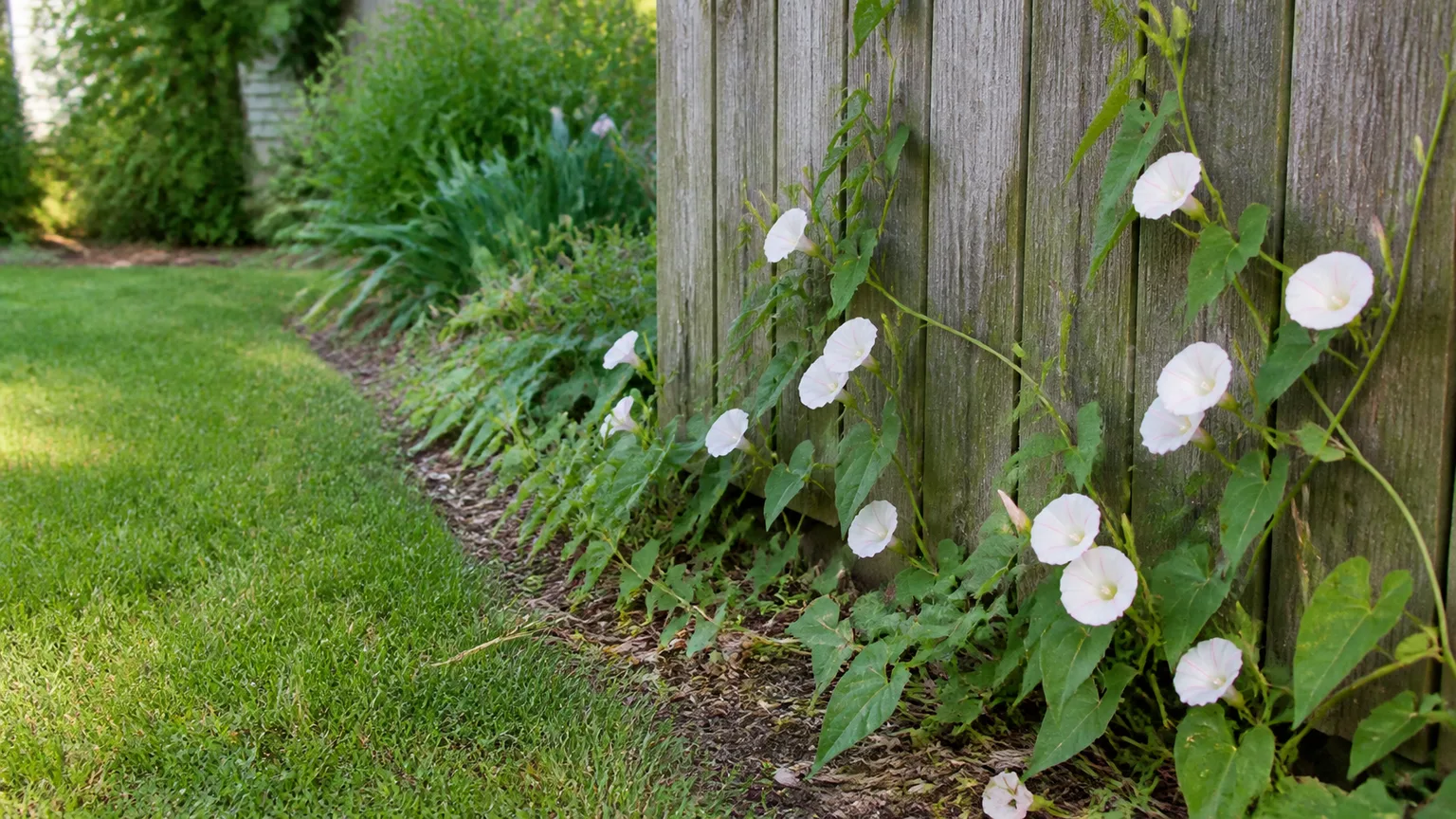
If a thin vine keeps returning from the same patch, wraps around nearby plants, and carries small white or pink funnel-shaped flowers, suspect bindweed. The most common target is field bindweed (Convolvulus arvensis), although hedge bindweed (Calystegia sepium) looks similar and behaves differently enough to matter when you are deciding how aggressively to clear it.
The honest answer to “How do I get rid of bindweed?” is not a single product or a single afternoon of digging. Remove young plants carefully, prevent flowers from becoming seed, and keep cutting or covering regrowth so the underground system cannot rebuild its energy. A small patch may be reduced quickly; an established patch usually takes repeated attention across more than one growing season.
The short answer: cut growth now and weaken roots over time
Start by removing every visible shoot you can reach without disturbing desirable plants. If the soil is loose and the plant is young, use a hand fork to lift the root. If the vine is mature or entangled in a shrub, cut it at soil level, collect the top growth, and return to the spot whenever new shoots appear.
That strategy works because bindweed is powered by what it stores below ground. Cutting off the leaves repeatedly prevents photosynthesis and forces the roots to spend stored carbohydrates on replacement shoots. It is a war of attrition, not a promise that one cut kills the root system.
For a dense patch, choose between careful digging and a complete light-blocking cover. For a lawn, build a dense, properly managed turf and use only a post-emergence product whose label allows the target weed, grass species, and application site. Do not use a lawn herbicide in a vegetable bed or assume that a non-selective spray can be kept safe around shrubs by being careful with the nozzle.
Is it bindweed? Check leaves, flowers, and growth habit
Field bindweed starts inconspicuously. Young vines can look like loose threads, then develop alternate, arrowhead-shaped leaves with smooth margins. The stems trail across soil or twine around a support, and the flowers are usually white to pale pink, funnel-shaped, and roughly 1 to 1½ inches wide. The UC Statewide Integrated Pest Management Program’s field bindweed profile also notes that the leaves can vary with growing conditions, so identify the whole plant rather than relying on one leaf.
The underground clue is just as important as the flower. When you loosen the soil, bindweed may reveal pale, brittle roots that run both horizontally and vertically. A plant that reappears in the same place after the top is removed is telling you that its root system, not just its leaves, is the problem. The Gardening Know How bindweed guide also recommends using the vine’s growth habit and repeated regrowth—not flower color alone—to confirm what you are dealing with.
Field bindweed vs. hedge bindweed
Field bindweed (Convolvulus arvensis) is the smaller, more lawn-like species. Its stems commonly trail or climb to about 3 feet, its grey-green leaves are usually oval to arrow-shaped, and its flowers are about ¾ inch across. It tolerates dry conditions and often appears in lawns, gravel, cultivated soil, and disturbed edges.
Hedge bindweed (Calystegia sepium) is larger and more vigorous. Its heart-shaped leaves can reach about 5 inches, its stems can climb around 10 feet, and its funnel-shaped flowers may be around 2 inches wide. The green bracts at the flower base are also more conspicuous than those of field bindweed. The RHS identification guide is useful when the plant is climbing through a hedge or perennial border and you need to distinguish a large bindweed from the smaller field type.
The control principles overlap, but the setting matters more than the label. A few field bindweed seedlings in open soil are worth lifting immediately; hedge bindweed threaded through an established shrub may be safer to cut back repeatedly while you protect the shrub’s roots and stems.
Bindweed vs. ornamental morning glory
Bindweed is often called wild morning glory because both plants belong to the morning-glory family and have funnel-shaped flowers. That common name can cause a costly mistake: an ornamental morning glory is not automatically the same plant as field bindweed.
Field bindweed usually has smaller flowers and smaller leaves than the showier annual morning glories sold for gardens. Many ornamental morning glories have larger, heart-shaped leaves, thicker stems, and flowers that may be blue, purple, or a stronger pink. Species and climate vary, so a persistent volunteer that returns from the same soil should be identified before you decide to keep it or spray it. The NC State Extension plant profile lists hedge bindweed as a common look-alike and reinforces that field bindweed is a perennial that spreads by seed, roots, and rhizomes.
Why bindweed returns after you pull it
Bindweed is difficult because it combines three forms of persistence: deep vertical roots, shallow lateral roots that can make new shoots, and seeds that can wait in the soil. The UC IPM account reports roots reaching 20 feet or more, while most of the root mass is nearer the surface; that combination explains why a shallow dig can miss the plant but a complete excavation is rarely practical in a planted bed.
Root and rhizome fragments can also regenerate. The same source describes new plants forming from pieces as short as about 2 inches, while King County warns that a patch can be spread by fragments left behind after pulling or soil disturbance. That does not mean pulling is always wrong. It means you should pull young plants carefully, lift rather than chop established roots, and remove every fragment you can see.
Seeds create a second problem after the original roots are weakened. Field bindweed can produce hundreds of seeds, and UC IPM’s life-cycle summary notes that seed found in soil decades old can remain viable. You cannot remove a decades-old seed bank in one session, but you can stop adding to it by removing flowers before seed capsules mature and by checking new bare soil after digging.
Choose the control plan by location
The same vine needs a different response in a vegetable row, a lawn, and a fence line. Use this quick match before choosing a tool:
| Where it is growing | Best first move | What to avoid |
|---|---|---|
| A few vines in a flower or vegetable bed | Loosen soil and lift the plant and reachable roots; cut regrowth | Broad spraying, rototilling, and pulling through a valued plant |
| A dense bed infestation | Remove what you can, then cover the entire patch and monitor edges | Leaving gaps, cutting holes without a plan, or planting into fragments |
| Established lawn bindweed | Improve turf density, mow at the correct height, then consider a labeled selective post-emergence treatment | Broadcast non-selective herbicide or assuming mowing eradicates it |
| Fence, path, gravel, or unmanaged edge | Cut before flowering, remove debris, and use a continuous barrier where spread is coming from next door | Letting vines climb into shrubs or composting cuttings |
In a flower or vegetable bed
Protect the crop first. If bindweed is wrapped through stems, do not yank the vine upward; unwind it in the direction that releases it, or cut it into manageable pieces and remove those pieces from the bed. Pulling hard can break both the bindweed and the desirable plant you are trying to save.
Work when the soil is slightly moist, not waterlogged. A hand fork or narrow border fork lets you follow pale roots around a perennial’s root ball more gently than a shovel. If roots disappear under a plant you cannot lift, stop excavating before you damage that plant and switch to repeated cutting of the bindweed shoots.
In a lawn
Mowing keeps bindweed from climbing and reduces its visible growth, but it is not a stand-alone eradication method for an established patch. Healthy turf competes more effectively with weeds than thin, drought-stressed turf. Colorado State University Extension recommends a dense, well-managed lawn, timely and even irrigation, mowing around 2½ to 3 inches when appropriate for the turf, and careful fertilizer use based on grass type and age. Read the PlantTalk Colorado guidance for the important distinction between lawn care and herbicide choice.
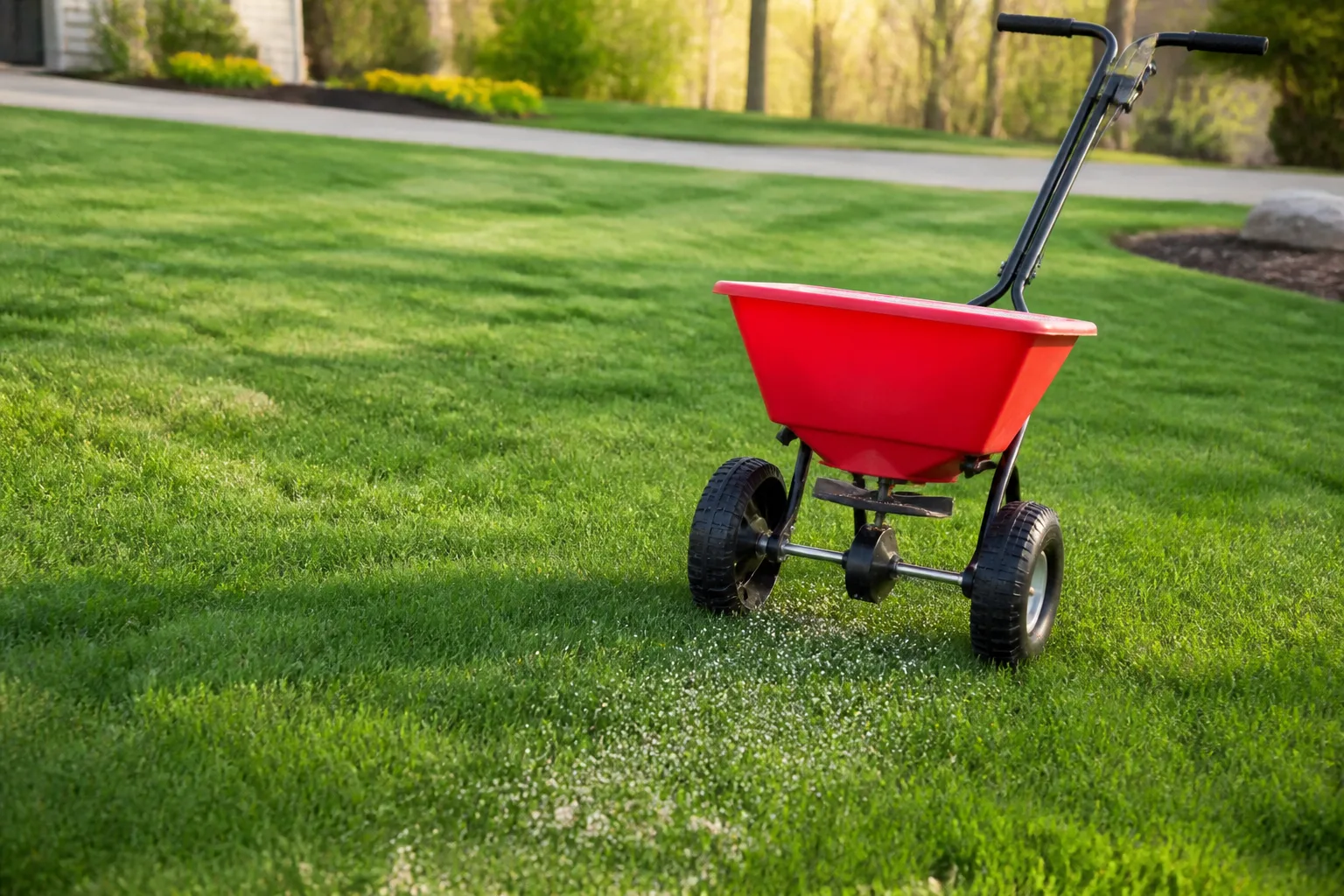
If bindweed still flowers above the grass, look for a selective post-emergence product labeled for bindweed and your particular turf. Pre-emergence products do not solve established perennial bindweed because they do not remove the existing root system. Product labels, grass tolerances, local rules, and availability change, so treat the label—not an old product name or a neighbor’s recipe—as the controlling instruction.
Along a fence, path, or unmanaged edge
Edges are where bindweed often arrives from another property, a neglected strip, or disturbed soil. Start on the cleanest side and work outward so you do not drag vines and root fragments through areas that are still clear. Cut the stems before they flower, bag the material, and check the boundary again after rain or irrigation.
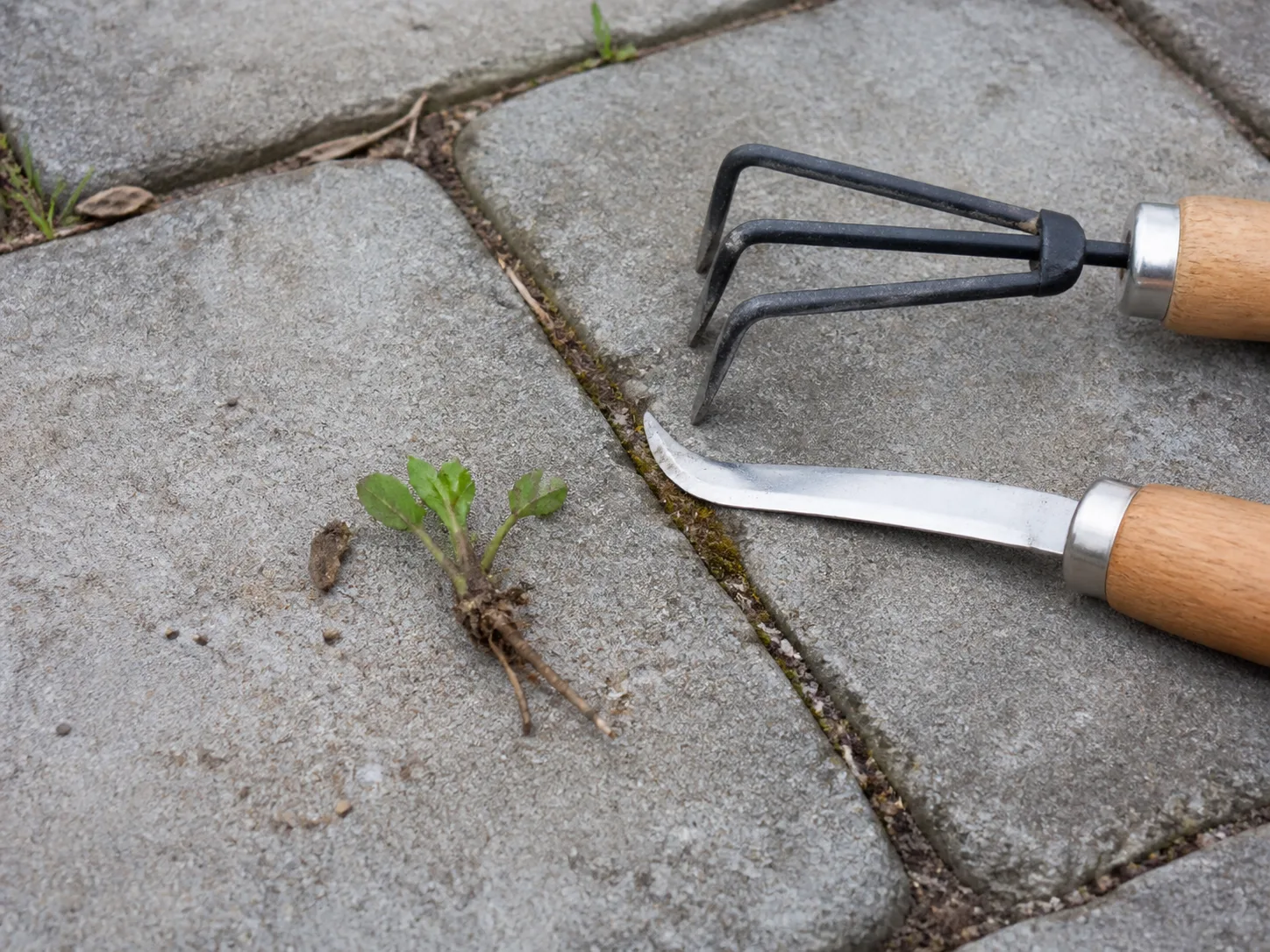
A solid vertical barrier can slow movement across a bed edge, but it is not an underground wall against every root. The King County field bindweed guidance recommends a long-term plan, says barriers need to be deep and continuous, and emphasizes covering the whole patch rather than leaving a narrow gap where shoots can reach light. Keep the top edge visible enough to inspect, and do not let stems arch over it.
How to remove a small patch by hand
Hand removal is the best starting point when there are only a few plants, especially near vegetables, herbs, pollinator plants, or shrubs. It gives you the highest precision and avoids herbicide drift, but success depends on returning for regrowth rather than expecting to extract every deep root.
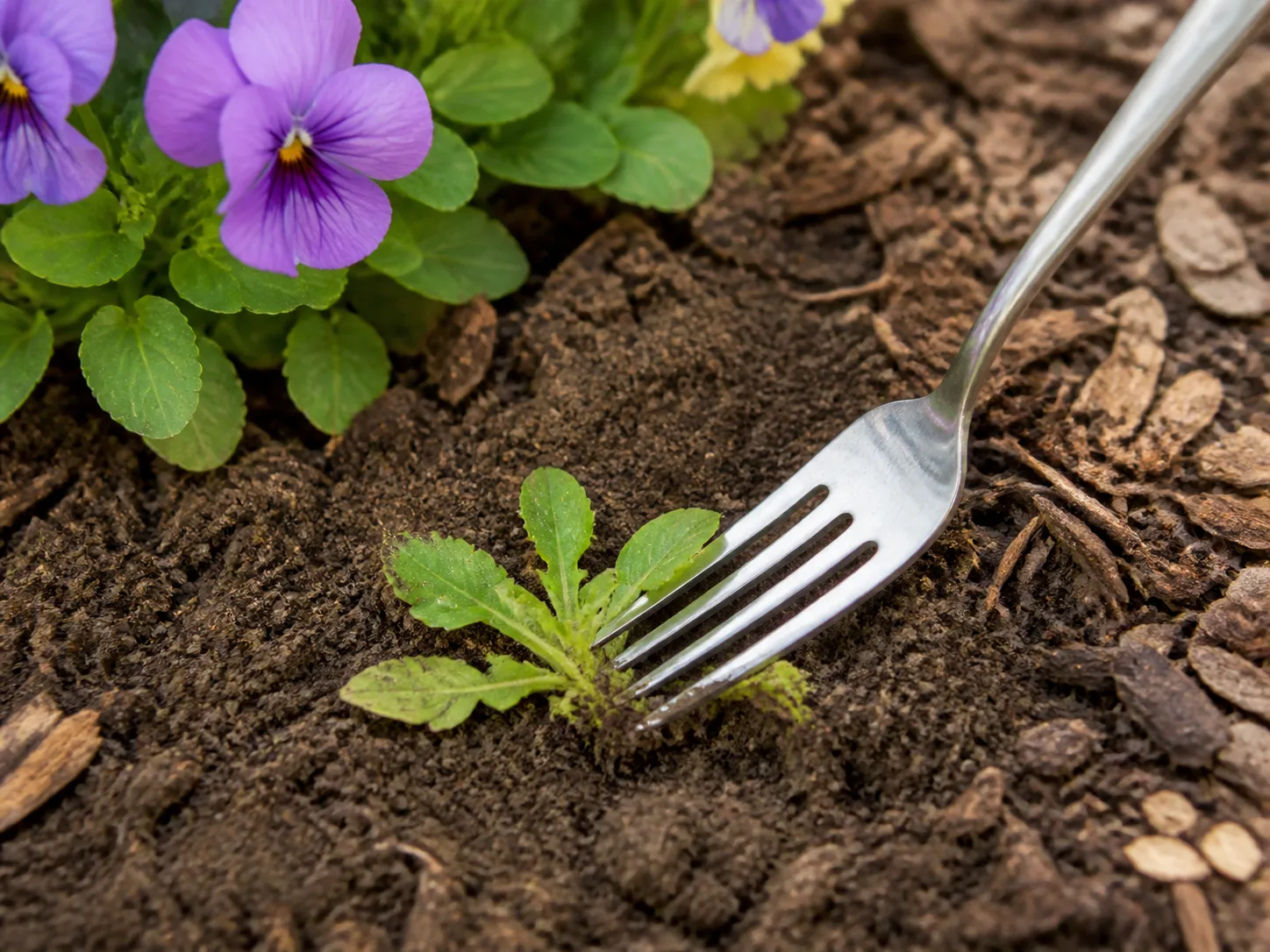
- Trace the vine to its rooting point. Follow the stem across the soil before pulling. A vine may have several points where it contacts the ground, and cutting at the wrong point can leave the rooted section behind.
- Moisten the soil lightly. Wait until the soil is workable, then use a hand fork beside the crown. Avoid digging when the bed is sticky enough to smear or compact around roots.
- Lift, do not snap. Ease the crown and the reachable lateral roots upward. If a root breaks, search the loosened soil for the fragment instead of abandoning it in the planting bed.
- Separate bindweed from valued plants. Unwind stems before you move the plant material. If the root is entangled with a shrub, remove the top growth and plan to cut new shoots repeatedly rather than damaging the shrub to chase every root.
- Bag the material immediately. Keep roots, stems, flowers, and seed capsules out of the bed, wheelbarrow, and home compost. Clean soil from tools before moving to an uninfested area.
The RHS recommendations make the same useful distinction: fork out seedlings when they are small, fork established plants as deeply as practical, and keep checking for missed regrowth. A five-minute inspection every week is more effective than a dramatic excavation followed by six weeks of inattention.
How to suppress a large patch without spreading it
Large infestations need containment before removal. Mark the full edge of the patch, avoid rototilling it, and decide whether you can keep the area exposed for repeated cutting or cover it completely for long-term light exclusion. Do not move soil, mulch, or root-filled plants from the patch to another bed. The Planet Natural control overview similarly treats bindweed as an integrated-management problem: physical suppression, prevention, and careful chemical decisions work together better than a single promised cure.
Repeated cutting
Use sharp shears, a hoe, string trimmer, or mower—whichever lets you cut the vines at soil level without striking desirable plants. Remove the top growth before it flowers, collect the pieces, and cut again whenever fresh shoots appear. A two- to three-week check is a practical baseline during active growth, but faster regrowth deserves a faster visit.
Repeated cutting is particularly useful where digging would destroy an established planting. Each cut removes the photosynthetic surface and makes the root system spend energy on another shoot. The plant may look unchanged for much of the first season; judge progress by smaller, slower, or less frequent shoots over time rather than by one brown patch.
Smothering and light exclusion
Smothering works only when the cover blocks light across the whole infestation. Overlap sheets of cardboard or use a heavy, continuous landscape fabric, then add a deep mulch layer to hold the cover down and close gaps. Extend the cover beyond the visible vines because roots and shoots can spread past the point where stems are showing.
Established bindweed is unusually persistent under cover. King County recommends a long-term complete cover, and the RHS describes keeping light-blocking cover in place for several years, with roughly 8 inches of organic matter over cardboard as one option. Inspect the edges regularly, repair tears, and remove any shoot that finds a seam. When you finally uncover the area, expect dormant seedlings to appear and monitor the exposed soil rather than treating the cover as a permanent cure.
Mulch is more reliable for suppressing seedlings than for instantly killing a mature root network. A thick, undisturbed layer can reduce light and make new shoots easier to spot, but thin mulch, open seams, and mulch that breaks down into loose organic soil will not contain a vigorous patch by themselves.
When herbicide is appropriate—and how to limit damage
Herbicide can be part of an integrated plan for a large lawn or an empty, non-crop area, but it is not a shortcut to guaranteed eradication. The UC IPM field bindweed guidance describes herbicides as more useful for suppression than eradication and says they work best alongside seed prevention, cover, competition, and repeated removal.
In a lawn, use only a selective product whose current label includes bindweed and the grass species you grow. Colorado State University Extension identifies systemic post-emergence products as the relevant category for established bindweed and notes that some quinclorac-containing lawn formulations can be effective. That does not make every quinclorac product legal or safe for every lawn, so check the full label for site, rate, turf tolerance, weather restrictions, protective equipment, and re-entry instructions.
In a bed or around shrubs, a non-selective systemic herbicide can injure any green tissue it touches. If a label permits the use and you decide it is justified, treat a small target during active, non-drought-stressed growth, prevent drift, shield nearby plants, and never spray a vine that is resting on the foliage of a plant you want to keep. Do not borrow a lawn product for a bed, mix a stronger solution because the weed is persistent, or use an old online rate without checking the current product label and local regulations.
Expect to monitor and retreat only as the label allows. A temporary collapse of the foliage is not proof that the root system is dead, and the absence of residual activity means a new seedling can still appear after the treated plant has gone brown.
What not to do with bindweed
Do not rototill an infested bed as your first response. Cultivation can cut the root system into pieces and distribute those pieces through clean soil. If you must dig, work carefully, lift roots, and inspect the loosened soil before you replant.
Do not pull blindly through a shrub, compost the cuttings, or leave flowering vines on the soil surface. Do not rely on vinegar, salt, bleach, or boiling water as a permanent root treatment. These approaches can burn foliage or injure surrounding plants without solving the underground problem; the RHS specifically cautions that household vinegar is not an effective bindweed control method.
Do not let a thick cover stop you from checking the edges. A single uncovered strip can provide enough light for a shoot to escape, and a barrier with gaps can redirect growth into the neighboring bed. Do not plant desirable ground cover as though it will automatically choke out a mature bindweed network; competition can help, but it works best after the infestation is already being monitored and weakened.
Prevent spread and dispose of cuttings safely
The cheapest bindweed plant to control is the one you prevent from establishing. Inspect new topsoil, compost, nursery plants, and shared tools before they enter a clean bed. The NC State Extension profile and King County both emphasize preventing introductions and acting while new infestations are still small.
Remove flowers before they become seed capsules. Keep mowing or cutting ahead of seed production, especially along fences and unmanaged edges where you may not notice the plant until it is already climbing. After digging, watch the disturbed soil for new seedlings; bare soil is an invitation to a seed that was already waiting below the surface.
Do not put bindweed roots, stems, flowers, or seed capsules in a home compost pile. A backyard pile may not maintain the heat or processing conditions needed to prevent regeneration, and fragments can be carried back into beds with finished compost. Seal the material in a bag for household disposal or follow your local noxious-weed or green-waste service’s instructions; rules for invasive plant waste vary by location.
A season-by-season follow-up plan
Early spring: Walk the bed, lawn edge, and fence line before the vines become tangled. Lift small seedlings while the soil is workable, flag the source of recurring shoots, and repair bare spots in turf or gaps in mulch.
Late spring through summer: Cut or lift new growth before flowering. Return every two to three weeks during active growth, or sooner when shoots appear. Keep the patch contained, remove fragments from the site, and maintain a full cover over areas being smothered.
Late summer into fall: Check for seed capsules and remove them before they mature. If herbicide is being considered for a permitted lawn or non-crop site, active, non-drought-stressed growth can be a more useful treatment window than a plant that has already shut down; follow the current label and local rules.
After cover removal or bed renovation: Do not replant and forget the area. Search for seedlings and regrowth, check incoming soil and root balls, and keep the surface covered with an intact mulch or a competitive planting once the bindweed pressure has declined.
Keep a simple note of where shoots appear and how quickly they return. The first sign of progress is often not a completely empty bed but a patch that produces fewer, shorter shoots and no flowers. Continue the routine until new growth is rare, then keep monitoring the boundary because dormant seeds and neighboring roots can restart the problem.
Conclusion
To identify bindweed, look for a twining or trailing perennial vine, alternate arrow-shaped or heart-shaped leaves, and small white-to-pink funnel flowers. Confirm the species when a morning glory look-alike is possible, then treat the root system and seed bank—not just the leaves—as the real job.
Lift young plants where you can, cut mature vines at soil level when roots are entangled, cover large patches completely, keep lawns dense, and use herbicide only when a current label and the site make it appropriate. Remove flowers before seed, keep every fragment out of home compost, and revisit the area on a schedule. Persistence is not a vague gardening virtue here; it is the control method.