How to Grow and Care for Incrediball Hydrangea
Learn when to prune Incrediball hydrangea, how much sun it needs, how to prevent drooping, and why soil pH will not turn its white blooms blue.

Incrediball is a smooth hydrangea with unusually large, rounded flower clusters and a more substantial stem structure than the older Annabelle type. It is still a shrub with heavy flower heads, though: a young plant in a windy spot can lean after a hard rain, and a severe annual cut can change how it grows. The most reliable care comes from matching light, water, spacing, and pruning to your climate and to the shape you want.
The cultivar is botanically identified as Hydrangea arborescens ‘Abetwo’ and sold under the Incrediball name. It typically reaches about 4 to 5 feet tall and wide, so plan for a real shrub rather than a small perennial. The breeder lists it for USDA hardiness zones 3 through 8, with sun exposure adjusted for the climate. Proven Winners ColorChoice’s cultivar profile gives the current cultivar specifications; university extension sources help explain how the broader smooth-hydrangea species behaves.
Incrediball hydrangea at a glance
| Need | Practical target |
|---|---|
| Mature size | About 4–5 feet tall and wide |
| Light | Sun to part sun; protect from harsh afternoon sun in hot climates |
| Soil | Moist, fertile, and well-drained; avoid a persistently soggy root zone |
| Water | Regular during establishment; thereafter water deeply when the root area begins to dry |
| Pruning | Early spring, after the shrub is established; a light one-third height reduction is a conservative routine |
| Flowers | Large white clusters that open green and age back toward green |
| Hardiness | Listed for USDA zones 3–8; container roots need more winter protection |
This is an outdoor deciduous shrub. It loses its leaves in winter, and its branches may die back in very cold or exposed sites. Because smooth hydrangeas make flower buds on the current season’s growth, normal winter dieback does not automatically mean you have lost the next summer’s bloom.
What Incrediball is—and what it is not
Incrediball belongs to Hydrangea arborescens, commonly called smooth hydrangea. The species is native to the eastern United States, while ‘Abetwo’ is a selected garden cultivar bred for especially large flower clusters and improved stems. The flowers are rounded mophead-like clusters, not the long cones produced by panicle hydrangeas such as ‘Limelight’. Those plant groups differ in mature shape and care, so do not apply advice for a cone-flowered hydrangea automatically to Incrediball. NC State Extension’s Plant Toolbox describes smooth hydrangea as a new-wood bloomer and notes that its flower-bearing shoots can bend after heavy rain.
The comparison most gardeners make is with Annabelle, another smooth hydrangea with white ball-shaped flowers. Incrediball was selected to improve flower size and stem strength, but “stronger” does not mean stormproof. The species’ big, water-catching flower clusters still create leverage at the top of each shoot; once a cluster is soaked, even a sturdy stem may bow. Choose Incrediball if you want the classic white smooth-hydrangea look with an improved framework, not if you require every stem to stay perfectly vertical in all weather.
The name also matters when you buy. ‘Abetwo’ is the cultivar name; Incrediball is the trade name. Incrediball Blush is a different selection with pink-toned flowers, while the original Incrediball’s flowers remain in the white-to-green range. A nursery label that says only “smooth hydrangea” may refer to Annabelle or another cultivar, so check the full label if you want the particular habit and bloom form described here.
Choose light that fits your climate
Incrediball tolerates full sun to partial sun, but the best position depends on how hot and dry your summers become. In cooler regions, a site with around six or more hours of sun can support abundant flowering without overwhelming the plant. In warm-summer areas, give it morning sun and relief from the hottest afternoon rays; the same shrub that thrives in a cool sunny border may scorch or wilt in a hot south- or west-facing bed.
Watch the plant during its first summer rather than judging the site from a single afternoon. A temporary midday droop that resolves as temperatures fall can be heat stress, while leaves that stay limp into evening and dry soil point toward inadequate root-zone moisture. If the plant repeatedly wilts despite moist soil, the site may be too hot, the soil may drain poorly, or roots may still be settling in. Moving it into afternoon shade can help, but do not use shade so deep that flowering becomes sparse.
For a hedge or border, consider overhead tree shade as well as direct sun. Mature trees compete for water, and dense canopies can reduce light and airflow at once. A bright edge of woodland or a garden with morning sun and open afternoon shade often offers a better balance than a deeply shaded spot beneath a large tree.
Prepare the soil and leave room to mature
Give the roots soil that holds moisture between waterings but drains after rain. Smooth hydrangea can tolerate a range of garden soils, including some clay, but prolonged saturation is different from consistent moisture: oxygen-starved roots are more likely to decline, and extra watering will make the problem worse. If water stands in the planting hole long after rain, choose a better-drained location or improve drainage across the bed instead of filling a single hole with a richer, sharply different mix.
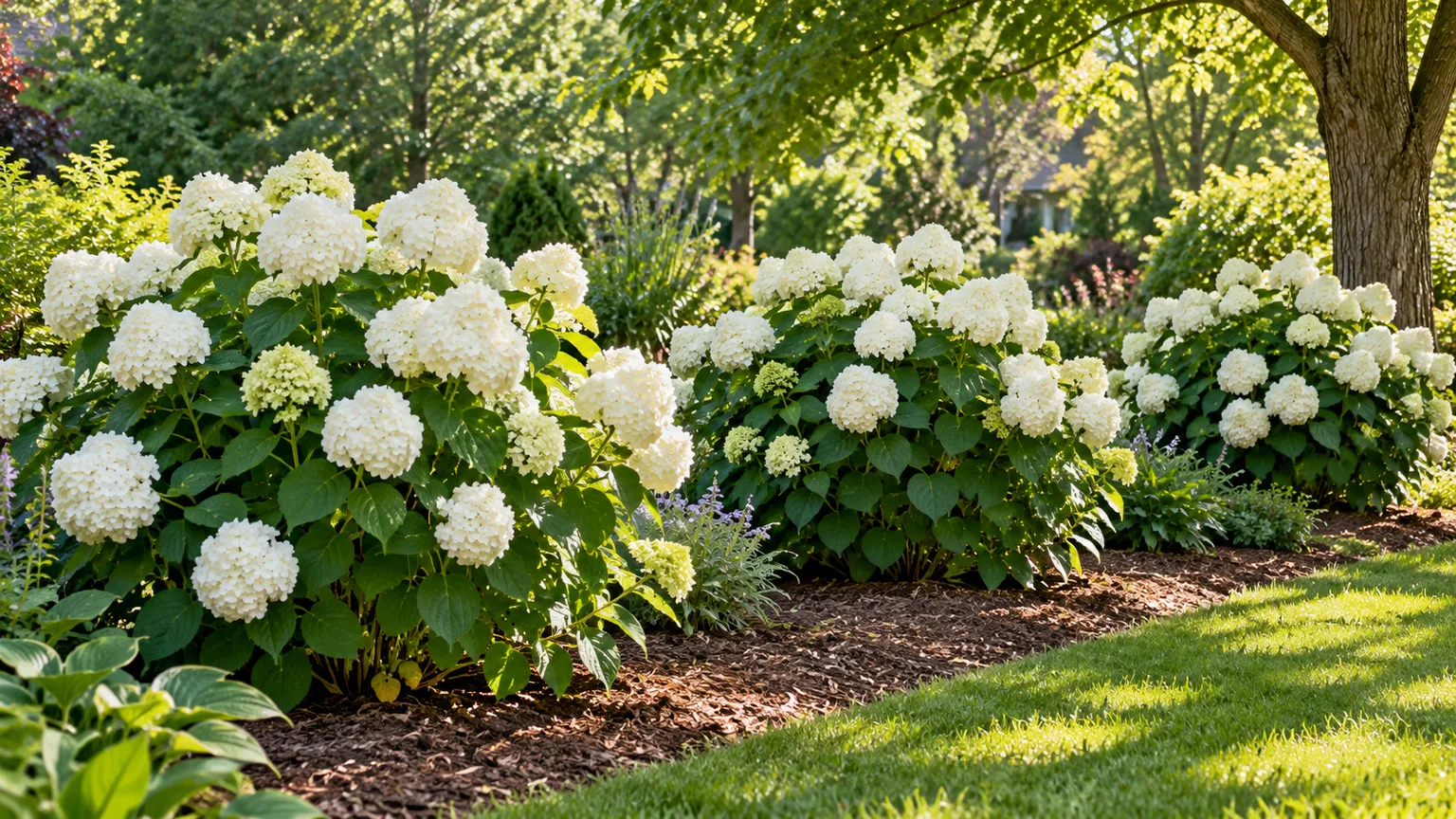
Allow for a mature spread of roughly 4 to 5 feet. In a continuous hedge, the breeder’s landscape guidance uses about 4 feet between plants to let neighboring shrubs knit together; for a looser row of individual shrubs, use close to 5 feet on center and allow additional clearance from paths, siding, and windows. Proven Winners’ hedge-spacing guidance is a useful reference for a connected hedge, while the wider spacing gives each plant more air and access for pruning.
Do not tuck the crown below grade. Planting too deeply can keep the stem bases wet and make establishment harder. Set the top of the root ball level with the surrounding soil, then mulch over the bed without piling mulch against the stems.
Planting a container-grown shrub
Spring and fall are convenient planting windows because cooler conditions reduce stress while roots adjust. In a hot climate, fall planting can be easier than establishing a new shrub during peak summer heat; in a cold climate, spring gives the plant a full growing season before its first winter. If the shrub arrives while weather is unfavorable, keep the root ball evenly moist and protect it from drying winds until you can plant.
Dig a hole about twice as wide as the root ball and no deeper than its height. If the roots are tightly circling the pot, tease the outer roots loose so they can grow outward; if they are densely matted, make a few shallow vertical cuts through the root mat. Set the shrub at the correct height, backfill with the excavated soil, and water slowly so the root ball and surrounding soil settle together. Epic Gardening’s practical Incrediball planting and care guide likewise emphasizes a broad planting hole and thorough watering after installation.
Keep the root zone evenly moist through the first growing season, particularly during dry spells. A newly planted shrub has not yet explored much soil, so nearby rain may not wet the original root ball enough. Check both the root ball and the surrounding soil with a finger or trowel; if one is dry while the other is wet, adjust how slowly and where you water rather than simply increasing the amount.
Water deeply without keeping roots soggy
Water based on the soil, not a fixed weekday schedule. During the first few months, check the root ball every few days in hot or windy weather; once the shrub is established, check the soil several inches below the surface and water when that root zone is beginning to dry. Apply water slowly at the base so it penetrates rather than running off the surface, then let the soil drain before watering again.
The goal is a steady supply of moisture, not permanently wet ground. Leaves that droop in late afternoon and recover overnight may reflect heat load, while a shrub that stays wilted with wet soil may have root stress rather than thirst. Test the ground before adding water. If the soil is dry and hard beneath mulch, water more slowly and in more than one pass; if it is saturated, pause watering and correct the drainage or irrigation pattern.
A 2- to 3-inch layer of organic mulch helps moderate soil temperature and slow evaporation. Keep a small mulch-free ring around the stem bases so the crown is not buried. Mulch is especially useful in a sunny bed, but it cannot compensate for a poorly drained site or an irrigation line that keeps the soil waterlogged.
Mulch and fertilize only when needed
Incrediball does not need a high-input fertilizer routine. If the shrub grows steadily and produces healthy leaves and flowers, leave it alone; extra fertilizer does not guarantee larger blooms. Excess nitrogen can push soft leafy growth at the expense of flowers and may produce longer, less self-supporting shoots. If growth is weak or a soil test identifies a deficiency, use a fertilizer labeled for woody flowering shrubs at the labeled rate and timing rather than guessing with a heavy application.
Avoid fertilizing late in the growing season. A late surge of tender growth may not harden before cold weather, and unnecessary feeding can aggravate excessive vegetative growth. A thin topdressing of compost can improve soil structure over time, but it should not be piled against the stems or treated as a substitute for checking drainage.
Do not add soil acidifier to make the original Incrediball blue. Its flower color is not controlled by soil pH. Soil testing can still be useful for diagnosing nutrient or pH problems, but color manipulation is not a reason to amend this cultivar’s soil.
Prune for a strong plant, not just large flowers
Incrediball blooms on new wood, meaning the flower clusters form on shoots grown during the current season. That gives you more flexibility than with hydrangeas that set next year’s flower buds on old stems. Still, pruning style affects the plant’s framework, final height, and the weight each new shoot must carry.
For an established shrub, the cultivar breeder recommends pruning in early spring when buds swell, cutting the plant back by about one-third and making cuts just above buds. University of Minnesota Extension’s hydrangea pruning guide, reviewed in 2026, notes that smooth hydrangeas can be pruned hard after they have had a couple of growing seasons, or left unpruned when a larger shrub is desired. These are different valid approaches, not a contradiction about whether the plant will flower: each encourages a different size and stem structure.
Use a light spring trim for routine care
For routine maintenance, wait until the worst winter weather has passed and new buds begin to swell. Remove dead or broken stems first, then shorten the remaining growth by roughly one-third of the shrub’s height, cutting just above a pair of healthy buds. Use clean bypass pruners for stems you can cut easily and loppers for thicker branches; avoid shearing every stem to the same low height unless that is the deliberate renewal plan.
A recently planted shrub should be allowed to establish before a hard annual cut. For its first season or two, focus on watering, removing damaged stems, and shaping only where a branch is broken or badly misplaced. Preserving some older woody stems gives the plant a more substantial base while its root system is still developing.
Reserve a hard cut for a specific reason
You can cut an established smooth hydrangea much lower in late winter or early spring because it flowers on new growth. That can be useful when a shrub has outgrown its space or needs renewal, but cutting the entire plant to the ground every year is not necessary. Very low pruning tends to trade a compact woody framework for a flush of vigorous new shoots; the flower heads may be large, but long fresh stems can be more vulnerable to rain and wind.
If your plant is already tall and floppy, do not assume a lower cut is the only fix. Try reducing the shrub by one-third, removing a few of the oldest or weakest stems at the base, and leaving sturdier stems at varied heights. This selective approach improves air movement and can retain a supportive framework without making the shrub a uniform row of short stubs. Avoid pruning after new shoots have elongated in spring unless you are correcting damage; late cuts remove growth the plant has already invested in and can delay the show.
Keep rain-heavy flower heads from leaning
Incrediball’s stems are stronger than Annabelle’s, but wet flower clusters can still bend. A newly planted shrub, a plant cut very low, or a shrub grown in deep shade may have more flexible shoots. The first practical response is not to prune harder: give the plant enough light for sturdy growth, avoid excess nitrogen, and preserve some older stems when you prune.
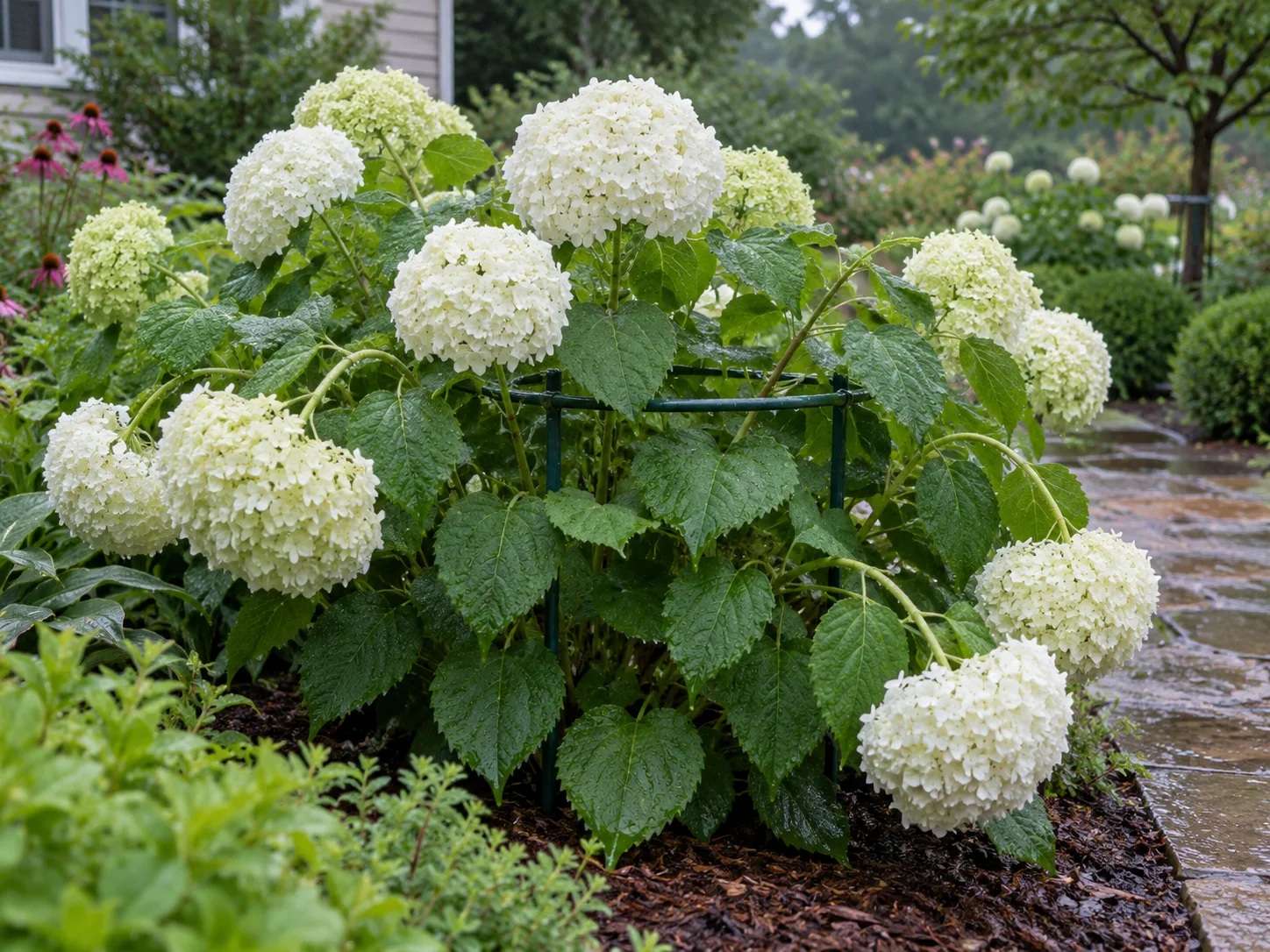
If stems lean every year, install a discreet grow-through support in early spring before shoots fill in. A circular shrub support or a few stakes with a crosswise grid can hold the outer stems while leaves and flowers conceal much of the structure. Set supports low enough to be unobtrusive but high enough to catch stems before they collapse; do not cinch stems tightly into narrow ties.
After an exceptional storm, gently lift a broken or heavily bowed stem and tie it loosely to a stake if it is not split. A split stem will not regain strength, so remove it with a clean cut. Some gardeners prefer the natural, arching look and accept temporary leaning; support is a design choice, not a prerequisite for plant health.
Understand flower color and bloom timing
The original Incrediball’s flower clusters open with a green cast, turn white as they mature, and later shift toward green again. The exact timing varies with local weather, light, and the plant’s age, but expect a summer display rather than a guaranteed date or a continuous, season-long succession of fresh white heads. Removing an old cluster makes the shrub tidier; it does not reliably force a new full flush of flowers.
Soil pH does not turn these blooms blue or pink. That well-known color response applies to some bigleaf hydrangeas, not this smooth-hydrangea cultivar. Incrediball Blush is a separately bred pink-flowering cultivar; adding aluminum or changing pH will not transform an original Incrediball into Blush. If a label promises blue flowers, it is not describing the standard ‘Abetwo’ cultivar.
You can leave the aged flower heads through fall and winter for structure, then remove them during spring pruning. The breeder notes that the dried heads can remain attractive into winter. If you want cut flowers, cut stems when the heads feel papery and firm rather than at their freshest, softest stage; mature heads generally hold their shape better when dried.
Protect the roots through winter
The listed hardiness range is USDA zones 3 through 8, but a zone rating is a guide, not a guarantee for every exposed garden. Wind, soil drainage, snow cover, late frost, and the health of the shrub all affect performance. In the ground, a well-established Incrediball usually needs little special winter protection; a layer of mulch over the root zone is more useful than wrapping the whole shrub tightly.
Because it flowers on new wood, winter dieback of last year’s stems does not automatically eliminate flowers. Wait until late winter or early spring to assess the shrub, when live buds and dead stems are easier to distinguish. Remove broken or clearly dead wood, then follow the pruning approach that fits your desired size. In the coldest sites, protect the roots and avoid late-season fertilizing that could encourage soft new growth.
Spring freezes are a separate risk. New shoots can emerge early during warm weather and be damaged by a later frost. If a cold snap is forecast after budbreak, a breathable cover overnight can reduce exposure on a small shrub; remove it during the day so the plant does not overheat. Damaged tips may look alarming, but new growth farther down the stem can still develop.
Grow Incrediball in a container or move it
A container can work for a temporary display, but a 4- to 5-foot shrub with a broad root system is not an easy permanent patio plant. Choose a large, heavy pot with generous drainage holes, use a quality outdoor container mix, and expect to water more often than an in-ground plant. A small nursery pot dries too quickly and may not anchor a top-heavy shrub once it leafs out.
Winter is the limiting factor. Roots in a pot are exposed to colder air on all sides and are less insulated than roots in garden soil. The breeder advises choosing a plant rated about two hardiness zones colder than your local zone for permanent container culture. In a severe winter, an unheated sheltered location or moving the pot into protected storage may still be needed. Do not bring it into a warm living room as if it were a houseplant; it needs its outdoor dormancy cycle.
If you want to move an established Incrediball, do it while dormant in early spring or fall when the soil is workable and the weather is cool. Water the shrub before digging, take as wide a root ball as practical, and replant it at the same depth. Moving a large shrub is stressful, so prune only damaged or awkward stems rather than combining transplanting with a severe cut. Keep the relocated root zone evenly moist while it re-establishes.
Troubleshoot a shrub that will not bloom well
First check whether the plant is correctly identified. Panicle, bigleaf, oakleaf, and smooth hydrangeas have different flower shapes and pruning needs. If the shrub has cone-shaped flowers or pink-to-blue mophead flowers, it may not be Incrediball, and applying smooth-hydrangea pruning advice could be the wrong fix.
For a confirmed Incrediball, work through these causes in order:
- It is still establishing. A newly planted shrub may prioritize roots and leafy growth before it produces a full display. Keep moisture steady and avoid trying to force blooms with extra fertilizer.
- It receives too little useful light. Deep shade often means fewer flowers and weaker shoots. Move it toward brighter morning light if the site remains cool, while preserving afternoon shade in hot climates.
- The root zone dries during bud growth. A shrub may survive a dry spell but produce less growth and smaller flower heads. Check soil moisture several inches down and water deeply when the root area begins to dry.
- The shrub was cut very low or late. New-wood flowering means pruning will not remove the next year’s old-wood buds, but a late or very hard cut can delay growth and reduce the season’s early display. Leave a supportive framework next spring.
- Excess nitrogen is driving leaves instead of flowers. Stop routine feeding and use a soil test before adding fertilizer again.
- Spring frost damaged emerging shoots. Wait for new growth lower on the plant before deciding the entire shrub is lost.
If you see healthy leaves but no flowers for multiple seasons, photograph the whole shrub, its light conditions, and the pruning cuts. A local extension office can help distinguish a site problem from a mislabeled cultivar or a disease issue.
Watch for disease and protect pets
Powdery mildew and leaf spots can occur, particularly where plants are crowded or foliage stays humid. Improve airflow by giving shrubs enough space, water at the soil rather than spraying leaves late in the day, and remove badly affected fallen debris. Powdery mildew often looks worse than it harms an established shrub; identify the problem before reaching for a fungicide. Penn State Extension’s hydrangea disease guide describes common symptoms such as powdery growth and leaf spots, while Illinois Extension’s powdery mildew guidance recommends avoiding excessive fertilizer and watering that produce vulnerable growth.
Keep pets from chewing the leaves or flowers. The ASPCA lists hydrangea as toxic to dogs, cats, and horses; if an animal eats part of the shrub, contact your veterinarian or an animal poison-control service for advice. ASPCA’s hydrangea listing provides the species-level warning. Planting it in a bed does not mean pets will necessarily be exposed, but discourage chewing and clear pruned material where animals can reach it.
Conclusion
Incrediball is a cold-hardy, white-flowering smooth hydrangea that rewards a well-chosen site more than a complicated feeding program. Give it bright light suited to your summer climate, room to reach its 4- to 5-foot spread, moist but draining soil, and steady water while it establishes. Its new-wood flowering makes pruning flexible, but a light spring trim and a retained woody framework are often a better starting point than cutting every stem to the ground each year.
The plant’s stronger stems reduce one common Annabelle problem; they do not remove the physics of a rain-soaked flower head. If a mature shrub still leans, adjust light and pruning first, then add a low support before the next bloom season. With those expectations, Incrediball can give you large seasonal flowers without demanding a rigid schedule or color-changing soil treatments.



