Does Diatomaceous Earth Kill Stink Bugs?
Does diatomaceous earth kill stink bugs? Learn when DE can work, why it often fails indoors, and the safer exclusion and removal steps that work better.
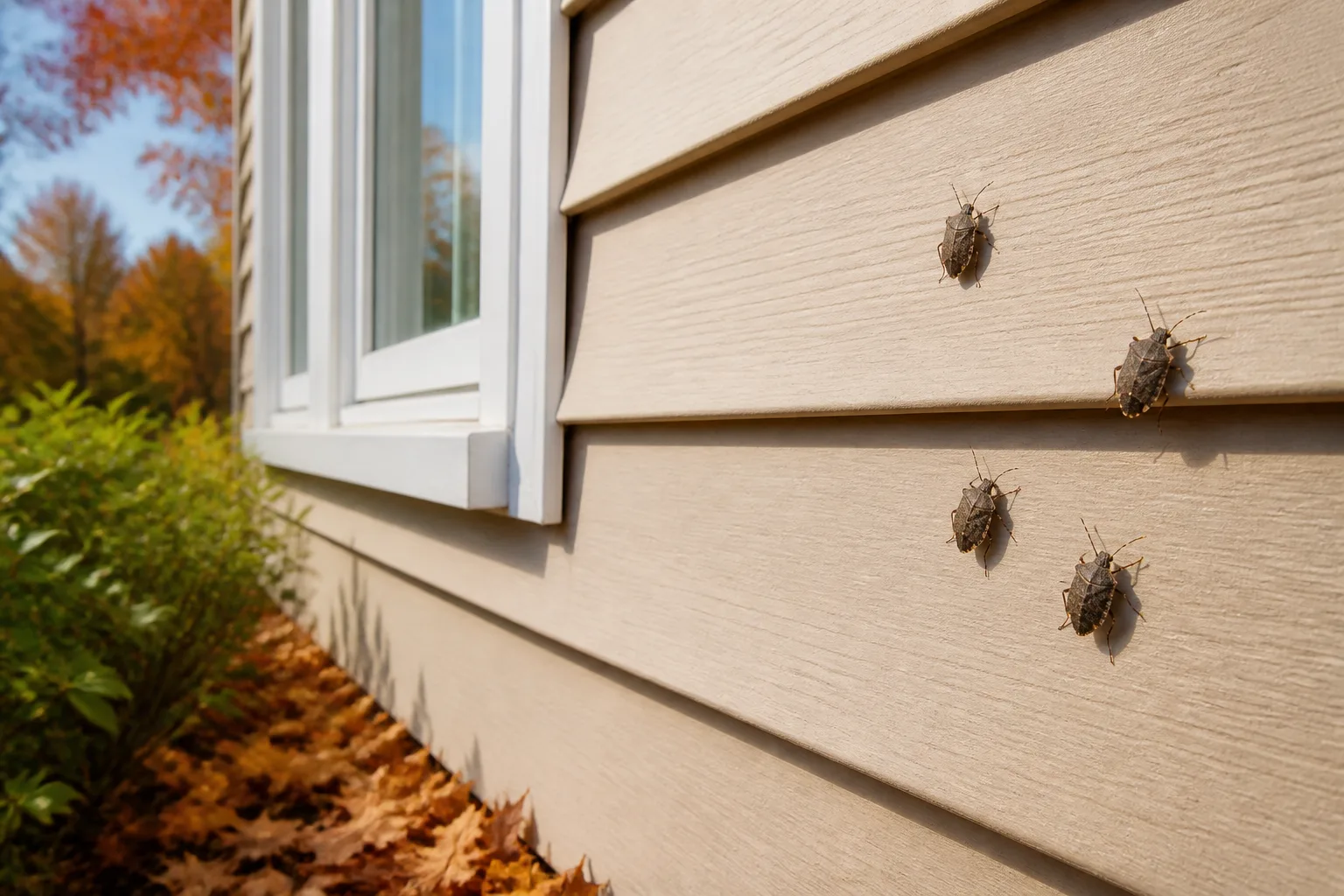
Yes, diatomaceous earth can kill a stink bug if the insect picks up enough dry powder and stays in contact with it. That is a much narrower promise than “DE gets rid of stink bugs,” though. A stink bug that crosses a dry, label-approved deposit may eventually die from desiccation; a stink bug tucked inside a wall void, avoiding the powder, or arriving through a different gap is unaffected.
For a few bugs on a patio or along a known exterior route, DE can be a reasonable supplemental tool. For a fall invasion inside the house, the better order is physical removal, entry-point repair, and—when the numbers keep returning—an exterior assessment by a licensed pest professional. The powder may kill exposed insects, but exclusion is what breaks the cycle.
The Short Answer: Yes, but Not Reliably
DE is a dry, abrasive material made largely from the fossilized silica skeletons of diatoms. The National Pesticide Information Center explains that it works by absorbing oils and fats from an insect’s outer cuticle while its particles abrade that protective surface. It does not need to be eaten, and it does not act like a fast neurotoxic spray. (National Pesticide Information Center)
That mechanism explains both the “yes” and the “not reliably.” The insect must physically contact the powder, the powder must remain dry, and the exposure must last long enough to damage the cuticle and upset the insect’s water balance. A stink bug walking across a light dusting has a chance of being affected; a bug flying over it, hiding behind trim, or getting the powder wet does not.
The practical verdict is simple:
| Situation | Is DE worth considering? | Better priority |
|---|---|---|
| One or two bugs on a dry outdoor threshold | Sometimes, as a labeled supplement | Remove the bug and close the gap |
| A seasonal stream entering windows or doors | Usually not by itself | Repair screens, weather-stripping, and caulk |
| Bugs emerging from baseboards or a wall void | Poor DIY target | Seal the opening and get an assessment |
| Stink bugs feeding on vegetables or fruit | Only if the product label allows it | Scout, hand-remove, cover, and use targeted control |
| A dusty indoor room with children, pets, or respiratory sensitivity | Avoid casual dusting | Use non-dust removal and exclusion |
This is why a bag of DE can sit untouched while the house still fills with stink bugs. It may be killing a few exposed insects without addressing the route that supplies the next few dozen.
What DE Does to an Insect
Think of DE as a contact desiccant dust, not a bait and not a repellent. It has no reason to draw a stink bug out of hiding, and the insect does not have to consume it for the material to work. Its job begins only after a crawling insect walks through enough dry product for the particles to cling to its body.
The outer cuticle normally helps an insect retain moisture. DE’s absorbent and abrasive particles compromise that barrier, so the insect gradually loses water. The time varies with the insect, the amount of contact, temperature, humidity, and whether the powder stays undisturbed; a precise “DE kills stink bugs in X hours” promise is not justified by the evidence gathered for this question.
Dryness and contact are the limiting conditions
Dryness is not a minor detail. NPIC says DE remains effective as long as it is kept dry and undisturbed, while water turns the powder into a clump or carries it away from the route insects use. A water-based application may be easier to spread in some outdoor situations, but the deposit has to dry before its desiccating action can occur, and the product label controls whether that use is permitted.
This creates a useful decision rule: dry plus contacted can work; wet plus avoided cannot. Rain, dew, irrigation, condensation, sweeping, and a thick visible ridge can all reduce the chance that a stink bug will pick up a meaningful dose. Reapplying blindly can add dust without improving contact.
There is also a selection problem. A contact dust does not know the difference between a nuisance stink bug, a predatory stink bug, a beetle, a spider, or another arthropod that crosses the treated surface. In a garden, place any control only where the label permits and avoid flowers and areas busy with pollinators.
Why Stink Bugs Are a Poor DE Target Indoors
Many fall stink-bug problems are not indoor infestations in the usual sense. Brown marmorated stink bugs (Halyomorpha halys) commonly enter buildings in late summer and fall to find protected places to overwinter. Penn State Extension notes that they do not reproduce inside structures or damage the building; they hide in places such as wall voids and later emerge when warmth makes them active again. (Penn State Extension)
That behavior works against DE. A powder line on a windowsill may catch an individual wandering along the sill, but it will not reach insects already behind the sill, underneath trim, in an attic, or inside a wall. Dusting every crack can also make the room harder to clean and increase airborne exposure without sealing the opening that lets the insects move through.
Stink bugs are also mobile. They may gather on a warm exterior wall, fly toward a light, squeeze behind trim, or emerge from a ceiling fixture. A static barrier is easy to bypass unless it lies directly across the route, stays dry, and is placed where the product label allows use. That is a poor match for a building with many separate entry points.
The University of Maryland Extension describes the indoor problem as a nuisance rather than a plant-feeding emergency: these bugs generally do not bite, are not attracted to houseplants for food, and are often drawn by light while wandering indoors. (Maryland Grows) If the bugs keep appearing around a grow light or a bright window, moving the light temporarily and closing the nearby route may accomplish more than dusting the plant room.
Identify the Bug and the Problem First
“Stink bug” can mean many members of the family Pentatomidae. Some are crop pests, some are incidental visitors, and some are predators that help eat other insects. Washington State University notes that roughly 200 stink-bug species occur in the United States and that some are beneficial, so treating every shield-shaped bug as the same pest is a fast way to choose the wrong response. (Washington State University Tree Fruit)
For a common brown marmorated stink bug, look for a mottled brown, shield-shaped adult about 17 millimeters long, alternating light and dark bands on the antennae, and a banded edge around the abdomen. Penn State Extension describes egg masses on leaf undersides and five nymphal stages, which is useful when the problem is in the garden rather than in a wall.
The setting is just as important as the body pattern. A handful of adults on a sunny outside wall in October suggests overwintering pressure; clusters of nymphs under vegetable leaves in summer suggest active feeding and reproduction outdoors. Those are different problems with different first actions.
Brown marmorated stink bugs are not the only shield bugs
Do not automatically dust a beneficial predatory stink bug because it resembles a brown marmorated stink bug at a glance. If the bug is on a flowering plant, on a crop, or in a place where natural enemies are valuable, take a clear photo and compare the markings with a university extension identification guide before treating.
You also do not need to solve the species question perfectly to handle an indoor visitor. Avoid crushing it, remove it without spreading odor, and inspect the opening it used. Species-level identification becomes more important when plant damage, egg masses, or repeated outdoor clusters are involved.
If You Try DE, Treat It as a Narrow Supplemental Barrier
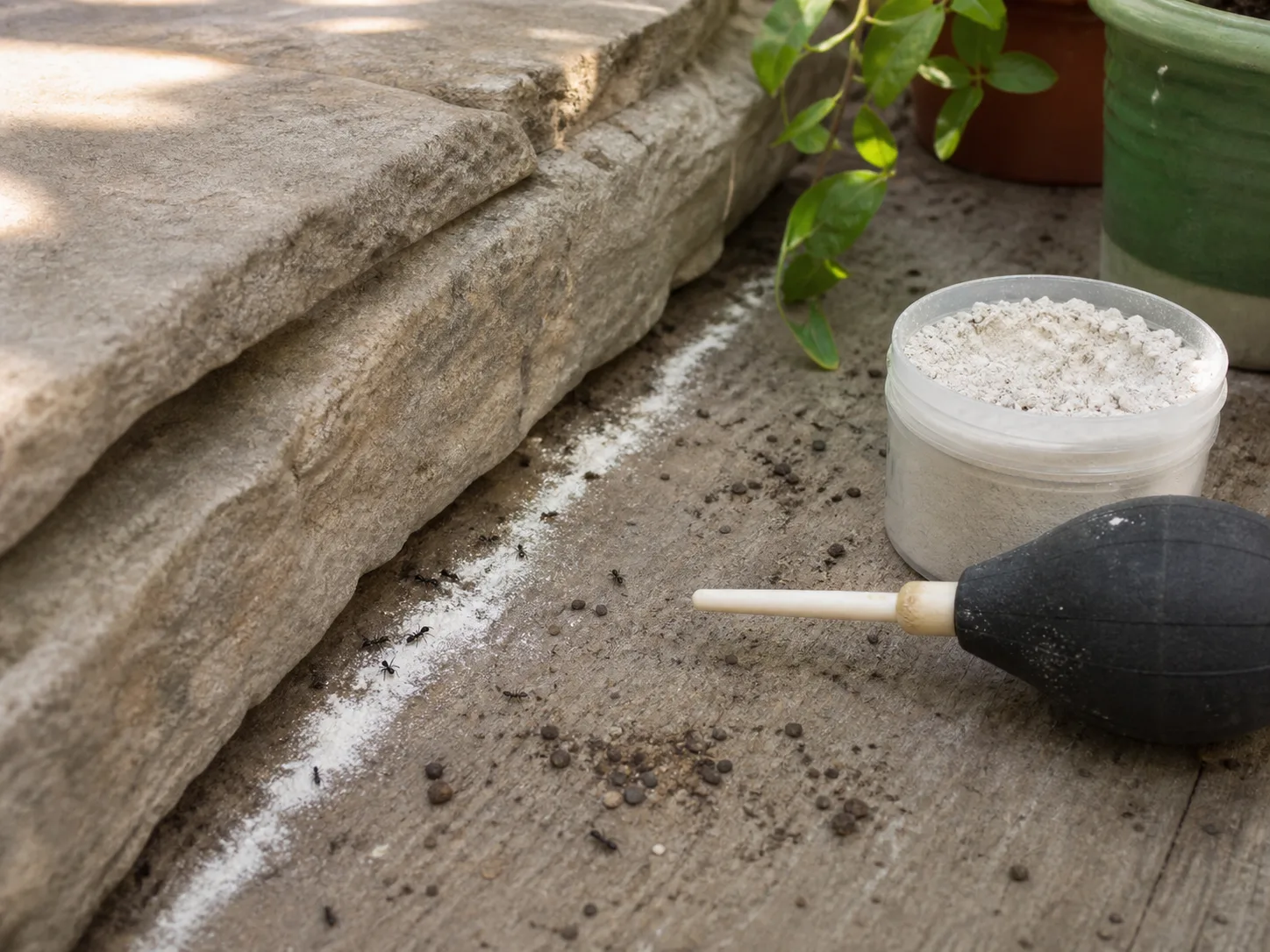
Use DE only to solve a defined contact problem, not as a white perimeter around the entire house. A sensible example is a dry, sheltered crack on the exterior where you have seen bugs crawl and where the product label permits application. A poor example is broadcasting powder across a porch, sprinkling it into a living room, or filling wall cavities because you cannot find the access point.
Product choice and dust safety matter more than the word “natural”
Read the package before opening it. NPIC distinguishes pesticide products containing DE from the many non-pesticide products used in foods, filters, paints, and other applications. “Food-grade” describes a processing/use category; it does not automatically mean the bag is registered or labeled for stink bugs, indoor cracks, edible crops, or a particular surface. (National Pesticide Information Center)
Never substitute pool-grade DE for pest control. Pool products are processed for filtration and can contain more crystalline silica, while the respiratory risk of inhaling crystalline silica is materially different from ordinary brief contact with amorphous DE. Keep the original container, follow the label’s target and site instructions, and do not mix products or invent a concentration.
The powder is not “poisonous” in the way many conventional insecticides are, but that does not make airborne dust harmless. NPIC lists possible irritation of the nose and airways if inhaled, abrasive eye irritation, and skin dryness or irritation. Work in still conditions, avoid creating a cloud, use the label-specified protective equipment, keep people and pets away during application and settling, and store the container out of reach. (National Pesticide Information Center)
For a narrow outdoor application, the sequence is:
- Confirm the insect and identify the route it is actually using.
- Read the product label for the target pest, location, application method, and precautions.
- Apply the smallest thin layer that can put dry powder on the route, rather than a thick mound that an insect may avoid.
- Keep it away from flowers, food-preparation surfaces, air intakes, children’s play areas, pet resting areas, and wet locations unless the label specifically addresses that use.
- Recheck after rain, dew, irrigation, or cleaning, and reapply only as the label allows.
If you cannot explain exactly where the stink bug must crawl through the deposit, DE is probably not the right first move. Seal the route or remove the insect instead.
When DE Will Fail
The most common failure is treating visibility as proof of exposure. Seeing a bug near a white patch does not mean it crossed the patch, picked up enough powder, or stayed in contact long enough for desiccation to matter.
DE is especially likely to disappoint in these situations:
- The powder gets wet from rain, dew, watering, or condensation.
- The application is outdoors in wind and blows away before insects cross it.
- A thick ridge is placed where a bug can walk around it.
- The bug is flying, dropping from a ceiling, or hiding inside a wall void.
- The treated crack is not the opening the insects use.
- The problem is a stream of new fall invaders rather than a few exposed insects.
- The product is unlabeled for the site or the gardener assumes food-grade means every use is approved.
- The dust is placed on flowers or broad foliage where non-target insects may contact it.
Rain is not the only reset. A person sweeping the threshold, a dog brushing through a powder line, or a maintenance worker caulking over it can remove the deposit. That is another reason exclusion is more durable: a repaired screen or new door sweep keeps working after the weather changes.
Do not judge the method by whether you find dead bugs nearby. If the count is not falling after the route is sealed and the exposed bugs are removed, the useful conclusion is not “add more DE.” It is “the source, route, or species assumption needs another look.”
The Better First Response for Bugs Already Inside
Start with removal, not room-wide dusting. A vacuum is fast for exposed adults, and a cup or jar with a little soapy water is useful when there are only a few. Penn State Extension and NC State Cooperative Extension both describe vacuuming as a practical way to remove live and dead stink bugs, while warning that the vacuum can pick up their odor. (N.C. Cooperative Extension)
Use a bagged vacuum if you have one, or empty a bagless canister outdoors as soon as you finish. Do not crush the bugs against a wall or window: their defensive secretion produces the smell, and Penn State notes that sensitive people can experience rhinitis, conjunctivitis, or occasional skin irritation around the odor.
For a small number, gently guide the bug into a cup rather than grabbing it. If you release it outside, do so away from doors and windows; if the goal is removal, a soapy-water container avoids the crushing that makes the room smell and keeps the bug from flying back inside.
Remove them without turning the vacuum into an odor machine
The cleanest routine is short and physical: vacuum the visible bugs, empty the canister or remove the bag outside, wipe the nozzle if needed, and then inspect the nearest window, door, vent, or trim. If bugs are emerging from several rooms, track where they appear at sunrise or after the heat comes on; that pattern can reveal a shared wall or ceiling route.
A shallow pan of water with a few drops of dish soap under a lamp can help collect wandering adults overnight in a dark room. Gardenia describes this as a simple indoor trap, but treat it as a temporary population-reduction tool—not a replacement for sealing—and keep the pan and lamp away from children, pets, and anything flammable. (Gardenia)
Avoid foggers and casual indoor spraying when the bugs are inside wall or attic spaces. Penn State Extension warns that killing insects in voids can create a secondary problem when carpet beetles feed on the dead bodies, and that sprays into cracks do not prevent more stink bugs from emerging.
Seal the Routes Stink Bugs Use to Enter
The durable fix is mechanical exclusion: make the opening disappear. Penn State lists cracks around windows, doors, siding, utility pipes, chimneys, fascia, and damaged screens as important targets; Maryland Extension adds weather-stripping, vent covers, conduit, pipe penetrations, and window air-conditioner gaps. (Penn State Extension)

Run a 15-minute exterior inspection
Walk the sunny sides of the house during the part of the day when stink bugs are most visible. You are looking for a path, not just a bug: a gap under a window trim, a torn screen, a loose garage seal, or a cable and pipe passing through siding with daylight around it.
Check these locations in order:
- Doors: Replace worn weather-stripping and install a tight door sweep; inspect the garage door’s bottom seal too.
- Windows: Repair torn screens, confirm the screen seats tightly, and caulk gaps around stationary trim.
- Vents and openings: Look at dryer vents, exhaust fans, soffits, attic vents, crawl-space vents, and chimneys for missing or damaged screening.
- Utility penetrations: Inspect cable, internet, electrical, air-conditioning, plumbing, and conduit entries for gaps in the seal.
- Siding and trim: Examine joints, fascia, loose boards, and the area behind or under trim where insects can disappear.
- Window AC units: Remove seasonal units when appropriate or close the surrounding access points according to the equipment instructions.
Use the right repair for the opening. Flexible weather-stripping belongs at a moving door or window; caulk belongs on a fixed seam; a damaged screen needs replacement or patching; a vent needs a properly fitted screen that does not block airflow. Expanding foam is not a universal answer around every cable, flue, or appliance.
The best test is what happens after the repair. If the indoor sightings shift to a different wall or stop at that opening, you have learned something; if nothing changes, continue the inspection instead of layering more powder over the first guess.
Make Fall Prevention a Routine
Timing matters because adult brown marmorated stink bugs move toward sheltered overwintering sites in fall. Penn State describes adults beginning that search around September and October in Pennsylvania, while local weather and species shift the calendar elsewhere. Start the inspection before repeated cool nights and before you see large numbers basking on warm walls. (Penn State Extension)
This Is My Garden’s practical fall checklist emphasizes the same sequence: inspect and seal doors, windows, thresholds, utility holes, and vent screens before the insects begin pressing indoors. Its most useful insight is operational rather than chemical—small repairs made before the invasion are easier than chasing bugs room by room after they have settled behind trim. (This Is My Garden)

Reduce easy attractants near the building without pretending the landscape can be made stink-bug-free. Harvest ripe fruit promptly, remove fallen produce, keep dense weeds and debris from touching the foundation, and avoid leaving doors or garage doors open for long periods during peak activity. These steps are supporting measures; they cannot compensate for a torn screen or a large unsealed utility opening.
Exterior lighting can also influence where insects gather, especially around doors at night. WSU documents that brown marmorated stink bugs are attracted to lights, while the more important fall driver is the search for warm, sheltered overwintering space. A shielded fixture or a less attractive outdoor light can reduce congregation at the door, but it is not a substitute for closing the route. (Washington State University Tree Fruit)
Separate a Home Nuisance From a Garden Pest
The same insect can be a nuisance at the house and a real crop pest in the yard. Brown marmorated stink bugs feed on many fruits, vegetables, ornamental plants, and weeds; Penn State lists apples, peaches, apricots, figs, citrus, persimmons, beans, corn, tomatoes, and soybeans among the hosts. Feeding damage can appear as distorted or scarred fruit rather than as a dramatic hole in a leaf.
If stink bugs are on plants, scout before treating. Look under leaves for egg masses, inspect developing fruit, note whether you are seeing adults or nymphs, and check where damage is appearing first. A few adults on a non-fruiting ornamental are a different risk from a growing nymph cluster on tomatoes or peaches.
Protect crops without blanket-dusting the garden
For a small planting, knock bugs into a soapy-water container, remove egg masses where practical, harvest on time, and use row cover over susceptible crops when the crop and pollination needs allow it. Gardenia recommends early scouting, hand removal, row covers, and focusing treatment on hot spots rather than spraying without evidence of active pests. (Gardenia)
DE can fit only if the product label allows the crop, pest, application site, and method. Even then, a dry contact dust is not selective; avoid flowers and do not treat the entire plant because “natural” sounds gentler. Apply to a defined, dry target area, protect yourself from the dust, and compare the likely crop benefit with the cost to beneficial insects and the need to repeat after weather.
Do not confuse garden prevention with indoor exclusion. Removing fallen fruit may reduce food near the house, but it will not close a gap under the fascia; dusting a garden path will not stop adults already inside the wall. Keep the two plans separate so each action has a clear job.
When a Professional Treatment Makes Sense
Call for an assessment when bugs return in large numbers after you have repaired obvious openings, when they are emerging from inaccessible wall or attic spaces, or when plant damage is substantial enough that you need a crop-specific plan. A licensed professional can map likely routes, recommend an exterior treatment that matches the label and timing, and tell you which repairs are worth making before the next seasonal peak.
Ask what the service is designed to accomplish. Good questions include: Which entry points did you find? Is the proposed product labeled for stink bugs and the exact exterior surfaces? What should be kept away during application and for how long? How will success be measured—fewer exterior congregations, fewer indoor sightings, or both? What exclusion repairs remain necessary?
Penn State Extension notes that exterior insecticide applications can offer limited relief when complete sealing is difficult, but sunlight reduces residual performance, sometimes to only several days or a week. That makes timing and exclusion more important than a one-time promise of permanent control. (Penn State Extension)
Be particularly cautious about anyone recommending indoor dusting of every void or routine fogging without an inspection. A professional plan should explain the source of the problem, minimize unnecessary exposure, and include a path to reduce reinvasion rather than simply killing the bugs that happen to be visible today.
Conclusion
Does diatomaceous earth kill stink bugs? Sometimes—but only when dry powder contacts the insect long enough to desiccate it. That makes DE a limited contact tool, not a reliable answer for a house that is easy to enter or a wall void full of overwintering adults.
If the bugs are already inside, remove them with a vacuum or cup and avoid crushing them. Then repair screens, weather-stripping, door sweeps, vent covers, utility penetrations, and trim gaps before the next fall wave. Use DE only when the product label supports the specific target and location, keep the dust out of breathing zones and pollinator areas, and bring in a licensed professional when the route is inaccessible or the invasion keeps restarting.



