How to Grow and Care for European Fan Palm
Learn how to grow European fan palm in a bed or container, with practical advice on sun, drainage, watering, winter protection, pruning, and spiny fronds.
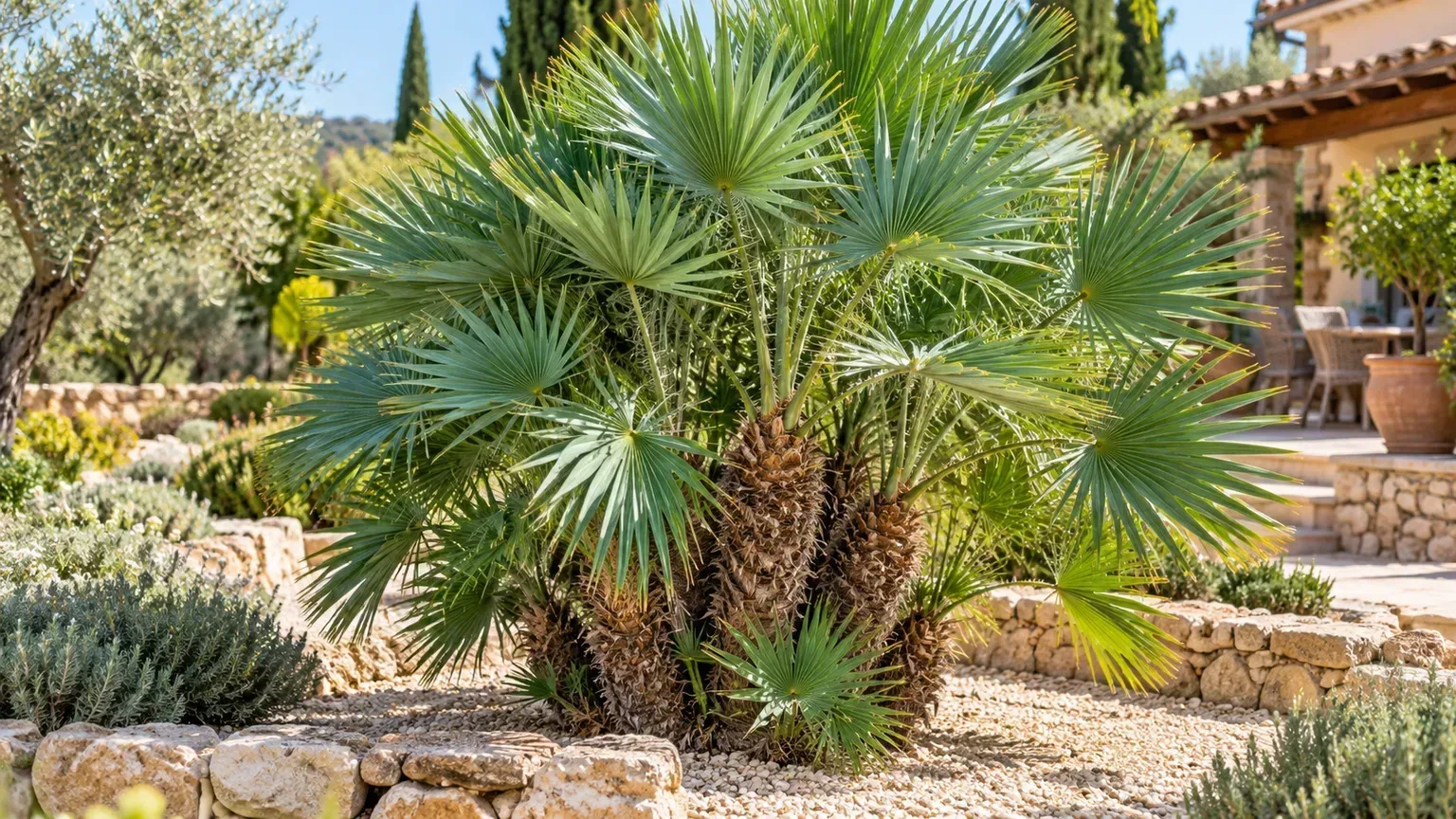
The European fan palm (Chamaerops humilis), also called Mediterranean fan palm or dwarf palm, is a slow-growing, clumping palm for gardeners who want bold fan-shaped foliage without the tropical cold sensitivity of many palms. It is most dependable outdoors in mild-winter regions, where sharp sun and fast-draining soil suit it. In colder climates, a container can make winter protection possible, but a potted palm is not as insulated as one rooted in the ground.
The practical care formula is straightforward: give it a bright site, allow water to drain freely, keep young roots evenly supplied with moisture while they establish, and leave enough clearance for the spiny leaf stalks and eventual clump. Do not choose it just because it is called “dwarf”—a mature plant can become a broad, substantial shrub.
Is European Fan Palm Right for Your Climate and Space?
This is a good palm for a warm-temperate landscape, a sunny courtyard, or a large patio container. UF/IFAS describes it as suitable for USDA zones 8 through 11 and notes that established specimens can survive temperatures around 10°F or lower, sometimes with leaf damage while the trunk survives and regrows. Treat that as a useful hardiness range, not a guarantee: cold duration, wind, wet soil, the plant’s age, and whether it is in the ground all change the outcome. A young palm or one in a pot is more exposed than an established landscape plant.
Think in terms of the winter your garden actually gets, not only its zone label. If your site regularly has prolonged freezes, freezing rain, or cold winds, use a movable container or choose a more reliably hardy plant. If winters are usually mild but occasional cold snaps occur, a sheltered planting spot can reduce exposure. The UF/IFAS profile and NC State Extension profile both describe this species as one of the more cold-tolerant palms, while emphasizing that it still needs proper site conditions.
Space is the other decision. Landscape references put mature plants in a broad range, roughly 6 to 15 feet tall and often 6 to 20 feet wide depending on form and growing conditions. A young nursery plant may look like a compact accent for years, but its basal suckers can develop into a many-stemmed mound. Do not put it in a narrow foundation strip or beside a gate if you are unwilling to prune the clump or brush past spines.
What Makes Chamaerops humilis Distinctive?
European fan palm is an evergreen, clumping palm native to the Mediterranean coast of southern Europe and North Africa. It is unusual among palms for its shrubby, multi-trunk growth: several short, fibrous stems can rise from the base and support a dense, rounded crown. The leaves are palmate, meaning their narrow segments radiate from one point like the folds of a fan. They range from green to blue-green or silvery, depending on the plant and cultivar.
Small yellow flowers can appear in spring on mature plants, tucked close to the leaves, followed by berry-like fruits. Flowers and fruit are usually supporting details rather than the reason to buy one; foliage and form are its main landscape value. The petiole—the stalk that joins a fan leaf to the trunk—can carry numerous sharp teeth. That feature helps explain why the palm works best as a focal point or barrier behind a bed, not as a plant that people or pets brush against every day. NC State Extension notes the variation in leaf color, shape, and petiole armature, so appearance can differ among nursery selections.
Choose a Site With Sun, Space, and Safe Access
Choose a spot where the canopy can broaden and where leaf stalks will not reach a walkway, play area, pool entry, or narrow side yard. If you are planting a row or a group, plan spacing from the expected mature spread rather than the nursery pot width. Four feet between small plants may look adequate on planting day, but it can create a crowded, difficult-to-prune thicket as each palm matures. For a specimen, leave several feet of clearance around the outer edge of its eventual crown.
A little shelter from the coldest winter wind is useful in marginal climates, but do not tuck the palm into a damp, dark corner to achieve it. Good drainage and enough light matter more than a protected position that stays wet. In a windy site, avoid planting where stiff fronds will scrape a wall or where the crown will be repeatedly battered against a fence. Because the leaf stalks are spiny, wear thick gloves and eye protection when working nearby, and use long-handled tools rather than reaching through the foliage.
How Much Light Does It Need?
Full sun generally keeps the plant compact and supports strong growth; partial shade is tolerated. NC State Extension warns that too much shade can loosen the plant’s shape, while UF/IFAS notes that shade can slow growth and produce somewhat larger fronds. That trade-off can be useful in a very hot site, but deep shade is not a shortcut to a dense, healthy palm. Aim for several hours of direct sun, ideally most of the day outdoors.
An indoor European fan palm needs the brightest available position, such as a large unobstructed south- or west-facing window in the Northern Hemisphere, with enough room to keep foliage from pressing against glass. It can survive indoors, but it is not an ideal low-light living-room palm. If growth becomes weak, leaves stretch toward the window, or the crown thins, improve the light or move it outdoors when temperatures are safely warm. Introduce it to stronger direct sun gradually after a winter indoors to reduce scorch on leaves that developed under lower light.
Plant in Soil That Drains Quickly
Drainage is the soil requirement to get right. This palm tolerates a range of textures—from sand to loam and some clay—once excess water can move away from the root zone. It is less forgiving of a low spot that stays saturated after rain or irrigation. NC State Extension identifies overwatering as a cause of root and stem rot; amending a poorly drained site or planting on a slight mound is safer than hoping a drought-tolerant palm will tolerate wet feet.
Before planting, check the site after a normal rain. If water remains pooled long after surrounding ground has drained, choose another spot, improve drainage, or use a raised bed. Do not fill a planting hole with a pocket of loose potting mix inside dense clay; the abrupt texture change can hold water around the roots. Instead, improve the broader planting area, loosen compacted ground, and position the root ball so the top of the root mass sits level with the surrounding soil. Planting too deeply buries the crown and stem base, where persistent moisture can cause decline.
Spring is a practical planting time because roots have a warm growing season to establish before winter. Water the root ball before placing it, backfill with native soil improved only as needed, and water slowly to settle the soil without compacting it. Keep mulch a few inches away from the stems so the base stays airy.
Water Deeply While Young, Then Back Off
A newly planted palm needs more attention than an established one. During its first growing season, water deeply when the root zone begins to dry rather than letting the entire root ball bake hard between waterings. In a hot spell, that may mean checking it several times a week and watering weekly or more often; in cool, rainy weather, the same schedule can keep roots too wet. Test beneath the surface with a finger or narrow trowel instead of relying on a calendar.
Once the palm is established and producing growth, it is notably drought tolerant. Water slowly enough to wet the root zone, then let the soil drain and dry somewhat before watering again. A brief dry period is usually less damaging than repeatedly saturating the crown and roots. If leaves yellow while the soil stays wet, stop automatic watering and inspect drainage before adding fertilizer or changing the light.
For a container plant, check more often in hot weather because a pot warms and dries faster than garden soil. Water until a little drains from the bottom, empty any saucer, and wait until the upper portion of the mix has dried before watering again. In winter, lower light and slower growth reduce water use, so the interval should lengthen. The goal is not to keep the mix constantly damp; it is to prevent both prolonged saturation and severe, repeated drought stress.
Feed Lightly During Active Growth
European fan palm is not a fast-growing plant that needs constant feeding. In a landscape bed, start with the soil and the palm’s appearance rather than applying fertilizer automatically. If growth is healthy and the soil is reasonably fertile, extra feeding may do little. A palm fertilizer formulated for landscape palms can be used during the active growing season when needed, but follow the product label for the region, plant size, and application method; do not improvise a concentrated dose against the trunk.
For a container plant, nutrients wash out more quickly, but heavy fertilizer can build up salts in a small root volume. Use a complete, slow-release product at the labeled rate in spring or during active growth, and stop feeding as growth slows for winter. Pale older leaves, weak growth, or discolored leaflets can have multiple causes, including light, water, root health, and nutrient availability. Diagnose the growing conditions before treating every color change as a deficiency. Avoid fertilizing a palm with damaged roots or a newly divided offset until it shows signs of recovery.
Grow It in a Container Without Keeping It Soggy
A pot is useful if your winters are colder than the palm can reliably tolerate or if you want to move it between an outdoor patio and bright winter quarters. It also limits the plant’s ultimate size, but it does not turn a large, slow-growing landscape palm into a small tabletop plant. A European fan palm needs a heavy, stable container: its broad foliage catches wind, and a light pot can tip as the clump grows.
Set the container in a position with abundant sun and enough clearance for the spiny leaves. Use drainage holes that remain open, and do not leave the pot standing in water. Choose a size only moderately larger than the root ball when repotting; an oversized pot holds more wet mix than the roots can use. Because the species grows slowly and dislikes unnecessary root disturbance, repot when the root ball is crowded or roots are emerging from the drainage holes, not simply because a year has passed.
Choose a Mix and Pot That Let Roots Breathe
A commercial palm, cactus, or citrus mix can work if it drains freely. If your potting mix stays wet for days, blend it with a coarse component such as pumice, perlite, or small bark to create air spaces; there is no universal ratio because products differ. Avoid dense garden soil in a container. It can compact and stay waterlogged, especially indoors where evaporation is slower.
When repotting, slide the root ball out gently and avoid shaking or washing away all the soil. Move it into a pot with drainage and fresh mix, keep the crown at its original height, then water thoroughly and let the excess drain. Do not use a layer of gravel at the bottom as a substitute for drainage holes; the water still needs an open exit from the pot. A saucer is fine if you empty it after watering.
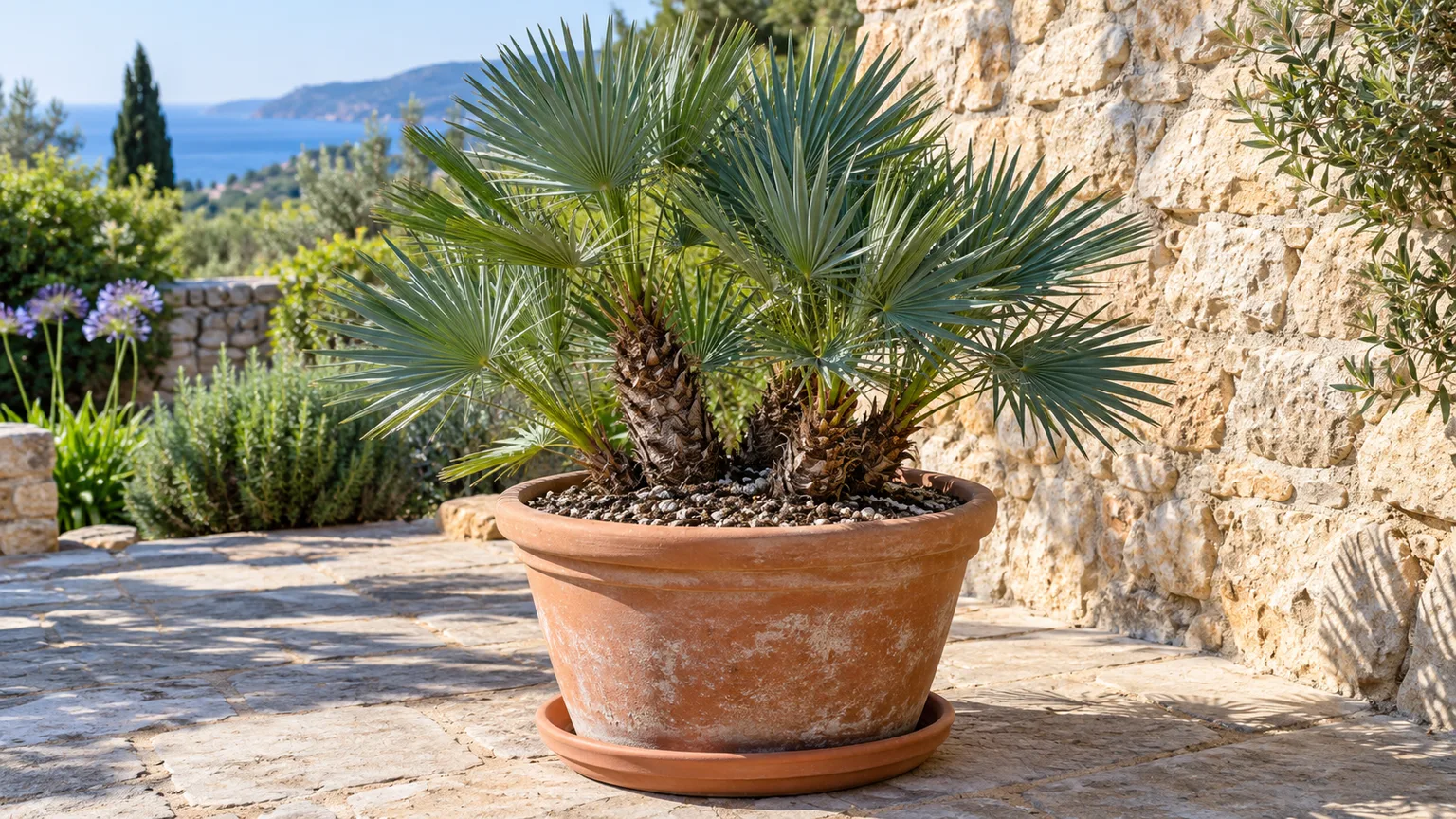
Container culture makes winter moves possible, but the pot still needs stable footing and fast drainage.
Protect the Palm Through Winter
Cold tolerance is not the same as immunity to cold. UF/IFAS reports that an established palm can survive around 10°F or below, with foliage sometimes damaged and new leaves returning later. That threshold should not be treated as a temperature to test: a short, dry cold snap is different from a prolonged freeze in wet soil, and container roots are less protected than roots in the ground. If your area routinely drops below the plant’s likely tolerance, move a container to a bright, cool, frost-free space before the cold arrives or choose another species.
For an in-ground plant in a marginal climate, keep the root zone well drained through winter and use a sheltered microclimate, such as a south-facing wall that does not trap water. When a hard freeze is forecast, a breathable frost cloth over the crown can reduce exposure; remove it when the event passes so the plant receives light and airflow. Do not tightly wrap wet foliage in plastic or leave a cover on through mild weather. If fronds brown after a cold event, wait until the danger of more freezes has passed before cutting; damaged leaves can provide some protection to the crown while temperatures fluctuate.
A potted palm moved indoors should receive the brightest available light and good air movement. Reduce watering as growth slows, keep it away from hot heating vents, and check for scale or spider mites while it is inside. Return it outdoors gradually in spring, beginning in a sheltered bright-shade location and increasing sun over a week or two.
Prune Dead Fronds and Manage Suckers
For the natural multi-trunk form, pruning is minimal. Remove fully dead, broken, or diseased fronds with sharp, clean loppers or a pruning saw, cutting close to the base without gouging the trunk. A frond that is partly green is still contributing energy; do not strip it just because it hangs below the crown. Avoid “hurricane cutting” or shaving the canopy into a narrow topknot. Severe pruning reduces the plant’s working leaf area and can make it look unnatural.
The leaf stalks have sharp spines, so gloves, long sleeves, eye protection, and a stable stance are sensible. Do not reach blindly into the crown or pull a frond toward your face. If you need to remove basal suckers to create a single-trunk look, recognize that this is a recurring maintenance choice: new shoots can return, and cuts close to the main stem can injure it. Many gardeners get a better result by accepting the natural clump and placing the palm where its outline has room.
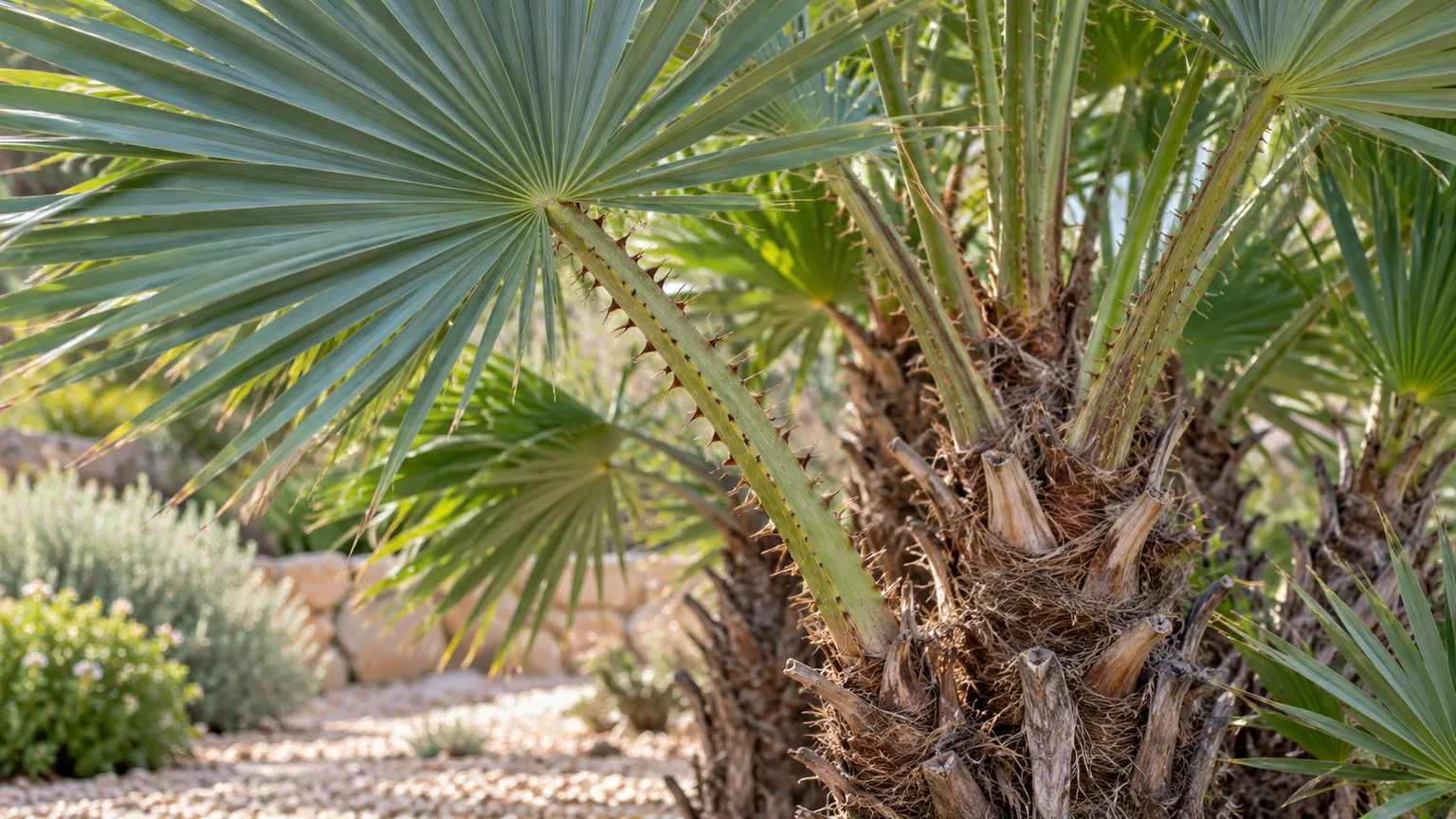
Spiny petioles are a real placement and pruning concern; do not work inside the crown without protective gear.
Propagate From a Rooted Offset
Division is faster than seed, but it is not as simple as cutting any small shoot away from the parent. Select a sucker with its own roots and enough stem tissue to support new growth. Spring or early warm weather gives the division a long recovery period. Wear heavy gloves, expose the connection carefully, and use a clean, sharp knife or pruning saw to separate the offset while keeping as many roots as possible.
Pot the division in a small container with drainage and a fast-draining mix, or plant it in a prepared landscape site if it already has a substantial root system and the weather is warm. Set it at the same depth it was growing, water to settle the mix, and keep it lightly but evenly moist while new roots form. Do not keep it saturated. Keep the plant in bright shade or filtered light for the initial recovery, then increase sun gradually as it resumes growth. A root-poor sucker may wilt or fail even when handled carefully, so leave undersized offsets attached until they are better developed.
Start New Palms From Seed
Seed propagation is possible but slow and less predictable for a home gardener who wants a copy of a named cultivar. Seeds collected from a cultivar may not reproduce its exact leaf color or form. Germination can take weeks or longer, and seed freshness, warmth, and moisture all matter. If the priority is preserving a specific silver or compact selection, seek a rooted division or a correctly labeled nursery plant instead.
Use ripe, viable seed from a reputable source, remove any fleshy covering, and sow in a clean, free-draining medium. Keep the medium warm and evenly moist, not waterlogged, and be patient rather than digging up seeds to check them repeatedly. Once seedlings are large enough to handle, pot them individually and grow them on in strong light. They will need time to develop a recognizable clumping form, so seed is a project for patient growers, not a quick way to fill a landscape bed.
Troubleshoot Leaf, Root, and Pest Problems
The most useful first question is not “Which fertilizer should I use?” but “What changed in the root environment?” Yellowing across several leaves, soft stem bases, or a persistently wet pot points first to drainage and overwatering. Check that holes are open, the pot is not sitting in a full saucer, and the palm is not planted too deeply. Root or stem rot can follow chronic saturation, so correct the moisture problem before feeding.
Brown tips or ragged edges can follow cold, dry wind, drought, salt exposure, or physical contact. Older outer fronds also age and eventually die; a single old leaf turning brown is not the same as new growth collapsing. Check the pattern: damage limited to the windward side suggests exposure; crisping after a freeze suggests cold injury; repeated yellowing while the soil is wet points to root stress. UF/IFAS warns that this palm is not salt tolerant, while NC State’s plant data describe it as moderately tolerant, so the practical choice is to avoid direct salt spray unless a local extension source confirms the site is suitable.
Indoor palms can attract scale, mealybugs, and spider mites, particularly when air is dry or plants are crowded. Inspect the undersides of leaf segments and the bases of stalks when bringing a container indoors. If you find pests, isolate the palm and identify the insect before selecting a treatment. For any pesticide or insecticidal soap, follow its label and test a small area first; a palm’s waxy foliage and indoor setting make casual spraying a poor default.
Separate Cold or Transplant Stress From Ongoing Decline
A palm may pause after transplanting or moving indoors because roots are adapting to a new moisture and light pattern. If the crown remains firm and the center spear is intact, avoid pulling it or repeatedly disturbing the root ball; hold fertilizer and keep conditions stable while you monitor new growth. After cold damage, brown older fronds can remain visible for a while even when the trunk is alive. Wait for warmer weather and inspect the center for new leaves before removing damaged foliage.
A worsening pattern deserves a closer look: a soft crown, foul-smelling wet mix, a loose or collapsing stem, or a center spear that detaches easily may indicate severe rot. In that case, check the root ball and correct drainage immediately. If the palm is valuable or the diagnosis is unclear, ask a local extension office or qualified arborist to assess it rather than applying a broad pesticide or fertilizer treatment without evidence.
Choose a Cultivar for Size and Leaf Color
The species itself varies in color and form, and cultivar labels are not always consistent among nurseries. ‘Vulcano’ is commonly selected for a more compact habit and reduced spines compared with the typical species, but “less spiny” should never be read as “safe beside a walkway.” Silver-leaved forms, including plants sold under names such as Atlas or blue Mediterranean fan palm, can have a dramatic look in a sunny, dry garden. Check the botanical name, mature dimensions, and local cold performance on the specific plant you are buying.
If you need a narrow single trunk, a clumping European fan palm may not be the simplest choice. Removing suckers can train the shape, but that maintenance continues as the palm matures. If you enjoy a multi-stemmed silhouette, let the clump develop and give it room. The RHS plant profile describes the species as a bushy evergreen palm with rounded fan leaves and mature flowers, and recommends bright conditions and well-drained compost for container cultivation.
Use the Palm Where Its Form Can Spread
European fan palm works well as a sculptural anchor in a gravel garden, sunny courtyard, Mediterranean-style planting, or large patio container. Its coarse, fan-shaped leaves contrast with fine grasses, low groundcovers, and rounded shrubs. A single plant can frame an entry or soften a wall, while a group can create a substantial green screen. Leave enough setback for the mature crown and do not use it as a soft, touchable edge beside a path.
In humid or rainy climates, place it where water runs away rather than toward the trunk. In a dry climate, its drought tolerance after establishment can reduce supplemental watering, but that does not mean it should be planted in a narrow strip of compacted rubble and forgotten. In exposed coastal sites, salt exposure deserves caution. The Gardening Know How growing guide also emphasizes the palm’s slow growth, sun-to-partial-shade range, and preference for well-drained soil; those are useful starting points, while your site’s actual winter and drainage conditions should determine placement.
Conclusion
European fan palm is a strong choice when you want an evergreen, multi-stemmed palm that handles more cold and drought than many tropical-looking alternatives. Its success depends less on constant care than on getting three decisions right at the start: whether your winter is suitable, whether water drains from the roots, and whether the spiny crown has enough clearance.
Plant it in spring in sun or light shade, water regularly while it establishes, and taper irrigation once roots are settled. Use a heavy pot with open drainage if you need to move it for winter, prune only dead or damaged fronds, and keep any divisions rooted and protected while they recover. If your garden is persistently wet, deeply shaded, salty, or too tight for the eventual clump, choose a better-matched palm before planting; that is easier than trying to correct the site after a slow-growing specimen has settled in.



