How to Grow and Care for Fatsia Spider Web Plants
Grow Fatsia Spider Web in bright shade and well-drained soil. Learn indoor care, watering, pruning, propagation, winter protection, and leaf troubleshooting.
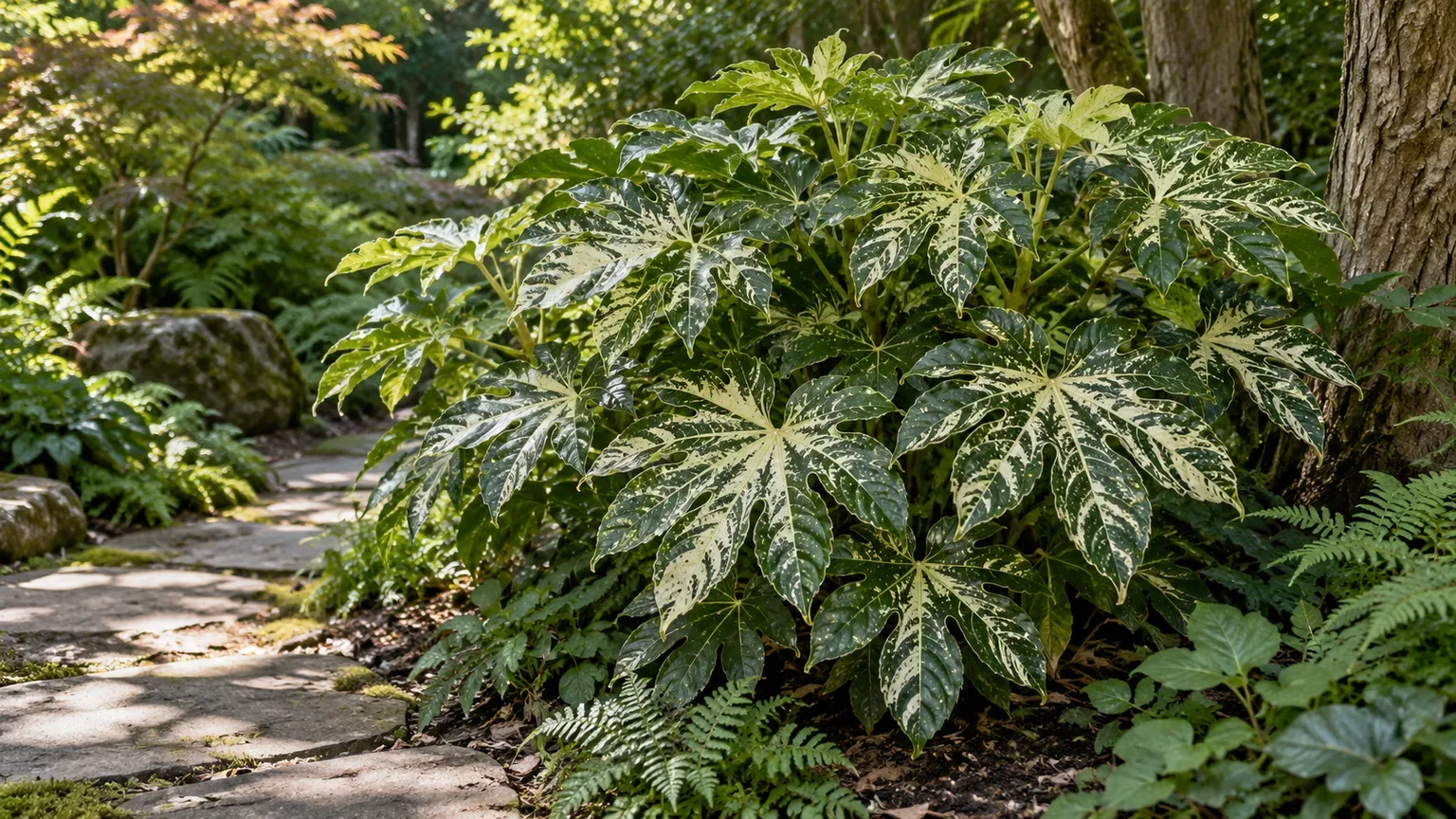
Fatsia Spider Web (Fatsia japonica ‘Spider’s Web’) is an evergreen Japanese aralia grown for broad, hand-shaped leaves speckled with cream and white. It brings light to a sheltered shade garden and can also live in a pot indoors, but the two settings call for different light and watering decisions. The basic rule is simple: give it bright shade, evenly moist but freely draining roots, and enough room for a shrub that can outgrow an ordinary houseplant corner.
| Care need | Practical target |
|---|---|
| Outdoor light | Partial shade in a sheltered site; protect young leaves from strong afternoon sun |
| Indoor light | Bright, indirect light in a cool, airy room |
| Soil | Fertile, humus-rich, moist but well-drained |
| Water | Water thoroughly when the upper soil begins to dry; drain excess |
| Mature size | Can approach about 6–8 feet or more in favorable conditions; cultivar growth is slower to establish |
| Main upkeep | Light spring pruning, occasional repotting, and frost protection in cold or exposed sites |
Is Fatsia Spider Web a good fit for your garden or home?
Choose this cultivar if you want an evergreen focal point for shade and enjoy foliage with irregular cream-white flecks. Its large lobed leaves give a coarse, architectural texture, so one shrub can anchor a small courtyard or soften a shady wall. It also works as a substantial indoor specimen while young, provided you can offer a cool, well-lit position and a pot with drainage.
Think of it as a shrub that can be kept in a container for a time, not a compact tabletop plant. The species can reach several feet in height and spread, and the RHS notes that ‘Spider’s Web’ establishes more slowly than the plain species and may be less hardy, particularly while young. If the only available spot is a hot, south-facing window or a windy exposed bed, another plant will be easier to keep attractive.
How the white pattern differs from plain green fatsia
The cultivar’s “web” is a natural pattern of cream or white variegation scattered over green leaves; it is not a disease or a coating. Individual leaves can show different amounts of pale marking, and new growth may look lighter before it matures. The RHS profile lists ‘Spider’s Web’ under the Japanese aralia name ‘Tsumugi-shibori’ and describes it as an evergreen shrub for partial shade and moist, well-drained soil. (Royal Horticultural Society cultivar profile)
Variegated leaves have less green tissue to capture light than solid-green leaves, so a plant may grow more slowly than a plain fatsia. That does not mean it needs direct sun or heavy fertilizer. Give it enough light to grow steadily, then let the cultivar’s own leaf pattern develop; forcing growth with rich feeding can produce soft foliage without improving the markings.
Choose a sheltered, partially shaded outdoor spot
A sheltered position with partial shade is the safest starting point outdoors. Fatsia tolerates deeper shade, but bright shade or gentle morning light can help the white pattern show while protecting leaves from harsh afternoon rays. Avoid planting it where reflected heat from a wall or paving cooks the foliage, or where cold, drying wind repeatedly tears or scorches the large leaves.
The cultivar can tolerate some sun when the soil stays moist, but “sun tolerant” is not the same as “best in full sun.” The RHS cultivar profile recommends partial shade and protection from cold drying winds for ‘Spider’s Web’; the RHS fatsia growing guide notes that the species can handle deeper shade and, in suitable soil, some full sun. University of Florida IFAS Extension likewise describes Japanese aralia as a shade-loving shrub. Use the cultivar-specific advice as the more cautious default, especially in hot-summer climates.
Give an indoor Fatsia bright, indirect light
Indoors, place the plant near a bright window where sunlight is filtered or arrives gently in the morning. An east-facing window is often a useful starting point; a bright north-facing window may work if the room is not dim. If it is several feet from a window, rotate the pot every couple of weeks so one side does not lean toward the light.
Do not move a shade-grown plant straight into a hot, sunny window or outdoors in midsummer. Acclimate it over a week or two, starting in shade and increasing exposure only if leaves remain unmarked. Brown, papery patches on the window-facing side suggest light or heat scorch; moving it back from the glass is more useful than increasing humidity or fertilizer. The RHS fatsia growing guide describes fatsia as a good indoor plant in a cool, bright, well-ventilated position, rather than a plant for a hot room over a radiator.
Give the roots rich soil that still drains freely
Fatsia prefers soil that holds some moisture without staying saturated. In a garden bed, ordinary fertile loam improved with mature compost can work well, as long as water does not pool around the roots. The species tolerates a range of soils, but the RHS and NC State Extension both emphasize moisture with drainage; heavy, compacted ground is a risk when it remains wet after rain.
For a container, use a quality peat-free potting mix that drains after watering. A little fine bark or perlite can improve air space if the mix stays dense, but do not turn it into a dry, gritty cactus blend. The goal is a root zone that remains lightly moist between waterings while allowing excess water to escape through open drainage holes. A decorative outer pot is fine, but empty it after watering so the nursery pot never sits in a pool.
Planting a shrub in a low spot because it is shady is a common mistake. Shade is helpful; stagnant water is not. If a site is naturally wet, raise the planting area or choose a better-drained location rather than relying on a layer of gravel at the bottom of a planting hole.
Water by checking the root zone, not the calendar
Water a newly planted fatsia deeply enough to wet the full root ball, then keep checking the surrounding soil during its first growing season. The interval will change with rainfall, soil type, pot size, wind, temperature, and how much sun reaches the plant. An established outdoor shrub may need little extra water outside a prolonged dry spell, while a potted indoor plant can dry much faster.
For a container, press a finger about an inch into the mix. If that layer is dry and the root ball feels lighter, water slowly until excess drains from the bottom; then empty the saucer. If the mix is still cool and damp, wait and check again rather than adding water because the leaves look tired. For an outdoor plant, check soil a few inches below the surface. A brief wilt during a hot afternoon can recover as temperatures fall; persistently drooping leaves plus wet soil point toward a drainage or root problem.
Consistent moisture is useful, but permanently soggy soil deprives roots of air and can lead to root rot. Conversely, letting a small pot become bone dry can cause droop and brown margins. Use the feel of the mix and the drainage rate to choose the next watering, not a weekly schedule copied from another climate.
Plant Fatsia Spider Web outdoors with room to mature
Spring or early fall is a practical planting window because the roots can settle before summer heat or winter cold. Water the nursery pot before planting, loosen only tightly circling roots, and set the root ball at the same level it sat in its container. Backfill with the existing soil mixed with a modest amount of compost, firm gently, and water slowly to settle the soil around the roots.
Leave enough room for the mature shrub rather than spacing it like a small perennial. Japanese aralia commonly grows several feet tall and wide; cultivar size varies with climate, age, and pruning, and ‘Spider’s Web’ is slower to establish than the species. If you are planting near a path, doorway, or window, account for the broad leaves and the plant’s eventual reach so you do not have to cut it back hard every year.
Keep a light mulch over the root zone to reduce moisture swings, but leave a gap around the stems. Deeply piling mulch against the base traps moisture where stems meet the soil and can hide damage. Water regularly while the plant establishes; once it is making steady new growth, reduce supplemental irrigation and water mainly through dry periods.
Keep a potted Fatsia healthy indoors
Fatsia can make a dramatic indoor plant, but it needs more light than a dark corner provides and more room than its nursery pot suggests. Put it in a cool, airy room with bright indirect light, away from heating vents, cold drafts, and doors that open directly to winter weather. The variegated leaves may lose some visual contrast in dim light, while harsh sun can leave scorched patches.
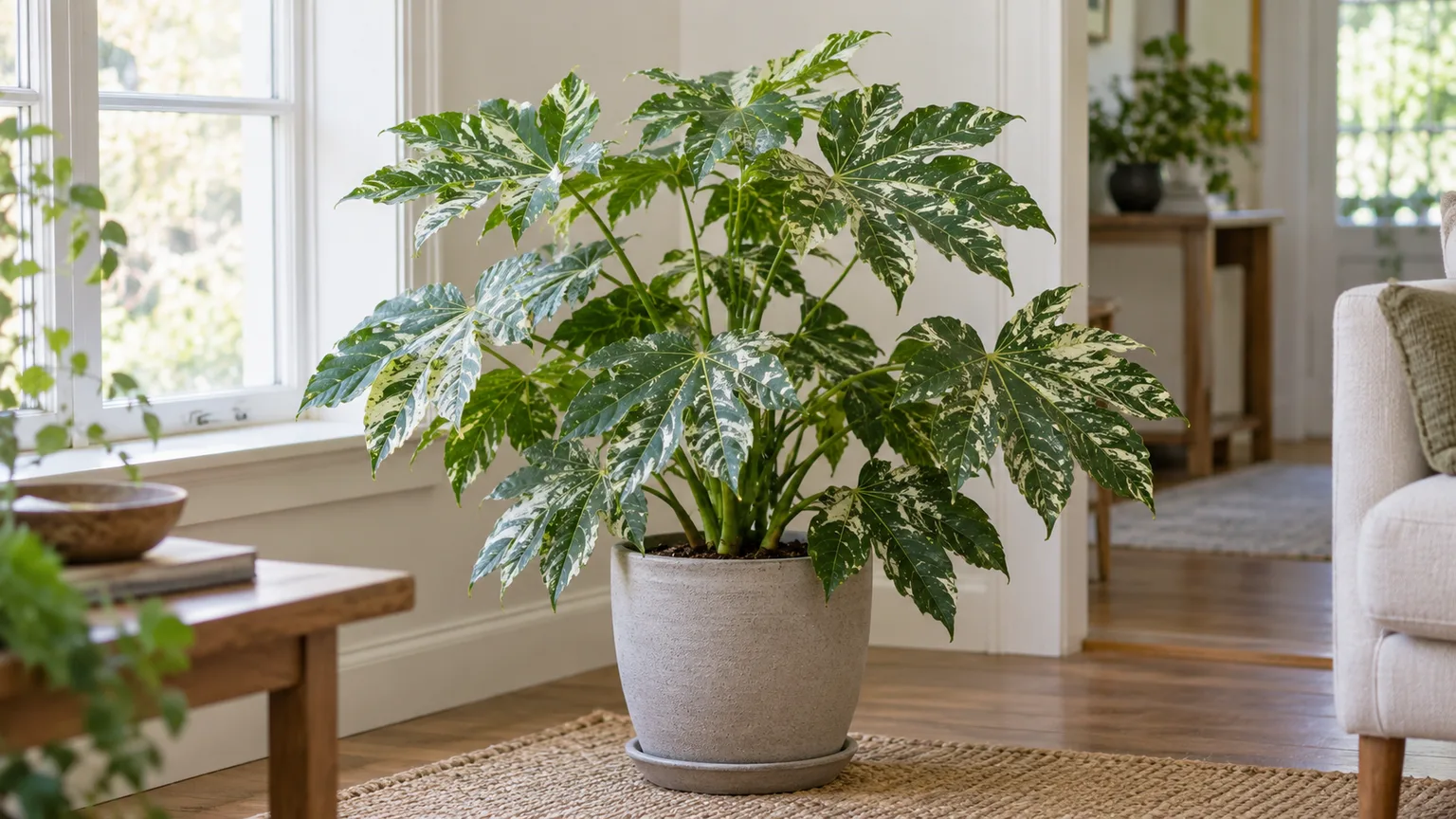
Indoor air does not need to be tropical for the plant to grow. Normal household humidity is often workable if watering and light are right; in a very dry heated room, brown leaf edges may worsen. Improve the growing conditions first by moving the plant away from hot air and checking the soil moisture. Misting is temporary and does not correct a dry root ball, a waterlogged pot, or inadequate light.
Large leaves collect dust, which can reduce their appearance and make pest checks harder. Wipe them gently with a damp soft cloth when needed, supporting the underside so the leaf does not crease. Avoid leaf-shine products, which can leave residue and do not solve a care problem.
Repot only when the root ball needs more room
Repot when roots have filled the container, circle densely around the root ball, or emerge from the drainage holes, or when the mix has broken down and drains poorly. A plant that dries unusually fast despite normal conditions may also be root-bound. Do not repot automatically every spring; the RHS describes fatsia as a short-term container plant because it can become large, and frequent upsizing can leave excess wet soil around a small root system.
Move up by one pot size, choosing a container with several clear drainage holes. Slide the root ball out, loosen only the outermost circling roots, and set the plant at the same depth in fresh potting mix. Water it in and let it drain completely. If the plant is already larger than the room can support, pruning a few stems or moving it outdoors in a suitable climate may be more practical than shifting it into a huge pot.
A heavy ceramic pot can stabilize the broad canopy, but the weight makes seasonal moving difficult. If you need to bring the plant inside before frost, a lighter nursery pot inside a decorative cachepot is easier to handle; remove the inner pot to water and drain it.
Fertilize during active growth, then pause
Feed an indoor plant lightly during spring and summer if it is actively producing leaves. A balanced houseplant fertilizer used at the label rate is enough; if the plant grows slowly in a cool room, reduce or skip feeding rather than applying a monthly dose automatically. Stop fertilizing when growth slows in fall and winter.
Outdoor plants in decent soil may need no routine liquid feeding. A thin layer of mature compost around the root zone in spring can replenish organic matter and help the soil retain moisture. Do not let compost or fertilizer touch the stem bases, and do not use fertilizer as the first response to yellowing. Check drainage, watering, light, age of the affected leaves, and pests first. Extra nitrogen cannot reverse sun scorch or repair roots damaged by standing water.
If a container plant has been in the same mix for years, refreshing the potting medium during repotting is often more useful than escalating fertilizer. A weak-looking plant may be short on light or root space, and a soluble feed adds salts to a pot without solving either problem.
Prune for shape and remove damaged stems
Routine pruning is not necessary, but it can control size and remove dead, damaged, or awkward growth. Mid- to late spring is a good time for a light cleanup once the worst cold has passed and new growth is visible. Use clean, sharp pruners and cut a whole unwanted stem back to its origin or to a healthy side shoot rather than shearing every leaf across the top.
Before shortening a stem, decide what shape you want. Fatsia’s large leaves and upright stems create its architectural look; repeated topping can make the outline blunt and can expose bare stem. If one stem is much taller than the rest, reducing it selectively may encourage a fuller shape, but the result is less formal than a clipped hedge. Remove dead leaves at their stalks, and let the plant replace them naturally rather than stripping healthy lower foliage for cosmetic reasons.
Wear gloves if you have sensitive skin and wash tools after cutting. Dispose of diseased leaves rather than leaving them against the plant. Light pruning is usually enough; a severely overgrown shrub can be cut back more hardily, but it may take time to regain its balanced form.
Cut out all-green shoots that reverse
Occasionally, a variegated fatsia produces a shoot with entirely green leaves. This is called reversion: that shoot no longer displays the cultivar’s pale pattern and may grow more vigorously than the variegated stems. If you leave it, the green branch can increasingly dominate the plant.
Trace the all-green shoot to where it joins the main stem and remove it at that point. Do not merely pinch off the leaves, because the same branch will continue producing green foliage. Compare new leaves before cutting: some leaves naturally show more green or white than others, so remove only a clearly solid-green stem. This simple check helps preserve the cultivar’s overall look without pruning away normal variation. Garden Ninja’s cultivar notes describe Spider’s Web as slower growing and discuss removing reverted green shoots at their origin.
Propagate the cultivar from semi-ripe cuttings
Take a semi-ripe cutting in late summer from healthy growth that has begun to firm at the base but is not woody. A cutting is the better way to reproduce a named cultivar because seedlings may not retain the parent’s distinctive variegation. The RHS recommends semi-hardwood cuttings for ‘Spider’s Web’; BBC Gardeners’ World gives late summer as a practical time for fatsia cuttings.
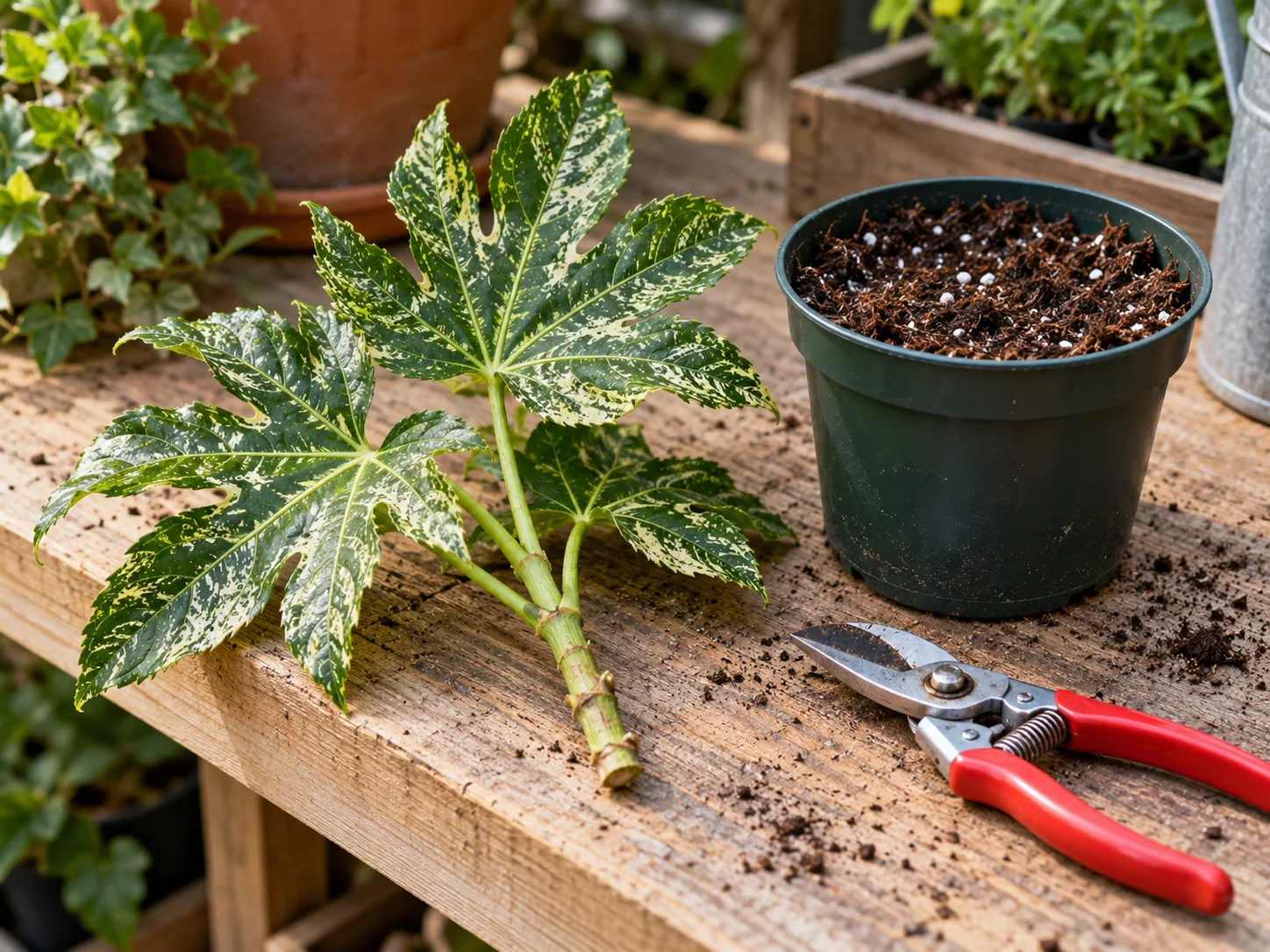
Choose a non-flowering shoot with several healthy leaves and cut just below a leaf joint using clean shears. Remove the lower leaves so no foliage sits in the mix, then place the cutting in a small pot of moist, free-draining propagation mix. Covering the pot loosely with a clear bag can slow moisture loss, but keep the plastic from pressing on the leaves and ventilate it regularly to reduce condensation and rot.
Set the cutting in bright, indirect light in a warm, steady spot. Keep the mix slightly moist, never saturated. Roots take several weeks and timing varies, so avoid pulling the cutting up to check; gentle resistance or new growth is a better sign. Pot it on after a usable root system forms. Seed from berries can grow the species, but it is not a dependable way to preserve the ‘Spider’s Web’ pattern.
Protect Spider Web Fatsia through winter
Cold tolerance depends on the plant’s age, exposure, drainage, and local winter pattern. The RHS warns that this cultivar may be less hardy than the species, especially when young; a sheltered wall or canopy can make a meaningful difference. Southern Living Plants lists it for USDA Zones 8a through 10b, but zone labels describe average winter lows, not protection from wind, sudden freezes, wet soil, or unusually cold spells.
In a mild climate, leave an established shrub outside and mulch over the root zone in late fall. Keep mulch away from stems. If a prolonged hard frost is forecast, cover a young or exposed plant with horticultural fleece and remove the cover when temperatures rise. A container is more vulnerable because its roots are surrounded by air; move it to a sheltered, cool location or insulate the pot, while keeping it dormant rather than placing it beside a heater.
For an indoor plant, reduce watering as growth slows and keep it away from cold window glass and hot radiators. Do not fertilize through winter or try to compensate for low light with extra water. If frost damages leaves, wait until spring growth clarifies what is dead before pruning; browned foliage can protect stems temporarily.
Understand the flowers and black berries
Mature outdoor fatsias can produce rounded clusters of small cream-white flowers, typically in fall, followed by dark berries. These blooms are a bonus rather than the main reason to grow ‘Spider’s Web’, and an indoor plant may never flower. Age, growing conditions, and the length of the season affect whether flowers form, so lack of bloom alone does not indicate poor care.
University of Florida IFAS Extension describes the species’ fall flower clusters and shiny black winter fruit. The berries are ornamental, not food; the RHS cultivar page also says not to eat them. If fruiting stems become messy near an entry or patio, remove them after the display. Avoid pruning all new growth before the flowering season if you hope to see blooms, because pruning changes which stems remain to mature.
Flowers sit above the bold leaves and may attract insects outdoors, but the shrub’s foliage remains its strongest year-round feature. Do not add excess fertilizer to force flowering. Correct light, a healthy root zone, and time are better foundations than a high-nitrogen feeding that encourages leaves at the expense of a balanced plant.
Diagnose yellow, brown, curling, or drooping leaves
Start by identifying which leaves are affected and checking the soil before you change care. One or two older leaves yellowing near the base can be normal turnover on an evergreen shrub. A sudden wave of yellow leaves across the canopy, especially with wet soil, points more strongly to root stress, poor drainage, cold injury, or another environmental change.
Brown, crisp patches on the side facing a window or afternoon sun usually indicate scorch. Move the plant to bright indirect light or deeper outdoor shade and protect it from hot reflected light; damaged tissue will not turn green again, so judge the fix by the next leaves. Brown edges can also follow a dry root ball, drying wind, or a sharp change in indoor humidity. Check whether the mix is dry or wet rather than assuming every brown edge needs more water.
Drooping can mean either too little water or roots that cannot take up water because the mix is saturated. If the pot feels light and the soil is dry, water thoroughly and let it drain. If it is heavy and wet, stop watering, confirm that holes are open, and inspect roots if the plant keeps declining. Healthy roots are firm; dark, soft roots and a sour smell suggest decay. Correct the cause before removing leaves or applying fertilizer.
Check stems and leaf undersides for pests
Scale insects, thrips, and mealybugs can affect fatsia, especially indoors or in sheltered warm spaces. Inspect leaf undersides, veins, petioles, and stem joints, looking for small fixed bumps, white cottony patches, fine stippling, or distorted new growth. A sticky surface can be honeydew from sap-feeding insects, but it is not enough by itself to identify the pest.
Isolate an affected houseplant before it touches other plants. Wipe a few leaves and stems with a damp cloth and monitor new growth; for a larger infestation, confirm the pest and follow a product label that specifically permits use on the plant and pest. Avoid spraying an unknown product in direct sun or applying repeated treatments without checking whether the pest remains. The RHS lists scale, thrips, and mealybugs among possible pests, but a careful inspection is still the first step.
Is Fatsia Spider Web safe around pets?
The ASPCA plant database lists Fatsia japonica as non-toxic to dogs, cats, and horses. That is a species-level listing, not a reason to let pets chew ornamental foliage or berries; the cultivar’s fruit is described as ornamental and not to be eaten. Keep the plant out of reach of persistent chewers, and contact a veterinarian if an animal eats a large amount or develops symptoms.
If you have a pet that mouths plants, place the pot where it cannot be tipped or chewed. This is useful even for plants considered non-toxic because leaves and potting mix are not food, and any plant material can upset an animal’s stomach. Use the ASPCA’s listing for the toxicity question rather than relying on seller descriptions or broad claims about “pet-safe” houseplants.
Conclusion
Fatsia Spider Web does best when its two main needs are balanced: enough light to support growth and soil that stays lightly moist without becoming waterlogged. Outdoors, start with sheltered partial shade; indoors, choose a cool, bright room with indirect light and open drainage. Water according to the soil’s condition, not a fixed weekly timetable.
Give the shrub space, prune selectively in spring, and use semi-ripe cuttings when you want to keep the cultivar’s variegation. When leaves discolor, check light, moisture, drainage, and pests in that order before changing fertilizer or cutting the plant back. With those checks in place, the white-flecked foliage can remain the feature that brightens a shaded garden or a roomy indoor corner.



