How to Fertilize a New Lawn: Seed, Sod, and Timing
Learn when and how to fertilize a new lawn from seed or sod. Use soil-test results, safe rates, watering, and local phosphorus rules to guide each application.
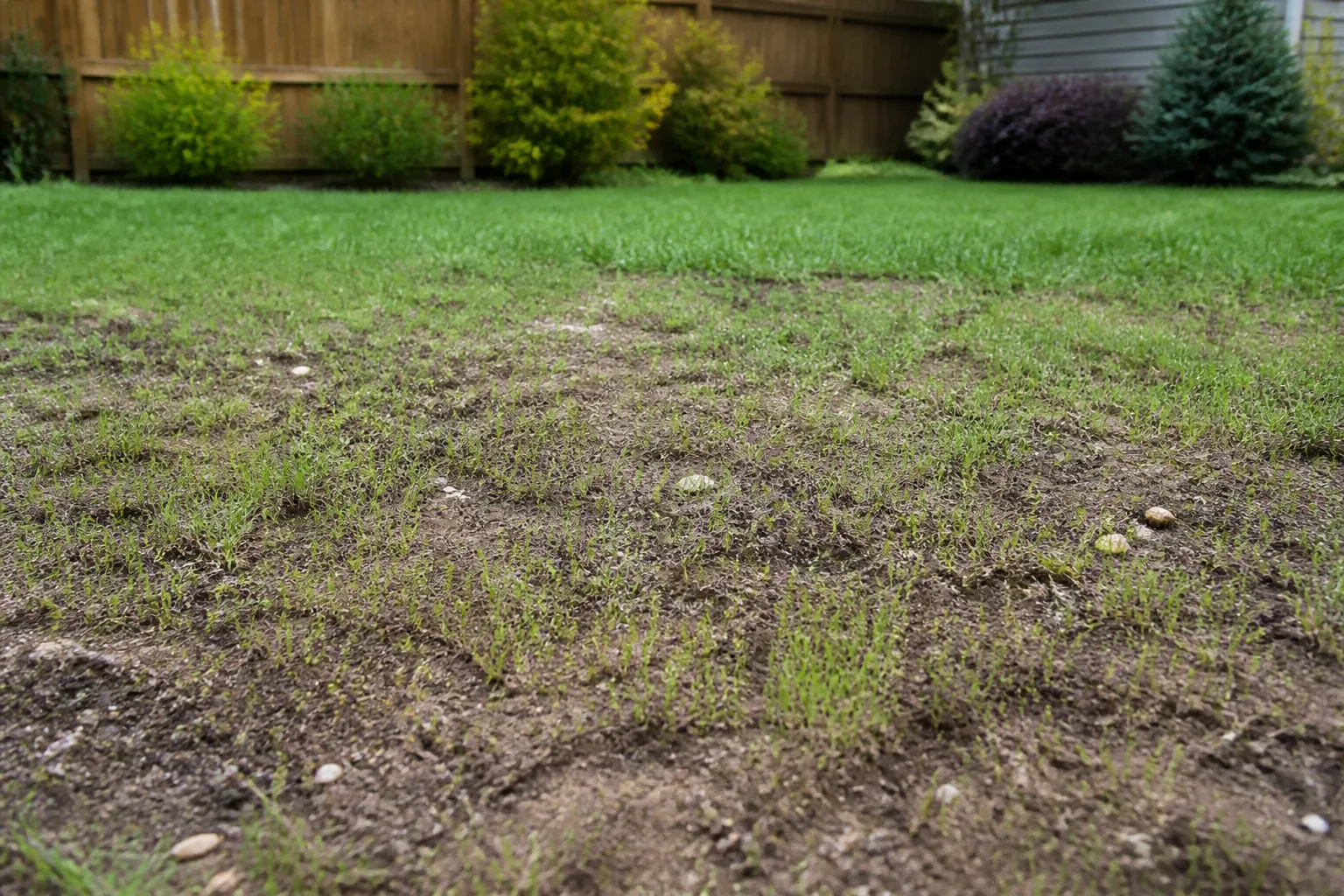
Start with a soil test, then fertilize only for the nutrients the report and local rules allow. A new lawn may benefit from a starter fertilizer at seeding, but the words “starter” and “new grass” do not make every bag appropriate. A test can show that phosphorus or potassium is already sufficient, while a high-nitrogen product can stress seedlings or sod that has not rooted.
Seed and sod also have different needs. Seedlings depend on a shallow, consistently moist seedbed; sod arrives with mature blades but has lost much of its root system when harvested. The right plan is therefore a sequence: test and prepare the soil, choose a product that fits the test, calculate the exact amount, water according to the product label and planting method, and wait for evidence of establishment before feeding again.
Start with a soil report, not a fertilizer bag
It is tempting to choose the bag labeled “starter” and spread it before the seed or sod arrives. That reverses the most useful decision. Fertilizer supplies nutrients, but it cannot correct a compacted subsoil, poor drainage, a badly graded site, or a pH problem; applying it without a test can also add nutrients that are already abundant.
Before major renovation, sample the area that will become lawn and send it to a university or reputable soil-testing laboratory. Follow that lab’s directions for sampling depth and number of cores; many tests ask you to combine several cores from a uniform area into one representative sample. Keep clearly different areas—such as a former vegetable bed, a shady side yard, and a construction fill area—separate because one sample can hide important differences.
Penn State Extension recommends testing before establishment so the report can guide fertilizer, lime, and organic-matter amendments. It also notes that phosphorus and potassium move slowly through soil, so test-recommended amounts may be incorporated before planting, while nitrogen is handled as a surface starter application rather than tilled deeply where it may be lost. Those are regional extension recommendations, not a universal formula for every soil or state. (Penn State Extension)
What a lawn soil test tells you
A standard lawn test typically reports soil pH and nutrient levels such as phosphorus and potassium, then recommends amendments based on the grass and regional calibration used by the lab. pH matters because it affects how available nutrients are to roots; adding more fertilizer does not reliably fix a nutrient that the soil chemistry is making difficult to use. Ask the lab or your local Cooperative Extension office how to interpret a result if the report does not clearly distinguish lawn recommendations from garden recommendations.
Soil tests often do not prescribe nitrogen in the same way they prescribe phosphorus or potassium. Nitrogen is used and lost more quickly, so recommendations tend to account for grass species, season, and growth stage. Treat a generic N rate found online as a reference point only. Your local extension’s guidance and the fertilizer label should govern what goes on the site.
If the lawn is being built over recently disturbed soil, test before grading and amendment if possible. A soil test taken after adding compost, topsoil, lime, or fertilizer may no longer represent the original site, while a test taken from a few convenient handfuls near the surface can miss the compacted or nutrient-poor layer the new roots will actually encounter. Where the site has imported fill, construction debris, or unusually poor drainage, correct those physical problems before trying to solve them with fertilizer.
Choose fertilizer by the test, not the word “starter”
“Starter fertilizer” is a product category, not a guarantee that a product is right for every new lawn. These blends are marketed for establishment and may contain nitrogen, phosphate, and potash in different proportions. Some contain more phosphorus than a new lawn needs; others are formulated with little or no phosphorus for soils where it is restricted or already abundant.
Use the soil report to compare guaranteed analyses on the bag. If the report calls for nitrogen but no phosphorus, do not choose a phosphorus-heavy blend simply because the front says “starter.” If the report recommends lime, apply the specified amount and product separately or use a combination only when its label and nutrient analysis match the recommendation.
What N-P-K numbers actually mean
The three numbers on a fertilizer label give the percentage by weight of nitrogen (N), available phosphate (P₂O₅), and soluble potash (K₂O). A 20-10-10 product is 20% nitrogen, 10% phosphate, and 10% potash by weight. These label numbers are not the same as elemental phosphorus and potassium percentages, so compare product labels and soil reports using the units they actually provide rather than converting casually.
Nitrogen supports leaf growth and color; too much too early can push blades faster than delicate roots can support. Phosphorus is involved in energy transfer and root development, but it is not a universal “root booster” that should be applied regardless of soil status. Potassium supports several plant functions and may be recommended when a soil test identifies a deficiency. More of any nutrient is not automatically better.
You do not need to chase a particular ratio such as 10-10-10. A soil test may call for a product with a different ratio, and two bags with different N-P-K numbers can deliver the same amount of nitrogen at very different product weights. Choose the product by the nutrient needed, the label’s permitted use, the application method, and the legal rules where you live.
Seeded turf and sod need different decisions
Seed and sod can both establish a durable lawn, but their early root conditions differ. With seed, the target is even germination and enough root growth to hold the soil; with sod, the immediate job is to reconnect the cut root layer to moist prepared soil. Fertilizer supports those processes only if it is present at a useful rate and the new grass can take it up.
Fertilizing at seeding
For a new lawn from seed, first determine whether the soil test recommends phosphorus or potassium to be worked into the seedbed. A test-directed preplant amendment can be incorporated as the soil is prepared. Nitrogen is commonly applied near seeding as a starter fertilizer rather than tilled several inches down; follow the specific recommendation and label so the nutrient is available without being concentrated against germinating seed.
Penn State Extension’s establishment guidance says starter fertilizer can be applied just before or immediately after seeding. It gives an additional application of 0.5 pound of nitrogen per 1,000 square feet, four to eight weeks after starter, as one way to help thicken new turf when more fertilizer is needed. That timing is a Pennsylvania extension example, not permission to repeat a dose automatically: the soil report, grass growth, local guidance, and product label still matter. (Penn State Extension)
Do not mix a large quantity of granular fertilizer directly into the seed at the rate intended for a lawn. Concentrated salts against a seed or tiny root can cause damage, and fertilizer granules can settle unevenly in ruts. Apply uniformly over the intended lawn area and keep the seedbed lightly moist. If the chosen product requires watering in, use enough water to move granules off leaf or seed surfaces as directed without washing seed down a slope.
Fertilizing before and after sod
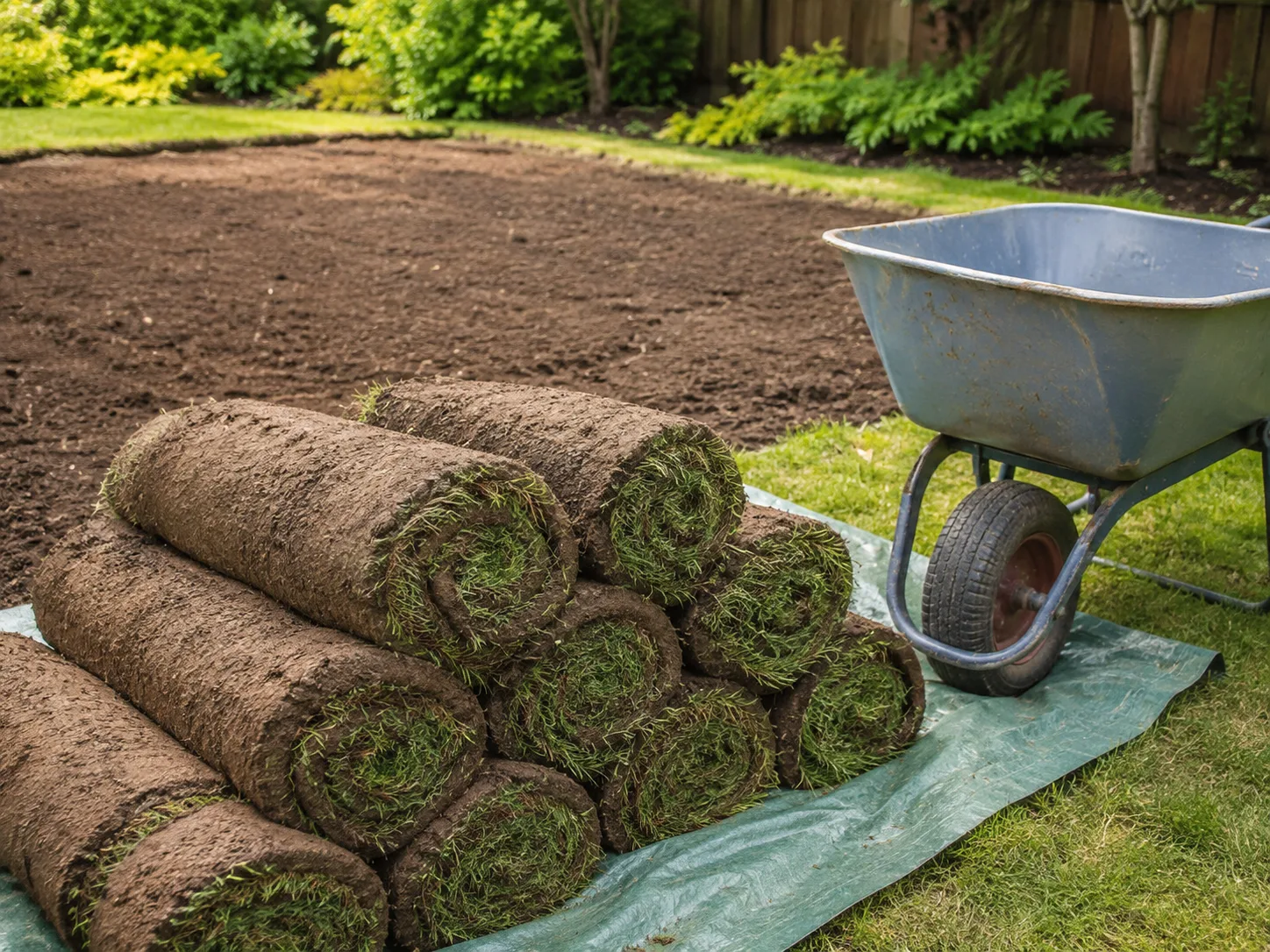
Sod is not the same as a lawn with an established root system. Harvesting cuts most roots close to the surface, so the sod must first knit its remaining roots into the prepared soil. A soil test before installation can show which amendments belong in the bed; putting the right nutrients into the prepared soil is different from dumping a high-nitrogen dose on top of stressed, freshly laid turf.
If a test and local guidance call for a starter fertilizer before sodding, apply it evenly to the soil and incorporate only as directed before laying the rolls. Do not put concentrated granules between sod and soil, where they can interfere with close contact or create an uneven dose. Then water the sod so both the sod layer and the soil beneath it are moist, not merely the blades.
After installation, wait until the sod resists a gentle tug before considering another feed. Test a small edge or corner without pulling the piece up: resistance suggests that roots are beginning to anchor, while an easy lift means the sod still needs time and careful moisture management. A sod supplier’s guide and extension schedules may differ in how they count the first post-installation feed; Lawn Love’s article, which includes advice from a University of Florida turfgrass specialist, describes a 30-to-60-day pause as common for sod while roots develop. Use that as context, not a fixed countdown for every species or climate. (Lawn Love)
Before or after planting?
There is no single required order for every fertilizer and planting method. Applying before can make it easier to incorporate a soil-test-directed amendment; applying a suitable starter after seeding can simplify the work when the label allows it. For sod, most nutrient corrections are easier to make before laying the rolls because the soil surface becomes covered.
Incorporate test-directed amendments before planting
When a test calls for phosphorus, potassium, lime, or an organic amendment, correct the soil before seeding or sodding if the report says to incorporate it. Spread the amount across the measured lawn area and mix it only to the depth specified by the report. Avoid tilling wet soil, which can smear and compact it, or pulverizing very dry soil into a powder that later crusts over.
After incorporation, firm and grade the soil so it is smooth but not hard-packed. Seed needs contact with a stable surface and a very shallow covering; sod needs an even bed without air pockets. Fertilizer cannot compensate for high spots that dry out, hollows that pond, or soil that has been compacted by construction traffic. A few minutes checking grade and drainage can prevent months of patching.
Surface-apply starter after seeding when appropriate
If you seed first, use a starter product only if its label lists the intended lawn use and the nutrients fit the test and local rules. Spread it evenly after seeding, then water in as the label directs. Keep the irrigation gentle enough that seeds stay in place; a single hard spray can create bare streaks and fertilizer-rich puddles at the low end of the lawn.
Avoid choosing between “before” and “after” based on a claim that one method always produces better roots. The practical differences are handling and placement: preplant amendments can be incorporated; a surface feeding is easier when the planting is already done; and sod requires the soil surface to remain available until its prep is complete. The product label may also specify whether to water immediately, wait for a dry surface, or avoid application under particular weather conditions.
Calculate the product amount and calibrate the spreader
The application rate on the bag is the controlling instruction. Many lawn directions express the amount of product per 1,000 square feet, while soil reports may state pounds of a nutrient per 1,000 square feet. Convert between them carefully; do not set a spreader by guessing what “a light pass” looks like.
For example, if a local recommendation calls for 0.5 pound of nitrogen per 1,000 square feet and you have a 20-10-10 fertilizer, the bag contains 20% nitrogen. The arithmetic is 0.5 ÷ 0.20 = 2.5 pounds of product per 1,000 square feet. This is an illustration of the calculation, not a general starter rate; the soil test, local recommendation, product directions, and any maximum annual rate take precedence.
Measure the lawn’s actual area before calculating the bag amount. Divide irregular yards into simple rectangles or triangles, calculate each section, and subtract house, patio, driveway, beds, and other areas that will not receive fertilizer. If a lawn is 30 feet by 45 feet, its area is 1,350 square feet. At the hypothetical 2.5 pounds per 1,000-square-foot rate above, the amount would be 3.375 pounds for that measured area, provided that rate is allowed by the label and local recommendation.
Use a spreader that matches the area and product. A drop spreader puts granules directly beneath its opening and is useful near pavement or narrow edges; a broadcast spreader covers more ground but can throw material farther than you intend. Check the label’s spreader setting as a starting point, but remember that settings vary by product and spreader model. Calibrate using the manufacturer’s procedure rather than assuming a setting transfers from one bag to another.
For more even coverage, apply half the calculated amount in one direction and half across it at right angles, if the product label permits that pattern. Walk at a steady pace, overlap passes slightly, and shut the hopper before turning or crossing pavement. LawnStarter’s practical guidance also emphasizes measuring the lawn and keeping spreader passes consistent; those basics matter especially on new turf, where skipped strips and overlaps are more visible and concentrated fertilizer is harder on young roots. (LawnStarter)
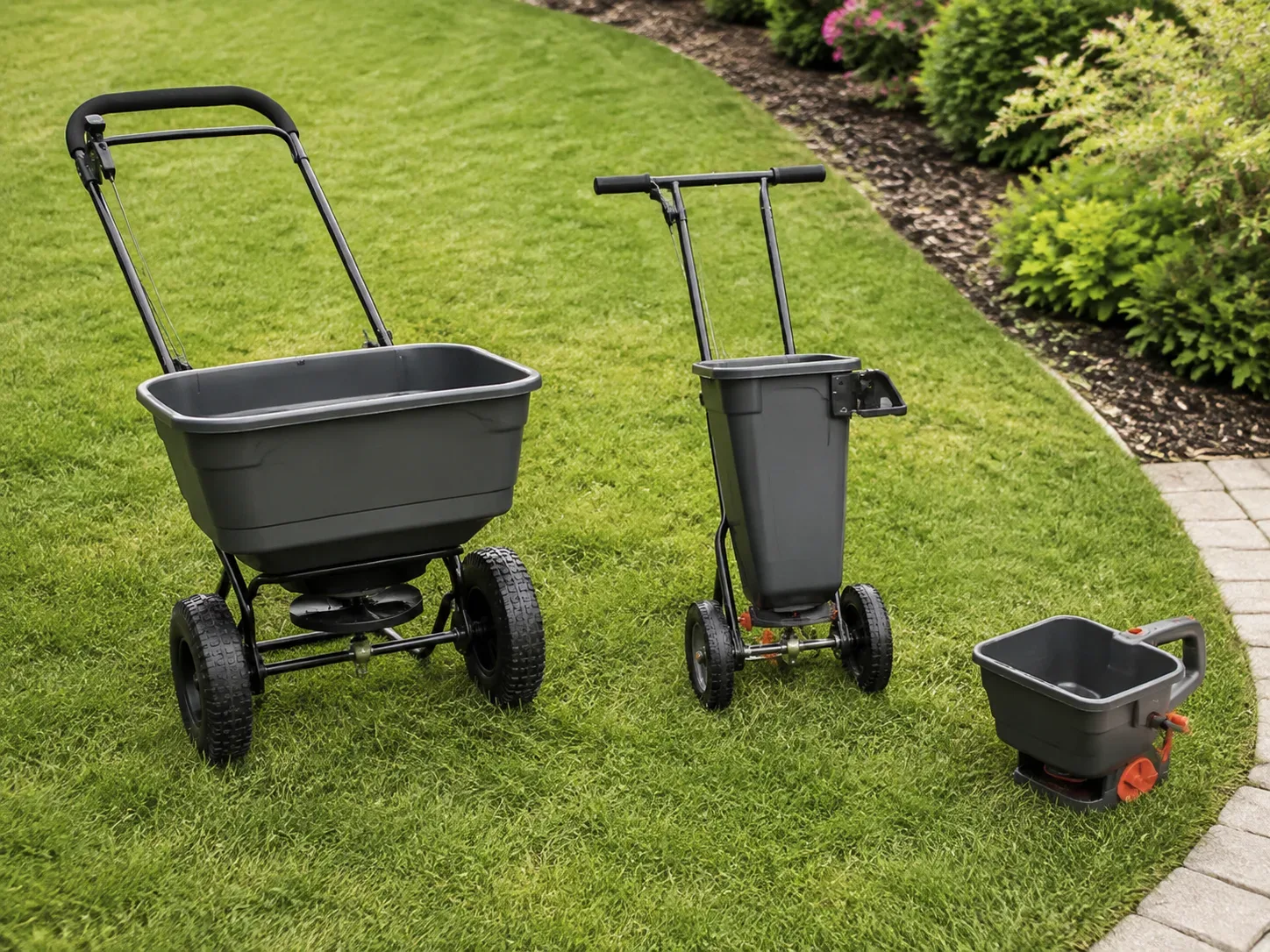
Sweep granules from sidewalks, driveways, and gutters back onto the lawn if the label allows, rather than hosing them toward a storm drain. Store leftover fertilizer sealed and dry, away from children, pets, feed, and water sources, and follow the label for cleanup. A spilled pile can deliver far more product to one spot than the intended lawn rate.
Water new grass without washing nutrients away
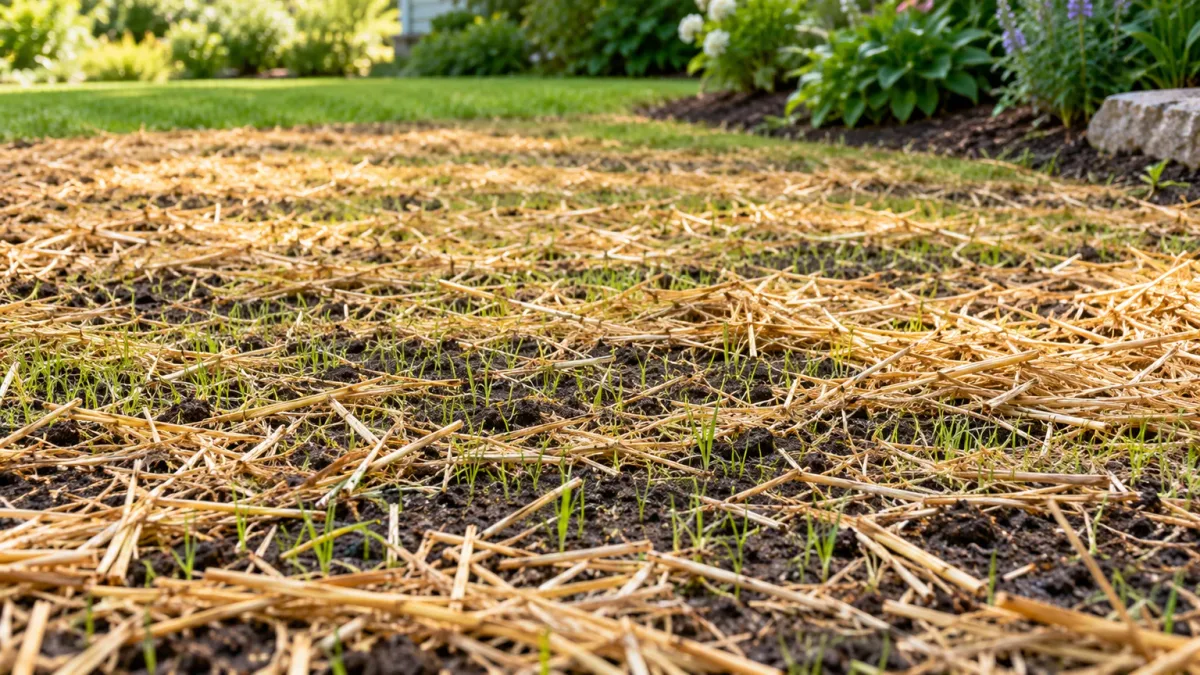
Watering is part of fertilizer timing, but it does not mean flooding the seedbed. For seed, the upper layer must stay consistently damp until germination and early establishment, which can require brief, frequent irrigation in hot or windy conditions and less in cool, rainy weather. The goal is to keep seed from repeatedly drying, not to leave standing water or make the soil muddy.
For sod, water deeply enough that moisture passes through the sod and reaches the soil below. Check the seam or lift a small corner to see whether the underside and bed are damp; green blades on top do not prove the root zone is moist. Adjust for rainfall, shade, slope, temperature, and soil texture. Sandy soil may drain quickly, while compacted clay can stay wet at the surface and still shed water downhill.
When fertilizer directions require watering in, follow the stated amount and timing. If a storm is likely to send water across the lawn, postpone the application rather than relying on rain to distribute fertilizer. Heavy runoff can carry soluble nitrogen and phosphorus into storm drains, ponds, and streams, and it may leave the new lawn with less of the intended nutrient. Conversely, fertilizer left on tender grass blades during hot, dry weather can increase the risk of scorch, depending on the product and application.
After seedlings are established or sod roots have anchored, gradually shift from frequent shallow irrigation to a deeper, less frequent pattern appropriate for the grass type and local climate. Make that transition gradually: suddenly allowing a new seedbed to dry can undo good preparation, while continuing short daily watering indefinitely encourages shallow roots and keeps the surface wet. Use rainfall and a simple soil check to adjust the schedule rather than following a timer blindly.
Plan the first follow-up feed around roots and growth
Do not schedule a second application simply because a calendar reminder says “four weeks.” First confirm that the lawn is growing, that the first product has had time to work, and that the test or extension recommendation supports another feeding. If seedlings are still sparse because of dry soil, poor contact, shade, or the wrong season, adding fertilizer may intensify stress without fixing the cause.
For seeded cool-season turf in Pennsylvania, Penn State Extension describes a possible follow-up of 0.5 pound of nitrogen per 1,000 square feet four to eight weeks after the starter application when additional nutrition is needed. Other regions and grass types may use different rates or timing. If a soil test already indicated sufficient nutrients or local law restricts the product, do not use this example as a reason to add fertilizer. (Penn State Extension)
For sod, let root-in and mowing readiness guide the next step alongside local advice. A light tug test is more useful than counting a fixed number of days, because a cool spell, heat, drought, poor soil contact, or species can slow rooting. Some sod guidance recommends waiting until the lawn has rooted and been mowed several times before moving to a normal feeding program. That extra time reduces the temptation to push leaf growth while the new root system is still shallow. (Super-Sod)
Match timing to the grass type and season
Cool-season grasses, including tall fescue, Kentucky bluegrass, and perennial ryegrass, grow most actively during cooler parts of the year. In many regions, late summer or early fall is favorable for establishing them because soil remains warm enough for germination while air temperatures ease; local frost dates, rainfall, and species still affect the window. Penn State’s establishment guidance describes late summer as an optimum seeding period for much of Pennsylvania, but that should not be copied to a different climate without checking local recommendations.
Warm-season grasses, such as bermudagrass and zoysiagrass, establish during warm weather and should generally be fertilized when actively growing. A dormant or heat-stressed lawn cannot make good use of an aggressive nitrogen dose. When the weather is unusually hot, dry, cold, or wet, wait for suitable conditions if the label allows; no formula can replace active growth and moisture at the roots.
There is also a difference between a newly planted lawn and an established lawn’s annual schedule. Early establishment feeds should be based on the soil report and how the lawn was planted. Later maintenance may be timed to the grass’s seasonal growth and local rules. Do not import a three-times-a-year schedule from another state just because it is easy to remember.
Follow local phosphorus rules and protect waterways
Phosphorus helps plants, but excess phosphorus can contribute to nutrient pollution when it moves off a lawn in runoff. Some states and municipalities limit phosphorus in lawn fertilizer, with different exceptions for establishing a new lawn, hydroseeding, or a soil-test-confirmed deficiency. The exception is not automatically the same everywhere, and a product label does not override a local law.
For example, New York State’s Department of Environmental Conservation describes limited circumstances in which phosphorus fertilizer may be used for new lawn establishment or a documented soil deficiency. Check the current rule where you live before buying or applying a phosphorus-containing starter product; if the rule is unclear, ask your state environmental agency or Cooperative Extension office. (New York State Department of Environmental Conservation)
Keep fertilizer off pavement, storm drains, saturated ground, frozen soil, and water edges. Do not apply before a forecast that could create runoff, and avoid spreading onto steep slopes unless you can use a locally approved erosion-control method. New seed and loose soil are especially vulnerable to movement, so stabilize the surface with a thin, suitable mulch or erosion-control blanket when the site and seed label call for it.
If the area drains toward a lake, stream, or roadside ditch, a soil test and careful measurement matter even more. Use only the nutrients the report calls for, keep a buffer where local rules require one, and sweep stray granules from hard surfaces. Reducing excess is more effective than hoping fertilizer stays where it lands.
Avoid burn, weed-and-feed damage, and uneven growth
The most common fertilizer mistake is treating a high rate as insurance. New roots are small, and excessive soluble salts can pull moisture away from tender tissue. A pile under a spreader, overlapping passes, or a guessed rate can produce yellow-brown streaks even when the rest of the lawn looks fine.
Do not use weed-and-feed on newly seeded grass unless the product label explicitly permits it for the exact establishment stage. Many pre-emergent herbicides are designed to stop seeds from germinating, and post-emergent products can injure young turf. Wait until the lawn has reached the label’s required number of mowings or maturity threshold before applying weed control; the exact interval depends on the herbicide and grass, so a generic “three months” rule is not a substitute for the label.
Avoid applying fertilizer to drought-stressed, heat-stressed, dormant, or waterlogged grass. If the lawn is already struggling, inspect moisture, grade, soil contact, and root development first. A fertilizer does not repair sod that is floating over an air pocket, seed washed out of a low spot, or a seedbed that crusted after heavy rain.
Organic and synthetic fertilizers can both supply plant nutrients, but their release patterns and nutrient analyses differ. Organic sources may release nutrients more slowly and depend on soil conditions; they can still add phosphorus and nitrogen and are not automatically harmless to runoff. Compare the label and soil-test fit, and use compost or manure only when its nutrient content and application method are appropriate for a new lawn.
Troubleshoot a new lawn before adding more fertilizer
If growth is patchy, first map the pattern. Straight skips or arcs may point to spreader coverage or sprinkler reach; a dense strip at the low edge can indicate seed or nutrients moved downhill. A uniform pale color may suggest a nutrient issue, but pale seedlings can also reflect cold, shade, water stress, or a grass species that is still emerging. Wait until the expected germination window for the seed type has passed before diagnosing bare soil as a fertilizer failure.
If the lawn has brown or yellow bands after feeding, check whether the bands match overlapping spreader passes or a spill. Watering may help move some products into the soil, but do not flood a slope or wash material into a drain. Follow the fertilizer label’s spill and overapplication instructions; if a large amount was applied or turf damage continues, contact the local extension office with the product analysis, rate, date, grass type, and area treated.
If sod lifts easily, do not respond with more fertilizer. Improve contact by checking for air gaps and dryness beneath the rolls, then water appropriately and keep traffic off while roots establish. If seed has not emerged, verify the species, planting depth, soil moisture, and temperature, and look for crusting or washout. Correct the failed condition before reseeding; otherwise the next batch is likely to fail in the same way.
Conclusion
Fertilizing a new lawn works best as part of soil preparation, not as a blanket treatment. Start with a representative soil test, choose a product whose nutrients match the report and local phosphorus rules, and calculate the amount from the label and measured lawn area. A “starter” label alone does not tell you whether the formula is needed or how much to use.
For seed, apply any needed starter near planting and protect the shallow seedbed with gentle watering. For sod, correct the soil before installation, keep the rolls in close contact with moist soil, and wait for roots to anchor before considering another application. Then use local guidance and the product label to set the next timing. Measured rates, even coverage, active growth, and runoff prevention give new turf a better foundation than extra fertilizer ever will.



