How to Grow and Care for Firebush
Firebush care made clear: choose the right Hamelia patens, plant it for mature size, water through establishment, prune for flowers, and handle freezes.
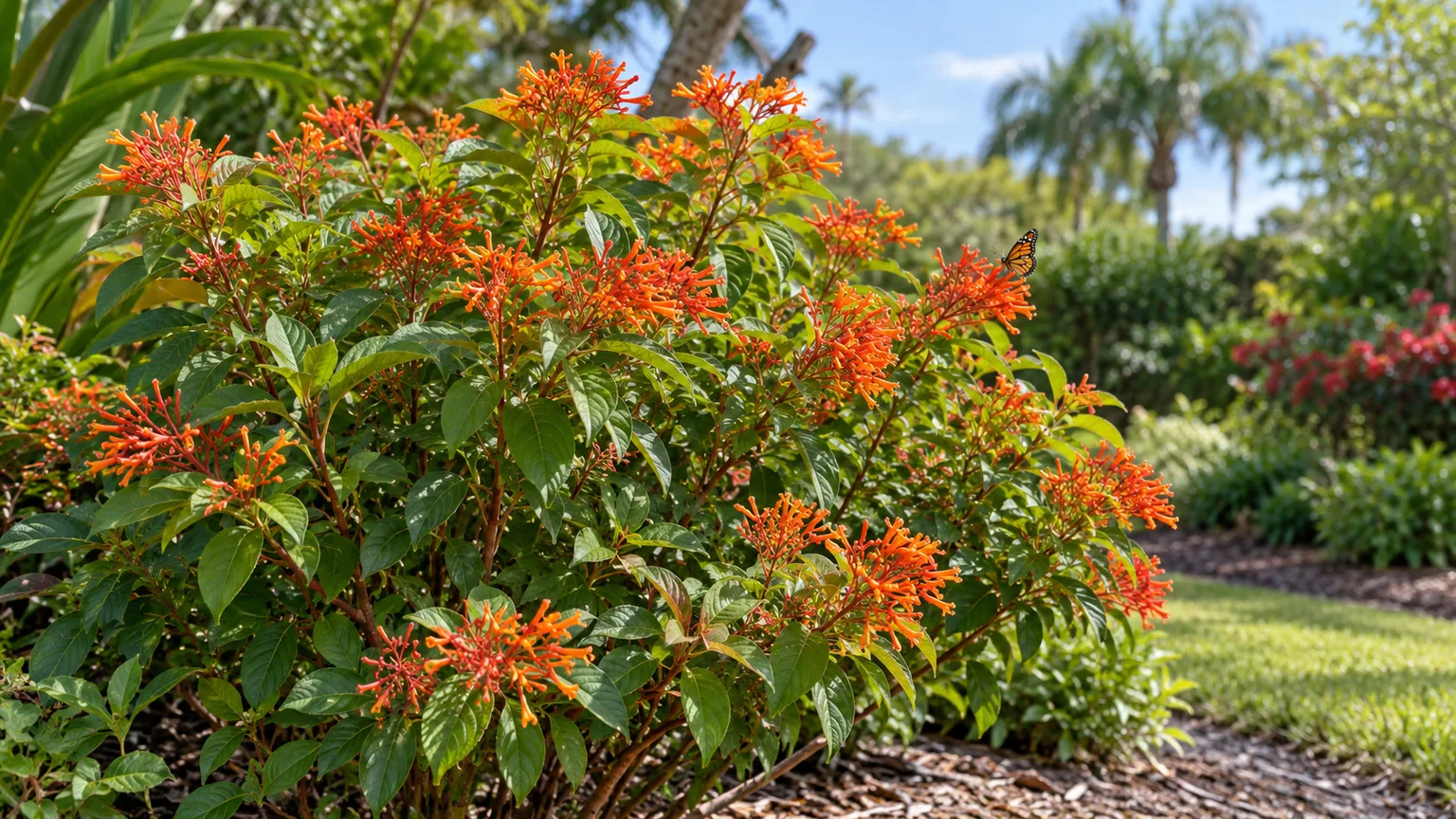
Firebush (Hamelia patens) is a fast-growing shrub for warm gardens, valued for orange-red tubular flowers and the birds and butterflies that visit them. The easiest way to succeed is to get three decisions right before planting: choose a form suited to your region, give it enough sun and room, and keep the root zone moist while it establishes without leaving it waterlogged.
A mature plant can be a small, loosely branched shrub or a substantial screen, depending on climate and pruning. In places with frost, stems may die back even when roots survive. That difference explains why one gardener describes firebush as a perennial and another treats it like a tropical annual. The care below accounts for both.
Firebush at a Glance
| Feature | What to expect |
|---|---|
| Botanical name | Hamelia patens |
| Common names | Firebush, scarlet bush, firecracker shrub |
| Habit | Fast-growing, soft-stemmed shrub or small tree |
| Mature size | Commonly 6–12 feet tall; larger in warm areas, smaller where it freezes back |
| Light | Full sun for the strongest flowering; partial shade tolerated |
| Soil | Adaptable, preferably well-drained |
| Water | Regular water while establishing; moderate drought tolerance once rooted |
| Flowers and fruit | Orange-red tubular flowers followed by dark berries |
| Best use | Warm-climate specimen, informal screen, border, or large container |
The numbers are a planning range, not a promise about your individual plant. UF/IFAS describes mature plants from about 6 to 12 feet, with the potential for 15 feet or more in favorable conditions; frost, shade, container restriction, and pruning all reduce the finished size. The UF/IFAS firebush profile and UF/IFAS Gardening Solutions guide are useful regional references.
Choose a Firebush That Fits Your Region
If you garden in Florida and want the local native, look for Hamelia patens var. patens. Ask the nursery to confirm the botanical name and source; “firebush,” “dwarf firebush,” and “compact firebush” can refer to different plants. The Florida Wildflower Foundation cautions against nonnative H. patens var. glabra, which may be sold as African, dwarf, or compact firebush and can interbreed with native plants. It notes that the native selection ‘Calusa’ offers a more compact option.
Labels do not always tell the whole story. UF/IFAS describes dwarf firebush as a related nonnative form with smoother leaves and lighter flowers, while also noting the smaller-flowered cultivar ‘Firefly.’ These names are not interchangeable proof of local nativity. If ecological fit matters, buy from a native-plant nursery and verify the full name instead of relying on flower color or a sales tag alone. The Florida Wildflower Foundation’s firebush profile explains the distinction and regional planting concern.
Outside Florida, check whether the plant is appropriate for your area and whether it can survive local winter temperatures. Firebush is native across parts of the tropical and subtropical Americas, but “native somewhere” does not mean native to every region where it grows. Choose locally appropriate species and cultivars, and follow local guidance about planting plants that may spread beyond the garden.
Climate and Hardiness: Separate Stem Damage From Root Survival
Firebush performs best where summers are warm and the growing season is long. Published hardiness ranges vary: the UF/IFAS landscape profile lists zones 9–11, while its Gardening Solutions page describes planting in zones 8–11. That apparent conflict is easier to understand when you separate evergreen top growth from root survival. In a cold winter, stems can die to the ground and the plant may resprout from its roots after spring warmth returns.
In a mild coastal or subtropical garden, firebush may behave as a large evergreen shrub and flower for much of the year. Farther north, a plant can return from the crown but start the season much smaller, flower later, or fail after a severe or prolonged freeze. UF/IFAS Extension reports root hardiness through zone 9, while Gardenia’s growing profile likewise notes that frost can kill the plant to the ground and that it is grown as an annual in colder areas.
Do not use the zone number alone as a guarantee. A sheltered wall, well-drained soil, cold-air drainage, and the duration of a freeze can change the outcome. If your winters routinely freeze the ground or produce long spells below freezing, treat firebush as a warm-season annual or grow it in a container that can be moved under protection. If it is in the ground, expect possible dieback rather than assuming the shrub will remain evergreen.
Give Firebush Sun for the Best Flowering
Choose a site with at least six hours of direct sun if flowers are the priority. Firebush tolerates partial shade and can retain attractive foliage there, but shaded plants commonly produce fewer blooms and looser growth. The Florida Museum of Natural History’s wildflower profile describes a wide light tolerance, while UF/IFAS and Gardenia both recommend sun for better flowering.
In very hot locations, some afternoon shade may reduce heat stress, especially for a newly transplanted shrub, but all-day shade is a poor choice if you are waiting for a show of blooms. Check the site in the growing season, not just in winter: trees that are leafless in January may cast dense shade by summer. If the shrub is already established and flowers poorly, look for an encroaching canopy or a fence that blocks midday light before adding fertilizer.
Choose Soil and Plant With Drainage in Mind
Firebush grows in a broad range of soils, from sandy to loamy and even some clay, as long as water does not remain around the roots for long periods. It tolerates a range of soil pH, including alkaline soils, but adaptability is not the same as liking a permanently soggy planting hole. If the site stays waterlogged after rain, choose a raised bed or another location rather than trying to solve the problem with a layer of gravel at the bottom of the hole.
Plant during warm weather after the risk of frost has passed. Set the shrub where its full mature width can fit without constant clipping. Dig a hole about as deep as the root ball and wider than it, loosen circling roots gently, and set the top of the root ball level with or slightly above surrounding grade. Backfill with the excavated soil, water slowly to settle it, and add a thin mulch layer while keeping mulch away from stems.
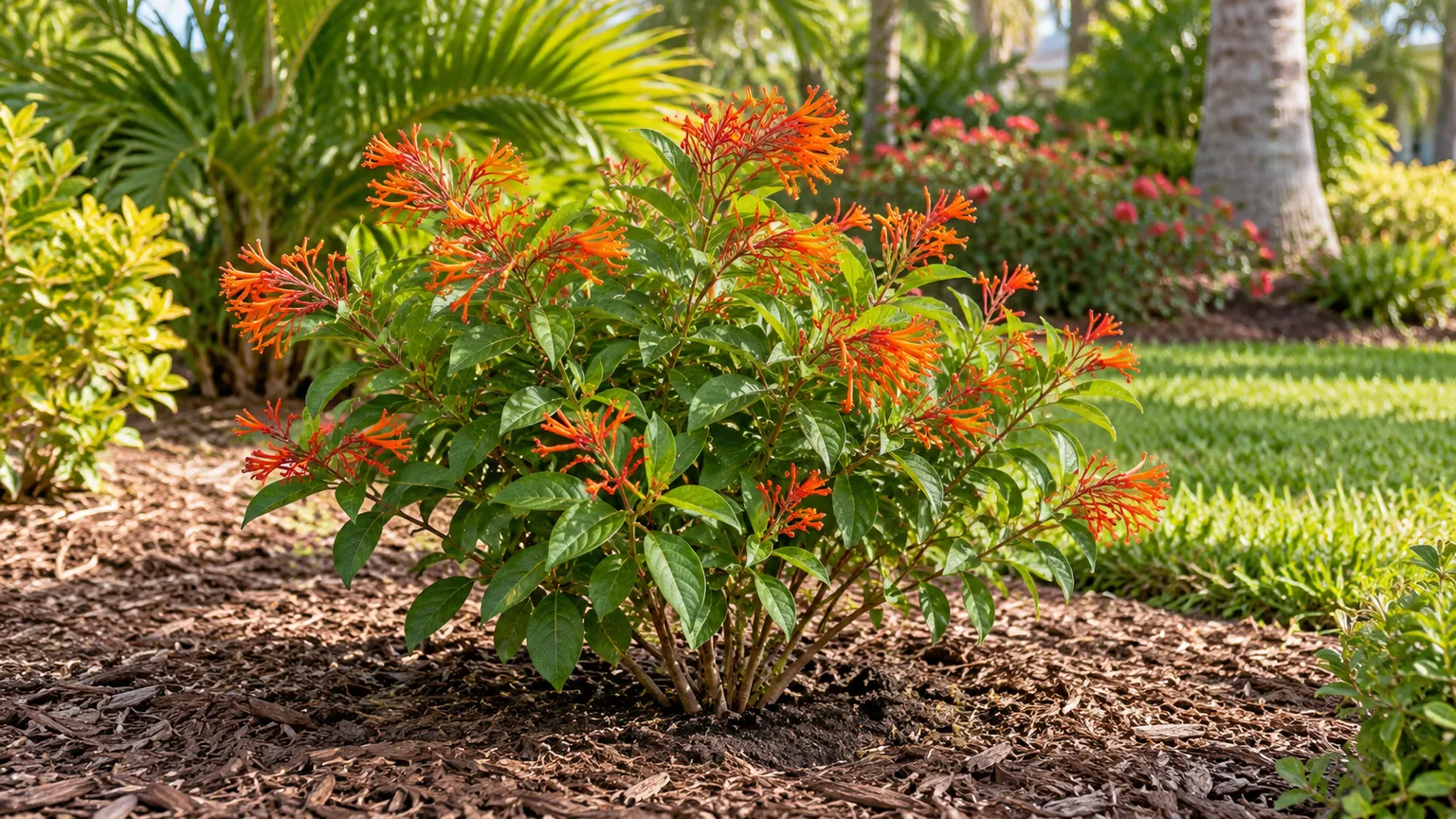
A common mistake is to plant a nursery shrub in a cramped foundation strip and plan to “keep it small” by shearing it every few weeks. That can remove new flower tips and leave a dense outer shell over bare inner stems. If the available footprint is narrow, choose a verified compact selection, use a large container, or select a naturally smaller shrub for that site.
Water Deeply While the Shrub Establishes
A newly planted firebush needs regular water until its roots begin exploring the surrounding soil. Water the root ball slowly when the top few inches start to dry, adjusting for rainfall, soil texture, and heat. Sandy ground drains quickly and may need more frequent checks; heavy soil can remain wet much longer. The goal is steady access to moisture during root establishment, not a fixed calendar schedule.
After the shrub has rooted in, it can tolerate dry spells better than a newly planted specimen. UF/IFAS calls it heat- and drought-tolerant once established, but the plant may still look better and flower more consistently when it gets moisture during prolonged dry weather. Check the soil before watering: if it is still moist several inches down, wait. If it is dry at root depth and the leaves begin to droop in heat, give a slow soak rather than a quick sprinkle across the surface.
Containers need closer attention because they dry faster than garden soil and warm up on sunny patios. During hot or windy weather, check a potted plant daily, but water only when the mix is actually drying. Make sure excess water drains freely and never let the pot sit in a full saucer.
Fertilize Lightly, If at All
Do not fertilize firebush automatically every month. In-ground shrubs in reasonably fertile soil often grow well without extra feeding, and UF/IFAS recommends sparing fertilizer. Too much nitrogen can push leafy growth at the expense of flowers, create soft stems, and make the plant harder to keep in scale.
If growth is weak after you have confirmed adequate light and sensible watering, use a soil test or follow a local Extension recommendation before applying fertilizer. A light, balanced landscape fertilizer in the active growing season may help in genuinely poor soil, but it will not correct deep shade, compacted wet ground, or freeze damage. Avoid feeding late in the season where new growth could be exposed to cold.
For a potted firebush, nutrients wash out more quickly, but the same restraint applies. Use a container mix with some initial fertility and follow its label; if you supplement, use a modest dose during active growth. Stop if the plant is growing vigorously but flowering less.
Prune for Shape Without Removing Every Flowering Tip
Prune to solve a clear problem—dead or damaged wood, a branch rubbing against a path, or a plant that has outgrown its assigned space. Firebush flowers at branch tips, so repeated clipping can remove the very growth that would carry the next flush of blooms. UF/IFAS cautions that heavy or frequent pruning can reduce flowering and suggests keeping plants no shorter than roughly five to eight feet where they are grown as large shrubs.
In frost-prone regions, wait until the worst cold has passed and new growth begins before cutting back stems that might still be alive. Scratch a small patch of bark: green tissue indicates living wood; dry brown tissue suggests dieback. Then remove only dead portions, cutting back to live growth or to the base if the stem is fully dead.
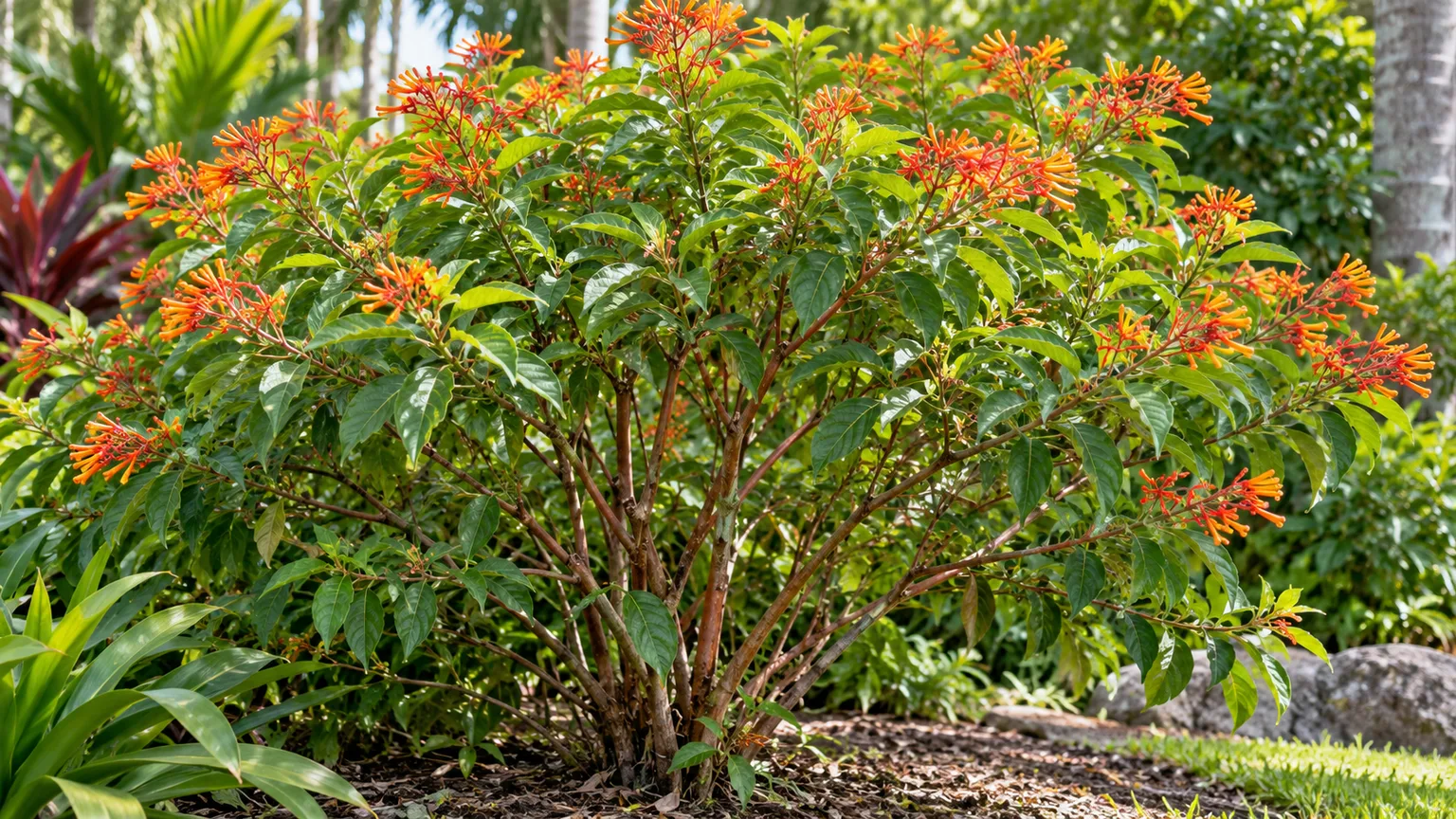
In warm regions, shape lightly during active growth or after a flowering flush rather than shearing the whole shrub on a rigid schedule. Thin a few crowded stems at the base to open the plant, then shorten only branches that exceed the desired outline. If you want a formal hedge, expect to trade some flowers for a crisp surface and more frequent maintenance. For a wildlife garden, preserve the natural form and avoid removing every cluster of flowers and fruit.
Grow Firebush in a Container
A large container is useful if your climate is too cold for firebush outdoors year-round or if you need to control the plant’s footprint. Choose a sturdy pot with multiple drainage holes and room for the root ball to expand. Use a quality outdoor container mix that drains freely; garden soil in a pot compacts and stays wet more easily.
Set the pot in a sunny position and rotate it periodically if growth leans toward the light. Container shrubs are more exposed to temperature swings than those planted in the ground, so move the pot to a sheltered, bright place before a hard freeze. A very small pot is not a lasting size-control strategy: it dries quickly and can restrict roots enough to stress the plant.
Expect more frequent watering and periodic repotting or root pruning than with an in-ground plant. If the plant is healthy but the pot has become difficult to manage, move it one size up in spring rather than jumping to an enormous container full of wet mix. In cold regions, a container lets you keep the roots alive through winter, but indoor rooms may lack the intense light and warmth required for the shrub to thrive. A bright protected porch or greenhouse is often a better winter location than a dim living room.
Protect Firebush and Assess Freeze Damage
Before a cold snap, water a dry in-ground plant at the root zone and make sure mulch is in place, but do not wrap the shrub tightly in plastic. A cover can reduce exposure during a brief frost if it reaches the ground and is removed after temperatures rise; it cannot make a tropical shrub reliably hardy through a prolonged freeze. Move containers to a protected location and group them near a sheltered wall if necessary.
After a freeze, wait. Leaves may turn dark, drop, or look scorched while the roots remain viable. Do not cut the plant to the ground immediately after a cold night: dead stems can provide some protection, and it may take time to see where live tissue resumes. Once spring growth appears, prune back to healthy wood and give the roots normal water as the plant restarts.
If no shoots emerge as warm weather progresses, scratch a few stems low on the plant and check for green tissue. A dry, brown stem all the way to the base is dead, but roots may still send up new growth later. If the crown is soft or the soil has stayed saturated, root loss from waterlogging may be more likely than cold injury. Cold recovery is never guaranteed; a severe freeze, young planting, or poorly drained soil can kill the whole plant.
Propagate Firebush From Cuttings or Fresh Seed
UF/IFAS lists fresh seed, stem cuttings, and air layering as propagation methods. A cutting is the practical choice when you want a copy of a plant with a known flower color and growth habit; seedlings may vary. In Florida, propagate only a plant you have correctly identified, especially if you are trying to preserve a native selection.
Take a 4- to 6-inch semi-hardwood cutting from current-season growth that has begun to firm but is not brittle. Use clean pruners, cut just below a node, remove leaves from the lower half, and keep a few leaves near the tip. Place it in a clean, free-draining propagation medium, moisten the mix, and cover loosely with a clear humidity cover that does not press against the leaves. Keep it warm in bright shade, not direct afternoon sun, and vent the cover if condensation stays heavy.
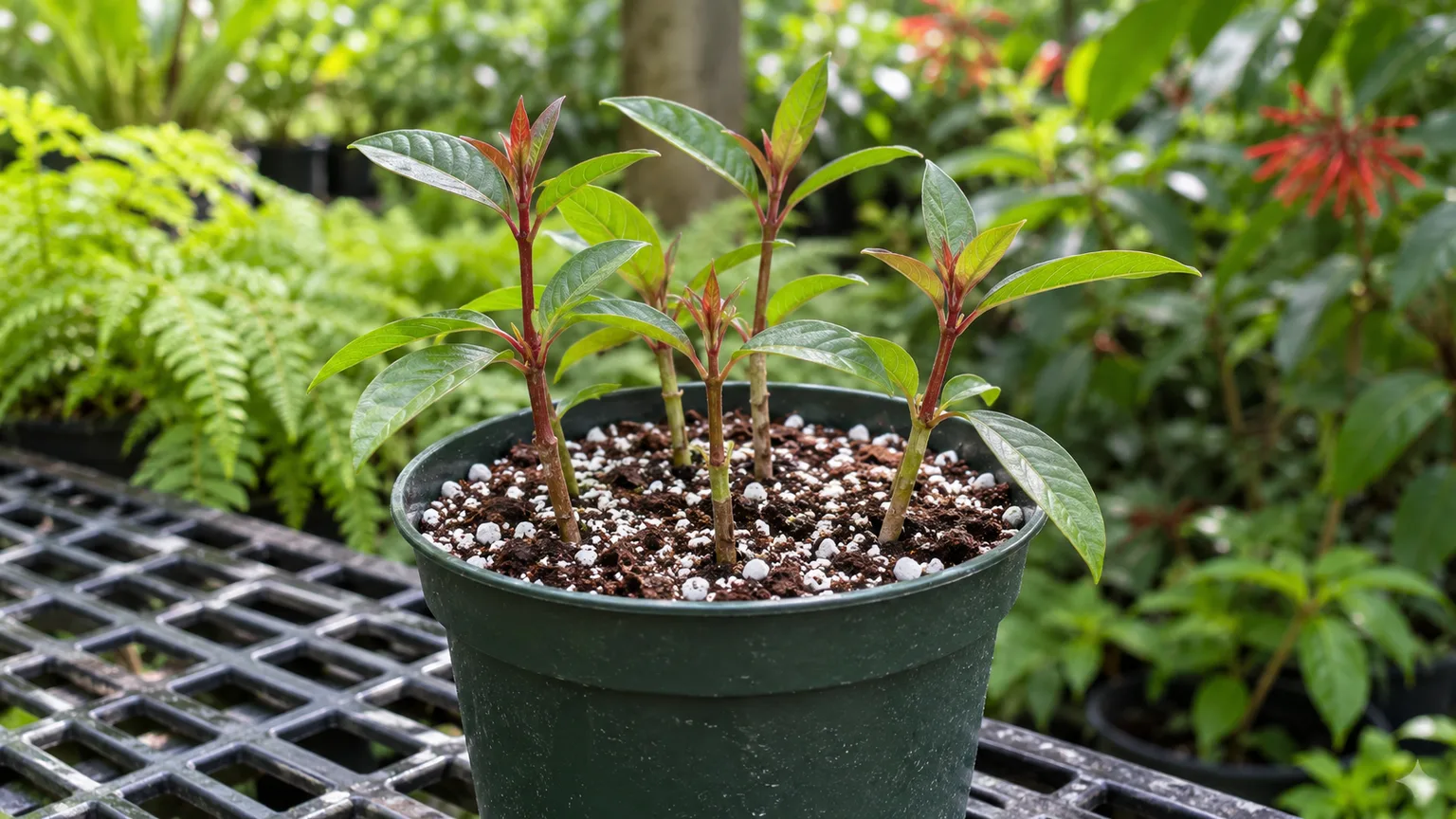
Keep the medium slightly moist, not saturated. Check for resistance with a gentle tug after several weeks rather than repeatedly removing the cutting to inspect it. Timing and rooting speed depend on stem maturity, warmth, humidity, and the health of the parent, so do not expect every cutting to root on the same schedule. UF/IFAS’s guide to stem cuttings identifies firebush as suitable for semi-hardwood propagation and explains the difference between soft and more mature cuttings.
For seed, collect mature dark fruit only from a correctly identified plant and sow fresh seed in a clean, moist, free-draining mix. Do not let the tray dry out, but do not keep it flooded. Seed propagation is useful when you want several plants, though it takes patience and offspring may not match the parent exactly. Keep seedlings protected until they have enough roots and foliage to handle outdoor conditions.
Diagnose Poor Flowering Before Adding Fertilizer
If a firebush has foliage but few flowers, check light first. A shrub in deep or increasing shade may stay alive and leafy while blooming sparsely. If it receives strong sun, consider whether repeated pruning is cutting off terminal growth, whether it has recently resprouted after a freeze, or whether excess nitrogen is pushing leaves rather than flowers.
A recently planted shrub may spend its first season building roots before producing a full display. It can also flower later in colder regions where stems die back and regrowth starts from the base. Give it time, protect its root system, and correct one limiting factor at a time instead of changing water, fertilizer, and pruning simultaneously.
Look at the soil before blaming nutrition. Roots stressed by chronic wetness or a tight, dry root ball cannot use fertilizer effectively. Fix the growing condition first. If the plant is healthy, gets full sun, has not been sheared, and still fails to flower after a full growing season, consult a local Extension service with photos and details about the site and care history.
Check Yellow Leaves, Pests, and Other Problems
Firebush is generally a low-maintenance shrub with few serious pest problems, but it is not immune to stress. UF/IFAS lists occasional scale, mites, and aphids; inspect the undersides of leaves and tender growth before treating anything. A few insects or chewed leaves do not automatically justify a spray, especially on a plant that is flowering and attracting pollinators.
Yellow leaves on a plant in wet soil point first to drainage or overwatering, especially if leaves yellow broadly and growth slows. Allow the root zone to dry to a reasonable level and confirm water can escape the site or container. If foliage yellows during a dry, windy spell, check moisture several inches down and water deeply if the root ball is dry. Wind and cold can also brown leaves, so consider recent weather before assuming disease.
If you find a pest, identify it and check whether it is causing sustained damage before acting. Use any pesticide only if necessary and exactly according to its label; avoid spraying open flowers or beneficial insects. If damage continues, take a clear photo and contact a local Extension office rather than applying multiple products at once. Firebush problems often begin with site stress, so review light, drainage, and recent cold exposure before treating leaves.
Use Firebush as a Wildlife Shrub With Room to Grow
The tubular flowers attract butterflies and hummingbirds, and the dark berries feed birds. UF/IFAS names zebra longwings and gulf fritillaries among its butterfly visitors; the Florida Museum profile also notes that flowers draw butterflies and hummingbirds while berries attract birds. A single shrub can add a strong nectar source, but it works best as part of a planting with flowers available through multiple seasons.
Use firebush as a specimen, informal screen, or background shrub where its mature size and loose shape will not crowd a walkway or window. It can be paired with lower-growing flowers and other regionally appropriate native plants to build a layered habitat. Give it space from neighboring shrubs so you can reach the base to inspect and prune without repeatedly cutting back the whole canopy.
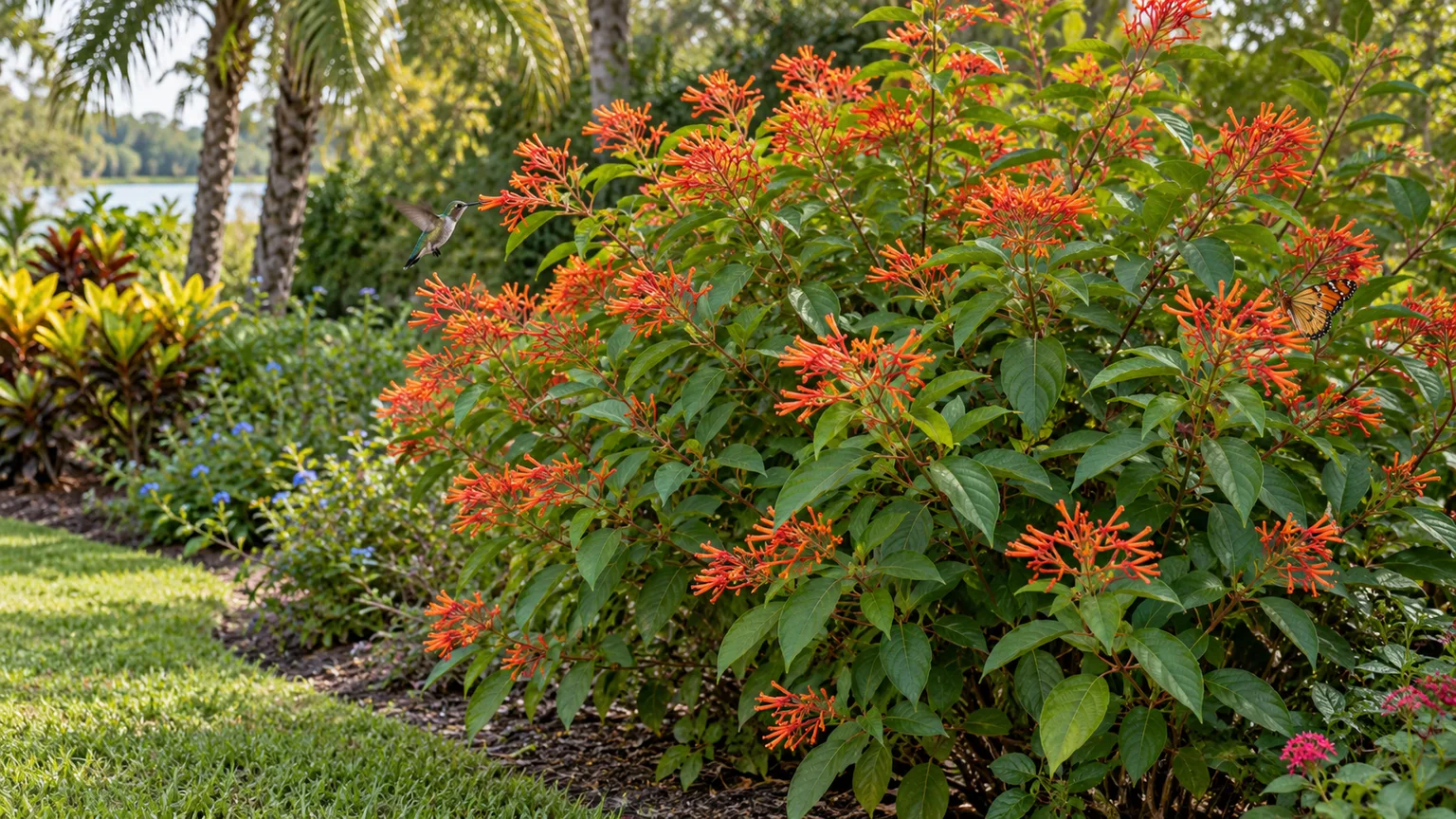
Plan around both fruit and wildlife. If you do not want seedlings in a formal bed, remove ripe fruit or unwanted seedlings while young; otherwise, leave some berries for birds. Be aware that plant identity and regional suitability matter: the Florida Wildflower Foundation cautions against nonnative forms that may mix with Florida’s native firebush populations. The right plant, placed in the right region, makes the shrub a more responsible wildlife choice as well as an easier one to maintain.
Conclusion
Firebush care is mostly about matching the shrub to a warm, sunny site with room to spread. Start with a correctly identified plant, especially if you are gardening in Florida; water regularly while it establishes, let the soil drain between waterings, and limit fertilizer and clipping so flowers remain on the branch tips.
In colder areas, expect possible stem dieback and wait for spring growth before deciding the plant is dead. In containers, plan for faster drying and winter protection. If blooms are scarce or leaves yellow, check sun, water, drainage, freeze history, and pruning before reaching for fertilizer or pesticide. With those conditions in balance, firebush can become a long-flowering shrub that supports wildlife without demanding constant care.



