How to Grow and Care for Vining Jasmine Indoors and Out
Learn to care for vining jasmine indoors or outside, train stems on a trellis, time pruning, and diagnose yellow leaves, falling buds, and missing blooms.
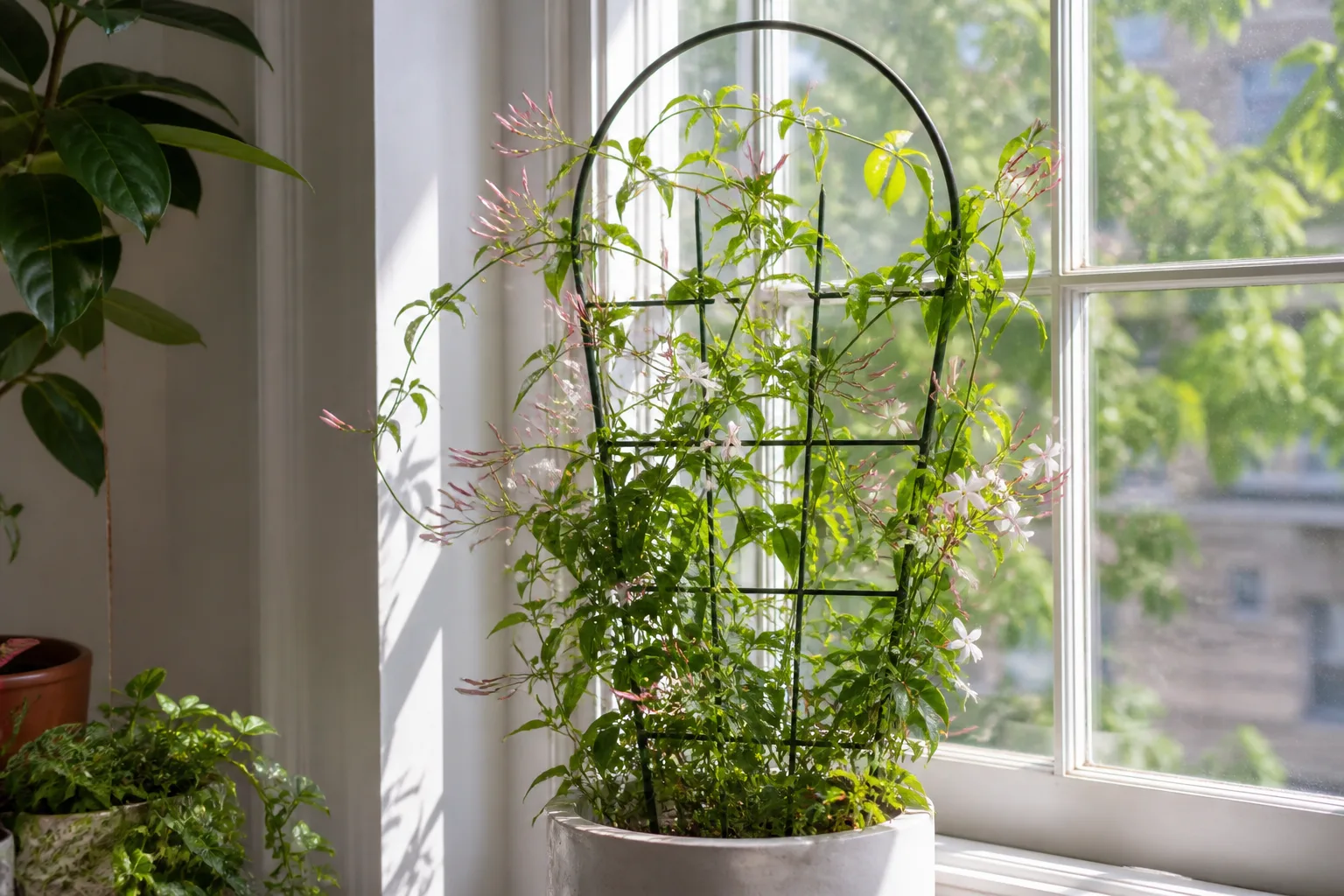
A vining jasmine can cover a hoop with glossy leaves and clusters of pink buds that open into scented white flowers, but the word “jasmine” on a pot tag is not enough to choose its care. The plant may be a tender pink jasmine, a summer-flowering common jasmine, or a lookalike from another genus. Start by finding the botanical name; then match the support, seasonal temperature, and pruning window to that plant.
For most people looking for an indoor flowering vine, pink or Chinese jasmine (Jasminum polyanthum) is the relevant plant. It grows quickly, needs strong light, and rewards a grower who can guide new stems and give it a seasonal routine. It is manageable in a container, but it is not a compact low-light plant that can be left to trail wherever it lands.
Identify the jasmine on your plant label
True jasmine belongs to the genus Jasminum in the olive family, Oleaceae. A label that says “jasmine” may refer to a different plant entirely: star jasmine is Trachelospermum jasminoides, Madagascar jasmine is Stephanotis floribunda, and Cape jasmine is Gardenia jasminoides. Their names and flowers may sound familiar, but their growth and temperature needs are not interchangeable. The Royal Horticultural Society’s jasmine guide separates true jasmine from these common-name lookalikes.
Pink jasmine, also called Chinese jasmine or many-flowered jasmine, is Jasminum polyanthum. It is an evergreen twining vine with dark, compound leaves; pink buds open into fragrant white flowers, commonly in late winter or spring when grown under suitable conditions. The RHS describes it as a vigorous, tender climber usually kept in a container in a bright conservatory or greenhouse, while its broader guide identifies it as a tender houseplant. That combination explains why the plant can be kept indoors in a cold climate but still needs more light and space than an ordinary foliage houseplant (RHS plant profile, RHS growing guide).
Which true jasmine vines suit a container?
J. polyanthum is usually the best match when the goal is a fast, fragrant vine for an indoor hoop or a patio container that can be moved before cold weather. Common jasmine (J. officinale) is also a climber, but it is generally grown outdoors in a warm, sunny spot and can become much larger. The Missouri Botanical Garden’s common-jasmine profile describes it as a vigorous vine that needs frequent pinching and shaping, and notes that it can be grown indoors with support if it gets plenty of light. Arabian jasmine (J. sambac) is often more shrub-like than twining, so it may suit a bright indoor pot but is not the same kind of long climbing vine.
| Name on the tag | Growth habit | Practical growing choice |
|---|---|---|
| Pink or Chinese jasmine (Jasminum polyanthum) | Fast, twining vine; pink buds and white flowers | Bright container, hoop or trellis, seasonal temperature plan |
| Common jasmine (J. officinale) | Vigorous twining vine; mainly summer flowering | Best with outdoor space or a large bright support |
| Arabian jasmine (J. sambac) | Usually shrubby or upright | Bright, warm container; less suited to a long vine display |
| Star jasmine (Trachelospermum jasminoides) | Evergreen twining vine, but not Jasminum | Identify separately; do not copy true-jasmine temperature advice |
If you are unsure, photograph the tag and foliage, then ask the nursery for the Latin name before changing the plant’s location. Flower color alone is not a reliable identifier because several true and false jasmines produce white flowers. For a broader comparison of species and common-name confusion, see the site’s jasmine growing guide; this article focuses on caring for the vining forms in containers.
Choose indoor, outdoor, or seasonal container growing
The best setup depends on climate and light. In a frost-prone region, use a container so a tender pink jasmine can spend warm weather outside and come back in before cold nights. In a mild, sheltered climate, it can grow outdoors in the ground or in a large pot, but a vine on a wall or fence still needs a support you can prune and reach.
A bright conservatory, sunroom, enclosed porch, or sunny window is more suitable than the center of a dim living room. If your only location is several feet from a window, the plant may remain alive but grow thin stems and set few flowers. A grow light can improve winter foliage and help maintain compact growth, but it does not create outdoor airflow or replace a species-specific seasonal cue.
A pot is also a useful boundary for a plant that can run longer than the room or support allows. You can redirect new stems around a hoop and shorten them after bloom, instead of letting them wind into curtains, blinds, or other plants. If you want a vine to cover a pergola or fence permanently, confirm that your local climate suits the species before planting it in the ground.
Give the vine bright, steady light
Place container jasmine at the brightest practical window, often an east-, south-, or west-facing exposure. The RHS recommends bright filtered light for J. polyanthum, while White Flower Farm advises bright light with little or no direct sun while flowers are open. Those recommendations can be reconciled by distinguishing the plant’s growth from its display: strong light supports healthy growth and bud formation, while extreme heat right against glass can shorten the life of open flowers.
A plant that has spent weeks in a dim shop or interior room should not be shifted suddenly into hot midday sun. Move it closer to the glass over several days, or use a sheer curtain during the harshest afternoon period, and watch for pale scorched patches on the window-facing leaves. Turn the pot occasionally if the new growth leans hard toward the light, but avoid repeatedly changing rooms once buds are showing.
Long gaps between leaves, thin stretched stems, and a vine that keeps reaching for one window are signs that the light is weak. Move the plant toward brighter light before adding fertilizer; feeding a light-starved vine tends to produce more soft growth rather than a stronger flowering framework. If the plant is in a north-facing room or shaded by an exterior building, supplemental lighting may be necessary for consistent growth.
Match temperature and bloom timing to the species
Pink jasmine’s flowers usually appear after a period of seasonal change, not because it receives an extra dose of fertilizer. The RHS lists Chinese jasmine as tender and says to keep tender jasmines above about 13°C (55°F), bringing outdoor pots inside when nighttime temperatures approach 13–15°C (55–59°F). The RHS also describes J. polyanthum as flowering from late winter into spring in its climate, with timing shifting when it is grown under glass or in other climates.
Cool-night advice for pink jasmine is not consistent
Some practical growing directions recommend a much cooler spell for flower-bud formation. White Flower Farm, which grows J. polyanthum for indoor winter display, recommends four to five weeks of nights at 40–50°F, bright days, and no artificial light after sundown. That differs sharply from the RHS advice to keep this tender jasmine above 55°F. Treat those as different production approaches rather than one universal temperature rule.
For a home grower without a known cultivar or greenhouse setup, use the more cautious threshold: keep the vine bright, protect it from frost and cold drafts, and try a naturally cool room that stays around or above 55°F in autumn. Do not put the plant outside on cold nights to chase blooms. If it remains healthy but does not flower, check light, late pruning, and the plant’s identity before attempting colder treatment; a seller’s guidance for the exact cultivar may justify a more specialized routine.
Common jasmine (J. officinale) has a different seasonal pattern. The Missouri Botanical Garden describes it as a spring-to-fall bloomer that rests during the colder months when grown indoors, so use the name on the tag instead of forcing it into pink jasmine’s winter-bloom schedule. In every case, avoid hot-air vents, fireplaces, and sudden temperature swings that dry the foliage or stress developing buds.
Water by checking the potting mix
Watering frequency changes with window exposure, pot size, temperature, and season, so “once a week” is only a reminder to check—not a rule. During active growth, water thoroughly when the upper layer of mix begins to dry, then let the excess drain away. White Flower Farm recommends watering pink jasmine when the top half-inch is dry and warns against soggy mix; that is a useful starting point for a small pot, but a larger or cooler container may need a longer interval.
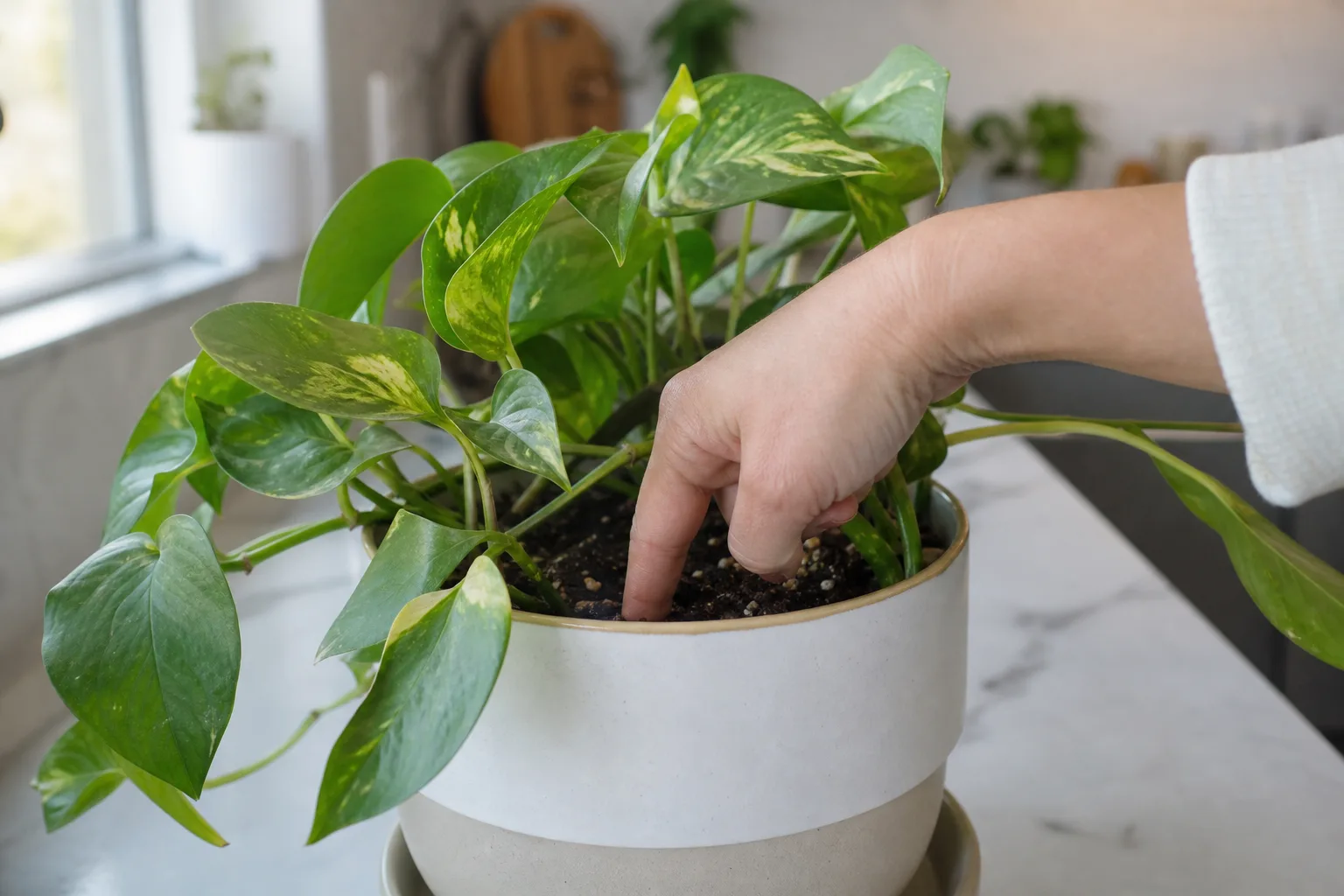
Use a finger or wooden skewer to check the mix instead of judging from the dry surface alone. If the top feels dry but the pot is still heavy and the soil below is cool and wet, wait. If the pot has become light and the mix is dry several inches down, water slowly until moisture runs from the drainage holes, then empty the saucer so the roots are not left standing in water.
Reduce watering when growth slows in a cool, dim winter room, but do not let the root ball dry into a hard, shrunken mass. Yellowing leaves and a persistently wet pot point toward poor drainage or excess watering; limp leaves with very dry soil indicate the plant has gone too long without water. Make one correction and observe new growth rather than alternating between soaking and drought.
Choose a draining pot and airy mix
Use a container with unobstructed drainage holes and a saucer you can empty. A heavy ceramic pot can steady a tall vine, but a decorative cachepot without drainage should hold a nursery pot only if you remove that inner pot for watering and let it drain fully before putting it back. Standing water at the bottom of a cover pot can keep the mix saturated even when the top looks dry.
A peat-free indoor mix or standard quality potting mix loosened with perlite, fine bark, or another coarse component gives roots both moisture and air. Gardenia’s indoor jasmine guide describes the same balance of moisture and drainage; use the structure as a starting point and adjust if your mix stays wet for days. Do not fill a pot with garden soil: it is usually too dense in a container and may drain unevenly. Avoid solving every watering problem by adding more amendments; the practical test is whether water wets the root ball evenly and then drains without leaving the mix swampy for days.
Repot when roots have filled the pot, water passes straight through without wetting the root ball, or the plant dries unusually fast despite reasonable conditions. Move up only one pot size and keep the base of the stems at the same soil level. A huge pot leaves more wet mix around a comparatively small root system, slowing drying and making root problems more likely. If the plant only needs fresh mix, a modest root trim and same-size container may be enough.
Train long stems on a hoop or trellis
A vining jasmine does not cling to a wall by itself. Its stems twine, so give them a hoop, small trellis, obelisk, or taut wires to wrap around. Install the support before the vine becomes tangled, and choose a material that is stable in the pot and wide enough that new growth can be distributed rather than packed into a tight knot.
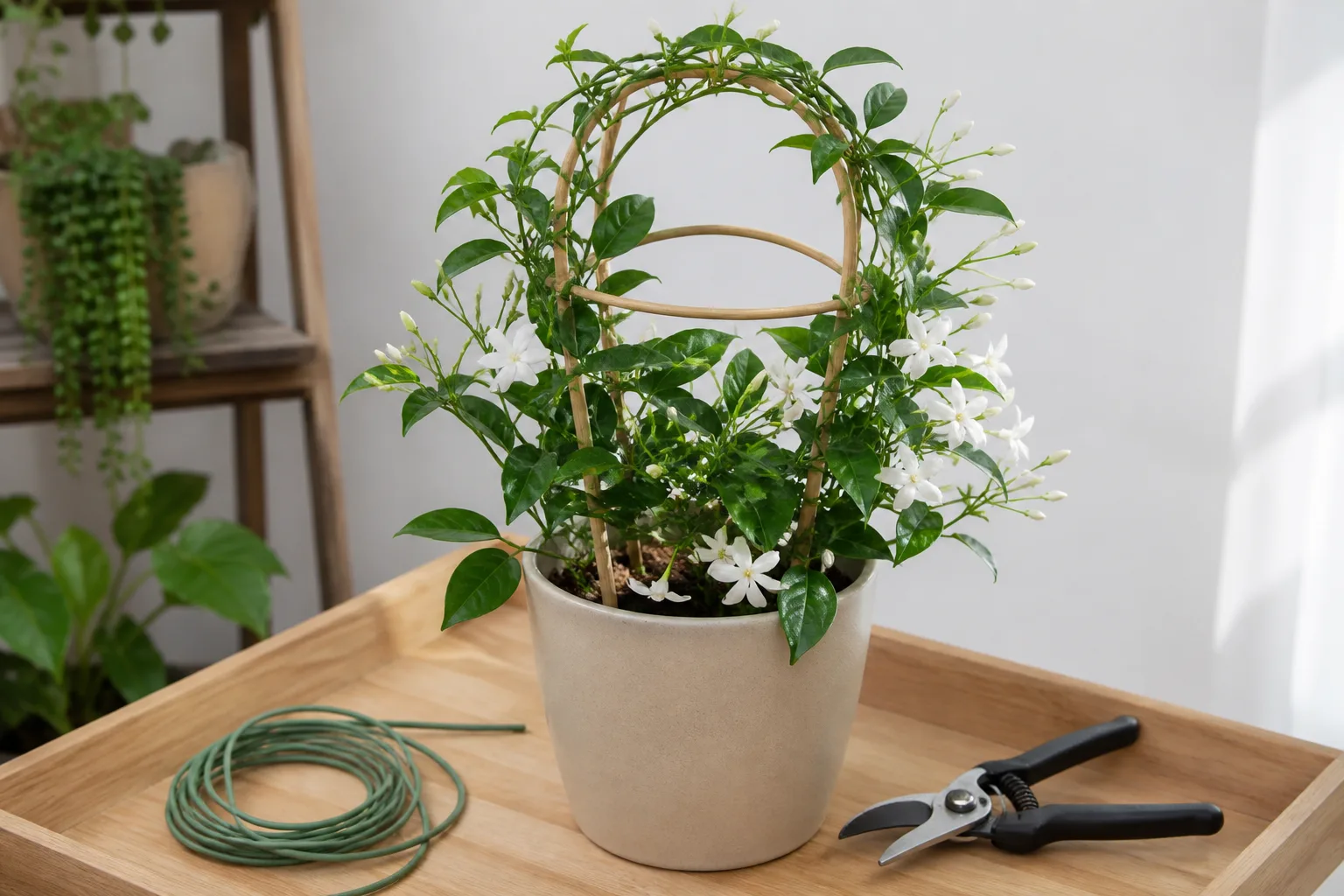
Guide young flexible shoots around the support while they are still easy to bend. Use soft plant ties in loose figure-eight loops where the stem crosses the support; ties should hold the stem close without cutting into it as it thickens. Do not pull a mature woody stem sharply backward. If a branch has grown in the wrong direction, shorten it after flowering and train a fresh shoot in its place.
Spread stems around the support to let light and air reach inner leaves. A dense ball of foliage may look full at first, but crowded growth is harder to inspect for pests, and the shaded interior contributes little to flowering. Check ties every month or two during fast growth and loosen any that have started to bind.
Feed lightly and manage indoor humidity
Feed only while the plant is actively growing. A balanced liquid houseplant fertilizer at the label’s recommended rate is adequate for most container jasmine; if the label recommends frequent applications, use its seasonal directions rather than automatically feeding every week. Pause or reduce feeding when growth slows in winter. Too much nitrogen can make a lush vine that produces fewer flowers, but switching to a high-phosphorus product will not compensate for weak light or incorrect pruning.
Indoor humidity is most useful when the pot sits near a heating vent or the air is very dry. Move the vine away from radiator blasts and hot-air registers first; that change is more reliable than misting leaves, which only wets them briefly. A room humidifier can help raise humidity for nearby plants, but keep air circulating and avoid wet foliage sitting against a cold window overnight.
Prune after the main flowering flush
For a spring-flowering pink jasmine, prune after the flowers fade and before the plant begins setting the next season’s buds. The RHS recommends thinning overcrowded growth after flowering, while White Flower Farm advises stopping pruning by early August because buds are set in late summer. These timings can shift with climate and the plant’s actual bloom cycle, so let the finished flowers—not a fixed calendar date—start the pruning window.
First remove dead, damaged, tangled, or very weak shoots. Then shorten the longest stems to a healthy side shoot or leaf node and redirect the remaining growth onto the support. A light post-bloom trim improves access and keeps the vine in bounds; a hard cut is useful only when the plant is badly overgrown and you accept that it may take time to rebuild flowering growth.
Avoid shearing the whole vine in late summer or fall. That can remove developing buds just before the plant is expected to bloom, leaving you with new foliage but no flowers. Also avoid trimming every stem to the same length: selective cuts preserve the strongest framework and leave younger shoots to fill gaps.
Move the container outside and back safely
A summer outdoors can give a potted jasmine more light and airflow than most rooms. Wait until frost risk has passed and nights are consistently mild, then acclimate the plant gradually: start in bright shade or gentle morning sun, and increase exposure over a week or two. A plant moved directly from indoor filtered light to intense midday sun can scorch even if the temperature is comfortable.
Place the container where the support can be secured and where you can reach the back of the plant for inspection and pruning. Keep the pot from sitting in a rain-filled saucer, and check moisture more often during warm, windy weather because a small container can dry quickly outside. If the vine is growing against a wall, leave room behind the support for airflow and occasional access.
Bring a tender pink jasmine indoors before nighttime temperatures fall below the range recommended for the species. The RHS threshold is 13–15°C (55–59°F), so do not wait until the first frost warning. Before bringing it inside, inspect the stems, leaf undersides, and pot rim for aphids, scale, mealybugs, or other hitchhikers; rinse foliage and isolate the plant briefly if you find pests. Make the reverse transition before buds are well formed if you can, since a sudden change in light and temperature may cause some buds to drop.
Troubleshoot poor flowering and common stress
When a jasmine vine grows leaves but will not flower, work through the likely causes in order. Confirm the botanical name first, because pink jasmine, common jasmine, and star jasmine do not share one bloom calendar. Then check whether the plant gets strong light, whether it was pruned after bud formation began, and whether it experienced the seasonal conditions suited to that species. Add fertilizer only after those basic conditions are right.
Yellow leaves often mean a root-zone or watering issue, especially when the pot remains wet for several days or lacks drainage. Check the bottom of the container and the mix below the surface before watering again. If yellowing begins after a move from outdoors to indoors, also check for a sudden light reduction and pests; the timing of the change often points to the stressor.
Bud drop can follow a fast move between very different conditions, an abrupt drop in light, dry soil, or heat from a vent. Keep the plant in one bright, stable place while buds are developing and avoid turning that period into a series of experiments. A few old leaves dropping is not automatically a crisis; widespread drop combined with wet soil, wilting, or visible pests calls for a closer check.
Brown tips or crispy edges are not proof that a jasmine needs daily misting. Look for hot dry airflow, a root ball that repeatedly dries completely, or salt buildup from frequent fertilizer. Correct the cause gradually and avoid stacking changes—repotting, heavy pruning, a new fertilizer, and a location change all in one week make it hard to know what helped.
Check pests before treating the plant
Indoor jasmine can attract aphids, mealybugs, scale, and spider mites, especially when growth is crowded or the air is dry. Inspect new stems and the undersides of leaves with a bright light; look for sticky residue, cottony clusters, small fixed bumps, or fine webbing. A hand lens helps distinguish a mite problem from dust or dried spray.
Isolate an affected pot before it sits beside other houseplants. For a small infestation, physically remove pests and rinse the foliage, then recheck the plant every few days because eggs and hidden insects may remain. Use only a treatment labeled for the plant and pest, following its instructions; do not apply a pesticide or oil to a stressed plant in direct sun or indoors without checking the label for those conditions.
True Jasminum species are listed by the ASPCA as non-toxic to cats, dogs, and horses. That listing does not cover every plant sold under the name “jasmine,” so confirm the botanical name before relying on it and keep pets from chewing any houseplant.
Propagate from semi-ripe cuttings
Pink jasmine can be propagated from semi-ripe stem cuttings in summer; the RHS also describes layering as an option. A semi-ripe cutting is a new stem that has begun to firm up but is not yet woody. Choose a healthy shoot that has no flowers or visible pests, and take several cuttings if you want to improve the chance that one roots successfully.
Use clean snips to cut a short piece just below a leaf node, remove the lower leaves, and place the bare node into a moist, airy propagation mix. Keep the cutting warm and bright but out of harsh direct sun, and cover it loosely with a clear bag or propagator to reduce drying. Vent the cover periodically and keep the mix damp, not waterlogged; a sealed wet environment can rot the stem before roots develop.
Do not tug every day to see whether it has rooted. Wait for fresh growth or gentle resistance, then move the young plant into a small pot with ordinary well-draining mix. Keep it in bright indirect light while it adjusts, then gradually give it the brighter exposure the mature vine needs. The RHS recommends semi-ripe cuttings for tender and glasshouse jasmines in spring or summer, which is a better guide than expecting seed-grown plants to flower quickly.
Conclusion
Vining jasmine becomes easier once you identify the species and give its stems a structure. For pink jasmine, prioritize a bright position, a draining pot, careful watering, and a hoop or trellis that you can reshape after flowering. Let the plant’s bloom cycle determine pruning, and use a cautious cool-season routine because recommendations for the exact temperature cue differ.
If growth is weak or flowers are missing, check identity, light, and pruning timing before changing feed or watering. Move an outdoor container back inside before cold nights, inspect it for pests, and make seasonal transitions gradually. With that routine, the vine stays manageable and has a better chance to flower without asking you to guess at every care decision.



