How to Grow and Care for Jasmine: Complete Guide
Learn how to grow jasmine indoors or outdoors: pick the right species, plant it well, set light and watering, prune after bloom, and fix no-flower problems fast.
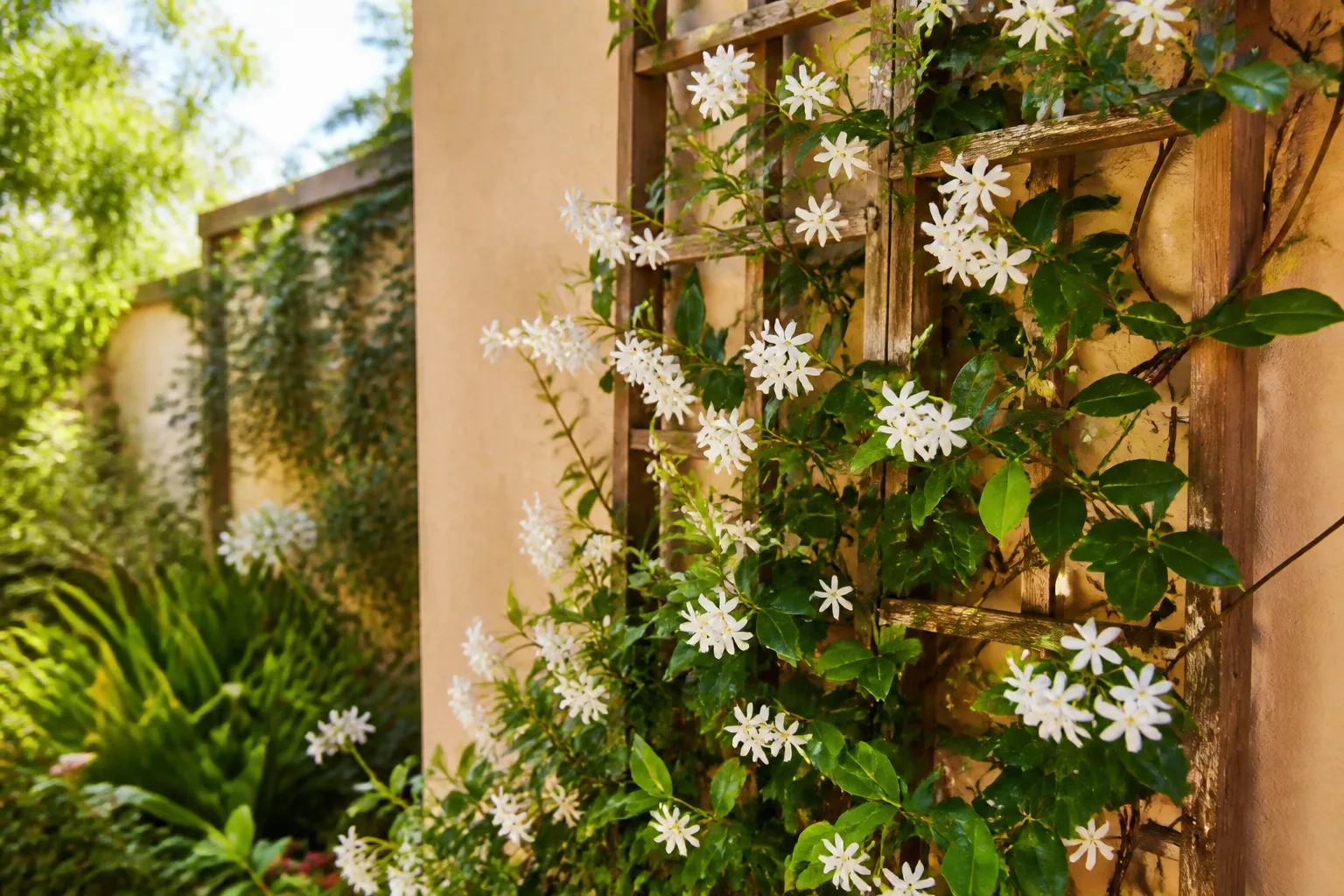
Jasmine is not one plant with one calendar. The genus Jasminum holds more than 200 species of twining vines and arching shrubs, and the care card that works for a hardy winter jasmine hedge will fail a tender pink jasmine on a windowsill. Before you adjust watering or buy fertilizer, read the botanical name on the tag. That single line decides hardiness, bloom season, pruning month, and whether your plant belongs outdoors year-round, in a pot on the patio, or indoors with a cool winter rest.
This guide walks you from species choice through planting, daily care, bloom troubleshooting, and propagation. For symptom-specific depth on light, watering, soil, and named problems, use the jasmine care hub and the companion jasmine care guide once you know what you are growing.
Start With the Botanical Name on Your Tag
Nurseries label many fragrant plants “jasmine.” Only plants in the genus Jasminum (family Oleaceae) are true jasmine. The name comes from the Persian yasmin, passed through medieval Latin—fitting for a plant grown for scent for centuries (NC State Extension).
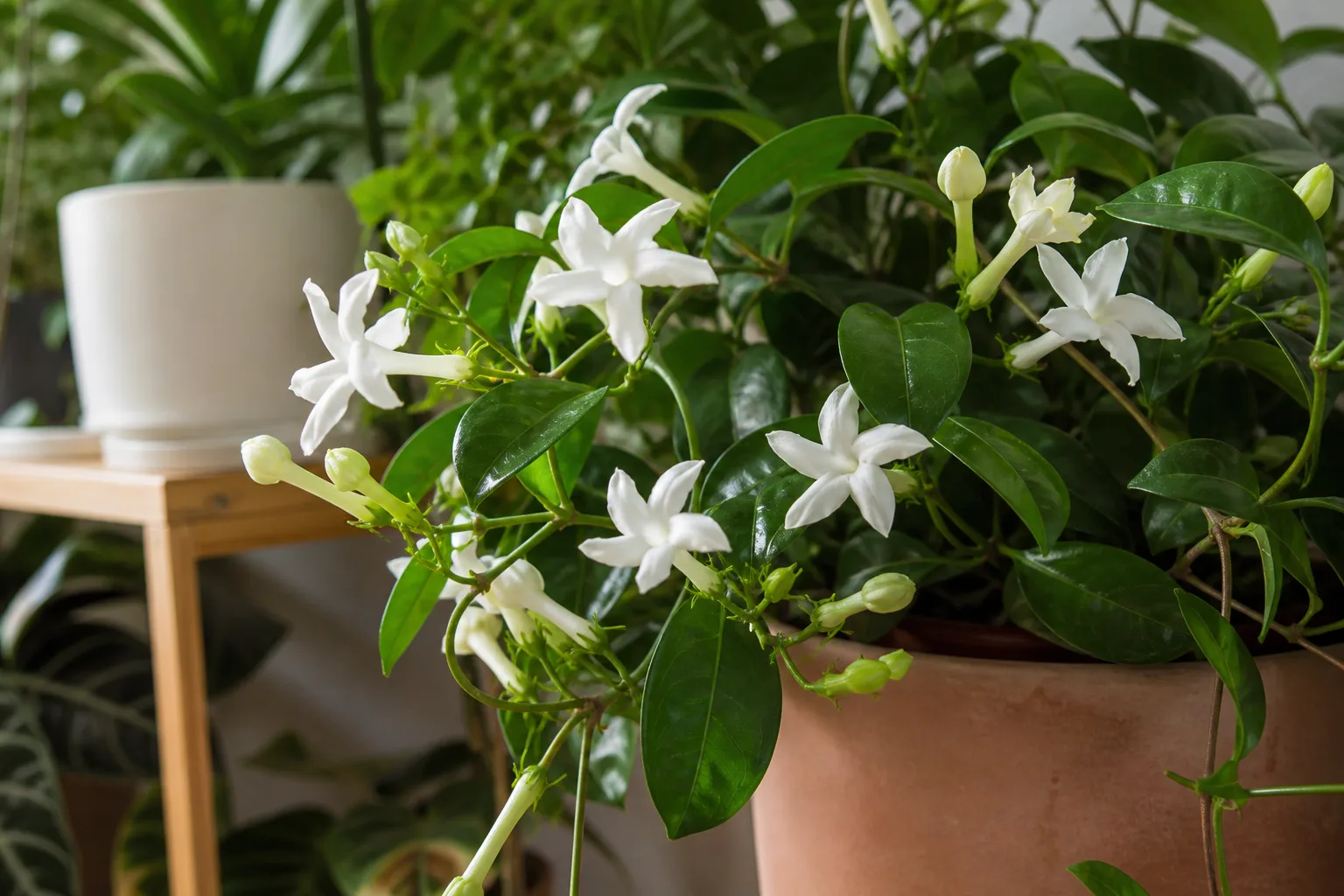
True jasmine can be evergreen or deciduous, a twining vine or a loose shrub, and hardy anywhere from about USDA zone 6 to zone 11 depending on species. Flowers are usually small, star-shaped, and intensely fragrant when conditions are right. Leaves are typically opposite, often glossy, and sometimes pinnate with five to nine leaflets on common jasmine.
True Jasmine vs Star Jasmine and Jessamine Lookalikes
Three lookalikes cause the most confusion:
| Plant | Botanical name | What differs | Care takeaway |
|---|---|---|---|
| Star jasmine | Trachelospermum jasminoides | Not a Jasminum; waxy evergreen leaves; very fragrant white flowers | Hardy vine in warm zones; different pruning and hardiness than true jasmine |
| Carolina jessamine | Gelsemium sempervirens | Yellow trumpet flowers; native southeastern U.S. vine | Toxic to people and pets—do not confuse with edible-scented jasmine |
| Cape “jasmine” | Gardenia jasminoides | Thick glossy leaves; rose-like white flowers | Different genus; acid-loving; not a jasmine vine |
True jasmine (Jasminum) is listed by the ASPCA as non-toxic to cats, dogs, and horses. Always confirm the genus before assuming pet safety. If the tag says only “jasmine” with no Latin name, ask the seller or compare leaf shape and flower color to the species section below.
Choose the Right Jasmine for Your Space
Match the plant to your climate and goal before you dig a hole or pick a pot. Most general advice online assumes common jasmine (Jasminum officinale), a summer-flowering twiner hardy in USDA zones 7–10 that can climb 20 to 30 feet on support in warm climates. That is not the same plant as the pink-budded houseplant sold for Valentine’s Day.
Summer-Flowering Vines for Walls and Pergolas
Common or poet’s jasmine (J. officinale) produces fragrant white to pale pink flowers on old wood from late spring into fall in warm regions (NC State Extension). It wants full sun to partial shade, fertile well-drained soil, and sturdy support. In containers it can be kept compact with post-bloom pruning and overwintered indoors north of zone 7.
Royal jasmine (J. rex) is a compact, fast twiner for USDA zones 10–11, with pure white flowers nearly year-round in frost-free climates. Treat it as a tender conservatory or patio plant elsewhere.
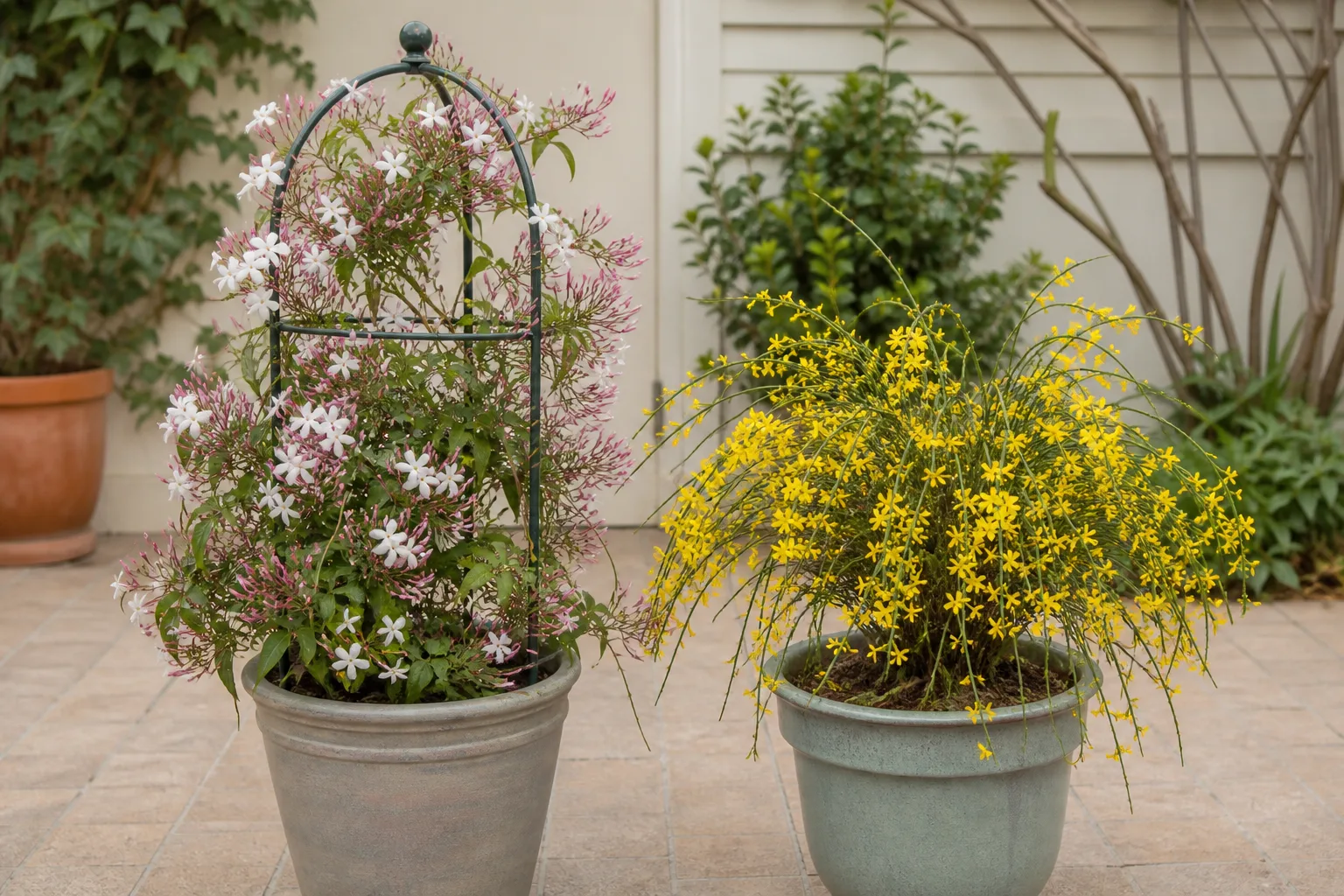
Pink or Chinese jasmine (J. polyanthum) is the fragrant indoor vine most retailers sell in late winter. Outdoors it survives only in mild zones 8–11; everywhere else it is a container or houseplant that needs a cool autumn rest near 50–55°F (10–13°C) to set buds for the next flush (RHS).
Winter Jasmine for Cold-Season Color
Winter jasmine (J. nudiflorum) is a different beast: a sprawling, arching shrub, not a perfumed summer vine. Bright yellow flowers open on bare green stems in late winter and early spring. It is hardy in USDA zones 6–10, tolerates partial shade, and works as a hedge, ground cover, or wall-trained shrub. The blooms are cheerful but not strongly scented—do not buy it expecting room-filling fragrance.
Tender Pink Jasmine for Indoor Fragrance
If your goal is a scented houseplant, J. polyanthum is usually the right target. It is vigorous, twining, and capable of hundreds of flowers per season when light and winter temperature cooperate. Plants forced into bloom at the garden center often fail the following year unless you give them that cool rest from roughly October through January in a bright but unheated room, porch, or cool conservatory (PlantAlmanac).
Where and When to Plant Jasmine
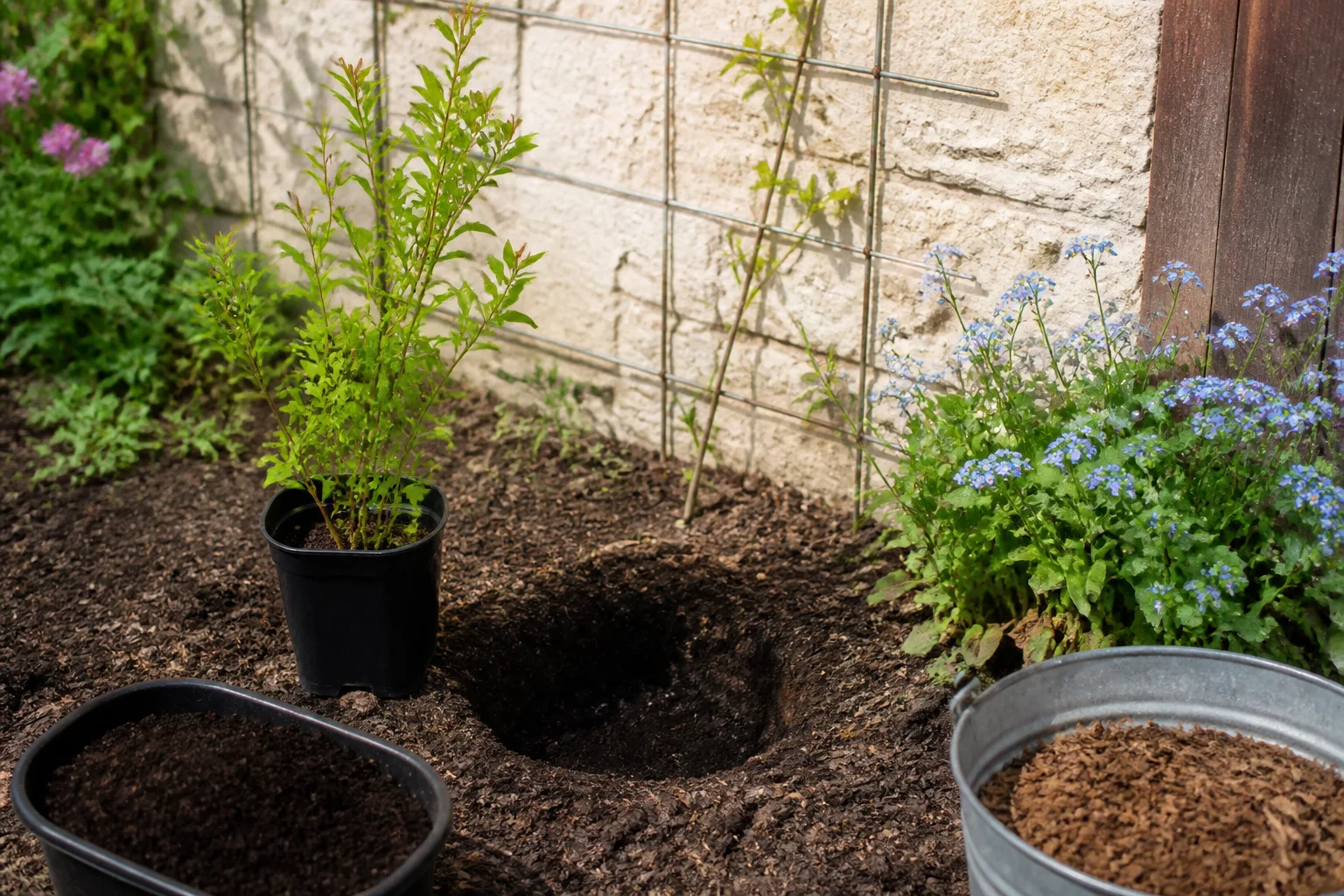
Outdoor Ground Planting Steps
For in-ground vines and shrubs:
- Pick the season. Plant summer-flowering jasmines in spring or autumn when soil is workable and extremes are past (RHS). Winter jasmine establishes well if planted in autumn or winter.
- Choose the microclimate. Summer vines want a warm, sheltered, sunny wall or fence. Avoid frost pockets for marginally hardy species.
- Prepare the hole. Dig twice the root-ball width and the same depth. Mix compost into the backfill for fertility and drainage.
- Set the plant. Crown at soil level; fan roots outward if pot-bound.
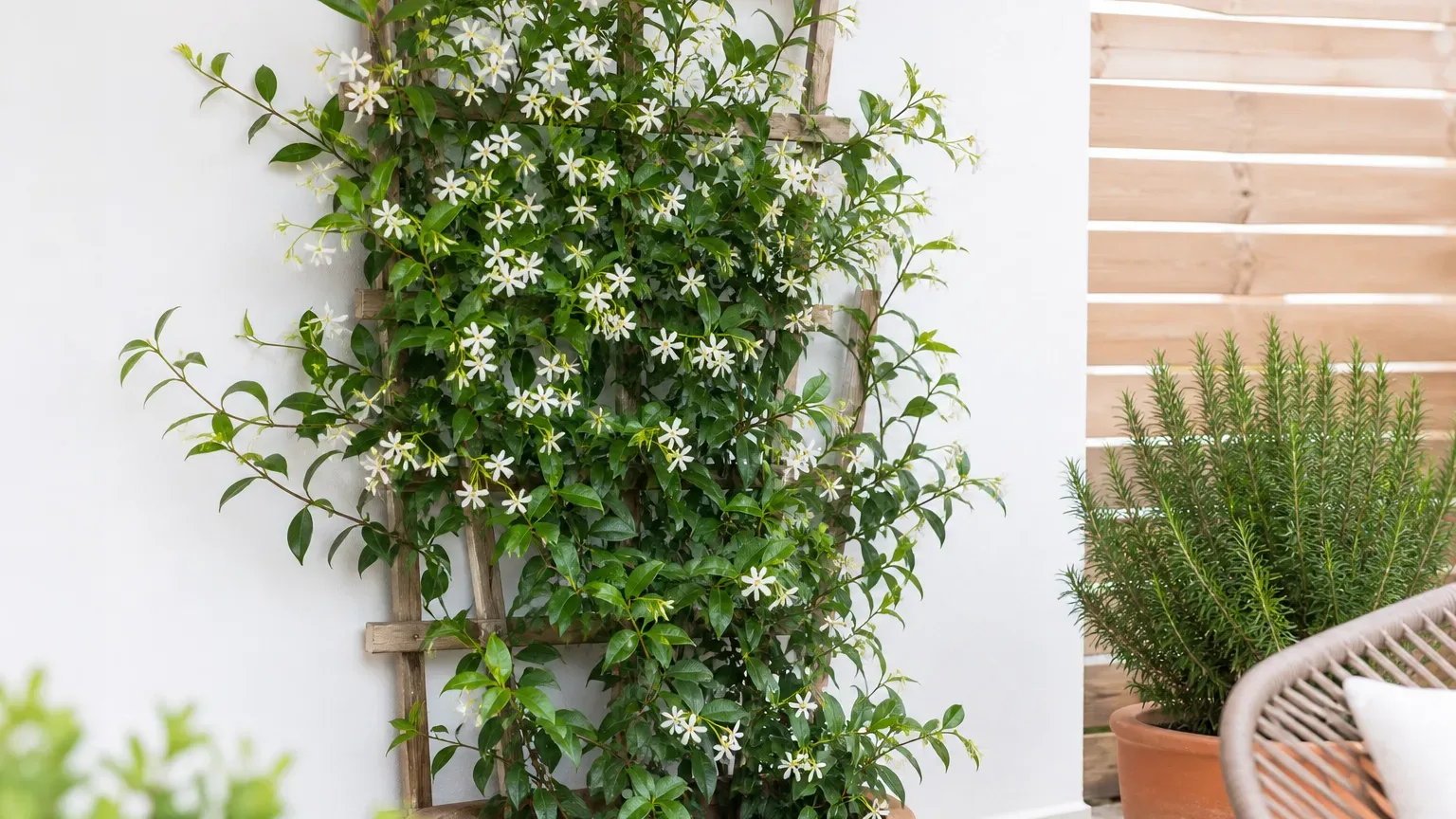
- Install support immediately for twining species—trellis wires, pergola posts, or sturdy mesh. Jasmine does not cling like ivy; it wraps.
- Water in thoroughly and mulch 2–3 inches, keeping mulch a few inches away from stems.
Container and Houseplant Setup
Use a pot only one size larger than the nursery container unless roots are circling badly. Every pot needs drainage holes. A heavy ceramic or clay pot helps top-heavy vines stay upright. Add a trellis hoop, bamboo teepee, or wall-mounted wires on day one—retrofitting support on a mature vine is frustrating.
For indoor J. polyanthum, plan two locations: a cool bright winter spot (50–60°F / 10–16°C) and a warm spring display spot (65–75°F / 18–24°C) once buds swell. A single south-facing window can work for both if the room temperature drops at night in winter.
Light: The Bloom Switch Most Growers Miss
Jasmine grown in “bright indirect” light alone often stays leafy and silent. Flowering requires strong light on growing tips—outdoors that means full sun to partial shade with at least six hours of direct sun for most summer vines (NC State Extension). Indoors, a south- or west-facing glass with some direct sun beats a distant north window.
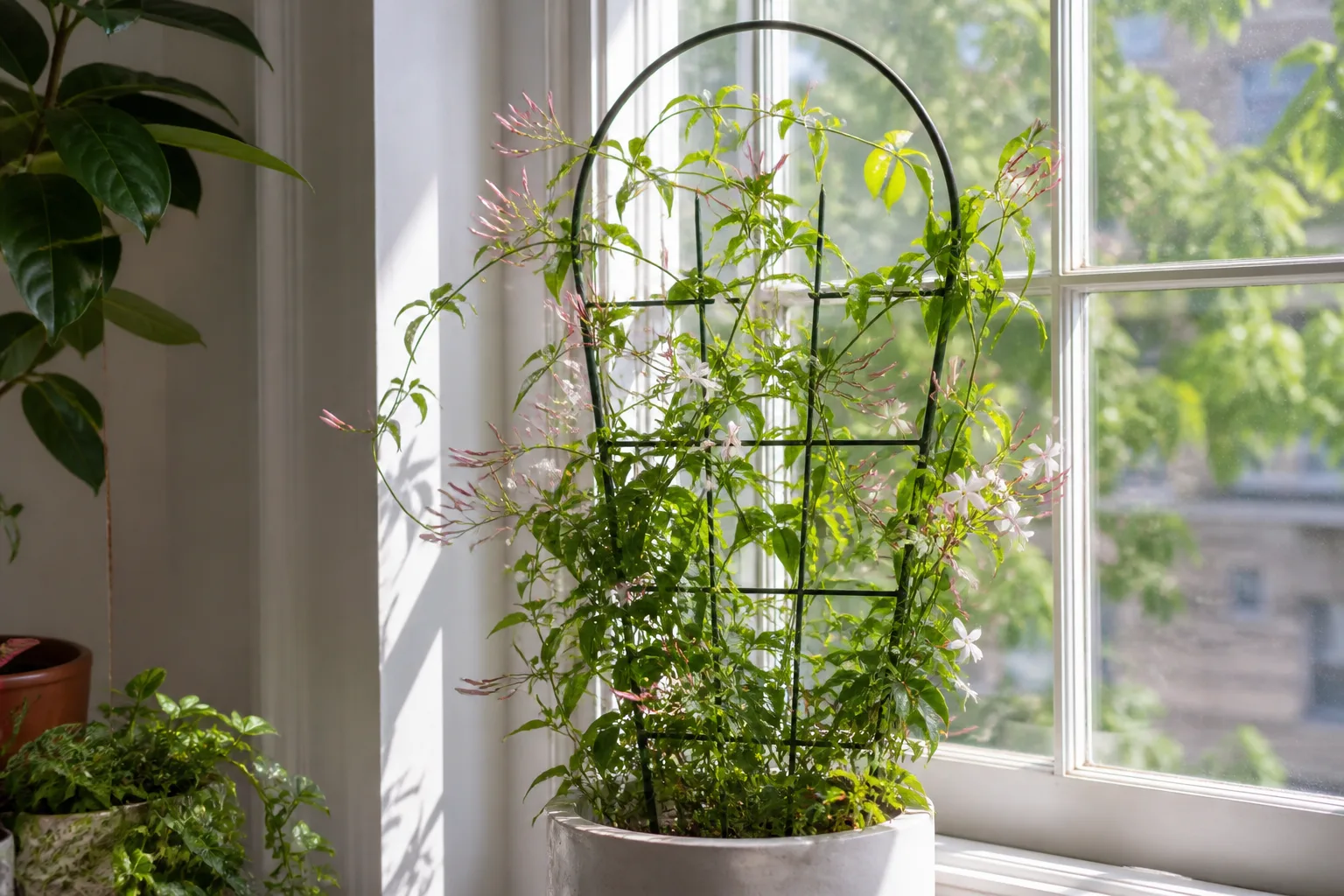
Winter jasmine blooms on leafless stems and tolerates more shade than summer perfume vines. Pink jasmine indoors needs maximum winter light during the cool rest; etiolated stems produce few buds. If windows are weak, supplement with a full-spectrum LED positioned 12–18 inches above the canopy for 12–14 hours daily during the bud-initiation months.
Move outdoor container plants gradually when changing exposure. Scorch appears as bleached or crisp patches on leaves after a sudden shift from shade to harsh afternoon sun.
Soil, Drainage, and pH Basics
Jasmine prefers fertile, loamy, well-drained soil enriched with organic matter (NC State Extension). Heavy clay needs compost and grit; pure peat retains too much moisture in pots. Aim for pH 6.5–7.5—neutral to slightly alkaline.
Container mix recipe that works widely: high-quality potting soil plus 20–30% perlite or grit and a handful of compost. Bark fines lighten the mix and mimic the airy root zone vigorous vines prefer. Never line the bottom of a pot with gravel “for drainage”; use a mesh screen over the hole and a proper airy mix instead.
Watering Without Root Rot
The goal is even moisture while actively growing, not constant wetness. Check the top inch of soil with your finger or a moisture meter. When it feels dry, water until a little drains from the bottom, then empty the saucer.
| Situation | Starting rhythm | Adjust when |
|---|---|---|
| New in-ground plant | Weekly deep soak first year | Hot dry spells need more; established plants often need only summer drought irrigation |
| Outdoor container | Every 2–4 days in summer | Pot weight lightens; wilting at midday that recovers by evening |
| Indoor active growth | Every 3–7 days | Room heat and sun dry small pots quickly |
| Cool winter rest | Every 10–14 days or less | Soil stays cool and plants drink slowly |
Yellow leaves with wet soil point to overwatering or poor drainage. Crisp brown edges with dry soil suggest underwatering. Always verify roots before changing the schedule—symptoms overlap.
Temperature, Humidity, and the Cool Rest That Triggers Buds
Most true jasmines are tropical to subtropical in origin. Active growth sits comfortably between 60 and 75°F (16–24°C). Frost kills tender species; J. officinale and J. nudiflorum survive typical zone 7 winters once established.
Indoor pink jasmine is the species most growers lose to warmth. It initiates flower buds after roughly six to eight weeks at 50–55°F (10–13°C) with bright light and reduced water (PlantAlmanac). A plant kept at normal room temperature all winter often grows soft leggy stems and skips bloom. After buds set, move it to a warmer room to open flowers.
Humidity helps indoor vines, especially with central heating. Aim for 40–50% if possible—grouping plants, a humidity tray with pebbles and water below pot level, or a small humidifier all work. Misting foliage is optional; wet leaves overnight can encourage fungal spots.
Missouri Botanical Garden notes that container J. officinale should rest cool from October to March indoors, with high humidity and strong light when you want flowers (Missouri Botanical Garden).
Fertilizer: When Feed Helps—and When It Blocks Flowers
In-ground jasmine in decent soil rarely needs chemical feed. A spring compost mulch or slow-release organic fertilizer is enough. Overfeeding nitrogen produces lush leaves at the expense of flowers.
Container and houseplant jasmine benefit from feeding during active growth only:
- Balanced liquid feed every two weeks from spring through late summer, half strength for indoor pots.
- Switch to a higher-potassium formula (tomato or bloom booster) as buds form.
- Stop feeding entirely during the cool winter rest.
If blooms are poor despite good light, check whether you are over-fertilizing before adding more product. Streaky dark green growth with no buds often means too much nitrogen.
Support, Training, and Controlling Vigorous Growth
Twining jasmines wrap clockwise or counterclockwise around slender supports. Provide horizontal wires, trellis mesh, or slim poles—thick posts are hard to grip. Tie new leaders loosely with soft plant tape every 8–12 inches until they hold on their own.
Train main stems early in the direction you want coverage. Let side shoots develop for flower wood, then shorten them after bloom. J. officinale can cover a pergola in a few seasons in zone 8+; plan access for pruning before it becomes a canopy you cannot reach.
Winter jasmine does not require a trellis unless you espalier it on a wall. Left alone it arches and roots where stems touch soil—useful for slopes, unruly on a formal path edge.
Pruning by Species and Bloom Timing
Prune immediately after the main flowering flush for each species. Jasmine blooms on wood formed the previous season (or older wood on some types). A late-summer haircut on a spring bloomer removes next year’s flowers.
| Species | Prune when | How much |
|---|---|---|
| J. officinale | After summer bloom fades | Shorten flowered shoots to strong side buds; remove dead or crossing wood |
| J. nudiflorum | After yellow spring flowers finish | Thin one-third of oldest stems; shorten overly long arching branches |
| J. polyanthum | After late-winter/spring indoor flush | Cut flowered stems by one-third to one-half; train fresh growth to support |
Use clean, sharp bypass pruners. Disinfect between cuts if you suspect disease. Damaged or diseased branches can be removed any time.
Propagating Jasmine From Cuttings
Softwood or semi-ripe cuttings in late spring and early summer are the most reliable home method (RHS semi-ripe cuttings guidance).
- Take 6–8 inch (15–20 cm) cuttings from healthy non-flowering shoots.
- Remove all but the top two or three leaf pairs.
- Dip the cut end in rooting hormone (optional but helpful).
- Insert into moist, airy mix—half perlite, half potting soil.
- Cover with a clear bag or dome; keep bright indirect light and 70–75°F (21–24°C) bottom warmth if possible.
- Check for roots in 4–6 weeks with a gentle tug.
- Pot individually once roots hold soil and new growth appears.
Take several cuttings; not every stem roots. Layering—bending a low stem to soil while still attached—is a low-fail option for outdoor shrubs like winter jasmine.
Getting Jasmine to Bloom Reliably
Work through this sequence when flowers are missing:
- Confirm species and normal bloom month. Winter jasmine flowers in late winter; J. polyanthum in late winter indoors; J. officinale in summer outdoors.
- Check light on stem tips. Move to stronger sun or add grow lights before changing anything else.
- Verify winter temperature for indoor types. Warm rooms without cool rest = leaves, not buds.
- Review last prune date. Pruning too late removed flower wood.
- Inspect roots. Severe root-bound stress or chronic wet soil aborts buds.
- Feed with potassium, not nitrogen, only after steps 1–5 look sound.
Deadheading spent flowers on repeat-blooming container plants can tidy the vine and redirect energy. Cut stems back to a leaf joint without tearing bark.
Nursery plants in full bloom were often forced out of season. Enjoy the show, then follow the cool-rest calendar if you want a natural cycle next year.
Pests, Diseases, and When to Start Over
Outdoor jasmine may host caterpillars (budworms, leaf rollers), aphids, or scale. Catch them early: hand-pick caterpillars, blast aphids with water, scrape scale gently, then apply horticultural oil on a cool overcast day following label rates.
Indoor jasmine more often sees spider mites, mealybugs, whitefly, and scale. Webbing, sticky honeydew, or pale stippled leaves are clues. Insecticidal soap works on soft-bodied pests; repeat weekly until clear. Isolate infested plants so pests do not spread.
Fusarium wilt causes blackened roots and sudden collapse in warm weather. There is no reliable cure for homeowners—dispose of the plant and soil, sanitize pots, and do not replant jasmine in the same spot immediately. Rust and leaf blight favor wet foliage; improve airflow, avoid overhead watering, and use copper fungicides only when cultural fixes fail.
Repotting and Long-Term Container Care
Jasmine blooms well slightly root-bound, but roots circling out of drainage holes need a pot 1–2 inches larger, usually every two to three years in early spring before growth surges. Tease circling roots gently and refresh the outer third of mix.
Lifespan varies by species and care. Many jasmine plants live 5–10 years in containers; vines in ideal ground sites can persist far longer with renewal pruning. When an old indoor vine becomes all woody stems with few leaves, propagate a fresh cutting rather than fighting decline.
Conclusion
Growing jasmine well is less about memorizing a generic care card and more about matching species to climate, giving twining vines support and post-bloom pruning, and— for fragrant houseplants—respecting the cool winter that turns leafy growth into buds. Read the Latin name, place the plant where stem tips see real sun, water when the soil actually dries, and prune right after flowers fade. When a specific symptom needs a deeper walkthrough, continue with the jasmine care hub for targeted fixes on light, watering, pests, and bloom failure.



