Star Jasmine Care Guide: Light, Water, Soil & Pruning
Trachelospermum jasminoides
Grow Star Jasmine in sun or light shade with a sturdy support, fertile free-draining soil, and regular summer water. Learn container, flowering, pruning, and pet-safety care.
Star Jasmine Care Guide: Light, Water, Soil & Pruning
Start with wateringThe most common care mistake for Star JasmineWatering guide →Star Jasmine care essentials
Light
Water
Keep newly planted and container-grown Star Jasmine evenly moist but never waterlogged. Once established in the ground, water deeply during long dry spells. In pots, water when the top 2–3 cm feels dry.
Soil
Fertile, moisture-retentive but free-draining loam or a loam-based container mix. Adaptable from slightly acidic through alkaline conditions.
Humidity
Temperature
Fertilizer
Excess fertilizer is not a substitute for adequate light, drainage, or root room.
About Star Jasmine
Star Jasmine is native to China, Japan, Korea, and Vietnam, typically reaches 4–9 m as a supported outdoor climber; 1.5–3 m when regularly pruned in a large container indoors, with slow to moderate while establishing, then vigorous in warm, favourable conditions growth. Star Jasmine has a climbing growth habit and part of the Apocynaceae family. It is also known as Confederate Jasmine, Chinese Jasmine, Chinese Ivy, and Trader's Compass.
| Detail | Information |
|---|---|
| Also known as | Confederate Jasmine, Chinese Jasmine, Chinese Ivy, Trader's Compass |
| Native region | China, Japan, Korea, and Vietnam |
| Mature size | 4–9 m as a supported outdoor climber; 1.5–3 m when regularly pruned in a large container |
| Growth rate | Slow to moderate while establishing, then vigorous in warm, favourable conditions |
| Growth habit | Climbing |
| Scientific name | Trachelospermum jasminoides |
| Family | Apocynaceae |
Star Jasmine Care Guide: Light, Water, Soil & Pruning
Star Jasmine is easiest to understand once you stop treating it as a small indoor jasmine. Trachelospermum jasminoides is a woody evergreen twiner in the dogbane family, Apocynaceae, rather than a true Jasminum. The NC State Extension profile describes its climbing habit, opposite glossy leaves, fragrant white flowers, and need for a support. In practical terms, it wants the light, root space, airflow, and framework of a garden vine even when you grow it in a pot.
For most Indian homes, the best position is outdoors on a bright balcony, terrace, courtyard, pergola, or sheltered wall. Give it several hours of useful sun, regular but not constant moisture, fertile free-draining soil, and wires or trellis that the young stems can wind around. A dim room may preserve leaves for a while, but it rarely provides the light or space needed for dense growth and a strong flush of flowers.
Start with the right plant and place
Common names create the first care error. Star Jasmine, Confederate Jasmine, and Chinese Jasmine can all refer to Trachelospermum jasminoides, while unrelated plants also carry “jasmine” in their names. Confirm the botanical name on the label; the Kew Plants of the World Online search is a useful taxonomic cross-check.
Then judge the site before changing water or fertilizer. A healthy Star Jasmine needs overhead brightness, moving air, a draining root zone, and room to climb. Choose a location where the mature framework can stay in place; repeatedly moving and untangling a woody vine is harder on the plant than rotating a compact houseplant.
Star Jasmine care at a glance
Aim for sun to light shade, with protection from scorching late-afternoon exposure in extremely hot climates or behind heat-trapping glass. Water when the upper 2–3 cm of container mix has dried, then soak the full root ball and drain it. Ground plants need regular establishment water and deep irrigation during prolonged dry weather, not daily surface sprinkling.
Use fertile loam or a loam-based potting mix that holds modest moisture while releasing excess water quickly. Train stems as they extend, feed container plants lightly during active growth, and prune after the main flowering period or in spring where winters interrupt growth. These basics align with the Royal Horticultural Society’s species guidance, but local heat and monsoon rainfall determine how often you check the pot.
Growth habit, size, and seasonal behaviour
Star Jasmine begins modestly, then becomes vigorous once its roots and framework are established. Supported outdoor plants can eventually reach roughly 4–9 m in favourable conditions; regular pruning and restricted roots can hold a container specimen nearer 1.5–3 m. Size is not just a label fact—it determines whether a light balcony rail is enough or whether you need wall wires, a strong trellis, an arch, or a pergola.
The leaves usually stay glossy and evergreen in mild climates. Cool weather can bring bronze, burgundy, or red tones without disease, especially on exposed foliage. Growth slows in cooler or darker periods, while warm conditions and longer bright days increase shoot extension and water use.
Why a permanent support matters
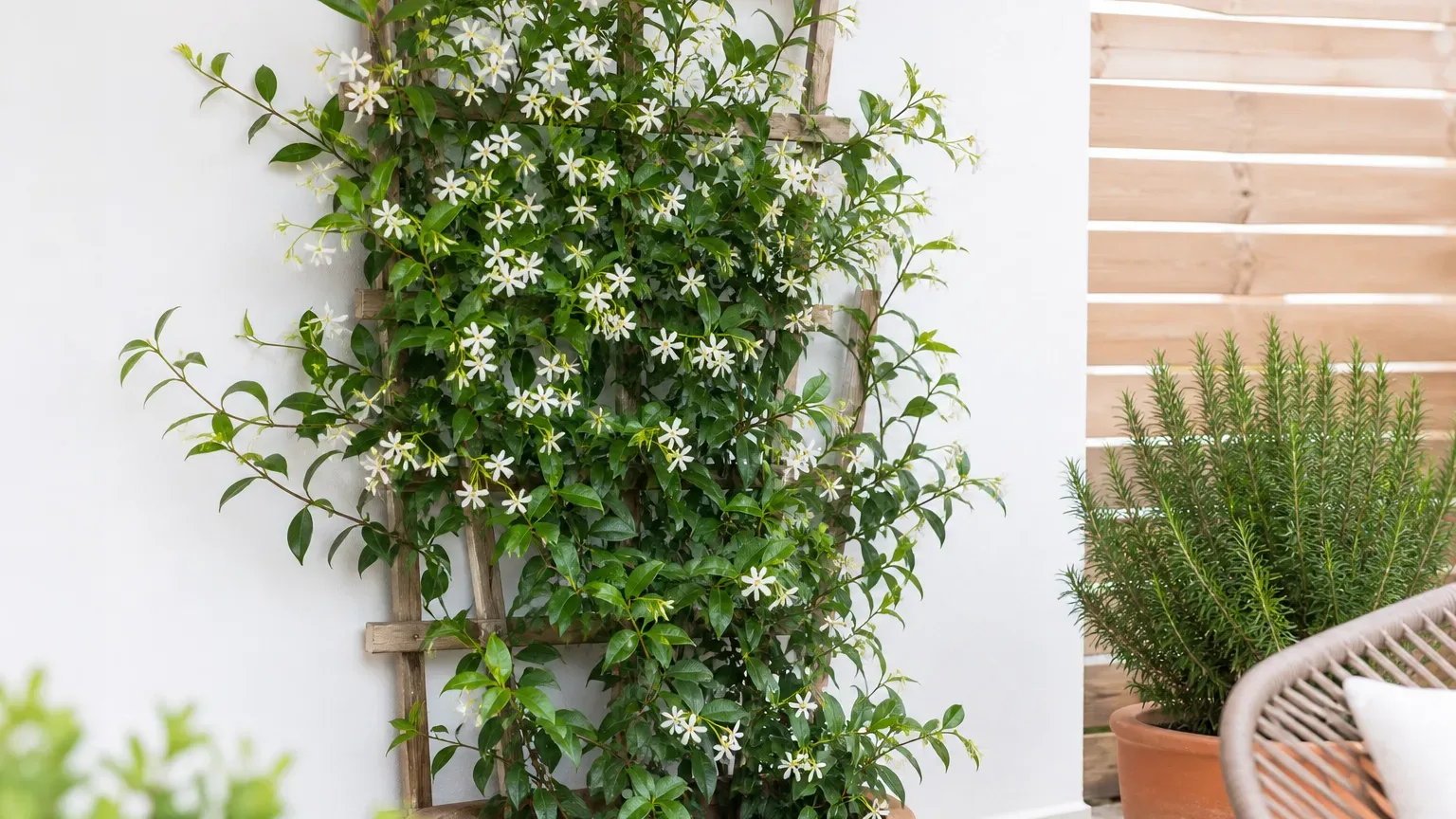
Star Jasmine twines; it does not adhere to bare masonry like ivy. Space wires slightly away from a wall, or use trellis with gaps large enough to guide shoots through. Tie young stems loosely with soft ties until they begin winding around the structure, checking ties as stems thicken.
Guide growth early around windows, gutters, shutters, and railings. Waiting until stems are woody turns a five-minute training job into severe pruning, and hard cuts may remove much of the next display if made at the wrong point in the flowering cycle.
Light for dense growth and fragrant flowers
Full sun usually supports the densest growth and best flowering, while light shade is useful where afternoon heat is severe. The RHS cultivation profile recommends sun or partial shade with shelter. On an Indian west-facing balcony, morning sun plus bright afternoon shade can be safer than hours of hot reflected sun from glass and concrete.
Deep shade creates long gaps between leaves, thinner stems, and fewer flowers. Move a shade-grown plant toward stronger sun gradually over one to two weeks so existing leaves can adjust. For detailed placement and warning signs, use the Star Jasmine light guide rather than trying to correct poor light with extra feed.
Water deeply without keeping roots wet
Newly planted vines need consistent moisture while roots spread into surrounding soil. Established in-ground plants are more resilient, but they still benefit from deep watering during long hot dry spells. In containers, check the top 2–3 cm and the pot’s weight; water thoroughly when the surface is dry and the container feels lighter.
Never use a calendar alone. A terracotta pot in May sun may dry quickly, while a glazed container during humid monsoon weather may stay wet for many days. Persistent saturation excludes oxygen from roots and favours decline; the University of Minnesota Extension root-rot guidance explains why poorly drained, overwatered root zones are vulnerable. The Star Jasmine watering guide covers seasonal checks and recovery in detail.
Soil and drainage, especially through monsoon
The useful target is fertile, moisture-retentive but free-draining soil. For a container, combine about half loam-based potting mix with roughly 30% peat-free multipurpose compost or fine composted bark and 20% perlite, pumice, or coarse grit. Treat those percentages as a starting point: increase the coarse drainage fraction if your local mix collapses or remains wet through monsoon.
Drainage holes must remain open, and the pot should never stand in runoff. Raise terrace containers slightly so cloudbursts can escape from below. Heavy ground soil may need a raised planting position and broad organic improvement; adding a small pocket of loose mix inside a water-holding clay basin does not solve drainage. See the Star Jasmine soil guide for mix adjustments.
Growing Star Jasmine in a container
A large container works when it is stable, draining, and paired with its own support. Begin only one pot size above the root ball; a dramatically oversized pot holds a large volume of unused wet mix. Repot in spring when roots circle densely, growth stalls despite suitable care, or the container dries within a day during normal warm weather.
Container culture keeps the vine manageable but increases dependence on you. Roots experience faster temperature swings, exhaust nutrients sooner, and cannot follow moisture into deeper ground. Review the Star Jasmine repotting guide before disturbing a flowering or heat-stressed specimen.
Feeding without sacrificing flowers
Feed the soil, not the urge to force blooms. Ground-grown Star Jasmine in reasonably fertile soil often needs only compost or a modest spring application. Container plants can receive a balanced liquid feed at the label rate during active spring and summer growth, then little or none when growth has slowed.
Too much nitrogen can encourage soft leafy extension that is harder to train and does not correct low light. Salts also accumulate faster in containers. Penn State Extension’s houseplant fertilizing guidance stresses adjusting fertilizer to active growth rather than using it as a cure for environmental stress. The Star Jasmine fertilizer guide explains timing and warning signs.
Training and pruning the vine
Training is continuous and light; pruning is periodic and selective. Redirect flexible shoots around supports, remove dead or rubbing stems, and shorten wayward growth with clean tools. Where the plant flowers heavily, make major shaping cuts after flowering so you can enjoy the display before reducing the framework.
An overgrown plant can tolerate harder renovation, but spreading major cuts across more than one season preserves leaf area and reduces the shock of removing most productive wood at once. Wear gloves because cut stems release milky latex. Use the Star Jasmine pruning guide for cut placement and seasonal decisions.
How to encourage flowering
When a mature vine does not bloom, inspect light first. Deep shade, severe repeated pruning, excessive nitrogen, a recently disturbed root system, or a young plant still establishing can all delay flowers. Better flowering usually comes from correcting the limiting condition, not adding a “bloom booster” to an unsuitable site.
Keep the framework intact, give the canopy enough sun, and avoid keeping roots either bone-dry for long periods or chronically wet. Flowering is seasonal and climate-dependent, so compare the plant with its own new growth rather than expecting a nursery specimen’s forced display to repeat immediately.
Temperature, winter colour, and climate fit
Star Jasmine performs best in warm, sheltered conditions but is more cold-tolerant than many tropical vines. The species-specific NC State plant record places it in a range suited to mild climates and notes its evergreen ornamental value. Young plants and exposed containers are less buffered than established vines in the ground.
In much of peninsular and coastal India, extreme summer heat and monsoon drainage matter more than frost. In colder northern locations, protect container roots and foliage from hard frost and drying wind. Bronze winter foliage alone is often a normal response; combine colour with stem firmness, soil condition, and new-season recovery before diagnosing disease.
Pests, root trouble, and warning signs
Check stems and leaf undersides for scale insects, mealybugs, and sticky honeydew, especially on crowded sheltered plants. Thin congested shoots to improve inspection and airflow, but do not spray blindly when the problem is actually sun scorch or water stress.
Yellow leaves with wet, sour-smelling mix and persistent wilt point toward root trouble; crisp margins, curling, and a very light pot point toward drought. White bleached patches concentrated on the sun-facing side suggest heat or scorch. Diagnose the root-zone moisture and recent placement changes before adding fertilizer or watering again.
Propagation choices
Layering is forgiving because the shoot remains connected to the parent while a pinned section roots in adjacent mix. Semi-ripe cuttings taken from firm current-season growth are another practical method in warm weather. Both methods need bright filtered light, clean material, and an airy medium rather than saturated compost.
Propagation will not fix an unsuitable parent site, so take material from vigorous, pest-free growth and correct the original care issue first. The Star Jasmine propagation guide gives the step sequence and aftercare.
Pet safety and handling sap
The ASPCA Star Jasmine entry lists Trachelospermum jasminoides as non-toxic to cats, dogs, and horses. That classification is species-specific; do not apply it to every unrelated plant sold as jasmine. Prevent routine chewing because fibrous plant material can still upset an animal’s stomach.
Cut stems exude milky latex, so wear gloves while pruning and wash exposed skin. Keep sap away from eyes and do not turn a horticultural safety note into medical or veterinary advice; seek appropriate professional help if a person or animal develops symptoms.
Common Star Jasmine care mistakes
The most common mistake is treating the vine as a low-light indoor foliage plant. The second is installing no permanent support and then cutting back every shoot that reaches beyond the pot. Both remove the conditions that let Star Jasmine express its natural shape and flower well.
Other recurring errors include daily shallow watering, leaving a saucer full through monsoon, putting a small root ball into an enormous wet pot, feeding a shaded plant heavily, and assuming bronze winter leaves mean the vine is dying. Make one evidence-based correction at a time and judge the newest growth.
When to use this page vs other Star Jasmine guides
Use this overview when you are choosing a location, deciding whether the vine suits your space, or checking the whole care system. For a single variable, go directly to the light guide, watering guide, or soil guide. Use the repotting guide for crowded container roots and the pruning guide before making structural cuts.
Related Star Jasmine guides
- Star Jasmine light — choose sun exposure and diagnose sparse growth or scorch.
- Star Jasmine watering — decide when to soak a pot or established ground plant.
- Star Jasmine soil — build a free-draining mix for local rainfall and container materials.
- Star Jasmine fertilizer — feed active growth without relying on excess nitrogen.
- Star Jasmine repotting — choose pot size, timing, and aftercare.
- Star Jasmine propagation — compare layering with semi-ripe cuttings.
- Star Jasmine pruning — train, shape, and renovate the woody framework.
Conclusion
Good Star Jasmine care begins with respecting the plant’s identity: it is a sun-loving or light-shade woody climber, not a compact plant for a dim room. Give Trachelospermum jasminoides a sturdy permanent support, enough brightness to flower, deep watering followed by drainage, and a fertile root zone that never stays waterlogged.
In Indian and similarly warm climates, adjust for the site in front of you. Protect roots from monsoon saturation, foliage from extreme reflected afternoon heat, and container plants from faster drying. Train early, feed modestly, prune with the flowering cycle in mind, and let new growth—not a fixed care calendar—show whether the vine is comfortable.
How to care for Star Jasmine?
When should you water Star Jasmine?
Keep newly planted and container-grown Star Jasmine evenly moist but never waterlogged. Once established in the ground, water deeply during long dry spells. In pots, water when the top 2–3 cm feels dry.
- Test the top 2–3 cm of mix and lift the pot - In pots, water when the top 2–3 cm feels dry.
- water thoroughly when the surface is dry and the container feels lighter - In pots, water when the top 2–3 cm feels dry.
- Drain excess water - Keep newly planted and container-grown Star Jasmine evenly moist but never waterlogged.
What soil works best for Star Jasmine?
Fertile, moisture-retentive but free-draining loam or a loam-based container mix. Adaptable from slightly acidic through alkaline conditions.
- 50% loam-based potting mix - Fertile, moisture-retentive but free-draining loam or a loam-based container mix.
- 30% peat-free multipurpose compost or fine composted bark - Fertile, moisture-retentive but free-draining loam or a loam-based container mix.
- 20% perlite, pumice, or coarse grit - Fertile, moisture-retentive but free-draining loam or a loam-based container mix.
Grower notes for Star Jasmine
What matters most with Star Jasmine
Star Jasmine is an evergreen, woody twiner rather than a true Jasminum. Give it sun or light shade, a warm sheltered position, and fertile soil that drains freely. Stronger light supports denser growth and better flowering; deep shade may keep leaves green but usually produces a thin vine with fewer fragrant flowers.
Give the twining stems support
The vine does not cling to a wall by itself. Install sturdy wires, trellis, an arch, or a pergola and tie young shoots loosely until they begin twining. It can eventually cover a large area, so guide stems early and keep them clear of gutters, shutters, and weak railings.
Best placement in a real home
A sunny or lightly shaded balcony, terrace, courtyard, or sheltered wall is a better fit than a dim room. Place it near a doorway or seating area to enjoy the intensely fragrant white summer flowers. In very hot climates, morning sun with some afternoon protection reduces leaf scorch, especially for plants behind glass.
Water for establishment, not saturation
Water regularly through the first year and during hot dry spells. Containers need closer attention because they dry quickly, but Star Jasmine also resents waterlogging. Let the top 2–3 cm dry, then soak the root ball and empty any saucer rather than giving frequent small sips.
Before you buy this plant
Choose a plant with glossy opposite leaves, firm twining shoots, and clean stems. Avoid specimens with scale insects, cottony mealybugs, sticky honeydew, or a sour wet root ball. Confirm the label says Trachelospermum jasminoides: Star Jasmine belongs to Apocynaceae and is not the same plant as true jasmine in the genus Jasminum.
How to tell Star Jasmine is settling in
Stable glossy growth, shoots beginning to twine around their support, and fragrant pinwheel-shaped blooms show good establishment. Bronze or red winter foliage can be a normal cold response. Propagate by layering in spring or semi-ripe cuttings in summer or autumn; prune congested or wayward shoots in spring.
Is Star Jasmine safe for pets?
ASPCA lists Trachelospermum jasminoides as non-toxic to cats, dogs, and horses. The broken stems release milky sap, so discourage chewing and wash sap from skin; large amounts of any plant material may still cause stomach upset.
Star Jasmine (Trachelospermum jasminoides) is specifically listed by ASPCA as non-toxic to cats, dogs, and horses. This classification applies to this species, not every plant sold with "jasmine" in its common name. Broken stems exude milky latex that may irritate sensitive skin, so wear gloves when pruning and prevent routine pet chewing.
Watering Star Jasmine
For Star Jasmine, test the top 2–3 cm of mix and lift the pot; water thoroughly when the surface is dry and the container feels lighter and water check container plants every 2–3 days in hot weather and about weekly in mild weather; established ground plants need less frequent watering. Water most often through warm active growth and flowering; reduce sharply in cool winter weather without letting a container dry out completely.
| Detail | Information |
|---|---|
| How often | Check container plants every 2–3 days in hot weather and about weekly in mild weather; established ground plants need less frequent watering |
| How to check | Test the top 2–3 cm of mix and lift the pot; water thoroughly when the surface is dry and the container feels lighter |
| Seasonal changes | Water most often through warm active growth and flowering; reduce sharply in cool winter weather without letting a container dry out completely |
Signs of overwatering
- yellowing leaves
- persistent wilt in wet soil
- soft or darkened roots
- sour-smelling potting mix
Signs of underwatering
- drooping or curling leaves
- dry, crisp leaf edges
- flower or bud drop
- pot pulling away from the mix
Soil & potting for Star Jasmine
Use a mix of 50% loam-based potting mix, 30% peat-free multipurpose compost or fine composted bark, 20% perlite, pumice, or coarse grit for Star Jasmine. Free drainage is essential; prolonged wetness can lead to Phytophthora root rot. Target soil pH around 6.0–7.5 preferred; tolerates mildly acidic to alkaline soil. Repot every 2–3 years, or sooner when roots crowd the container, ideally in spring, just before active growth.
| Detail | Information |
|---|---|
| Recommended mix | 50% loam-based potting mix, 30% peat-free multipurpose compost or fine composted bark, 20% perlite, pumice, or coarse grit |
| Drainage | Free drainage is essential; prolonged wetness can lead to Phytophthora root rot |
| Soil pH | 6.0–7.5 preferred; tolerates mildly acidic to alkaline soil |
| Repotting frequency | Every 2–3 years, or sooner when roots crowd the container |
| Best season to repot | Spring, just before active growth |
Signs it needs repotting
- roots circling densely or emerging from drainage holes
- pot drying within a day in warm weather
- stalled growth despite suitable light and feeding
- vine becoming unstable or top-heavy
Humidity & temperature for Star Jasmine
Fertilizer & pruning for Star Jasmine
Use excess fertilizer is not a substitute for adequate light, drainage, or root room. for Star Jasmine.
| Detail | Information |
|---|---|
| Fertilizer type | Excess fertilizer is not a substitute for adequate light, drainage, or root room. |
Common problems on Star Jasmine
Yellow Leaves
MediumLikely cause: Common on this plant type; confirm with recent watering, light, and root checks.
Quick fix: Inspect the plant and correct the most likely care stressor before stacking treatments.
Full fix guide →Brown Tips
MediumLikely cause: Common on this plant type; confirm with recent watering, light, and root checks.
Quick fix: Inspect the plant and correct the most likely care stressor before stacking treatments.
Full fix guide →Root Rot
MediumLikely cause: Common on this plant type; confirm with recent watering, light, and root checks.
Quick fix: Inspect the plant and correct the most likely care stressor before stacking treatments.
Full fix guide →Overwatering
MediumLikely cause: Common on this plant type; confirm with recent watering, light, and root checks.
Quick fix: Inspect the plant and correct the most likely care stressor before stacking treatments.
Full fix guide →Underwatering
MediumLikely cause: Common on this plant type; confirm with recent watering, light, and root checks.
Quick fix: Inspect the plant and correct the most likely care stressor before stacking treatments.
Full fix guide →Spider Mites
MediumLikely cause: Common on this plant type; confirm with recent watering, light, and root checks.
Quick fix: Inspect the plant and correct the most likely care stressor before stacking treatments.
Full fix guide →Mealybugs
MediumLikely cause: Common on this plant type; confirm with recent watering, light, and root checks.
Quick fix: Inspect the plant and correct the most likely care stressor before stacking treatments.
Full fix guide →Aphids
MediumLikely cause: Common on this plant type; confirm with recent watering, light, and root checks.
Quick fix: Inspect the plant and correct the most likely care stressor before stacking treatments.
Full fix guide →Leggy Growth
MediumLikely cause: Common on this plant type; confirm with recent watering, light, and root checks.
Quick fix: Inspect the plant and correct the most likely care stressor before stacking treatments.
Full fix guide →Slow Growth
MediumLikely cause: Common on this plant type; confirm with recent watering, light, and root checks.
Quick fix: Inspect the plant and correct the most likely care stressor before stacking treatments.
Full fix guide →Wilting
MediumLikely cause: Common on this plant type; confirm with recent watering, light, and root checks.
Quick fix: Inspect the plant and correct the most likely care stressor before stacking treatments.
Full fix guide →Drooping Leaves
MediumLikely cause: Common on this plant type; confirm with recent watering, light, and root checks.
Quick fix: Inspect the plant and correct the most likely care stressor before stacking treatments.
Full fix guide →Low Humidity
MediumLikely cause: Common on this plant type; confirm with recent watering, light, and root checks.
Quick fix: Inspect the plant and correct the most likely care stressor before stacking treatments.
Full fix guide →Not Enough Light
MediumLikely cause: Common on this plant type; confirm with recent watering, light, and root checks.
Quick fix: Inspect the plant and correct the most likely care stressor before stacking treatments.
Full fix guide →Fungus Gnats
MediumLikely cause: Common on this plant type; confirm with recent watering, light, and root checks.
Quick fix: Inspect the plant and correct the most likely care stressor before stacking treatments.
Full fix guide →Mold on Soil
MediumLikely cause: Common on this plant type; confirm with recent watering, light, and root checks.
Quick fix: Inspect the plant and correct the most likely care stressor before stacking treatments.
Full fix guide →