Star Jasmine Soil Guide: Mix, Drainage and pH
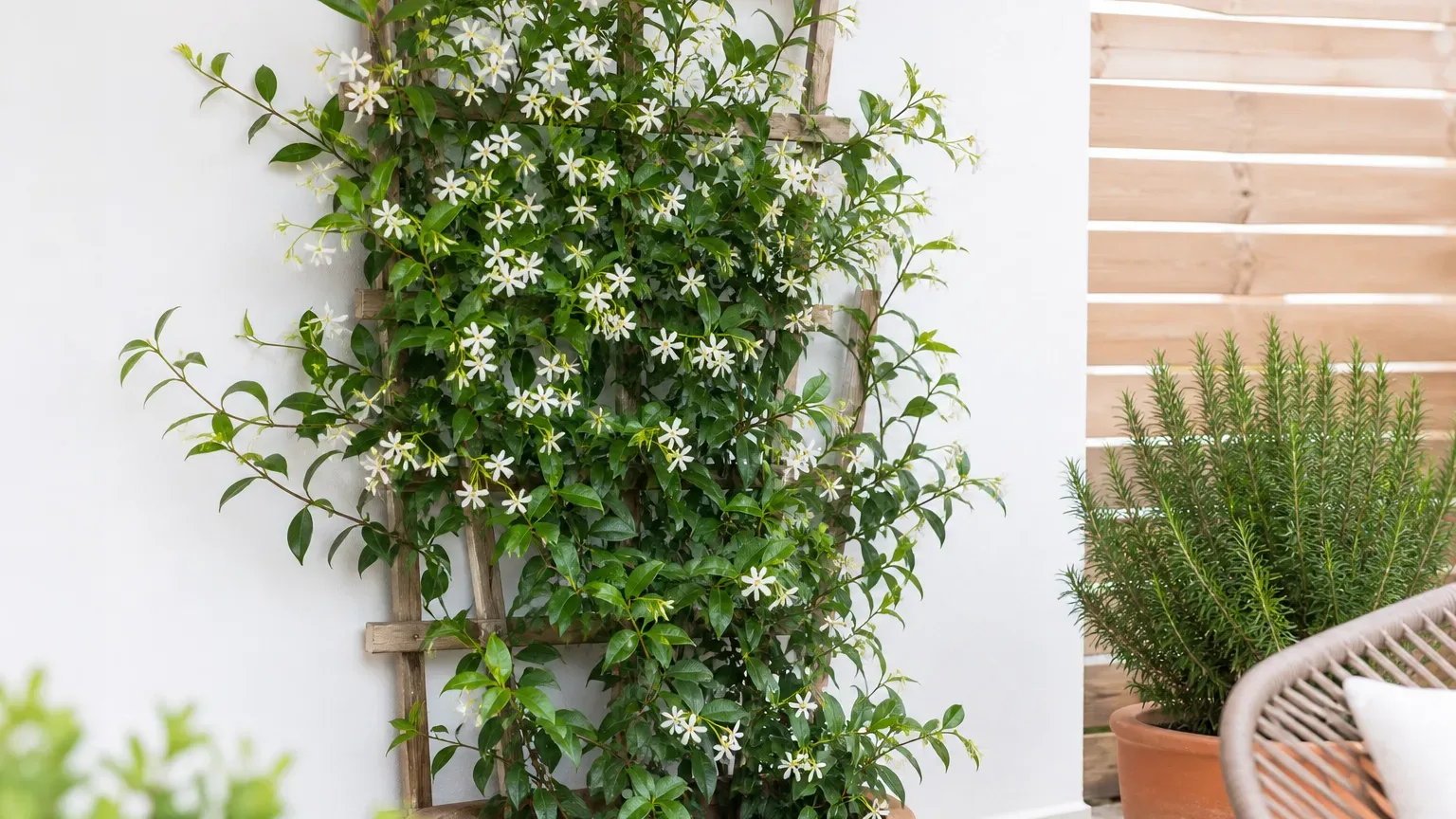
Star Jasmine Soil Guide: Mix, Drainage and pH
Star Jasmine Soil Guide: Mix, Drainage and pH
Star Jasmine needs a root zone that stays lightly and evenly moist during active growth but releases surplus water quickly. That balance matters more than buying a bag labelled for jasmine: Trachelospermum jasminoides is a woody evergreen climber, and its long-lived roots need both moisture and air.
For a container, start with a structured loam-based mix amended with composted bark or coir and a durable mineral aerator. In the ground, improve the drainage of the wider bed and avoid creating a small compost-filled pocket inside heavy clay.
Quick answer: the best soil for Star Jasmine
The best Star Jasmine soil is fertile, moisture-retentive and freely draining. The RHS growing guide recommends free-draining fertile or moderately fertile soil, while the NC State Extension profile identifies moist loam with good drainage. Those descriptions point to a crumbly mix that holds some water between particles without remaining saturated.
For a pot, use roughly 50% loam-based potting mix, 30% fine composted bark or peat-free multipurpose compost, and 20% perlite, pumice or coarse horticultural grit. Treat that formula as a starting point: pot size, rainfall, heat and the water-holding capacity of local ingredients can justify a 5–10 percentage-point adjustment.
What Star Jasmine roots need from soil
Star Jasmine is adaptable, but “adaptable” does not mean indifferent to soil structure. Its root zone must anchor a top-heavy vine, retain enough moisture to support glossy evergreen foliage, and drain after a deep watering or tropical downpour. A quality container medium should let water and air move through while retaining adequate moisture, a balance described by Clemson Cooperative Extension.
This is why texture outranks any single fashionable ingredient. Fine compost alone collapses as it decomposes; pure garden soil becomes dense in a pot; a very coarse cactus mix may dry before a large climbing vine can use the water. Build a mix from components with different jobs instead of expecting one material to do everything.
Ground soil: improve structure, not just fertility
In the garden, a reasonably drained loam may need only surface compost and mulch. The Missouri Botanical Garden profile describes Star Jasmine as tolerant of a range of soils while preferring a well-drained loam, which is more useful than prescribing a narrow recipe for every site.
Heavy clay needs a wider strategy. Do not excavate one deep hole and fill it with fluffy potting mix, because that abrupt textural boundary can leave the root ball sitting in water. Plant slightly high where appropriate, loosen a broad area, route runoff away from the crown, and consider a raised bed if water remains after rain. Organic matter can improve air and water relationships in mineral soil over time, as explained by University of Minnesota Extension, but it cannot repair a site with nowhere for water to drain.
Container soil: hold moisture without closing air spaces
A pot limits the volume of air and water available to roots, so particle structure has to survive repeated watering. Loam-based mix supplies weight and nutrient buffering, fine bark or coir holds moisture, and perlite or pumice preserves larger pores. Use a container with open drainage holes; a decorative cachepot is safe only when you remove accumulated water after irrigation.
Do not put ordinary garden soil into a balcony pot. It is heavy, compacts easily and can drain too slowly in a container; University of Georgia Extension likewise distinguishes container mix from garden soil because the latter can promote root disease. A mature vine also needs physical stability, so avoid an ultra-light peat-and-perlite mix unless the pot itself is heavy and the support is independent.
A practical Star Jasmine potting mix
For a 10-litre batch, combine 5 litres of loam-based potting mix, 3 litres of fine composted bark or good peat-free multipurpose compost, and 2 litres of perlite, pumice or coarse grit. Moisten the components before blending so they mix evenly, then squeeze a handful: it should hold together briefly and break apart when touched rather than smear into a dense lump.
Use only mature, clean compost. Large unfinished wood chips create uneven cavities, while very fine compost can settle and reduce air space. If coir is your moisture-holding component, rinse and buffer it when the product instructions require that treatment, and do not assume all compressed coir has identical salt levels.
Adjusting the mix for heat and monsoon rain
On a hot, windy Indian balcony, increase the moisture-holding fraction slightly or use pumice instead of very light perlite, which can rise during watering. A larger pot, surface mulch and afternoon shade from the container itself often improve moisture stability more reliably than making the whole mix finer. Coordinate soil changes with the Star Jasmine watering guide because a fast-draining mix still fails if it receives frequent small sips.
Where monsoon rain reaches the pot, increase the coarse fraction modestly, keep drainage holes unobstructed and raise the container off a flat floor. Do not add a gravel layer to “create drainage”; the useful change is an open outlet and a structured mix throughout the root zone. If the plant cannot be moved under cover, a rain shield over the pot surface can reduce saturation without depriving the foliage of outdoor light.
Choosing and correcting a store-bought mix
A good commercial base should feel springy and contain visible particles rather than resembling black paste. Potting media commonly combine materials such as bark, coir, peat, perlite and vermiculite to balance air and water, as summarized by Illinois Extension. Read the ingredients, but judge the wetted texture too: branding alone does not reveal how a locally stored bag will behave.
If multipurpose mix stays dense after wetting, blend in 15–25% perlite, pumice or coarse bark. If a cactus mix sheds water and dries within a day, combine it with a loam-based mix or moisture-holding compost rather than using it neat. Avoid amending by guesswork after planting; test a small wet batch first.
Test drainage before trusting the label
For a container mix, fill a spare pot, water slowly until the entire profile is wet, and observe the outlet. Water should begin leaving the drainage holes without prolonged ponding, and the pot should become noticeably lighter over the following days. If the surface remains glossy and wet while no water exits, stop and correct blocked holes or compacted mix before planting.
In a bed, dig a test hole near the intended site, fill it with water, let it drain once, then refill and watch the decline. The purpose is not to force every soil into a universal hourly rate; it is to detect water that barely moves or a hard layer that traps it. Illinois Extension’s drainage guidance explains the root problem directly: saturated soil leaves too little air and favours root rot.
Star Jasmine soil pH: useful, but not the first priority
Star Jasmine does not require sharply acidic soil. RHS describes the genus as preferring neutral to alkaline conditions while also growing in slightly acidic soil, so a practical target around pH 6.0–7.5 is reasonable rather than mandatory. The species’ broad tolerance means drainage, root oxygen and balanced nutrition usually deserve attention before minor pH adjustment.
Test before adding lime, sulfur or acidifying products. Soil pH affects nutrient availability, but blind correction can create a new imbalance; Oregon State University Extension recommends basing management on the measured condition and the crop’s needs. If leaves yellow while veins stay greener, check drainage and feeding history as well as pH instead of assuming the soil is simply too alkaline.
Planting Star Jasmine in the ground
Choose a site where runoff does not collect and prepare a broad area no deeper than necessary for the root ball. Set the plant at its nursery depth, backfill mostly with the loosened native soil, firm gently, and water deeply to settle large air gaps. Keep mulch away from direct contact with the woody stem.
Do not enrich the planting hole heavily with fertilizer. Establishing roots need to enter the surrounding soil, and a rich isolated pocket can keep them circling close to the original root ball. Use the Star Jasmine fertilizer guide for feeding decisions and the repotting guide when the plant is container-grown rather than planted in a bed.
Signs the soil mix is wrong
Read symptoms together with the condition of the root zone. Yellow leaves can follow wet roots, nutrient issues, cold or normal ageing, while drooping can occur in both dry and saturated soil. Push a finger or wooden skewer into the mix, check pot weight, smell the drainage water, and inspect outlet flow before choosing a correction.
A soil problem is more likely when the pot remains wet for many days, water runs down the sides without wetting the centre, the surface has sunk far below the rim, or roots are packed into a dense circle. Correct the physical cause first; feeding a poorly aerated root ball adds salts without restoring oxygen.
Wet, airless soil and root decline
Persistent yellowing, stalled growth, wilting despite wet mix, a sour smell, or dark soft roots justify a closer inspection. Excess water and poor drainage favour soil-borne root pathogens including Phytophthora, a relationship described by University of Georgia Extension. These signs are not proof of one pathogen, but they are enough to stop routine watering and check the roots.
Remove standing water, clear the outlet and let the mix approach an appropriate moisture level. If roots are actively decaying, move the plant into fresh structured medium after trimming clearly dead tissue with clean tools; then follow the Star Jasmine repotting guide for pot size and aftercare. A severely affected ground plant may require drainage work beyond the planting hole.
Compacted or fast-drying soil
Compacted mix may accept water slowly, shrink into a hard mass and leave roots starved of both air and evenly distributed moisture. A hydrophobic dry mix behaves differently: water races down a gap beside the pot while the centre remains dry. Rehydrate it gradually from several passes, then assess whether decomposition or root crowding means the plant needs fresh medium.
A pot that dries within a day may be root-bound, undersized, excessively coarse or exposed to reflected heat. Do not automatically make the mix denser. Check the roots and container first, then coordinate any change with the Star Jasmine light guide because intense afternoon heat can drive rapid water loss even when the soil recipe is sound.
When to use this page vs other Star Jasmine guides
Use this soil guide when choosing ingredients, correcting compaction, checking drainage or deciding whether the root zone’s structure is causing decline. For how often and how deeply to irrigate, use the watering guide; for moving a crowded vine to a larger pot, use the repotting guide.
The Star Jasmine overview connects soil with placement and support. The propagation guide covers the different medium needed for cuttings, while the pruning guide deals with controlling a vine that has outgrown its support rather than restricting roots to slow it down.
Related Star Jasmine guides
- Star Jasmine watering — match irrigation to pot size, weather and the mix’s drying rate.
- Star Jasmine repotting — replace broken-down soil and manage crowded roots safely.
- Star Jasmine fertilizer — feed without using fertilizer to compensate for poor drainage.
- Star Jasmine light — distinguish heat-driven drying from a soil recipe problem.
- Star Jasmine propagation — choose a cleaner, finer medium for new cuttings.
Conclusion
Give Star Jasmine a fertile, structured root zone that holds useful moisture but drains fully after watering. In pots, a 50:30:20 blend of loam-based mix, mature bark or compost, and mineral aeration is a practical starting point; in beds, solve drainage across the site rather than creating an isolated amended hole.
Before changing pH or adding fertilizer, wet the soil and observe how it behaves. Drainage speed, pot weight, smell and root condition usually reveal more than the product label, and they point to the first useful action: open the outlet, restore structure, resize the pot or adjust watering.