How to Grow and Care for Living Stones (Lithops)
See how to grow living stones with bright light and fast-draining soil, when to water or wait, how to repot, and how to spot trouble in each season.
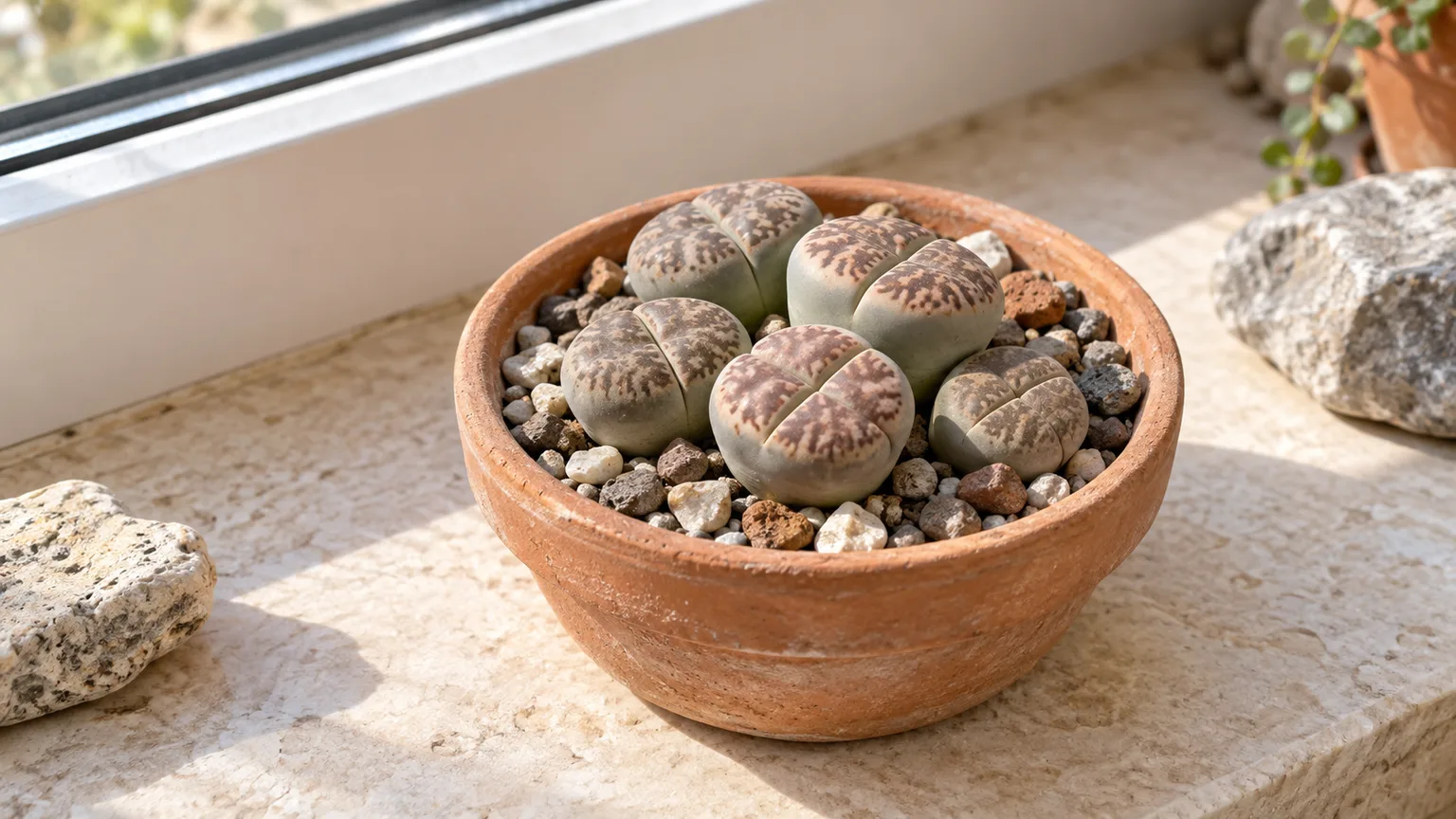
A living stone can spend weeks looking unchanged, then suddenly open a fissure, flower, or push a new pair of leaves through the old one. That slow, compact rhythm is part of its appeal—and the reason ordinary succulent advice can cause trouble. The safest care routine follows the plant’s growth stage, not a weekly watering reminder.
Lithops are small succulents from southern Africa. Give them several hours of direct, preferably morning, light; a mineral-rich mix in a pot with an open drainage hole; and water only when the plant is in an appropriate active stage. In particular, keep the pot dry while a new leaf pair is replacing the old one. The old leaves store water and nutrients for that growth, so a plant that looks wrinkled during the split may be using its reserves normally.
What living stones are—and why their cycle matters
“Living stones” or “pebble plants” usually means plants in the genus Lithops, a group in the Aizoaceae family. Each plant has two fleshy leaves joined at the base, with a narrow cleft between them; the leaf tips sit at or just above the soil. Their patterned, sometimes translucent-looking upper surfaces let light reach photosynthetic tissue below the ground, while the plant’s small profile and stone-like colors help it blend into rocky habitats. The Royal Horticultural Society describes the genus as nearly stemless, with a pair of very fleshy leaves and daisy-like flowers emerging from their cleft. UW–Madison Extension and the RHS give useful botanical context.
The key to care is the annual leaf replacement cycle. A new pair forms inside the old pair and draws on the older leaves as it expands. In time, the old leaves become thin, dry husks; they should be allowed to finish that transfer before you resume watering. This internal recycling explains why “water when wrinkled” is unreliable advice for Lithops: a shrinking outer pair can be normal, while a soft, translucent active body is a warning sign.
Choose a healthy Lithops plant
When you buy one, look for a firm body with a recognizable pair of leaves, an intact growing cleft, and color or markings that look even for that specimen. A mature plant may sit low in the pot, and a little dryness is not automatically a problem. Avoid plants that are wet, collapsed at the base, unusually elongated, or buried so deeply that the leaf surface is nearly covered. If several heads share one pot, check that the mix is dry and that none of the bodies has soft spots.
Ask the seller, if possible, when the plant was last watered, whether it has recently been repotted, and where it was grown. A Lithops raised under greenhouse shade may burn if moved straight to a hot, sunny windowsill, while one already acclimated to strong light may stretch indoors. Its recent care history matters more than a care label that gives a month-by-month schedule without accounting for your hemisphere or indoor conditions.
Build a root-safe pot and mineral mix
The plant may be tiny above the surface, but its root system is not miniature in proportion. Use a pot with a drainage hole and enough depth for the taproot—roughly 3 to 5 inches is a practical starting point for a single plant, adjusted to the root length and pot shape. A pot that is much wider than the root system holds more damp medium than the plant can use; choose a snug container with enough room below the plant rather than a broad decorative bowl with no drain.
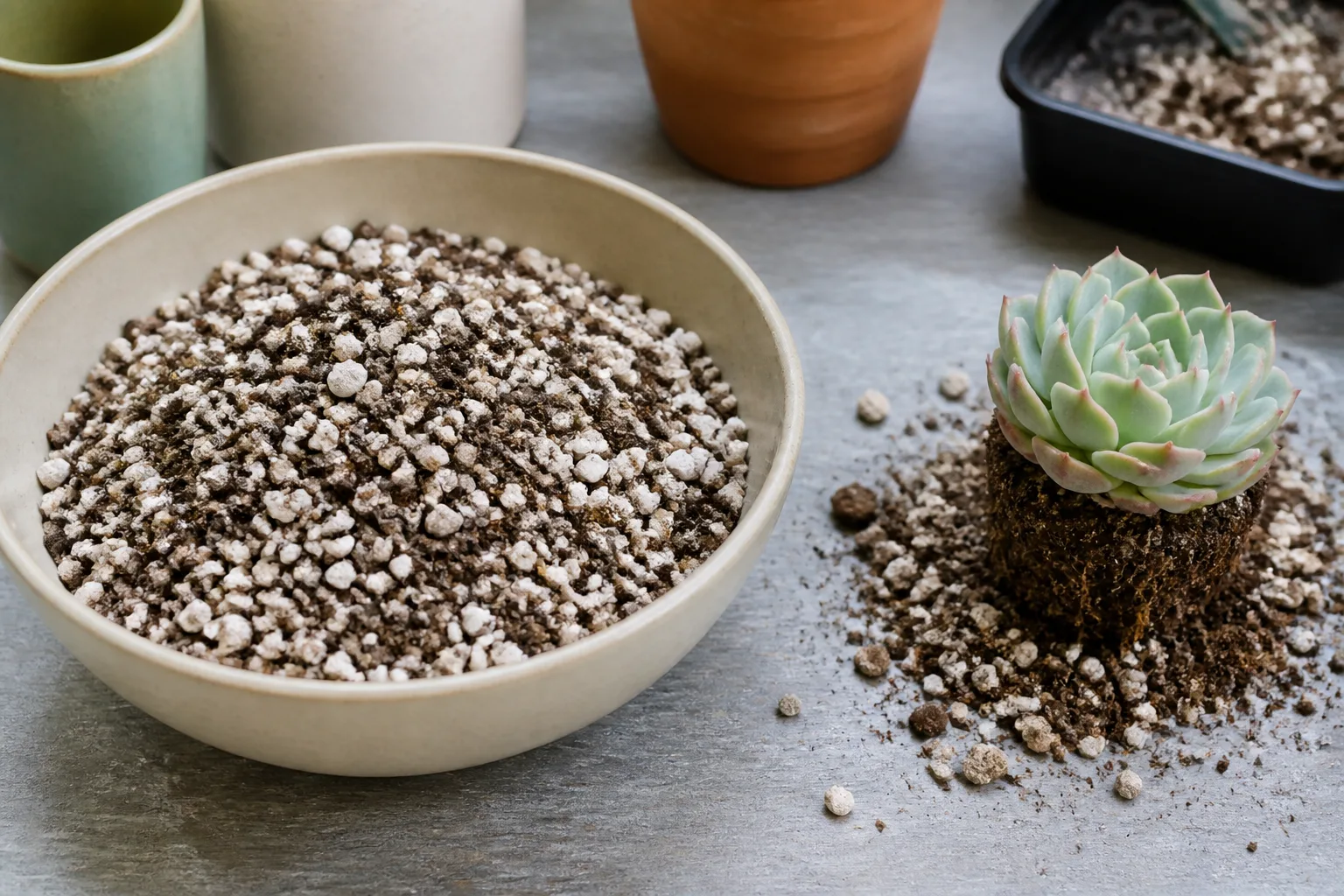
Lithops need a medium that wets through when watered but lets excess water leave quickly and dries predictably. Start with a commercial cactus mix amended with coarse, stable mineral material such as pumice, perlite, or horticultural grit. A blend that is mostly mineral—often around 70 to 80 percent inorganic material, with the balance a modest amount of potting mix—gives many indoor growers a useful starting point; adjust toward more grit if your home is humid, the pot is glazed, or the mix stays damp for days. The exact blend matters less than the result: water should not linger around the roots. Practical substrate guidance from Savvy Gardening and Sublime Succulents also emphasizes free drainage and a lean mix.
Keep the crown high and the drainage open
Set the plant so its leaf body sits slightly above the soil line rather than burying the cleft or neck. A thin top dressing of small, clean gravel can hold the plant steady and keep splashed soil away from the body, but it should not cover the leaves or turn the surface into a sealed layer. Decorative pebbles are optional; a drainage hole and an airy root zone are not.
Do not add a layer of stones at the bottom of a pot in place of a drainage hole. That does not solve a blocked outlet, and it reduces the depth available to the roots. Empty any cachepot or saucer after watering so the pot never sits in runoff.
Give living stones strong light without sunburn
Indoors, use the brightest window you can provide. Several hours of direct sun—often morning sun through an east or south-facing window in the Northern Hemisphere—followed by bright daylight is a sensible starting point. UW–Madison Extension describes about four to five hours of early direct sun with afternoon protection as a successful windowsill arrangement, while other grower guidance favors longer direct exposure; that variation is a reason to watch the plant and the heat at the glass instead of treating one number as universal.
A Lithops that receives too little light may grow taller, lean, lose its compact outline, or become greener and less patterned. Move it gradually: begin with bright indirect light, then add direct sun over a week or two, especially if it came from a shaded shop. Sudden midday sun through hot glass can bleach or scorch the upper leaves. If a bright window is not available, a grow light can supplement the room; position it so the plant receives strong light without warming the leaves, and use the manufacturer’s distance and timer guidance as a starting point.
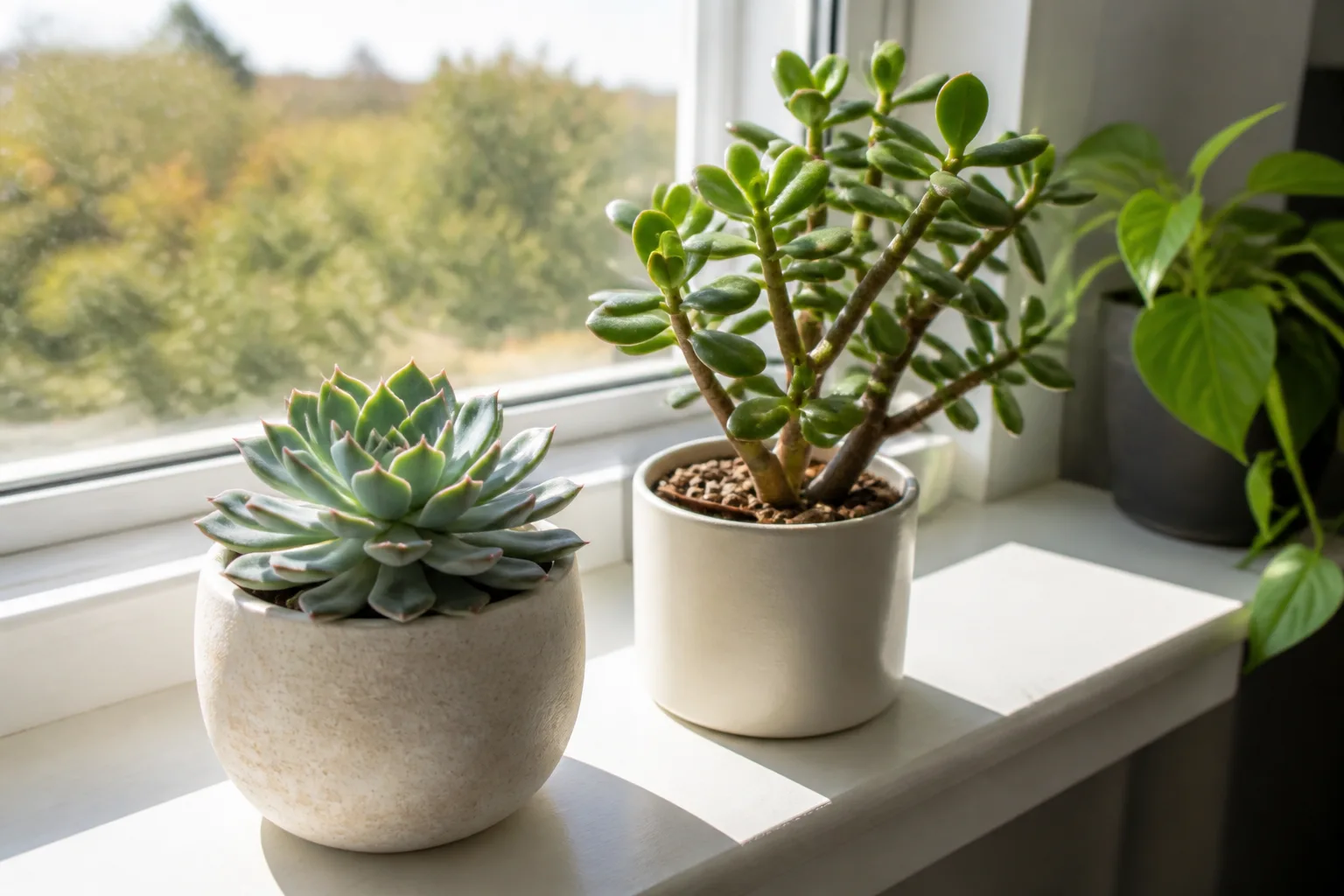
Turn the pot occasionally if one side consistently faces the window, but do not spin it every day to chase perfect symmetry. The important signals are compact growth and stable color, not a perfectly uniform display. If a plant already stretched for light, it will not shrink back; better conditions can support healthier future growth, but the old elongated tissue remains.
Water by growth stage, not by calendar
There is no dependable “every two weeks” rule for living stones. Species, pot size, substrate, humidity, air movement, and the plant’s previous care all affect how quickly its mix dries. Use the annual cycle as the first decision, then confirm the soil is dry before watering. In its native range, Lithops experiences sparse, variable moisture, and the plant’s paired leaves store water; indoor care should preserve that dry-down pattern rather than keep the root zone constantly moist. UW–Madison Extension and Savvy Gardening both emphasize seasonal rest and caution around the leaf change.
When watering is appropriate, wet the medium thoroughly and let every drop drain. Avoid pouring into the cleft or leaving water pooled around the leaves. Then wait for the mix to dry fully and for the plant’s growth stage to justify another watering. If you are unsure whether the plant is actively growing, waiting is usually safer than adding water because the top looks wrinkled.
Spring: wait for the old leaves to finish their job
During leaf replacement, the old pair supplies moisture to the emerging leaves. Keep the pot dry while the old leaves remain fleshy or leathery, even if the plant looks smaller than it did in autumn. Do not peel, cut, or tug at the old leaves; they are not dead just because they are folding or drying at the edges.
Resume watering only after the old pair has become papery and the new pair is fully exposed. At that point, if the plant is entering active growth and the medium is dry, water once and let the pot drain. The calendar date varies with the plant and growing environment, so the dry, spent outer leaves are a better cue than “spring” on its own.
Summer: let the plant rest
Many Lithops pause during the hottest part of the year. If the plant is compact and firm, the mix is dry, and there is no clear new growth, leave it alone rather than giving it routine summer water. A warm season can be a resting period even in a bright indoor room, but air-conditioned homes or cool, cloudy summers may shift the pace.
If an established plant becomes severely shriveled while the soil has been bone dry for a long time and it is clearly not replacing leaves, a small, cautious watering may be reasonable. Do not use this exception to treat every wrinkle; first confirm the plant is not in its normal leaf-splitting phase and that the pot drains well. A soft body, darkening base, or continuing collapse calls for inspection, not another drink.
Late summer and fall: support renewed growth
As temperatures moderate and the plant resumes growth, it may develop a flower bud from the cleft. This is generally the period when watering can become more regular, but only if the medium dries completely between waterings. A flower is a useful sign that the plant has reached a reproductive stage; it does not mean the pot should stay wet or that fertilizer is required.
After flowering, stop watering as the plant enters its next rest and prepares the new leaf pair. The exact transition can be gradual. Track what the plant is doing rather than switching abruptly on a date that worked for a different specimen.
Winter: keep the splitting plant dry
In winter, a new pair is often forming within the older leaves. The outside can wrinkle and shrink as it transfers stored water inward. Leave the pot dry and let the old pair thin naturally; watering during this phase can keep it swollen and slow the visible replacement process.
Indoor warmth can shift timing, so winter is a useful pattern rather than an absolute calendar command. If your Lithops is clearly growing or flowering at another time, record that cycle and adjust future care to it. Don’t force a dormant-looking plant into active growth with water or fertilizer.
Keep temperatures frost-free and air moving
Typical indoor temperatures suit living stones, provided the plant is not pressed against a cold window or trapped in stagnant, humid air. They tolerate warm conditions better than many houseplants, but heat plus a wet root ball is a risky combination. Keep the soil dry during rest, give the plant room for air to circulate, and avoid sudden temperature swings from vents or exterior doors.
Treat Lithops as frost-sensitive container plants in most of the United States. Move outdoor pots inside before frost is forecast; a warm spell is not a reason to leave them outside overnight if cold weather may return. If your home stays humid, terracotta can help the mix dry faster, although changing the medium and watering behavior is more important than relying on pot material alone.
Understand flowering and seed capsules
A mature, well-lit plant may send a white, yellow, or orange daisy-like flower through the cleft, often in autumn in the Northern Hemisphere. The bloom opens in daylight and closes later, and it may last only a few days. Seed-grown plants generally need several years to reach flowering size; a young, otherwise healthy specimen is not failing because it has not bloomed yet. UW–Madison Extension notes that Lithops flowers are self-sterile, so seed production requires pollen transfer between flowers rather than simply waiting for a flower to set seed by itself.
If you want seed, use a small, clean, soft brush to transfer pollen between flowers on genetically distinct plants when they are open. Let the seed capsule dry on the plant. In nature, moisture triggers the capsule to open; once it has matured, you can moisten it carefully to release seed, then sow on a fine, fast-draining surface. Seed raising is a slow project, and seedlings need more consistent moisture than established plants, so keep them in a separate tray where you can manage them without wetting adult Lithops.
Fertilize lightly and repot only when needed
Most living stones do not need frequent feeding. They grow in lean, mineral conditions and can be damaged by an overly rich mix or repeated high-nitrogen fertilizer, which can encourage soft, stretched growth. If you choose to feed a plant in active growth, use a cactus fertilizer diluted well below the label’s full houseplant strength, and apply it sparingly; do not fertilize during leaf replacement or dormancy. It is also reasonable to skip fertilizer entirely if the plant is stable and flowering.
Repot only when the roots have outgrown the container, a multi-headed clump is crowded, or the old mix has compacted and stopped draining. Slow growth means a healthy Lithops can stay in the same pot for years. When repotting is necessary, work during a period when the plant is not splitting, protect the taproot from bending or tearing, remove loose old mix gently, and use a clean pot with fresh mineral substrate. Let any damaged roots dry before returning to a normal watering routine.
Propagate by seed or careful division
Seed is the best route if you want genetic variation, but it asks for patience. Sow fresh seed on the surface of fine, gritty medium, cover it only very lightly, and keep the surface evenly moist—not waterlogged—until germination. Once seedlings appear, give them bright light and gradually increase the time between waterings as they establish. Young plants do not follow the exact dry routine of mature specimens; letting a tiny seedling go bone-dry too early can set it back.
Division is possible when a mature plant has become a multi-headed cluster with separate growth points. Do not divide a single two-leaf body, and do not pull heads apart by force. Repot the cluster, tease apart only where roots separate naturally, and keep as much root attached to each division as possible. Because Lithops grow slowly and root damage can be hard to recover from, division is a way to manage a crowded clump, not a routine way to multiply every plant.
Diagnose common Lithops problems
Start with season and texture before changing care. A living stone may wrinkle as it rests or transfers water to new leaves; the same wrinkle can mean something else if the plant is actively growing. Check whether the body is firm or soft, whether the old leaves are drying normally, how long the medium remains wet, and whether the plant gets enough light. That sequence helps separate a normal stage from a root-zone problem.
| What you see | More likely explanation | First response |
|---|---|---|
| Old outer leaves shrinking while a new pair appears | Normal leaf replacement | Keep the pot dry; do not remove the old leaves |
| Soft, translucent, or mushy active leaves | Too much moisture or rot | Stop watering; inspect the base and roots if collapse continues |
| Tall, narrow growth or a strong lean | Not enough light | Increase light gradually and rotate the pot occasionally |
| Pale or scorched patches after a move | Sunburn from abrupt exposure | Shift to bright indirect light, then acclimate more slowly |
| Wrinkles outside leaf replacement | Possible thirst, heat stress, root damage, or a mix that stays wet | Check stage, soil dry-down, and firmness before watering |
Mushy leaves or a collapsing base
A soft, dark, or translucent body is more concerning than a dry, papery outer leaf. Stop watering and check whether the mix is still wet several days after irrigation. If the plant continues to collapse and the base smells sour or roots are dark and soft, remove it from the medium, trim only tissue that is clearly rotted with a clean tool, and repot into fresh, dry, mineral mix. Keep it in bright, indirect light while it recovers; do not water immediately after root work.
Rot is difficult to reverse once it reaches the growing point. Prevention is more reliable: use a drain hole, do not leave water in an outer pot, avoid watering during leaf replacement, and let the medium dry fully. A plant that has been watered repeatedly at the wrong time may show splitting or deformation; do not try to fix that by feeding it or adding more water.
Wrinkles, stretching, fading, and stalled growth
If the old pair is shrinking while the new leaves become plump, that is a normal transfer, not a request to water. If the active body is uniformly wrinkled after the medium has been dry and the plant is in a growth period, it may need water—but check for damaged roots first, because a plant cannot take up water normally if its roots have rotted. One measured watering during an appropriate stage is safer than repeatedly misting the leaves.
Stretching, leaning, and fading usually point to light that is too weak or too one-sided. Improve exposure gradually; a Lithops cannot reverse an elongated shape, but new growth can remain more compact. Brown, bleached, or papery patches that appear soon after a move into direct sun suggest scorch, so back off and acclimate more slowly. If growth seems stalled, compare the plant with its expected seasonal stage before treating a naturally slow period as a problem.
Grow Lithops outdoors only in a suitable climate
A pot outdoors can provide excellent light and airflow, but only if you can control rain and cold. Use a sheltered, bright position where summer storms will not repeatedly soak the mix, and move the pot inside before frost. In cool, wet climates, an outdoor Lithops is more work than an indoor one because protection from prolonged dampness matters as much as warmth.
In frost-free regions with dry conditions, a protected outdoor site may be possible, but in-ground planting is not the easy default. You need a mineral substrate, excellent drainage, and a local climate that does not keep the root zone wet. For most growers, a movable pot gives more control over both rain and temperature and makes it easier to respond when the plant enters its resting or leaf-replacement phase.
Conclusion
Growing living stones is less about frequent attention than about noticing the right signals. Give a Lithops strong light gradually, a deep pot with a drainage hole, and a mostly mineral mix; then let its leaf-replacement cycle determine when watering pauses and resumes. A wrinkling old pair can be doing useful work, while a mushy active body calls for immediate attention to moisture and roots.
Keep notes on when your plant flowers, splits, and sheds its old leaves, because its own pattern is more reliable than a universal calendar. With a dry-down-friendly setup and patient timing, this small succulent can remain a compact, long-lived feature on a bright windowsill without being fussed over every week.