How to Grow and Care for Mistletoe
American mistletoe is a tree parasite, not a potted plant. Choose a suitable host, place fresh seed safely, and protect the tree as the clump grows.
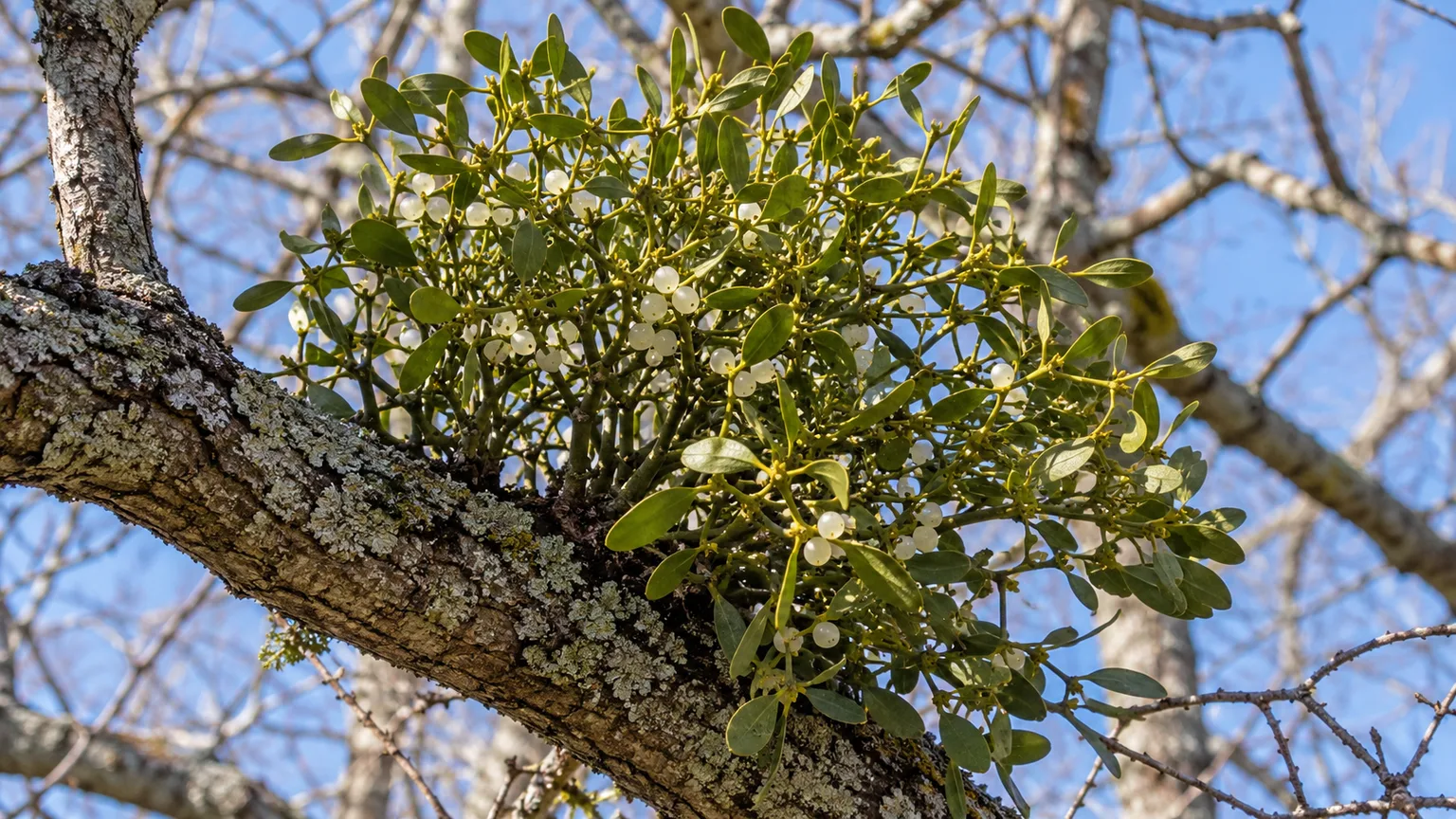
American mistletoe is not a shrub you plant in the ground or a houseplant you can keep in a pot. It is a living-tree parasite: its green leaves make sugars through photosynthesis, while a specialized structure inside the host branch draws water and mineral nutrients. That unusual arrangement makes deliberate cultivation possible, but it also means the first question is not which potting mix to buy. It is whether you want to introduce a long-lived parasite to a tree you own and can monitor.
In much of the eastern and central United States, the familiar white-berried holiday plant is American mistletoe, Phoradendron leucarpum. Its evergreen clumps can feed birds and add winter habitat, yet heavy growth can stress a tree and weaken individual limbs. If you are curious about growing it, identify the species, select a vigorous and compatible host, and treat berry sowing as a slow experiment—not a guaranteed garden project.
Decide Whether Mistletoe Belongs in Your Garden
Mistletoe makes sense only in a narrow situation: you have an established, healthy hardwood tree; the plant is native or otherwise appropriate where you live; the tree is yours to manage; and you are comfortable accepting some risk to its branches. The best candidate is not an orchard tree whose crop matters to you, a young planting, a specimen already weakened by drought or decay, or a tree whose upper canopy cannot be inspected safely. A healthy tree may tolerate a small number of clumps, but tolerance is not the same as harmlessness.
There are sound reasons to appreciate an existing clump rather than remove every one. Broadleaf mistletoes produce berries that birds eat, and their evergreen canopy clumps can provide cover and nest sites; UC IPM describes these ecological roles while also explaining the costs of severe infestation (UC Statewide IPM Program). In a natural area, the wildlife value may justify leaving a modest infestation on a vigorous tree. In a small yard, a heavily fruiting tree beside vulnerable young trees, or a high-value shade tree with declining limbs, prevention and management may matter more.
Set the goal before sowing. If you want a few cut sprigs for winter decoration, a single monitored clump on a robust tree may be enough; if the goal is to “grow mistletoe” as a general ornamental, a holly, evergreen shrub, or artificial mistletoe gives the look without infecting a tree. Keep new seed off trees in parks, rights-of-way, orchards, or other people’s property, and check local rules before harvesting or altering a tree. Do not intentionally establish an unidentified mistletoe or a forest-pest species.
Identify the Mistletoe Before You Plant It
“Mistletoe” names many plants with different hosts and growth habits. Before buying or collecting berries, match a reliable botanical identification to your region and the host tree; a common name on a decorative sprig is not enough. The advice below is specifically for American leafy mistletoe, Phoradendron leucarpum, not every plant sold as mistletoe.
American leafy mistletoe is the usual U.S. choice
American mistletoe is a native evergreen broadleaf hemiparasite found in the central and eastern United States. It usually forms a rounded, twiggy clump among the crown branches of deciduous hardwoods, with leathery green leaves and small whitish berries on female plants. NC State Extension describes it as relying on a host for support, water, and nutrients while making its own food, and notes its association with maples and oaks (NC State Extension).
This is an aerial plant, not a root parasite in the garden bed. It has no ordinary soil-root system that you can move into a container, and a fallen sprig will not become a self-sustaining potted plant. The seed’s sticky pulp, often called viscin, helps it cling to bark; after germination, the young plant must form a haustorium that connects with the host’s water-conducting tissue. That biology explains why a seed may stick to the branch and still fail to establish.
European and dwarf mistletoes need different decisions
European mistletoe, Viscum album, is a different species and is not interchangeable with American mistletoe. Its distribution, preferred hosts, propagation timing, and toxicity evidence differ; for example, the Royal Horticultural Society’s sowing calendar and branch advice address V. album in the UK, not American plants (Royal Horticultural Society). Those instructions are useful for understanding the general seed-on-branch method, but local American timing and host selection should follow American-species references.
Dwarf mistletoes (Arceuthobium spp.) are another group entirely, often associated with conifers and forest disease. They have tiny scale-like leaves and can be difficult to identify when not flowering. Do not sow or transplant a dwarf mistletoe as a holiday plant; ask a local extension office or certified arborist to identify suspicious growth, especially on pines, spruces, firs, or hemlocks. Correct identification is the point where a little caution can prevent years of avoidable host damage.
Choose a Healthy, Compatible Host Tree
American mistletoe uses many hardwoods, but “many” does not mean any tree will work. Extension sources list oak, maple, elm, hickory, ash, walnut, poplar, and other broadleaf hosts; susceptibility varies by location and species. Texas A&M Forest Service reports American mistletoe on more than 100 tree species in the eastern United States and notes that water oak, sugarberry, and elm are commonly infected in its region (Texas A&M Forest Service). A tree that hosts mistletoe naturally near you is a more defensible choice than an unrelated species selected from a generic list.
Choose a mature, vigorous tree with a broad canopy and no obvious major decline. Avoid a recently planted sapling, a tree with extensive deadwood, a fruit tree whose crop is important, or one already dealing with drought, root disturbance, construction damage, or serious disease. Mistletoe adds demand for water and minerals; when the host has little reserve, that extra demand can magnify existing stress rather than create a neat, harmless ornament.
The branch matters as much as the species. Natural infection succeeds when sticky seed reaches suitable young growth; Texas A&M notes that infection occurs when seeds germinate on thin-barked small branches and that a rootlike haustorium enters through a lenticel or bud. Look for a well-lit, living branch that is not a major structural limb, but do not climb or reach from an unstable ladder to place seed. If the suitable part of the canopy is out of safe reach, either hire an arborist to assess the idea or do not attempt it.
Understand What Mistletoe Takes From Its Host
A mistletoe clump is hemiparasitic, not fully dependent on the tree for every part of its energy. Its green tissues photosynthesize, but the haustorium taps the host’s water and mineral supply. The plant’s canopy position is important: American mistletoe benefits from light, and its green leaves can remain visible after a deciduous host drops its foliage. You do not improve it by watering the leaves or feeding the clump with soil fertilizer because neither is a standalone soil-grown plant.
The tradeoff is gradual and variable. On a vigorous tree, one or a few small clumps may be tolerated for years; a heavy infestation can reduce vigor, worsen drought stress, and contribute to branch dieback. The University of Georgia Extension explains that individual limbs can become more vulnerable to wind or ice and that simply cutting off the visible foliage often leaves the haustorium behind. Tree condition, drought, branch architecture, and infestation load all change the risk, so no blanket claim that mistletoe either always kills or never harms a tree is reliable.
That variability also shapes the planting decision. A single clump on a sound tree in a region where the species is native is different from many clumps on a declining tree at the edge of a small lot. If you want wildlife value, observe an existing mistletoe population before deliberately increasing it. If you do proceed, choose a location you can revisit and be willing to remove the new growth if the host starts losing vigor.
How to Sow Fresh Mistletoe Berries on a Branch
Mistletoe is propagated by seed attached directly to a living host branch. It cannot be started in a seed tray and transplanted later, because the seedling must make its host connection where it germinates. Success depends on fresh seed, species compatibility, branch condition, and weather; even careful sowing may produce no visible plant.
Collect fresh, ripe berries responsibly
Use berries from a correctly identified local American mistletoe plant only when you have permission to collect them. Female plants bear the berries; a male plant will not provide seed. Skip berries that are shriveled, dried out, crushed, or detached long enough to lose their sticky coating. The RHS notes that mistletoe seed is light-sensitive and that dry or stored berries are poor candidates, while the species-specific growing guide at Gardener’s Path likewise emphasizes fresh berries and the uncertainty of establishment.
Timing is not a single calendar date across the species’ entire range. In many U.S. areas, ripe fruit is easiest to find in late fall or winter, but local ripening and weather vary; sow when fruit is naturally ripe rather than storing it until a prescribed month. If your only available sprig is a retail holiday decoration, do not assume it is the right species, locally adapted, or viable for sowing. Never move potentially invasive or nonnative mistletoe between regions just to obtain seed.
Place seeds on a small, well-lit branch
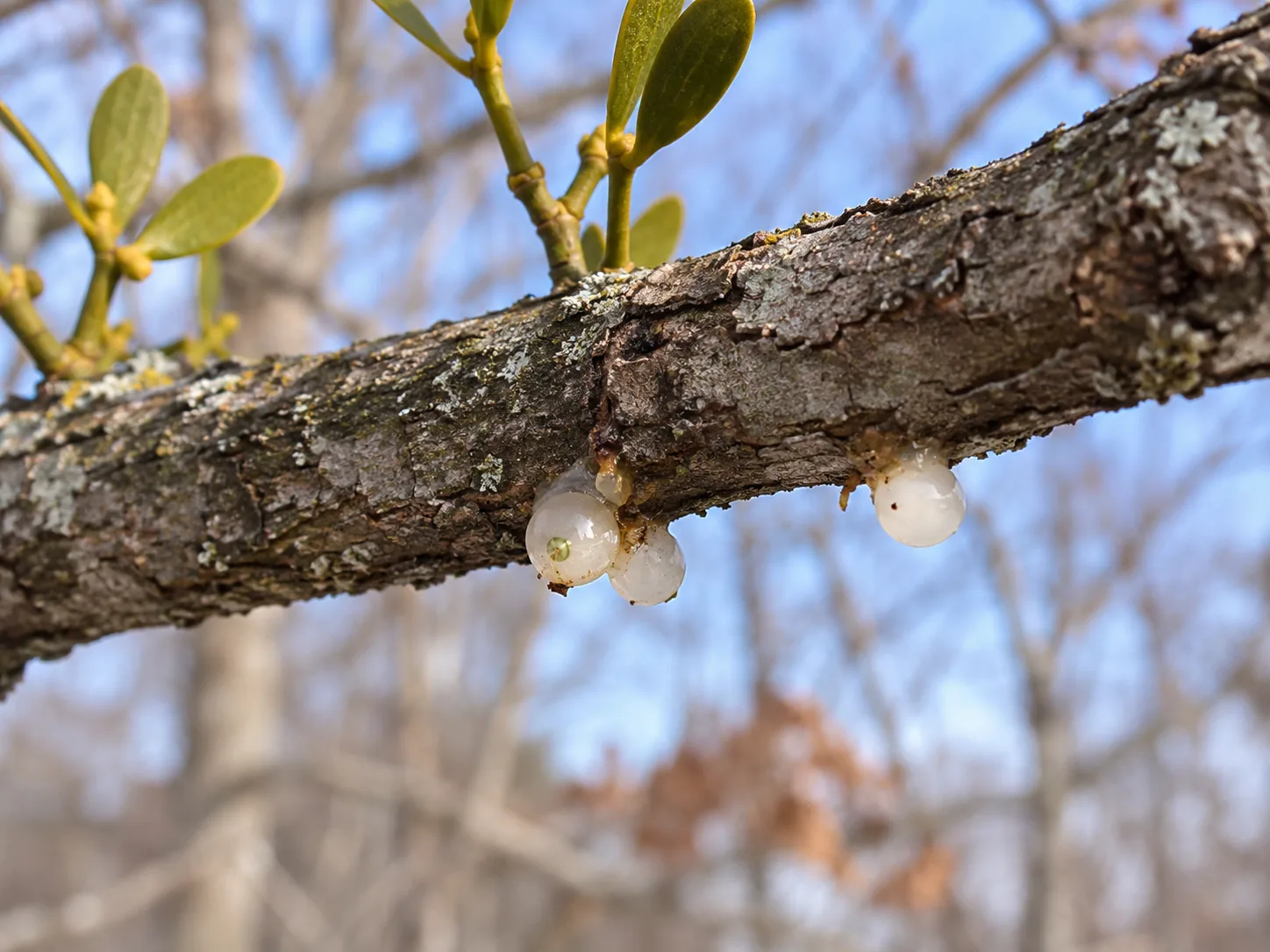
First mark a few candidate branches from the ground, and confirm that they belong to a compatible hardwood on your own property. Favor a healthy, relatively smooth branch in good light, about pencil to finger thickness, rather than a thick trunk, damaged limb, or deep-shade interior. Mistletoe seeds are naturally moved by birds and stick to bark; for a garden trial, gently squeeze a ripe berry so its sticky seed pulp touches the bark. Do not cut or peel bark to create a wound. The RHS propagation guide recommends wiping seed onto the branch surface instead of nicking bark; that is a sensible low-injury method, though its species guidance is for European mistletoe.
Place several seeds on separate candidate branches rather than crowding all of them onto one spot. This is not a guarantee that any will take, but it spreads the trial across small differences in branch age, bark, exposure, and moisture. A trusted U.S. gardening guide, Gardener’s Path, also recommends multiple seed placements because not all survive; treat that as practical horticultural advice, not as a measured success rate. Label the branches from a safe vantage point so you can check them later without repeatedly handling the seed.
Monitor establishment without disturbing the branch
After sowing, leave the seed in place. Do not wrap the branch tightly, keep it continuously wet, apply rooting hormone, or scrape the bark to “help” the haustorium. The tree’s normal moisture and the mistletoe’s germination biology govern establishment; the seed needs to remain attached long enough to germinate and connect to living tissue. If a dry spell threatens a young, recently planted host, water the tree’s root zone according to the tree’s needs rather than spraying the canopy every day.
Patience means years, not weeks. Texas A&M Forest Service reports that the aerial portion may grow less than half an inch in its first year, with a spread of about three feet taking six to eight years under favorable conditions; UC IPM likewise describes slow growth and notes that mistletoes may take years to flower and set seed. A seed that produces no obvious leafy ball in the first season has not necessarily failed, but repeated probing can damage the attachment site. Check at intervals during leaf-off season, when evergreen clumps are easier to see against bare branches.
Care for the Host Tree, Not a Pot of Mistletoe
Once established, the mistletoe does not need a potting schedule, direct fertilizer, or routine hand watering. The care job is to preserve the host tree’s health and keep the clump’s effect within a level you accept. Think of the mistletoe and tree as one management decision: if the host declines, the parasite is not worth preserving at any cost.
Water the root zone during drought
Mistletoe takes water from the tree, so prolonged drought is the moment to pay attention. Water the host deeply over the root zone when local tree-care guidance recommends it, especially if the tree is valuable, young relative to its species, or already showing drought stress. A slow soak around the dripline is more useful than wetting leaves or pouring water at the trunk, and temporary drought support is not a reason to keep a chronically stressed tree under parasite load.
Do not use one fixed weekly schedule for every host. Soil texture, rainfall, tree size, heat, and local water restrictions determine whether supplemental irrigation is appropriate. If the canopy is thinning, leaves are wilting outside the normal seasonal pattern, or branch tips are dying, assess the whole tree rather than assuming the mistletoe alone is responsible. A local arborist or extension office can help distinguish drought, root problems, disease, and parasite effects.
Use light and fertilizer carefully
American mistletoe occupies exposed parts of a host canopy where it can receive light, but that does not mean you should thin a tree aggressively to brighten the clump. Heavy pruning can injure the host and create new structural problems, while dense canopy growth may naturally limit mistletoe on shaded branches. Choose the site before sowing; do not reshape a mature tree around a decorative plant.
Do not fertilize the mistletoe directly. Fertilizer placed in soil feeds the tree’s root system, not a separate mistletoe root ball; adding it without a diagnosed need can encourage unwanted tree growth or create nutrient imbalance. Follow the host species’ normal care and use a soil test or professional recommendation before correcting a deficiency. There is no ordinary mistletoe pest-control routine to schedule, but watch for decline in the host and for new seedlings on nearby trees.
Prune, Tolerate, or Remove an Established Clump
A small clump on a vigorous tree may be left in place if its ecological value and appearance suit the garden. Keep the decision active: recheck the tree and the clump each dormant season, before new leaves hide the canopy. If the mistletoe is fruiting and you do not want it to spread, harvesting berries before birds distribute them can reduce seed movement, though birds may still carry seeds from other trees.
Keep an intentional clump small and monitored
Do not shear the clump every few weeks as if it were a hedge. Mistletoe foliage can regrow from the established attachment, and repeated cutting of visible shoots may not remove the embedded haustorium. If you are preserving one small plant for wildlife or a limited holiday harvest, remove excess clumps by pruning only branches that can be removed without compromising the canopy, and have a tree professional judge large limbs.
Mistletoe can break branches under ice or wind, particularly when clumps are heavy or the limb is already compromised. That does not mean every clump is an emergency; inspect the branch’s size, attachment, deadwood, lean, and targets below it. A large limb over a roof, path, or play space needs an arborist’s assessment regardless of whether mistletoe is present. Avoid tying decorations, ladders, or harvest bags to a branch that may already be weak.
Remove unwanted growth before it spreads
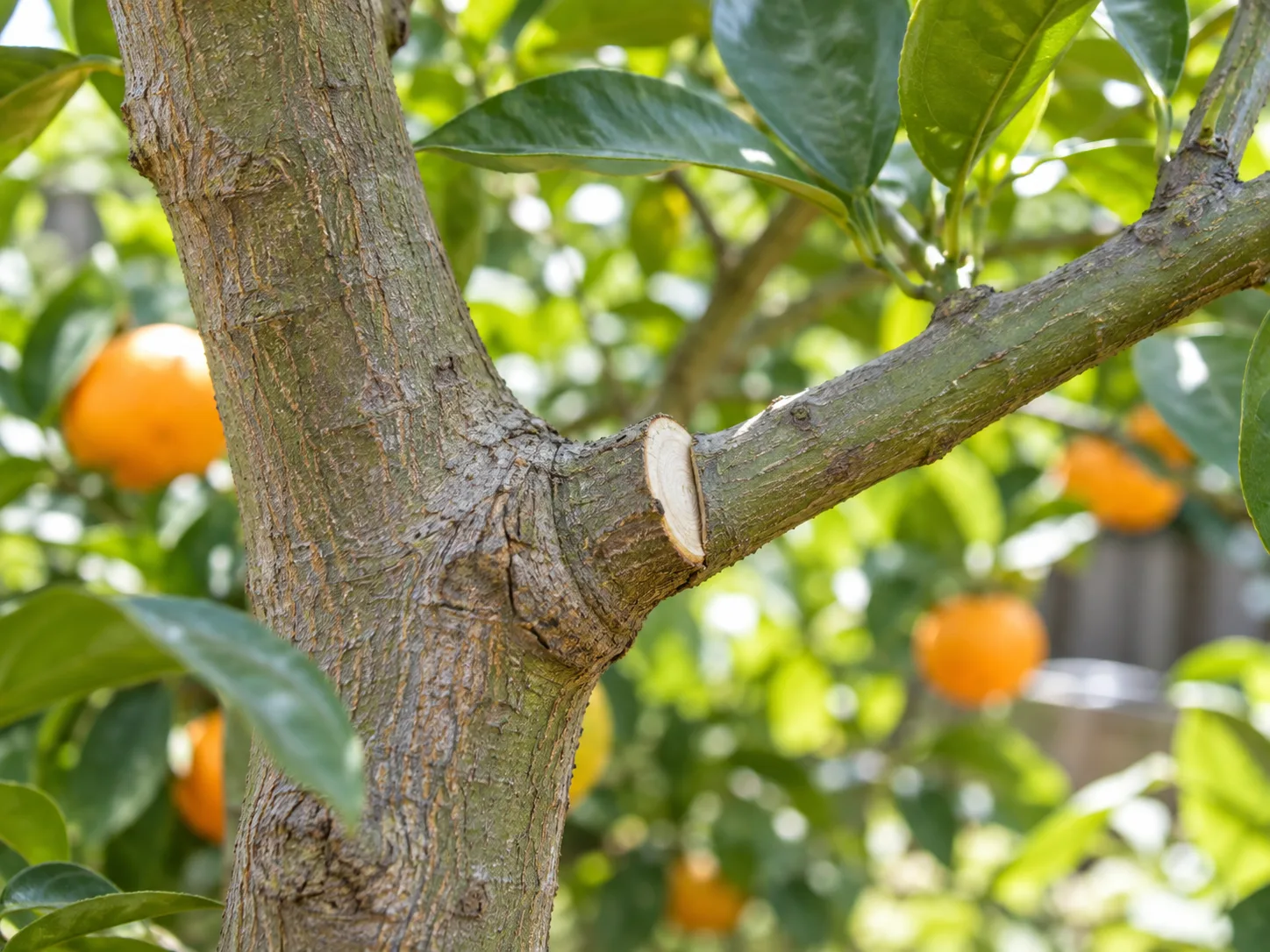
For a small, reachable branch, the most reliable control is usually to prune out the infected section before berries mature, cutting at least 12 inches below the visible mistletoe attachment so embedded tissue is removed. UC IPM recommends removing infected branches at least a foot below the attachment and using proper thinning cuts; this avoids leaving a short stub that can resprout. Do not remove major limbs or a large share of the canopy yourself, and never climb into a tree or use a pole saw near power lines.
If the mistletoe sits on a trunk or a limb too valuable to remove, control is more complicated. UC IPM describes cutting back the visible growth and excluding light with a secured opaque wrap as a possible method, but Texas A&M Forest Service notes that work high in a tree is difficult and dangerous, and that growth often returns from embedded tissue. Have an arborist decide whether this method is appropriate; avoid tight wraps that can injure bark, and do not improvise an herbicide spray. Herbicides or growth regulators can affect the host and nearby plants, and product use must follow current label and local rules.
Removal should be proportional to the tree’s condition. A few small clumps on a healthy tree may not justify large pruning wounds; repeated clusters on a stressed tree, dying limbs, or a hazard above people may warrant prompt professional management. UC IPM emphasizes that topping a tree to strip out mistletoe weakens its structure and destroys its form. If removing enough branches would leave an unsafe or severely depleted crown, ask an arborist about the tree’s overall prognosis instead of chasing every green clump.
Troubleshoot Slow Growth and Poor Berry Set
A seed that stays small or disappears is common, not proof that you used the wrong fertilizer. It may have dried out, landed on unsuitable bark, been removed by a bird, lacked a compatible host, or failed to make a haustorial connection. Mistletoe’s first aboveground growth can be tiny, and some of its development occurs inside the branch. Leave the sowing site alone and make a fresh trial only if the host still meets the health and location criteria.
Flowers without berries point to plant sex and pollination, not a lack of water. In the Texas A&M Forest Service account for East Texas, male and female flowers occur on separate plants, and only female plants produce seed-bearing berries; other sources also note that both sexes are needed for fruit. A solitary female may flower without fruit if no compatible pollen source is nearby, while a male plant will not produce berries. Since sex may not be obvious until maturity, sowing a few separate seeds improves the chance of having both types but also raises the number of parasites you might eventually need to manage.
Yellowish foliage in winter is not automatically a disease. Texas A&M notes that mistletoe can become greenish yellow during winter; compare it with the normal seasonal appearance of the local population and check the host branch for swelling, dieback, or other stress. Mistletoe itself has few commonly reported pest or disease problems, so unexplained damage warrants identification of both the parasite and the host rather than automatic pesticide use.
Handle Mistletoe Safely Around People and Pets
Keep harvested sprigs and fallen berries away from children, cats, dogs, and horses. Toxicity reports vary by mistletoe species and by the amount eaten: the National Capital Poison Center explains that small accidental ingestions of American Phoradendron are usually unlikely to cause serious poisoning, but gastrointestinal symptoms can occur, while European Viscum album has a different and more serious ingestion record (Poison Control). That distinction is not a reason to let anyone sample the plant; correct identification is often uncertain, and pets may eat more than a person notices.
The Pet Poison Helpline reports that pets that ingest American mistletoe commonly develop vomiting or diarrhea, with larger ingestions potentially causing low blood pressure and unsteady walking. Sweep up berries and leaves, store cut sprigs in a closed container, and do not place mistletoe on food or where a pet can knock it down. If a person or animal eats any part, note the plant identity and likely amount, then contact a poison center, veterinarian, or animal poison service promptly for case-specific instructions; do not induce vomiting unless a medical professional tells you to.
Harvesting also presents a physical risk. Mistletoe is often high in the canopy, so leave high cutting to a trained arborist equipped for tree work; consumer ladders and improvised pole tools are not a safe shortcut. If your goal is holiday décor rather than a growing project, a purchased or artificial sprig avoids both host-tree damage and the temptation to climb.
Conclusion
Growing American mistletoe means deliberately introducing a slow-growing parasite to a living tree. If the plant is native in your area, the host is vigorous and compatible, you have permission, and an arborist can handle any high work, sowing a few fresh berries on small sunlit branches can be an interesting long-term wildlife project. It may take years, and it may fail even when conditions look right.
The most useful care routine is to identify the species, monitor the tree, water the host during drought when appropriate, limit spread, and prune only when the cut is safe for the tree and the person doing it. If you cannot accept a lasting parasite or your tree is already stressed, enjoy an existing clump from a distance—or choose a nonparasitic evergreen for the same winter look.



