How Perennials Make a Garden Easier to Maintain
Planning a perennial garden? Compare shrubs and perennials, choose plants by site, water new roots wisely, and save money through division and swaps.
Replacing a thirsty lawn or a row of fussy shrubs with perennials can be one of the most satisfying garden changes you make. The plants return from the same root systems, can need less supplemental water once established, and can often be multiplied instead of repurchased.
The important qualification is that a perennial garden is not a magic “plant it and forget it” button. You trade repeated mowing, shearing, replanting, or shrub shaping for a concentrated setup period, seasonal observation, selective cutback, and occasional division. Make that trade deliberately and the garden gets easier; make it by impulse and you may create a crowded bed that needs more attention than the shrubs did.
Why this swap saves work—but not instantly
An herbaceous perennial lives for multiple growing seasons and often dies back above ground in winter before returning from its crown or roots. A shrub is a woody perennial: its stems remain above ground and expand year after year. That difference explains both the appeal and the limit of the swap. NC State Extension describes woody ornamentals as long-lived plants that keep their branches above ground year-round, which is exactly why shrubs can provide winter structure, screening, and a dependable backdrop.
The time savings appear when the original problem is a recurring task that the new planting does not need. A lawn replacement can reduce mowing and edging. A naturally shaped perennial border can reduce the need to shear a plant into an outline it does not want to keep. A drought-wise grouping can reduce summer irrigation after roots explore the surrounding soil. A bed planted with self-supporting plants and a living mulch of foliage can also reduce bare soil where weeds germinate.
That does not mean every perennial uses less water than every shrub. A new perennial in full sun can need frequent attention, while an established shrub may be quite independent. A bed with thirsty bee balm beside drought-loving lavender is not water-wise just because both plants return each year. Compare task by task: water, pruning, cleanup, pest monitoring, replacement, and correction at mature size.
Perennials versus shrubs: choose by the job a plant must do
Before you remove a shrub, write down what it currently contributes. Is it hiding a utility box, screening a window, holding a slope, framing the entry, or giving the bed height in winter? If the answer is yes, replacing it with a 12-inch perennial may save pruning but leave you with a new privacy, erosion, or design problem.
Use perennials where the job is seasonal color, pollinator habitat, soft edging, ground-level texture, or filling a bed that does not need year-round mass. Keep or replace shrubs with another woody plant when the job is permanent structure, a visual barrier, wind protection, or height that should not disappear after the first hard frost. Often the best result is a layered planting: one appropriately sized shrub or small tree for structure, then perennials in front to do the colorful, seasonal work.
| Garden job | Usually better fit | What to watch |
|---|---|---|
| Year-round screen or foundation structure | Shrub or small tree | Mature width, pruning timing, roots, and clearance from buildings |
| Seasonal flowers and pollinator food | Herbaceous perennials | Bloom gaps, seed-head cleanup, and first-year watering |
| Dry sunny slope or hot sidewalk edge | Site-matched drought-tolerant perennials | Drainage and establishment; “drought tolerant” does not mean dry at planting |
| Shade beneath trees | Shade-tolerant perennials or compatible ground covers | Root competition, dry shade, and the tree’s mature canopy |
| Lawn edge that is hard to mow | Perennial border with a defined edge | Grass creeping into the bed and the need for an accessible path |
This job-based test prevents a common mistake: removing the plant that is inconvenient to prune, then discovering that the replacement needs staking, deadheading, aggressive thinning, or weekly watering. Low maintenance is not a species trait in isolation. It is the result of a plant, a site, and a job agreeing with one another.
Audit your site before removing anything
Spend a few days observing the proposed bed before you buy replacements. Walk past it in the morning, at midday, and late afternoon. Mark direct sun, reflected heat, shade, roof runoff, standing water, and the parts that are hard to reach without stepping into the bed or dragging a hose across a walk.
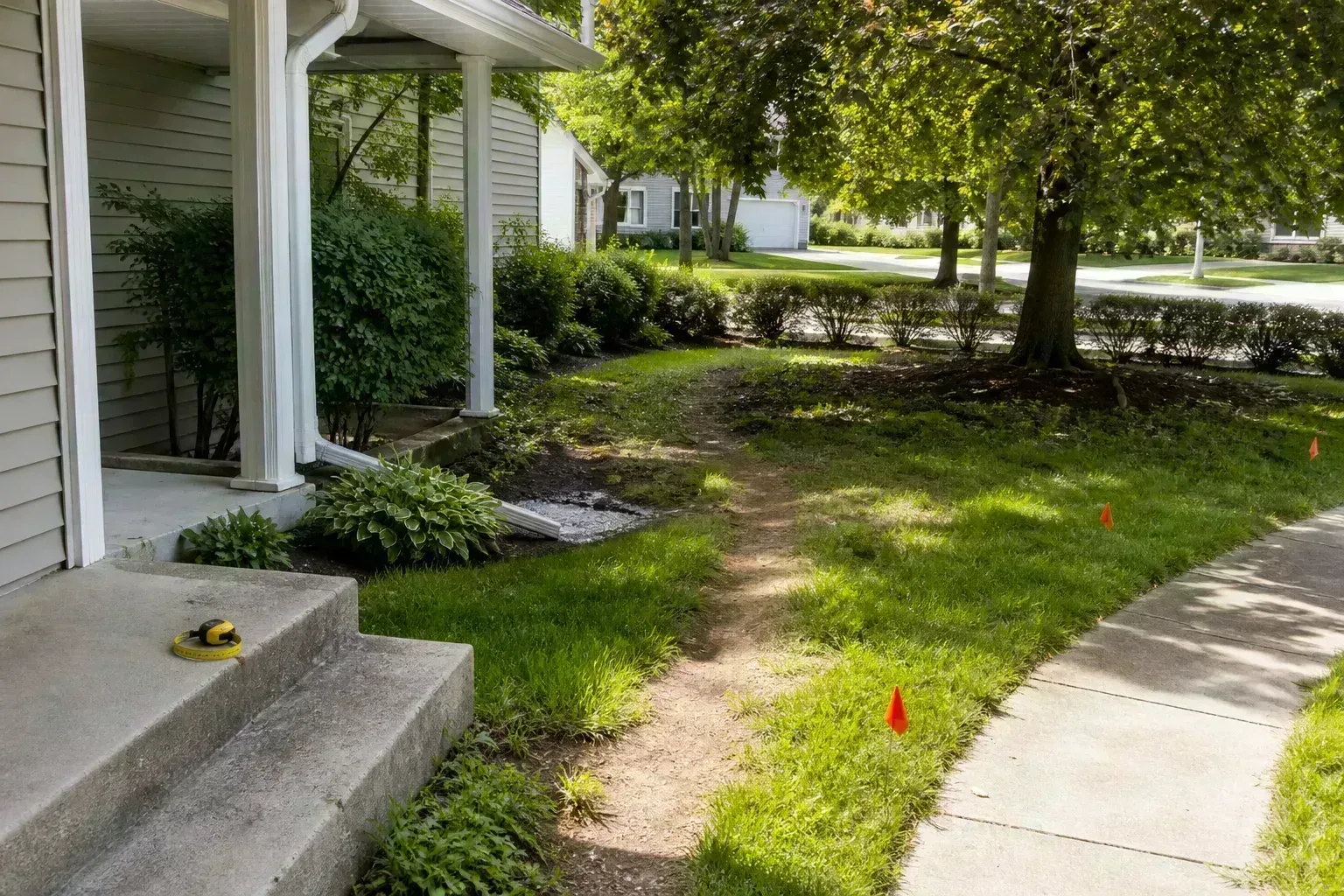
Sketch the bed on paper. Add doors, windows, paths, downspouts, utility covers, property lines, and the mature outline of any plant you keep. A simple drawing exposes expensive mistakes early, such as a tall perennial blocking a sightline or a moisture-loving species placed on the dry side of the foundation.
Sun, shade, soil, and water decide the palette
Start with conditions rather than a favorite flower. Colorado State University Extension recommends considering sun, wind, soil, irrigation, maintenance time, and mature plant size before design. That order is useful in any climate.
For each planting pocket, record light, moisture, drainage, and soil texture. “Full sun” can mean six or more hours of direct light, while a south-facing wall adds heat. “Shade” beneath a tree is not the same as dry shade beside a foundation.
Do a quick drainage check before you call a plant drought tolerant. Dig a hole about a foot deep, fill it with water, and observe whether it drains or remains pooled. If the site stays wet, improve grading or choose plants that tolerate moisture. Compost cannot solve a downspout that dumps water into a lavender crown.
Group plants by water need, a practice often called hydrozoning. Put dry-site plants together in the hottest or highest parts of a bed, and place moisture-loving plants where runoff collects or irrigation can reach them. Separate zones are more efficient than keeping a mixed bed equally damp.
Keep structure where you need it
A full perennial conversion can look bare in spring and after frost. Keep an evergreen, naturally shaped shrub, ornamental grass, or small tree where the bed needs winter form; you can reduce shrubbery without removing every woody plant.
Check mature height and spread, not the size of the pot. Place tall plants at the back or center of an island bed, shorter plants near the viewing edge, and leave a route for watering, weeding, and division. Gardener’s Supply explains that mature width and spacing are as important as height; packing a bed for instant fullness creates future rework.
Build a perennial palette that can look good for three seasons
Think in roles instead of a long shopping list. Choose early, midseason, and late-season interest, then repeat plants in groups and vary foliage shape and height so the bed reads as a design rather than a row of blooms.
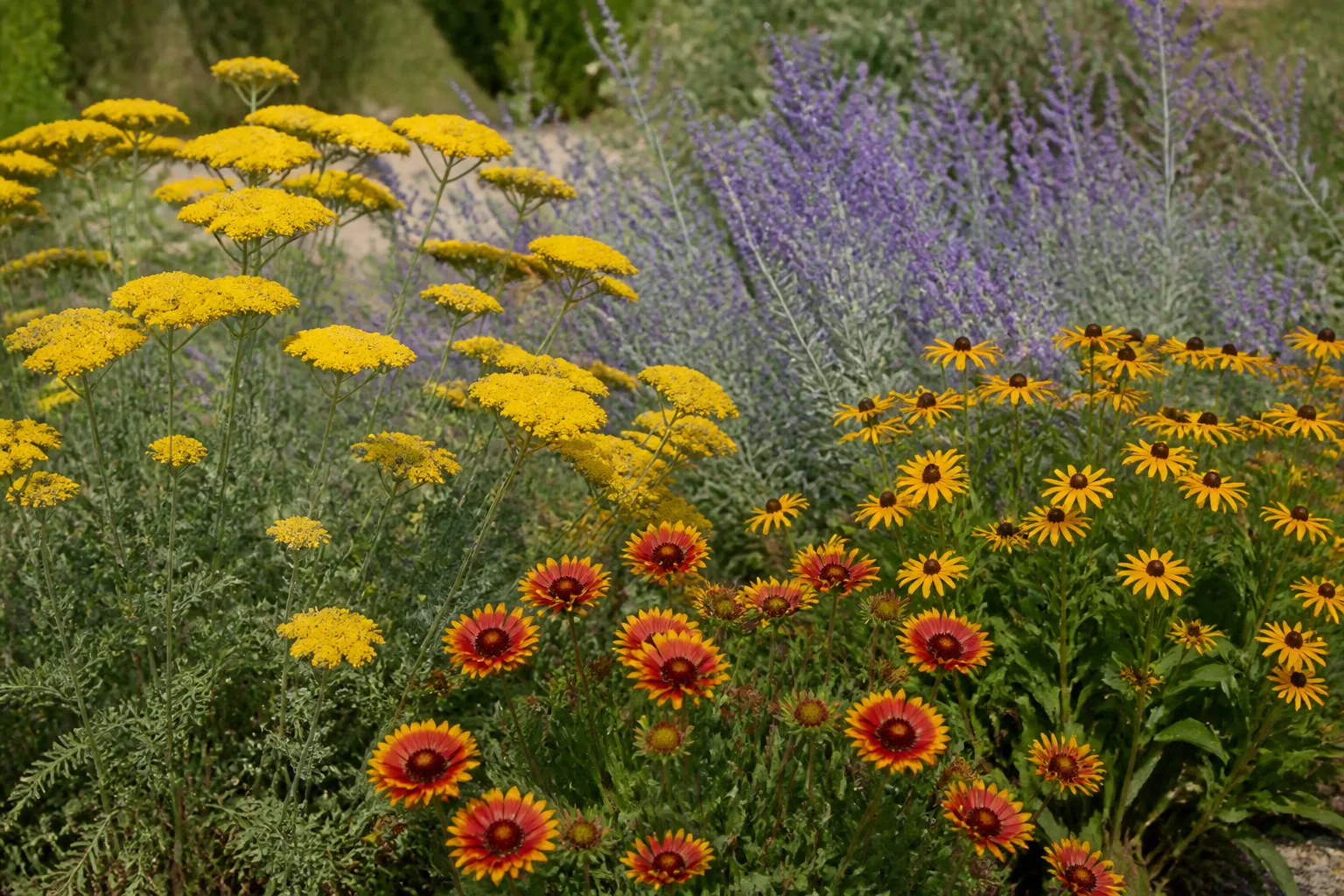
The easiest palette is usually smaller than the one you imagine at the nursery. Three or four dependable plant types repeated through a bed are easier to water, mulch, divide, and troubleshoot than twelve unrelated species. Add a new plant only when it fills a real gap in bloom time, height, texture, habitat value, or site tolerance.
A sunny, dry-site palette
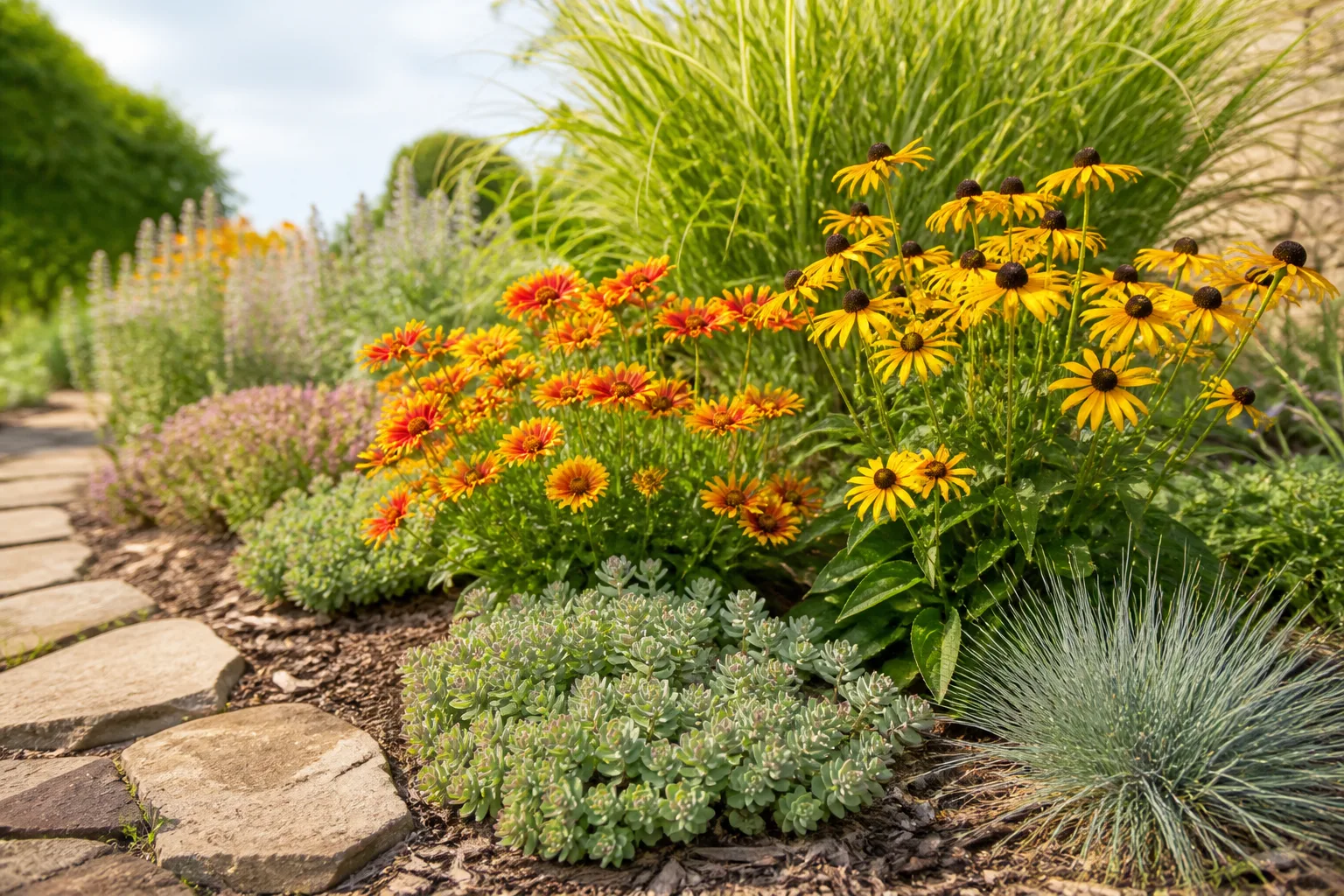
For a bright, sharply drained bed, look at plants such as catmint, lavender, sedum, yarrow, salvia, coreopsis, coneflower, black-eyed Susan, and some regionally native grasses or flowering perennials. These are examples, not guarantees. Cultivar, climate, soil, humidity, deer pressure, and available water can change the maintenance picture substantially.
Use foliage as a drought clue, but do not rely on appearance alone. Narrow, gray, silver, or succulent leaves often reduce water loss, while a plant from a dry meadow may still need regular water while young. Garden Design’s practical perennial guide lists lavender, milkweed, coneflower, Russian sage, salvia, sedum, coreopsis, and yarrow among low-care candidates when their light and soil needs are met. Match the recommendation to your site before you copy the plant name.
Avoid turning a dry border into a thirsty flower show by adding plants that need constant moisture for lush leaves. If a plant looks wilted each time the weather turns hot, it is not necessarily a bad plant; it may simply be in the wrong water zone.
A moist or part-shade palette
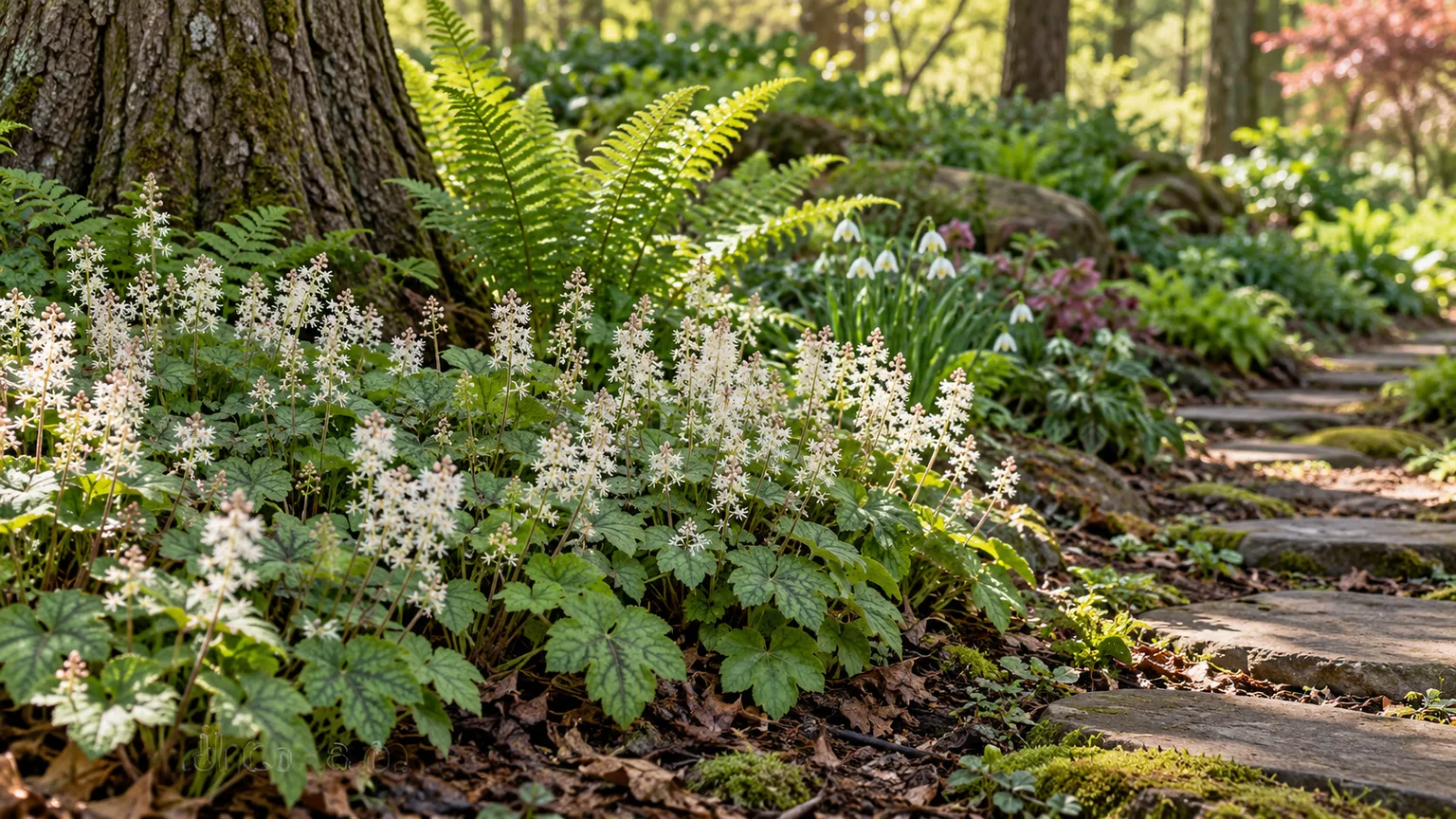
Part shade opens the door to heuchera, hosta, ferns, bleeding heart, woodland phlox, and other shade-tolerant perennials, but dry shade beneath mature trees is a special challenge. Tree roots can take up water before the perennial can, and adding more irrigation may not solve the competition. Start with plants that naturally tolerate the light and moisture you actually have, then use leaf mulch carefully to protect the surface without burying crowns.
For a damp low spot, consider moisture-loving plants rather than forcing a dry-site palette to survive. The Missouri Botanical Garden’s native home-garden list separates herbaceous perennials by sun, shade, and moisture-related conditions, and it is a useful reminder that “native” is not a single growing requirement.
Build in access. Shade gardens often spread into a soft, irregular shape, but you still need to reach the back plants without compacting the soil or stepping on crowns. A narrow path, stepping stones, or a maintained edge can save more time than an additional “easy” plant.
Use natives without treating “native” as a shortcut
Native perennials are a strong place to start because plants from your local region are more likely to align with local seasons, soils, and wildlife relationships. The National Park Service recommends learning your local ecoregion, observing how water moves through your property, and checking regional plant finders before choosing species. Its guidance also emphasizes planning the yard for people first, including children, pets, paths, and the way the space will actually be used.
Native does not mean maintenance-free. The Missouri Botanical Garden explicitly notes that native plants still require maintenance, and even well-behaved species need watering while they establish, occasional weeding, and some management of seedlings or spread. Choose plants described as well behaved for home gardens, and check whether a plant spreads by rhizomes, reseeds freely, or becomes much taller in rich soil.
Leave room for wildlife and for your own tolerance of seasonal change. Seed heads and standing stems can shelter insects and feed birds, but a bed beside a narrow walk may need selective cleanup. The National Park Service recommends leaving some dead plant material in place for winter habitat; remove it when it carries disease or creates a safety problem.
Remove shrubs in phases and protect the soil
Do not clear the entire bed on the same weekend unless you have a planting plan, disposal plan, and enough time to establish everything. Remove one problem shrub or one manageable section first. That lets you see how much sun reaches the soil, how quickly the bed dries, where the old roots are, and whether the visual gap is larger than you expected.
Keep a shrub temporarily if it is healthy and doing an important job. If it is crowded, diseased, blocking a window, or simply the wrong size, remove it after checking for nesting wildlife, underground utilities, irrigation lines, and local disposal requirements. Large woody roots and stumps may need professional removal; do not turn a small garden refresh into a risky excavation.
Once the plant is out, remove perennial weeds and unwanted roots while the soil is exposed. Do not automatically rototill the entire bed. Deep tillage can bring buried weed seed to the surface and disturb soil structure. Loosen compacted areas, improve drainage or grading where necessary, and use a soil test to guide amendments rather than adding fertilizer by habit.
Protect exposed soil with temporary clean mulch, keeping it away from shrub trunks and perennial crowns. If the area is large, phase the conversion over a season: establish one section, learn what survives, then repeat the successful pattern.
Plant for establishment, not instant fullness
The plants that look largest on planting day are not always the best value. A healthy, well-rooted container perennial can establish more reliably than a tiny stressed plug in hot weather, but buying many large plants can exhaust the budget. The middle path is to buy a few anchor plants at a size you can afford, space them for mature spread, and fill the waiting gaps with divisions, seed-grown plants, or short-lived fillers.
A low-waste planting sequence
Use this order for each section of the swap:
- Mark the mature outlines. Set nursery pots on the soil and move them until the grouping looks balanced. Read the tag for mature width and allow air space between plants that are vulnerable to foliar disease.
- Prepare the bed, not just the holes. Remove grass and perennial weeds, correct drainage issues, and add organic matter only where a soil test or site condition supports it. Healthy soil is not the same as soil that stays constantly wet.
- Water the container before planting. A thoroughly hydrated root ball is less likely to shed dry soil when you slide it out of the pot. Plant on a cool, cloudy day or in the morning or evening during warm weather.
- Set the crown at the right level. Place the plant at the same soil level it had in the container. Burying a crown to make a small plant look established can lead to rot; leaving the root ball high can expose roots to drying.
- Loosen only tight roots. If roots are circling densely, tease the outer layer or make a few shallow vertical cuts. Do not shred a healthy root ball just to make it look loose.
- Backfill with the soil you removed. Press gently around the root ball to eliminate large air pockets, then water slowly until the soil settles. Top up with more soil if the plant sinks.
- Mulch after watering. Cover the surrounding soil with a moderate layer, keeping it a few inches away from stems and crowns. The goal is a cool, moist surface, not a buried plant.
Savvy Gardening’s summer planting guidance makes an important practical point: even a drought-tolerant perennial needs regular water to become established, and planting during an active drought or water restriction is a poor time to start a new bed. If your community has watering limits, delay the swap or reduce its size.
Water by root-zone checks
Watering is where many promised time savings disappear. New perennials have a small root ball surrounded by a much larger volume of soil, so the plant can be thirsty even when the bed surface looks damp. Check the root zone with your finger or a narrow trowel, look for wilting that does not recover in the evening, and account for wind, heat, soil type, and recent rain.
As a starting framework, Colorado State University Extension notes that sunny new plantings may need water every couple of days during the first month, then longer intervals such as four to six days as roots expand. That is not a universal timer. Heavy clay, sandy soil, a heat wave, reflected pavement, rainfall, and plant species can all change the interval.
Water deeply enough to moisten the whole root ball and the surrounding soil, then allow the surface to begin drying before watering again. Drip or soaker irrigation keeps water near the roots and avoids wetting foliage. Once established, let the plant’s site and weather guide you; do not continue a first-month schedule forever simply because it appears on a calendar.
Use mulch and density to win the weed battle
A new perennial bed is often weediest before it is fullest. Open soil invites weed seeds, while mulch buys time as plants expand, slows evaporation, and makes small weeds easier to pull.
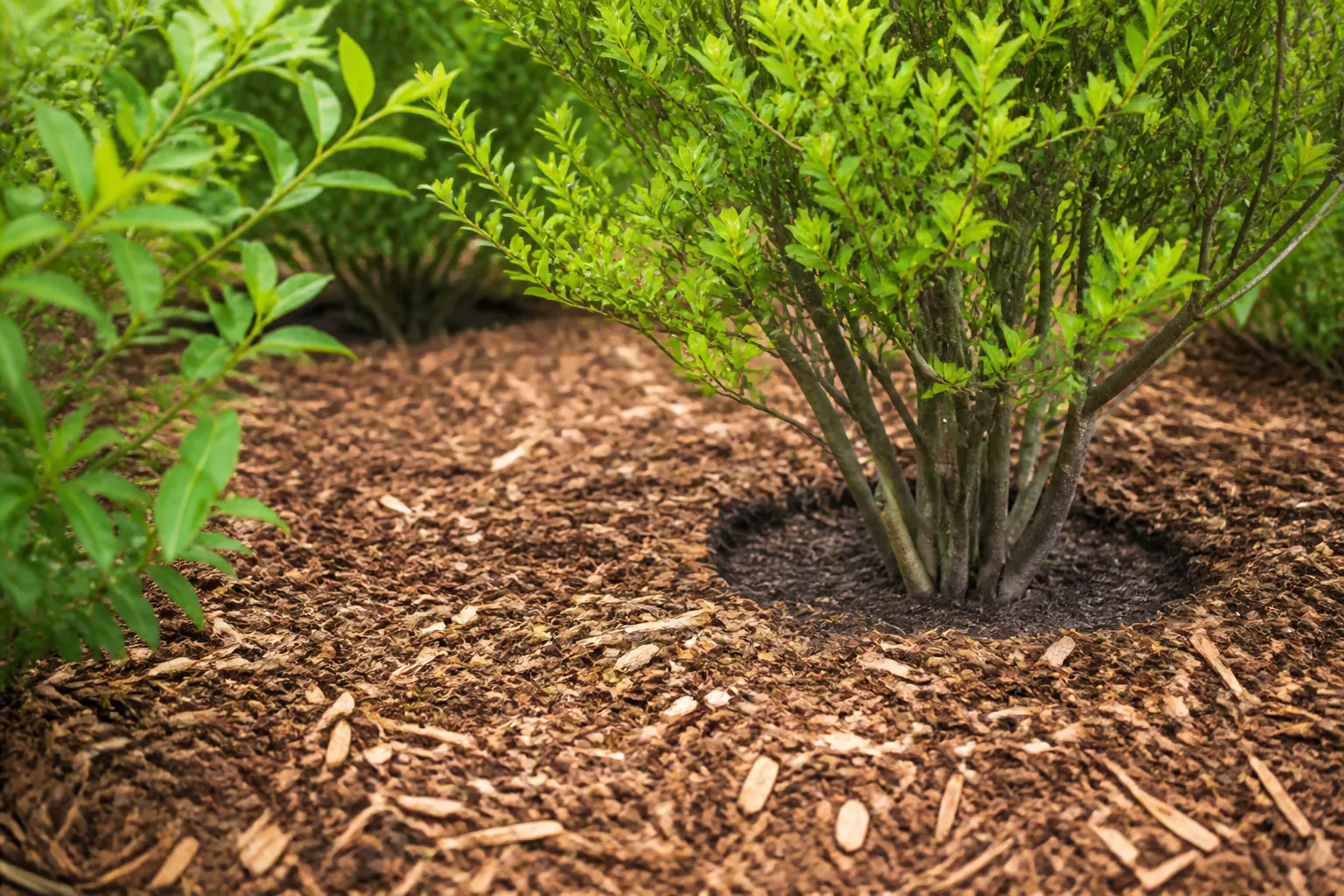
Apply mulch evenly rather than building a volcano around each plant. Keep stems and crowns exposed, pull mulch away from the house foundation and woody trunks, and refresh only when the layer has decomposed or thinned. Too much mulch can keep crowns wet, encourage shallow roots, and hide weeds until they are large.
Density is the long-term weed strategy. Plant to mature width, repeat a few compatible species, and use ground-covering foliage where it truly suits the light and moisture. Do not use an aggressive spreader simply because it fills a gap quickly. Gardener’s Supply warns that vigorous perennials can take over a garden, and the time spent removing an invasive or overly enthusiastic plant is the opposite of the savings you were trying to create.
An edge matters too. A crisp trench, permanent edging, or a strip of hardscape keeps lawn runners out and gives the bed a deliberate outline. It also means you can mow without trimming around every stem. The best low-maintenance bed is not the one with the fewest plants; it is the one where the boundary, spacing, and access make the routine tasks quick.
Maintain selectively: pruning, seed heads, and division
Perennial maintenance is seasonal, not absent. In spring, remove material blocking new growth, check for winter damage, and pull small weeds. During the growing season, deadhead only when it improves performance or appearance; many plants can keep their seed heads.
Do not cut every perennial to the ground on the same fall weekend by default. Standing stems can add winter structure, catch snow, shelter insects, and provide seed for birds. Cut back plants that are diseased, collapsing onto a path, or likely to spread a problem into next year, then leave healthy stems where their winter presence is an asset. Colorado State University Extension recommends less fall cleanup when wildlife habitat is a goal, with thorough cleanup when a known pest or disease requires it.
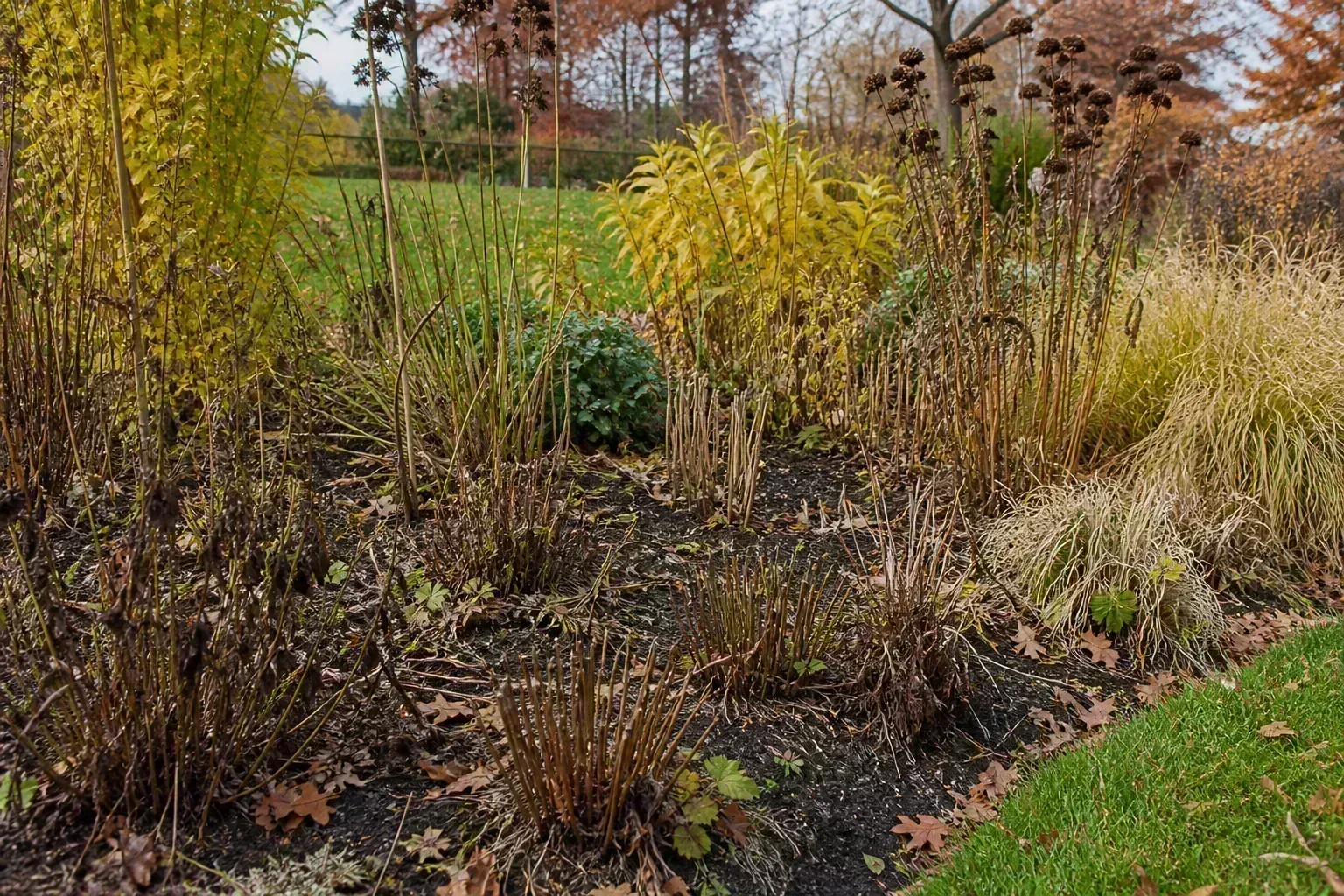
Selective maintenance saves more time than rigid rules. A plant that naturally forms a tidy mound may need nothing beyond an old-stem cleanup. A tall plant in a windy front bed may need staking or a shorter cultivar. A bee balm that repeatedly develops mildew may need more air space, a resistant selection, or a different location—not simply more cutting.
Divide only the perennials that want it
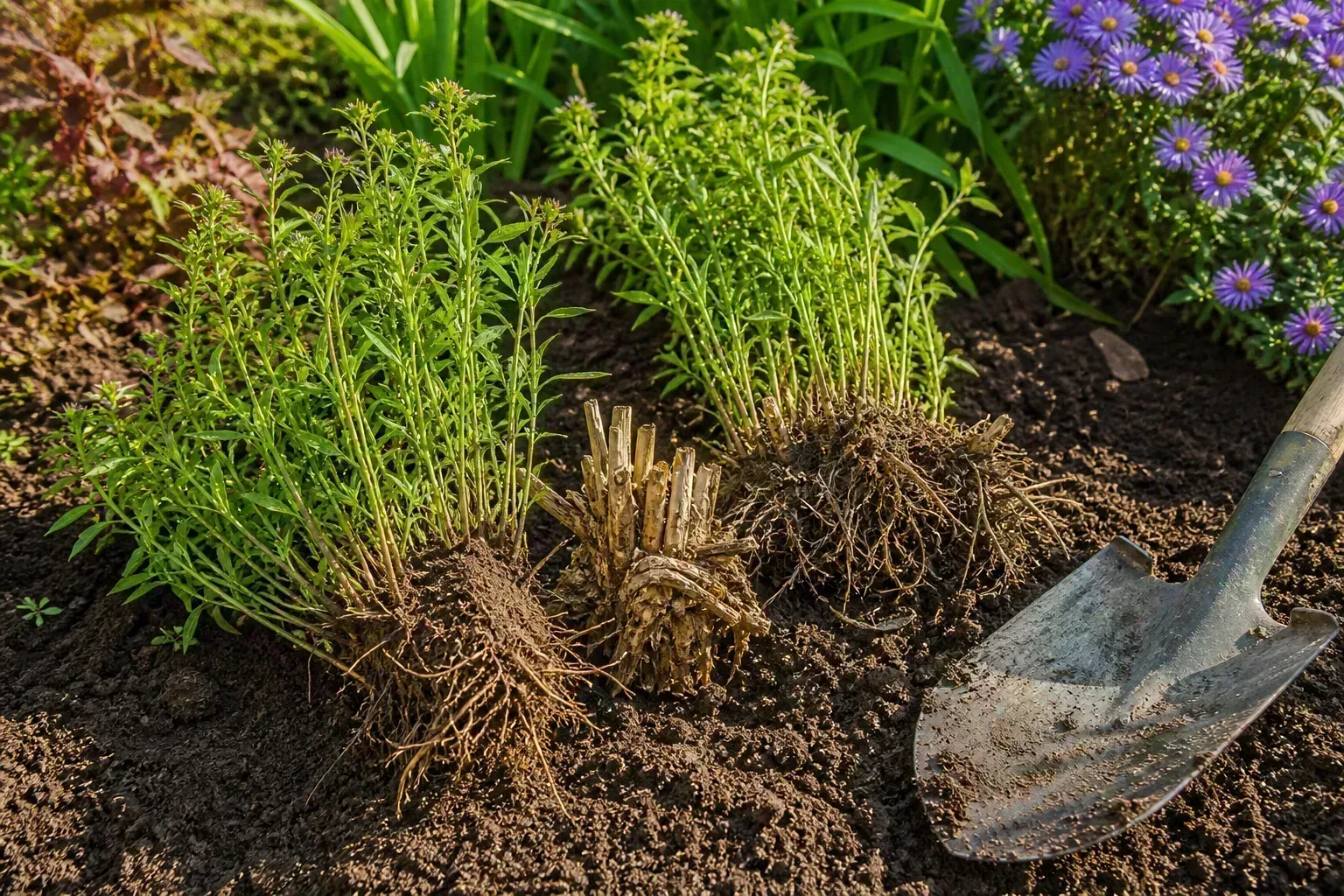
Division is one of the best ways a perennial garden can reduce future spending, but it is not a universal propagation method. When a clumping perennial becomes crowded, develops a bare center, blooms poorly, or spills beyond its space, lift it during the appropriate off-season and replant healthy divisions. You can use the extras elsewhere or share them with another gardener.
The broad timing rule is to divide spring- and summer-flowering plants in fall and late-summer or fall-flowering plants in spring, when the plant is not actively blooming. Epic Gardening’s horticulture-reviewed division guide recommends avoiding the dead of summer and winter because heat stresses disturbed roots and cold leaves new divisions little time to establish.
Not every perennial should be cut into pieces. Plants with a single woody stem, such as lavender and Russian sage, and taprooted plants such as butterfly weed and false indigo are poor candidates for casual division. Before you dig, identify the plant and its root system. If you are unsure, propagate by seed or buy another plant rather than sacrificing a mature specimen.
Prepare the new holes first, water the parent plant the day before if the soil is dry, and work on a cloudy day when possible. Lift the whole clump, preserve several shoots or buds on each division, replant immediately at the original depth, water once to settle the soil, and keep the divisions evenly moist without leaving them saturated. Extra care is temporary; the future plants are the payoff.
Track the savings you actually get
The first season may not look cheaper. You may buy plants, compost, edging, mulch, hoses, replacement soil, and a tool to remove the old shrubs. Count those costs honestly, then compare them with the recurring costs and hours the old planting required over several seasons.
Keep a simple note with four columns: task, old frequency, new frequency, and remaining work. For example, record lawn mowing and edging, shrub pruning, irrigation runs, annual flower purchases, weed-pulling time, mulch refreshes, and plant replacements. Do not claim a water saving because you watered less; compare the same weather period and remember that young plants need extra care.
Your second-year budget can fall if you use divisions, seed, local plant swaps, or healthy plants from a friend’s garden. Check plant identity and restrictions before sharing material, and do not collect plants from the wild. The EPA’s natural-landscaping guidance describes native perennial plantings as a way to reduce recurring inputs such as water, fertilizer, herbicides, and replanting, but project figures are not a guaranteed household payback.
The best measure may be time rather than dollars. If you can water one hydrozoned section efficiently, reach every plant, and finish spring cleanup quickly, the design is doing its job; if you spend every Saturday pulling runners from a poorly chosen ground cover, it failed even if the plants were free.
When perennials are the wrong swap
Keep the shrubs or lawn when they perform a job the perennial bed cannot replace. A shrub may be the most efficient way to screen a bedroom window, hold a visual boundary, shelter a patio, or give a foundation planting winter form. A small lawn may be the safest surface for children to play on, the easiest path for a wheelbarrow, or the only area that tolerates regular foot traffic.
Perennials are also a poor choice when you cannot provide establishment water, when the bed is under a long-term water restriction, or when the site has unresolved drainage or soil-compaction problems. Drought-tolerant plants still need roots to connect with the surrounding soil. Planting a large area during a heat wave can turn a water-wise idea into a row of stressed, expensive replacements.
Skip the full conversion if you dislike seasonal change. Many herbaceous perennials disappear or look tired after frost, while shrubs remain visible. You may prefer a smaller perennial pocket in front of dependable structure. That is not a compromise or a failure; it is often the most durable design.
Finally, do not remove a healthy mature plant just because a trend calls it high maintenance. Pruning once a year may be less work than digging out a root system, buying replacements, watering them through summer, and waiting two years for the bed to recover. The smartest swap is selective: remove the plants that create recurring work, keep the ones that earn their space, and choose replacements by what they can reliably do.
Conclusion
The perennial swap saved time because it was treated as a design decision, not a shopping spree. The bed was audited first, plants were grouped by light and water needs, structure was kept where it mattered, and the planting was given enough room to grow into its place. The first season still required watering, weeding, and observation, but those jobs supported a bed that could become easier instead of locking in more correction.
If you want to try it, start with one section. Measure what the current planting costs in time, water, pruning, and replacement; remove only what is not earning its space; choose a short palette that fits the site; and use mulch, access, and mature spacing to protect the investment. After a few seasons, divide the perennials that welcome it and let the garden pay you back with more plants, more habitat, and fewer chores.