How Often to Water Outdoor Plants by Type and Season
Find a practical outdoor plant watering schedule by checking root-zone moisture, counting rainfall, and adjusting for pots, beds, weather, and plant age.
The practical answer: water by soil, not by calendar
For most outdoor plants, the right watering interval is the time it takes the active root zone to dry enough that the plant needs another thorough drink. That might mean checking a sunny container every morning during a heat wave, while an established shrub in cool, mulched soil may need no extra water for weeks. A fixed “twice a week” rule can overwater one spot and leave another parched on the same property.
Use a calendar as a reminder to inspect, not as a command to irrigate. Start by checking the soil where the roots are, look at recent rain and the forecast, then water slowly if that root zone is drying. Afterward, confirm that the water reached the intended depth. This simple loop—check, water, verify, adjust—is more reliable than counting days alone.
A useful starting point for an actively growing vegetable garden or mixed annual bed is roughly 1 inch of water per week, including rainfall. It is a planning benchmark, not a universal prescription: hot, dry, windy conditions, shallow roots, sandy soil, fruiting crops, and exposed raised beds can raise demand, while cool weather, heavy soil, mulch, and a good rain can lower it. Utah State University Extension’s vegetable watering guidance, for example, gives many crops a broad range around 1 to 2 inches weekly and explains that crop, growth stage, temperature, and soil alter the amount. Use the soil check below to decide how that weekly total should be divided.
What changes the interval between waterings?
Plants lose water through their leaves, while roots draw replacement moisture from the soil. When heat, sun, wind, and active growth speed that loss, soil dries sooner. A plant’s species and stage matter too: a newly planted perennial has a small root system, a mature drought-adapted shrub can explore a larger soil volume, and a vegetable setting flowers or fruit may be less tolerant of uneven moisture.
The setting can change the answer within a few feet. A bed in full afternoon sun, a windy balcony, a wall that reflects heat, or a slope that sheds water will usually dry faster than a shaded, level bed. Rain also falls unevenly: a tree canopy, roof eave, or dense shrub can leave soil surprisingly dry after a storm. The goal is not to memorize a schedule for every species; it is to identify the few conditions that change the rate of drying and check those locations more often.
Soil texture and drainage
Sandy soil drains quickly and stores less plant-available water than a loam or clay soil, so it often needs smaller applications more frequently. Clay can hold moisture longer, but a slow-draining clay bed is not automatically safer: if water sits around roots, oxygen becomes scarce and roots can decline. A garden bed that remains wet for days after ordinary irrigation needs a drainage investigation, not another scheduled watering.
Organic matter and mulch can improve water retention, but they do not make every soil behave alike. Utah State University Extension notes that one inch of water penetrates about six inches into loam as a rough guide; that relationship changes with soil structure and infiltration. Dry, compacted, or crusted surfaces can send water sideways as runoff before it reaches roots. When the topsoil is very dry, begin with a short, gentle pass, let it soak in, and then continue rather than flooding the bed in one rush.
Sun, wind, slope, and mulch
Full sun and wind increase evaporation from soil and water loss from leaves. Containers on a hot stone patio, black pots in afternoon sun, hanging baskets exposed to wind, and plants under roof overhangs deserve more frequent checks than sheltered beds. A rain forecast does not guarantee that a rain-shadowed plant will receive any useful moisture.
A 2- to 3-inch layer of organic mulch can slow evaporation and moderate soil temperature, which lengthens the interval between deep waterings. Keep it away from plant crowns and tree trunks, and do not assume a mulched bed is wet underneath just because the surface looks dark. Lift the mulch and check the soil. University of Minnesota Extension recommends roughly a 3-inch layer around newly planted trees and shrubs while keeping mulch off the trunk; excessive depth can interfere with water movement and oxygen around roots. Mulch reduces the pace of drying; it does not replace checking.
A starting routine for common outdoor plants
The following ranges help you decide what to inspect first. They are check frequencies, not mandatory watering frequencies. When the weather is mild, you may water less; when a root zone is dry sooner, water sooner. Most established in-ground plants benefit more from a thorough soak followed by a drying interval than from a little water every day.
| Planting situation | How often to check | What to use as the watering trigger |
|---|---|---|
| Vegetable beds and annual flowers | Every few days in warm weather; more often during heat | Soil drying in the active root zone; keep seedlings and moisture-sensitive crops more even |
| Outdoor containers and hanging baskets | Daily in hot, sunny, or windy weather | Potting mix drying below the surface; water through the root ball until excess drains |
| Raised beds | At least several times a week in summer | Drying in the upper root zone; shallow and exposed beds may dry quickly |
| New trees and shrubs | Frequently during establishment, especially after planting and in dry spells | Dryness in the root ball and adjacent backfill soil |
| Established trees and shrubs | Check during prolonged dry weather | Top 6 to 9 inches of soil in the root zone becoming dry |
| Established drought-adapted plants | Less often than thirsty annuals or vegetables | The plant’s species-specific needs and soil moisture; do not keep naturally dry-soil plants constantly wet |
Vegetable beds and herbs
Vegetables need relatively steady soil moisture, but the most important timing depends on the crop. Leafy greens and shallow-rooted crops can dry quickly; tomatoes, cucumbers, beans, and other fruiting vegetables use more water during flowering and fruit development. Utah State Extension explains that moisture swings can affect crop quality—for example, inconsistent moisture can contribute to bitter, misshapen cucumbers or splitting in heading brassicas. Seeds and newly emerged seedlings are a special case: their roots have not reached deeper moisture, so keep the seed zone evenly moist without washing seeds out or saturating the bed.
For established vegetables, start with the weekly rainfall-and-irrigation total, then check below the surface. If the bed receives about an inch of rain but the root zone remains dry under a leafy canopy, add targeted water. If the soil is still damp several inches down, skip irrigation even when a weekly total looks low. Mediterranean herbs such as rosemary, sage, and thyme generally prefer a drier interval than basil, parsley, lettuce, or cucumbers; grouping plants by similar demand helps avoid keeping the whole garden wet for one thirsty crop.
Pots, hanging baskets, and raised beds
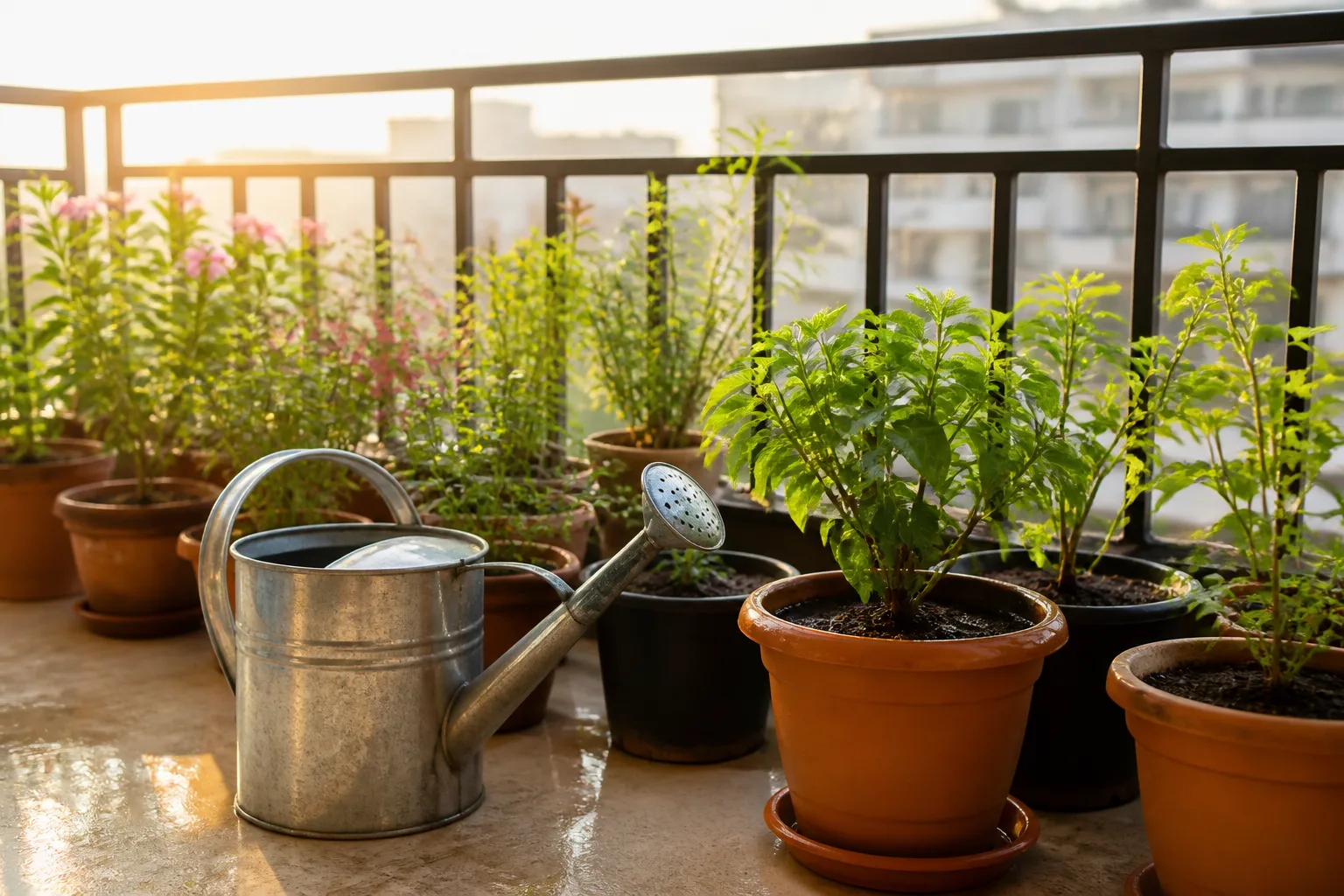
Outdoor containers have a small reservoir of potting mix, so they can move from moist to dry much faster than in-ground beds. Check beneath the surface rather than judging by color alone, and water the whole root ball until water exits the drainage holes. If dry mix has pulled away from the pot edge or water rushes straight through, apply water in two or three slow passes with a short pause between them so the mix can rewet. Empty saucers after drainage; roots should not sit in stagnant water.
A small pot, porous terra-cotta, a dense root ball, a sunny wall, and wind each increase how often you need to inspect. In peak summer, a daily check is sensible and a large, actively growing container may need water daily or more than once on an exceptionally hot day—but only if the mix is actually drying. UF/IFAS recommends checking container soil frequently, watering thoroughly when it feels dry, and accounting for pot size and material. Hanging baskets have even less insulation and can dry quickly, especially in exposed locations.
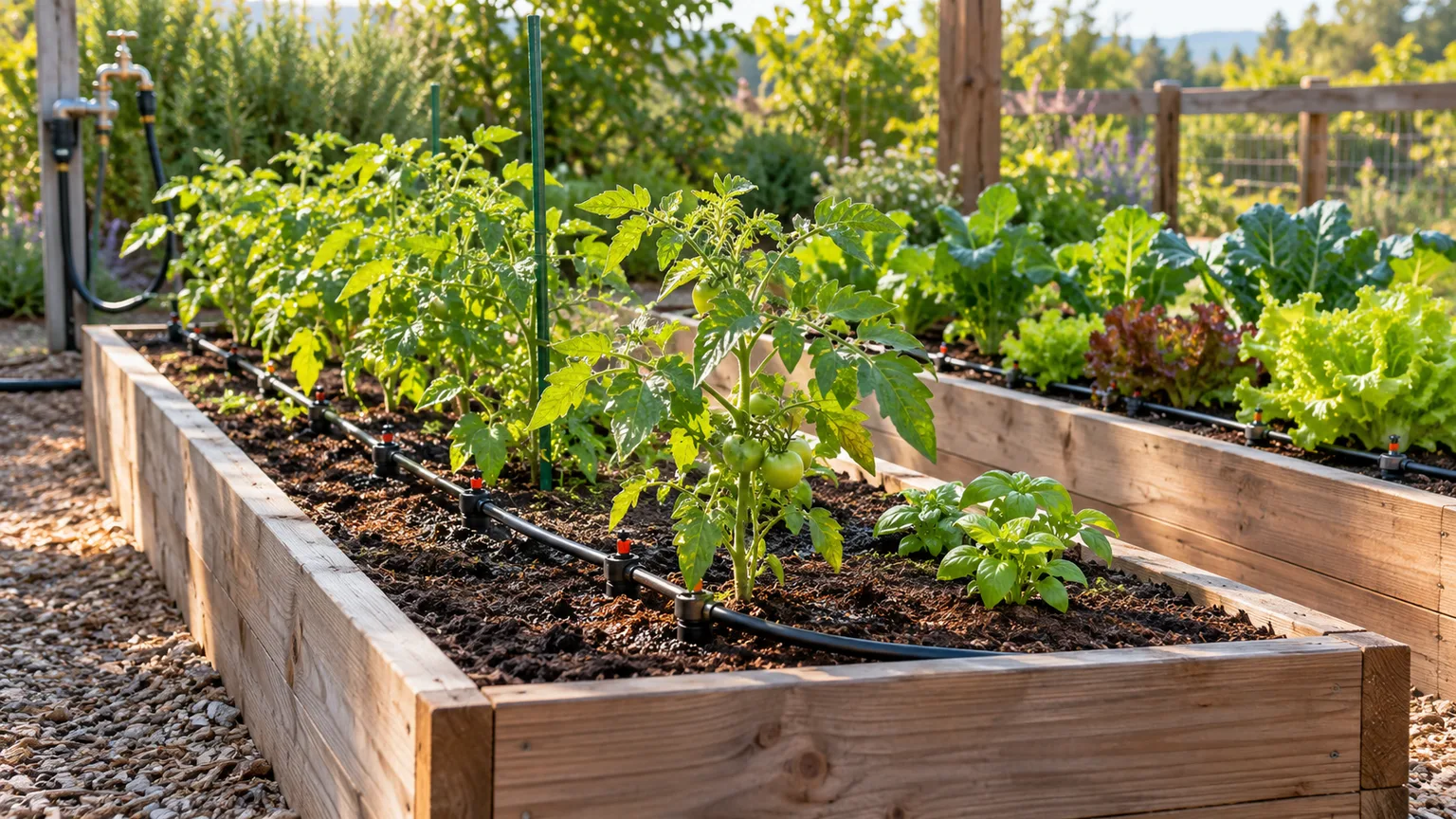
Raised beds sit between pots and in-ground beds. They have more soil volume than a pot, but their sides and elevated position can warm and dry the mix more rapidly than the ground around them. The bed’s depth, construction material, crop density, wind, mulch, and drainage all matter. Check one edge and the center: the edge can dry first, while moisture from a deeper bed may remain below the surface. Do not assume a raised bed needs daily watering simply because it is raised.
Trees, shrubs, flowers, and new transplants
New plantings need closer attention than established ones because their roots occupy a limited volume. For the first several weeks, check the original root ball and surrounding soil often enough to prevent either from becoming bone dry, then keep monitoring through the first growing season and during dry spells. Water slowly over the root ball and into the backfill area so roots have reason to grow outward. A sprinkler that wets the lawn around a tree may not put enough water where a newly planted root ball needs it.
University of Minnesota Extension offers a useful region-specific starting quantity for newly planted trees: about 1 to 1.5 gallons per inch of stem caliper at each watering, with more water needed as roots grow. That is not a substitute for checking soil or a universal rate for every climate and soil; use local extension advice where available. For established trees and shrubs, UMN recommends checking the top 6 to 9 inches of soil in the root zone and watering deeply when that layer has dried. During regular rainfall, well-sited established woody plants may need little extra irrigation, but drought can change that.
Annual flowers often need more frequent checks than established perennials, especially when planted from small nursery packs in hot weather. Perennials in their first year also need regular watering until their roots establish; after establishment, many adapted perennials can manage on rainfall except through prolonged dry spells. Do not apply the vegetable-bed inch-per-week benchmark automatically to all flowers, shrubs, or trees.
Check the root zone before you turn on the hose
A plant’s leaves can suggest stress, but soil tells you whether watering is the right next step. Check more than one representative spot: a container, a sunny bed edge, and a shaded bed can have different moisture even if they share one irrigation zone. Avoid sampling only immediately beside a drip emitter or directly under the hose, where the reading may not represent most roots.
For a hand-watered garden, press a finger into the soil or use a narrow trowel to open a small test hole. For a large landscape, inspect more than one depth or area, particularly beneath the canopy of a tree or shrub. Replace the soil after checking so the hole does not become a channel for runoff. If the root zone is moist and cool, wait; if it is dry at the depth that matters for that plant, water and then recheck after the soil has had time to absorb it.
Use a finger or trowel at the right depth
The surface dries first, so a powdery top layer alone is a poor reason to irrigate. For young annuals and recently planted perennials, UMass Extension suggests checking roughly the top 2 inches and watering so moisture reaches about 5 to 6 inches around the plant. For established trees and shrubs, Minnesota Extension uses a deeper check: the top 6 to 9 inches of the root zone. Vegetable crops differ, so a trowel gives a more useful reading than a one-inch finger test when the roots extend deeper; Utah State’s crop-specific recommendations show how widely weekly needs can vary.
In a pot, push a finger below the dry-looking surface, or slide in a wooden skewer if the container is narrow. Feel the mix on the skewer when you pull it out. The goal is not to follow one universal depth but to sample where the plant’s active roots are. If a shallow sample is dry and the deeper zone is still damp, a second full watering may do more harm than good. If the root ball is dry but nearby garden soil is moist, target the root ball rather than soaking the entire bed.
A soil-moisture meter can help compare locations, but treat an inexpensive meter as a relative reading, not a laboratory measurement. Test it in soil you know is wet and in soil you know is dry. A trowel, finger, and a few weeks of observation are often enough for a home garden.
Count rainfall and calibrate your irrigation
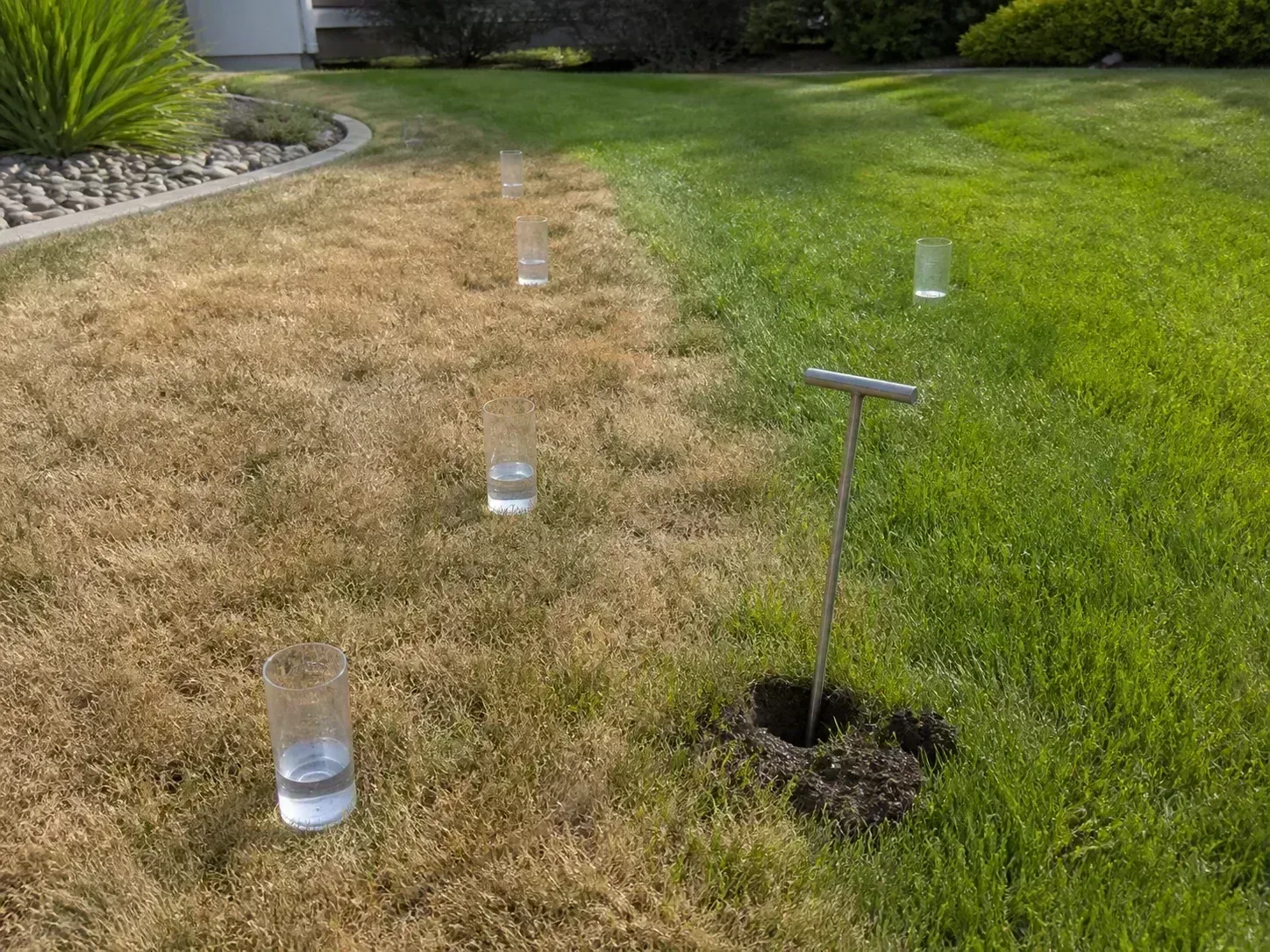
A rain gauge turns “it rained last night” into a useful measurement. Place it in an open area away from trees, buildings, and sprinklers; empty it after each storm and note the total. UF/IFAS explains that gauge placement matters because obstructions and irrigation can distort the reading. A gauge records what fell there, though—not necessarily what entered every root zone. Check under tree canopies, next to walls, beneath eaves, and in containers separately.
If your vegetables or annual bed use a one-inch weekly target as a starting benchmark, subtract measured rain before deciding whether supplemental irrigation is due. One inch over a 100-square-foot area is about 60 gallons, but that calculation only describes the water depth delivered across that area. It does not tell you whether the water infiltrated evenly or reached roots. Fine Gardening recommends using multiple catch cans to measure sprinkler output; do the same with shallow, straight-sided containers spaced across the watered zone.
Run the sprinkler for a known time, measure the average depth in the cans, and check the soil afterward. If one can collects much more than another, adjust head placement or watering in separate zones. If runoff begins before the root zone is wet, split the run into shorter cycles with pauses. Record the runtime that actually moistens the root depth you are targeting, then use that as a starting point—not a permanent guarantee as weather changes.
Apply water slowly enough to reach the roots
Aim water at the soil around the roots, not at foliage or open pavement. A watering can with a gentle rose, a hose on a low-flow setting, a soaker hose, or drip irrigation can put water where plants can use it. A forceful stream can dislodge soil, expose roots, and make water run away before it soaks in. Illinois Extension recommends testing hose duration in the garden: water for a set time, then probe the soil to find out whether moisture went beyond the surface.
For an established bed, water long enough to moisten the active root zone, then let the soil begin to dry before watering again. “Deeply” does not mean creating a puddle or leaving the soil saturated. In compacted clay or on a slope, use a slow application or multiple short cycles so water infiltrates rather than escaping. In very sandy soil, smaller applications at shorter intervals may be more effective because water moves through quickly. Fine Gardening makes the key distinction: generic inch-per-week rules work best under uniform conditions; the practical goal is to wet the roots without keeping them airless.
Early morning is usually the easiest time to water: less is lost to wind and heat, and overhead-watered leaves have time to dry. If a plant is genuinely drought-stressed and morning has passed, water it when you can rather than leaving it dry until the next day. Directing water to the base reduces unnecessary leaf wetting. The Royal Horticultural Society recommends watering early and applying water to the plant base to help limit fungal problems associated with wet foliage. BBC Gardeners’ World Magazine likewise advises watering at the base and using a good soak rather than a daily sprinkle.
Adjust the routine for heat, rain, and the season
Heat, low humidity, and wind can shorten the interval between checks dramatically. During a heat wave, inspect pots daily and probe vegetable beds more often; water only the parts of the garden whose root zones are drying. Do not respond to every forecasted high temperature by automatically doubling the duration. First check whether yesterday’s irrigation remains at root depth. If it does, extra water may simply displace oxygen or run off.
Rainfall is useful only when it reaches the roots. A short shower can wet the leaves and mulch while leaving soil dry underneath. Conversely, a slow soaking rain may cover much of a garden’s weekly need. Check the gauge and the soil, and account for rain shadows. If a storm is forecast and plants are not already stressed, postpone irrigation and reassess afterward. Avoid watering merely to hit a weekly number when the bed is already moist.
Spring and fall usually bring slower growth and lower evaporation than midsummer, so the same bed may need less frequent watering. As annuals and vegetables mature, their demand can change with flowering, fruiting, and harvest; crop-specific guidance helps. In cool climates, dormant roots can still be injured by prolonged dry weather, especially for newly planted trees and shrubs, but do not water frozen soil or already saturated ground. In warm or rainy climates, local rainfall patterns and restrictions may matter more than a temperate-region schedule.
If your irrigation controller runs on fixed days, adjust it when rain, temperature, or seasons change. A rain sensor can stop unnecessary cycles, but it cannot confirm that water reached an individual container under an eave. Keep at least one manual soil check in your routine even with an automated system. A drip system is also not “set and forget”: clogged emitters or a disconnected line can quietly leave part of a bed dry.
Triage wilt: thirsty, waterlogged, or heat-stressed?
Wilt is a clue, not a diagnosis. A plant that droops during the hottest part of the afternoon but recovers by evening or the next morning may be reacting to heat faster than it can replace water. Check its soil before watering. If that root zone is cool and moist, shade exposure, wind, root damage, or another stress may be involved; more water is not automatically the fix. Fine Gardening cautions that midday drooping does not always mean drought.
A plant that is wilted early in the morning, paired with dry soil at root depth, is more likely to need water. Give it a slow, thorough watering and check whether it recovers after the root zone is rehydrated. Do not spray the foliage and assume the roots have been watered. For a newly planted tree, inspect both the root ball and the surrounding soil; a dry root ball can remain a separate pocket even when the bed around it is damp.
Persistently wet soil plus yellowing, weak growth, or drooping points in another direction. Roots need oxygen as well as water, and a plant in saturated soil can wilt because damaged roots cannot take up water normally. Pause irrigation, check drainage and emitter placement, and let the root zone drain. If symptoms continue despite appropriate moisture, inspect for root disease, pests, stem damage, or planting problems rather than increasing the watering schedule. UMass Extension notes that hot-weather wilt can occur despite adequate water and warns that soggy soil can kill plants.
Watering mistakes that waste water or stress plants
Watering by the same schedule all year ignores changes in rainfall, growth, temperature, and daylight. Keep a recurring check on the calendar, but let soil and weather determine whether the hose actually runs. Likewise, a timer that waters every zone for the same duration may give pots, trees, and vegetable beds the wrong amount because each has different soil volume, root depth, and delivery rate.
Giving frequent surface sprinkles to established plants wets only the shallow layer and can encourage roots to stay near the surface. A gentle, deeper application is usually more useful, with exceptions for seed germination and very young seedlings whose roots remain shallow. Watering the entire garden to satisfy one thirsty plant can leave dry-soil herbs or succulents too wet; group plants with similar water needs when practical or use separate irrigation zones.
Treating all wilt as thirst is another common failure. Check for dry soil at root depth before adding water. Assuming rain fell evenly can also leave pots, plants beneath tree canopies, and beds by walls under-watered. And watering too fast on clay or a slope creates runoff instead of root-zone moisture. Slow the flow, split the run, or move the delivery point. A short test with a trowel after watering often catches all three problems before they become a repeated routine.
A low-fuss weekly system that gets more accurate
A reliable routine does not require testing every plant every day. Divide the garden into a few practical groups: exposed containers, vegetable or annual beds, new trees and shrubs, and established landscape plants. Pick one representative plant or location in each group, then check the most vulnerable areas more often: small pots, sunny edges, sandy patches, and recent transplants. If the root zones stay moist between checks, you can gradually check less often.
At the start of the week, empty and read the rain gauge, look at the upcoming forecast, and inspect soil in those representative locations. Water only the zones that have dried to the depth appropriate for their roots. Deliver water slowly at the base. Later that day—or after enough time for infiltration—test one spot with a finger or trowel. If the surface is damp but the root zone is still dry, lengthen or split the next irrigation. If soil remains soggy, shorten the run or increase the interval and investigate drainage.
Keep a simple note for two or three weeks: date, rain, which group was watered, approximate runtime, and what soil felt like afterward. That record will reveal whether your sandy bed dries in two days, whether the raised bed edge needs an extra check, or whether a mature shrub has been receiving water it does not need. Recalibrate after a heat wave, a new planting, mulch, a major pruning, or a change in irrigation equipment. A schedule learned from your own soil is more useful than a generic weekly rule.
Conclusion
Check the soil before deciding how often to water outdoor plants. Vegetable beds and annuals can use about an inch of water weekly as a starting point, while containers often need daily inspection in hot weather, newly planted trees need close monitoring, and established woody plants should be watered when the deeper root zone dries. Rainfall, soil type, exposure, mulch, plant age, and season all shift the interval.
Make each watering count: apply it slowly to the roots, verify the moisture depth, and adjust the next run from what you observe. That approach prevents the two costly errors a calendar cannot catch—watering a still-wet root zone and leaving dry roots without water.



