How to Straighten and Stake a Leaning Tree Step by Step
Learn how to straighten a young leaning tree safely: check its root ball, reset a movable small tree, add flexible support, and know when to call an arborist.
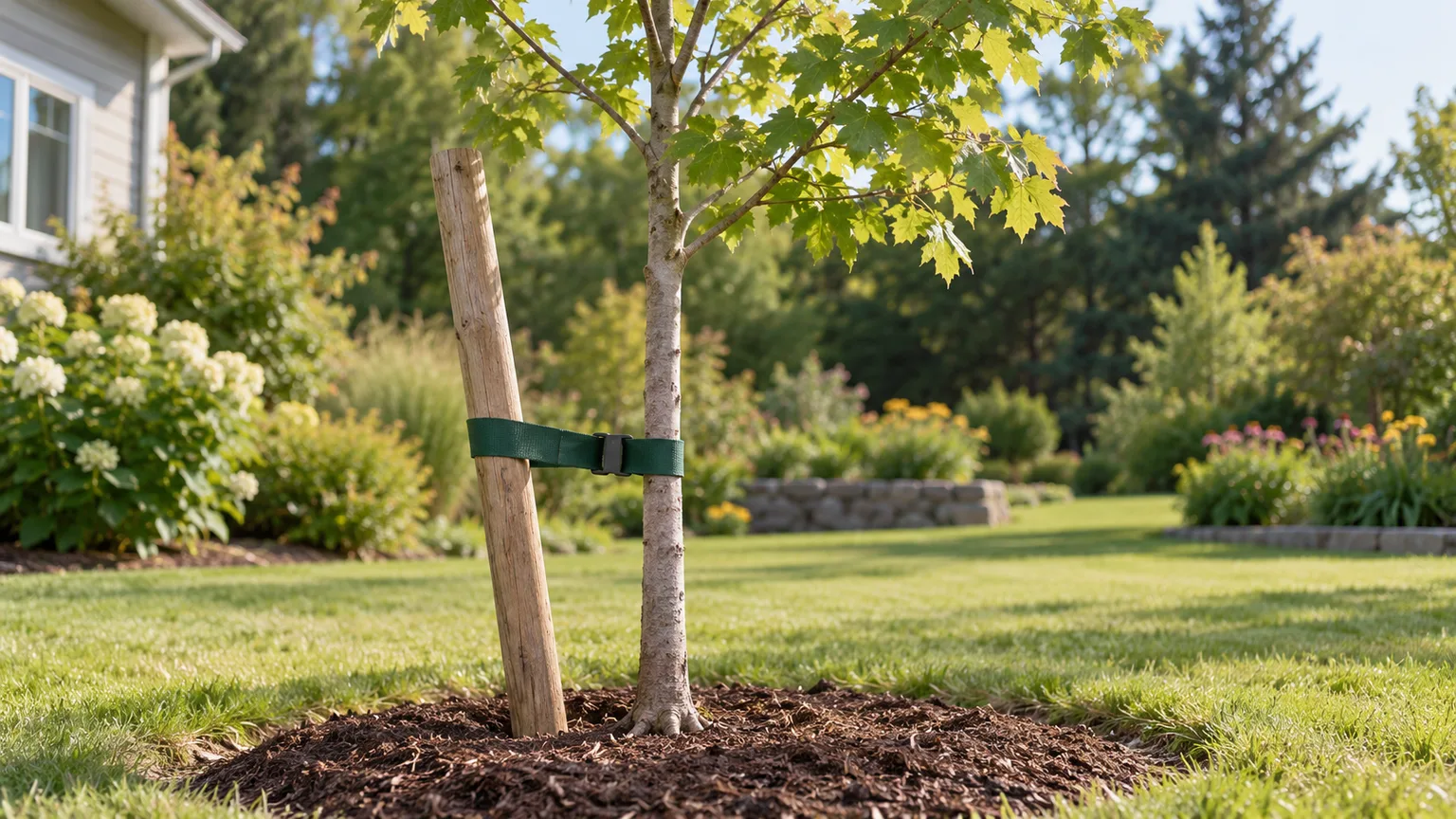
A small tree that was planted recently and now leans may be correctable, especially if its root ball has shifted in loose soil. First check whether the roots and soil move together when you gently move the lower trunk. If they do, resetting the root ball and adding temporary, flexible support may help it establish upright.
A tree that has stood for years at an angle is a different case. Its trunk and roots may have adapted to that position, and pulling it toward vertical can split the trunk or tear roots. After a storm, a raised mound of soil, exposed roots, a crack, or a tree leaning over a house, road, or power line is a reason to keep clear and contact a qualified arborist.
The goal is not to make every trunk perfectly vertical. It is to protect a young tree whose root ball is unstable, then remove support once its roots hold. Over-staking can prevent the trunk from developing the movement and strength it needs.
When a leaning tree can be straightened
The safest candidate is a small, recently planted tree that has not yet established roots beyond its original root ball. It may have tipped in a storm, settled after planting, or been placed in a loose planting hole. If the root ball is still intact and the trunk is not damaged, you can often shift the root mass a little and hold it temporarily while new roots grow into nearby soil.
Check the base before looking at the canopy. With one hand low on the trunk, apply gentle pressure in the direction the tree is already leaning, then toward upright; watch the soil at the trunk. If the whole root ball rocks or a narrow gap opens and closes around it, the base is moving. If the soil stays still while only the trunk bends, the roots may be anchored and the lean may be part of the tree’s structure rather than a loose planting.
That test is a clue, not a reason to push hard. Stop if you hear cracking, see soil heave, or feel the trunk flex sharply. The University of California Agriculture and Natural Resources explains that young-tree root stability, uneven root growth, and trunk movement matter more than the angle alone; for a larger leaning tree, support systems belong with a trained arborist (UC ANR’s guidance on leaning trees).
Check for signs that make this a professional job
A tree can look merely crooked from across the yard while its root plate is shifting below ground. Before you handle stakes or ropes, scan the soil, trunk, canopy, and the area where the tree could fall. If the tree could hit a person, vehicle, building, fence, or power line, do not stand beneath it or try to pull it upright.
Stop if the root plate has lifted or the trunk is damaged
A fresh lean after strong wind or saturated soil, a raised crescent of earth on one side of the trunk, fresh cracks in the ground, exposed large roots, a split stem, or hanging limbs all point beyond routine staking. Do not walk under damaged branches, climb the tree, attach a strap to a vehicle or structure, or use a come-along or winch as a homeowner fix. A failed anchor or torn trunk can release suddenly.
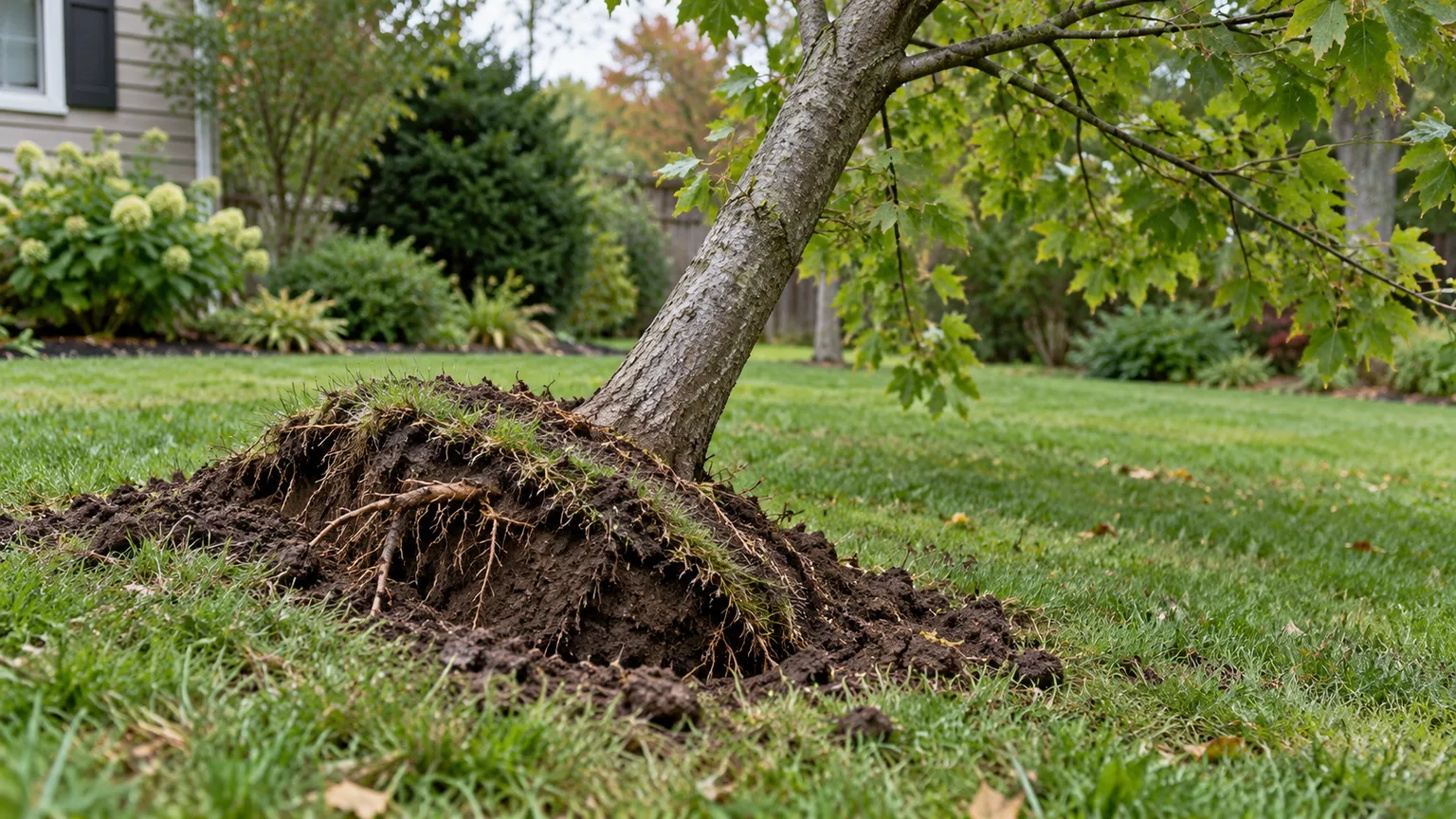
A true wind-thrown tree is not fixed by tightening a rope. The University of Minnesota Extension describes a more involved recovery method that requires room for the lifted root mass to settle back into the ground; it warns that pulling without dealing with the heaved soil can cause further root damage or break the stem. Even when a tree may be recoverable, the size, health, soil, root condition, and equipment needed determine whether the work is appropriate for an arborist rather than a homeowner (University of Minnesota Extension’s staking and guying guide).
Find the cause before choosing a fix
A newly planted tree can lean because its root ball was not firmed in, it was planted at an angle, or the nursery stake stayed attached and held the trunk too rigidly. Wind can rock a small root ball before roots spread into surrounding soil. Wet, loose soil can reduce its grip, while a small root ball beneath a large, leafy crown may simply need temporary stabilization.
An older tree may lean because growth has followed light, prevailing exposure, a slope, or a long-standing imbalance in its canopy. A tree that has grown at an angle for years may have formed supporting roots and wood in response to that position. Pulling the trunk vertical now can cause more harm than leaving a stable, nonhazardous lean.
Look for a pattern rather than guessing from wind direction. Is the root flare buried? Does the ground move when the trunk moves? Is water collecting or standing near the planting area? Does the lean start at the roots, or does the trunk curve above a stable base? The answer tells you whether the problem is a shifted root ball, poor drainage, site exposure, planting depth, a crooked leader, or simply the tree’s natural form.
Will a leaning tree straighten on its own?
A young tree’s new shoot often grows upward even when its lower trunk is angled, so a minor lean can become less noticeable as the canopy develops. That does not mean an established trunk will straighten like a bent pole. The tree may instead form a gentle curve, keep a slanted trunk, or develop uneven growth as it reaches toward light.
If the root ball is stable and the tree is otherwise healthy, watch a slight lean through the next flush of growth before intervening. A tree that leans away from a building or toward a safe open space may not need correction. If a young trunk is bent but its roots are firm, training the central leader is a separate, gradual job; repeated small adjustments are safer than trying to force the whole trunk into a new line at once.
When staking helps—and when it can weaken a tree
Staking is justified when a young tree’s root ball rocks, the tree cannot stay upright after planting, or its crown and root mass are poorly balanced for an exposed site. It can hold the roots steady while new roots form. It is not a way to immobilize the entire trunk, correct every natural lean, or compensate for a bad planting location.
Guidance differs on how often new trees should be staked. The RHS recommends support for many newly planted trees, with a single angled stake suitable for most young specimens; Purdue Extension and Oklahoma State University Extension emphasize that many trees establish better without routine support and that staking is mainly for special cases such as small root balls or exposed sites. The practical rule is to stake only when the root ball needs stabilization, and then preserve some trunk movement (RHS tree-staking guidance; Purdue Extension’s recommendations; Oklahoma State University Extension).
Fine Gardening makes the same distinction between steadying roots and locking the crown: unnecessary or rigid staking can limit trunk taper, rub bark, or girdle the tree. Stake only to the degree needed to stop the root ball from rocking; allow the upper trunk to flex in ordinary wind (Fine Gardening’s explanation of when to stake).
Gather the right stakes, ties, and tools
For one small tree, gather one or two sturdy wood or metal stakes long enough to remain firm once driven into undisturbed soil, a mallet, and a broad, flexible tree tie with a spacer. Use a hand spade to check the root-ball edge and to close small voids after repositioning. A helper makes it easier to watch the trunk and root ball separately as you move the tree.
Avoid thin rope, fishing line, bare wire, zip ties, or a narrow cord wrapped around bark. A short piece of garden hose does not automatically make a wire safe: the tie still needs to move without rubbing or constricting the trunk. Commercial arboricultural straps are convenient because they are wide, adjustable, and designed for temporary support.
Before driving a stake, identify the root-ball boundary and check for buried utility lines. Place stakes beyond the root ball rather than punching through it or driving them beside the trunk where large roots are likely to run. In the United States, contact 811 before digging; elsewhere, use the local utility-marking service. If you cannot safely place a stake without risking roots or services, change the support plan or ask an arborist.
Choose the right moment and prepare the root zone
Work when the soil is moist enough to move without crumbling into dust, but not saturated or slick. If the site is dry, water the root zone gradually and let it drain before you try to reposition the tree. Do not add more water to a boggy site; extra water will make footing and anchoring worse and may be the underlying reason the tree is unstable.
Remove mulch from the trunk so you can see the root flare and soil line. Keep the flare at grade when you reset the tree; do not bury the trunk to make it look upright. If you find the tree was planted too deeply, the planting depth itself needs correcting rather than hiding under extra soil. Fine Gardening’s tree-planting guidance also stresses exposing the root collar and treating staking as optional when the root ball is stable.
How to straighten a recently planted small tree
Use this sequence only if the tree is small enough for you and a helper to control by hand, the base is not cracked or heaved, and the root ball moves slightly without tearing sounds. Make small changes rather than aiming for a perfect vertical line in one pull.
- Expose and inspect the base. Pull mulch back, find the root flare, and identify which way the root ball needs to move. Remove any loose nursery tie that is pinching the trunk, but do not strip bark or dig through major roots.
- Place the stake or stakes first. Set them outside the root ball on the side or sides that will resist the tree’s movement. Drive each into firm soil. The RHS recommends burying a stake at least 40 centimeters (about 16 inches), but ground conditions and stake length matter; the stake must hold without damaging roots or services.
- Move the root ball, not just the upper trunk. With a helper watching the base, use slow, steady hand pressure low on the trunk to guide the root mass back toward upright. If the tree was planted very recently and the root ball is bound by compacted soil, a small amount of soil may need loosening on the side it must move into; stay outside the root mass and avoid severing large roots.
- Set the tree close to upright and refill. Once the root ball has settled into the new position, backfill any open space with the original soil. Keep the root flare visible at the surrounding soil level and gently firm the soil by hand so large air gaps close without crushing it.
- Attach temporary support and recheck. Tie the trunk to the stake or stakes, then ease off your hand pressure. The root ball should remain steady while the top of the tree can move a little. If the tree immediately tips back, do not keep tightening until the trunk bows; stop and reassess the planting hole or call a professional.
Stop at resistance; do not bend the trunk like a lever
A little resistance is normal, but sudden resistance is a limit, not a challenge. If the tree does not shift with gentle pressure, if the trunk flexes but the root ball stays put, or if you hear a crack, see a new soil split, or feel roots tearing, release the pressure and stop. A stake can steady an unstable root ball; it cannot safely force a mature root system or stiff trunk into a new position. The practical guidance from Horticulture.co.uk likewise stresses gradual pressure on a small tree and treating cracking or tearing as a stop signal.
Do not pull high on the trunk, jerk the tree, wrap a rope directly around bark, or use a vehicle or powered winch. Pulling higher increases leverage and can bend or snap the stem before the roots move. If hand pressure is not enough for a recently planted sapling, the job is no longer a simple staking repair.
Choose a support layout for the tree’s size and exposure
A single angled stake is often enough for a small, light tree. A pair of stakes on opposite sides can control movement in more than one direction, while additional guying may be appropriate for larger transplants or very exposed sites. Once a tree is too heavy to hold safely by hand, do not scale up the number of stakes and force; have an arborist size the anchors and support system.
The stake’s job is to keep the root ball from rocking, not to brace the crown rigidly. Place it outside the root ball and angle it toward the tree only if that configuration lets you tie the trunk without the stake touching it. The exact side depends on which way the base moves and how wind reaches the site; a tree’s lean alone does not reliably tell you the prevailing wind direction.
For a larger tree, guy wires and anchors need correct placement, protected contact points, and an inspection plan. Purdue Extension notes that larger transplanted trees may use three guying points, but also warns that ties should be below two-thirds of the tree height and allow movement. Treat that as a professional support design, not an invitation to pull a heavy tree upright with improvised equipment.
Attach a flexible tie without rubbing bark
Use a broad, smooth, flexible tree tie. A figure-eight connection separates the trunk from the stake: one loop goes around the stake, the strap crosses between the two, and the other loop circles the trunk. A built-in spacer or the crossover keeps the trunk from rubbing directly against wood as it moves.
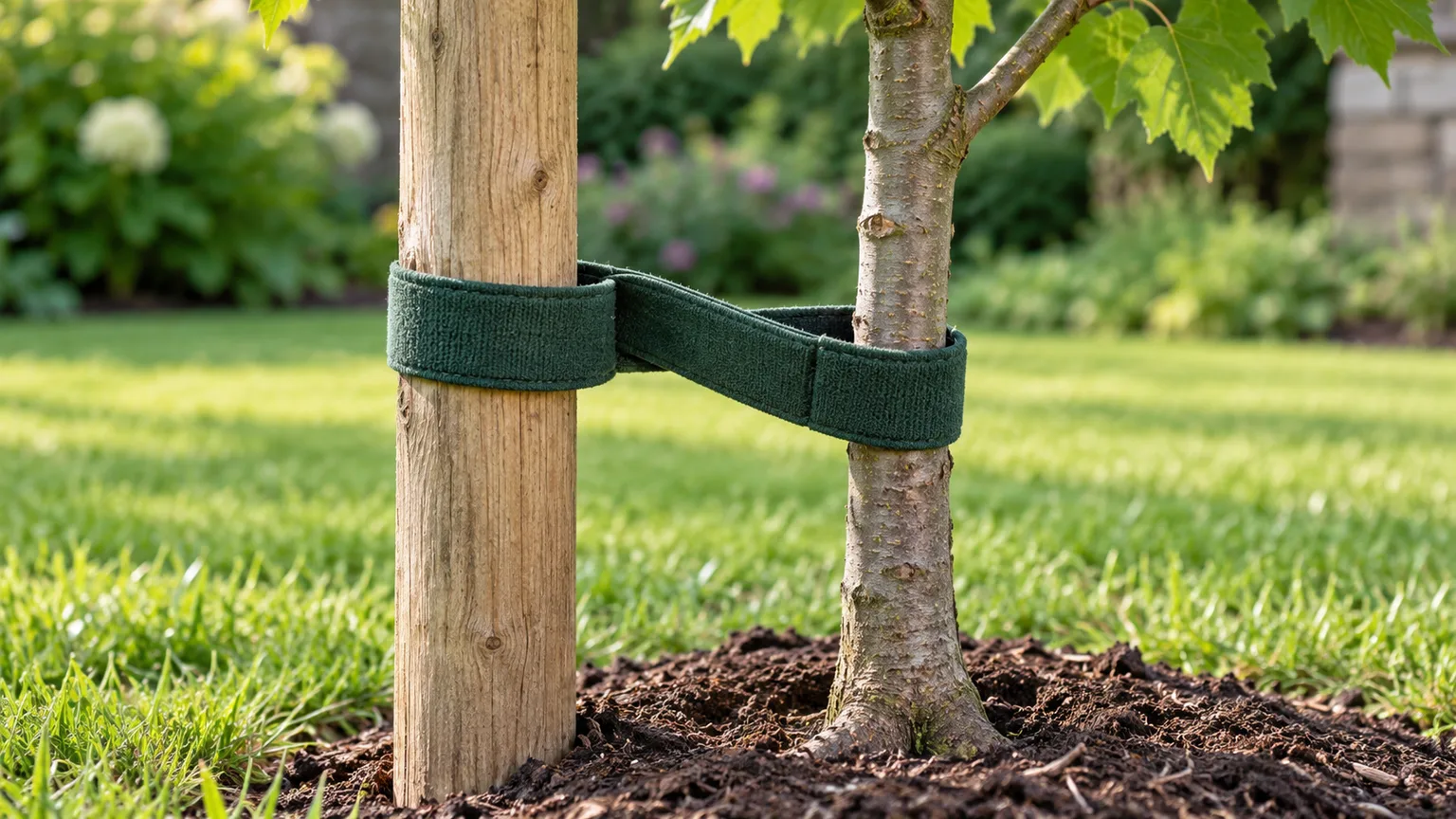
The RHS uses a spacer to protect the trunk and places a single-stake tie roughly 40 to 50 centimeters (16 to 20 inches) above the ground for a small tree. For taller saplings, follow the tree-tie maker’s instructions and keep the tie low enough that the upper trunk remains free to flex. Do not add several high ties simply to make a tree look perfectly straight.
Check the tree’s bark before you finish. The strap should lie flat, not twist into a narrow cutting edge, and should not pinch the trunk when it sways. Purdue Extension and Fine Gardening both identify abrasion and girdling as common outcomes of ties that are too tight, too high, or left on too long (Purdue Extension; Fine Gardening).
Set tension so the roots stay still but the trunk can move
There are two different movements to judge. At the base, the root ball should not rock in its planting hole. Above the tie, the trunk should have a small amount of natural sway; this movement encourages the trunk to develop taper and helps the tree adapt to wind.
After tying, gently move the trunk a few inches in each direction. If the base shifts, adjust the anchor or add a properly positioned support. If the trunk is locked upright with no flex, loosen the tie. If it swings far enough to rub the stake, use a spacer, change the tie position, or correct the anchor rather than cinching the strap against the bark.
A good tie is snug, not tight. You should be able to inspect the bark where the strap contacts it, and the tie should not leave a groove, mark, or abrasion after movement. Check it again after the first windy day and as the trunk grows; a tie that fit in spring can become restrictive later in the season.
Backfill, water, and mulch after resetting the root ball
Water slowly around the root ball after repositioning so the soil settles around the roots. If the tree was just planted, follow normal establishment watering for its species, soil, and weather rather than keeping the ground constantly wet. Standing water or repeated saturation is a drainage problem to solve, not a signal to add more stakes.
Spread a shallow ring of mulch over the root zone to moderate soil moisture and temperature, but keep it several inches away from the trunk and do not cover the root flare. A mulch mound pressed against the bark hides the soil line, traps moisture against the trunk, and makes it harder to spot a new lean or tie abrasion. Recheck the tree’s vertical position after the water drains and the soil has settled.
Check the system and remove it when roots hold
Inspect the tree weekly at first, then every few weeks through the growing season and after strong wind or heavy rain. Check whether the root ball has shifted, the stakes remain firm, the tie is still broad and padded, and the trunk has no rubbed or compressed area. Adjust a slipping tie promptly; remove it if it is damaging bark or if support is no longer needed.
There is no single date that suits every tree, but support is temporary. Purdue Extension recommends removing ties as soon as feasible, usually by the end of one growing season or one year; Oklahoma State Extension allows one to two growing seasons when the tree still needs support. These ranges are not a reason to leave a strap in place without checking it. At the end of the first growing season, loosen or remove one tie and gently move the trunk while watching the soil. If the root ball stays firm, remove the remaining support. If it still rocks, find out why before extending support.
A perpetually windy site, a tree with a very small root ball, or a species that needs ongoing structural support may be an exception. In that case, ask a local extension service or arborist for a plan specific to the tree rather than leaving ordinary staking hardware attached indefinitely.
What to do when a tree is partly uprooted
A lifted root plate is not the same as a sapling that has settled crooked in its hole. The exposed roots may be torn, dried, or still attached to a large mass of compacted soil. Pulling the trunk back without allowing the root plate to settle can break more roots, damage the stem, or leave the tree unstable even if it looks vertical afterward.
Keep people away from the fall zone and contact an arborist, especially if the tree is large or there is property nearby. Do not guess whether a certain fraction of the roots remains intact; important roots can be damaged below the surface, and a tree that stands today may still fail in another storm. A professional can assess whether recovery is realistic, whether the tree needs specialized guying, or whether removal is safer.
For a very small tree that was planted recently and has only shifted within its original planting hole, use the earlier root-ball procedure if the trunk, roots, and surrounding soil are intact. Once roots are exposed, soil is heaved, or the tree has been pulled substantially out of the ground, get an on-site assessment before attempting to reset it.
Fix site conditions that will cause the lean to return
A stake can hold a tree upright while it establishes, but it cannot correct a persistently unsuitable site. If runoff collects around the planting hole, improve drainage or move the tree while it is still small enough to transplant safely. If the site is exposed to a wind tunnel between buildings or on an open slope, consider whether the species, support system, or planting location should change.
For a recently planted tree, check that the root ball is planted at the right depth and that the root flare remains at grade. Trees planted too deeply can settle or develop root problems; trees planted too shallowly may not anchor well. The RHS and university sources emphasize that anchorage develops over time, and support does not replace correct planting or healthy roots.
Do not prune off large healthy branches just to counterbalance a lean. Removing too much canopy can stress a tree and does not repair a loose root system. If the crown is damaged, heavily one-sided, or needs structural pruning, ask a certified arborist to decide what to remove and when. Then remove the temporary support when the roots can hold the tree on their own.
Conclusion
Start with the base: if a small, recently planted tree’s root ball has shifted but its roots and trunk are intact, guide the root mass back gently, firm the soil, and use a temporary flexible tie that keeps the base steady while allowing the trunk to sway. Inspect the tie and soil regularly, then remove the stakes once the root ball holds without them.
If the tree is established, suddenly leaning after a storm, cracked, heaved, or large enough to threaten people or property, do not try to winch it upright. Keep clear and have an arborist assess the tree. A modest lean is often less harmful than an aggressive correction that tears roots or splits the trunk.



