How to Get Rid of Ghost Ants: A Safe, Step-by-Step Plan
Learn how to identify ghost ants, trace their trail, remove food and moisture, seal entry points, and use bait safely when sanitation is not enough.
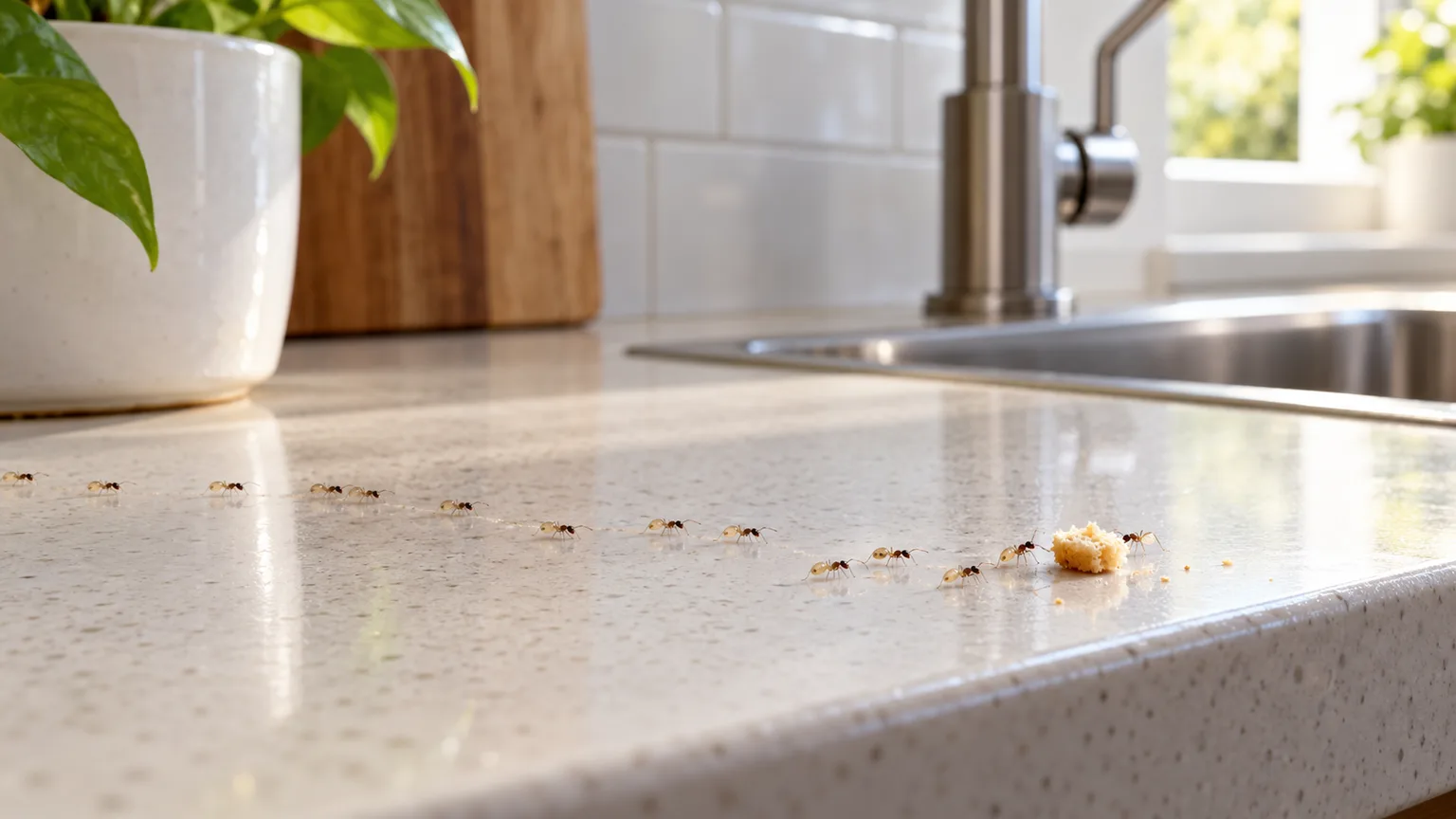
Ghost ants are so small and pale that a line of them can look like crumbs moving across a counter. If you suspect them in a kitchen, bathroom, or sunroom, start by confirming what you are seeing and following the trail. Wiping up the visible workers or spraying the first ant you spot rarely answers the important questions: where are they entering, what are they feeding on, and is there a nest nearby?
A reliable plan is to identify, observe, clean, exclude, and then decide whether bait or professional help is warranted. Ghost ants can nest in several protected places and forage between them, so a quiet day after one quick fix does not prove the source is gone. The steps below focus first on changes that improve a home whether or not the ants turn out to be ghost ants.
The quickest safe plan for ghost ants
Use this sequence when you see a trail:
- Take a clear photo or collect a few workers in a sealed container for identification. Do not handle insects with bare fingers.
- Watch the trail for several minutes. Note where it begins and ends, but do not disturb it with spray or cleaner yet.
- Remove accessible food and water near the route, then wipe the trail with soapy water after you have mapped it.
- Check the likely entry and nesting areas—pipe gaps, windows, baseboards, plant pots, and vegetation touching the home.
- Close confirmed openings and correct leaks when you can do so without sealing ants inside a wall cavity or damaging a surface.
- If activity continues, consider only a properly labeled ant bait in a location ants already use and people and pets cannot reach. Follow its label exactly.
- Recheck the route and call a pest professional if ants persist, appear in several rooms, or the source is inaccessible or uncertain.
This order is useful because a chemical treatment is not a substitute for identifying the pest, removing what draws it in, or finding the route. It also avoids putting bait or pesticide in a random place where ants may never encounter it. For most households, careful observation and cleaning are safe first steps; bait is optional and requires extra care.
Confirm the ant before choosing control
A ghost ant, Tapinoma melanocephalum, is exceptionally small—about 1.3 to 1.5 millimeters long. Its head and middle body are dark brown, while its legs and rear abdomen are pale or translucent. That two-tone pattern can be striking in a close photograph, but the pale parts disappear against a light counter, and the ant is so small that a casual glance is not a reliable identification.
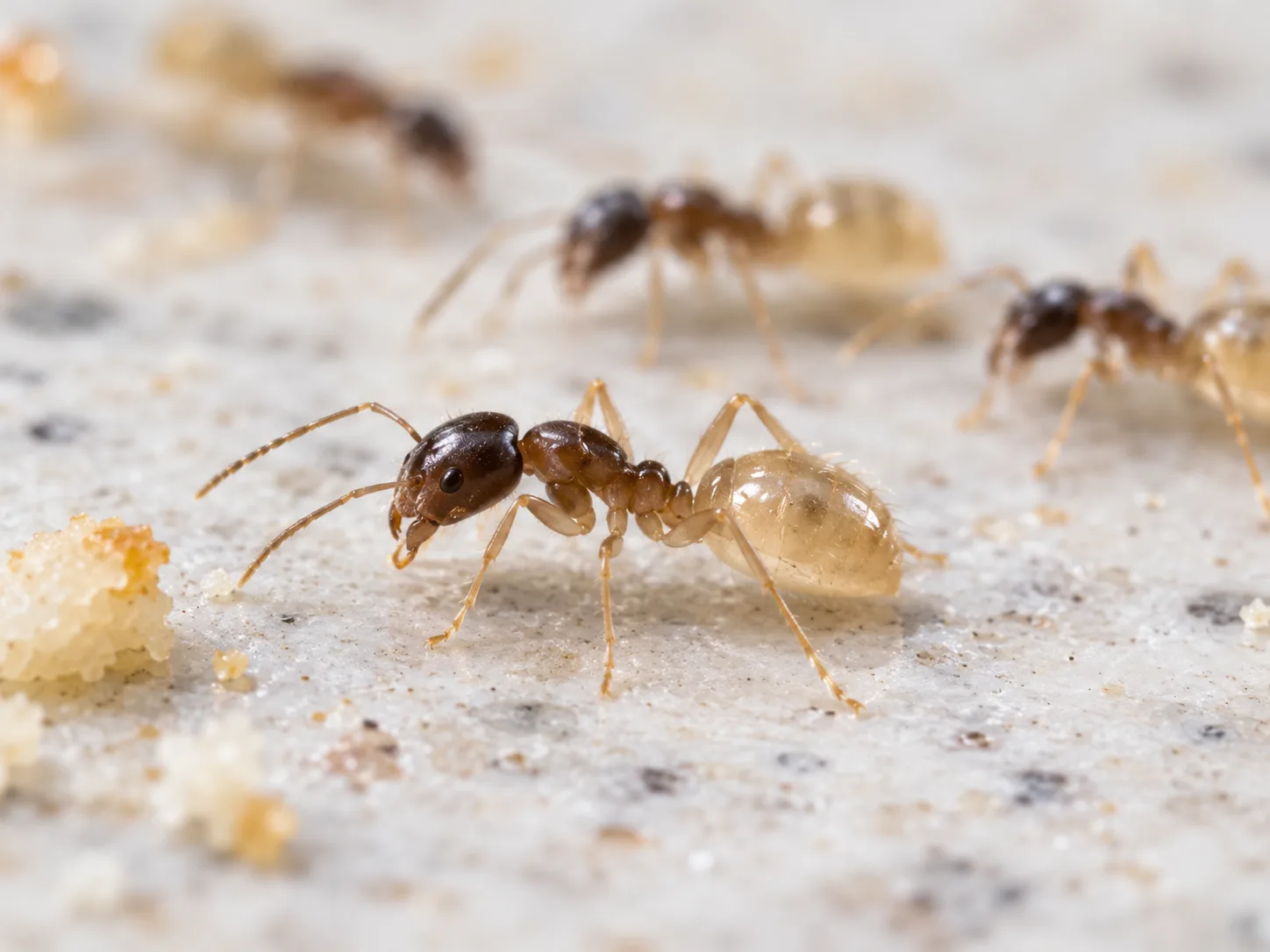
The University of Florida Institute of Food and Agricultural Sciences (UF/IFAS) describes ghost ants as tropical or subtropical ants that are most established in warm regions, including Florida and Hawaii. In cooler climates, sightings are more likely in protected heated buildings or greenhouses. If the climate and setting do not fit, or the ants look uniformly dark, do not assume ghost ants from size alone. A county extension office or pest professional can help confirm the species from a sharp image or specimen.
Ghost ants are generally a nuisance pest rather than a structural pest. Their presence is a reason to investigate food, water, and entry routes—not proof that a home is damaged or dangerously infested. Finding a few workers in a bathroom also does not tell you whether the nest is in the room, outside the foundation, or somewhere else in the building.
Ghost ants vs. common lookalikes
Ghost ants are often confused with other tiny household ants. A close-up view of the body can help, but features such as the small waist nodes may require magnification and a trained eye. UF/IFAS notes that ghost ants have one waist node, while Pharaoh ants have two. Because those nodes can be difficult to see on a moving ant, do not rely on that single feature if you are not used to identifying insects.
Some ants called “sugar ants” are also mistaken for ghost ants, but that common name is used inconsistently for different species. Uniformly dark coloring or a noticeably different size can rule out a ghost ant, yet color changes with lighting and background. Photograph several workers beside a ruler or coin for scale, include a clear side view if possible, and ask an extension office or licensed professional to confirm the identification before choosing a species-specific treatment.
If you cannot tell which ant it is, pause before using pesticide. Different ant species can forage for different foods and respond to different control methods. Correct identification makes the next steps more efficient and reduces unnecessary chemical use.
Trace the route to find the real source
Ghost ants use trails to move between food, water, and protected nest sites. Rather than immediately wiping away every worker, spend a short period watching where the line travels. Look for movement along counter edges, sink plumbing, cabinet seams, baseboards, window frames, and the outside foundation. A flashlight held at a low angle can make tiny pale bodies easier to see.
Mark the route on a simple sketch or take photos at the places where it disappears. Note the time and whether activity is concentrated near food, water, a plant, or an exterior wall. Ant traffic can change through the day, so one observation is only a snapshot. Avoid following workers by moving appliances or opening walls; those actions can create safety problems and will not necessarily reveal the nest.
One trail does not necessarily lead to one central nest. UF/IFAS reports that ghost-ant colonies can have multiple reproductive females and subcolonies that exchange workers, and that new colonies may form by budding. This flexible arrangement helps explain why activity can shift or return after a single trail is cleaned. It does not mean every treatment causes ants to split; it means you should inspect more than the first visible line and avoid treating a visible worker as the whole problem.
Where to inspect indoors and outside
Indoors, start at the trail’s endpoints and the places where moisture or food collect. Check beneath sinks, around pipe openings, behind splash guards, along window and door frames, and at gaps around baseboards. Look for a line entering a cabinet, a wall gap, a utility penetration, or a plant pot. Do not pull apart built-in cabinets or cut into drywall to look for a nest.
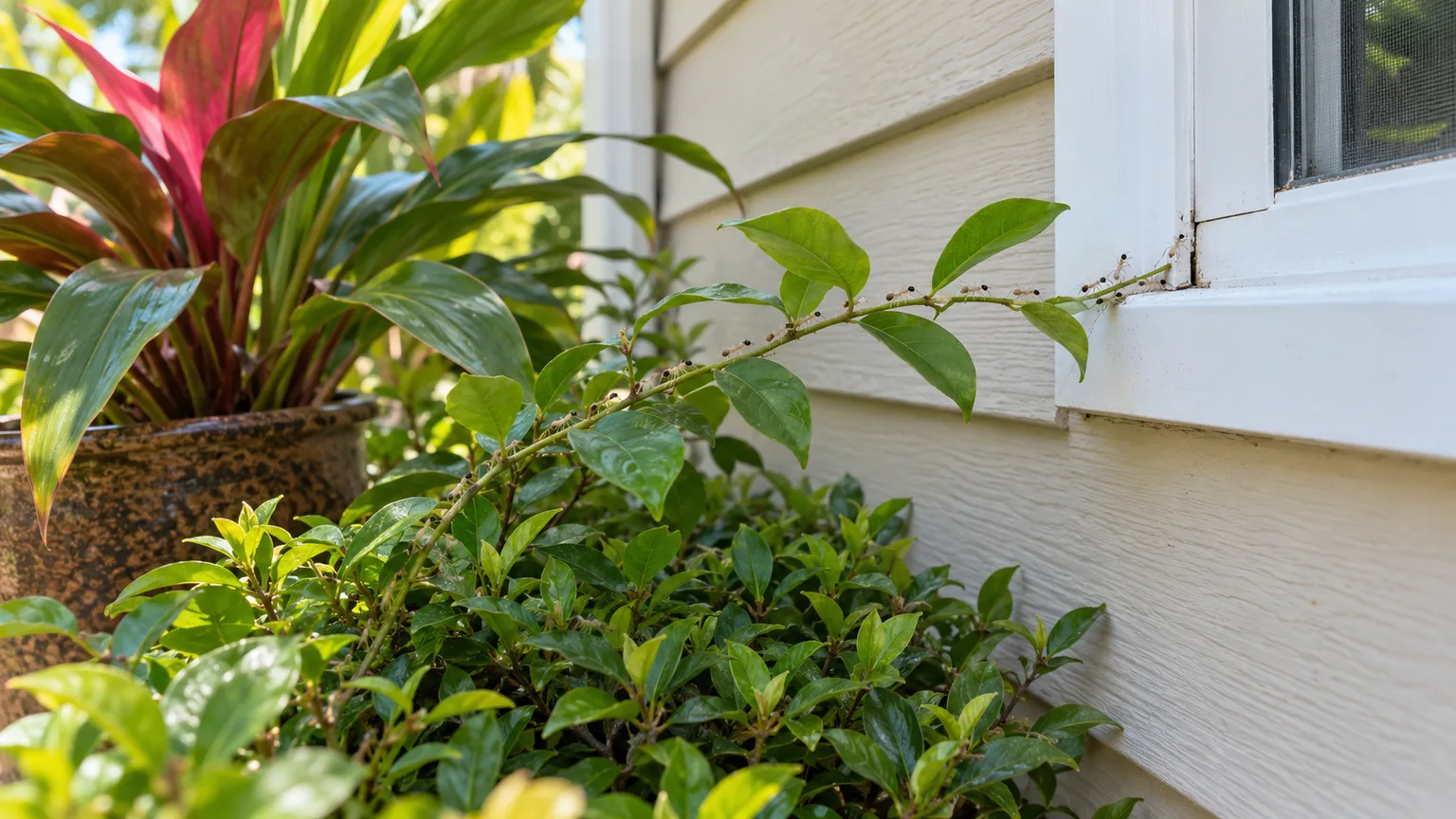
Outside, inspect the foundation, window trim, door thresholds, gutters, and vegetation that touches siding or roof edges. Ghost ants may nest outdoors in protected sites and can also use indoor voids, including spaces around cabinets and baseboards. A trail on a shrub may be visiting honeydew produced by aphids or other sap-feeding insects rather than traveling directly from a nest into the house. Check the plant for those insects before deciding that the ants themselves are the only issue.
Keep inspection low-impact: use a flashlight, take a picture, and note the gap or plant where activity disappears. If the trail vanishes into an inaccessible wall or ceiling space, that is useful information for a professional. Do not seal the opening blindly if doing so could trap ants inside a cavity or redirect them to a new route.
Remove food and water that keep ants coming back
Sanitation will not instantly eliminate a hidden colony, but it removes the reward that keeps workers returning. Wipe sticky spills promptly, especially juice, soda, syrup, fruit residue, and pet-food drips. Clean the underside of counters and appliances, empty crumb trays, and vacuum crumbs from couch cushions and under furniture where snacks may have been eaten.
Store pantry foods in closed containers and rinse recyclable drink cans or jars before placing them in a bin. Empty indoor garbage and recycling regularly, wipe sticky residue from the bin, and keep pet food bowls clean between meals. These are ordinary housekeeping steps, not a signal that the home is dirty: a few drops of sweet liquid can be enough to attract foragers.
Water matters as much as food. Repair dripping faucets and plumbing leaks, dry sink rims and shower corners, and reduce persistent condensation around pipes or windows. Check the underside of sinks and the area around appliance hoses for moisture. The National Pesticide Information Center’s ant guidance recommends removing food and water sources as part of ant management; UC IPM also recommends fixing leaks and managing conditions that support foraging.
If ants are active around a houseplant, inspect both the pot and the foliage. Look for aphids, scale insects, or mealybugs that can produce honeydew, and check whether the pot’s saucer holds standing water. Avoid bringing a heavily active pot from outdoors into a room. If you move it outside for inspection, choose a safe place away from doors and windows, and avoid spreading soil or insects through the house.
After tracing the trail, wash the route with soapy water and dry it. This removes visible ants and food residue and helps remove the trail cue. Do not use a scented cleaner as a supposed repellent or assume that fragrance will solve the source; the point is to clean the surface, remove attractants, and then monitor whether a route reappears.
Block entry points after you map the trail
Once you know where workers cross into the home, close practical gaps around that route. Use an appropriate caulk for small cracks at window frames, pipe penetrations, and trim, following the product directions and surface requirements. Repair torn screens, adjust door sweeps, and close gaps at thresholds. For larger openings, damaged materials, or gaps near wiring and plumbing, use a qualified repair professional rather than filling the cavity with an unsuitable product.
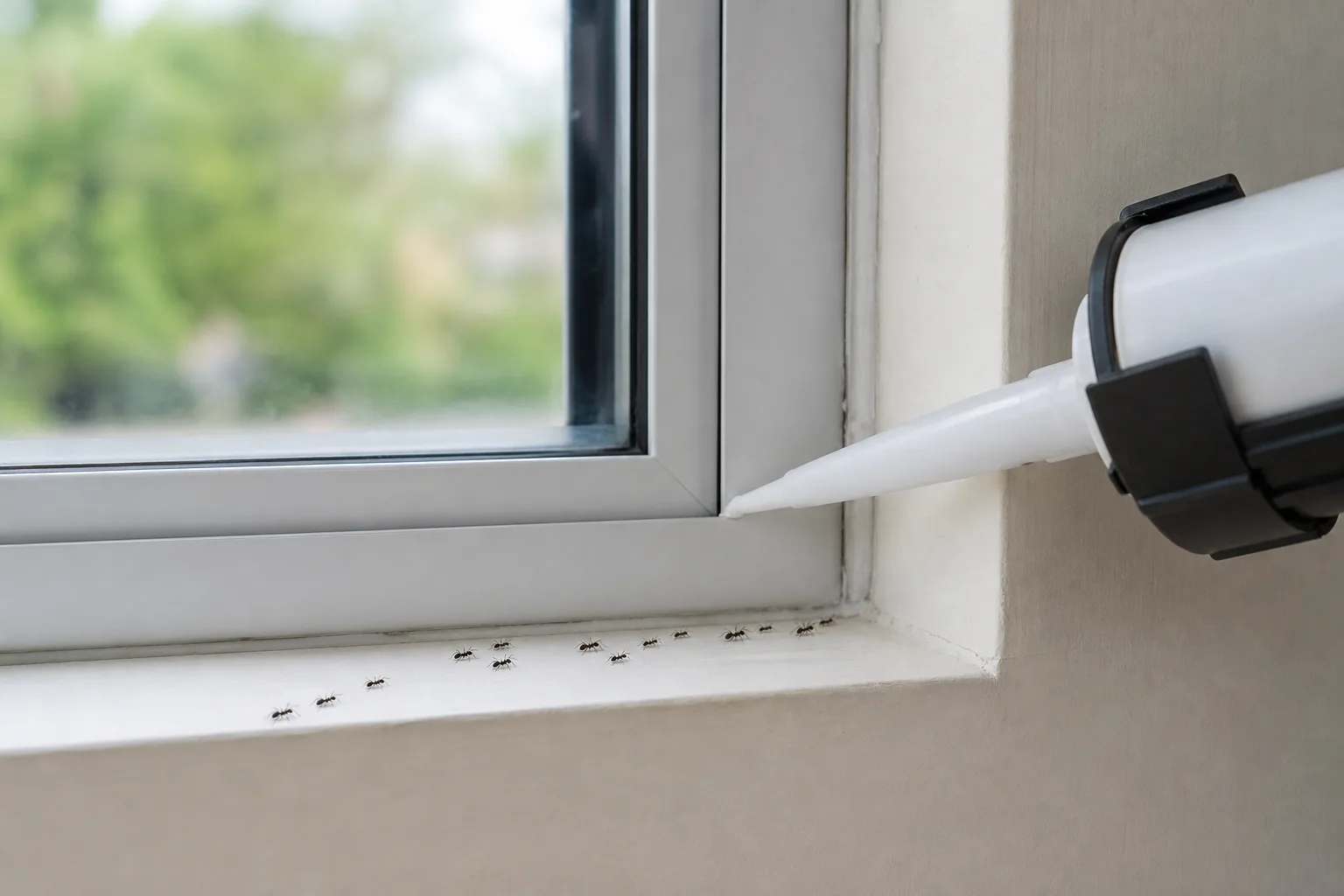
The National Pesticide Information Center (NPIC) includes sealing cracks and gaps among nonchemical ant-control steps. UC IPM’s general ant management guidance similarly recommends sealing likely entry points and trimming vegetation away from buildings. These measures can reduce access even if an outdoor colony remains in the yard.
Do not seal a gap until you understand whether it is an entry route or a ventilation or drainage opening that must remain functional. If workers repeatedly emerge from inside a wall, blocking the surface may divert them elsewhere without addressing a nest. Note the location, reduce food and moisture nearby, and ask a pest professional to inspect if the route continues.
Check potted plants and outdoor bridges
Ghost ants can use potted plants as protected nesting sites, and plants that touch the house can form a route to a window or roof edge. Inspect pots before bringing them indoors, including beneath the rim, around the drainage holes, and under the saucer. If you see a steady trail, keep the plant separate from indoor food and other houseplants while you identify the activity.
Outside, prune branches and vines so they do not rest against siding, windows, or rooflines. Move stored lumber, leaf piles, and other debris away from the foundation when practical, and avoid creating a new bridge with hoses, trellises, or stacked planters. You do not need to clear every ant nest from a garden: ants also forage outdoors and are part of the food web. Focus on the specific route into the living space and on plants with honeydew-producing pests.
If a potted plant is the likely source, do not automatically drench the soil or apply a pesticide not labeled for that use. Ask a local extension service or nursery about safe plant-specific options, particularly for edible plants or a valuable container plant. Quarantine and observation are often more informative than moving the pot from one indoor room to another.
Use bait strategically and safely
If cleaning, moisture correction, and practical exclusion do not stop regular indoor activity, a ready-to-use ant bait may be an option. Baits are designed for foraging workers to find and carry back toward nestmates. Their performance depends on ants accepting the bait, and no one food type is guaranteed to attract every colony at every time. The UF/IFAS ghost-ant profile recommends monitoring whether ants feed and relocating bait if there is no uptake after a day or two.
Treat bait as a pesticide, even when it comes in a small station or looks like food. Choose only a product whose label permits the ant use and the indoor location you intend to treat. Read all directions, restrictions, and safety language first. Product formulations and legal uses differ; do not copy a recipe from a forum or use a product outdoors when its label allows only indoor placement.
Place bait where workers are already foraging
Set a bait station beside an active route where workers can reach it, but not on a food-preparation surface, inside a sink, on a hot appliance, or where it will be washed or disturbed. A nearby hidden location is not automatically better if ants never travel there. Follow the label’s placement instructions and do not put out extra product in an attempt to speed results.
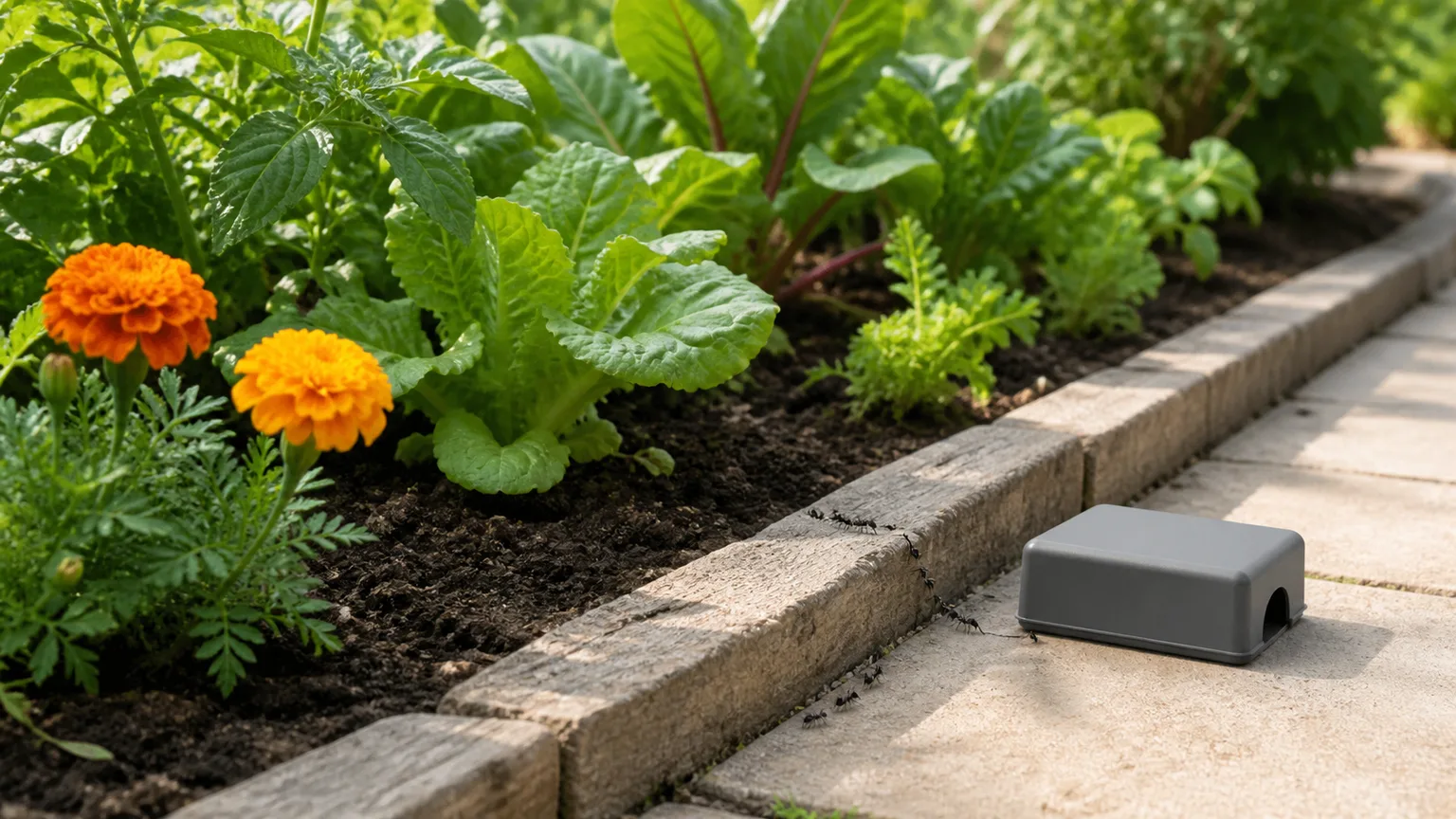
Watch from a distance to see whether workers visit. If no ants feed within the period described in the label—or within a day or two as a practical observation window—remove or relocate the bait only as directed and choose a spot on a confirmed route. Do not spray or wipe across the bait trail while you are trying to learn whether ants accept it. If workers are feeding, give the labeled product time to work and replenish or replace it only as directed.
A bait station can reduce exposure compared with an exposed drop, but it is not automatically childproof or pet-proof. Keep a note of where each station is placed and check it on the schedule stated by its label. If ants ignore it, the route changes, or activity spreads to other rooms, reassess identification and access rather than adding multiple unapproved products.
Protect children, pets, food, and non-target insects
Place bait only where children and animals cannot reach, open, tip, lick, or carry it. Keep it away from food, dishes, pet bowls, toys, and surfaces used to prepare meals. If you cannot create a truly inaccessible placement, do not set bait out; use sanitation and exclusion while asking a pest professional about safer options for your household.
The NPIC guidance on pesticides and pets warns that food-formulated baits can attract pets and advises following product directions and keeping products inaccessible. The NPIC label-reading guide explains that labels provide approved uses, precautions, first aid, storage, and disposal directions. Follow the exact label for the product in hand, including what to do if a person or animal contacts or ingests it. For an exposure, use the label’s emergency instructions and contact the appropriate poison-control or veterinary resource promptly.
Do not place bait outdoors where children, pets, birds, or beneficial insects could encounter it unless the label specifically allows the site and you can protect non-target organisms as directed. Never transfer bait into a food container, remove it from its station, or put it next to edible foods. Store remaining pesticide in its original package, locked away from children and pets, and dispose of it according to the label and local requirements.
Why sprays and home remedies often fail
A contact spray can kill ants it directly reaches, but visible workers are only a small part of a colony. If the nest is in a wall void, outdoor soil, plant pot, or another protected place, spraying a trail may leave the source untouched. Residues can also interfere with ants reaching bait, and a repellent product may cause foragers to avoid the treated route. That is why a broad spray is not the best first move when the goal is to learn where the trail goes and whether bait is accepted.
It is too broad to say that every spray will make ghost ants multiply or that every bait will solve them. Colony response depends on species, product, placement, and circumstances. Ghost-ant colonies can occupy several sites, so a treatment aimed at one visible line may fail even without any “splitting” effect. Stick to integrated pest management: identify the ant, change the conditions attracting it, close access, monitor, and use a labeled pesticide only when needed.
Skip homemade borax or sugar mixtures, essential-oil sprays, and powders scattered along counters. Improvised mixtures have unpredictable strength and exposure, may contaminate surfaces, and can harm a child or pet that mistakes them for food. “Natural” does not mean safe, and a household recipe is not equivalent to a product label. Soap and water are useful for cleaning a trail; they should not be presented as a colony treatment.
Track progress and troubleshoot a returning trail
Keep a brief log with the date, room, route, approximate number of ants, nearby food or water, and any change you made. Recheck the same locations daily for the first several days, then less often if activity declines. Compare the trail’s position and density rather than relying on a single ant sighting. A few stragglers after cleaning may come from an outdoor route; a steady line from the same gap suggests that access or nesting conditions remain.
If the trail returns, use this checklist:
- Same route, food or water nearby: clean the overlooked spill, pet-food area, recycling bin, leak, or condensation source.
- Same gap after sealing: confirm the seal is intact and whether ants are emerging from within the structure; do not keep caulking blindly.
- New route after cleaning: follow it to a new endpoint and inspect another window, pipe opening, pot, or exterior bridge.
- Bait is untouched: verify the ant identification and location, and use only the product’s label directions; workers may not be feeding on that formulation.
- Bait is visited but activity continues: allow the time stated on the label, monitor other trails, and avoid adding sprays or unapproved products that disrupt the plan.
- Ants spread across rooms or floors: stop treating each sighting separately and get a professional inspection for hidden access and nest sites.
Look for a downward trend over several observations, not a dramatic overnight disappearance. Ghost-ant activity may vary as workers switch routes or food sources. If the same level of activity persists after a week of careful sanitation and route management, or if it grows despite following a bait label, request help identifying the source.
When to call a pest professional
Call a licensed pest-management professional when you cannot confidently identify the ant, trails persist after practical food, moisture, and entry fixes, or activity appears in multiple rooms. Professional help is also sensible when the route leads into an inaccessible wall or ceiling, a large group of potted plants is involved, or you cannot place any bait safely because of children, pets, or household circumstances.
Ask the company to explain how it will confirm the species, inspect for entry routes and nesting sites, and reduce the conditions that support ants. An integrated pest management approach should begin with inspection and prevention, then choose a targeted control only if appropriate. Ask which products would be used, where they would be placed, what precautions apply, and what follow-up is included. A reputable provider should be willing to explain those choices in plain language and follow all product labels and local licensing rules.
If ants are concentrated near a leak, damaged trim, or a wall opening, address that building issue too. Pest treatment cannot repair water damage or close a construction gap. Avoid companies that promise instant, permanent elimination without asking where you see ants or what is attracting them; ghost-ant control is more reliable when the plan is based on observed routes and confirmed identification.
Prevent ghost ants from returning
Keep a small prevention routine rather than waiting for another trail. Wipe counters after sticky foods and drinks, rinse recyclables, store sweets and pet food in closed containers, and empty bins before residue builds up. Fix drips, dry persistent condensation, and check under sinks and around appliance hoses a few times a year. After watering houseplants, empty standing water from saucers and watch for ant traffic around pots.
Maintain a gap between shrubs, vines, tree limbs, and the house where feasible. Keep screens and door sweeps intact, and seal small openings that you have confirmed are entry routes. When you bring a container plant inside, inspect its pot and foliage first. If ants appear, record the route and move the plant only if you can do so without carrying an active trail into another room.
For outdoor activity, focus on keeping ants from crossing into living areas rather than eliminating every colony from the yard. Check plants for honeydew-producing pests if ants repeatedly visit leaves or stems. Manage those plant pests with advice appropriate to the plant, and avoid putting broad-spectrum insecticide on flowers or foliage simply because ants are present.
The key preventive habit is noticing the first trail and checking its route. Ghost ants are tiny and easy to overlook, but a quick photo, a dry and clean counter, a repaired leak, and a sealed confirmed gap can keep a minor nuisance from becoming a recurring indoor pattern.
Conclusion
Getting rid of ghost ants starts with finding out whether that is truly the species and where workers are traveling. Watch the trail, remove food and water, wash the route, inspect pots and vegetation, and close practical entry gaps. If activity remains, use a labeled ant bait only where it is safe and ants will find it, then track the results. Persistent, widespread, or inaccessible activity deserves a professional inspection that addresses the source—not just the visible workers.



