How to Grow Peach Trees for a Sweeter Homegrown Harvest
Plan a peach tree that fits your yard. Get practical guidance on cultivars, planting depth, watering, pruning, fruit thinning, disease prevention, and harvest.
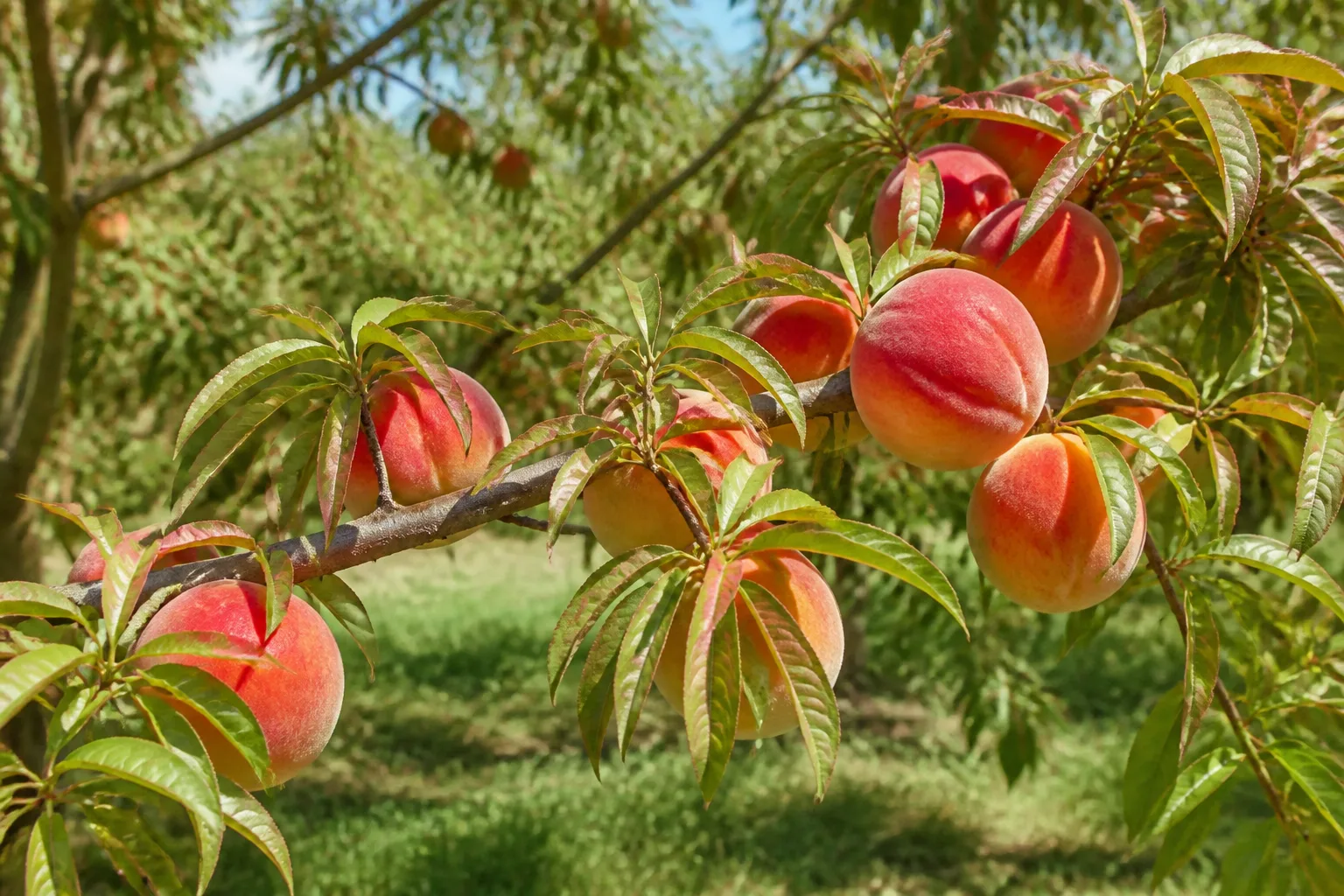
A peach tree can flower beautifully and still produce no useful harvest. The difference between a tree that merely survives and one that ripens good fruit often comes down to decisions made before planting: whether the cultivar gets enough winter chill, whether spring frosts collect at the site, and whether the tree is trained to carry a manageable crop.
Peaches (Prunus persica) are deciduous stone fruits. Most common cultivars are self-fruitful, so one tree can pollinate itself, but flowering does not guarantee fruit: cold injury, poor cultivar fit, inadequate sun, and an overloaded canopy can all reduce the crop. Treat a peach tree as a small orchard project with a yearly rhythm—choose the right grafted tree, establish its roots, renew fruiting wood, thin the crop, then harvest carefully.
Decide Whether Your Climate Can Ripen Peaches
Peaches suit many temperate gardens, but they are less forgiving than their sunny fruit suggests. A cultivar must receive enough winter chill to break dormancy normally, bloom at a useful time, and have enough warm growing season left to ripen its fruit. USDA hardiness zone is only one clue: it describes winter cold, not whether your winters meet a cultivar’s chill requirement or whether a warm spring will trigger flowers before the last frost.
Before you order, compare local climate records with the nursery’s cultivar information and ask a nearby Extension office which peaches fruit reliably in your county. This is especially important in warm-winter regions, high mountain valleys, inland frost pockets, and places with erratic late freezes.
Match chill hours, bloom timing, and ripening date
Chill hours are a measure of winter cold that a tree needs before it can resume normal growth. The number belongs to the cultivar, not to peaches as a whole. UGA Extension, for example, defines a chill hour as an hour between 32°F and 45°F and recommends comparing local historical totals with a variety’s requirement. Other regions may use different chill models, so use the same method as your local cultivar list rather than mixing numbers from different systems.
A mismatch can look like poor or uneven budbreak, flowers opening across a long period, weak fruit set, or a tree that grows leaves but produces little fruit. Choose a cultivar whose chill requirement is reliably met in an average winter, not one that barely fits a single unusually cold year. Then check its bloom and harvest windows. A late-blooming cultivar can reduce frost exposure in some locations, while an early-ripening one may be a better fit where summers are short. These traits are separate; one does not guarantee the other. Compare the regional cultivar information in UGA Extension’s peach guide and Utah State University Extension’s peach guide with recommendations for your own area.
Read the cultivar and rootstock labels before buying
A nursery tree usually combines a named scion—the top that determines the variety—with a rootstock selected for size, soil adaptation, or resistance to local problems. Ask for both names. Rootstock affects mature spacing and vigor, while the cultivar affects chilling need, bloom, harvest timing, flesh color, and whether it needs a pollination partner. Utah State Extension notes that most peaches are self-fruitful but lists exceptions, so verify the label instead of assuming every cultivar can fruit alone.
Buying a grafted tree is the practical choice when you want a known variety and a predictable harvest. A tree grown from a pit may be fun, but it will not reliably reproduce the fruit you ate, and it takes longer to reach bearing age. If you want to experiment with a seedling, see our guide to growing a peach from seed.
Choose a Sunny Site With Lower Frost Risk
Give a peach tree at least eight hours of direct sun, with open air around the canopy. Inadequate light encourages weak growth and leaves fruiting branches shaded; a dense, shaded canopy also dries more slowly after rain. Utah State and Georgia Extension both emphasize full sun and good drainage.
Pay attention to the cold-air path across your yard. Cold air drains downhill and settles in low spots, so a slightly elevated position on a gentle slope is often safer than the bottom of a hollow. A wall can protect a tree from wind and provide warmth, but a very warm south-facing wall may advance bloom and expose flowers to a later freeze. The best location is not automatically the warmest one; it is a sunny spot where bloom is less likely to coincide with a frost pocket.
Leave space for the mature tree, not just the young whip in the nursery pot. Depending on rootstock and training, a peach may need roughly 12 to 20 feet of space. Check the recommended mature spread and the pruning style before laying out more than one tree. Keep the planting area clear of competing lawn and weeds so a young root system does not have to compete for water and nutrients.
Test drainage and soil before planting
Peaches need oxygen around their roots. If water stays in the proposed planting hole for a long time after rain, choose another site or get local advice on drainage rather than trying to solve a fundamentally wet location with extra gravel at the bottom of the hole. Root and crown problems can follow persistently saturated soil. A soil test before planting is also valuable because adjusting pH or major nutrient deficiencies is easier before the tree is established.
The ideal pH is regional: UGA Extension’s guide gives a target of about 6.0 to 6.5 for its peach-growing conditions, while Utah State discusses the challenges of alkaline western soils. Do not add lime, sulfur, or fertilizer based on a generic online number. Use a local soil test and its crop-specific recommendation. If the ground is compacted or heavy, improve a broad planting area according to local advice; do not create a rich, amended pocket that holds water differently from the surrounding soil.
Plant at the Correct Depth and Protect the Graft
Plant bare-root peaches while dormant, as soon as the soil can be worked; timing differs by region, and fall planting may suit some climates while spring is safer in others. Avoid setting a tree during hot, dry weather. Keep bare roots shaded and moist until planting. For a container tree, water the root ball first and tease apart circling roots gently if needed.
Dig a hole wide enough to spread the roots without bending them, but no deeper than necessary. Set the tree so it sits at its nursery depth, with the graft union clearly above the soil line. Do not bury the graft: the scion can root, defeating the size or disease-resistance properties selected in the rootstock. Backfill with the native soil unless a soil test or local Extension recommendation says otherwise, then water slowly to settle soil around the roots. Avoid placing a concentrated fertilizer dose in the hole.
Spread a shallow layer of organic mulch over the root zone to reduce weeds and conserve moisture, leaving several inches bare around the trunk. Mulch piled against bark keeps the base damp and can encourage decay or provide cover for rodents. Stake only if the tree is unstable or the site is windy, and remove or loosen ties before they constrict the trunk. UGA Extension and the RHS planting guide both stress planting at the right depth and preparing the tree for its local conditions.
Establish the Tree With Deep, Consistent Water
A newly planted peach tree needs regular moisture while roots establish, especially during dry spells and the first couple of growing seasons. Water the root zone slowly and deeply rather than giving the trunk a quick splash every day. The goal is moist soil through the active root area, not a permanently wet planting hole. Check below the mulch with a finger or narrow trowel before watering; sandy soil dries faster than clay, and a tree planted in turf may compete with grass even when the lawn looks green.
Once established, a deep soak is generally more useful than frequent shallow irrigation. Utah State Extension describes watering mature trees every seven to fourteen days in its dry climate, with the interval adjusted for soil and heat, and recommends wetting soil down through the root zone. That schedule is a regional example rather than a universal timer. During fruit swelling, drought can limit fruit size; after harvest, the tree still needs enough water to support leaves and next year’s buds. Reduce irrigation when rain has already soaked the soil, and correct drainage before increasing water on a yellowing tree.
Use a drip line or soaker hose under the canopy where possible. Avoid wetting foliage late in the day, and keep grass or weeds from crowding the trunk. In a hot, dry week, a young tree may need water more often than an established one; in cool, rainy weather, it may need none. Container peaches dry much faster and need more frequent checks.
Fertilize According to Soil and Shoot Growth
Do not use a fixed fertilizer amount for every peach tree. Soil fertility, rootstock, tree age, crop load, rainfall, and last year’s growth all change what the tree needs. A soil test is the starting point; then watch the length and density of new shoots. If the tree is already making long, vigorous shoots, extra nitrogen can create more leafy growth and shading without solving fruit problems. If growth is weak, first rule out waterlogging, drought, root damage, poor light, or a wrong cultivar before adding fertilizer.
Extension programs give different fertilizer schedules for their soils and climates. UGA Extension’s Georgia program, for example, uses staged applications and adjusts mature-tree feeding to growth and crop load. Utah State recommends assessing annual shoot growth and soil nutrients rather than applying nitrogen when growth is already strong. Those examples are not interchangeable recipes for every region. Apply a recommended fertilizer over the root zone at the labeled rate, keep granules away from the trunk, and water it in if the label calls for that. Avoid late-season nitrogen in places where it would push soft growth into cold weather.
A mulch layer can support soil structure and moisture, but it does not replace correcting a confirmed nutrient deficiency. Conversely, yellow foliage is not proof that the tree needs a general-purpose fertilizer. Iron availability, poor drainage, and root stress can create symptoms that fertilizer will not fix.
Prune for an Open Center and Young Fruiting Wood
Peaches are usually trained to an open-center, vase-shaped framework rather than a single central leader. The open middle lets light reach fruiting branches and allows air to move through the canopy. A mature peach bears on shoots that grew the previous year, so annual pruning renews productive wood and keeps the canopy low enough to manage. It is not simply a haircut: each cut should either maintain the framework, remove a problem branch, or make room for new fruiting shoots.
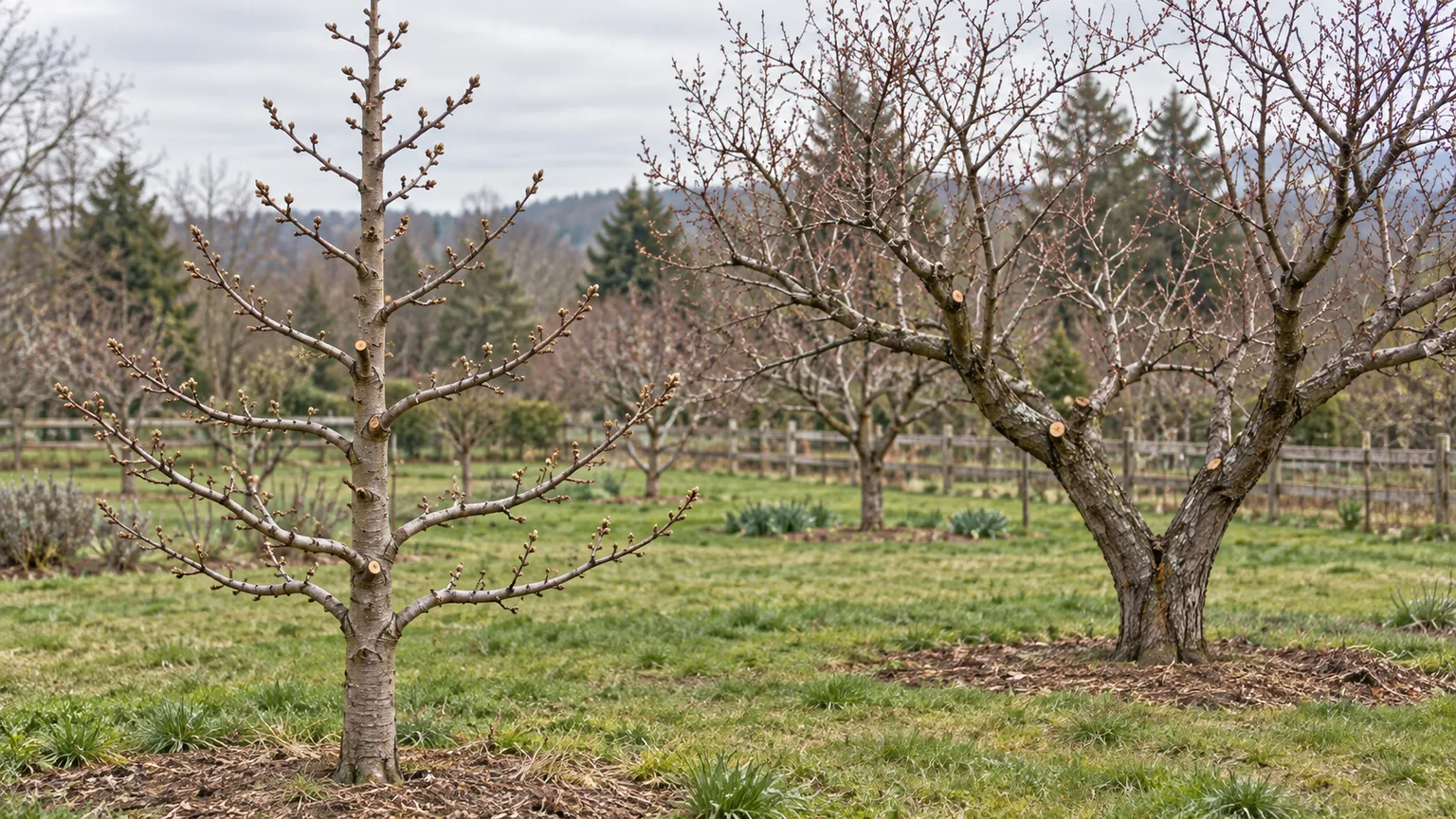
An open framework lets light reach the inside of the canopy and keeps fruiting branches accessible.
During the first few years, select about four or five well-spaced scaffold branches that angle outward from the trunk, then keep the center open as the tree fills in. Remove dead, broken, crossing, inward-growing, and very low branches. On a mature tree, thin out some older, shaded wood and preserve healthy one-year shoots that can carry the next crop. Avoid taking large limbs all at once if the tree has been neglected; severe renovation can trigger excessive shoots and reduce the next harvest.
Make major cuts at the right local time
Pruning calendars vary with climate. Utah State Extension recommends pruning dormant trees, commonly in February or March in its region; UGA Extension also describes winter pruning. In a colder location, check local guidance on timing so you can avoid exposing a recently pruned tree to the harshest winter conditions. The goal is to complete structural pruning before spring growth gets underway, at a time suited to your winter risk and local disease pressure.
Use sharp bypass pruners for small shoots and a clean pruning saw for larger limbs. Cut just outside the branch collar instead of leaving a long stub or cutting flush to the trunk. Disinfect tools between trees when disease is suspected. Remove suckers that grow below the graft union because they come from the rootstock, not the fruiting cultivar. For a detailed framework, see our fruit-tree pruning guide.
Thin Peaches Before the Branches Overload
A peach tree often sets more fruit than it can mature into large, good-quality peaches. Thinning removes some young fruit so the ones left have space and resources to develop; it also lowers the weight that can break branches. This can feel wasteful the first time, but it is one of the most effective ways to avoid a canopy full of undersized fruit.
Thin after the tree has set fruit and the earliest natural drop has passed, while peaches are still small. Guidance differs on the exact stage: UGA Extension advises thinning when fruit is about 0.7 to 1 inch across, while orchard educators interviewed by Martha Stewart describe doing it when fruitlets are marble-sized. Local climate, cultivar, and frost history affect the timing, so use the stage recommended by your regional Extension service and finish before the pits harden.
Start by removing fruit that is damaged, misshapen, or markedly smaller. Then leave one healthy peach about 6 to 8 inches from the next along the branch; remove tight clusters rather than keeping several fruits touching. On especially vigorous trees, you may leave somewhat closer spacing if local guidance supports it, but do not let branches carry a continuous chain of fruit. A good rule is to step back and check the whole limb after thinning: fruit should not crowd at the tips, where leverage makes a loaded branch more likely to bend or snap.
Prevent Disease and Scout for Pests
Peach health depends on prevention because several serious problems are easier to stop than to reverse. Choose a cultivar suited to local disease pressure, keep the canopy open, avoid chronic wet soil, remove mummified fruit and fallen diseased debris, and inspect the trunk and new shoots regularly. Warm, wet regions may have very different pest and fungal pressure from dry western gardens, so a spray calendar copied from another state can be ineffective or unsafe.
Do not apply a broad-spectrum pesticide just because leaves look imperfect. Identify the likely pest or disease first, then check local Extension recommendations and the product label for the crop, target, timing, protective equipment, and pollinator precautions. A label is a legal instruction, and rates or products that are not labeled for the intended use should not be substituted. If a tree has recurring losses, a county horticulture office can help confirm the diagnosis and whether a home orchard is practical in that area.
Recognize leaf, fruit, and trunk warning signs
Peach leaf curl is a fungal disease that causes thickened, distorted leaves that may turn reddish or yellow and drop early. Infection occurs around budbreak in wet conditions, and the problem varies by location and cultivar. Prevention is regional: the RHS guidance describes rain shelter for fan-trained trees in the UK and notes that fungicides are not available to amateur gardeners there. In other regions, ask Extension whether any preventive product is appropriate and labeled locally; do not assume that a treatment used elsewhere is permitted or useful in your garden. Once symptoms appear, treatment will not reverse the affected leaves, so plan prevention before next spring’s budbreak.
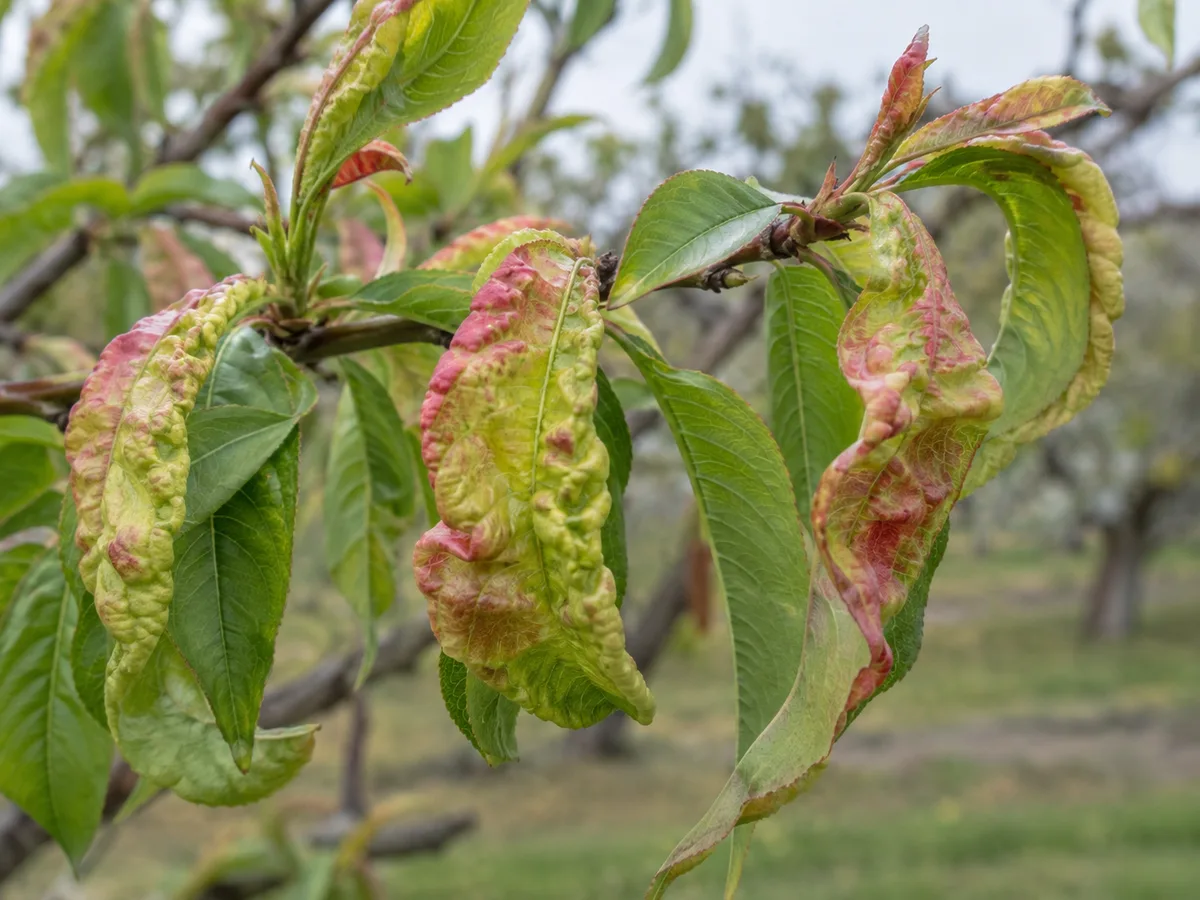
Leaf curl distorts young peach leaves; visible symptoms are a cue to plan prevention for the next susceptible period.
Brown rot can affect flowers and fruit, especially when damp weather coincides with bloom or ripening. Remove rotting fruit promptly and clear mummified peaches that can carry infection into the next season. If a fruit develops a soft brown spot that spreads or shows tan spore tufts, remove it rather than leaving it attached. UGA Extension notes that local brown-rot pressure can be severe, which is why disease management must be regional.
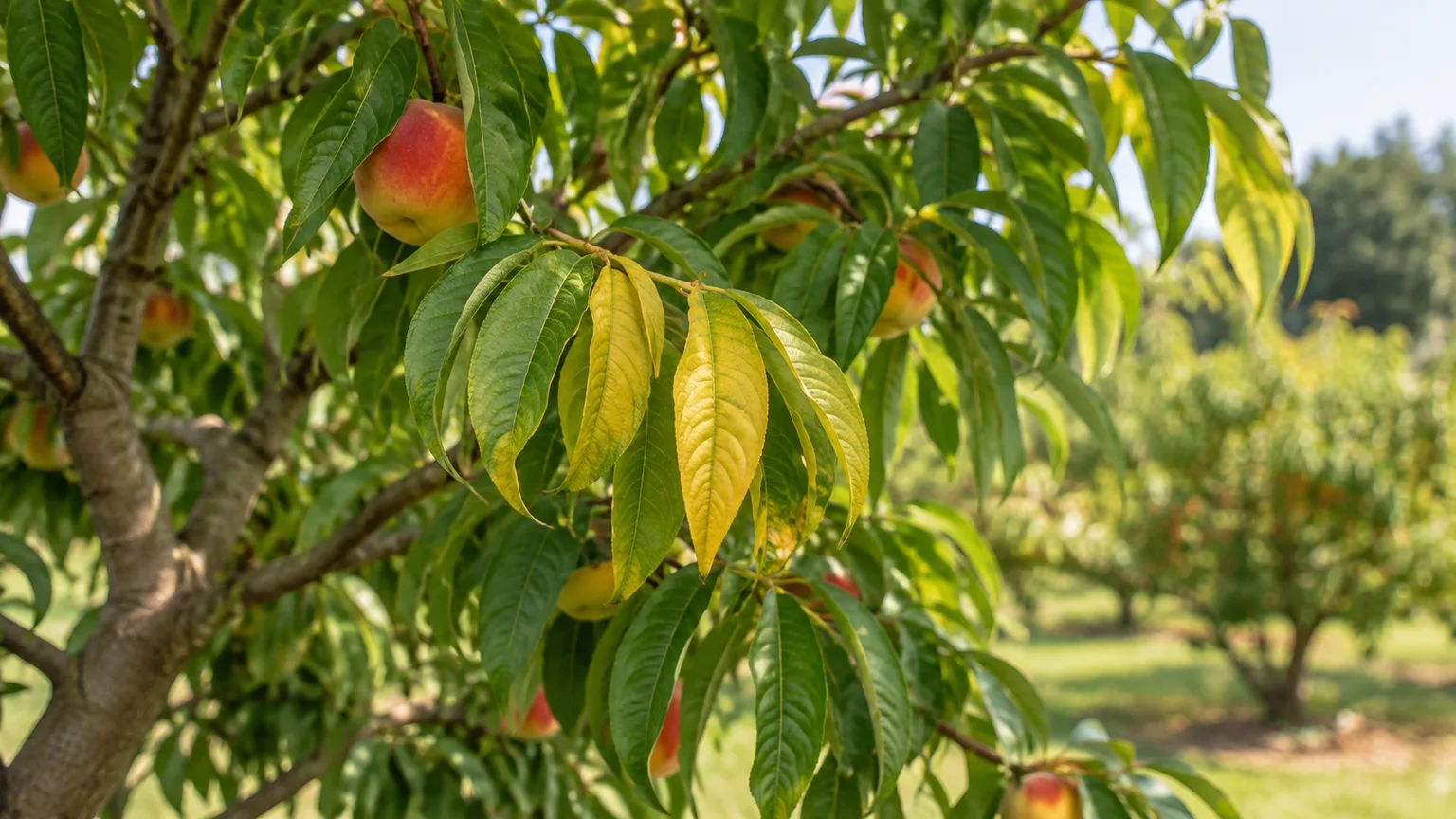
Look at where symptoms occur before diagnosing yellow leaves. Yellowing between green veins may suggest iron chlorosis in alkaline soil; whole-tree yellowing and decline can point to waterlogged roots or another root problem. Aphids can distort tender shoots and leave sticky honeydew. Sap mixed with sawdust-like frass near the soil line is a warning sign for peach tree borers, while gum alone is not a diagnosis—it can follow wounds, stress, or several pests. Compare leaves and fruit with an Extension diagnostic guide, and use a peach-tree yellow-leaf guide if you need to narrow the cause before treating.
Peach leaves, stems, and seeds contain compounds that can be toxic to pets, particularly as plant material wilts. Keep prunings and fallen leaves away from animals, and do not let pets chew pits or tree debris. The ASPCA lists peach as toxic to dogs, cats, and horses; if an animal eats leaves or stems, contact a veterinarian or animal poison-control service promptly.
Harvest by Maturity, Not by Red Blush
Harvest dates vary widely by cultivar and region, so use the variety’s expected window as a starting point, not a promise. A deep red blush can appear before the fruit is ripe. Look for the background color to shift from green toward cream or yellow, depending on flesh type, and notice whether the peach gives slightly near the stem with a gentle lift. A ripe peach should have a characteristic aroma and should separate with a small upward twist; pulling hard can tear fruiting wood.
Handle ripe peaches gently because they bruise easily. Pick in several passes instead of stripping the tree at the first sign of color. If a storm threatens, harvest mature but firm fruit and let it soften at room temperature; fruit picked too early may soften without developing the flavor of tree-ripened peaches. Keep harvested fruit cool, and use very soft or damaged peaches first. Remove fallen or rotting fruit from beneath the canopy so it does not attract insects or serve as a disease source.
Grow a Peach Tree in a Container
A patio peach is possible if you choose a naturally compact cultivar on a suitable rootstock and have a plan for watering, pruning, and winter protection. The RHS guide recommends compact varieties and large containers; its example pot size is at least 18 inches wide and deep. A pot needs unobstructed drainage, a stable location with full sun, and enough weight to resist wind. Do not try to keep a standard peach small by severe root pruning or repeated topping.
Container soil dries faster than garden soil, especially while fruit is swelling, so check moisture often during warm weather. Water thoroughly until excess drains, then allow the top layer to begin drying rather than leaving the roots in standing water. Feed only as directed for the container medium and product. In climates with hard freezes, container roots are more exposed than roots in the ground; move the pot to an unheated sheltered space or insulate it according to local guidance while still allowing the tree its normal winter dormancy. A peach is deciduous and needs seasonal outdoor conditions; a warm living room is not a substitute for winter chill.
Troubleshoot Flowers, Fruit Set, and Yellow Leaves
If a peach tree does not flower, first ask how old it is and whether it received enough winter chill. Newly planted trees may need time to mature, while a cultivar that does not fit the climate may grow foliage without flowering normally. If it flowers but sets no fruit, check for a freeze during bloom, poor pollination conditions, or an unusual cultivar that needs a partner. Most peaches are self-fruitful, but verify the specific variety before buying a second tree or assuming the cause is pollination.
If fruit sets and then drops, some early drop is natural. Severe drop can follow frost, drought during fruit development, disease, insect injury, or a tree carrying more fruit than it can support. Inspect fallen fruit for punctures, rot, or larvae; check soil moisture; and thin the remaining crop if branches are crowded. If fruit stays small, the most common correctable issues are inadequate thinning, too much shade, inconsistent water during fruit swell, or weak tree vigor. Do not respond by adding nitrogen until you have checked growth and soil.
Yellow leaves call for a pattern check. Are only the oldest leaves yellowing, are veins greener than the tissue between them, or is the whole canopy pale? Is the soil wet several days after rain? Are leaves curled, spotted, or stippled? These observations narrow the possibilities between nutrient availability, excess water, disease, and sap-feeding pests. Take a soil sample or clear photographs to your local Extension office before using iron products or pesticide; a mistaken treatment can mask symptoms while leaving the underlying cause untouched.
Conclusion
Success with peach trees starts with a cultivar that fits your winters and growing season, planted where sun, drainage, and cold-air movement work in your favor. Once established, the tree needs deep water during dry spells, fertilizer guided by soil and growth, an open framework renewed each year, and deliberate fruit thinning before the crop becomes crowded.
Expect some trial and adjustment. Record when buds open, whether frost follows bloom, how long new shoots grow, and when fruit ripens; those notes make next year’s choices more accurate than a generic zone label. When a tree struggles, diagnose the specific cause before adding fertilizer or sprays, and use regional Extension guidance for local disease and pest management.



