How to Keep Deer Out of Bird Feeders
Stop deer from raiding bird feeders without harming birds. Use this practical plan for feeder height, less spilled seed, deterrents, and fencing.
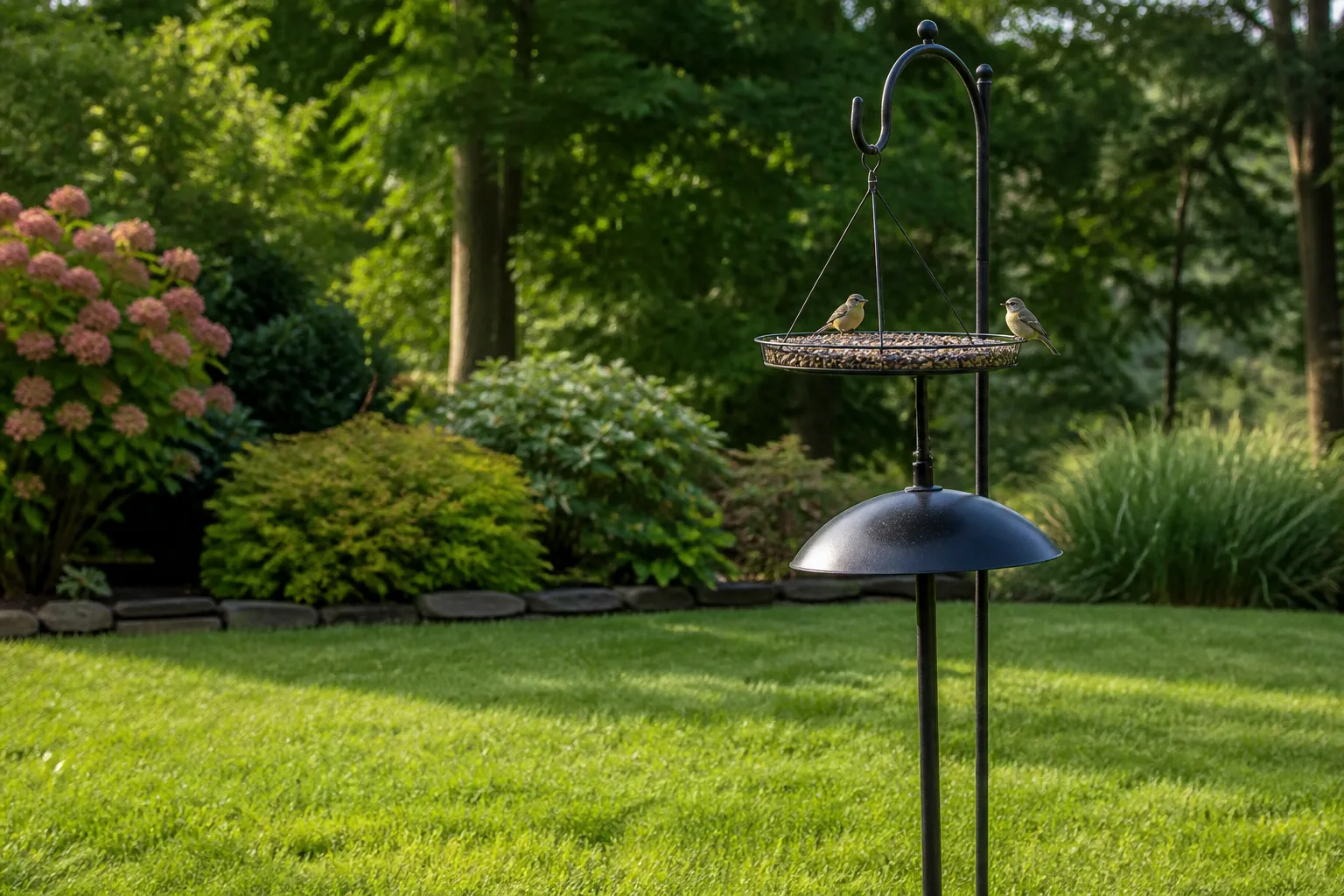
The most effective way to keep deer out of bird feeders is to remove the easy food on the ground first, then make the feeder difficult to reach. Raise the feeder on a sturdy pole away from branches, roofs, stumps, decks, and other launch points; add a wide catch tray; clean up spilled seed every day; and use a motion-activated sprinkler or a properly sized fence if deer still approach.
Do not start by coating birdseed with a homemade deterrent. Birds, deer, squirrels, raccoons, and pets all use the same yard, and an improvised substance can create a new safety or cleanup problem. A better plan is to change the food reward and the access route in that order. The Internet Center for Wildlife Damage Management’s bird-feeder guidance makes the same useful distinction: wildlife is attracted both by direct access to a feeder and by food that falls below it.
The best first fix: remove the ground-level reward
If deer are walking beneath a feeder, eating seed from the grass, or pawing through a catch tray, take away that reward before changing anything else. A deer that cannot reach the feeder can still learn that your yard offers a dependable meal at ground level. Once that pattern is established, a taller feeder may solve only half the problem.
For the next several evenings, sweep or rake the area under the feeder and remove seed from nearby mulch, paving, and low shrubs. Empty any tray before it overflows, and look for seed kicked out by birds rather than only seed that visibly fell straight down. If you find fresh tracks each morning, the ground is still advertising the feeder even if the feeder itself looks secure.
This first step is inexpensive, reversible, and useful for more than deer. Fallen seed can attract mice, rats, squirrels, raccoons, and other animals. A clean feeding zone also makes it easier to tell whether your next change is working because you will be measuring new visits rather than old food being consumed.
Why deer keep returning to bird feeders
Deer do not need to climb a pole to benefit from a bird feeder. They can eat sunflower kernels, millet, cracked corn, and other seed that birds scatter while sorting through a mix. Open platform feeders and overfilled tube feeders are especially likely to create a broad patch of food beneath the main feeding point.
The problem becomes more persistent when a feeder sits near natural cover. Deer can browse along a wooded edge, pause beneath shrubs, and return to the same spot with little exposure. Winter and early spring can intensify the pressure because available forage is limited in many regions. A deer that ignores a feeder in June may investigate it regularly when other food is scarce.
There is also a difference between deer visiting and deer being fed. A single animal passing through is not necessarily a feeder failure. Repeated tracks, droppings, browsing around the pole, or deer waiting under the feeder show that the site has become a predictable food stop. That is the point at which you should change the setup rather than simply hope a scent or flashing object will end the pattern.
Bird-feeder placement matters to birds too. BHG’s bird-feeder guidance recommends placing feeders near protective cover without putting them where predators can ambush birds. Your goal is a compromise: close enough to shrubs or trees for birds to retreat, but far enough from trunks, low branches, fences, sheds, and rooflines that larger animals can use them as access points.
Build a feeder setup deer cannot easily reach
Relocation is often the highest-value change after cleanup. A feeder in the middle of an open lawn is easier to monitor, but the pole still has to be tall, stable, and separated from anything that helps an animal reach it. Moving a feeder only a few feet away from a deck or tree may not change the result if the deer can still stand beneath it or approach along the same open route.
Height matters, but the takeoff point matters more
There is no universal height that makes a bird feeder deer-proof. Deer can rear up, stretch their necks, and exploit uneven ground, a retaining wall, or a raised bed. A feeder that is six feet above the ground may be out of reach in one yard and accessible in another if it stands beside a stump or the edge of a porch.
Use the height guidance as a design starting point, not a guarantee. A practical pole setup puts the feeder high enough that a standing deer cannot reach it and keeps the feeder away from launch points. Wildlife-damage guidance commonly uses a roughly 10-foot separation from branches or ledges when the goal is to prevent jumping animals from reaching a feeder. The distance matters because a feeder that is high but close to a branch is still connected to the ground through that branch.
Walk around the installation and inspect it from the deer’s point of view. Could a deer stand on a slope, stone border, firewood stack, or low wall? Could it push the pole or reach the feeder from a nearby railing? Could the feeder swing toward a structure in strong wind? Fix those details before adding a new product.
Use a pole and baffle as one system
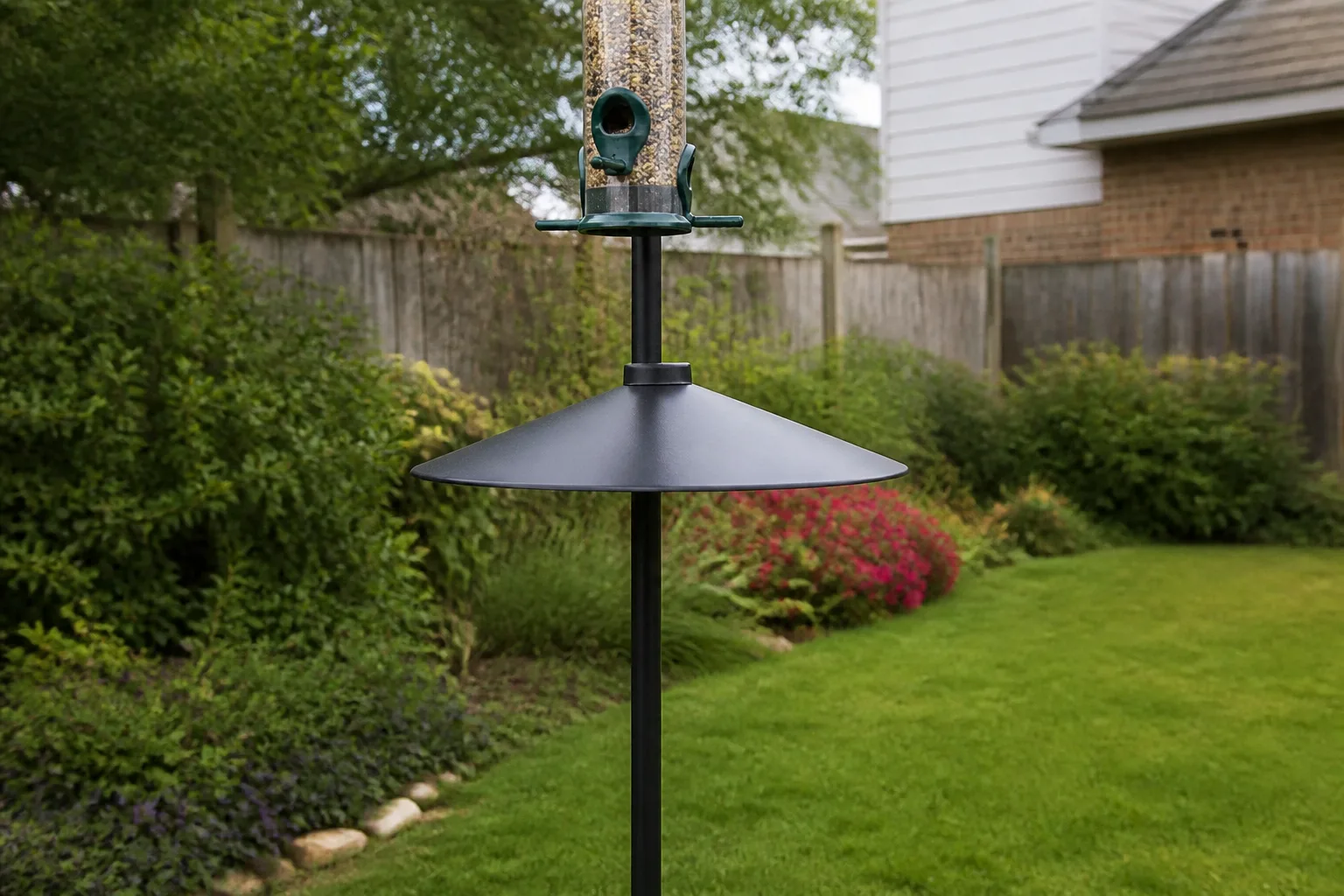
A baffle is useful, but many feeder baffles are designed primarily to stop climbing squirrels and raccoons. A cone on a pole does not prevent a deer from standing below the feeder, and it does not matter how polished the baffle looks if the feeder is low enough to reach directly.
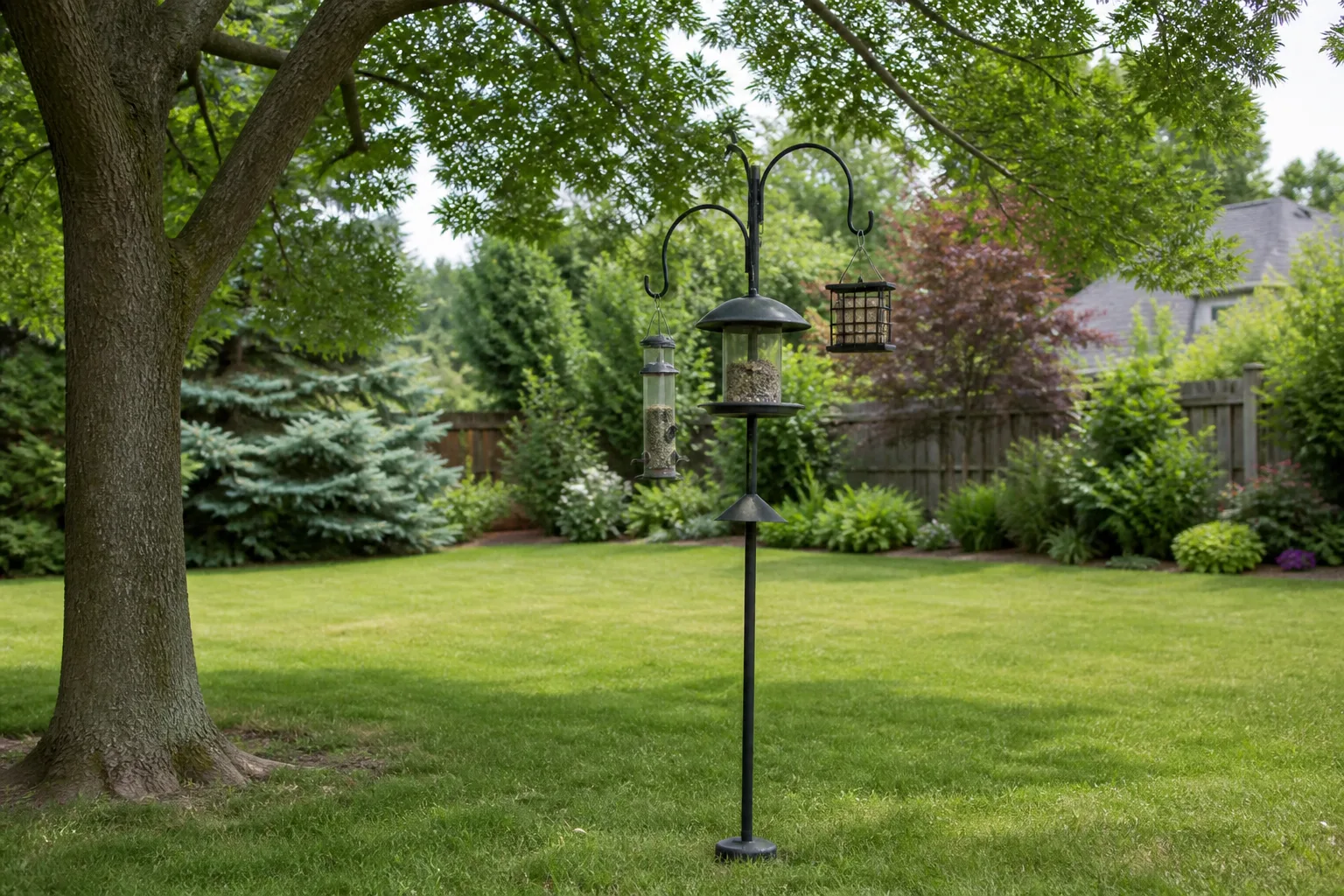
Install the pole in firm soil and choose a baffle that matches the pole diameter and the animals you are trying to exclude. Keep the feeder centered over the pole, check that the baffle cannot slide down, and remove low branches that touch or nearly touch the pole. If you hang the feeder from a tree instead, assume squirrels and other climbing animals will eventually reach it; a hanging feeder is usually a poor choice when the goal is to reduce every route to the seed.
For a visual check, a correctly placed feeder should have open space beneath it, a stable pole, and a broad shield that catches seed without becoming a second food platform. This bird-feeder pole and baffle example shows the kind of separation that makes the setup easier to monitor. It is not a guarantee against a determined deer, but it removes several simple access routes at once.
Control the seed that reaches the ground
Feeder design controls only the direct-access problem. You still need to control the foraging problem below it. The fastest way to do that is to reduce waste, catch what falls, and make your feeding routine fit the birds that actually use the feeder.
Choose seed birds are more likely to use
Mixed seed can create more waste than it appears to. Some birds select the kernels they prefer and toss the rest onto the ground. A pile of rejected seed can then feed deer and rodents even though your intended birds received only part of the mix.
Consider using separate feeders with single types of seed instead of filling one feeder with an inexpensive blend. Black-oil sunflower is widely used by many common songbirds, while thistle or nyjer suits a different group. The right choice depends on the birds in your region, but the principle is simple: buy less of what your birds consistently reject.
Do not add hot pepper powder to seed as a default deer solution. Capsaicin is often discussed because mammals react to it differently from birds, but loose powder can become airborne, irritate eyes and airways, and create a hazard for the person mixing it. The wildlife-management literature also notes that these methods are not foolproof, especially when animals are hungry. Use an appropriately labeled product only if it is specifically registered and directed for that use; never invent a concentration.
Add a catch tray you can empty
A catch tray or basin under the feeder can keep a large share of seed off the ground, but it works only if it drains and is emptied regularly. A solid tray that holds rain can become heavy, dirty, and unstable. A tray with drainage openings or mesh can catch seed while allowing water to escape.
Check the tray daily during wet weather and whenever bird activity is high. Remove damp or moldy seed rather than leaving it for ground-feeding birds. BHG’s feeder-cleaning guidance recommends regular cleaning because damp seed supports fungal and bacterial growth; the same hygiene principle applies to a catch tray.
If you want to keep feeding ground birds, make that a deliberate, short-duration activity rather than a permanent pile beneath the feeder. Scatter a measured amount in a place where you can remove leftovers, or use a blanket that can be collected afterward. Leaving a continuous buffet below the elevated feeder defeats the purpose of elevating it.
Use motion deterrents at the approach route
When cleanup and placement reduce the food reward but deer still approach, add a deterrent where the deer enter—not directly beside the feeder where it may startle birds. Watch the yard for a few evenings and identify the route, gap, or edge the deer use. A motion device aimed across that path has a better chance of changing behavior than a light pointed randomly at the feeder.
Motion sprinklers are usually more useful than lights
A motion-activated sprinkler gives a sudden, harmless burst of water when an animal crosses its detection zone. Penn State Extension lists motion-sensor water sprays among the devices used to repel nuisance wildlife. The unit should be positioned so it covers the approach route without soaking the feed, electrical connections, a walkway, or a place where people regularly pass.
Sprinklers have limits. They need a working water supply, can freeze, may trigger on pets or people, and can become less surprising if the deer learn the detection range. Adjust the sensitivity and angle, refill or inspect the water source, and move the unit after the deer begin avoiding its original position. A sprinkler is a behavior-changing layer, not a physical fence.
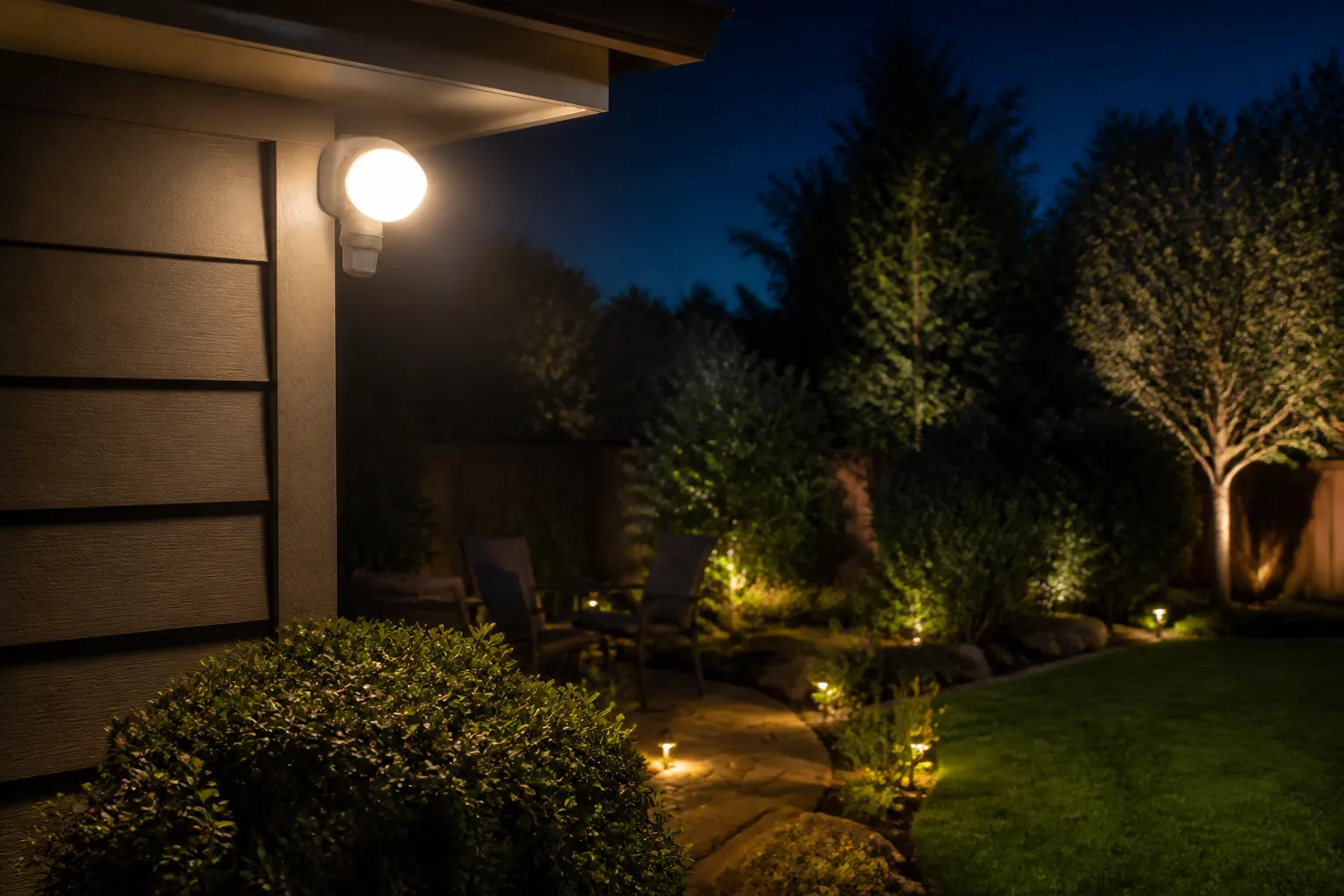
Motion lights can help in some situations, especially when deer approach a feeder at night, but light alone is easy for wildlife to habituate to. A light aimed toward a window can also disturb people without changing the deer’s route. If you use a light, treat it as an observation and short-term deterrence tool rather than the only defense.
Give scare devices a job they can actually do
Static scare devices tend to lose power as deer learn that they are harmless. Penn State Extension specifically warns that light or noise emitters may need to be moved because deer learn quickly. The practical lesson is to use movement, timing, and a clear approach-zone target rather than leaving one shiny object beside the feeder for an entire season.
Use motion devices after the ground reward has been removed. Otherwise, the deer may back away from the sprinkler, wait, and return as soon as it stops—or simply eat the seed outside the device’s range. If the deer begin entering from another direction, move the device to that route or add a second coverage point. Do not keep increasing the number of gadgets without checking whether the original feeder placement is still inviting them.
Use deer repellents carefully
A labeled deer repellent can be useful around the perimeter of a feeding area, but it should be treated as a temporary layer. Many repellents rely on odor, taste, or both, and rain, irrigation, plant growth, and deer pressure can reduce the effect. Extension and wildlife-management guidance commonly lists ingredients such as putrescent egg solids, ammonium soaps, capsaicin, and blood meal among repellent categories, but the product label determines where and how a formulation may be used.
Read the label and protect the feeding zone
Do not spray a repellent on birdseed, inside a feeder, on a birdbath, or on surfaces birds regularly touch unless the label explicitly permits that use. Keep treated plants and posts far enough from feed and water that wind, runoff, and contact do not contaminate them. Never assume that “natural” means harmless to every bird, pet, child, pollinator, or aquatic organism.
Choose a product that states the target animal, application site, reapplication conditions, and precautions. If the label says to reapply after rain, treat that as part of the maintenance cost. A scent sachet that works for a few dry days may be reasonable for a small approach route; it is a poor substitute for exclusion when deer pressure is high.
The Old Farmer’s Almanac’s deer-repellent discussion is useful for understanding why odor and taste approaches are popular, but homemade recipes should not be treated as universal formulas. Eggs, soap, oils, and pantry ingredients vary in strength and may attract other animals, damage plants, or wash into soil. If you use a repellent, use a labeled product and keep a record of when it was applied and how deer responded.
Decide when a fence is worth it
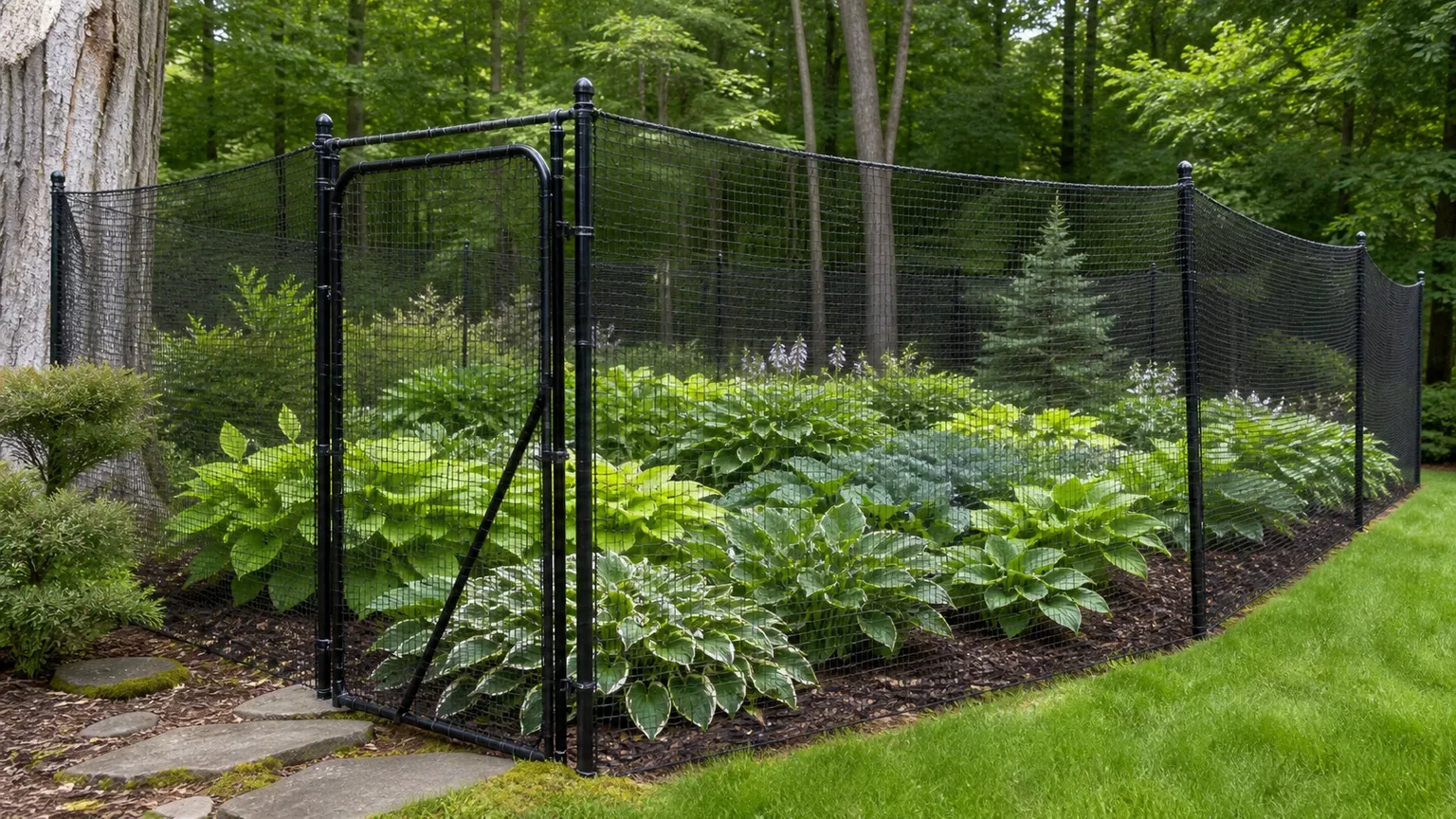
If deer continue to visit after you remove spilled seed, relocate the feeder, and add a targeted deterrent, a fence is the most dependable escalation. Pesticide Environmental Stewardship’s exclusion guidance describes exclusion as an immediate, long-term method that avoids chemical exposure to non-target animals. That reliability comes with cost, visual impact, installation work, and the need to maintain gates and fence lines.
Protect the feeder area or the whole yard
You do not always need to fence the entire property. A small, properly anchored enclosure around the feeder can be enough when the rest of the yard is not suffering deer damage. For larger areas, wildlife-management guidance commonly uses an eight-foot barrier as a starting point, while individual-plant protection may use a lower fence. Penn State Extension notes that deer can clear an eight-foot fence and suggests taller or double-fence designs in some situations, so local conditions and the three-dimensional layout matter.
A double or offset fence can work because deer are reluctant to jump into a narrow space when they cannot judge the landing. A tall mesh fence needs a secure gate, no low spot to crawl under, and enough tension that deer cannot push the mesh inward. The Internet Center for Wildlife Damage Management’s deer-control guidance emphasizes that permanent woven-wire fences are durable but expensive, while electric and temporary designs require regular inspection.
Electric fences deserve extra caution around children, pets, neighbors, and people with medical devices. Check local rules, use warning signs where required, keep vegetation from grounding the fence, and follow the charger manufacturer’s instructions. If the fence protects only a feeder, a non-electric mesh enclosure is often easier to explain, inspect, and live with than a complex energized system.
Follow a seven-day reset plan
If you are not sure which intervention matters most, run a short reset instead of changing everything at once. The goal is to remove the reward, observe the route, and then add one new barrier or deterrent at a time.
- Day 1: Remove spilled seed from the feeder area, empty the tray, and note deer tracks, droppings, browsing, and the likely approach route.
- Day 2: Move the feeder to a level, open position on a sturdy pole. Remove nearby launch points and check the feeder’s height from the ground and from any raised surface.
- Day 3: Refill with a smaller amount of seed that your birds use well. Add a draining catch tray and record how much seed reaches it.
- Day 4: Clean the feeder and tray. If you see fresh tracks, place a motion-activated sprinkler across the route rather than beside the feed.
- Day 5: Inspect after rain or irrigation. Repair leaks, remove damp seed, and check that the sprinkler still covers the route without spraying the feeder.
- Day 6: If deer are still entering, add a labeled repellent to the approach perimeter or plan a small mesh enclosure. Do not spray the feed zone.
- Day 7: Decide whether visits are declining. If the deer still wait under the feeder or return nightly, stop treating the problem as a minor nuisance and choose exclusion or a temporary feeding pause.
This sequence also prevents a common diagnostic error: attributing success to a scent or light when the actual improvement came from removing food from the ground. Keep the setup that works, and remove any extra product that adds maintenance without changing deer behavior.
Avoid the mistakes that keep deer coming back
The most common mistake is raising the feeder while leaving a thick layer of seed below it. The second is installing a baffle that blocks squirrels but placing the feeder beside a deck, branch, or retaining wall. A third is applying a repellent to the feeder itself, where it can contact birds, contaminate feed, or create a residue that is difficult to clean.
Do not assume a deer-resistant plant list solves a feeder problem. Deer preferences vary with region and hunger, and changing the plants around the pole may not remove a concentrated seed reward. The University of Wisconsin Extension notes that deer may eat almost any plant under severe conditions; use plant selection as a landscape choice, not as your only feeder defense.
Avoid chasing deer, cornering them, feeding them elsewhere, or using toxic substances. Wildlife-control laws vary, and relocating or trapping animals can create safety and legal problems. A humane deterrence plan changes access and rewards while giving animals a route away from the yard.
Know when to pause bird feeding
Taking down the feeder temporarily is a responsible choice when you cannot keep the ground clean, deer are visiting repeatedly, or the feeder is drawing animals into conflict with pets, traffic, neighbors, or garden plants. A feeding pause does not have to be permanent. Remove the feeder, clean the area, store the seed securely, and wait until the attractant and route have been addressed.
Pause feeding immediately if the seed is wet or moldy, if a sick or injured animal is visiting, or if the feeding area is becoming a congregation point for multiple species. The National Park Service’s discussion of deer exclosures shows why physical exclusion can protect vegetation where browsing pressure is persistent; the same logic applies to a small feeder zone when repeated deterrence has not changed behavior.
When you restart, use a smaller amount of seed, a cleaner feeder, and a placement you can monitor. If deer return within a few nights, the reset has answered the question: the site is still providing a reward, and the next step should be a barrier or another pause rather than more seed.
Conclusion
To keep deer out of bird feeders, start with the ground, not the feeder: remove fallen seed, empty the catch tray, and stop creating a dependable meal beneath the pole. Then use a high, stable feeder placement with open space around it, add a motion-activated sprinkler on the deer’s approach route, and use only labeled repellents kept away from bird food and water.
If deer pressure is high or the visits continue after a seven-day reset, choose exclusion. A properly built mesh enclosure or deer fence is more dependable than a permanent light, scent, or noise gadget, even though it costs more. And if you cannot keep the feeding zone clean and safe, taking down the feeder for a while is the humane, practical answer.