12 Ideas for Landscaping Property Lines
Plan a property-line garden that fits your lot. Compare hedge, shrub, grass, and mixed-border ideas, then check mature size, access, and local restrictions.
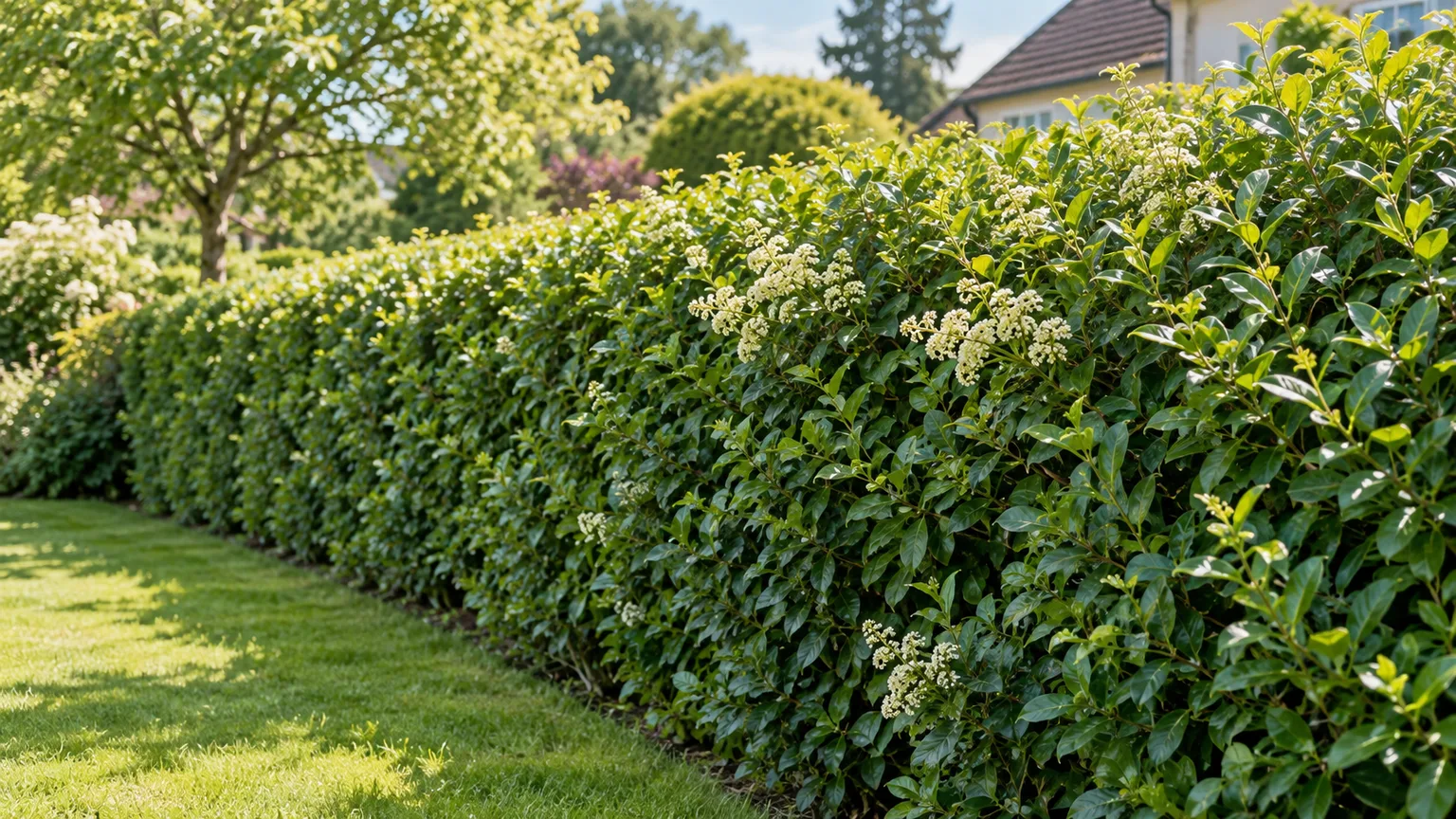
A property edge can be a green screen, a flower border, a wind filter, a habitat strip, or simply a softer transition between two lawns. The best design depends on what you need to hide or frame, how much room you have, how the site grows, and how much pruning you are willing to do. A row of identical evergreens is only one option—and it is not automatically the easiest one.
Start by separating the legal boundary from the planting line. A bed can look most natural a few feet inside the property, with shrubs staggered rather than planted directly over a surveyed line. That small design choice gives plants room to reach mature size, leaves you a place to work, and makes future conversations with a neighbor simpler.
Confirm the boundary before drawing a planting bed
Do not use an old fence, a line of trees, or a mow strip as proof of the legal boundary. Fences may have been installed for convenience rather than accuracy, and visible markers can be missing or displaced. Penn State Extension’s guidance for forest property lines explains that a licensed land surveyor is the professional who can establish a boundary; if the line is uncertain, get qualified local help before installing a permanent hedge, wall, or tree row.
Next, check whether the strip has an easement, shared access, a drainage route, or utility infrastructure. A utility corridor may need to stay clear for repair crews, while roots can conflict with buried pipes or paving. University of Idaho Extension also notes that local ordinances may restrict planting near property lines, sidewalks, parking strips, signs, and utility lines. Requirements vary by municipality and plant, so there is no reliable universal setback to copy from a generic garden plan.
Before digging, contact the local utility-marking service and identify underground lines. If a structure, retaining wall, or drainage change is part of the project, ask the appropriate local office whether permits or additional rules apply. These checks may feel less exciting than choosing flowering shrubs, but they are much cheaper than removing a mature screen or repairing a disturbed utility corridor.
Decide what the edge needs to do
Write down the main job before you shop. “Make the yard private” can mean blocking a second-story window, screening a patio while seated, disguising a chain-link fence, reducing headlight glare, or adding a clear visual boundary without blocking the view. Each problem calls for a different height, density, and planting depth.
A tall hedge will not create instant privacy, and a low flower border will not screen a standing adult. Conversely, a dense evergreen wall can make a small yard feel boxed in, shade a neighbor’s garden, or demand repeated shearing. If the goal is only to soften a fence, a layered border with gaps may do the job with less material and a more natural look.
Use the view you need to change as a measuring guide. Stand or sit in the actual spot, note the eye level and direction of the view, then mark the target with a temporary stake or ribbon. This helps avoid spending years growing a tall screen to cover the wrong sightline.
Choose a style that fits the site
A useful property-line planting has a clear shape from the house and still looks intentional from the other side. The following ideas work in different kinds of yards; combine them only when their light, moisture, and maintenance needs line up.
Layered mixed border
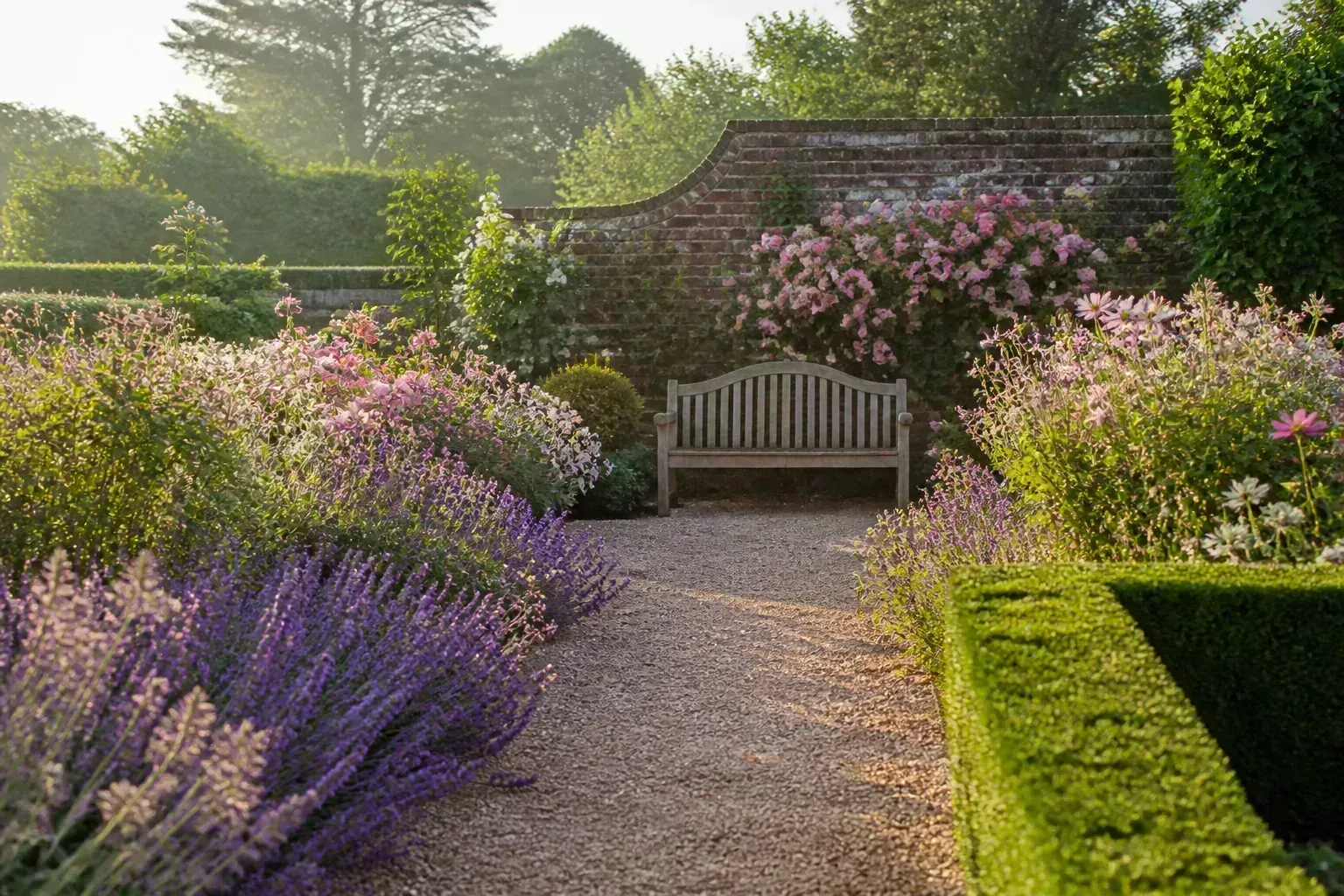
A layered border gives a fence or open lawn depth instead of turning it into a flat green wall. Put the tallest shrubs or narrow small trees toward the back, medium flowering shrubs in front of them, and lower perennials or grasses at the edge. For a boundary shared with a neighbor, choose plants that look finished from both sides or keep the tall structure set far enough inward that you can reach the back for pruning.
Repeat a short list of plants rather than buying one of everything. Three or five repeated groupings make a long edge read as one design, while a limited palette avoids the patchwork look that can develop when each plant has a different growth rate. BBC Gardeners’ World’s border-planning guide recommends matching the plant palette to the border’s conditions and using repetition and plant height to create a coherent scheme; those same principles help a boundary bed feel deliberate rather than leftover.
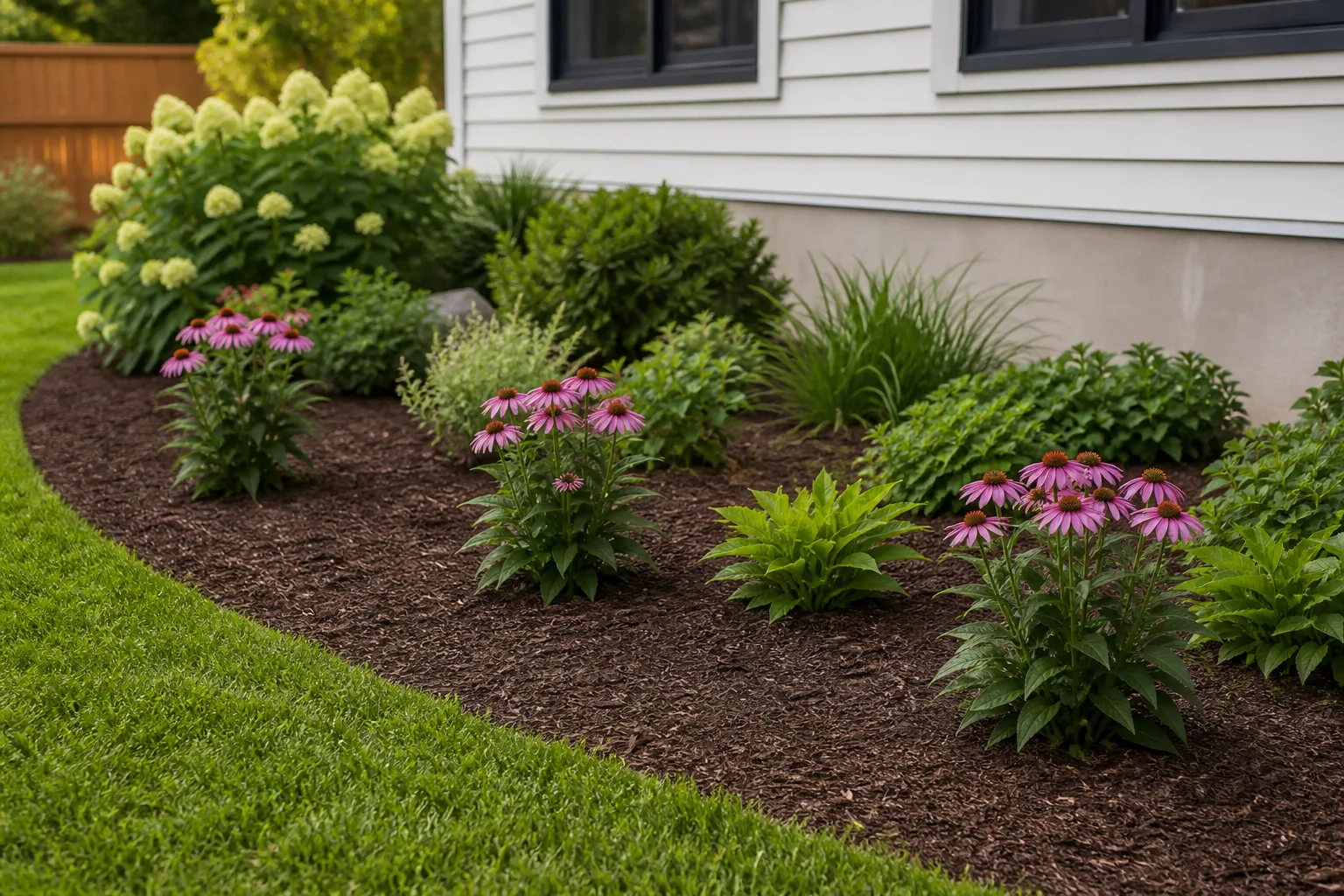
A mixed border can include an evergreen anchor for winter structure, several flowering shrubs for seasonal color, and a low front edge that hides bare soil while the larger plants fill in. For example, a sunny, well-drained boundary in much of the eastern or central United States might use a locally appropriate ninebark or viburnum with native perennials beneath it. In a different climate or wet site, the plant palette should change; the design principle stays the same, but the species must fit.
Evergreen screen or formal hedge
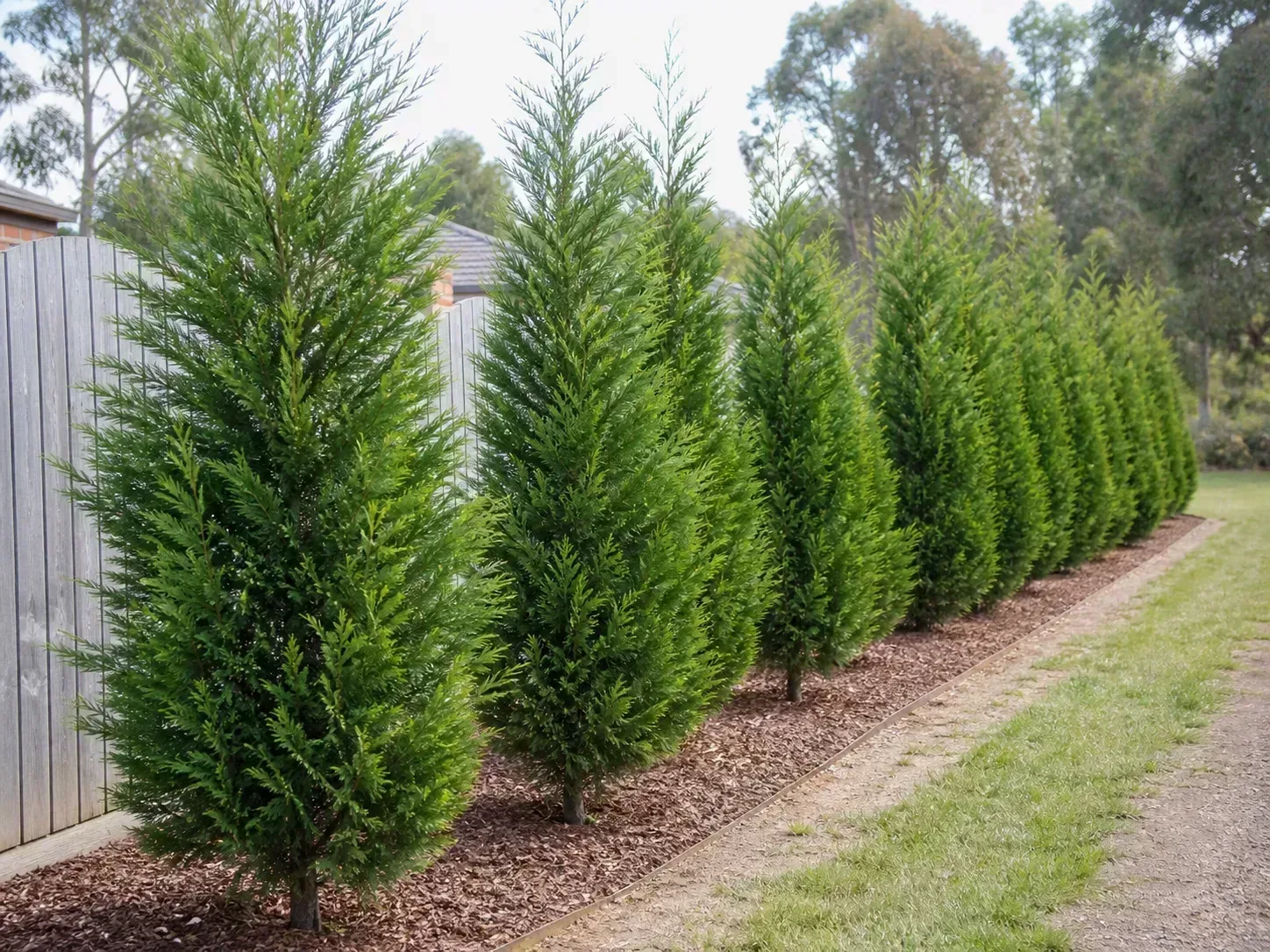
Choose an evergreen hedge when you need year-round screening and have enough width to let plants reach their intended form. A single straight row gives a crisp, formal boundary; two staggered rows create a thicker screen but use more space and cost more to plant. The right choice depends on the distance you need to cover and how much land you can give the plants without crowding paths or structures.
Check the mature width, not just the nursery-pot size. A hedge that must be cut back hard every season because it was planted too close to a walk, fence, or neighbor’s side is not low maintenance. Select a compact or columnar cultivar only after checking its expected width in your region, and leave enough room for a person to move behind the row if both sides need trimming.
Evergreens vary in winter hardiness, disease resistance, shade tolerance, and response to shearing. Arborvitae can make an effective screen in suitable conditions, but a long row of one cultivar may become visibly uneven if plants fail or outgrow the location. Mix species or break a long hedge into repeated groups when you want a softer effect and a little more resilience. Avoid assuming that “fast-growing” is a benefit: vigorous plants need more frequent pruning and can quickly become too large.
Loose mixed hedge
A mixed hedge uses several shrubs in a repeating sequence instead of clipping every plant into the same shape. It can provide flowers, berries, fall color, and shelter for wildlife while still defining the edge. Choose a few species with similar light and soil needs, then repeat them in a rhythm—for instance, a taller shrub every few plants with lower shrubs between—not as a random collection.
Regional options may include serviceberry, native dogwood, viburnum, or ninebark, but local species and cultivar sizes matter. Fine Gardening’s regional hedge discussion, written by landscape designer Marti Neely, compares choices such as Hicks yew, arrowwood viburnum, and ninebark and describes how their mature dimensions and growing conditions differ. Its examples are useful as a comparison, not a universal plant list; the right selection depends on your climate, available space, and the local status of each species.
A loose hedge takes less geometric trimming than a formal clipped line, but it is not maintenance-free. Some shrubs sucker, spread by seed, or grow much wider than their labels suggest. Check whether a plant is invasive or restricted in your state, and plan how you will keep suckering stems from crossing into lawn, paving, or a neighbor’s garden.
Ornamental grass and perennial ribbon
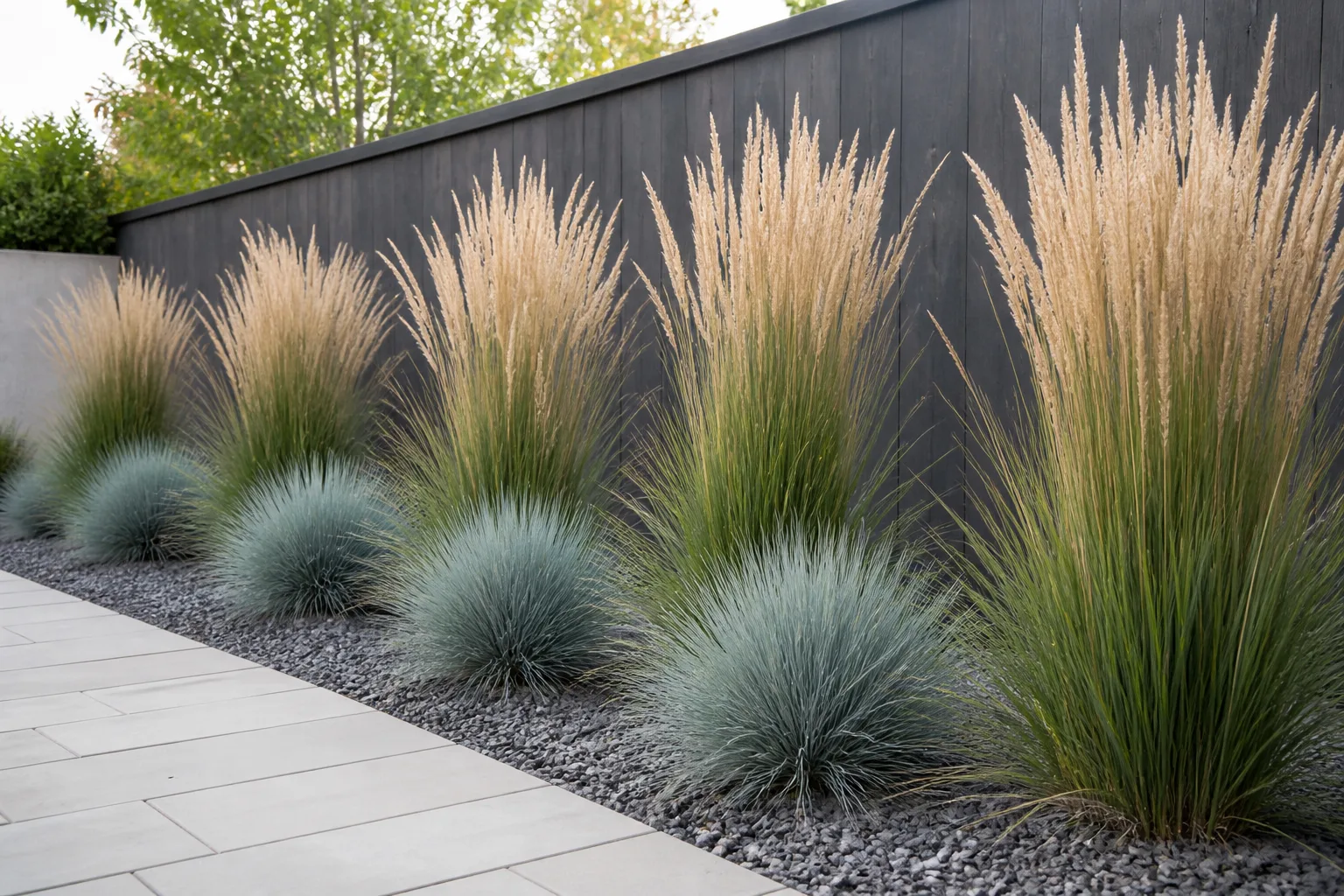
A ribbon of ornamental grasses or clumping perennials works when you want movement and seasonal texture without building a tall, continuous screen. Repeat the same grass in drifts, then weave in lower flowers that tolerate the same sun and soil. This pattern suits sunny fences, driveway edges, and wide property lines where a natural, open look matters more than visual privacy.
Grasses can soften a rigid fence, hold their shape through part of winter, and provide a strong vertical accent. Choose clumping types rather than spreading runners if you want a controlled edge, and verify mature height so seed heads do not obstruct a driveway sightline. In small spaces, a narrow upright cultivar can be more practical than a broad, arching grass that leans into the path.
This style generally needs a late-winter or early-spring cutback, but the work is concentrated rather than repeated shearing throughout the season. It will not block a view in winter as completely as a dense evergreen hedge. If you want both seasonal texture and year-round screening, combine grasses in front of a set-back evergreen or fence rather than expecting the grass itself to function like a wall.
Trees and a wooded edge
Trees suit a long, spacious boundary where you want height, shade, wind filtering, or a transition to existing woodland. A loose line of small trees with shrubs beneath can feel more natural than a row of tightly spaced large conifers. Where privacy is the goal, remember that deciduous trees lose their leaves; evergreen trees or a mixed understory are needed for winter cover.
Do not plant a large shade tree close to a property boundary simply because the young tree looks small. Mature canopy and root spread can reach well beyond the trunk, and branches may eventually overhang neighboring space. Avoid planting directly beneath overhead wires, and keep roots away from septic areas, foundations, pavement, and utility corridors according to local and species-specific guidance. University of Idaho Extension recommends checking mature height and spread and considering debris, light, water needs, and care before selecting a tree or shrub.
For wind, a porous planting is often more useful than an impenetrable wall. A mixed row of trees and shrubs can slow airflow while allowing some wind through, whereas a solid barrier can create turbulence around its edges. If the site is exposed, ask a local extension educator or landscape professional which species tolerate your region’s wind, winter, and soil conditions.
Flowering and wildlife border
A flowering property edge can frame a path, soften a fence, and support pollinators without pretending to be a privacy screen. Combine shrubs with staggered bloom seasons and add native perennials that suit the same light and moisture. A border can still feel structured if you repeat each plant in small groups and keep a consistent front edge.
Use regionally native plants when they fit the site and your design goals, but do not treat “native” as a shortcut for “small” or “low maintenance.” A native shrub can still spread, drop fruit, or grow into a broad thicket. Check mature dimensions and whether the plant is appropriate for the exact moisture and sun conditions at the boundary.
The Royal Horticultural Society notes that shrubs can contribute flowers, foliage, fruit, and structure across seasons, but they need appropriate growing conditions and regular watering while establishing. That is a good rule for any new border: the right plants reduce future work, yet young plants still need attentive watering and weed control as they root into the site.
Adapt the design to a small or narrow lot
In a narrow side yard, think in cross-section rather than imagining a deep landscape bed. A single row of compact shrubs, a climber on a properly placed support, or a low border in front of an existing fence may be all the space allows. Keep a clear route for meters, gates, bins, and maintenance, and do not use a large hedge to solve a privacy problem that occurs only at one seating area.
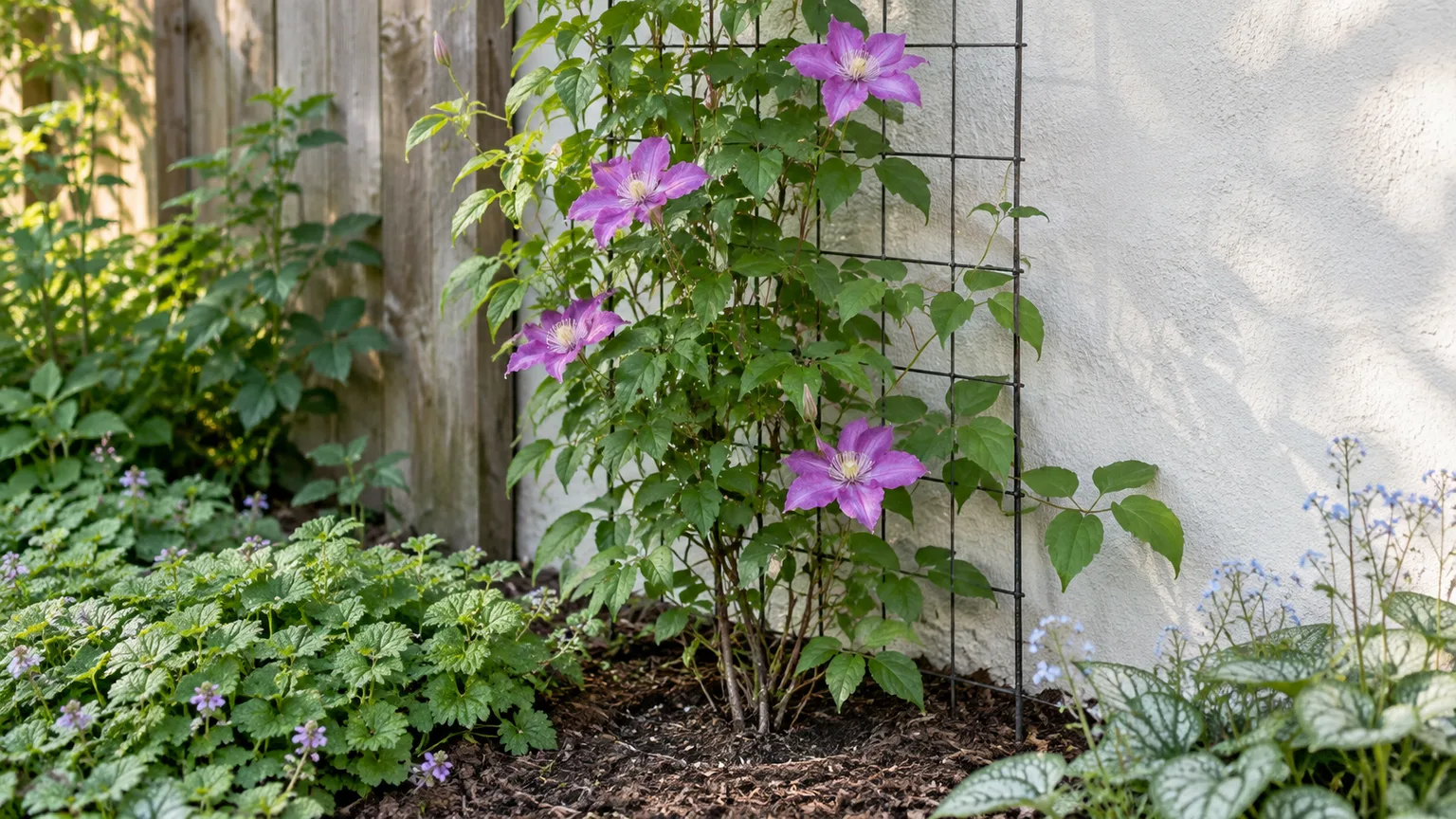
Vertical structure can save ground space. A trellis with a suitable vine can soften a fence, while a narrow, upright shrub may work where a wide, rounded shrub would block the passage. Neither is automatically fast or easy: vines need a sound support and periodic control, while narrow forms still need the right amount of sun and may need pruning to retain their shape.
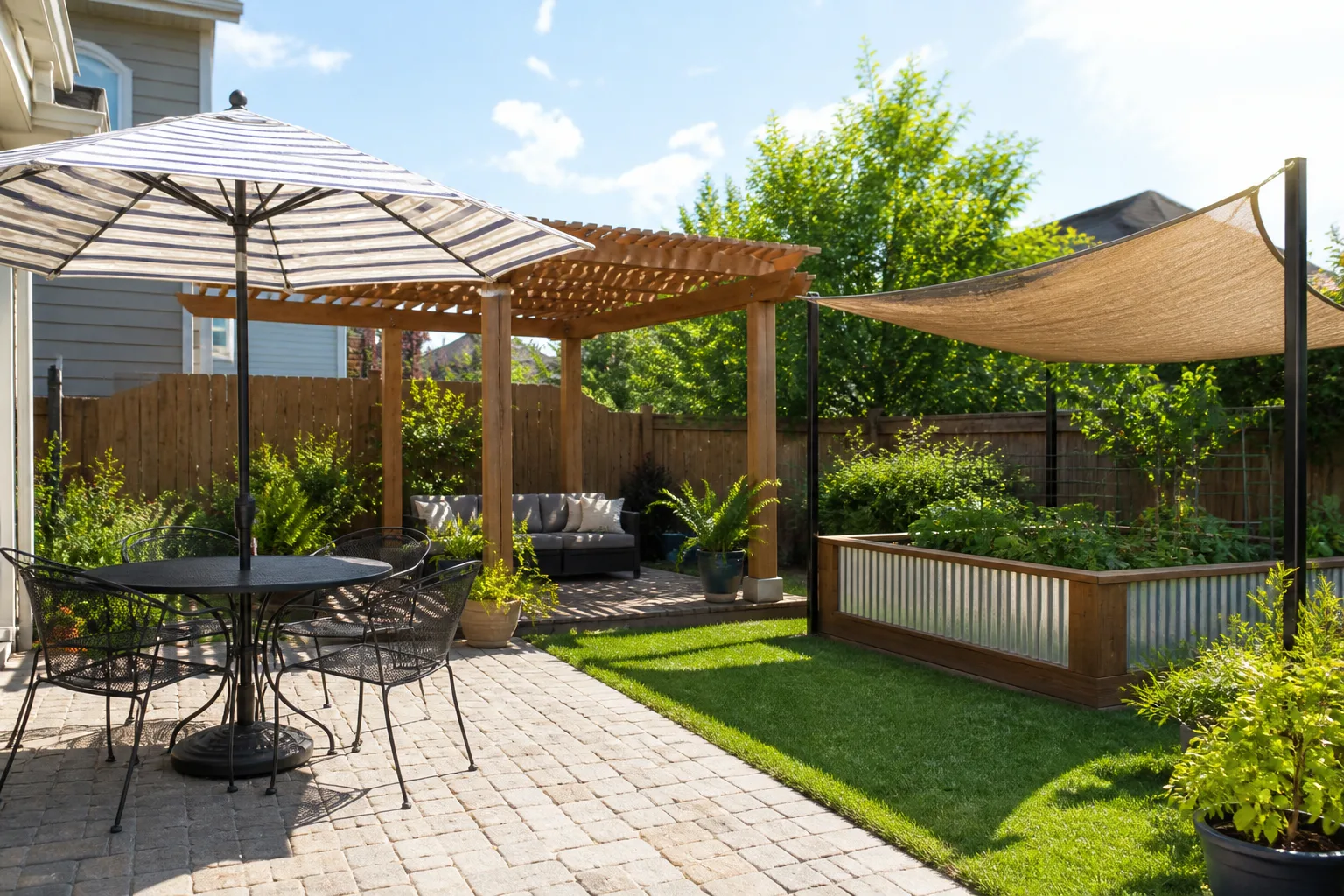
If the property line is so close that plants would grow over a walkway or into a neighbor’s yard, use containers or a constructed screen only after confirming local rules and wind safety. A container can control roots and simplify maintenance, but it dries faster than in-ground soil and may need more frequent watering. On a truly tight boundary, a narrow bed with a few well-chosen plants is often more useful than squeezing in a double row that will be difficult to maintain.
Plant along a fence, driveway, or shared view
A fence gives immediate structure, so plants do not have to do every job. Plant a low and medium-height border in front of it, train a climber on a separate trellis, or leave selected open bays so the fence remains accessible for painting or repair. Keep woody stems away from gates and latch points, and leave a working gap wherever a fence panel, meter, or drainage feature may need attention.
Along a driveway or street, prioritize visibility and mature height before flowers. Low plants near corners and entrances preserve sightlines; taller shrubs belong where they cannot block drivers, pedestrians, or turning vehicles. Do not place prickly shrubs beside a narrow walkway where people must brush past them, and avoid fruiting plants where fallen fruit would create a slippery surface.
For a neighbor-facing line, design for two views. A formally clipped hedge with a bare backside can look unfinished from next door, while a layered planting can look good from both yards if the taller structure is placed thoughtfully. If branches cross the boundary later, local laws and customs differ; it is better to agree on access and pruning expectations before planting than to rely on assumptions after the shrubs mature.
Match plants to light, soil, and mature size
Spend a few days observing the line before choosing plants. A border beside a tall fence may receive less sun than the open lawn; a narrow passage can be dry because the roof blocks rain or damp because a downspout discharges there. Check the soil after rain and during a dry spell, because “average garden soil” is not a useful description of a site that stays soggy or bakes against a west-facing wall.
The BBC Gardeners’ World border-planning guide recommends matching plant choices to the border’s aspect and soil, then considering style, budget, and available maintenance time. That sequence prevents the most common design mistake: choosing a plant for its flower photo, then trying to force it into a spot with the wrong light or moisture.
Use the plant label or a regional extension reference to record the mature height and width of each candidate. The label’s range can vary by climate, soil, and pruning, so take the larger plausible size seriously. University of Idaho Extension advises considering mature spread and potential nuisance from leaves, flowers, or fruit to neighbors, along with sunlight, water compatibility, and maintenance requirements.
| Site or goal | Border direction | Main trade-off |
|---|---|---|
| Year-round screening, room to grow | Evergreen hedge or mixed evergreen screen | Screening takes time; clipping and replacement access matter |
| Softer look with seasonal interest | Repeated mixed shrub border | More species means more careful matching and occasional pruning |
| Sunny, wide edge with movement | Clumping grasses and perennials | Attractive texture, but limited winter privacy |
| Long, open or wooded boundary | Trees with an understory | Height and habitat, but eventual shade, roots, and debris |
| Narrow passage or small patio | Compact row or separate trellis screen | Saves width; support, watering, and access need planning |
Lay out spacing and access before planting
Measure the area you can actually use, from the boundary inward, then sketch the mature plant widths to scale. If two shrubs each mature four feet wide, planting their trunks two feet apart will not create a tidy narrow hedge; it will create a crowded line that must be pruned continuously. Follow spacing guidance for the species and the look you want, then leave room for plants to meet without swallowing the path.
Mark proposed locations with pots, stakes, or temporary flags before digging. Walk the route from both sides and look from the windows and patio. This simple dry run can reveal that a large shrub blocks a gate, a taller tree hides a good view, or the design feels too uniform when repeated every three feet.
A straight formal hedge usually needs consistent spacing and a long-term pruning plan. A mixed border can be staggered, with a rhythm of repeated groups rather than a continuous line; just avoid placing plants so close that their canopies overlap heavily before you intend them to. When height matters, put tall plants at the back and shorter ones toward the front, adjusted for the direction people will see the bed. Gardeners’ World uses this layering principle for borders so taller plants can form a backdrop without hiding lower planting.
Before planting, confirm you can reach every shrub with the tools you expect to use. If a hedge needs both sides clipped, plan the access strip now. If the plants will only be reachable from one side, choose species and a form that can be maintained from that side without repeatedly leaning over a fence or stepping into a neighbor’s yard.
Plan for upkeep, neighbors, and the first two years
The lowest-maintenance design is usually the one that fits the available space at maturity. A hedge can require a trim once or twice a year depending on the species and desired form, but a hedge planted too close to a fence may need repeated corrective cuts. A loose shrub border generally asks for selective pruning, removal of dead stems, and occasional control of suckers rather than geometric shearing.
Water new plants regularly during their first growing season and through dry spells while roots establish. The RHS advises not letting new shrubs dry out before roots reach into the surrounding soil; University of Idaho Extension similarly treats planting season, root handling, watering, and mulch as part of successful establishment. A drought-tolerant plant is not drought-proof immediately after transplanting. A drip line or soaker hose can make a long boundary easier to water consistently without wetting pavement.
Mulch helps suppress weeds and moderate soil moisture, but do not pile it against shrub stems or tree trunks. Keep the edge defined in a way you can maintain—a shallow cut edge, mow strip, or stable path is often more practical than a fussy stone border along a long line. Avoid heavy soil fill around established trees, and be careful about adding a raised bed where tree roots or drainage could be affected.
Talk with a neighbor before a tall screen changes their light, blocks a view they rely on, or creates recurring leaf and fruit cleanup. You do not need agreement for every small plant, but a short conversation can surface shared concerns about a fence, access, irrigation, or the look of both sides. If the planting will affect a shared structure or boundary, put the arrangement in writing and confirm any local rules rather than treating a friendly verbal assumption as a permanent agreement.
Avoid the mistakes that make borders expensive
The first common mistake is planting before confirming the line. The second is using a fixed distance—“three feet from the fence,” for example—as if it were a universal rule. The right placement depends on the actual boundary, local restrictions, mature spread, access, species, and intended pruning form.
Another expensive choice is buying only for fast growth. Fast-growing shrubs can screen sooner, but their size and pruning demand may quickly exceed what a small yard can support. A plant that grows slowly but fits the site can be more private over time because it remains dense and manageable instead of being cut back severely every season.
Do not assume a solid screen will solve noise. Plants can soften the view and create a more pleasant sense of enclosure, but a narrow hedge is not soundproofing. If noise is the central concern, consider the source, the height and continuity of any fence or wall, and whether a landscape professional can help integrate planting with the appropriate physical barrier.
Finally, do not choose invasive or aggressive spreaders just because they fill space. Check state and local invasive-plant lists, especially for species that spread by seed or rhizomes. Ask a local extension office or native-plant society for alternatives that serve the same height, season, and wildlife role in your region.
A practical sequence for turning an idea into a plan
- Verify the line and restrictions. Find a current survey or ask a licensed surveyor if the boundary is unclear. Check easements, utilities, local planting rules, and shared access before digging.
- Name the job. Decide whether you need winter privacy, a seated-height screen, a softer fence, color, wind filtering, or a clear edge. Choose one primary purpose and one secondary benefit.
- Measure the usable strip. Record its width, length, light, soil moisture, drainage, slope, overhead wires, and access points. Note views from the house and from the neighboring side.
- Choose a structure. Pick a formal hedge, loose mixed hedge, layered border, grass ribbon, tree line, or small trellis planting based on the space and maintenance you can provide.
- Shortlist regionally suitable plants. Check mature dimensions, hardiness, light and water requirements, spread, pruning needs, and local invasive status. Use regional sources rather than copying an online list from another climate.
- Mark, review, and plant. Place stakes or nursery pots at the planned locations and inspect the arrangement from multiple angles. Adjust for access and mature width, then plant and water according to the species’ needs.
This sequence prevents the common trap of buying a cart of attractive shrubs and then squeezing them into whatever space remains. A small drawing with measurements, plant names, mature sizes, and maintenance notes can be enough to guide a phased project; you do not have to install the whole length in one season.
Conclusion
The strongest property-line landscaping starts with a verified boundary, a clear purpose, and an honest look at the room plants will occupy when mature. From there, choose a form that fits the site: a layered border for color and depth, an evergreen screen for winter privacy, a loose mixed hedge for wildlife and seasonal interest, or grasses and trees for a more open edge.
Give plants the conditions and maintenance access they need, and think about how the planting will look from both sides. Those decisions do more for the finished garden than picking the fastest-growing shrub on the nursery bench—and they help turn a property edge into a useful, attractive part of the landscape.