How to Grow and Care for Yew: Planting and Pruning
Get a practical yew care plan: match a Taxus cultivar to your space, prevent root rot with drainage, prune for dense growth, and manage toxicity safely.
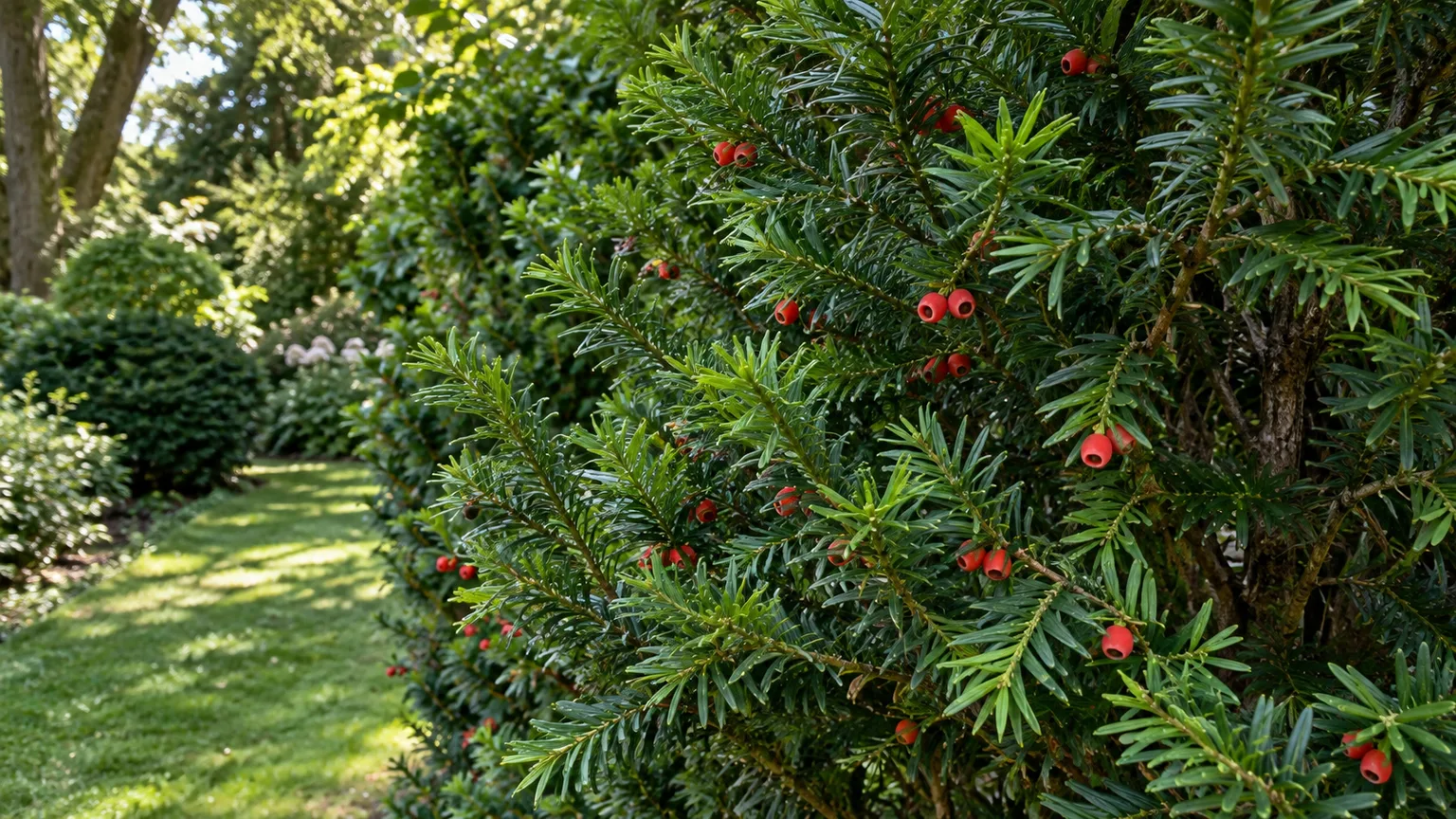
Yew is a slow-growing evergreen that can become a formal hedge, a clipped topiary, a compact foundation shrub, or a long-lived specimen tree. The genus Taxus includes species and cultivars with very different mature sizes, so success starts with choosing a plant that fits the space you actually have. Two other decisions matter just as much: keep its roots out of stagnant water, and plan around the plant’s serious toxicity to people and animals.
For most established yews, care is straightforward. Give a new plant consistent moisture while its roots settle, avoid waterlogged soil, and prune toward the shape you want instead of repeatedly cutting off the top. The details below help you adjust that plan to your species, site, climate, and use.
Know what yew is and what it needs
Yew is an evergreen conifer in the family Taxaceae, but its female plants do not make the familiar woody cones of pines. Instead, each seed sits partly inside a fleshy red structure called an aril. People often call the aril a berry, but that name can make the plant sound edible; the seed inside is highly toxic, and yew foliage and other parts also pose a poisoning risk.
Yews can live as shrubs or trees, and pruning can keep many cultivars much smaller than their untrimmed size. Their short, flat needles are generally arranged in two rows along the twig, and the dense branching makes them useful as screens. A NC State Extension profile of Taxus describes the genus as adaptable to sun and partial shade but sensitive to poor drainage, with cultivars ranging from low, spreading forms to upright selections.
A useful care summary is simple: match the plant’s eventual dimensions to its site, choose a spot with moving water rather than a soggy root zone, then water deeply while it establishes. Once the root system is settled, many in-ground yews need little intervention beyond occasional dry-weather watering and the pruning required by their design. A formal hedge needs more attention than a natural specimen left to grow.
Choose a yew that fits your space
“Yew” is not a single-size shrub. Some selections stay low and spread several feet; others become tall, narrow trees. A plant that is sold at a convenient small size may still outgrow a foundation bed, crowd a walkway, or shade a window if its cultivar label is ignored.
Before buying, write down the mature height and width you can accommodate, whether you need a hedge or a solitary plant, and the coldest winter conditions in your garden. Then compare those needs with the cultivar’s label and local university or arboretum guidance. The Purdue Arboretum’s Taxus guide notes that hardiness, shape, and deer resistance vary among species and cultivars, especially in hybrids.
English yew and Irish yew
English or common yew, Taxus baccata, is the classic dense hedge and topiary plant in milder climates. Its forms include broad, spreading shrubs and upright selections. Irish yew, often sold as T. baccata ‘Fastigiata,’ is a narrow, columnar cultivar that uses less ground width than a broad hedge, but can still grow tall and may open outward as heavy branches mature. Check the exact cultivar, not just the species name.
Low-growing forms such as ‘Repandens’ work better for short borders and ground-level structure than a tall screen. Some cultivars have gold or variegated foliage; these can need partial shade to keep the color from bleaching or scorching in intense sun. The RHS yew growing guide describes yew’s range of uses and notes that cultivar shape and foliage color influence where it performs best.
Japanese, Canadian, and hybrid yews
Japanese yew (T. cuspidata) is widely used in colder parts of North America, but the hardiness of a particular plant still depends on the cultivar and local exposure. It may grow as a broad shrub or upright small tree; dwarf selections are common for foundation planting. Canadian yew (T. canadensis) is a low, spreading native species suited to different landscape roles than a tall privacy hedge.
Anglojap or hybrid yews, Taxus × media, combine traits of English and Japanese yews and are sold in many forms. ‘Hicksii’ is commonly chosen for a narrower upright screen, while other hybrids stay compact or spread more broadly. Do not rely on one generic zone range for the genus: compare the label’s cold-hardiness rating with your USDA zone and ask a local extension office about wind, snow cover, and winter exposure. A practical Taxus growing guide from Harvest to Table also separates the landscape uses of English, Japanese, and hybrid forms; use it to narrow your choices, then let the cultivar label and local advice decide the final fit. A correctly sized cultivar is easier to maintain than one that must be constantly reduced.
Give yew light without exposing it to harsh stress
Yew tolerates a wide range of light, from sun to shade, which is one reason it is used under trees and beside buildings. Tolerance does not mean every position produces the same growth: a yew in deep shade tends to grow more slowly and may become less dense, while a young plant in hot, exposed sun can dry or scorch. Filtered light or morning sun with afternoon shade is a reliable compromise in warm regions.
Also consider wind, reflected heat, and winter exposure. A site that looks calm in summer may funnel drying winter winds across evergreen needles, especially when soil is frozen and roots cannot replace water lost from foliage. The University of Minnesota’s yew profile recommends protection from strong winter winds; in a harsh location, a sheltered side of a building or a windbreak can help, provided it does not create a wet pocket around the roots.
Choose soil for drainage, not a perfect recipe
Yew can grow in many soil textures, including clay, loam, and sand, as long as water does not remain around the roots. It generally prefers moderately moist, well-drained soil and can tolerate a range of pH values. That means you usually do not need a special acidic mix or an elaborate fertilizer program; the bigger question is whether rain drains away between storms.
Check the site after a heavy rain. If water stands in the planting area, the soil stays slick and saturated for days, or nearby plants repeatedly suffer root problems, choose another spot or correct the drainage before planting. In heavy soil, a broad raised mound can lift the root zone above the wettest layer. The RHS guide also recommends planting on a ridge where ground remains waterlogged; simply digging a deep hole and filling it with loose potting mix will not solve drainage if the surrounding clay holds water like a basin.
Avoid placing a root ball too deep or burying the stem under a thick mulch layer. Set the top of the root ball level with the surrounding soil, or slightly higher where drainage is marginal, and keep mulch away from the trunk. Yew is not a bog plant: persistently wet roots can decline even when the foliage initially looks green.
Plant yew at the right depth and time
Plant in fall or early spring when the ground is workable and the plant can establish without the stress of summer heat. Avoid planting into frozen soil, a saturated bed, or a forecast stretch of severe heat. Container-grown plants can be set out during mild weather if you can water consistently, but smaller plants often establish more readily than oversized specimens.
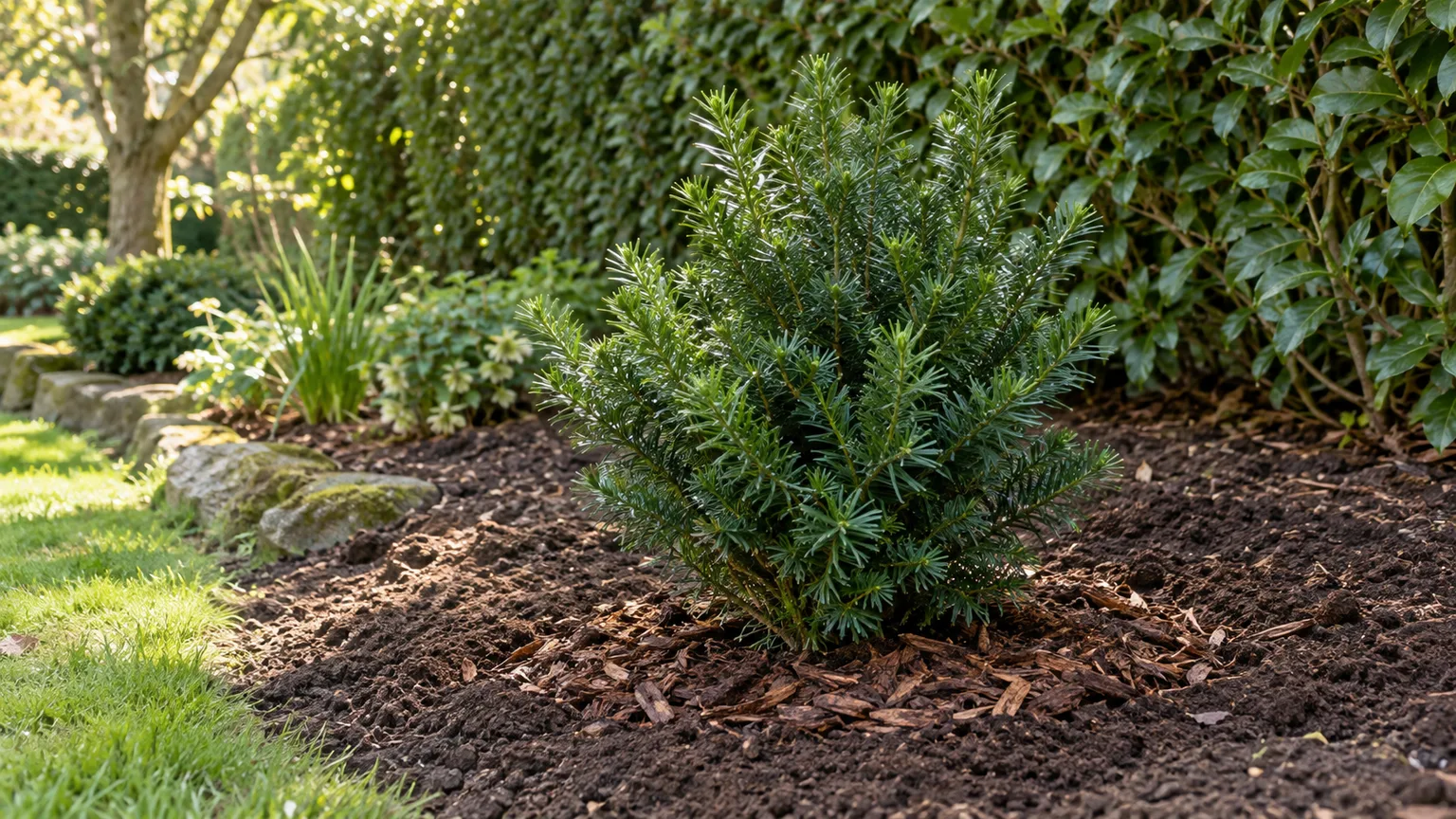
Dig a hole wider than the root ball but no deeper. Loosen circling roots at the outside of a container-grown root ball, set the plant at the correct depth, and backfill with the soil you removed rather than creating a rich, sharply different pocket. Water slowly to settle the soil around roots, then add a thin layer of mulch over the root zone with a clear gap around the stem. Keep the plant’s label so the cultivar and expected size do not get lost once the tag is removed.
For a hedge, mark the full line and check underground utilities, paths, mature tree roots, and the intended height before you plant. Buy plants of similar size from the same cultivar when a uniform screen matters. Do not crowd plants to get instant coverage; excessive crowding can leave the hedge difficult to access and make watering and pruning less even.
Set hedge spacing before you dig
There is no universal yew spacing number because cultivar width and hedge goals differ. For a single-row hedge, use the nursery’s recommended spacing for the specific cultivar and balance two outcomes: closer planting closes the gap sooner but raises plant cost and competition; wider spacing saves plants but leaves open windows for longer. A short border and a tall privacy screen may need different spacing even if the plant name is identical.
Measure the hedge’s future width as well as its distance from a fence or wall. If you cannot reach the back for trimming or airflow, a hedge planted too close to a boundary may become a recurring maintenance problem. The RHS planting guidance favors small bare-root plants for hedging because they often establish efficiently; availability and the best planting window vary by region.
Water by establishment stage
Water newly planted yews deeply enough to moisten the root ball and the surrounding soil, then check moisture before watering again. For the first year, inspect during dry periods rather than following a rigid weekly schedule: sandy soil, wind, heat, and a small root ball can dry quickly, while clay soil may stay wet much longer. A finger pushed into the soil near the root ball is a better guide than a dry-looking surface alone.
Once the plant is established, an in-ground yew usually needs supplemental water only during prolonged drought or unusual heat. A brief shower may wet the foliage without reaching the roots, so use a slow soak at the base when the soil is dry. If the soil is already damp, do not add water just because the calendar says it is time; more water cannot fix a plant whose roots are suffocating in saturated ground.
Containers are different because their limited soil volume dries faster and warms more quickly. Check the pot during hot weather and water thoroughly when the upper layer has begun to dry, letting excess water escape through the drainage holes. Never leave the pot standing in a saucer of water for long periods.
Feed lightly and mulch the root zone
Established yews growing steadily in decent soil usually do not need routine fertilizer. If a plant is pale or growing poorly, first check drainage, planting depth, light, root competition, and pests. Fertilizer will not repair root rot or a cultivar struggling in the wrong climate, and a high-nitrogen dose can push soft growth that the site cannot support.
If a soil test or clear growth issue indicates a nutrient need, use a balanced landscape fertilizer according to its label and apply it at the proper season for your region. Compost or a modest organic mulch is often enough to support soil structure. The RHS advises that yews generally need little feeding, with container plants more likely to benefit from periodic feeding because nutrients in potting mix are limited.
Spread a few inches of organic mulch over the root zone to moderate moisture and suppress weeds, but leave a bare ring around the trunk. Top it up when it thins instead of piling a new volcano over old mulch. Mulch helps buffer drying; it should not conceal a persistently wet crown or replace a drainage correction.
Prune for a full, tapered hedge
Yew tolerates clipping and can regenerate from older wood better than many conifers, which makes it forgiving when a hedge needs renovation. That does not make every cut harmless. Heavy pruning can remove years of growth, and a plant cut back beyond living foliage may recover unevenly or take a long time to refill.
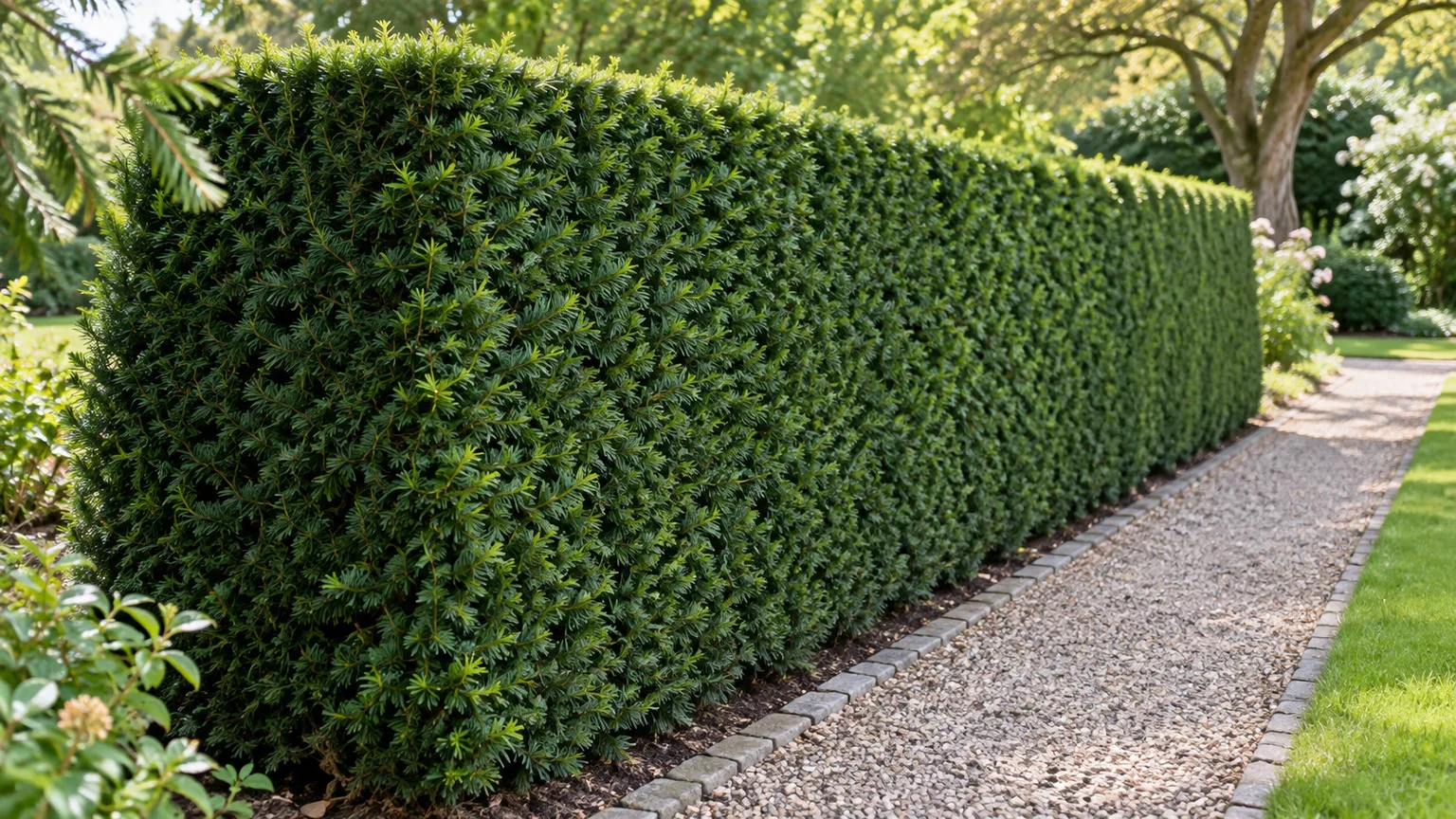
For a hedge, aim for a slight taper: the base should be wider than the top so lower branches receive light. If the top overhangs a narrow base, the hedge can become bare at the bottom even while the outer surface looks neat. Use hand pruners for selective branches and hedge shears for the outer surface; avoid shearing when the plant is drought-stressed or during extreme heat.
Routine trimming is usually done in summer or early fall after the main spring growth has extended, but regional timing varies with climate and the form you are maintaining. The RHS recommends an annual trim for established hedges, while a practical Ashridge Trees guide to trimming yew hedges describes September–October as a useful single-cut window in its UK context. Treat the month as a local guide, not a rule for every climate. Before trimming, inspect carefully for active bird nests and postpone work around a nest.
Shape young plants without stalling height
During the first years of hedge growth, focus on side branches and keep the hedge’s leader growing until it reaches the planned height. Repeatedly cutting the top early can slow upward progress; you can still shorten straggling side shoots to encourage a denser outline. Once the top reaches the target, clip it level and maintain that height with light annual cuts.
Start with a string line or a simple visual guide so the hedge does not drift wider or taller each season. Cut a little at a time, step back to inspect the profile, and keep the lower edge broad. If one plant is shorter than the rest, do not force a perfectly flat top immediately; a gradual line can let the lagging plants catch up without removing too much of the taller leaders.
Maintain old hedges and topiary
An established hedge can often be kept neat with one light annual trim, while formal topiary may need more frequent clipping during active growth. Make selective cuts back to a side branch when you are reducing a particular stem, and avoid leaving long bare stubs. For shapes that have opened outward, tie upright branches gently if the form allows, then prune protruding shoots back into the green outline.
Renovate an overgrown hedge in stages rather than removing a large amount of canopy in one pass. The RHS recommends a multi-year approach—lower the top first, then reduce one side and the other in following seasons—and notes that yew can be cut back more severely than most conifers. Ashridge Trees describes winter as a suitable time for major changes in its milder UK context. Because a severe renovation is difficult to reverse, check local guidance and the plant’s health before committing to a hard cut. Wear gloves, keep children and animals away from cuttings, and gather the debris promptly.
Grow yew in a container
Compact or slow-growing cultivars can make useful container specimens near an entry, patio, or formal seating area. Choose a pot with drainage holes and enough volume to hold the root ball with room for several years of growth; a small pot dries quickly and can become unstable as the shrub grows. Use a well-drained outdoor potting mix and avoid a decorative cachepot that traps runoff around the roots.
Water container yew more often than an in-ground plant, but let excess water drain. In winter, roots in a pot are more exposed to freezing and temperature swings than roots in the ground, so select a cultivar suited to the local climate and place the container in a sheltered position. If the pot freezes solid or dries out in a windy spell, foliage can brown even when the plant would have survived in open ground.
Prune to keep the plant within the container’s space, but do not assume that clipping makes an oversized cultivar permanently small. Repot when roots crowd the drainage holes or the plant dries out unusually fast, moving up only one pot size at a time. A compact cultivar is a more reliable long-term choice than a large yew maintained by constant root restriction.
Manage yew toxicity and clippings safely
Treat yew as an ornamental plant, never as food or a home remedy. Its foliage, bark, wood, and seeds contain poisonous compounds; the fleshy red aril around the seed is often described separately, but the seed inside is highly toxic and the fruit’s bright color can attract children. Poison Control reports poisoning after children ate yew berries and adults brewed tea from needles. A veterinary reference, the Merck Veterinary Manual, also lists Taxus among poisonous ornamentals and distinguishes the aril from its toxic seed.
Do not plant yew where grazing animals can reach it, and think carefully before using it beside a play area or where pets routinely chew shrubs. Even a non-fruiting male plant is not safe to eat because the foliage remains toxic. Wear gloves when pruning, avoid carrying cuttings through areas where animals forage, and bag or otherwise secure trimmings according to local green-waste rules. Do not leave a pile beside a fence or toss branches into a paddock.
If a person may have swallowed any yew part, contact Poison Control or emergency services immediately; in the United States, Poison Control can be reached at 1-800-222-1222. If an animal may have eaten yew, call a veterinarian or animal poison service immediately. Do not wait for symptoms or try to induce vomiting unless a qualified poison professional tells you to. If possible, take a photo or sample for identification without delaying the call.
Diagnose brown foliage and poor growth
Brown or bronzed foliage is a symptom, not a diagnosis. Before pruning or applying a product, note whether the damage is on one side, at the tips, across the whole plant, or concentrated at the base. Then check soil moisture, drainage, planting depth, wind exposure, and recent weather. A single brown patch after winter wind points toward a different cause than progressive browning in wet soil.
Yew can suffer root rot in waterlogged ground, and scale insects, mites, or vine weevils may contribute to decline. Inspect the underside of branches and the interior canopy for scale or webbing; check the root zone for standing water or a buried crown. The NC State Extension profile identifies poor drainage as a risk for root and fungal problems, while the RHS lists drought and waterlogging among the common causes of bronze-red foliage.
Check roots and site before treating foliage
If the plant has been watered frequently, stop and test the soil several inches below the surface before the next soak. If it remains wet for days, correct the drainage or move a young plant rather than trying a fungicide without a diagnosis. If the root zone is dry and the foliage is exposed to hot afternoon sun or winter wind, address the stress first and water deeply when needed.
For a hedge, compare neighboring plants. A single plant declining in an otherwise healthy row may have a damaged root ball, buried stem, or local drainage pocket; a whole row browning at once suggests a shared cause such as irrigation, soil saturation, or weather. Remove dead material with clean tools, but wait to reshape the plant until you see where live growth remains. If browning continues despite corrected conditions, or a mature specimen is declining rapidly, ask a local extension office or certified arborist to inspect it in person.
Propagate yew from cuttings
Cuttings are the practical way to reproduce a named cultivar because seedlings may not come true to the parent. Take semi-ripe cuttings from healthy current-season growth in late summer or early fall, and follow a regional propagation guide for rooting medium and overwintering conditions. Use clean pruners and gloves, label each cutting, and keep it in bright indirect light while the medium stays evenly moist rather than waterlogged.
Yew grows slowly, so rooting and establishment take patience. Seed propagation is slower still: seed may need extended treatment and can take one or more years to germinate. The RHS propagation guidance recommends cuttings for quicker, faithful reproduction and warns that seed germination can take several years. If you only need one hedge or specimen, buying a correctly identified cultivar from a reputable nursery is usually simpler than raising dozens of slow-growing plants.
Conclusion
Yew is a strong choice when you need an evergreen that can handle shade, clipping, and long-term structure, but only if the species and cultivar suit the site. Confirm its mature width and local hardiness, plant it where water drains, and give a new specimen regular checks through its first year. Then prune for a broader base, limit fertilizer to a demonstrated need, and manage all foliage and seed-bearing clippings as poisonous material. Those few decisions prevent most avoidable failures and let the plant do what yew does best: hold a clean, dependable shape for years.