14 Lawn Mower Storage Ideas for Every Home and Yard
Get 14 practical lawn mower storage ideas, plus clear guidance on gas, batteries, weather protection, airflow, and setups for compact or riding mowers.
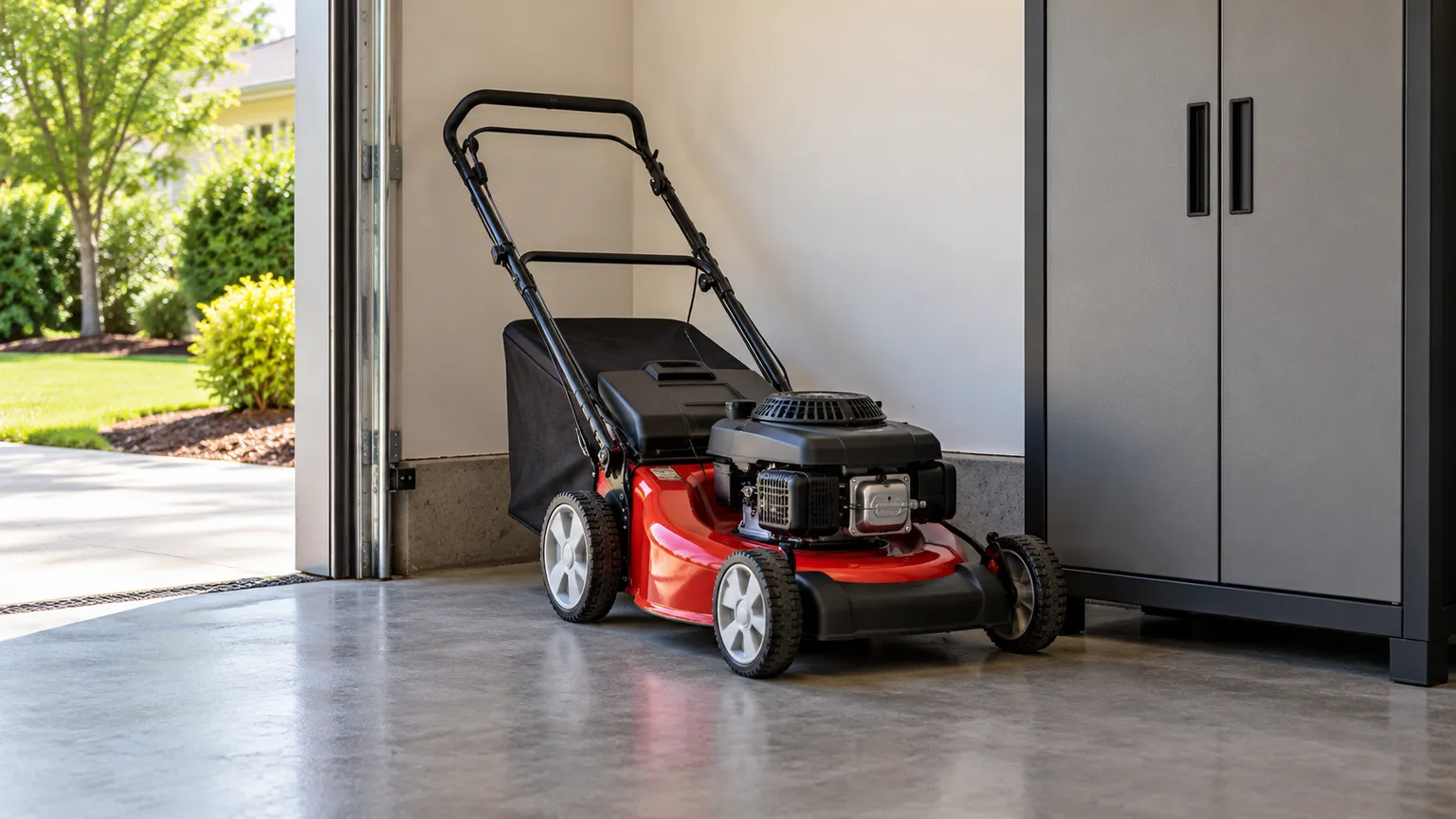
A mower is awkward to store because it is both bulky equipment and a machine with parts that weather, moisture, fuel, and careless lifting can damage. The right spot makes it easy to roll out for a quick cut, protects it between seasons, and keeps walkways and other equipment accessible.
There is no single best location for every mower. A compact cordless model may fit a wall cradle or utility nook; a gas push mower usually needs a level floor space; a riding mower needs a wide, low-clearance route; and a robot mower needs a properly placed charging base. Start with the mower’s manual, then choose from these 14 ideas based on weather, access, and how much space you have.
Start by choosing for mower, weather, and access
Think about storage as a combination of protection, movement, and safety. A roof alone will not stop wind-driven rain, a waterproof cover can trap moisture if it is sealed against damp grass, and a perfect shed is frustrating if its door is too narrow for the mower you own. Before building or buying anything, match the storage to your mower’s fuel or battery system and the way you will move it in and out.
| Mower or situation | Storage that usually fits best | Check before you commit |
|---|---|---|
| Gas push mower | Detached, lockable shed, away from the home | Fuel and engine instructions, ventilation, door clearance |
| Cordless push mower | Dry garage bay, shed shelf, or approved wall cradle | Mower manual, battery temperature and charging rules |
| Riding mower or zero-turn | Ground-level garage or purpose-built shed bay | Door height and width, ramp slope, turning radius |
| Robotic mower | Manufacturer’s charging base in its approved outdoor location | Adapter weather rating, drainage, cable route, winter rules |
| No enclosed space | Weather-rated locker or a temporary, well-secured cover | Condensation, runoff, theft, and local fire guidance |
These are starting points, not substitutes for the operating manual or local fire requirements. The U.S. Fire Administration says to keep gasoline and other flammable liquids in a shed away from the home, and notes the added fire risks found in garages and basements.
For a mower that contains fuel, a detached, lockable shed is the safer default; use an attached garage only if your local rules and the exact mower instructions permit it. Never keep a spare fuel can in an attached garage or living area. Electric-only indoor storage is a simpler choice for many households.
Match the storage position to the mower
First identify the mower’s weight, folded or unfolded dimensions, fuel type, and required storage orientation. For a push mower, check whether the handle folds without putting pressure on cables; for a riding mower, include the deck width, seat or roll bar height, and the turning room needed to line up with a door. A wall-mounted arrangement is only an option when the manufacturer permits that exact position and the mounting system is rated for the machine.
Also decide whether you are solving a daily parking problem or a long-term storage problem. Daily parking favors a short, clear route and a level spot; winter or multi-month storage calls for cleaning and model-specific fuel or battery preparation. Keeping those jobs separate avoids the common mistake of choosing a convenient nook and assuming it is automatically suitable for every season.
14 lawn mower storage ideas that solve different space problems
The options below are grouped by exposure and footprint. Ideas 1–7 use an existing indoor or enclosed area, 8–11 add outdoor protection, and 12–14 save floor space or serve a specialized mower. Use each as a starting design: drainage, ventilation, structure, and the mower’s instructions still determine whether it is appropriate for your model.
Indoor and indoor-adjacent setups
1. Give an electric mower its own garage floor bay. A marked floor rectangle near the side door is simple, stable, and easy to use after mowing. Keep it out of the vehicle door swing and away from the furnace, water heater, electrical panel, and the route people use to leave the garage.
Park the mower level on its wheels, with enough space to turn it without scraping a car or cabinet. A slim wall hook for gloves and hearing protection can define the area without trying to lift the mower off the floor. If you plan to park a gas mower in an attached garage, check local fire rules and the model manual first; the detached shed is the safer default for fuel-containing equipment.
2. Use the low garage corner under a sloped ceiling. The narrow wedge beneath a stair stringer or roof slope can fit a walk-behind mower where full-height shelving will not. Measure the handle at its actual folded and upright positions; the mower deck may clear while the handle catches a shelf or garage door track.
This is easiest for a battery mower; if the corner is in an attached garage, use it for a gas mower only when the model instructions and local fire rules allow it. Keep the tires on the floor and leave a hand-width buffer from damp foundation walls.
3. Turn an under-stair alcove into a compact equipment bay. A level nook beneath a basement or garage staircase can keep a folded electric mower out of a main walkway. This idea works best when the route is wide, the floor stays dry, and you can remove the battery and store it as directed.
Do not use the space for a gas mower or spare fuel if it is part of an occupied basement. Avoid stacking bins above the machine; the mower should roll out freely without someone lifting awkwardly on the steps.
4. Set up a detached garden shed as the all-season home. A lockable shed on a raised, level base gives the mower a roof, walls, and separation from living areas. Choose a door wide enough for the deck and handlebars, then leave the mower close to the entrance so you do not drag wet wheels past bags of soil or delicate tools.
A small threshold ramp can make a heavy push mower easier to roll in. The pictured shed keeps the machine at floor level and tools on the wall, a layout that preserves the center aisle.
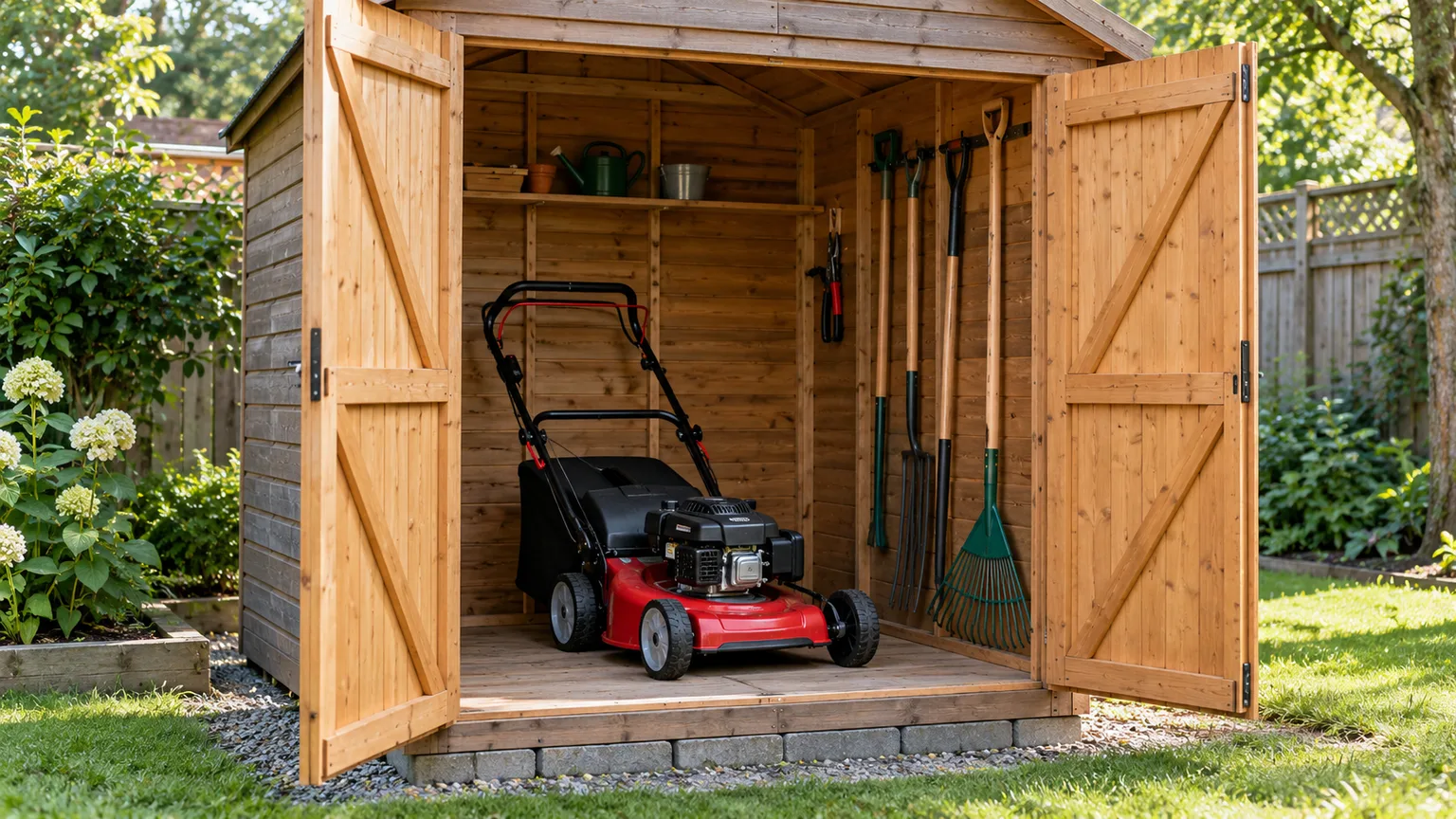
5. Add a service corner to a tool shed. If you already use a shed for shovels, rakes, and repair supplies, dedicate one end to the mower and its routine maintenance. Put a washable mat or boot tray beneath the wheels, and store the charger or small parts in a closed cabinet.
Keep blade-service tools separate from everyday access, and leave floor room to roll the mower out before cleaning or inspecting it. The aim is an organized station, not a pile of fuel cans and tools beside a hot engine.
6. Reserve the doorway side of a potting shed. A potting shed can be a convenient place to keep a mower near garden paths, but the working bench should not block the route. Keep the mower near an exterior door and protect potting soil, seed packets, and fertilizers from clippings and oil drips.
This arrangement works for compact push mowers when the shed floor is dry and strong enough; a riding mower typically needs a much larger door and turning area than a standard potting shed provides. If you use potting work surfaces for food or plant starts, put down a separate equipment mat.
7. Use a utility-room or mudroom nook only for a small electric mower. A lightweight, folded cordless mower may fit in a dry service area by an exterior door, which can be useful in a townhouse without a garage. Remove the battery if the manual directs you to, and charge or store it only in the conditions the manufacturer specifies.
Keep the mower away from coats, shoes, and escape paths; do not bring gasoline, fuel cans, or a gas mower into an occupied mudroom. If fumes, damp grass, or the blade enclosure would make the room unpleasant, choose an outdoor locker instead.
Covered outdoor setups
8. Buy a weather-rated mower locker. A purpose-built outdoor locker or small resin shed can be a good middle ground when a full-size garden shed is too costly or will not fit. Check the mower’s complete handle-and-deck dimensions, interior ventilation, door opening, floor load rating, and how rain drains away from the base.
A resin enclosure can keep direct rain off the mower but may become hot or humid in full sun, so place it on a shaded, level surface and follow the manufacturer’s ventilation guidance. A hasp or lockable latch helps deter casual access but does not replace a sturdy anchor in a windy yard.
9. Build a roofed lean-to against a detached outbuilding. A simple lean-to uses an existing wall to shelter a mower without taking up the space of a full shed. Site it where roof runoff is directed away from the mower and where prevailing rain does not blow directly into the opening.
Check local setback and building rules before attaching a structure to a fence or outbuilding, and do not block a window, utility access, or the path around the building. A side panel can reduce splash and provide privacy, but leave enough open area for air to move and moisture to dry. For a fuel-containing gas mower, keep the shelter away from the home and follow local fire requirements.
10. Use a covered pergola or carport end bay for frequent mowing. A deep roof over a dry, level parking area can keep sun and ordinary rain off a mower that is used every week. It is most useful as a quick-access seasonal station, not as a secure substitute for an enclosed shed: wind can push rain under the roof, and the mower remains visible.
Store it at the edge of the space so vehicles and people can pass safely. For a gas mower, choose a detached structure and follow local fire requirements; an attached carport is a better fit for electric equipment. Before a storm or long winter layup, move the mower to a more enclosed location or prepare it for the exact storage conditions described in its manual.
11. Create an under-deck bay only if the ground stays dry. The area below a raised deck can be hidden from view and keep equipment out of the garage. It is a poor choice where water collects, soil stays wet, or the deck leaks, because a roof does not prevent damp air or ground moisture.
Add a hard, slightly raised surface that drains away from the structure, and screen the opening against leaves without sealing the space airtight. Test it through a rainstorm before leaving a mower there for the season, and use a breathable cover only after the mower is fully dry. If the deck is attached to the home, reserve this bay for electric equipment; use a detached shed for a gas mower with fuel in its tank.
12. Treat a heavy-duty tarp as a short-term stopgap. If you must leave a mower outside temporarily, first park it on a level, raised platform in a spot that does not pond water. Choose a fitted, UV-resistant cover that reaches low enough to block wind-driven rain but leaves a route for trapped moisture to escape; secure it to the platform rather than fastening cords around sharp machine parts.
Remove the cover after rain or mowing so the deck can dry. A tarp is not a lockable shed, and it is a poor long-term answer in windy, snow-prone, or humid climates.
Space-saving, robotic, and temporary setups
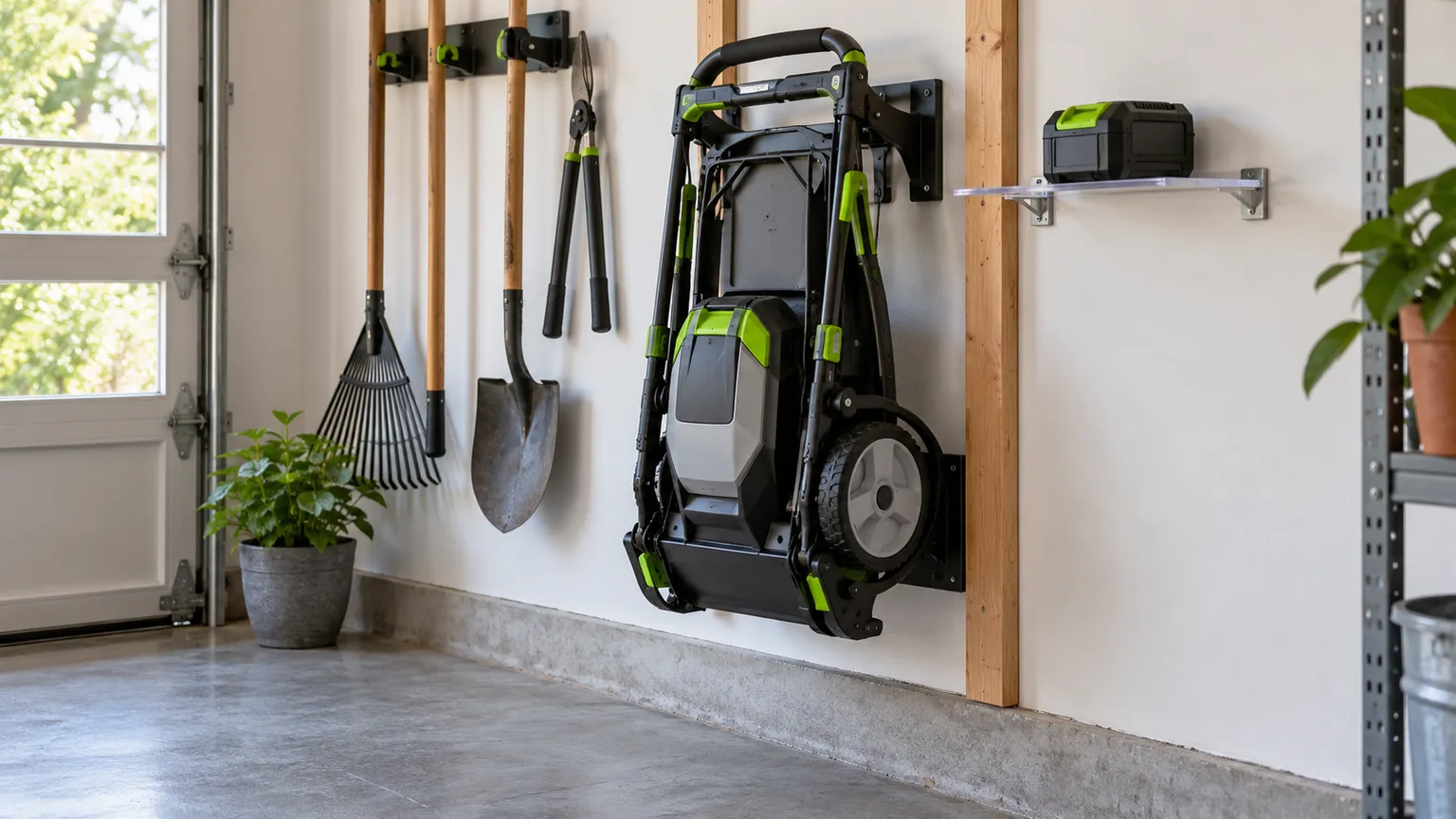
13. Mount a compatible compact mower in an approved wall cradle. A foldable battery mower can free up garage floor space when the manufacturer explicitly permits vertical storage and the cradle supports the mower’s weight at its intended contact points. Fasten the system into studs or an engineered backing, keep the mower away from a parked car, and follow the required orientation for the battery, oil, and deck.
The battery is shown stored separately on the shelf; whether yours should be removed depends on its manual. A generic pegboard hook or ceiling hook is not a safe substitute for a rated cradle.
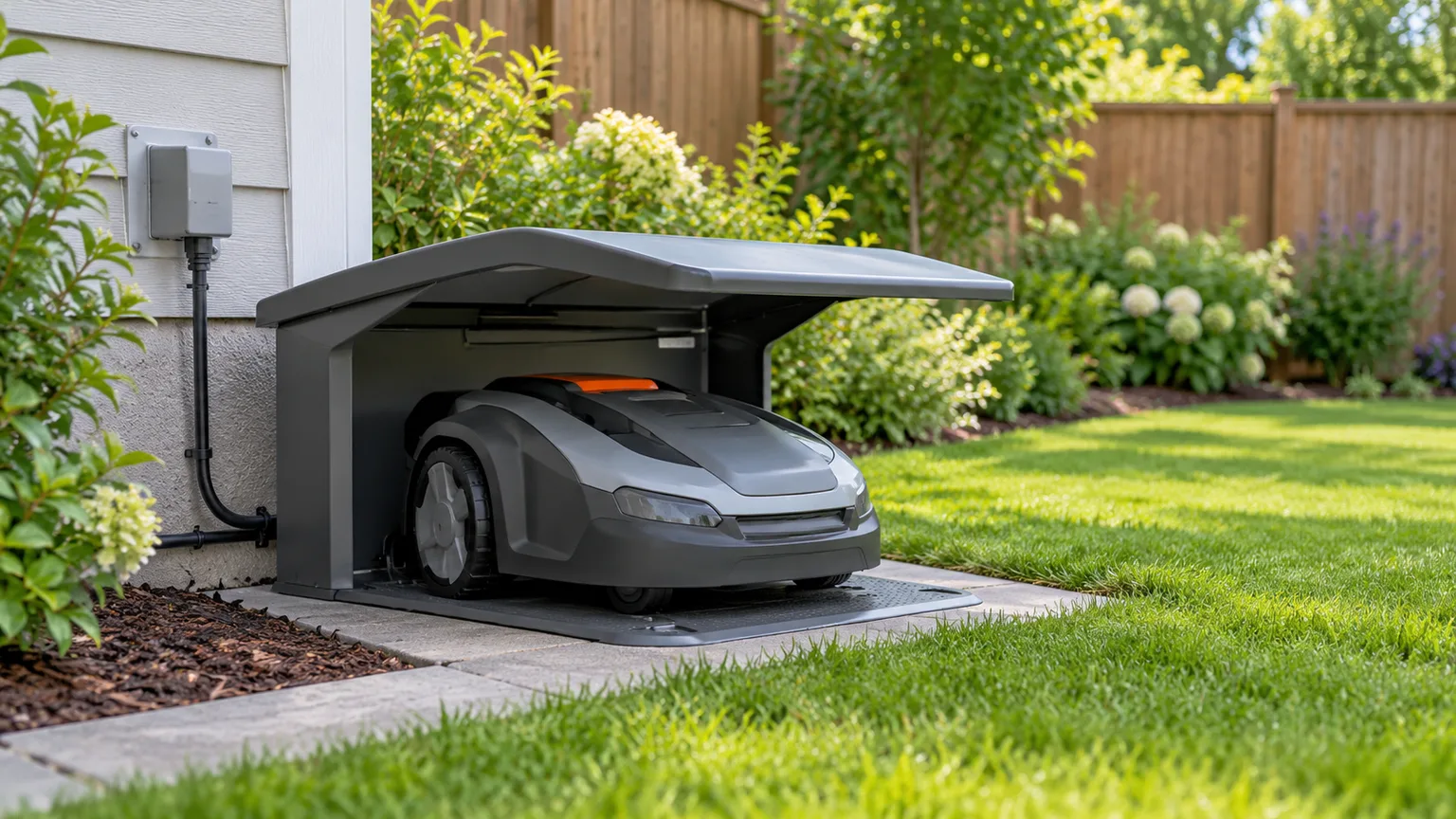
14. Give a robotic mower a properly placed charging shelter. Keep the charging base where the mower can approach it straight, find the boundary wire or navigation signal, and return without crossing a high-traffic path. A small hood can shade the mower and dock, but it must not obstruct sensors, ventilation, or the manufacturer’s clearance requirements.
Keep the power adapter and plug only in locations and weather conditions for which they are rated; Better Homes & Gardens’ testing found that a robot mower’s outdoor charging station did not automatically mean its adapter was weatherproof. If the mower is stored indoors for winter, use the manufacturer’s instructions for both the mower and battery rather than leaving a charging base connected under an improvised cover.
Make the setup safer than a parking spot
The storage location matters, but the mower’s condition when you park it matters too. Grass clippings hold moisture, and a hot engine can ignite nearby material.
A mower that is tilted or suspended in an unapproved position can leak fluids or fall. Build a repeatable routine: let the machine cool, switch it off, remove the key or disable starting, and clean it according to the manual before covering or storing it.
Treat gas storage as a separate safety decision
A gas mower is not simply another item to tuck into a basement corner. The U.S. Fire Administration identifies garages and basements as higher-risk fire areas and advises storing gasoline and other flammable liquids in a shed away from the home.
Its household hazardous-material guidance also says portable gasoline containers should be filled outdoors in an airy place and placed on the ground while filling. Do not keep a spare fuel can in an attached garage or living area; follow local fire rules and the container label.
For the fuel left in the mower, use the engine maker’s storage method rather than assuming every mower should be drained or stabilized in the same way. The University of Georgia Cooperative Extension recommends winterizing small engines that will sit unused for three or four weeks or longer.
Its example procedure drains the tank and runs the engine briefly to clear fuel from the carburetor, then checks oil, filters, and other service items. Some manufacturers give a different procedure, so treat that guidance as an example of why seasonal preparation matters, not as a replacement for your model’s instructions. Never drain fuel near a flame, hot engine, drain, or storm sewer.
Store batteries and charging gear by the manual
Battery mowers avoid gasoline storage but still need a suitable place for their battery packs and chargers. Remove the battery only when the maker instructs you to; store it indoors in the temperature range specified by the manual, away from moisture and heat sources.
Do not assume the garage is the right place in a region where it gets extremely hot or cold. Do not leave an unapproved charger running under a tarp or in a damp shed.
For a robot mower, think of the dock, power supply, and cable route as part of the storage system. The mower body may tolerate rain while its transformer or plug does not. Better Homes & Gardens’ robotic mower testing notes that one charging setup required a weather-protection solution for its adapter even though the dock itself was outdoors.
Check the exact weather rating before placing any electrical part outside; an improvised plastic box that traps heat or moisture can create a different problem.
Keep the mower ready to roll
Let a mower cool completely before you cover it, and remove wet clippings from the deck and wheels so they do not sit against metal for weeks. Follow the manual for cleaning around the blade; disconnect the spark plug wire or remove the battery before working near the blade, and never reach beneath a deck while the machine can start. Store a push mower level unless the manufacturer expressly permits another orientation.
Leave the mower on the floor unless a specific wall cradle is approved for its model and weight. Ceiling hooks and improvised straps are not sensible ways to suspend a mower above a car or walkway: a failed fastener can injure someone and damage both the machine and vehicle. Mount small accessories such as gloves and a grass bag on the wall instead, where they stay accessible without creating a lifting hazard.
Fit the storage to the room you actually have
A storage idea works only if the mower can reach it. A garage corner that looks large in a photo may become unusable once you account for the door track, car mirrors, a sloped slab, a workbench, and the mower’s turning radius. Mark the footprint on the floor with painter’s tape and practice the route before you buy a shed or drill a wall.
Measure the whole path, not just the floor bay
Measure the mower at its widest point with the handle folded and unfolded, then measure every doorway, gate, ramp, and turn between the lawn and its storage spot. Add enough space to grip the handle and move around the deck; do not wedge the mower tightly between a hot appliance and stacked boxes.
For riding equipment, check overhead clearance at the shed door and the approach angle on the ramp, not just the interior dimensions. A model with a wide cutting deck may fit inside but fail to turn through a narrow side gate.
Plan where the charger, battery, mower cover, and accessories will live so they do not occupy the clear route. Family Handyman’s garage-planning advice emphasizes mapping traffic flow and existing constraints such as windows, door tracks, and utilities before installing cabinets or wall storage. The same reasoning applies to a mower bay: access should stay clear after the car is parked, the garage door is open, and the mower is rolled into place.
If you share the space with children or pets, store keys and detachable batteries out of reach, keep blades covered or inaccessible, and secure a shed door. Where you store chemicals, fuels, or oily rags, follow the product label and fire-safety directions rather than grouping everything into one convenient cabinet.
Maintain a mower through long storage
Protection is not just about blocking rain. The best storage spot is dry enough to reduce corrosion, shaded enough to avoid excessive heat and sun damage, ventilated enough to let damp air escape, and easy to inspect after storms.
Check the area periodically for leaks, condensation, rodent nesting, or a cover that has loosened. If the mower is outdoors through a wet season, a quick inspection is more useful than assuming the roof or cover is working.
Use the right layup for your season
For between-mow storage, park the mower on a level surface, cool and clean it, and put it somewhere it can dry between uses. For an off-season pause, add the model-specific fuel or battery steps, check the oil and air filter where applicable, and make a note of any maintenance due before spring. The UGA Cooperative Extension recommends inspection of parts such as filters, spark plugs, wheels, handles, cables, and blades during extended small-engine storage preparation; use your manual to decide which checks apply to your machine.
A tarp can work in a pinch, but a fitted roof or enclosed shed is easier to keep dry over months. A wall rack saves floor space, but only for a mower designed to be stored that way.
A charging hood helps a robot mower, but cannot make an unweatherproof adapter safe outdoors. Choose the lowest-complexity setup that addresses your actual exposure, space, and mower type, then keep a short routine that prevents wet clippings, stale fuel, or forgotten batteries from turning a storage spot into a spring repair.
Conclusion
The most dependable lawn mower storage idea is usually a dry, level, easy-to-reach floor bay in a lockable shed or suitable garage. Smaller homes can use an outdoor locker, a covered bay, or an approved wall cradle for a compact electric mower; robot mowers need a base and electrical setup designed for the exact model. A tarp is best treated as temporary protection rather than a permanent shelter.
Before settling on a location, measure the mower and its full route, consider fuel and battery rules, check for water and heat sources, and leave room to move the machine without lifting or squeezing it past hazards. A few minutes of planning can keep the mower accessible during the season and better protected when it sits unused.