How to Grow and Care for Lombardy Poplar Trees Outdoors
Learn to grow Lombardy poplar trees: plan for mature size, roots, watering, canker, and decide if this short-lived screen fits your site before planting.
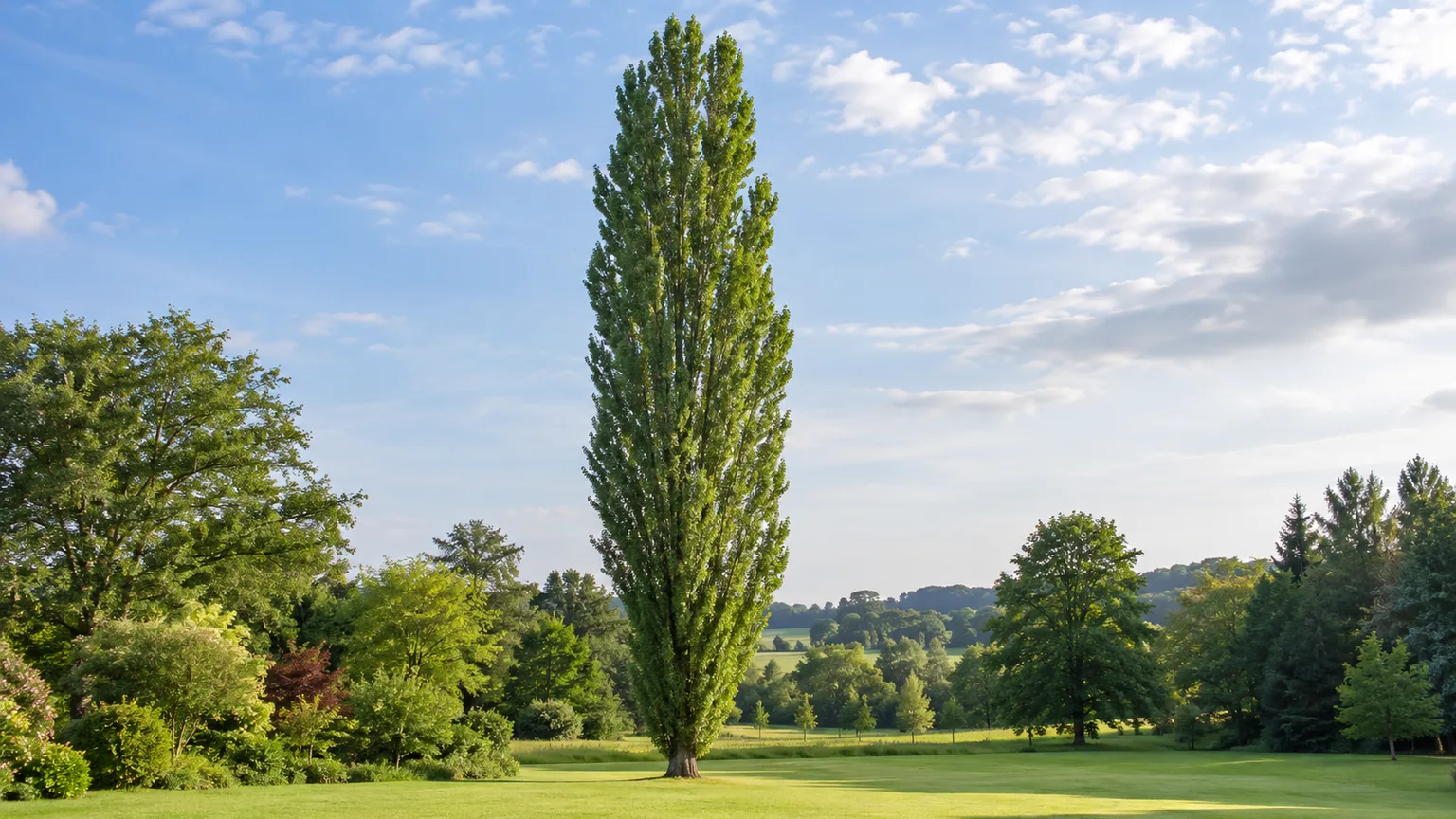
A Lombardy poplar is a fast way to put a tall, narrow tree on a property line, but it is a poor default for a small residential yard. The cultivar grows quickly, yet often declines young; its brittle branches, persistent root suckers, shallow spreading roots, and frequent leaf-and-twig drop can turn a convenient screen into a recurring maintenance and removal project. It fits best where there is open ground, room to keep it away from utilities and hardscape, and a deliberate plan to replace it later.
That is a more useful starting point than “plant one every eight feet.” The right decision depends on the tree’s mature footprint, the risks around the site, and how long you need the screen to last. Here is how to grow it if that tradeoff suits your property—and how to recognize when another tree would be a better choice.
Is Lombardy Poplar Right for Your Yard?
Choose a Lombardy poplar only when the site can accommodate a very tall tree and its roots without putting a house, sidewalk, drain system, septic components, or valuable garden beds in conflict. It can make sense on a broad rural boundary or as a temporary visual or wind screen, especially when you plant a longer-lived replacement at the same time. Its speed is the advantage; it does not make the tree a low-maintenance privacy hedge.
For a compact city lot, a planting strip beside pavement, or a spot where falling limbs could hit a home, car, play area, or neighbor’s property, the drawbacks usually outweigh that advantage. The North Carolina State Extension plant profile describes it as short-lived and best used as a windbreak away from most landscapes. The Missouri Botanical Garden similarly points readers toward open screens and road plantings rather than ordinary lawns and gardens. (NC State Extension; Missouri Botanical Garden)
Identify the Tree Before You Buy
Lombardy poplar is the narrow, upright cultivar Populus nigra ‘Italica’, also called Italian poplar or Lombardy black poplar. Its branches rise close to the trunk, so the crown reads as a column or tapered spire rather than a broad shade canopy. The leaves are simple, roughly triangular to diamond-shaped, green through summer, and yellow in fall; the bark darkens and furrows as the tree matures. (Oregon State University Landscape Plants; Royal Horticultural Society)
The named ‘Italica’ cultivar is a male clone propagated vegetatively, not a seed-grown female tree. That means a correctly identified Lombardy poplar does not produce the cottony seed fluff associated with female poplars, but its male catkins do release pollen. If allergies or cleanup are a concern, confirm the cultivar with the nursery rather than relying on “poplar” on a sales tag; other poplar types and mislabeled stock may behave differently. (Missouri Botanical Garden; NC State Extension)
Mature Size, Form, and Lifespan
Published size figures vary. The Missouri Botanical Garden lists a common mature range around 40–50 feet tall and 10–15 feet wide, while Oregon State University gives 70–90 feet tall with a similar 10–15-foot spread; the RHS profile lists a height over 12 meters and a wider 4–8-meter spread. These numbers reflect different references, locations, and specimens, so do not lay out a small yard around the narrowest estimate. Plan for a tall tree at least 70 feet high and allow more horizontal room than a young nursery tree suggests. (Missouri Botanical Garden; Oregon State University Landscape Plants; Royal Horticultural Society)
The columnar outline can make the footprint look deceptively small. A 10- to 15-foot spread is still a substantial crown, and the tree’s root system spreads beyond what the narrow crown implies. Fast early growth also does not mean a long-lived screen: sources describe Lombardy poplar as short-lived, with horticultural estimates commonly around 10–20 years, though an individual tree may decline sooner or persist longer. (Oregon State University Landscape Plants; Gardenia; Missouri Botanical Garden)
Plan for the Full Height, Not the Nursery Size
A slender 3-foot sapling can become a dominant tree before its buyer has finished planning the rest of the yard. Mark the likely crown width on the ground, then look upward: the mature top needs clear airspace, while the branches and fall zone need separation from roofs, parked vehicles, play areas, and overhead wires. Do not plant under utility lines hoping to control height by repeated topping; that creates weak regrowth and a misshapen tree rather than a reliably small one.
The practical question is not whether the tree can fit today, but whether you will still want it—and can safely manage it—when it is taller than the house. If the answer depends on keeping a 70-foot tree permanently narrow, choose a different species.
Choose a Site With Enough Room
Full sun and open ground support the tree’s columnar form, but the major site test is clearance. A wide rural property with no nearby paving, buried services, septic field, or high-value plantings is a more reasonable candidate than a narrow strip between a fence and a driveway. The RHS calls the tree useful as a screen or shelter belt while warning against planting near buildings because of the vigorous roots; both points can be true when the planting is large enough and planned carefully. (Royal Horticultural Society)
Regional conditions matter too. Oregon State University lists it as hardy to USDA Zone 3, but a hardiness zone only summarizes average winter minimums; it does not tell you whether a hot, humid growing season will increase canker problems or whether local soil and wind conditions suit the tree. North Carolina State Extension flags cankers in hot, humid climates, and the Connecticut Agricultural Experiment Station describes several diseases affecting poplars, including Cytospora canker, rust, and wetwood. (Oregon State University Landscape Plants; NC State Extension; Connecticut Agricultural Experiment Station)
Check the current local invasive-plant and tree-planting rules before buying. The Invasive Plant Atlas of the United States classifies Lombardy poplar as exotic and lists local invasive-listing sources that include the City of Ann Arbor; that is a reason to check your own jurisdiction, not evidence that the cultivar is legally prohibited everywhere. Avoid planting it near natural areas or waterways if local land managers identify it as a concern. (Invasive Plant Atlas of the United States)
Understand the Root System Before Planting
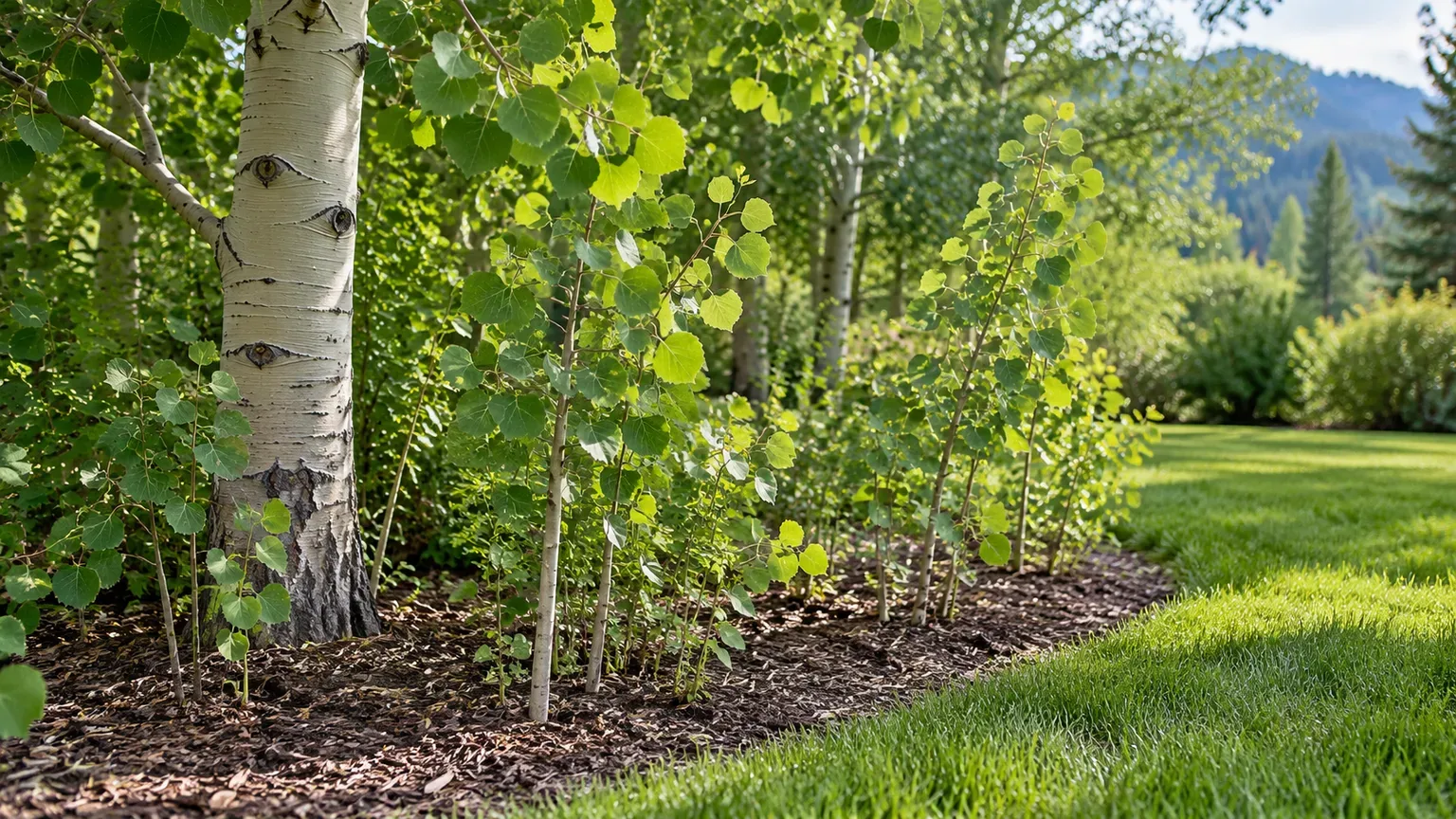
Lombardy poplar’s root system is shallow and spreading, and roots can send up new shoots well away from the trunk. That combination can lift pavement, interfere with mowing, spread into beds, and create conflicts with septic or drainage systems. It is not enough to give the trunk a few feet of space from a sidewalk and assume the roots will remain beneath the narrow crown. (NC State Extension; Missouri Botanical Garden)
Roots do not make the tree unsuitable everywhere, but they do make later removal harder. The Missouri Botanical Garden describes the roots as shallow-spreading and notes that suckers can appear; Fine Gardening’s discussion of fast-growing trees likewise cautions that poplar roots and debris can become a problem in home landscapes. Treat those sources as a practical warning, not a precise map of where roots will travel: soil, moisture, obstacles, and the location of leaks all affect root growth. (Missouri Botanical Garden; Fine Gardening)
Run a Site Check Before You Dig
Before planting, identify where water, sewer, irrigation, drainage, and electrical lines run, and separately map septic tanks and leach fields if the property has them. Public utility marking services may not locate private irrigation or septic components, so check with the system owner or a qualified locator. Also measure from the planting spot to walls, paving, garden beds, and neighboring property; do not rely on an improvised root barrier to rescue a tree from a site that is too small.
If the only available location is close to a foundation, patio, sidewalk, or buried system, select another tree. Root barriers and trenching are design tools for specific sites, not a guarantee that this vigorous tree will stay contained for its whole life.
Give It Sun and a Drainable Root Zone
Plant Lombardy poplar in full sun. Horticultural profiles list a broad range of soil types, but for a home planting aim for soil that holds some moisture without remaining saturated; a waterlogged planting hole deprives roots of oxygen, while a newly planted tree in dry soil can fail before its roots reach beyond the nursery root ball. (Royal Horticultural Society; Missouri Botanical Garden)
Do not try to compensate for poor drainage by adding a small amount of sand or gravel to the planting hole. Check how water moves through the site after rain, and choose a different planting position if water stands for long periods. Conversely, in a dry climate, plan for dependable irrigation during establishment and for supplemental watering during prolonged drought after planting.
Planting and Spacing a Screen
Plant when the tree can establish roots before heat or frozen soil makes watering difficult. For container-grown trees, Colorado State University Extension says planting can extend from spring into fall when irrigation is available; avoid a late-season planting if you cannot keep the root ball moist until the ground freezes. Follow local nursery and extension timing for bare-root or balled-and-burlapped stock. (Colorado State University Extension)
Set the root flare at or just above finished grade, remove ties and packaging as directed for the stock type, and backfill with the excavated soil rather than creating an amended pocket that differs sharply from surrounding ground. Keep the trunk upright, water the root ball and adjacent soil, and mulch around the tree while leaving the trunk base exposed. Inspect the young tree from more than one side before staking; staking is for a root ball that cannot hold the tree securely, not an automatic accessory.
Space for Airflow and Future Removal
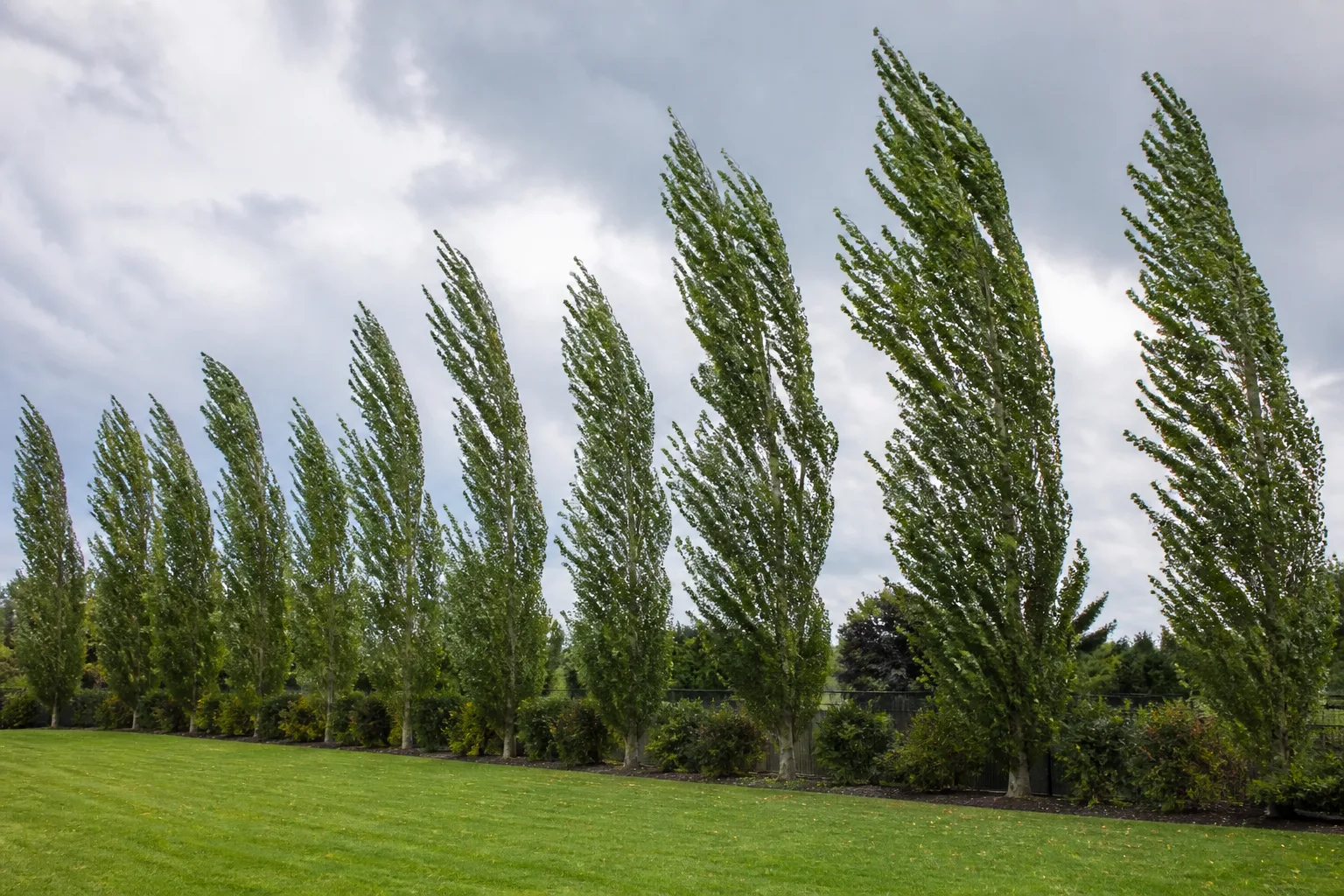
There is no spacing number that works for every screen. The RHS lists a mature spread of 4–8 meters, while the Missouri Botanical Garden gives 10–15 feet; Gardenia suggests closer spacing for a dense windbreak, but close planting trades a faster visual wall for overlapping crowns, more competition, and less room to inspect or remove declining trees. Let the intended mature crown width and the site’s maintenance access guide the layout rather than copying a single spacing figure from a nursery page. (Royal Horticultural Society; Missouri Botanical Garden; Gardenia)
| Planting goal | Layout principle | Tradeoff |
|---|---|---|
| Single specimen | Allow room for the full mature crown and access for pruning. | You gain a strong vertical accent, not an instant screen. |
| Dense, short-term screen | Close spacing can speed visual coverage if the property has room for root spread and eventual removal. | Crowns overlap sooner; competition and maintenance increase. |
| Long-term windbreak | Use locally suited trees in a mixed, planned row with room for mature crowns. | It may take longer to fill in, but one disease or failure is less likely to remove the whole screen. |
For a short-term screen, a closely spaced row may be an intentional choice if you have enough land and accept the pruning, suckers, and replacement work. For a long-term windbreak, use a mixed planting plan suited to your region instead of creating a single-species row that can decline together; plant the eventual replacement trees while the poplars are still young.
Watering and Mulching During Establishment
A newly planted tree needs regular water while its root system expands into surrounding soil. Penn State Extension’s general tree-establishment guidance recommends daily watering for the first one to two weeks, every two to three days for weeks three through twelve, then weekly watering until the tree is established; it also advises checking soil moisture at 6–9 inches and skipping irrigation when there has been substantial rain. Use that as a starting schedule, not a command to water saturated clay on a fixed calendar. (Penn State Extension)
Water the root ball and nearby soil rather than wetting only the trunk. If you can probe the soil to the root zone, use the feel of the soil to decide whether to irrigate; dry soil at depth needs water, while persistently wet soil calls for a pause and a drainage check. Penn State gives a general baseline of 1–1.5 gallons per inch of trunk diameter per watering, but root-ball size, soil texture, recent rain, and tree stock all affect what is appropriate at an individual site. (Penn State Extension)
Spread a 2–3-inch layer of wood-chip mulch over the root zone, keeping it several inches away from the trunk. Mulch reduces lawn competition and slows moisture loss, but a mound against the bark traps moisture and hides damage. As the canopy and roots establish, widen the mulched area if practical and keep lawn equipment away from the thin bark. (Penn State Extension; Colorado State University Extension)
Fertilizer and Routine Care
Do not fertilize a newly planted Lombardy poplar just to make it grow faster. The tree is already vigorous, and Colorado State University Extension warns that high-nitrogen fertilizer can push canopy growth at the expense of root establishment. If growth is poor, first check water, drainage, planting depth, and root damage; use a soil test before adding nutrients. (Colorado State University Extension)
Routine care is mostly observation and cleanup. Remove leaves and twigs where they create a slipping hazard or block drains, inspect the trunk for mower or string-trimmer wounds, and note where suckers emerge. A vigorous tree that is shedding larger branches, developing a canker, or declining at the top needs assessment rather than extra fertilizer.
Pruning Without Making a Weak Tree Weaker
Keep pruning light and purposeful. Remove dead, damaged, or rubbing branches when they are small and accessible, and correct obvious structural problems while the tree is young. Colorado State University Extension advises limiting pruning during establishment to broken branches and minimal structural correction; Penn State Extension explains that a proper removal cut preserves the branch collar and that topping leads to weakly attached shoots and can increase future problems. (Colorado State University Extension; Penn State Extension)
Do not top the tree to keep it below a roofline or utility wire. Topping removes the crown without creating a stable smaller tree, and the poplar’s fast regrowth can produce shoots with poor attachments. If the tree is already tall, has large dead limbs, or stands within falling distance of a structure or line, hire a qualified arborist; do not climb it or work near energized wires yourself.
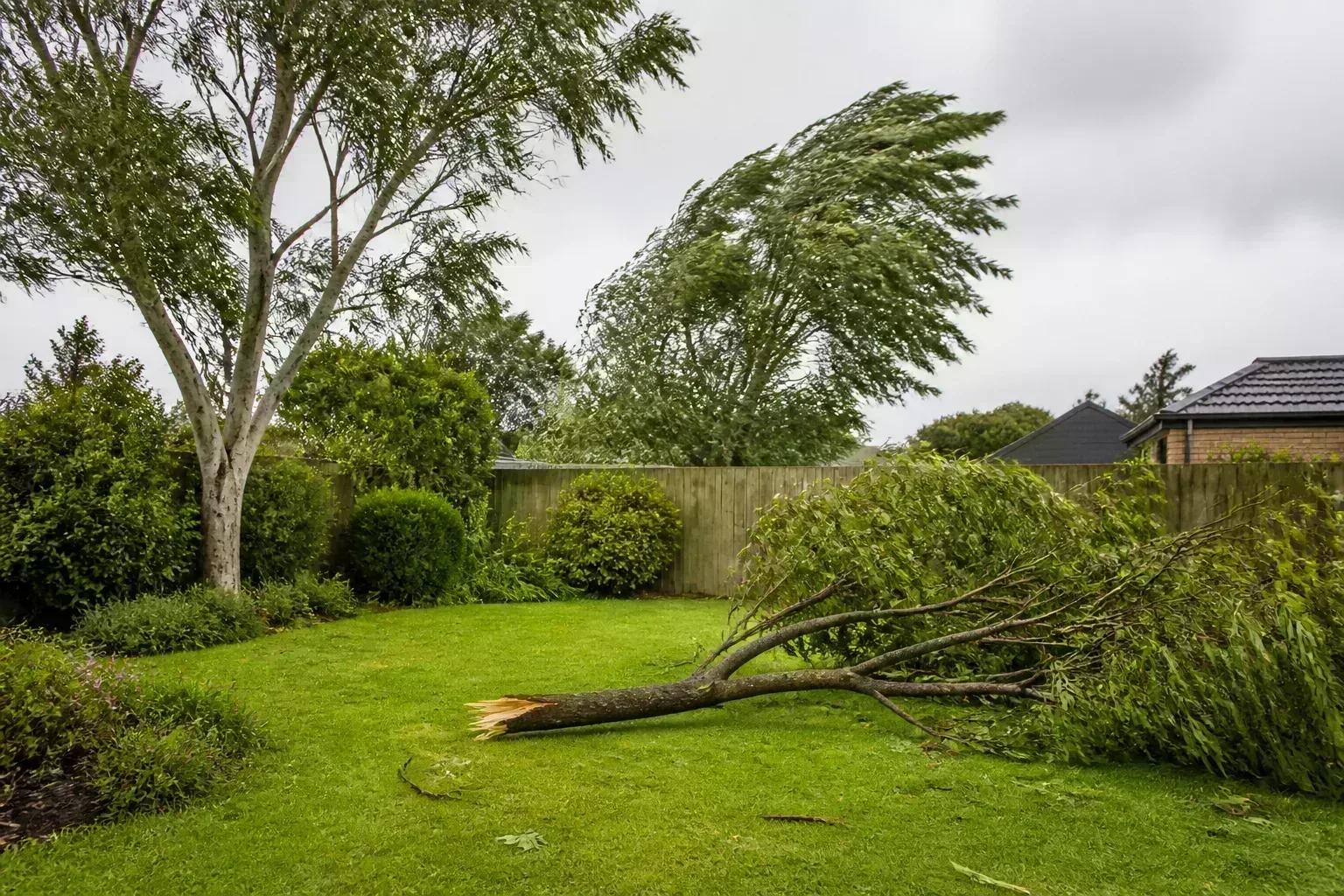
Check the crown at least annually and after severe wind, snow, or ice. Look from the ground for dead upper branches, cracked unions, hanging limbs, new lean, or bark lesions. Because the wood is weak and canker can kill upper branches, a visual check is not a guarantee of safety; ask an arborist to inspect a large declining tree near a target. (Oregon State University Landscape Plants; NC State Extension)
Pests, Cankers, and Early Decline
Poplars can host aphids, borers, caterpillars, and scale insects, but insect presence alone does not mean a tree needs treatment. Confirm the insect and the level of damage before taking action; avoid spraying a large tree based on a generic list of pests. The more consequential issue for Lombardy poplar is its vulnerability to disease and structural decline, especially when branches begin dying from the top down. (NC State Extension; Connecticut Agricultural Experiment Station)
Separate Rust, Canker, and Wetwood Symptoms
Rust may appear as dusty yellow-orange growth on the undersides of leaves and can cause early leaf drop; the Connecticut Agricultural Experiment Station notes that rust is a recurring poplar problem but not usually a serious threat to tree health. Cytospora canker can kill patches of bark and cause twig or upper-branch dieback, while wetwood can produce water-soaked or darkened wood and may be associated with odor and premature decline. These signs overlap with other stresses, so a single symptom is not a diagnosis. (Connecticut Agricultural Experiment Station; NC State Extension)
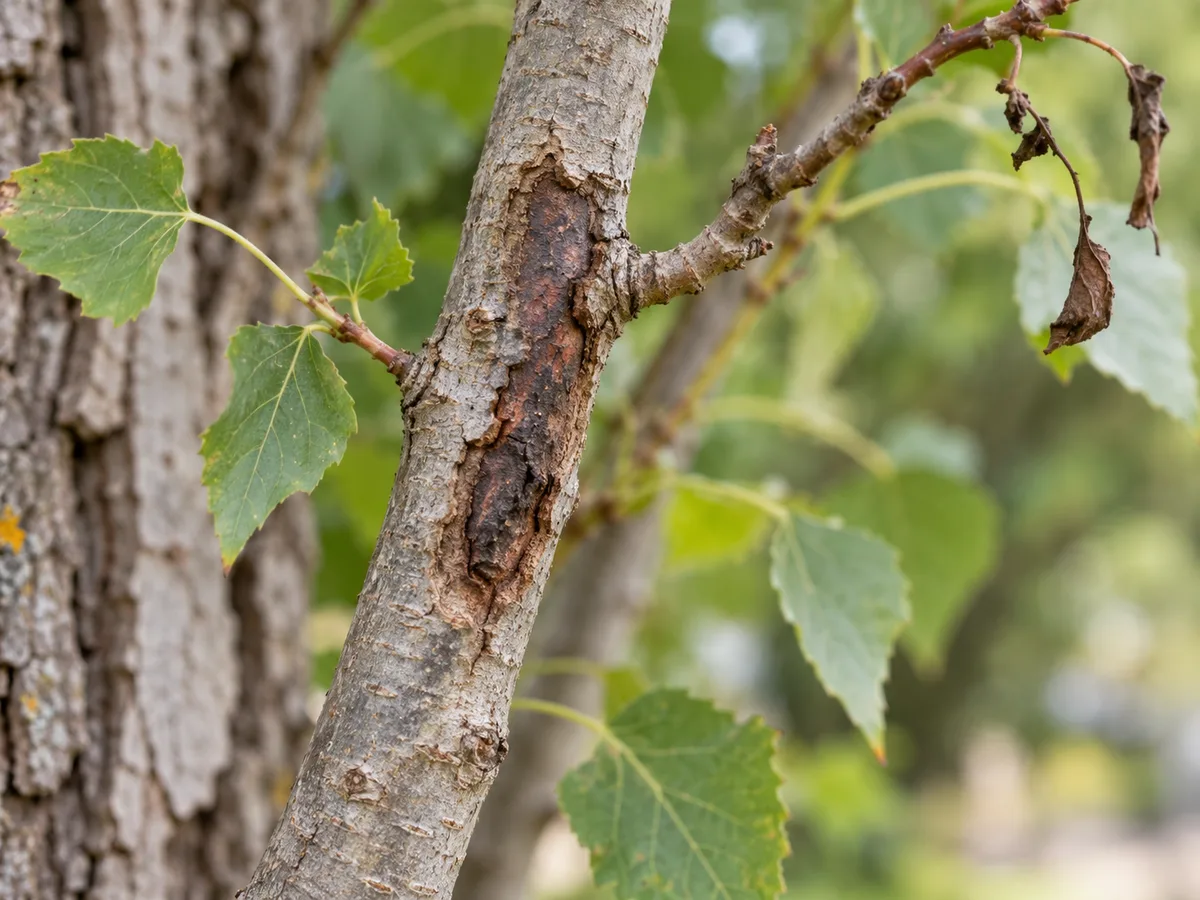
Canker symptoms need local diagnosis; a photo alone cannot confirm the pathogen.
If you see cankers, spreading dieback, or major limb loss, photograph the symptoms, note when they appeared, and contact your county extension office or a certified arborist for an on-site assessment. Pruning out a small dead branch may be straightforward, but cutting large branches from a mature poplar is hazardous and will not cure a tree with systemic decline. Do not apply a fungicide or insecticide without a confirmed diagnosis and a product label that specifically allows that use.
Propagation and Root Suckers
The named cultivar is a male clone, so seed is not the normal way to reproduce a true Lombardy poplar. Horticultural references recommend hardwood cuttings during dormancy; the RHS also lists suckers as a propagation route. A cutting from a healthy, accurately identified parent preserves the cultivar, but it also preserves the plant’s fast growth, pollen, short life, and root behavior. (Missouri Botanical Garden; Royal Horticultural Society; Gardenia)
For a small propagation trial, take a dormant hardwood cutting from healthy one-year-old growth, keep its orientation clear, and place the lower portion in a clean, well-drained medium that stays evenly moist but not waterlogged. Gardenia describes cuttings roughly 12–24 inches long with at least two nodes below the medium; treat that as one workable method, not a promise that every cutting will root. Pot the rooted cutting on until it has a stable root system, and do not plant the new tree unless the eventual site passes the same space and utility checks as a purchased tree. (Gardenia)
Root suckers are not harmless volunteer seedlings: they are shoots arising from the connected root system and may appear outside the original planting area. Remove small shoots as soon as practical, cutting them close to their point of origin without damaging the parent root; expect follow-up work rather than assuming one cut ends the problem. If suckers continue across lawn or paving, or appear after the parent tree is removed, get advice before trenching or using herbicide, since work near a living tree’s roots can injure it and chemical use depends on the product label and local rules.
Seasonal Care and Winter Concerns
In spring, inspect the trunk and crown as leaves emerge, then remove only small, clearly dead or broken branches you can reach safely. During summer, monitor moisture in the root zone during extended dry weather and watch for new upper-branch dieback, rust, or suckers. In fall, clear debris from gutters and drains, check the tree after storms, and continue watering a newly planted tree when the soil is dry and unfrozen.
Oregon State University lists the tree as hardy to USDA Zone 3, so an established specimen generally does not need a winter wrap in climates within that range. Young trees benefit more from correct planting depth, mulch that does not touch the trunk, and adequate moisture before the soil freezes than from wrapping the whole crown. In areas with heavy snow or ice, the weak wood is the bigger concern; inspect for damage afterward and have hazardous limbs assessed professionally. (Oregon State University Landscape Plants; Penn State Extension)
Better Trees for Long-Term Screening
If you need a screen to last for decades, choose a species for your region, soil, mature width, and water availability rather than replacing one fast-growing monoculture with another. A mixed screen often spreads risk: one pest or disease is less likely to remove every plant at once, and a mix of evergreen and deciduous layers can block views without requiring a row of giant trees. Ask a local extension office or municipal arborist for native and well-adapted choices that fit your measured space.
For a narrow, formal evergreen accent, North Carolina State Extension lists several eastern white cedar/arborvitae cultivars, including ‘Holmstrup’ and ‘Sunkist,’ among less problematic plants with a similar narrow form. That is regional guidance, not a universal substitute: arborvitae may be unsuitable where local deer pressure, drought, humidity, or soil conditions are severe. A locally recommended native hedge or a staggered mixed windbreak may be a better answer elsewhere. (NC State Extension)
A Lombardy poplar can still be useful where immediate height matters more than longevity and the property gives its roots and crown room. If you choose one, treat it as a temporary screen from day one: plant at a safe distance, establish it with consistent moisture, monitor its structure, and establish the long-lived replacement before the first tree begins to fail. (Fine Gardening; Royal Horticultural Society)
Conclusion
Lombardy poplar trees are fast, dramatic, and narrow, but those strengths come with a short service life, weak branches, persistent litter, and roots that can spread well beyond the crown. They are a conditional choice for open sites and planned temporary screens, not a universal privacy tree for a suburban boundary. Check mature dimensions, local invasive listings, buried systems, and the likely fall zone before planting; if the available spot is tight, choose a longer-lived tree that fits it from the start.



